Induction Melting Gold
Induction Melting Gold: Furnaces from 1 kg Benchtop to Industrial Scale
Quick Answer
Induction melting gold uses an alternating current in a copper coil to induce eddy currents in the gold charge and the graphite crucible. The gold heats and melts from the inside. Gold melts at 1,064 °C, and the crucible must withstand about 1,200–1,400 °C.
Typical sizes:
- Benchtop: 0.5–5 kg, 3–15 kW, 20–80 kHz, 3–10 min per melt
- Medium: 5–30 kg, 15–60 kW, 3–30 kHz, 8–20 min
- Industrial: 30–200 kg+, 60–300 kW+, 1–10 kHz, 20–45 min
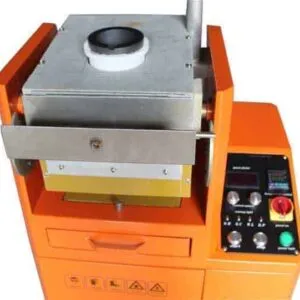
HLQ models include the M.MF.ML001 (1–2 kg, 220 V), the DW-SGM stationary furnace and the DW-TGM tilting furnace (both 2–8 kg).

What is Induction Melting Gold?
Induction melting gold is the electric melting of gold and gold alloys with electromagnetic induction. Compared with gas, coal or oil-fired crucible furnaces, it heats faster, controls temperature more precisely, runs cleaner with no combustion gases, and carries a lower risk of contaminating the gold.
For the full guide, see the induction gold melting furnace page.
| Type | Options |
|---|---|
| By capacity | Benchtop ~0.5–5 kg; medium ~5–50 kg; industrial 50 kg and above |
| By frequency | Low/medium frequency (1–20 kHz) for better penetration in larger melts; high frequency (20–100+ kHz) for rapid heating of small melts and jewelry work |
| By cooling | Air-cooled small benchtop units; water-cooled medium and large furnaces with a closed-loop chiller or cooling tower |

Key Applications

| Application | Typical tier |
|---|---|
| Jewelry casting and alloy production | Benchtop / medium |
| Small to medium scale gold refining | Medium |
| Fire assay and laboratory work | Benchtop |
| Recycling of electronic and dental scrap containing gold | Medium / industrial |
| Refineries and large casting houses | Industrial |

Suitable Materials
| Material | Notes |
|---|---|
| Gold (granules, scrap, bars) | Melts at 1,064 °C; charge must be clean |
| Gold alloys | Silver, copper or other alloying metals added after melting |
| Silver | Melted in the same furnaces |
| Copper, brass, bronze, other non-ferrous alloys | Within the furnace temperature and crucible limits |
| Electronic and dental scrap containing gold | Recycling application |
Crucibles
| Crucible | Typical use |
|---|---|
| Graphite / clay-graphite | Benchtop and medium units; most common |
| SiC / high alumina | Medium-scale smelters |
| Alumina / zirconia | Where carbon pick-up must be avoided |
Silver melting: induction melting silver.
Working Principle

- An alternating current flows through the copper induction coil.
- The coil creates a rapidly changing magnetic field.
- Eddy currents are induced in the gold charge and the conductive crucible.
- The electrical resistance of the metal turns the current into heat, melting the charge from the inside out.
Skin effect: at higher frequency the current flows near the surface. This gives fast heating of small charges but limits penetration, so larger melts use lower frequency. Background: how an induction heater works.
Current penetration depth in solid gold at 20 °C (physics reference)
| Frequency | 80 kHz | 20 kHz | 10 kHz | 3 kHz |
|---|---|---|---|---|
| Depth δ (ρ ≈ 0.024 µΩ·m) | ≈ 0.28 mm | ≈ 0.56 mm | ≈ 0.79 mm | ≈ 1.43 mm |
Key components
| Component | Function |
|---|---|
| Power supply | Rectifier, inverter and control electronics; sets output kW and kHz |
| Induction coil | Copper tubing, usually water-cooled; helical or pancake shape sets the heating pattern |
| Crucible | Withstands about 1,200–1,400 °C; chemically compatible with gold and flux |
| Cooling system | Closed-loop chiller or cooling tower for the coil and power electronics |
| Control system | Digital power control; pyrometer or thermocouple; interlocks for water flow, over-temperature and door switches |
| Furnace body | Refractory and insulation; mechanical support for coil and crucible |
Technical Specifications
| Parameter | Benchtop | Medium | Industrial |
|---|---|---|---|
| Capacity (pure Au) | 0.5–5 kg | 5–30 kg | 30–200 kg+ |
| Rated power | 3–15 kW | 15–60 kW | 60–300 kW+ |
| Output frequency | 20–80 kHz | 3–30 kHz | 1–10 kHz |
| Power supply | 1-phase 220–240 V or 3-phase 380 V | 3-phase 380/400/415/480 V | 3-phase industrial, e.g. 380–690 V |
| Max temperature | 1,200–1,350 °C | 1,250–1,400 °C | 1,250–1,400 °C |
| Melt time (full load) | 3–10 min | 8–20 min | 20–45 min |
| Cooling | Air-cooled or small water chiller | Closed-loop chiller, 10–40 L/min | Industrial chiller/tower, 40–150 L/min+ |
| Crucible | Graphite or clay-graphite | Clay-graphite / SiC / high alumina | — |
| Tilting / pouring | — | Manual or electric tilting | Hydraulic tilting |
| Control | Manual power / simple temperature control | Digital power and temperature control | PLC with multi-stage heating curves |
These are typical reference ranges. Actual values depend on the model.
Theoretical heat demand
| Batch | 1 kg | 5 kg | 30 kg |
|---|---|---|---|
| Gold heated to ≈ 1,100 °C (≈ 0.06 kWh/kg, physics) | ≈ 0.06 kWh | ≈ 0.3 kWh | ≈ 1.8 kWh |
Recommended Model Selection
| HLQ model | Type | Capacity | Published data |
|---|---|---|---|
| M.MF.ML001 | Small water-cooled melter | 1–2 kg gold | 220 V single phase, 50–60 Hz; output ≈ 3 kW; max 1,450 °C; 3–5 min; 580 × 300 × 330 mm; 28 kg |
| DW-SGM | Stationary gold melting furnace | 2, 3, 4, 5, 6 or 8 kg | IGBT; adjustable temperature with digital display; 100% load, 24-hour operation |
| DW-TGM | Tilting gold melting machine | 2, 3, 4, 5, 6 or 8 kg | Double IGBT; 600 × 510 × 1080 mm; 110 kg; tilting handle pours into the ingot mould |
Model pages:
- small induction gold melting furnace (M.MF.ML001)
- stationary gold melting furnace (DW-SGM)
- tilting gold melting furnace (DW-TGM)
- gold melting furnace for jewelry casting (MM-F series)

Process Workflow

| Stage | Action |
|---|---|
| Pre-start checks | Make sure cooling water is flowing at the correct temperature; check electrical connections and safety interlocks |
| Loading | Charge clean gold granules, scrap or bars; add flux (borax, silica, soda ash) if refining or deoxidizing |
| Melting | Start at low power, then ramp to full power; watch the temperature and the melt surface |
| Refining / alloying | Add silver, copper or other metals; stir mechanically or with an inert rod; skim the slag |
| Pouring | Preheat the moulds and wear full PPE; tilt the furnace or lift the crucible and pour smoothly to avoid splashing |
| Shutdown | Reduce power to zero and switch off; keep cooling water running for the recommended time |
Workshop layout

Common Problems and Solutions
| Problem | Likely cause | Solution |
|---|---|---|
| Splashing or eruption | Wet tools, moulds or scrap; uncontrolled charging | Never introduce anything wet; preheat moulds; charge in a controlled way |
| Melting slower than expected | Power too low for the batch; coil and crucible poorly matched | Match kW to the cycle time; check coil–crucible matching |
| Carbon or impurity pick-up | Crucible material not suited to the purity target | Choose a crucible that limits pick-up; use a lid to reduce oxidation and dust |
| Fumes during refining | Fluxes or other metals fuming | Provide local exhaust |
| Overheating of coil or electronics | Cooling water problem | Check flow and temperature; use a closed-loop chiller; keep water running after shutdown |
| Unstable operation | Unstable power supply | Use a stable single- or three-phase supply matched to the rating |
Engineering Selection Guide
| Factor | What to confirm |
|---|---|
| Melting capacity | Kilograms of gold per batch and batches per day |
| Power rating and melt time | Higher kW melts faster but needs more investment and power; match kW to the required cycle time |
| Power supply and site | Single- or three-phase voltage; electrical infrastructure and protection devices |
| Cooling system | Space for a chiller or cooling tower; ambient temperature and water quality |
| Purity and contamination control | Crucible choice; cover or lid design |
| Operation and safety | Automatic or manual control; interlocks, alarms, emergency stop; maintenance and spare parts |
| Pouring | Stationary (lift the crucible) or tilting (pour from the furnace) |
Advantages and Limitations
| Advantages | Limitations |
|---|---|
| High efficiency and fast melt times | Higher initial investment than simple gas furnaces |
| Accurate temperature control and repeatable results | Needs reliable electricity and cooling water |
| Cleaner workplace: no open flame, no combustion gases | Coil and crucible must be matched and inspected regularly |
| Reduced metal loss and oxidation | Less practical where the power supply is unstable or unavailable |
| Lower contamination risk and better gold quality | Crucible temperature limits apply |
| Compact footprint; easy to fit into existing lines | Molten-metal and electrical safety training is required |
Why Choose HLQ?
| Strength | What it means |
|---|---|
| Range from 1 kg | M.MF.ML001 (1–2 kg), DW-SGM and DW-TGM (2–8 kg), up to industrial systems |
| IGBT power | Stable output; 100% load, 24-hour operation |
| Protections | Over-voltage, over-current, insufficient water, over-heating, phase fault |
| Stationary or tilting | A tilting handle pours straight into the ingot mould |
| Crucible guidance | Graphite, clay-graphite, SiC, alumina or zirconia |
| Multi-metal use | Gold, silver, copper, brass and other non-ferrous alloys |
10 Core FAQs
1. How long does it take to melt gold by induction?
Typically 3–20 minutes at full load for small and medium units, and up to 45 minutes for large industrial units.
2. At what temperature does gold melt?
1,064 °C. Crucibles must withstand about 1,200–1,400 °C.
3. How much power do I need?
3–15 kW for 0.5–5 kg, 15–60 kW for 5–30 kg, and 60–300 kW or more for 30–200 kg.
4. Which frequency is used?
20–80 kHz for benchtop units, 3–30 kHz for medium units and 1–10 kHz for industrial furnaces.
5. Which crucible should I use?
Graphite or clay-graphite for most work. SiC, alumina or zirconia are also used, depending on purity requirements.
6. Can a single-phase supply be used?
Yes for benchtop units; the M.MF.ML001, for example, runs on 220 V single phase. Medium and industrial furnaces need three-phase industrial power.
7. Does a gold furnace need water cooling?
Small benchtop units can be air-cooled. Medium and large furnaces need a closed-loop chiller or cooling tower.
8. Can the same furnace melt silver and copper?
Yes. Silver, copper, brass, bronze and other non-ferrous alloys can be melted within the temperature and crucible limits.
9. What is the difference between the DW-SGM and DW-TGM?
Both handle 2–8 kg. The DW-SGM is stationary, so the crucible is lifted out to pour. The DW-TGM pours by moving a tilting handle.
10. What safety measures are needed?
Proper grounding, heat-resistant PPE, no wet tools or scrap in the melt, local exhaust for flux fumes, and an accessible emergency stop with dry-powder extinguishers.