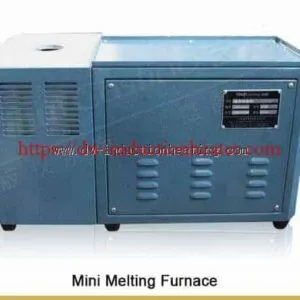
MF Small Induction Melting Gold Furnace
DW-TGM Small Induction Melting Gold Furnace — Tilting Gold Melting Machine, 2–8 kg
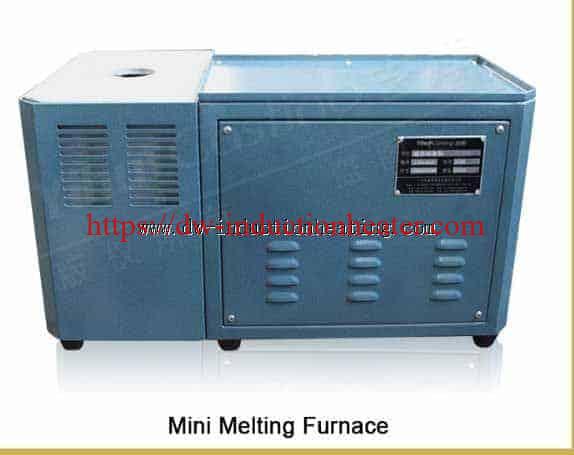
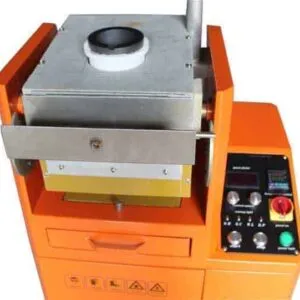
The DW-TGM is a compact tilting induction gold melting furnace. It is built as a complete station rather than a bare power supply: a double IGBT power supply, a special casting body, a tilting melting head with its own crucible, a control panel and a cabinet that measures 600 × 510 × 1080 mm and weighs 110 kg net. It is offered in blue or orange, carries a one-year warranty, and is published for 100 % full load, 24 hours continuous working.
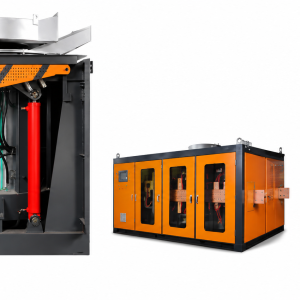
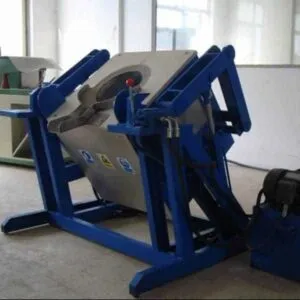
Its distinguishing feature is the tilt. When the melt is finished, the operator moves the tilting handle and the liquid metal is poured into an ingot mould. Nothing hot has to be lifted, carried or tipped by hand, and that is the single reason a small induction melter of this size is used on a goldsmith bench or in a small casting house rather than only as a laboratory unit.
One model covers the published capacity range. The DW-TGM is published at 2 kg, 3 kg, 4 kg, 5 kg, 6 kg and 8 kg melting capacity, and the batch size is set by the crucible fitted rather than by a separate model number. Within the published capacity bands, 2 kg to 5 kg sits in the benchtop class and 6 kg to 8 kg reaches into the medium class.
This page sets out the published specification, what the tilting discharge actually does, the selection rules for putting the capacity and the charge together, the operating sequence with its safety points, and — just as importantly — the parameters that the published page does not state and that therefore have to be confirmed before the machine is specified for a particular gold batch.

Table of Contents
- What is the DW-TGM Small Induction Melting Gold Furnace?
- Key Applications
- Suitable Materials
- Working Principle
- Technical Specifications
- Recommended Model Selection
- Process Workflow
- Common Problems and Solutions
- Engineering Selection Guide
- Advantages and Limitations
- Why Choose HLQ?
- 6 Core FAQs
What is the DW-TGM Small Induction Melting Gold Furnace?
It is an induction crucible furnace that melts a batch of metal and then pours it by tilting. The published product name is the Tilting Gold Melting Machine, the model is DW-TGM, and the whole machine is one casting with the power electronics, the melting head, the control panel and the cabinet integrated — which is what the published “compact, special casting design” refers to and what keeps the 600 × 510 × 1080 mm footprint possible.
Three published features define it against the alternatives. The double IGBT technology is the power device. The tilting function is the discharge method. And the fully equipped protections — overheating, over current, over voltage and phase fault — are what make it publishable as a 100 % full load, 24-hour continuous working machine rather than a duty-cycled laboratory unit.
What it is not is a tilting industrial melter. The capacity range stops at 8 kg on this model. Above that the same manufacturer publishes a separate DW-MF tilting induction series running from DW-MF-15 to DW-MF-160 with published maximum input powers of 15–160 kW, a series frequency range of 1–20 kHz, three-phase 380 V ±10 % at 50/60 Hz and a water-cooled induction coil. Those are different machines with different ratings, and the two ranges should not be quoted interchangeably. For the general induction melting furnace range rather than the tilting gold application, see the induction melting furnace page.
It is also not the electric furnace. HLQ separately publishes an MF series of electric gold melting furnaces with an SSR controller, an alloy heating element with a melting point up to 1900 °C, a high temperature proof ceramic melting chamber and a published maximum machine temperature of 1150 °C, in a small portable cabinet. If you need a 1 kg to 2 kg electric unit with a very simple controller, the small portable gold melting furnace is a different product with different limits — and it is worth comparing the two before specifying either.


Key Applications
The published gold-smelting duties for induction melting furnaces of this class are jewellery casting and alloy production, small to medium scale gold melting, recycling of gold-bearing electronic and dental scrap, and fire assay and laboratory work. Silver and copper melting are published alongside them, within the crucible and temperature limits.
| Application | Published scope |
|---|---|
| Jewelry casting and alloy production | Adding silver, copper or other alloying metals, stirring, skimming slag, then pouring into a mould |
| Small to medium scale gold melting | Batch melting of clean gold granules, scrap or bars into the crucible |
| Recycling of gold-bearing scrap | Electronic and dental scrap containing gold, charged and melted for re-alloying |
| Fire assay and laboratory work | Small charge work where the crucible and the endpoint are tightly controlled |
| Silver and copper melting | Named on the related HLQ gold pages, within the crucible and temperature limits |
| Industrial and refinery melting | For batches above the published DW-TGM capacity, the DW-MF tilting induction series |
The wider induction melting context, including how frequency and cooling method change with scale, is set out in HLQ’s induction gold smelter guide, which also carries the crucible material and safety reference data that this page’s published specification does not include.

Suitable Materials
What the DW-TGM can melt is bounded by two things: the crucible it is fitted with, and the temperature the charge needs. Neither is published on this page, so the honest position is that the material scope follows the crucible specification, which is confirmed with the order.
The related HLQ gold pages do publish the material and crucible framework that applies, and it is the right framework for the DW-TGM as well. Crucible materials published for induction gold melting are graphite, clay-graphite, SiC, alumina and zirconia. The published rule is that the crucible must withstand approximately 1,200–1,400 °C and must be chemically compatible with the gold and the flux. A crucible that is right for gold is not automatically right for silver or copper — the metal, the flux and the crucible have to be assessed together.
| Material | Published basis | What has to be confirmed |
|---|---|---|
| Gold and gold alloys | The published product purpose and the 2–8 kg capacity range | Alloy composition, permitted working fill against the crucible, and whether refining or alloying is needed |
| Silver | Named in the published application list | Separate crucible and temperature limit; the published DW-TGM capacity is a gold figure |
| Copper | Named in the published application list | Separate charge, crucible and endpoint; copper has a very different thermal mass and conductivity behaviour |
| Gold-bearing electronic and dental scrap | Published as a recycling duty | Charge identification and traceability, contamination control, and whether the scrap is safe to charge wet |
One boundary is worth stating plainly because it is often assumed and is not true: melting does not refine gold and does not prove its purity. The published guidance on this is explicit. An identified charge, a compatible crucible and any required assay or refining process must be established separately from the melt itself. The DW-TGM is a melter, and the alloying and skimming step that jewellery work depends on is an operation performed on the melt, not a property of the machine.


Working Principle
Heating a metal part is the result of internal energy losses within the material being treated, and a melting furnace is the extreme case of the same physics. An alternating current flows through the induction coil and creates a rapidly changing magnetic field around it. When the charge is placed inside that field, eddy currents are induced in the metal. The electrical resistance of the metal converts those currents into heat, and the metal melts from the inside out.
Two consequences matter for the gold batch. First, because the heat is generated in the metal and not around it, the outer surface of the charge and the crucible stay cooler than the melt — which is why the process is clean, why there are no combustion gases, and why the published comparison against a fuel-fired crucible furnace turns on lower contamination of the molten gold and reduced metal loss through oxidation. Second, the depth of heating is governed by frequency: the published rule is that low and medium frequency gives deeper heating and suits larger batches, while high frequency gives very rapid heating and suits small charges with precise control. The skin effect explains why — at higher frequencies the current flows mainly near the surface of the metal.
On this machine the heat path runs: alternating current in the coil from the double IGBT supply; a changing magnetic field around the crucible; eddy currents induced in the charge; the metal’s resistance converting them into heat; the charge melting and being held at temperature; and the tilting handle being moved so the liquid metal is poured into an ingot mould.
Against a fuel-fired crucible furnace the published advantages are much faster heating and higher efficiency, precise temperature control, cleaner operation with no combustion gases and less dust, and a lower risk of contamination of the molten gold. The published limitations are a higher initial investment, the requirement for reliable electricity and cooling, and the need for the coil and crucible to be correctly matched and regularly inspected. The wider case for the method is set out in HLQ’s advantages of induction heating overview.

Technical Specifications
| Item | Published value |
|---|---|
| Product name | Tilting Gold Melting Machine |
| Model | DW-TGM |
| Colour | Blue and orange for option |
| Size | 600 × 510 × 1080 mm |
| Net weight | 110 kg |
| Melting capacity | 2 kg, 3 kg, 4 kg, 5 kg, 6 kg, 8 kg |
| Power device | Double IGBT technology with compact, special casting design |
| Melting discharge | Tilting handle pours the liquid metal into an ingot mould as melting finishes |
| Protections | Overheating, over current, over voltage, phase fault |
| Duty | 100 % full load, 24 hours continuous working |
| Published performance claim | Quick temperature rising, electricity saving, low melting cost with high cost efficiency |
| Warranty | 1 year |

What the published specification does not state
The following are not published for the DW-TGM on this page, and they are the items that have to be confirmed before the machine can be specified for a particular batch. They are listed here rather than estimated, because guessing any of them would produce a quotation that cannot be built.
| Item | Status on this page | Reference value published on the related HLQ pages |
|---|---|---|
| Rated power | Not published | The related mini gold melting furnace page publishes a 2 kg gold configuration at 5000 W and a 1 kg gold configuration at 3500 W |
| Supply voltage and phase | Not published | Mini gold page: 200–235 V. DW-MF tilting series: three-phase 380 V ±10 %, 50/60 Hz |
| Output frequency | Not published | DW-MF tilting series: series frequency range 1–20 kHz. The gold smelter guide: low/medium 1–20 kHz, high 20–100+ kHz |
| Cooling method | Not published | Gold smelter guide: air-cooled for small low-power benchtop machines, closed-loop water chiller standard for medium and large. Mini gold page: external water pump at 1 L/min |
| Crucible material | Not published | Graphite, clay-graphite, SiC, alumina, zirconia |
| Temperature range | Not published | Crucible must withstand approximately 1,200–1,400 °C |
| Melt time per batch | Not published | Gold smelter guide: benchtop 3–10 minutes, medium 8–20 minutes, industrial 20–45 minutes |
Recommended Model Selection
For this machine the selection is short, because there is one model and six capacities. Three decisions are taken in order: the batch size, the crucible, and the site.
| Requirement | Recommended | Reason |
|---|---|---|
| Bench jewellery and small casting work | DW-TGM at 2 kg, 3 kg or 4 kg | Published benchtop class is approximately 0.5–5 kg; the smaller crucible keeps the charge volume and the heat requirement matched |
| Production casting and alloy work | DW-TGM at 5 kg, 6 kg or 8 kg | Published medium class is approximately 5–50 kg; 6 kg and 8 kg reach into it |
| Batches above 8 kg | Not the DW-TGM | The DW-MF tilting induction series is published from DW-MF-15 to DW-MF-160 with published maximum input powers of 15–160 kW |
| Charge composition | Confirm the crucible against the metal and the flux | Published crucible materials are graphite, clay-graphite, SiC, alumina and zirconia, and the crucible must be chemically compatible with the gold and the flux |
| Alloying or refining on the melt | Confirm the process separately | Melting does not refine gold and does not prove its purity; published fluxes are borax, silica and soda ash |
| Site supply | Confirm voltage, phase and current | Not published on this page — confirm before the machine is delivered |
| Cooling provision | Confirm cooling method and supply | Not published on this page, and it is directly relevant to the published 24-hour continuous duty claim |
| Continuous production | DW-TGM | The DW-TGM is the published continuous-duty unit in this range; the DW-MF series is the alternative for larger batches |
The item most often left until too late is the crucible. The capacity is a published number, but the capacity is only real if the crucible fitted holds that weight of gold with the permitted working fill, and that depends on the crucible material and on whether the batch is gold, silver or copper. Confirm the crucible against the charge before the machine, not after the first melt.
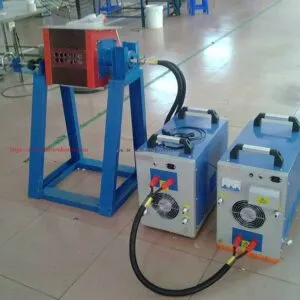
Process Workflow
This is the sequence for one batch, from a clean identified charge to a cast ingot. It is the published operating sequence for an induction gold smelter, and the steps that the DW-TGM’s own published features make specific — the tilting discharge at step 6, and the continuous-duty checks at steps 2 and 7.
| Step | Operator action | What to confirm |
|---|---|---|
| 1 | Charge clean gold granules, scrap or bars into the crucible | Charge identity and traceability; the published working fill for that metal |
| 2 | Check the machine before starting | Cooling water flowing and at the correct temperature; electrical connections and safety interlocks checked |
| 3 | Set the power | Start at lower power, then ramp to full power |
| 4 | Monitor the melt | Temperature and melt surface behaviour |
| 5 | Alloy or refine if required | Add silver, copper or other alloying metals; stir with a mechanical stirrer or inert rod; skim slag |
| 6 | Pour | Preheat the moulds; wear full PPE; move the tilting handle and pour smoothly to avoid splashing |
| 7 | Shut down | Reduce power to zero, shut off the system, keep the cooling water running for the recommended time |
Steps 2 and 7 are not padding. They exist because the DW-TGM is published for 100 % full load, 24 hours continuous working — a duty that only holds if cooling water and the interlocks are checked before the cycle and the machine is left to cool properly afterwards.
Two safety points from the published guidance deserve repeating because they are the ones that cost the most when they are ignored. Never introduce wet tools, moulds or scrap into the melt. And control the charging, because charging into a melt that is already hot is what causes eruptions and splashing.
Common Problems and Solutions
| Problem | Possible cause | Solution |
|---|---|---|
| Charge takes longer than expected | A different mass, alloy, starting state or crucible from the one the cycle was set up for | Compare the actual batch against a defined acceptance test; the published melt time on the related pages is a reference range, not a guarantee for an unidentified charge |
| The melt does not reach temperature | The power setting is too low for the mass and the fill, or the charge was added to a cold crucible | Confirm the power against the batch and the crucible working fill; start at lower power and ramp, as published |
| Unexpected contamination in the melt | Unidentified charge, residues from a previous alloy, or an incompatible crucible | Review material traceability and changeover practice, and confirm the crucible is compatible with the metal and the flux |
| Spattering or eruption during charging | Charging into a melt that is already hot, or a wet tool or scrap introduced into the melt | Control the charging as published; never introduce wet tools, moulds or scrap into the melt |
| Pouring is not clean | The mould is cold, or the pour rate is too high for the mould | Preheat the moulds and pour smoothly to avoid splashing, as published |
| Overheating protection trips | A monitored temperature condition | Follow the fault procedure; the published protection must not be bypassed, and the protection is a fault indication rather than something to reset and ignore |
| Over current, over voltage or phase fault trips | A monitored electrical supply condition | Follow the fault and reset procedure and confirm the approved electrical connection and supply before restarting |
| The crucible is worn or cracked early | Crucible material not matched to the charge, or thermal shock from a cold crucible on a hot chamber | Confirm the crucible material against the metal and the flux, and bring the crucible up with the chamber rather than charging cold into a hot chamber |
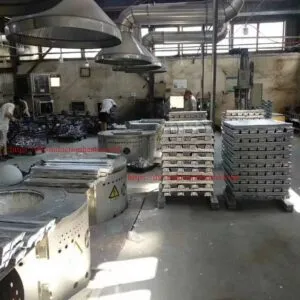
Engineering Selection Guide
Everything below has to be settled before the machine is specified. The left-hand column is what the published DW-TGM page states; the right-hand column is what is still open and must be confirmed. A quotation that skips the right-hand column is a quotation with the electrical and cooling design still unresolved.
| Area | What the DW-TGM page publishes | What must be confirmed |
|---|---|---|
| Machine | DW-TGM, tilting gold melting machine, 600 × 510 × 1080 mm, 110 kg net, blue or orange, 1 year warranty | Confirm the colour option and the delivery configuration |
| Batch | 2 kg, 3 kg, 4 kg, 5 kg, 6 kg, 8 kg melting capacity | The permitted working fill for the actual alloy, and the real batch mass per cycle |
| Crucible | Not published on this page | Crucible material, volume, working fill, service life and compatibility with the metal and the flux |
| Charge | Published duties are gold, silver, copper and gold-bearing scrap | Composition, source, condition and permitted charge preparation |
| Electrical supply | Not published on this page | Voltage, phase, incoming current, connection and the protection thresholds in the fault list |
| Cooling | Not published on this page | Cooling method, flow, pressure, water quality, inlet temperature and heat rejection — directly relevant to the published 24-hour duty |
| Control | PLC-style panel on the cabinet with power, power-on and start | The actual controller functions, temperature measurement basis and the programmable program capability |
| Discharge | Tilting handle pours into an ingot mould | Mould material, preheat method, mould size and the ingot weight that can be poured cleanly |
| Duty | 100 % full load, 24 hours continuous working | The conditions this claim is made under — batch size, ambient temperature and cooling arrangement |
| Protection | Overheating, over current, over voltage, phase fault | The trip settings, the reset procedure and the fault list — protection must not be bypassed |
| Workplace | Compact footprint, single cabinet | Working access, ventilation, the service route for the crucible and the safe handling path for the moulds |
| Scale-up | DW-TGM capacity stops at 8 kg | Whether the DW-MF tilting induction series from 15 kW to 160 kW is the right route above that batch size |
The two items that are usually left until too late are the cooling arrangement and the crucible specification. The cooling arrangement because the published 24-hour continuous working claim is a duty claim, not a free-standing promise, and the duty depends on how the heat is rejected. The crucible because the published capacity figure is only as good as the crucible fitted to it.

Advantages and Limitations
| Advantages | Limitations |
|---|---|
| The melt is discharged by tilting, so no hot metal has to be lifted, carried or tipped by hand | The published capacity stops at 8 kg; above that a different series is needed |
| Compact 600 × 510 × 1080 mm footprint at 110 kg net, with the power supply, head, control and cabinet integrated | Rated power, supply voltage, output frequency, cooling method, crucible material, temperature range and melt time are not published on this page |
| Heat is generated in the metal itself, so the melt is clean, the crucible stays cooler, and there are no combustion gases | The coil and crucible must be correctly matched and regularly inspected |
| Published quick temperature rising and electricity saving against resistance heating | Those claims carry no figures on the published page — no °C/min, no kWh per batch, no comparison basis |
| Published 100 % full load, 24 hours continuous working | The conditions behind that claim are not published, and the cooling method is not stated |
| Four published protections: overheating, over current, over voltage and phase fault | Trip settings, reset procedures and fault lists are not published; protection must not be bypassed |
| Six published capacities from 2 kg to 8 kg on one model, so the batch size is set by the crucible rather than by a new machine | Melting does not refine gold and does not prove its purity; assay and refining are separate processes |
| One-year published warranty | Coil and crucible are wear items and are not covered by a general machine warranty unless the quotation says so |
Against a fuel-fired crucible furnace, the published case for induction is much faster heating and higher efficiency, precise temperature control, cleaner operation with no combustion gases and less dust, and a lower risk of contamination of the molten gold. The published case against it is a higher initial investment, the need for reliable electricity and cooling, and less practicality where the power supply is unstable or unavailable. Where the machine’s advantage over a simple electric furnace matters is in the melt itself: heat inside the charge rather than transferred through the crucible wall from outside.
Why Choose HLQ?
HLQ Induction Equipment is a direct manufacturer in Quanzhou, Fujian, with 25 years of experience in the research and development, design and production of high-frequency and medium-frequency induction heating machines. IGBT medium-frequency induction heating equipment and medium-frequency induction melting furnaces are leading products in that range, together with open-type and closed water cooling towers — so the power supply, the coil and the cooling system on a station come from the same organisation.
The reasons to buy from the manufacturer are specific.
It is a manufacturer, not a trading company. The factory is in the high industry zone of Quanzhou city, Fujian province, with senior engineers and technical researchers, and engineers are available to service overseas if needed.
Coils and melting systems are designed, not just assembled. The coil design rules published by HLQ — the coupling distance, the pitch and the heat pattern, the copper tubing sizes and the cooling flow — are the same rules the induction department applies when it designs an inductor for a specific workpiece. Success is directly dependent on proper design of the inductors, and a coil bought as a catalogue item will never be right for a job without that work being done. The coil design guidance is published on the induction heating coil design page.
The machine is tested before it ships. After production, all machines are tested and debugged carefully before shipment, and HLQ’s own technical staff carry out the test machine running. A dedicated QC person inspects machinery production.
Quality control you can see. The QC team works to TQM with each step in compliance to the standards, and HLQ will take photos and shoot video of the build on request.
Installation, commissioning and training are included. HLQ’s engineers are sent to the customer’s workshop to supply installation, commissioning and training services until the machine is running normal production. On a melting machine that matters at the first melt rather than the fiftieth.
Documented packing, shipping and storage. A film layer for waterproof, a paper box, a wooden exporting case, then foam around the machine for shockproof. Shipping is free to the buyer’s shipper in China, or direct to any main port of China. Storage is a clean, dry environment at −20 to 60 °C and 0–95 % humidity with no dew and no corrosive gases or liquids.
A published warranty. The heating power carries a warranty of 12 months from the date the contract was signed, and the order can be followed at any time.
For the wider range, the gold melting furnace category collects the gold pages together, the IGBT tilting induction melting furnace category covers the tilting machines including the DW-MF series above the DW-TGM, and the metal melting furnace category covers the non-ferrous range. For the compact electric alternative, the electric mini gold melting furnace is the comparable product.
6 Core FAQs
1. How big a batch can the DW-TGM actually melt?
The published melting capacity is 2 kg, 3 kg, 4 kg, 5 kg, 6 kg and 8 kg, all on one model — the batch size is set by the crucible fitted, not by a separate machine. Within the published capacity bands, 2 kg to 5 kg sits in the benchtop class of approximately 0.5–5 kg and 6 kg to 8 kg reaches into the medium class of approximately 5–50 kg. Two caveats. First, the published figure is a capacity, not a guarantee of a clean full melt: the permitted working fill, the alloy and the crucible all have to be confirmed. Second, the published capacity is a gold figure, and it is not automatically the same working mass for silver or copper, which have different densities and thermal behaviour.
2. What is the difference between the DW-TGM and the DW-MF series?
They are different series with different ratings, and the figures should not be mixed. The DW-TGM is the small tilting gold machine: one model, published capacities from 2 kg to 8 kg, a published footprint of 600 × 510 × 1080 mm and a published net weight of 110 kg. The DW-MF series is published as eight models — DW-MF-15, 25, 35, 45, 70, 90, 110 and 160 — with published maximum input powers of 15–160 kW, a series frequency range of 1–20 kHz, three-phase 380 V ±10 % at 50/60 Hz, a water-cooled induction coil, and a main assembly of MF power generator, tilting furnace and compensation capacitor. If your batch is above the DW-TGM’s 8 kg ceiling, the DW-MF series is the route; if it is a bench or small casting operation, the DW-TGM is.
3. How long does a melt take, and what is the energy cost?
Neither figure is published for the DW-TGM, so neither should be quoted as though it were. The related HLQ gold smelter page publishes typical melt times as reference ranges — 3 to 10 minutes for benchtop units, 8 to 20 minutes for medium units and 20 to 45 minutes for industrial units — and the related mini gold melting furnace page publishes a 500 g test statement of about 6 minutes. Those are reference ranges and a source-reported test statement, not a guaranteed cycle time for your charge, and they exclude handling and turnaround. The published performance claim on this page is that temperature rises quickly, that electricity is saved, and that the melting cost is low, with no figures attached. If the energy cost of a batch matters to the business case, ask for a measured kWh per batch on your own charge rather than accepting a published claim without a number.
4. Does the machine need cooling water?
The DW-TGM page does not publish its cooling method, and that is a real gap rather than a formality — because the machine is published for 100 % full load, 24 hours continuous working, and the duty depends on how the heat is rejected. The related gold smelter guidance sets out the pattern: air cooling is used for small, low-power benchtop machines, while a closed-loop water chiller or cooling tower is standard for medium and large induction gold melting furnaces, and the related mini gold melting furnace page publishes an external water pump with a listed flow of 1 L/min. So the answer is that it depends on the configuration and must be confirmed with the quotation, along with the flow, the pressure, the water quality, the inlet temperature and the heat rejection capacity of the room.
5. What does the tilting discharge actually save?
It removes the need to lift, carry or tip hot metal by hand. The published feature description is that you only need to move the tilting handle to pour the liquid metal into the ingot mould as melting finishes, and that safety during the whole melting process is maintained. That matters most in a workshop where the mould has to be moved to the furnace rather than the furnace to the mould, and where every manual transfer of molten metal is a burn and splash risk. The published safety guidance adds the conditions that make it work: preheat the moulds, wear full PPE, pour smoothly to avoid splashing, and never introduce wet tools, moulds or scrap into the melt.
6. Does melting the gold refine it or prove its purity?
No, and this is worth being unambiguous about because the wording of “gold smelter” can suggest otherwise. The published guidance states that melting does not document gold refining, assay accuracy or purity improvement. What melting does is take an identified, composition-known charge and bring it to a controlled melt, at which point alloying metals can be added, the melt stirred and slag skimmed, and the material poured. Purity, assay and any refining requirement are separate processes that have to be established independently of the machine. If your requirement is a verifiable purity figure, that requirement belongs to your assay process, not to the furnace.