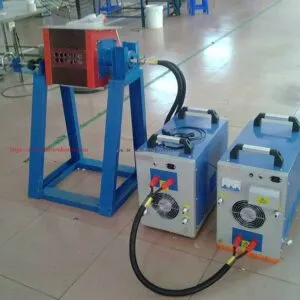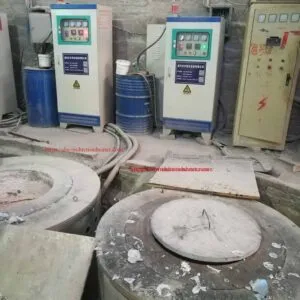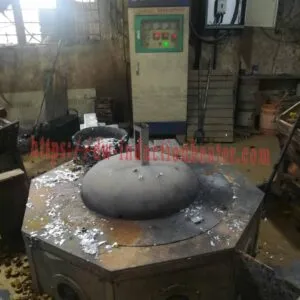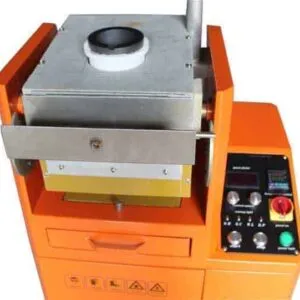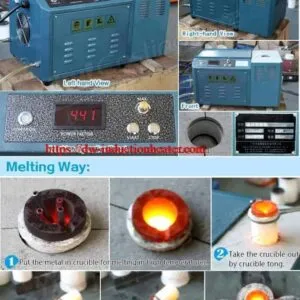
Small Induction Gold Melting Furnace
Small Induction Gold Melting Furnace for Jewelry and Precious Metal Casting
Quick Answer: The HLQ M.MF.ML001 is a compact, water-cooled, medium-frequency induction gold melting furnace designed for small precious-metal batches. The published configuration uses 220 V single-phase, 50/60 Hz input, approximately 3 kW rated output, and a stated 1–2 kg gold melting capacity. The product page lists a maximum temperature of 1450°C and a typical 3–5 minute melting-time claim. These are manufacturer-published specifications, not guaranteed results for every batch: charge mass, initial temperature, alloy, crucible, cooling, and power coupling all affect actual performance. The numerical induction output frequency has not been published for this model and should be confirmed before ordering.
Best fit: Jewelry workshops, goldsmiths, precious-metal casting, sample preparation, and small-scale remelting where clean, repeatable operation and a compact footprint matter more than large-batch throughput.
Table of Contents
- What is the Small Induction Gold Melting Furnace?
- Applications
- Suitable Materials
- Working Principle
- Technical Specifications
- Recommended Model Selection
- Process Workflow
- Coil and Fixture Design
- Common Problems and Solutions
- Advantages
- Limitations
- Why Choose HLQ Induction Equipment?
- Core FAQs
What is the Small Induction Gold Melting Furnace?
A small induction gold melting furnace is an electrically powered system that uses a high-current alternating magnetic field to heat a conductive metal charge within a suitable crucible. The heating is concentrated in the metal and, depending on crucible construction, in the susceptor or crucible as well. Unlike a fuel-fired furnace, there is no combustion flame directed at the molten gold. Proper ventilation and safe handling are still essential.
The HLQ M.MF.ML001 combines an IGBT-based induction power supply, an induction coil, a removable crucible or melting vessel, and water cooling into a benchtop-format machine. HLQ describes the electronics as using Infineon IGBT control components; component origin and bill of materials should be verified against the supplied quotation. The published 1–2 kg capacity refers to gold, not the same mass of every other metal.
For broader metal choices and larger furnace designs, see HLQ’s induction melting furnace portfolio. This page focuses on practical engineering decisions for the compact 3 kW precious-metal machine.
| Decision Question | Practical Answer | Why It Matters |
|---|---|---|
| What is it for? | Small gold and selected silver/alloy melting batches | Optimized for compact jewelry-scale work, not tonnage production. |
| How is it powered? | Single-phase 220 V mains; approximately 3 kW induction output | Electrical supply, breaker, wiring and input rating require confirmation. |
| What capacity is published? | 1–2 kg of gold | Volume, alloy, crucible and heating time alter practical batch capacity. |
| Which data are still needed? | Exact induction frequency, input kVA, coil current, cooling flow/pressure and crucible size | These are required for a firm engineering approval or FAT specification. |
Applications
Induction heating is useful when frequent small batches, controlled pouring, compact installation, and fast changeovers are important. Typical uses include jewelry manufacturing, repair operations, precious-metal recycling, and sample preparation.
| Application | Typical Charge | Main Process Objective | Selection Note |
|---|---|---|---|
| Gold jewelry casting | Clean gold or verified gold alloy | Melt and pour into prepared casting molds | Confirm required superheat and mold process; melting does not replace casting equipment. |
| Goldsmith workshop repair | Small gold offcuts | Recover usable molten metal | Segregate scrap by alloy and purity. |
| Precious-metal recycling | Sorted gold/silver scrap | Remelt for ingot production | Induction melting is not chemical refining or assay. |
| Silver jewelry production | Fine silver or sterling silver | Small-batch melting prior to casting | Silver batch mass must be verified separately from gold rating. |
| Educational or laboratory work | Known metallic samples | Repeatable test batches | Record charge, crucible, power setting and measured time. |
| Alloy development | Pre-weighed compatible metals | Produce small trial melts | Temperature measurement and chemistry verification may be needed. |
Suitable Materials
Gold and silver are the primary intended materials. Brass is listed by the manufacturer, but its zinc-bearing composition requires particular attention to temperature control and extraction. The ability to melt a material depends not only on melting point but also on vessel compatibility, batch geometry, energy transfer and the desired pouring temperature.
| Material | Approximate Melting Behavior | Suitability for This 3 kW System | Key Caution |
|---|---|---|---|
| Pure gold (Au) | Melting point 1064.18°C | Primary application; published 1–2 kg gold charge | Allow superheat above melting point for controlled pouring. |
| Gold jewelry alloys | Solidus/liquidus vary with karat and composition | Usually suitable if the alloy temperature is within equipment capability | Determine alloy-specific liquidus and prevent contamination. |
| Pure silver (Ag) | Melting point 961.78°C | Suitable in principle; confirm mass and crucible | Gold and silver of equal mass occupy different volumes. |
| Sterling silver | Composition-dependent melting interval | Potentially suitable after process trial | Watch oxidation and correct alloy charge composition. |
| Brass | Composition-dependent melting interval | Manufacturer-listed, subject to engineering review | Zinc fumes require ventilation and controlled superheat. |
| Copper | Melting point approximately 1085°C | Trial/alternative model assessment required | Heat loss, crucible compatibility and batch time can differ materially. |
| Steel and stainless steel | Common alloys typically need much higher melt temperatures | Not a recommended baseline use for this model | 1450°C published maximum may be insufficient for practical pouring. |
| Reference | Temperature | Comparison With Published 1450°C Maximum |
|---|---|---|
| Pure silver melting point | 961.78°C | Below the quoted maximum; useful pouring superheat still required. |
| Pure gold melting point | 1064.18°C | Below the quoted maximum; alloy liquidus may differ. |
| M.MF.ML001 maximum temperature (published) | 1450°C | Upper published figure; measurement method is not specified. |
Capacity reminder: At room-temperature bulk densities, 1 kg of gold occupies about 52 mL, while 1 kg of silver occupies about 95 mL. Those are approximate metal volumes, not recommended fill volumes. A crucible requires headspace for charge geometry, melting, thermal expansion and safe pouring.
Working Principle
An IGBT inverter converts incoming electrical power to alternating current at an induction frequency selected for the load. Current flowing through the water-cooled copper coil produces a changing magnetic field. The field drives eddy currents through the metal charge, turning electrical energy into heat through resistance. Magnetic forces can help circulate molten metal, although the degree of stirring depends on coil geometry, frequency, charge size and operating conditions.
| Step | System Element | Engineering Function |
|---|---|---|
| 1 | Single-phase supply | Feeds electrical power through the rated protection and isolation devices. |
| 2 | IGBT converter | Generates variable-frequency electrical excitation for the load. |
| 3 | Water-cooled induction coil | Creates an alternating magnetic field around the crucible. |
| 4 | Charge and appropriate crucible | Absorb useful heat; coupling depends on geometry and material. |
| 5 | Molten metal bath | Reaches liquidus temperature, then suitable pouring superheat. |
| 6 | Operator / optional instrumentation | Verifies readiness before pouring; instrumentation is configuration-dependent. |
Engineering calculation: A screening estimate for a pure-metal batch is Q ≈ m × [cp × (Tm − T0) + Lf], where m is mass (kg), cp is an approximate mean specific heat (kJ/kg·K), Tm is melting temperature, T0 is initial temperature, and Lf is latent heat of fusion (kJ/kg). This does not include crucible heating, superheat, radiative loss, or electrical conversion loss.
| Variable | Gold Example | Silver Example | Qualification |
|---|---|---|---|
| Charge starting temperature | 20°C | 20°C | Assumed ambient reference. |
| Approx. mean cp | 0.15 kJ/kg·K | 0.235 kJ/kg·K | Teaching-level approximation; actual cp changes with temperature. |
| Approx. latent heat of fusion | 64 kJ/kg | 105 kJ/kg | Rounded reference values. |
| Approx. ideal energy per kg to melt | 0.061 kWh/kg | 0.091 kWh/kg | Idealized heat into the metal only; real input energy is higher. |
| Charge Mass | Pure Gold | Pure Silver | Design Interpretation |
|---|---|---|---|
| 0.5 kg | 0.031 kWh | 0.045 kWh | Metal thermal requirement only. |
| 1.0 kg | 0.061 kWh | 0.091 kWh | Exclude furnace losses and pouring superheat. |
| 1.5 kg | 0.092 kWh | 0.136 kWh | Actual time depends on coupling, crucible and output. |
| 2.0 kg | 0.123 kWh | 0.181 kWh | Do not interpret as equal-rated gold and silver capacity. |
Why this matters: The manufacturer reports an approximately 3 kW output and a 3–5 minute melt-time figure. The calculation above cannot validate that time by itself: the fraction of rated electrical output that reaches the charge, heat-up of the crucible, and actual superheat are unknown. Request a timed melt test for the metal and batch mass you plan to use.
Technical Specifications
| Parameter | Specification | Notes |
|---|---|---|
| Model | M.MF.ML001 | As listed on HLQ product page. |
| Equipment type | Compact, medium-frequency induction melting furnace | Benchtop precious-metal format. |
| Input voltage | 220 V AC | Manufacturer lists single-phase supply. |
| Mains frequency | 50/60 Hz | Input frequency, not induction coil frequency. |
| Rated output power | Approximately 3 kW | Published as output power; input power and kVA are not specified. |
| Induction output frequency | Medium frequency; exact Hz/kHz not published | Obtain confirmed operating range from HLQ. |
| Primary melt charge | 1–2 kg gold | Published gold-specific capacity; do not apply uncritically to silver. |
| Maximum temperature | 1450°C | Published rating; sensor/location and tolerance not described. |
| Claimed melt time | 3–5 minutes | Reference claim only; batch/test conditions not supplied. |
| Cooling method | Flowing cooling water or chilled water | Flow, pressure, inlet temperature, and water quality to confirm. |
| Protection functions | Manufacturer lists overvoltage, overcurrent, low water and overheating protection | Confirm exact interlock and alarm implementation on supplied unit. |
| Power electronics | IGBT based; Infineon components claimed | Verify actual component BOM as quoted. |
| Dimensions (L × W × H) | 580 × 300 × 330 mm | Published machine dimensions; leave cooling/service clearance. |
| Net weight | 28 kg | Published machine weight; check shipping package separately. |
| Continuous-duty statement | Manufacturer claims full-load / 24-hour operation | Subject to correct cooling, ambient conditions, maintenance and factory confirmation. |
| Crucible bore, replacement type and coil ID | Not published | Require layout/drawing for ordering and spare-part selection. |
Electrical design check: Dividing 3,000 W by 220 V gives 13.6 A only as a theoretical ratio for 3 kW at the supply terminals with unity power factor. Because the published 3 kW figure is output power, this value is not a verified mains current rating. Size the supply, breaker, cable, grounding and residual-current protection using the manufacturer’s rated input current and applicable local electrical code.
Recommended Model Selection
Choose a furnace by the largest routine charge, metal chemistry, pouring-temperature margin, operating cycle, and electrical service. A machine that melts one small batch occasionally may be inefficient for continuous commercial production. For a compact alternative with a different published power/capacity configuration, compare HLQ’s small induction furnace listing.
| Application | Material | Recommended Power | Frequency |
|---|---|---|---|
| Small jewelry batch; up to 1 kg | Gold | Approx. 3 kW; M.MF.ML001 candidate | MF; numeric value to be confirmed |
| Gold batch approaching 2 kg | Gold | Approx. 3 kW published candidate; test cycle time | MF; numeric value to be confirmed |
| Silver jewelry batch | Pure or sterling silver | 3–5 kW class for screening; validate crucible and rate | Design-specific; request from supplier |
| Small brass sample melt | Brass alloy | 3–5 kW class for screening only | Design-specific; request from supplier |
| Higher-throughput 5–10 kg gold batch | Gold | 15 kW industrial MF series candidate | 1–20 kHz listed for larger DW-MF family; model-dependent |
| Gold processing around 10–20 kg/batch | Gold | 25 kW industrial MF series candidate | 1–20 kHz listed for larger DW-MF family; model-dependent |
Important: The 15 kW and 25 kW suggestions concern a different, larger industrial series and do not define options or frequencies for M.MF.ML001. Capacity and output must be reconfirmed with the exact crucible and melt-time requirement. HLQ also lists an MF small induction melting gold furnace page with the M.MF.ML001 rating; clarify product scope in the quotation to prevent duplicate-model confusion.
| Buyer Input | Example / Required Detail | Design Impact |
|---|---|---|
| Metal and alloy | 24K gold, 18K yellow gold, sterling silver, specific brass grade | Changes liquidus, superheat and crucible choice. |
| Maximum mass per pour | kg per batch plus required headspace | Sets crucible size and actual heating burden. |
| Production target | Batches per hour and operating hours per day | Determines whether a higher power model is more suitable. |
| Power supply | Voltage tolerance, phase, breaker capacity | Determines electrical compatibility. |
| Cooling utility | Water temperature, pressure, flow, quality and availability | Determines coil/power-stage protection. |
| Acceptance criterion | e.g., 1 kg of specified alloy from 20°C to pour-ready in x min | Enables a meaningful factory melt test. |
Process Workflow
Workflow: Confirm alloy and batch mass → Inspect dry crucible and coil → Establish verified cooling flow → Weigh and load clean, dry metal → Start controlled induction heating → Verify a fully molten bath and suitable superheat → Stop power and pour using rated tools → Record batch data and inspect the system.
| Stage | Operator Action | Acceptance / Safety Point |
|---|---|---|
| 1. Prepare | Identify alloy, remove incompatible contaminants, ensure charge is dry. | Never charge wet or sealed scrap; molten-metal moisture contact can be violent. |
| 2. Inspect | Check crucible, refractory lining, coil, leads and guard. | Replace damaged crucible or leaking coil before start-up. |
| 3. Cool | Start and confirm the approved cooling circuit. | Verify water-flow interlock and temperature within the supplier limits. |
| 4. Heat | Ramp induction power according to the approved process recipe. | Observe safe clearances and avoid charge bridging or uncontrolled overflow. |
| 5. Verify | Confirm full melting and the required pour temperature using approved methods. | Do not equate glowing appearance with verified melt temperature. |
| 6. Pour | De-energize as required by operating procedure and pour with proper PPE and tools. | Keep the mold and all tools dry and prepared. |
| 7. Record | Log metal, mass, time, settings, energy where metered and any defects. | Use data to validate batch repeatability and actual costs. |
Coil and Fixture Design
The coil is not simply an accessory: its diameter, axial height, number of turns and distance to the charge control heating efficiency and matching. A water-cooled copper induction coil is typically installed around a thermally compatible crucible, with electrical insulation and refractory barriers as designed by the manufacturer. The operator should not substitute an arbitrary crucible, coil or water line.
| Element | Design Principle | What to Confirm |
|---|---|---|
| Coil diameter | Match active charge envelope while maintaining required insulating/refractory clearance. | Crucible OD, insulating thickness, coil ID and mechanical tolerances. |
| Coil active height | Cover the effective charge height without excessive field beyond the load. | Charge height at smallest and largest standard batches. |
| Coil turns and tubing | Set by operating frequency, inverter matching and thermal load. | Approved drawing, tube cross-section and permitted current. |
| Crucible | Select material compatible with gold, silver, alloy chemistry and heat cycle. | Manufacturer part number, rated temperature, chemical compatibility and service life. |
| Cooling loop | Remove waste heat from coil and power electronics. | Flow, pressure, quality, inlet temperature and low-flow shutdown. |
| Pouring fixture | Keep hot vessel stable and handleable with rated tools. | Clearance, load rating, splash protection and ergonomic access. |
For repeated high-volume pours, the investment may favor an integrated tilting arrangement rather than manual crucible handling. HLQ’s tilting induction melting furnace range is a separate industrial equipment class to consider when batch sizes and handling risks increase.
Common Problems and Solutions
| Symptom | Likely Causes | Recommended Action |
|---|---|---|
| Gold takes longer than expected to melt | Large/cold charge, poor coupling, crucible loss, low actual output | Record mass and start temperature; measure power and repeat timed test. |
| Uneven or incomplete melting | Load placement, incorrect crucible geometry, charge bridging | Use approved charge size and vessel; review coil load matching. |
| Inverter trips during heating | Overcurrent, voltage deviation, wrong coil or failing component | Stop operation, record alarm and ask qualified service staff to diagnose. |
| Cooling alarm or overheating | Low flow, blocked path, hot inlet water, fouled heat exchanger | Stop heating and restore specified flow/temperature before restarting. |
| Crucible cracks or chips | Thermal shock, contamination, physical impact, end-of-life wear | Discard damaged vessel; use approved handling and conditioning protocol. |
| Oxidized or contaminated alloy | Dirty scrap, wrong crucible, excessive hold time, unprotected bath | Sort charge, follow alloy-specific process and verify composition. |
| Brass produces excessive fumes | Overheating, zinc-containing material, inadequate extraction | Stop and correct process temperature and source-capture ventilation. |
| Quality varies from batch to batch | Inconsistent mass, chemistry, superheat or hold time | Adopt a batch log, validated temperature measurement and acceptance window. |
Advantages
| Potential Advantage | Engineering Explanation | Condition / Qualification |
|---|---|---|
| Compact footprint | Published external dimensions are 580 × 300 × 330 mm. | Allow additional clearance for cooling hoses, electrical isolation and safe pouring. |
| Fast small-batch response | Electromagnetic energy can couple rapidly to conductive metal. | Actual time requires representative melt testing. |
| No burner flame at vessel | Electrical heating eliminates direct fuel flame at the melt point. | Molten-metal hazards and metal fumes remain. |
| Precise power adjustability | Inverter systems can vary heating power. | Temperature feedback and automatic control must be confirmed as options. |
| Reduced handling of bulk fuel | No gas cylinders or burner fuel are needed for the heating process. | Electrical supply and reliable water cooling are essential. |
| Repeatable process potential | Consistent charge and settings enable comparable cycles. | Track batch mass, alloy, temperature, time and vessel condition. |
| Selection Criterion | Induction Furnace | Resistance Furnace | Gas Furnace |
|---|---|---|---|
| Heat generation | Electromagnetic coupling to charge/susceptor | Heating elements warm vessel/chamber | Combustion heats vessel/chamber |
| Small-batch response | Often rapid if correctly matched | Dependent on element/chamber inertia | Dependent on burner and furnace thermal mass |
| Local combustion products | None from the heating method itself | None from the heating method itself | Present; requires combustion exhaust |
| Main utilities | Electricity + cooling water | Electricity | Fuel + combustion air |
| Primary selection trade-off | Power supply, matching and cooling complexity | Element wear and thermal inertia | Burner control, exhaust and heat loss |
Limitations
No furnace fits every metal, throughput or process quality requirement. Buyers should account for the constraints below before comparing only price or nameplate capacity.
| Limitation | Consequence | Better Approach |
|---|---|---|
| Gold-specific capacity rating | 2 kg silver is not volumetrically equivalent to 2 kg gold. | Specify metal, vessel dimensions and fill limit independently. |
| Unpublished exact induction frequency | Cannot finalize coil/load matching or compare frequency claims reliably. | Request the actual operating kHz range for M.MF.ML001. |
| Unspecified energy and cycle-test conditions | Cannot guarantee 3–5 minute results for every charge. | Define factory acceptance testing with representative alloy and mass. |
| Published 1450°C maximum | Inadequate temperature headroom for many high-melting alloys. | Select a high-temperature furnace engineered for the target metal. |
| Cooling-water dependency | Interrupted cooling can damage the inverter or coil. | Include flow interlock, documented cooling limits and maintenance. |
| Not a refining or purity analyzer | Remelting does not automatically remove chemical impurities. | Use separate refining, assay and quality-control processes as needed. |
| Molten-metal hazards | Burn, splash, fume, electrical and moisture-contact risks remain. | Use a controlled workspace, PPE, exhaust and trained operators. |
Why Choose HLQ Induction Equipment?
HLQ Induction Equipment Co., Ltd. supplies induction heating and melting solutions from Dongguan, Guangdong, China. For a small gold furnace, the value of a supplier should be assessed through the quality of its model selection, documented specifications, spare-part support and ability to demonstrate performance on the customer’s own alloy and batch size—not by unverified promotional superlatives.
| Deliverable | Why Buyers Need It | Suggested Acceptance Evidence |
|---|---|---|
| Confirmed electrical nameplate | Correct supply capacity and safe installation | Input V/Hz/phase, max input A/kVA, output kW. |
| Exact operating frequency | Coil/load engineering, comparable quotations | Documented kHz range for the supplied configuration. |
| Crucible and coil drawings | Consumable selection and replacement planning | Vessel part number, capacity, dimensions and coil assembly ID. |
| Cooling requirements and alarms | Thermal safety and service reliability | Min/max flow, pressure, inlet temperature and interlock test. |
| Representative melt-test record | Objective melting-time/quality benchmark | Material, kg, initial temp, elapsed time, pour temp and measured energy if available. |
| Spare parts and documentation | Lifecycle cost and troubleshooting support | Operating manual, recommended spares, warranty and maintenance list. |
For a broader view of metal types, furnace formats and scaling considerations, consult the induction furnace for metal melting guide. Send HLQ your alloy composition, target kilograms per melt, desired cycle time, available single-phase voltage and cooling-water conditions to obtain a technically grounded proposal.
Technical sales contact: HLQ Induction Equipment Co., Ltd. | Email: sales@dw-inductionheater.com | WhatsApp: +86-13155965571 | Dongguan, Guangdong, China.
Core FAQs
1. How many kilograms of gold can the M.MF.ML001 melt?
The published capacity is 1–2 kg of gold. Practical charge size depends on the supplied crucible, alloy, available headspace and duty cycle. Ask HLQ to verify performance for your routine production mass.
2. Is 3 kW the machine’s electrical input or induction output?
The target product page identifies approximately 3 kW as output power. It does not provide a verified input kW, input current or kVA value. Do not select the circuit breaker from output power alone.
3. What is the operating induction frequency?
HLQ describes the unit as medium frequency, but its exact numerical coil frequency is not stated. The 50/60 Hz figure is the mains frequency. Request an explicit kHz specification for the delivered model.
4. How long does it take to melt 1–2 kg of gold?
HLQ publishes a 3–5 minute melt-time claim without test details. Treat this as indicative until a test defines gold mass and purity, initial temperature, crucible condition, superheat and cooling.
5. Can this machine melt silver and sterling silver?
Gold and silver are listed applications. Yes in principle, but sterling alloy chemistry, crucible volume and desired silver batch mass must be checked. Equal-weight silver occupies substantially more volume than gold.
6. Is the maximum temperature high enough for gold melting?
Pure gold melts at 1064.18°C, below the published 1450°C maximum. The correct operating temperature must also allow for alloy liquidus and pouring superheat, while respecting crucible and equipment limits.
7. Does the furnace need cooling water?
Yes. The manufacturer lists running water or chilled water. Confirm minimum flow, pressure, water quality, allowable inlet temperature and alarm/interlock logic before operating the system.
8. Is the furnace suitable for steel melting?
Not as the recommended baseline application. Many steels require melting and pouring temperatures at or above the product’s published maximum. Select a purpose-built, higher-temperature furnace instead.
9. Can induction melting refine impure scrap into 24K gold?
No. Induction melting changes physical state; it does not automatically separate impurity elements or verify purity. Refining and assay are separate operations requiring appropriate processes.
10. What information should I submit to receive an accurate quotation?
Specify metal/alloy, charge mass, target melting or pour time, batches per day, voltage/phase, cooling-water availability, preferred pouring method and any acceptance-test requirements. This lets HLQ propose the suitable crucible, coil and power configuration.