
Handheld vs Large Induction Straightening Systems: How to Select Induction Straightening Equipment
Table of Contents
- Quick Answer
- Comparison Overview
- Working Principle Comparison
- Key Technical Parameters
- Efficiency and Energy Cost Comparison
- Temperature Control Comparison
- Material Quality and Surface Condition
- Safety and Compliance Comparison
- Maintenance Comparison
- Total Cost of Ownership
- Engineering Selection Guide
- Common Engineering Mistakes
- Common Problems and Solutions
- Real Project Case Study
- Honest Limitations of Both Methods
- Final Recommendation
- FAQ
Selecting induction straightening equipment usually comes down to one decision: a handheld system carried to the work, or a larger system with more power for thicker steel. This guide compares HLQ handheld DWS-P units (25–60 kW) with HLQ small, medium and large straightening systems (25–300 kW). It covers power, frequency, steel thickness, mobility, site utilities, duty cycle, temperature control, safety, maintenance and cost. It is written for shipyard production managers, bridge and steel-structure contractors, and purchasing engineers who need to specify straightening equipment that matches their structures, steel grades and working conditions.
Quick Answer
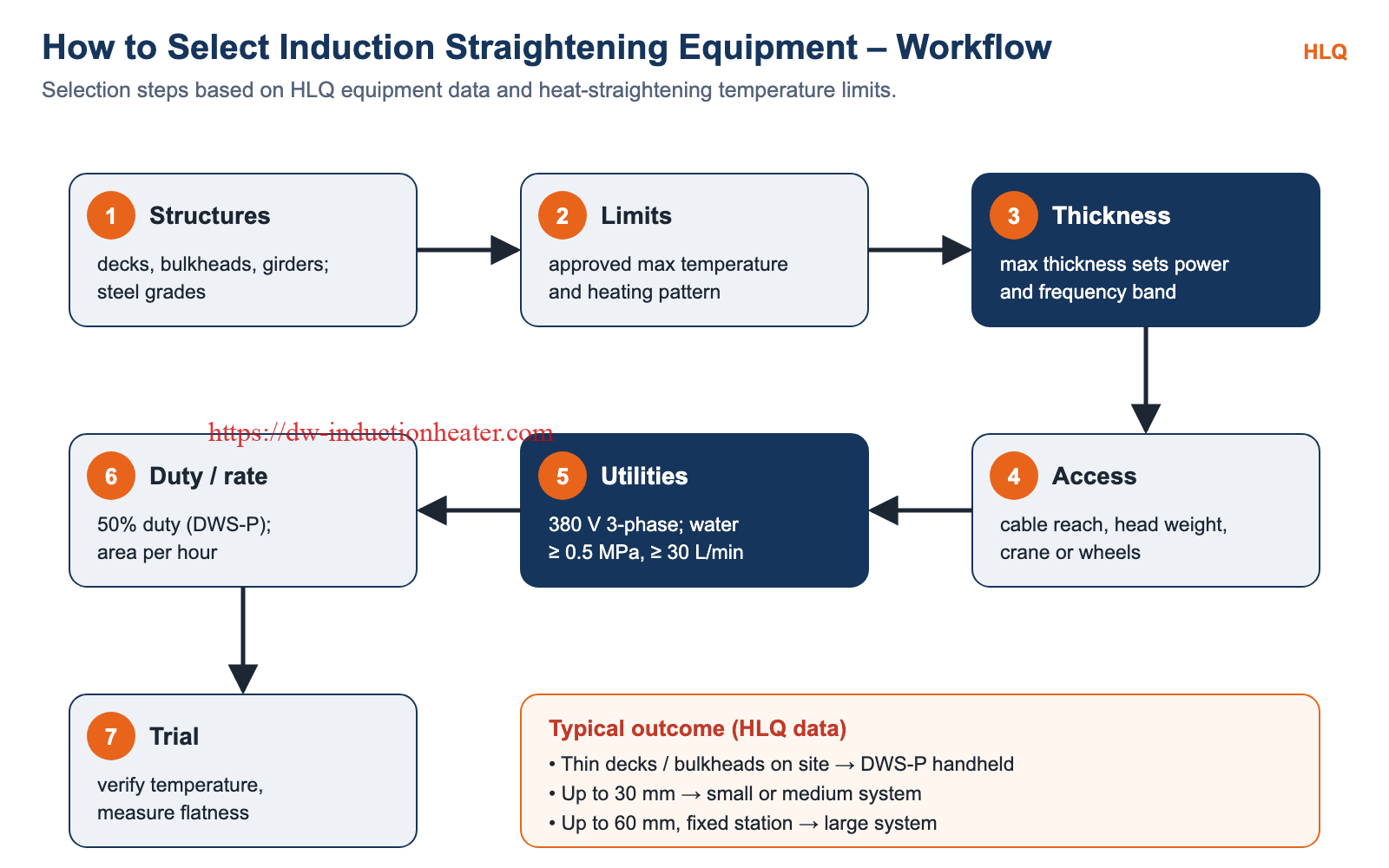
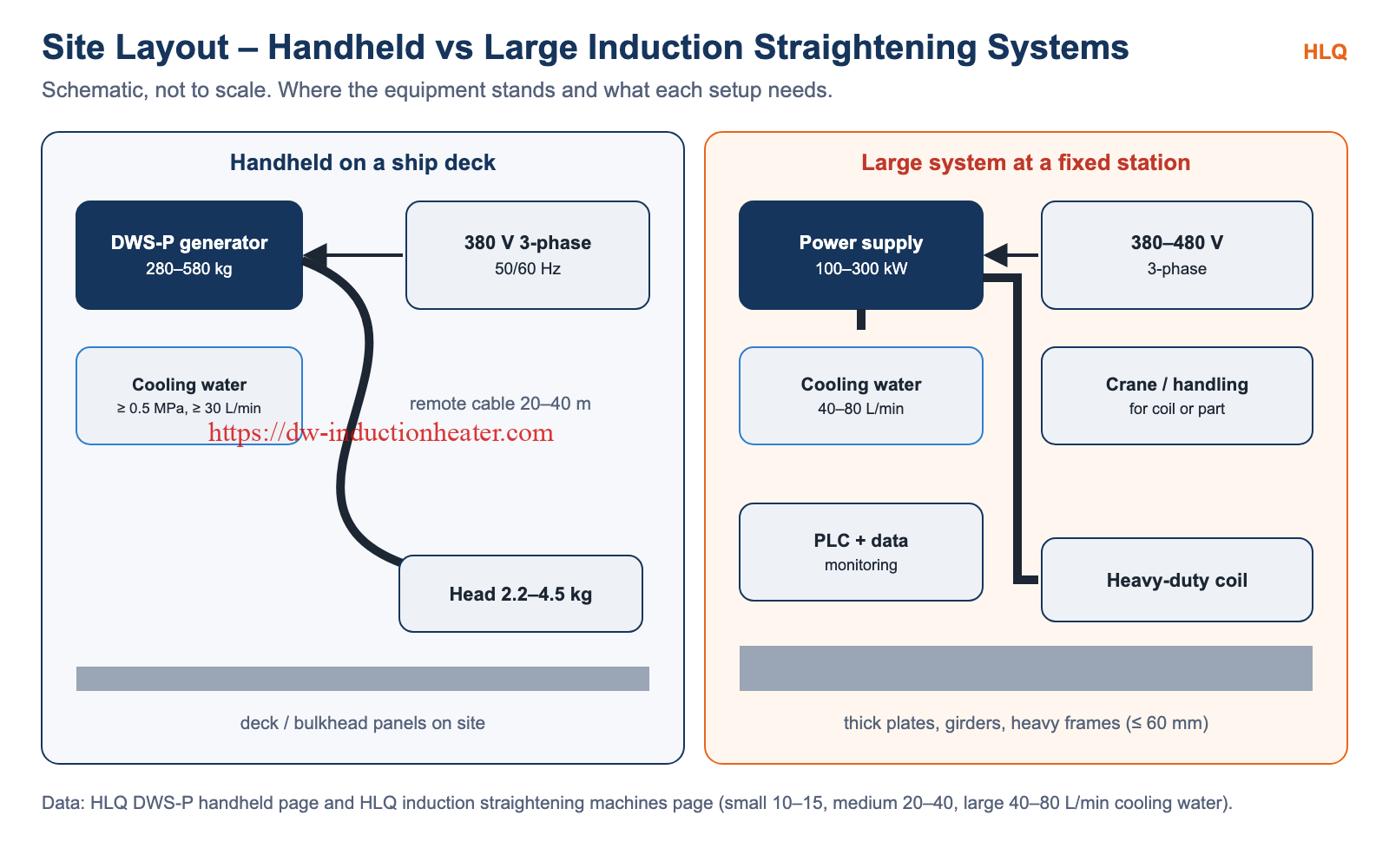
Choose a handheld system (HLQ DWS-25P, DWS-30P or DWS-60P) to straighten thin decks, bulkheads and frames on site. Its 2.2–4.5 kg head on a 20–40 m cable reaches the work, and 380 V 3-phase power and cooling water of at least 0.5 MPa and 30 L/min are available. Choose a larger system when the steel is thicker: HLQ lists steel thickness capacities of up to 15 mm for small systems (25–50 kW), 30 mm for medium systems (50–100 kW) and 60 mm for large systems (100–300 kW). Large systems also suit a fixed or crane-assisted station. In every case, the steel’s approved temperature limit, not the equipment’s capability, governs the process.
Comparison Overview
Induction straightening removes welding and impact distortion by heating local zones that contract as they cool. Most yards and contractors compare two equipment families:
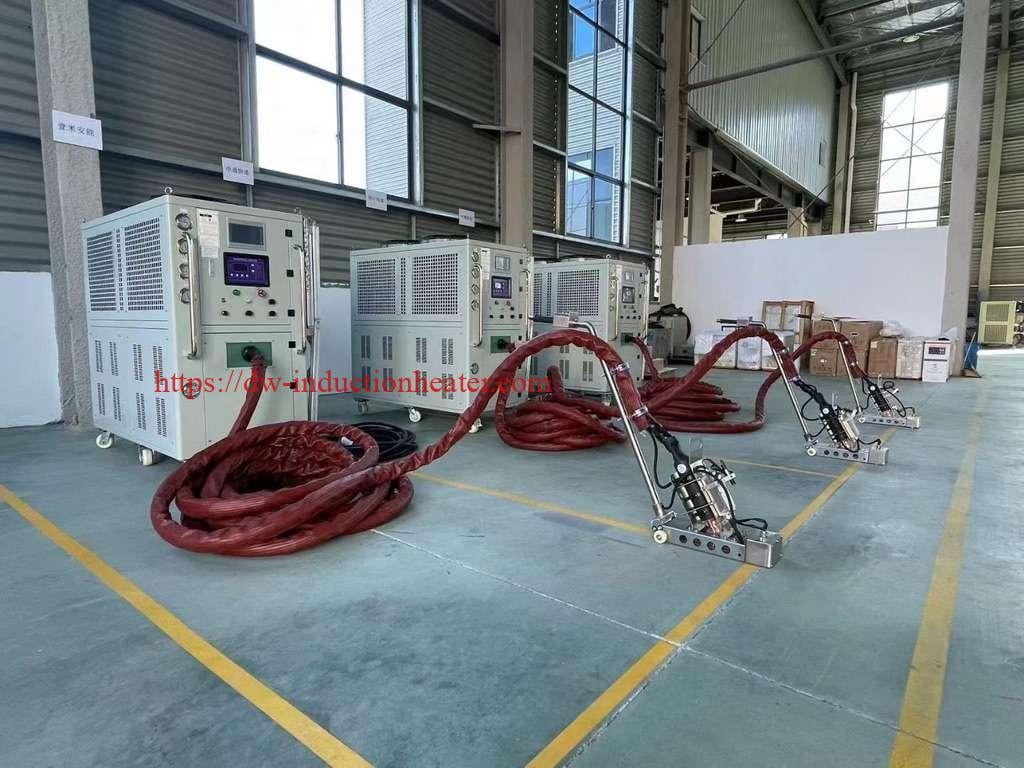
- Handheld systems: a generator with an internal chiller, a long remote cable and a light, water-cooled heating head that the operator moves over the structure. HLQ supplies these as the handheld remote induction heater (DWS-P series).
- Larger straightening systems: more power, lower frequencies and heavy-duty coils for thicker steel, on a cart, on wheels or as a fixed, crane-assisted installation. HLQ supplies these as induction straightening heating machines.
Working Principle Comparison
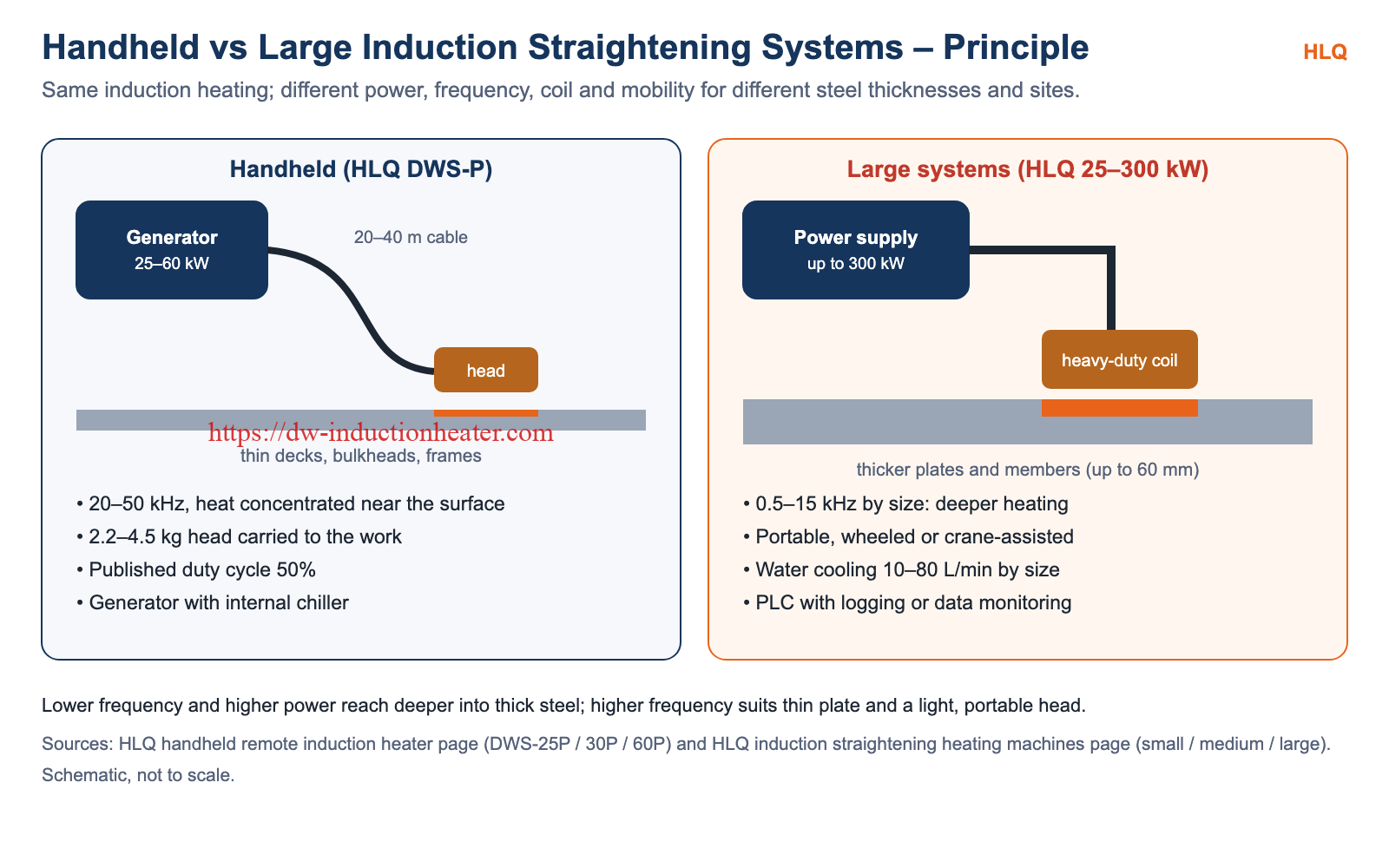
Both families heat the steel the same way: the coil induces eddy currents in the steel under it, the heated zone tries to expand, the surrounding cold steel restrains it, and on cooling the zone contracts and pulls the plate back toward its design shape. What differs is the scale:
- Handheld units run at 20–50 kHz, which concentrates heat near the surface and suits thin plate, with a light head that one operator can move.
- Larger systems use lower frequencies as size increases (5–15 kHz small, 2–8 kHz medium, 0.5–5 kHz large) and higher power, so heat reaches deeper into thick steel.
Key Technical Parameters
| Parameter | Handheld (HLQ DWS-P) | Large systems (HLQ small / medium / large) | Engineering Impact |
|---|---|---|---|
| Power | 25 kW / 30 kW / 60 kW max. input | 25–50 kW / 50–100 kW / 100–300 kW | Thicker steel needs more power |
| Frequency | 20–50 kHz | 5–15 kHz / 2–8 kHz / 0.5–5 kHz | Lower frequency heats deeper |
| Steel thickness | Thin decks, bulkheads and frames (application-specific) | Up to 15 mm / 30 mm / 60 mm | Main sizing criterion |
| Mobility | Heating head 2.2 / 2.7 / 4.5 kg; cable 20 m (25P) or 20–40 m (30P / 60P) | Portable or cart / semi-portable or wheeled / fixed or crane assisted | Site work vs fixed station |
| Generator weight | 280 kg / 316 kg / 580 kg | By configuration | Placement on deck or platform |
| Supply | 380 V, 3-phase, 50/60 Hz | 380–480 V, 3-phase | Site power planning |
| Cooling | Water ≥ 0.5 MPa, ≥ 30 L/min; internal chiller | Water-cooled: 10–15 / 20–40 / 40–80 L/min | Water supply at the work area |
| Duty | Published duty cycle 50% | By configuration | Real working rate |
| Coil | Interchangeable handheld heating heads | Flat pancake / custom; heavy-duty for large systems | Heating pattern and access |
| Control | Power control and protection functions | PLC with basic logging / data monitoring / advanced digital control | Process records |
Efficiency and Energy Cost Comparison
Working rate depends on how much of the input power ends up as useful heat in the steel. HLQ publishes an idealized example for its handheld units that assumes 50% utilization and 40% coupling:
| Model | Max. input power | Average useful power (example) | Idealized time per m² | Idealized area rate |
|---|---|---|---|---|
| DWS-25P | 25 kW | 5 kW | ≈ 369 s | ≈ 9.7 m²/h |
| DWS-30P | 30 kW | 6 kW | ≈ 308 s | ≈ 11.7 m²/h |
| DWS-60P | 60 kW | 12 kW | ≈ 154 s | ≈ 23.4 m²/h |
These are calculated values, not measured straightening rates. A handheld unit used on steel that is too thick for it does not save energy: it needs many more heats or cannot reach the required effect. Match power to thickness first, then compare running costs with your local electricity tariff and measured consumption from a trial.
Temperature Control Comparison
Both equipment families can heat steel far beyond straightening limits; HLQ systems list temperature ranges up to 800–1100 °C. The approved limit therefore has to come from the steel and the governing rules, not from the machine:
- Bridges: Iowa DOT provisions citing FHWA-IF-08-999 limit carbon steels to 1200 °F (about 650 °C), A514 and A709 Grades 100/100W to 1100 °F (about 593 °C), and A709 Grade 70W to 1050 °F (about 566 °C).
- Ships: IACS Recommendation 47 includes a line-heating temperature provision, and the value must be confirmed with the classification society.
With either system, set power and heating time per spot and verify each heat with temperature-indicating crayons or a calibrated pyrometer with verified emissivity. Larger systems with PLC data monitoring make it easier to record the settings used.
Material Quality and Surface Condition
Within the approved temperature limit, the straightening result depends on the heating pattern and restraint rather than on the equipment size. The main quality risks are:
- Overheating, especially of high-strength quenched and tempered steels.
- Uneven heating caused by a varying gap between the head and the steel.
- Over-correction from too many or too large heats.
Coatings over heated zones should be expected to need repair, because the same handheld technology is also used to disbond paint and coatings. For a comparison with torch methods, see induction straightening vs flame straightening.

Safety and Compliance Comparison
| Topic | Handheld systems | Large systems |
|---|---|---|
| Electrical | Generator, remote cable and head close to the operator; cable routing on deck | Higher power installation; fixed wiring for larger units |
| Handling | Generator 280–580 kg placed near the work; light head | Crane assistance for coils or parts on large systems |
| Cooling | Cooling water must stay within specification to protect head and cable | Higher water flow (up to 40–80 L/min) |
| Open flame | None | None |
| Standard | IEC 60519 series for electroheating installations | IEC 60519 series for electroheating installations |
Maintenance Comparison
- Handheld:
- Check cooling water pressure and flow (≥ 0.5 MPa, ≥ 30 L/min) and keep the internal chiller in good condition.
- Inspect the remote cable and heating head before each shift.
- Work within the published 50% duty cycle.
- Keep pyrometers calibrated.
- Large systems:
- Maintain the higher-flow cooling circuit (10–80 L/min by size).
- Inspect heavy-duty coils and their insulation.
- Service the PLC and data monitoring.
- Maintain the crane or handling equipment where used.
Total Cost of Ownership
Compare cost against the work the equipment will actually do:
- Purchase: handheld units cost less and need less infrastructure; large systems need more power, cooling capacity and possibly a crane.
- Utilization: equipment that matches the most common thickness is used every day. Oversized equipment sits idle, and undersized equipment needs repeat heats.
- Labour: operator time per square metre, which depends on power, duty cycle and heating pattern.
- Rework: settings that are repeatable and recorded reduce over-correction and re-straightening.
- Mixed work: many yards combine handheld units for thin plate with one larger system for heavy members.
Engineering Selection Guide
| Condition | Recommended Option | Reason |
|---|---|---|
| Thin decks, bulkheads and frames straightened on board | Handheld DWS-P | Light head, 20–40 m reach, no fixed installation |
| Large deck areas with high daily output | DWS-60P | Highest handheld power; HLQ lists it for large ship decks |
| Steel up to 15 mm | Small system (25–50 kW) or handheld | HLQ small system capacity up to 15 mm |
| Steel up to 30 mm | Medium system (50–100 kW) | HLQ medium system capacity up to 30 mm |
| Steel up to 60 mm, heavy frames or girders | Large system (100–300 kW) | Lower frequency (0.5–5 kHz) and higher power for thick steel |
| Limited site power or water | Handheld, after a utilities check | Lower power demand; internal chiller |
| Work that must be recorded for quality | System with PLC data monitoring | Logged settings per job |
For deck and bulkhead applications, see induction straightening of bulkheads and decks.
Common Engineering Mistakes
- Selecting by power alone: thickness, frequency, access and utilities matter as much.
- Treating the equipment’s temperature range as the process limit: the steel’s approved limit governs.
- Ignoring duty cycle: a 50% published duty cycle halves the time available for heating.
- Forgetting cooling water: DWS-P units need at least 0.5 MPa and 30 L/min.
- Underestimating access: cable length (20 m on the DWS-25P) and generator weight decide where the unit can stand.
- Buying before a trial: settings and working rate should be confirmed on representative plate.
- Using straightening equipment to form shapes: forming pipes and sections is a different process; see induction straightening vs induction bending.
Common Problems and Solutions
| Problem | Likely Cause | Solution |
|---|---|---|
| Heats take too long on thick plate | Power or frequency too high for the thickness | Move to a medium or large system with lower frequency |
| Uneven heating | Gap between head and steel varies; scale or coating | Keep a constant gap; check the head and surface |
| Unit stops during long runs | Duty cycle or cooling limits reached | Plan heating within the duty cycle; check water flow and pressure |
| Cannot reach the work area | Cable too short or generator too heavy to place | Choose a 20–40 m cable model; plan generator placement |
| Temperature above the limit | Settings not adapted to the steel | Reduce power or time; verify every heat |
| Inconsistent results between operators | No written settings | Fixed power and time per spot; record them |
Real Project Case Study
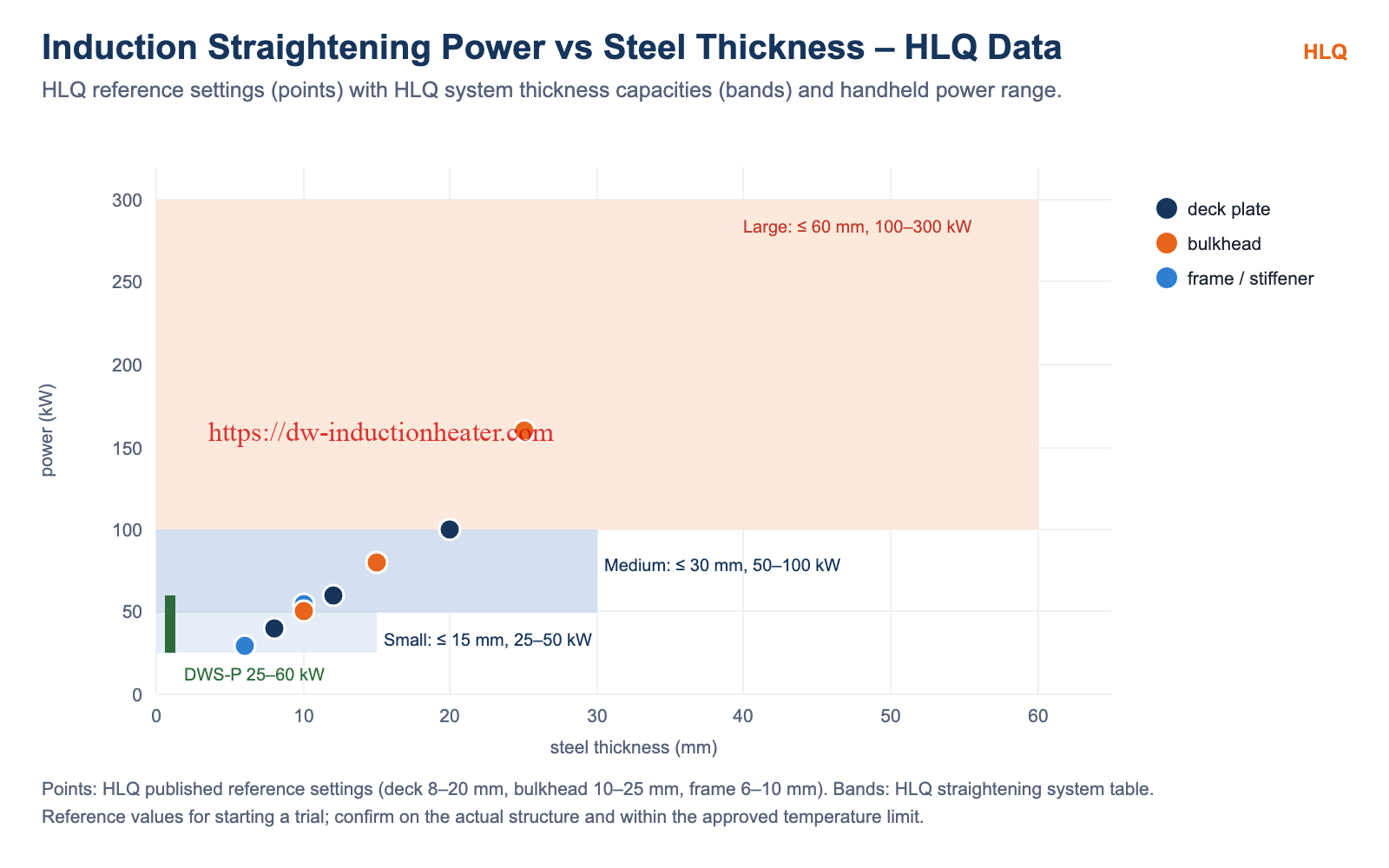
HLQ publishes reference settings for straightening ship structures. They show how the required power rises with steel thickness, which is the basis for choosing between handheld units and larger systems:
| Application | Thickness (mm) | Power (kW) | Heating time (s) | Max. temperature (°C) | Equipment class |
|---|---|---|---|---|---|
| Frame / stiffener | 6 | 30 | 30–45 | 600 | Handheld / small |
| Deck plate | 8 | 40 | 45–60 | 650 | Handheld (DWS-60P) / small |
| Bulkhead | 10 | 50 | 60–75 | 680 | Handheld (DWS-60P) / small |
| Deck plate | 12 | 60 | 70–90 | 700 | DWS-60P / medium |
| Bulkhead | 15 | 80 | 90–110 | 720 | Medium |
| Deck plate | 20 | 100 | 120–150 | 750 | Medium / large |
| Bulkhead | 25 | 160 | 180–210 | 780 | Large |
These are reference values for starting a trial. The equipment class column is derived from the HLQ power ranges. Settings above 650 °C are shipbuilding values: they must not be used for bridge members, and for ships they must be checked against the classification society’s limit. The photographs in this article show HLQ handheld systems on ship decks and steel structures. Customer-specific measurements are available on request for qualified projects. More background: induction straightening in the shipbuilding and marine industry.

Honest Limitations of Both Methods
- Handheld systems:
- Limited power for thick members.
- Published duty cycle of 50%.
- Need cooling water at the work area.
- The generator (280–580 kg) must be placed within cable reach.
- The head needs a reasonably flat, accessible surface.
- Large systems:
- Higher investment, power demand and cooling water flow.
- Less mobile; large units are fixed or crane assisted.
- Oversized for thin plate work.
- Both:
- Neither removes the need for an approved temperature limit, a heating plan, temperature checks and flatness measurement.
Final Recommendation
- Start from the structures, the steel grades and the approved temperature limit.
- Size the equipment by the thickest steel you will regularly straighten:
- Handheld DWS-P units for thin decks, bulkheads and frames on site.
- A small or medium system for steel up to 15 or 30 mm.
- A large system for steel up to 60 mm at a fixed or crane-assisted station.
- Confirm site power, cooling water, cable reach and duty cycle.
- Run a trial on representative plate before ordering.

FAQ
Should I choose a handheld or a large induction straightening system?
Handheld DWS-P units suit thin decks, bulkheads and frames on site; larger systems suit steel up to 15, 30 or 60 mm, depending on size.
How much power do I need for deck plate?
HLQ reference settings start at about 40 kW for 8 mm deck plate, 60 kW for 12 mm and 100 kW for 20 mm, to be confirmed by a trial.
Which frequency is best for straightening?
Higher frequency (20–50 kHz on handheld units) for thin plate; lower frequency (down to 0.5–5 kHz on large systems) for thick steel.
What site utilities does a handheld unit need?
380 V 3-phase power at 50/60 Hz and cooling water of at least 0.5 MPa and 30 L/min; DWS-P generators include an internal chiller.
How far can the heating head be from the generator?
20 m on the DWS-25P and 20–40 m on the DWS-30P and DWS-60P.
What is the maximum straightening temperature?
It depends on the steel. For bridge carbon steels, provisions citing FHWA guidance set 1200 °F (about 650 °C); quenched and tempered grades have lower limits.
Can one system do all the work?
Rarely. Many yards use handheld units for thin plate and one larger system for heavy members.
What information should I send for a recommendation?
The structure types and access, steel grades and thickness range, approved temperature limit, area to straighten per shift, and the available power and cooling water.