
Quenching & Tempering Steel Bar Line with Induction Heating: Process Guide
Quick Answer
On a quenching and tempering steel bar line, each bar is induction heated to its austenitizing temperature, quenched to form martensite and then tempered to the target hardness. On HLQ lines, 42CrMo bars are quenched from 840–880 °C in oil or polymer and tempered at 540–620 °C to reach 32–40 HRC. The bar diameter also matters, because larger bars harden less deeply. 42CrMo4 through hardens in oil up to about Ø 60 mm, and for C45 the specified tensile strength after Q&T falls as the diameter increases.
Table of Contents
- What Is a Quenching & Tempering Steel Bar Line?
- Key Applications
- Suitable Materials
- Working Principle
- Technical Specifications
- Recommended Model Selection
- Process Workflow
- Common Problems and Solutions
- Engineering Selection Guide
- Advantages and Limitations
- Why Choose HLQ?
- 8 Core FAQs
What Is a Quenching & Tempering Steel Bar Line?
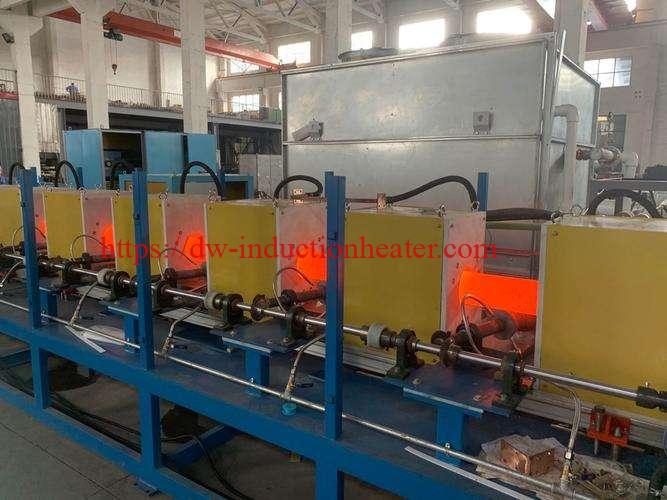
A quenching & tempering steel bar line heat treats round steel bars continuously in three stages:
- Medium frequency induction heats each bar above the upper critical temperature (austenitizing).
- A quench cools the bar quickly to form martensite.
- Reheating below Ac1 tempers the martensite, which reduces brittleness and quench stresses and sets the final hardness.
This guide covers the process itself: temperatures, quench media, the effect of bar diameter and the quality checks. For the equipment, see the induction quench and temper steel bar line. For the metallurgy in general, see induction hardening and tempering.

Key Applications
Quenched and tempered steel bars are used where parts must withstand bending, torsion, impact and cyclic loading:
- Automotive and commercial vehicles: drive shafts, axle shafts, torsion bars, stabilizer bars and gear shafts.
- Construction machinery: pins, bucket rods, hydraulic cylinder rods and tie rods.
- Oil, gas and mining: drill rods and sucker rods.
- General engineering: roller shafts, transmission shafts, high-strength bolts and spindles.
Suitable Materials
Process windows by grade (HLQ line data, compared with values that steel data sheets give for EN 10083):
| Grade | Quenching (°C) | Tempering (°C) | Quench medium | Target (HRC) | Source |
|---|---|---|---|---|---|
| 45# steel | 840–860 | 550–600 | Water / polymer | 28–34 | HLQ line data |
| C45 | 820–860 | 550–660 | – | – | EN 10083-2 values in steel data sheets |
| 40Cr | 840–870 | 520–600 | Oil / polymer | 30–38 | HLQ line data |
| 42CrMo | 840–880 | 540–620 | Oil / polymer | 32–40 | HLQ line data |
| 42CrMo4 | 820–860 | 540–680 | – | – | EN 10083 values in steel data sheets |
| 35CrMo | 840–870 | 500–580 | Oil / polymer | 30–36 | HLQ line data |
Steels for induction hardening normally contain 0.3% to 0.7% carbon. In the EN 10083 ranges, the lower end of the hardening temperature generally applies to water quenching and the upper end to oil quenching.
Working Principle
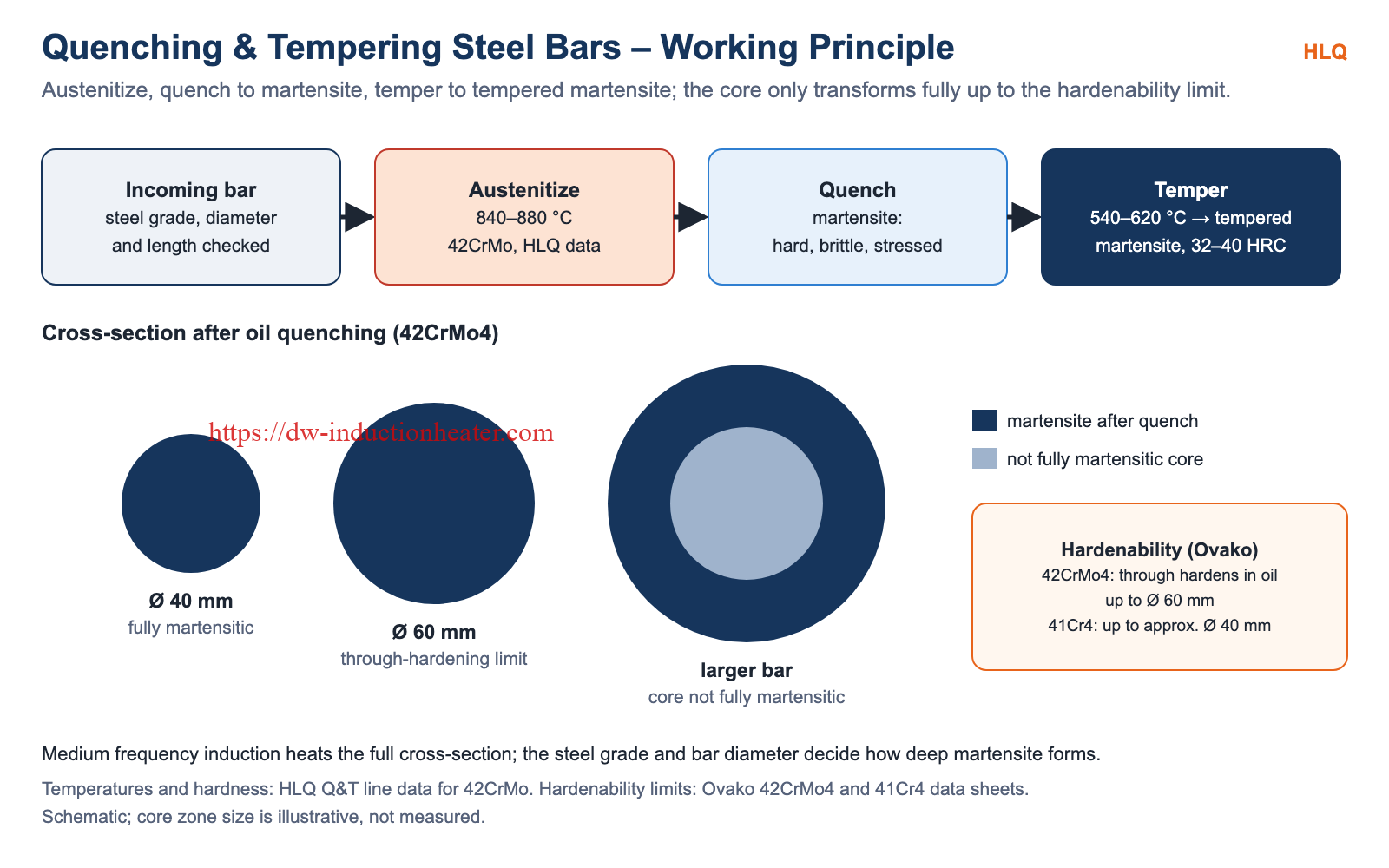
Medium frequency current (1–20 kHz) penetrates deep into the bar, so the core is heated as thoroughly as the surface (see skin effect in induction heating). After austenitizing, the quench turns the steel into martensite, which is hard but brittle and stressed. Tempering then turns it into tempered martensite with the required balance of hardness and toughness; see induction tempering.
How deep the bar hardens depends on the grade and the diameter. Ovako states that 42CrMo4 through hardens in oil up to Ø 60 mm, with larger sections not fully martensitic. It also states that 41Cr4 through hardens in oil up to approximately Ø 40 mm.
Technical Specifications
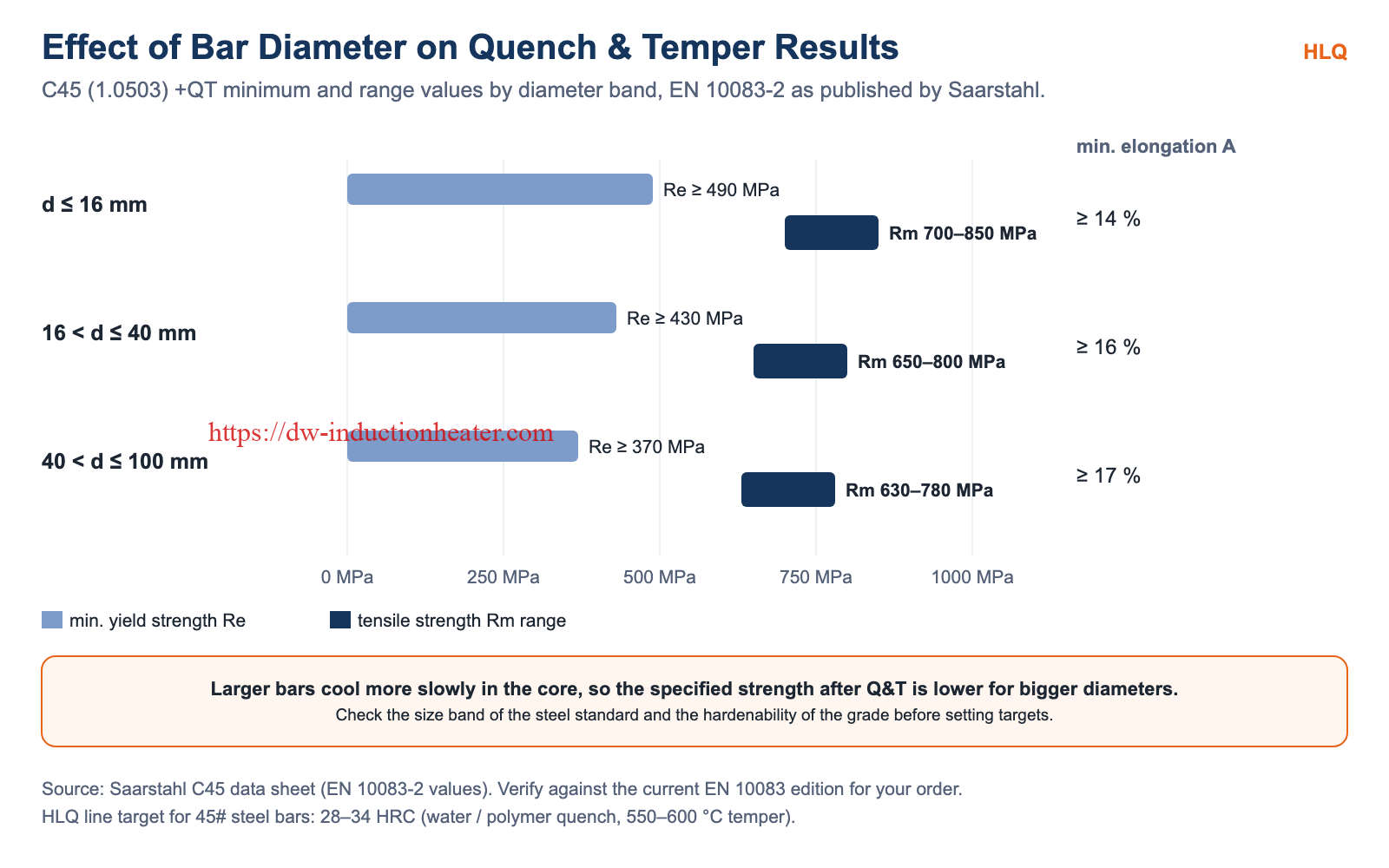
Diameter effect for C45 (1.0503) in the quenched and tempered condition. These EN 10083-2 values are taken from the Saarstahl C45 data sheet:
| Bar diameter | Tensile strength Rm (MPa) | Min. yield strength Re (MPa) | Min. elongation A (%) |
|---|---|---|---|
| d ≤ 16 mm | 700–850 | 490 | 14 |
| 16 < d ≤ 40 mm | 650–800 | 430 | 16 |
| 40 < d ≤ 100 mm | 630–780 | 370 | 17 |
Through-hardening limits after oil quenching (Ovako data sheets):
| Grade | Through hardens in oil up to |
|---|---|
| 42CrMo4 | Ø 60 mm |
| 41Cr4 | Approx. Ø 40 mm |
Process stages and their control parameters on an HLQ line:
| Stage | Purpose | What is set (HLQ) |
|---|---|---|
| Austenitizing | Transform the bar to austenite | Power, frequency and line speed to reach the quench temperature (e.g. 840–880 °C for 42CrMo) |
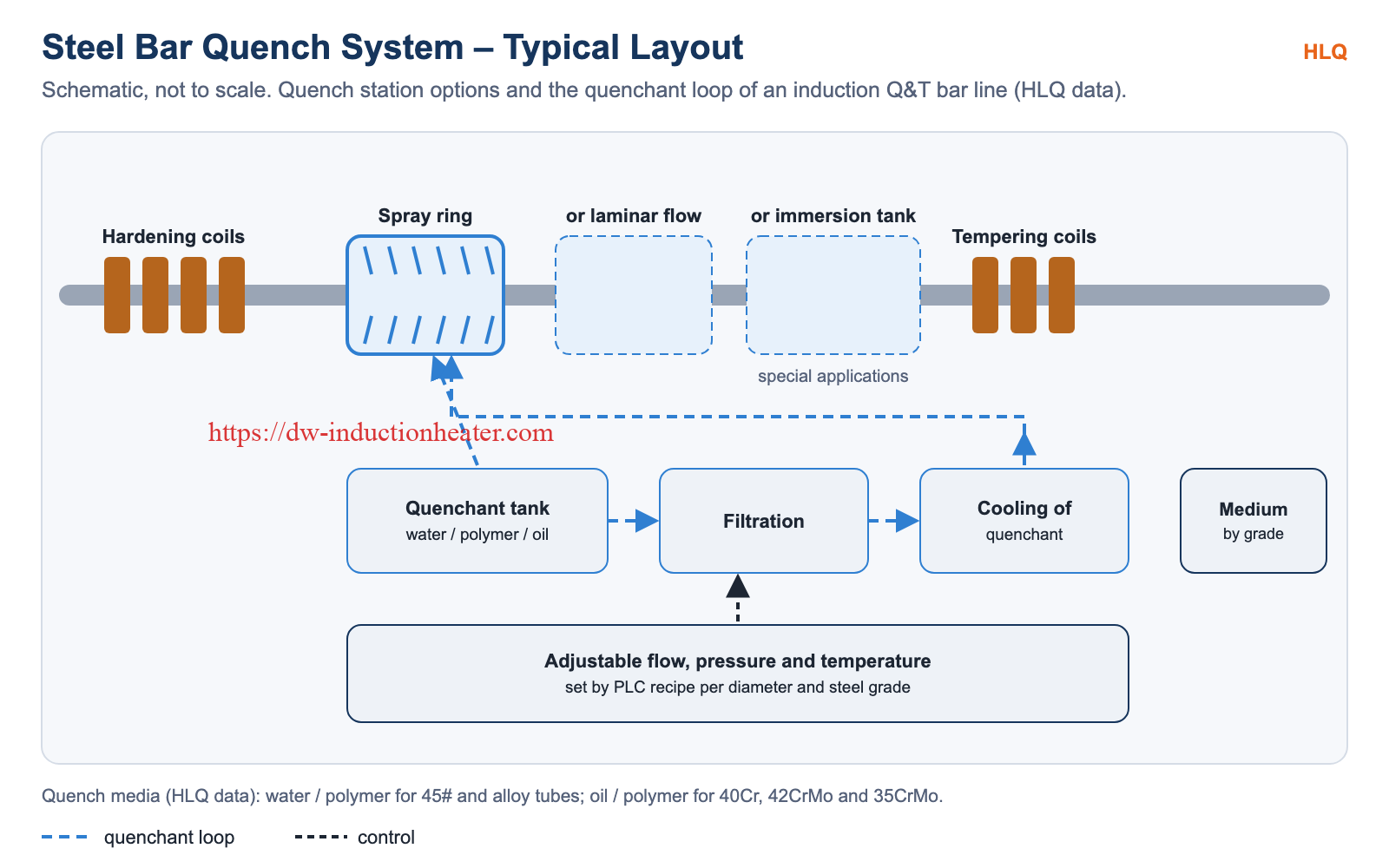
| Quenching | Form martensite | Spray ring, laminar flow or immersion; flow, pressure and temperature of water, polymer or oil |
| Tempering | Set hardness and toughness | Induction tempering stations or a continuous tempering furnace (e.g. 540–620 °C for 42CrMo) |
| Cooling and straightening | Straight, cool bars | Cooling bed or roller conveyor; hydraulic or mechanical straightening |
| Recording | Traceability | Real-time monitoring and data logging of power, frequency, temperature, speed and quench parameters |
Recommended Model Selection
The bar diameter range sets the line size. Typical HLQ values (details on the medium frequency induction quenching and tempering production line page):
| Bar diameter | Line model | Power | Frequency | Output |
|---|---|---|---|---|
| Ø 15–40 mm | MF-Q&T-150 | 150 kW | 8–15 kHz | 0.3–0.8 t/h |
| Ø 20–60 mm | MF-Q&T-300 | 300 kW | 5–10 kHz | 0.6–1.5 t/h |
| Ø 30–80 mm | MF-Q&T-500 | 500 kW | 3–8 kHz | 1.0–2.5 t/h |
| Ø 40–120 mm | MF-Q&T-800 | 800 kW | 3–5 kHz | 2.0–4.0 t/h |
| Ø 50–150 mm | MF-Q&T-1000 | 1000 kW | 2–4 kHz | 3.0–5.0 t/h |
For the full sizing method, see how to select an induction quench and temper line.
Process Workflow
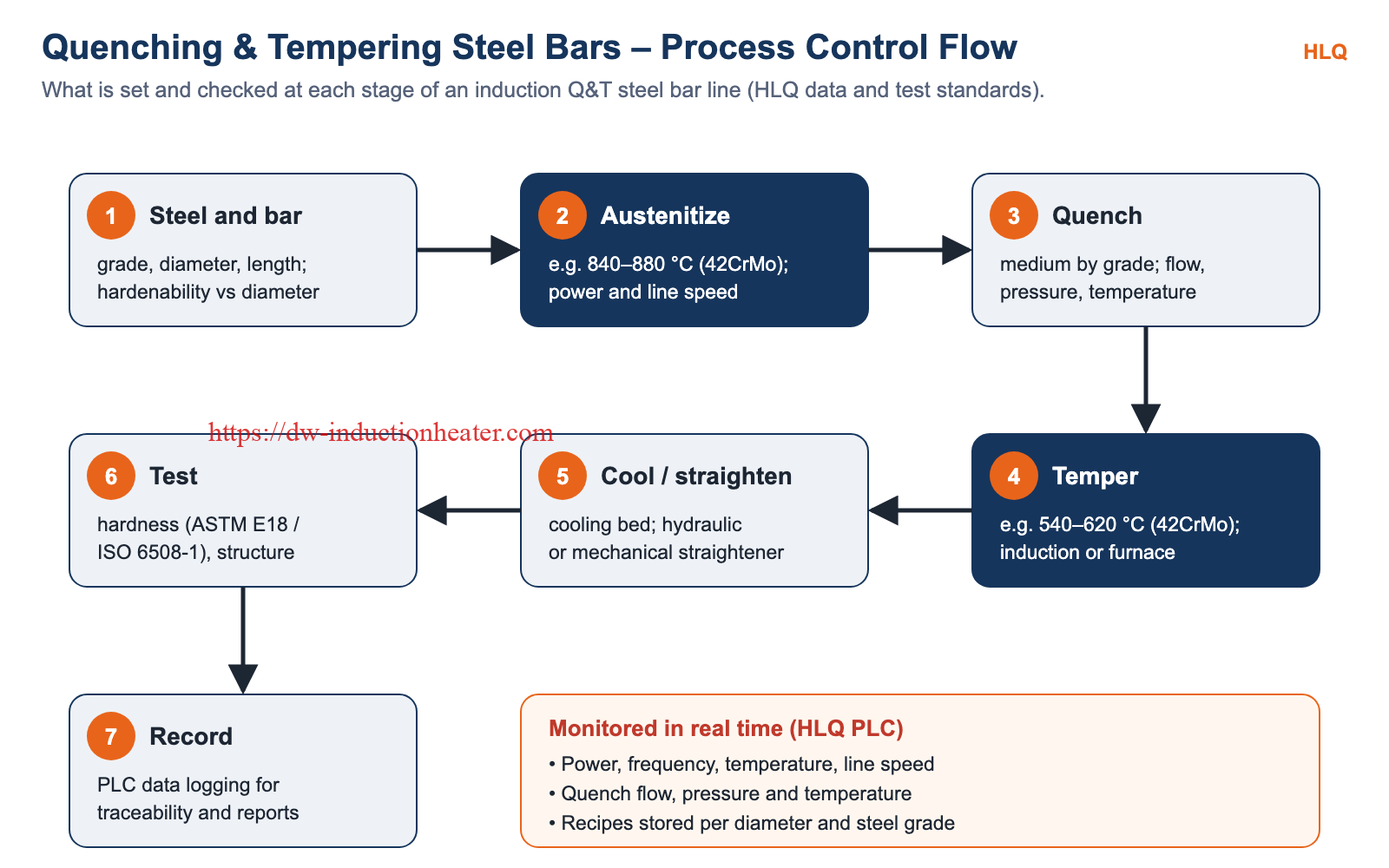
- Steel and bar check: confirm the grade, diameter and length, and the hardenability of the grade against the diameter.
- Austenitize: medium frequency coils heat the bar to the quench temperature for its grade.
- Quench: choose the medium by grade and set the flow, pressure and temperature.
- Temper: heat to the tempering temperature with induction or a continuous furnace.
- Cool and straighten: cooling bed, then a hydraulic or mechanical straightener.
- Test: Rockwell C hardness to ASTM E18 or ISO 6508-1, and a metallographic check of the structure.
- Record: PLC data logging for traceability and quality reports.
Common Problems and Solutions
| Problem | Cause | Solution |
|---|---|---|
| Core strength below target on large bars | Diameter beyond the through-hardening limit of the grade | Check the hardenability against the diameter (e.g. 42CrMo4 up to Ø 60 mm in oil) and set targets for the size band |
| Hardness below target | Quench medium not suited to the grade | Water/polymer for 45#; oil/polymer for 40Cr, 42CrMo and 35CrMo (HLQ data) |
| Uneven hardness along the bar | Temperature measurement disturbed by steam or smoke | Clean and calibrate the pyrometer lenses (HLQ maintenance guidance) |
| Bent bars | Uneven heating or quenching around the circumference | Skew rollers rotate the bar; straightener after cooling |
| Quench performance drifts | Contaminated or warm quenchant | Filtration and cooling of the quenchant, with flow, pressure and temperature control |
| Results cannot be traced | No process records | PLC data logging of power, frequency, temperature, speed and quench parameters |
Engineering Selection Guide
- Grade first: the grade sets the quench temperature, medium and tempering temperature.
- Diameter versus hardenability: check that the grade can through harden at the largest diameter.
- Targets by size band: use the standard’s size-band values (e.g. C45 +QT Rm 630–780 MPa for 40–100 mm).
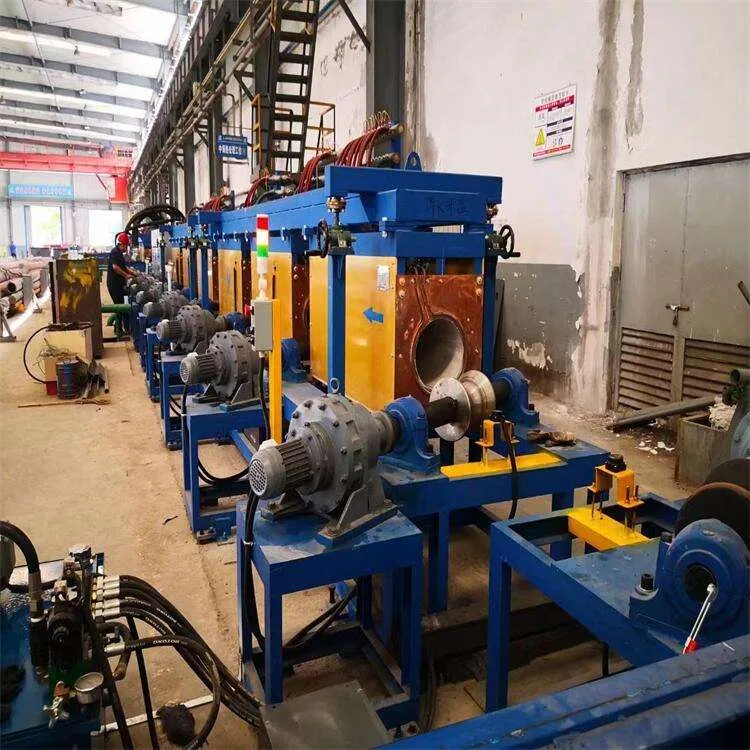
- Quench system: a spray ring or laminar flow for most bars, or an immersion tank for special applications.
- Tempering method: inline induction tempering stations or a continuous tempering furnace.
- Testing: plan hardness testing (ASTM E18 / ISO 6508-1), metallography and straightness checks.

Advantages and Limitations
| Advantages | Limitations |
|---|---|
| Uniform hardness and microstructure along the full bar length | Through hardening is limited by the grade’s hardenability and the bar diameter |
| Less waiting and handling between quenching and tempering | Larger diameters reach lower specified strengths |
| Recipes for each diameter and grade | The quenchant needs filtration and cooling |
| Data logging for quality traceability | Pyrometers and coils need regular maintenance |
Why Choose HLQ?
- Published process windows for 45#, 40Cr, 42CrMo, 35CrMo and alloy tubes.
- Spray ring, laminar flow and immersion quench options with quenchant filtration and cooling.
- Induction tempering stations or continuous tempering furnaces, depending on the process design.
- Bar lines from Ø 15 to 150 mm, with PLC recipes and data logging.
8 Core FAQs
1. What temperature is used to quench 42CrMo steel bars?
840–880 °C on HLQ lines. Steel data sheets citing EN 10083 give 820–860 °C for 42CrMo4.
2. What tempering temperature is used for 42CrMo bars?
540–620 °C on HLQ lines, giving 32–40 HRC.
3. Which quench medium should I use?
Water or polymer for 45# steel and alloy tubes; oil or polymer for 40Cr, 42CrMo and 35CrMo (HLQ data).
4. Why does bar diameter affect the result?
Larger bars cool more slowly in the core, so the specified strength is lower. For C45 +QT, Rm falls from 700–850 MPa (≤16 mm) to 630–780 MPa (40–100 mm).
5. Up to which diameter does 42CrMo4 through harden?
Up to Ø 60 mm after oil quenching, according to Ovako; larger sections are not fully martensitic.
6. Why must the bars be tempered after quenching?
Quenched martensite is hard but brittle and stressed. Tempering reduces the brittleness and stresses and sets the final hardness.
7. How is the hardness checked?
By Rockwell C testing to ASTM E18 or ISO 6508-1, together with a metallographic check of the structure.
8. Is tempering done by induction or in a furnace?
Either: medium or low frequency induction tempering stations, or a continuous tempering furnace, depending on the process design.