small induction furnace
Small Induction Furnace for Melting Gold, Silver, Jewelry, Copper and Steel
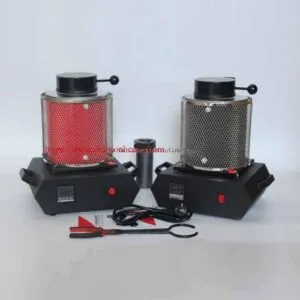
The small induction furnace on this page is a benchtop medium frequency induction melting furnace for goldsmiths, jewelry workshops, laboratories and small foundries. It runs from an ordinary single-phase 200-235 V supply, weighs about 7.5 kg, measures roughly 280 x 220 x 320 mm, and melts a 1 kg gold or 2 kg gold charge. A published test value gives 500 g of copper, silver or gold melting in about 6 minutes. Every specification on this page is published by HLQ; nothing here is estimated or invented.
This is the smallest machine in HLQ’s induction melting range, and the smallest one with the most ways to go wrong, because a benchtop unit has no separate power hall, no transformer and no dedicated cooling plant. Everything it needs has to fit on one bench: a mains spur with its own breaker, an external water pump, a crucible and tong set, a dry mold station, fume capture for the alloys that need it, and PPE.

Quick Answer
A small induction furnace is a benchtop medium frequency melting furnace that heats metal by electromagnetic induction, with the heat generated inside the metal itself. The unit published on this page takes a 200-235 V single-phase supply at 50-60 Hz, delivers 3500 W for a 1 kg charge and 5000 W for a 2 kg charge, with the controller adjusting the power, and melts 1 kg of gold or 2 kg of gold. It reaches a published maximum temperature of 1600 °C, is cooled by an external water pump at 1 L per minute, measures approximately 280 x 220 x 320 mm and weighs about 7.5 kg. A published actual test value gives 500 g of copper, silver or gold melting in about 6 minutes, and stainless steel and iron can also be melted. The machine is supplied with one furnace, one tong and one set of crucible.
For a buyer the important point is what is still missing from that specification. The exact induction output frequency, the input current and kVA, the coil current, the cooling flow and pressure limits, and the crucible bore and coil ID are not published for this unit, and all five are needed before the machine can be ordered against a factory acceptance test or installed. HLQ publishes the same gap for the neighbouring 3 kW M.MF.ML001 machine, and the fix is the same: request a confirmed electrical nameplate, a documented operating frequency range, crucible and coil drawings, the cooling requirements with alarm tests, and a representative melt-test record. HLQ’s larger induction melting gold range covers the same benchtop class and publishes the full ladder from 0.5-5 kg up to 30-200 kg and above.
Table of Contents
- Quick Answer
- Table of Contents
- What is the Small Induction Furnace?
- Key Applications
- Suitable Materials
- Working Principle
- Technical Specifications
- Recommended Model Selection
- Process Workflow
- Common Problems and Solutions
- Engineering Selection Guide
- Advantages and Limitations
- Why Choose HLQ?
- 6 Core FAQs
What is the Small Induction Furnace?
A small induction furnace is a compact coreless induction melting furnace built for jewelry-scale and small-foundry work. The trade also calls it a mini induction melting furnace, a goldsmith induction melting furnace or a benchtop induction furnace. The word “small” describes the batch, not the technology: the heating principle, the IGBT power electronics and the water-cooled copper coil are the same principles used on a 30 t foundry furnace, scaled down to a machine that a single operator can lift onto a bench.
What changes at this scale is the constraint set. A large induction furnace has a dedicated electrical room, a rectifier transformer, a capacitor cabinet, a closed-loop cooling tower and a crane. A benchtop unit has a mains socket, a small breaker, a bucket of water and a pump. That makes the machine far easier to install and far easier to move between benches, but it also means the buyer has to supply the utilities and the workshop discipline that a large plant gets from its infrastructure.
HLQ publishes this class as the benchtop tier of its gold melting range, alongside the medium and industrial tiers, and the benchtop tier is defined by the combination of capacity, power, frequency, supply, temperature and cooling that fits on one bench.
| Parameter | Benchtop | Medium | Industrial |
|---|---|---|---|
| Capacity (pure Au) | 0.5-5 kg | 5-30 kg | 30-200 kg+ |
| Rated power | 3-15 kW | 15-60 kW | 60-300 kW+ |
| Output frequency | 20-80 kHz | 3-30 kHz | 1-10 kHz |
| Power supply | 1-phase 220-240 V or 3-phase 380 V | 3-phase 380/400/415/480 V | 3-phase industrial, e.g. 380-690 V |
| Max temperature | 1,200-1,350 °C | 1,250-1,400 °C | 1,250-1,400 °C |
| Melt time (full load) | 3-10 min | 8-20 min | 20-45 min |
| Cooling | Air-cooled or small water chiller | Closed-loop chiller, 10-40 L/min | Industrial chiller/tower, 40-150 L/min+ |
| Crucible | Graphite or clay-graphite | Clay-graphite / SiC / high alumina | Not stated |
| Tilting / pouring | Not stated | Manual or electric tilting | Hydraulic tilting |
| Control | Manual power / simple temperature control | Digital power and temperature control | PLC with multi-stage heating curves |
The unit published on this page sits at the lower end of that benchtop tier and is the most compact version of it: 7.5 kg and 280 x 220 x 320 mm is small enough to be carried by one person and set on a normal workbench, and the 1600 °C published maximum gives it more temperature headroom than the 1,200-1,350 °C published benchtop band.

HLQ publishes several distinct machines in this class under different names, and choosing between them is a specification exercise rather than a preference. The three most relevant are set out below. The first is the unit on this page. The second is the M.MF.ML001, published on HLQ’s MF small induction melting gold furnace page, which is a heavier 28 kg water-cooled machine. The third is the stationary gold melting furnace with induction, model DW-SGM, which is available in 2, 3, 4, 5, 6 and 8 kg sizes.
| Published item | Unit on this page | M.MF.ML001 (MF series page) | DW-SGM (stationary series page) |
|---|---|---|---|
| Supply | 200-235 V, 50-60 Hz, single phase | 220 V, 50-60 Hz, single phase | Not stated; IGBT inverter |
| Power | 3500 W for 1 kg, 5000 W for 2 kg, controller adjusts the power | Output power around 3 kW | Not stated; “big output power” |
| Melting capacity | 1 kg gold or 2 kg gold | 1-2 kg gold | 2, 3, 4, 5, 6 or 8 kg |
| Max temperature | 1600 °C | 1450 °C | Adjustable melting temperature with digital display |
| Melting time | 500 g of copper, silver or gold in about 6 minutes (published actual test value) | 3-5 min | Not stated |
| Cooling | External water pump, 1 L per minute | Running water or chilling water | Not stated |
| Dimensions (L x W x H) | Approx. 280 x 220 x 320 mm | 580 x 300 x 330 mm | Not stated |
| Weight | About 7.5 kg gross | 28 kg net | Not stated |
| Power electronics | IGBT | INFINEON IGBT controller | IGBT |
| Continuous duty | Not stated | 100 % full load, 24 hours continuous working | 100 % full load, 24 hours continuous working |
| Supplied with | 1 furnace, 1 tong, 1 set crucible | Not stated | Not stated |
| Warranty | Not stated | Not stated | 1 year |
The practical conclusion is that the two 1-2 kg machines are not the same machine with different names, and a buyer should not compare them on the gold capacity figure alone. The unit on this page is roughly a quarter of the weight and a third of the footprint of the M.MF.ML001, with a higher published maximum temperature and a published 6-minute test at 500 g. The M.MF.ML001 publishes a shorter 3-5 minute cycle and a full 24-hour duty claim, and it is the machine whose published figures are quoted in HLQ’s small gold melting furnace engineering reference. HLQ also publishes a mini gold melting furnace induction page that repeats the same 1-2 kg parameter block as this page, which is worth knowing about before comparing quotations.
It is also worth separating this induction machine from the electric resistance furnace that occupies the same shelf. HLQ publishes three separate small gold pages, portable gold melting furnace, electric mini gold melting furnace and the for-sale twin, and all three describe an MF series resistance machine with an SSR controller, an alloy heating element rated to 1900 °C, a high temperature proof ceramic melting chamber and a machine maximum temperature of 1150 °C. That is a different technology with a different temperature ceiling, and the comparison table in the selection guide below sets the two side by side.

Key Applications
A small induction furnace is bought for a specific workshop duty, not for general foundry capacity. The published application list for this class of machine is set out below with the charge, the process objective and the selection caution that goes with each one.
| Application | Typical charge | Main process objective | Selection note |
|---|---|---|---|
| Gold jewelry casting | Clean gold or verified gold alloy | Melt and pour into prepared casting molds | Confirm required superheat and mold process; melting does not replace casting equipment. |
| Goldsmith workshop repair | Small gold offcuts | Recover usable molten metal | Segregate scrap by alloy and purity. |
| Precious-metal recycling | Sorted gold/silver scrap | Remelt for ingot production | Induction melting is not chemical refining or assay. |
| Silver jewelry production | Fine silver or sterling silver | Small-batch melting prior to casting | Silver batch mass must be verified separately from gold rating. |
| Educational or laboratory work | Known metallic samples | Repeatable test batches | Record charge, crucible, power setting and measured time. |
| Alloy development | Pre-weighed compatible metals | Produce small trial melts | Temperature measurement and chemistry verification may be needed. |
Two applications that are frequently asked for but are not on this list deserve a direct answer. The first is scrap melting at foundry scale, which is a different machine entirely: HLQ’s published iron and steel scrap work runs on the GW series from 0.35 t to 30 t per heat at 250 kW to 15,000 kW, and HLQ’s larger induction melting furnace range covers batch capacities from 10 kg to 5,000 kg. The second is refining and assay. Remelting does not remove chemical impurities from a metal, so a jeweller who needs refining, assay or certified purity still needs separate refining, assay and quality-control processes.

Suitable Materials
Which metals this machine can melt is decided by three published numbers: the metal’s melting or liquidus temperature, the unit’s published 1600 °C maximum, and the published vessel recommendation for that metal. The reference temperatures below are HLQ’s own published melting data, and the headroom column is the arithmetic difference between each reference temperature and this unit’s published 1600 °C maximum.
| Material | Published melting or operating temperature | Headroom to the published 1600 °C maximum | Published crucible or lining recommendation |
|---|---|---|---|
| Gold | Melting point 1064.18 °C | About 536 °C | Graphite or clay-graphite crucible |
| Pure silver | Melting point 961.78 °C | About 638 °C | Graphite or clay-graphite crucible |
| Brass | Approximately 850-1000 °C | About 600-750 °C | Silica or alumina; graphite or SiC crucible |
| Copper | Approximately 1083-1100 °C | About 500-517 °C | Magnesia lining; graphite or SiC crucible on small furnaces |
| Aluminum | Pure aluminum melts at about 660 °C; usual operating range 680-760 °C | About 840-920 °C | Graphite, SiC-graphite or high-alumina |
| Zinc alloy | Low temperature | Large | Low-temperature-compatible refractory lining |
| Stainless steel | Approximately 1400-1550 °C | About 45-200 °C | Neutral or basic lining |
| Carbon and low-alloy steel | Approximately 1450-1650 °C | About -50 to 150 °C | Acidic, neutral or basic refractory lining |
| Cast iron | Approximately 1150-1400 °C | About 200-450 °C | Acidic, neutral or basic refractory lining |
Three cautions come with that table. Gold jewelry alloys have a solidus and liquidus that vary with karat and composition, so the alloy-specific liquidus has to be determined and contamination prevented. Sterling silver and brass are composition-dependent and need a process trial; brass in particular produces zinc fumes, which require ventilation and controlled superheat. And the published page for this machine class records stainless steel and iron as meltable, but the published note is equally clear that the temperature headroom for many high-melting alloys is limited, so steel and stainless are not a recommended baseline use for a unit in this class.
The energy side of the same question is worth understanding, because it explains why gold and silver feel so different to melt even though the machine does not know what it is melting. HLQ publishes the theoretical heat content for the metals it melts.
| Metal | Heated to | Theoretical heat (rounded) |
|---|---|---|
| Gold | 1100 °C | About 0.06 kWh/kg |
| Copper | 1150 °C | About 0.19 kWh/kg |
| Aluminum | 720 °C | About 0.30 kWh/kg |
| Cast iron | 1450 °C | About 0.38 kWh/kg |
| Steel | 1600 °C | About 0.40 kWh/kg |
Those are the ideal heat into the metal only. The real electrical input is higher because the furnace body, the coil and the crucible absorb heat, and because a pouring superheat has to be added on top. This is the quantitative reason why a 2 kg silver charge is not the same job as a 2 kg gold charge even though the machine treats them identically.
Working Principle
The working principle of a small induction furnace is electromagnetic induction, identical in principle to a 30 t foundry furnace and different only in scale. The power supply converts mains AC into a high-frequency excitation current. That current flows through a water-cooled copper induction coil built around the crucible. The coil generates an alternating magnetic field, which passes into the metal charge inside the crucible and induces circulating eddy currents. The electrical resistance of the metal converts those currents into heat, and the charge softens, collapses and melts. Once a bath exists, the same rotating field produces electromagnetic stirring, which distributes temperature and composition through the melt.
There is no flame, no burner, no element and no electrode touching the metal. For a jeweller this matters for two reasons. The workshop does not fill with combustion gas or fume from the heating method itself, and the operator is not standing over an open flame at 1100 °C.
HLQ breaks the system down into six elements, and this is the right frame for understanding what can fail on a small unit, because the failures are not evenly distributed: the electrical and cooling elements fail, and the charge and the operator fail.
| Step | System element | Engineering function |
|---|---|---|
| 1 | Single-phase supply | Feeds electrical power through the rated protection and isolation devices. |
| 2 | IGBT converter | Generates variable-frequency electrical excitation for the load. |
| 3 | Water-cooled induction coil | Creates an alternating magnetic field around the crucible. |
| 4 | Charge and appropriate crucible | Absorb useful heat; coupling depends on geometry and material. |
| 5 | Molten metal bath | Reaches liquidus temperature, then suitable pouring superheat. |
| 6 | Operator / optional instrumentation | Verifies readiness before pouring; instrumentation is configuration-dependent. |
The unit on this page publishes a protection set that covers both the electrical and the cooling element, which is the part that makes a benchtop unit safe to leave running while the operator works on something else. The published list is: IGBT overheat and overcurrent protection, water shortage protection, over voltage and low voltage, surge, coil open and short circuit, no-pot circuit detection, and automatic alarm protection when the drive frequency is wrong, with more than 30 protection programs in total and a variety of internal fault auto-detection procedures.

Technical Specifications
The following is the complete published specification for the unit on this page.
| Parameter | Published specification | Note |
|---|---|---|
| Working voltage | 200 V to 235 V | Single-phase supply, no three-phase connection needed. |
| Working frequency | 50 Hz to 60 Hz | Mains input frequency, not the induction output frequency. |
| Working power | 1 kg 3500 W / 2 kg 5000 W | The controller adjusts the power. |
| Smelting capacity | 1 kg gold or 2 kg gold | Gold-specific rating. See the capacity caution below. |
| System protection | IGBT overheat and overcurrent protection, water shortage protection, over voltage / low voltage, surge, coil open / short circuit, no-pot circuit detection, automatic alarm protection when the drive frequency is wrong | More than 30 protection programs, with a variety of internal fault automatic detection procedures. |
| Water-cooled system | Comes with an external water pump | Published flow rate 1 L of water per minute. |
| Melting temperature | The actual temperature can be heated up to 1600 degrees | Published maximum. Measurement method is not specified. |
| Dimensions | Approximately 280 length x 220 width x 320 height mm | Innovative design, small size and light weight. Leave cooling and service clearance. |
| Machine gross weight | About 7.5 kg | Gross weight. Check the shipping package separately. |
| Melting speed | 500 g of copper, silver or gold in about 6 minutes | Published actual test value. Materials such as stainless steel and iron can also be melted. |
| Supplied with | 1 furnace, 1 tong, 1 set crucible | Spare crucibles and tongs are ordered separately. |
| Induction output frequency | Not published | Obtain the confirmed operating range before ordering. |
| Input current / input kVA | Not published | Required to size the breaker, the spur and the cable. |
| Coil current | Not published | Required for the power supply match. |
| Cooling flow and pressure limits | Not published beyond the 1 L/min flow rate | Required to set the interlock and the service limits. |
| Crucible bore, replacement type and coil ID | Not published | Require layout and drawings for spare-part selection. |
Five of those rows say “not published”, and together they are the most useful thing on this page for a buyer who is about to spend money. A factory acceptance test, a replacement crucible order, a spare coil order and an electrical sign-off all depend on those five numbers, and HLQ publishes them as an outstanding list rather than hiding them.
On the published 1 kg and 2 kg figures there is one caution that is worth repeating in its own right, because it is the most common misunderstanding on small induction furnaces: a 2 kg silver charge is not volumetrically equivalent to a 2 kg gold charge. Gold and silver of equal mass occupy different volumes, so the metal, the vessel dimensions and the fill limit all have to be specified independently rather than reading the gold rating across to another metal.
For the wider electrical and plant picture, HLQ publishes the following overall ranges for its induction melting equipment, which is where a benchtop unit sits relative to the rest of the range.
| Parameter | Range | Notes |
|---|---|---|
| Batch capacity | 0.5 kg (gold) to 5,000 kg | Customised to batch weight and daily output |
| Power | 3 kW (small gold melters) to 3,500 kW (large copper furnaces) | Set by batch weight and target melting time |
| Frequency | Gold about 1-80 kHz; aluminum about 0.5-20 kHz; copper about 0.25-8 kHz; iron and steel about 0.5-2.5 kHz | Lower frequency is used for larger furnaces |
| Input voltage | 380 V, 660 V, 750 V, 1,000 V or customised | Depends on power level and plant supply |
| Furnace body | Steel shell or aluminum shell | Steel shell for larger, heavy-duty furnaces |
| Tilting | Hydraulic, gearbox or manual; fixed design possible | Hydraulic tilting recommended for medium and large furnaces |
| Cooling | Closed-loop cooling tower or industrial chiller | For coil, power supply, capacitors and cables |
| Temperature measurement | Thermocouple, immersion probe or infrared pyrometer | Immersion measurement is common for molten metal |
| Control | Manual, digital, PLC or HMI | Automation improves repeatability |
| Protection | Over-current, over-voltage, water pressure, phase loss; leak alarm optional | Full protection recommended for large iron and steel furnaces |
Note the frequency entry: gold sits in the highest published band, about 1-80 kHz, while iron and steel sit at about 0.5-2.5 kHz. That is the clearest statement of why a small gold furnace and a small steel furnace are not interchangeable purchases, even when both are sold as “small induction furnace”, and it is why the missing output frequency on the specification above is worth chasing before the order is placed.
Recommended Model Selection
Start from the metal, the batch and the production rate, then work to the machine. HLQ publishes the gold melting ladder in three capacity bands, which is the correct starting frame for a buyer on this page.
| Range | Capacity (pure Au) | Rated power | Frequency | Typical melt time (full load) |
|---|---|---|---|---|
| Small | 0.5-5 kg | 3-15 kW | 20-80 kHz | 3-10 min |
| Medium | 5-30 kg | 15-60 kW | 3-30 kHz | 8-20 min |
| Large | 30-200 kg+ | 60-300 kW+ | 1-10 kHz | 20-45 min |
Within the small band, HLQ publishes three concrete models, and the DW-MF series is the route to take when the workshop outgrows a 2 kg crucible load.
| HLQ model | Type | Capacity | Published data |
|---|---|---|---|
| Unit on this page | Compact benchtop single-phase induction melting furnace | 1 kg gold or 2 kg gold | 200-235 V, 50-60 Hz; 3500 W for 1 kg and 5000 W for 2 kg; max 1600 °C; 500 g in about 6 minutes; approx. 280 x 220 x 320 mm; about 7.5 kg |
| M.MF.ML001 | Small water-cooled melter | 1-2 kg gold | 220 V single phase, 50-60 Hz; output about 3 kW; max 1,450 °C; 3-5 min; 580 x 300 x 330 mm; 28 kg |
| DW-SGM | Stationary gold melting furnace | 2, 3, 4, 5, 6 or 8 kg | IGBT; adjustable temperature with digital display; 100 % load, 24-hour operation |
| DW-TGM | Tilting gold melting machine | 2, 3, 4, 5, 6 or 8 kg | Double IGBT; 600 x 510 x 1080 mm; 110 kg; tilting handle pours into the ingot mold |
| DW-MF series | Medium frequency crucible melting furnace | 4-100 kg steel or stainless; 5-250 kg gold or silver; 3-75 kg aluminum | 15-160 kW; 3 x 380 V; 1-20 kHz; 100 % duty cycle for 24 hours; 50-145 kg |
Two published notes make the DW-MF route meaningful for a workshop that has outgrown 2 kg. The DW-MF melting time is about 30-50 minutes for a cold furnace and about 20-30 minutes for later melts once the furnace is hot, so a workshop running consecutive small heats is not waiting on cold-start time each time. And the DW-MF range runs from DW-MF-15 at 15 kW to DW-MF-160 at 160 kW with 8 step sizes, so the scale-up is a model change rather than a new product line. HLQ’s induction metals melting furnace page carries the full table, and it is also worth noting that the DW-MF gold and silver melting figures run from 5 kg or 10 kg on the smallest model up to 150 kg or 250 kg on the largest.

The published buyer inputs below are what HLQ asks for before it can configure the machine, and they are worth reading as a checklist before you contact a supplier.
| Buyer input | Example or required detail | Design impact |
|---|---|---|
| Metal and alloy | 24K gold, 18K yellow gold, sterling silver, specific brass grade | Changes liquidus, superheat and crucible choice. |
| Maximum mass per pour | kg per batch plus required headspace | Sets crucible size and actual heating burden. |
| Production target | Batches per hour and operating hours per day | Determines whether a higher power model is more suitable. |
| Power supply | Voltage tolerance, phase, breaker capacity | Determines electrical compatibility. |
| Cooling utility | Water temperature, pressure, flow, quality and availability | Determines coil and power-stage protection. |
| Acceptance criterion | For example 1 kg of a specified alloy from 20 °C to pour-ready in x minutes | Enables a meaningful factory melt test. |
Process Workflow
The published operating sequence for a small induction melting furnace is seven stages, and every one of them has a stated acceptance or safety point. It is a benchtop sequence, which means it is run by one person standing at the bench, and the sequence reflects that: the cooling circuit is confirmed before the heat starts, not after it goes wrong.
| Stage | Operator action | Acceptance / safety point |
|---|---|---|
| 1. Prepare | Identify the alloy, remove incompatible contaminants, ensure the charge is dry. | Never charge wet or sealed scrap; molten-metal moisture contact can be violent. |
| 2. Inspect | Check crucible, refractory lining, coil, leads and guard. | Replace damaged crucible or leaking coil before start-up. |
| 3. Cool | Start and confirm the approved cooling circuit. | Verify water-flow interlock and temperature within the supplier limits. |
| 4. Heat | Ramp induction power according to the approved process recipe. | Observe safe clearances and avoid charge bridging or uncontrolled overflow. |
| 5. Verify | Confirm full melting and the required pour temperature using approved methods. | Do not equate glowing appearance with verified melt temperature. |
| 6. Pour | De-energize as required by operating procedure and pour with proper PPE and tools. | Keep the mold and all tools dry and prepared. |
| 7. Record | Log metal, mass, time, settings, energy where metered and any defects. | Use data to validate batch repeatability and actual costs. |
Stage 1 is the one that protects the operator and it is also the one most often skipped in a busy workshop. Moisture in a charge can expand rapidly when it meets a 1100 °C bath, and a sealed container in the crucible is the same hazard with a longer fuse. Stage 7 is the one that protects the business: without a batch log of metal, mass, time and settings, the workshop cannot tell a process change from a bad day, and cannot quote a repeat order accurately.

Common Problems and Solutions
The published troubleshooting reference for this class of machine is set out below. Every symptom in it is one that a benchtop unit will actually produce, because the failure modes of a small machine are concentrated in the charge, the cooling circuit and the crucible rather than spread across a power hall.
| Symptom | Likely causes | Recommended action |
|---|---|---|
| Gold takes longer than expected to melt | Large/cold charge, poor coupling, crucible loss, low actual output | Record mass and start temperature; measure power and repeat a timed test. |
| Uneven or incomplete melting | Load placement, incorrect crucible geometry, charge bridging | Use approved charge size and vessel; review coil load matching. |
| Inverter trips during heating | Overcurrent, voltage deviation, wrong coil or failing component | Stop operation, record the alarm and ask qualified service staff to diagnose. |
| Cooling alarm or overheating | Low flow, blocked path, hot inlet water, fouled heat exchanger | Stop heating and restore specified flow and temperature before restarting. |
| Crucible cracks or chips | Thermal shock, contamination, physical impact, end-of-life wear | Discard the damaged vessel; use the approved handling and conditioning protocol. |
| Oxidized or contaminated alloy | Dirty scrap, wrong crucible, excessive hold time, unprotected bath | Sort the charge, follow the alloy-specific process and verify composition. |
| Brass produces excessive fumes | Overheating, zinc-containing material, inadequate extraction | Stop and correct the process temperature and the source-capture ventilation. |
| Quality varies from batch to batch | Inconsistent mass, chemistry, superheat or hold time | Adopt a batch log, validated temperature measurement and an acceptance window. |
The last two rows are the ones that matter most for a jewelry workshop, and neither of them is a fault in the machine. Brass fumes are a process and ventilation problem. Batch-to-batch variation is a record-keeping problem. Both get worse when the machine is shared between several operators with different habits, which is the normal arrangement in a working jewelry shop.
Engineering Selection Guide
The first decision is not between two induction machines. It is between an induction furnace and the other two technologies that sit on the same shelf and are sold under similar names, because they behave differently enough that choosing the wrong one costs a year of production.
| Selection criterion | Induction furnace | Resistance furnace | Gas furnace |
|---|---|---|---|
| Heat generation | Electromagnetic coupling to charge/susceptor | Heating elements warm vessel/chamber | Combustion heats vessel/chamber |
| Small-batch response | Often rapid if correctly matched | Dependent on element/chamber inertia | Dependent on burner and furnace thermal mass |
| Local combustion products | None from the heating method itself | None from the heating method itself | Present; requires combustion exhaust |
| Main utilities | Electricity + cooling water | Electricity | Fuel + combustion air |
| Primary selection trade-off | Power supply, matching and cooling complexity | Element wear and thermal inertia | Burner control, exhaust and heat loss |
For a benchtop jewelry machine, the practical consequences are: an induction furnace is faster to respond to a small charge and needs no combustion exhaust, but it needs a water supply and a correct electrical supply, and a resistance furnace needs no cooling water but its elements wear and its chamber has thermal inertia. The published resistance machine that HLQ also sells has a machine maximum temperature of 1150 °C, which is a different ceiling from the 1600 °C published for the induction unit on this page, and that difference matters for copper, brass and any alloy needing superheat.
The second decision is the workshop fit. The layout below is what the published machine actually needs on and around one bench.

The third decision is what evidence to demand before the order is placed. HLQ publishes the following list of deliverables for buyers of this class of machine, and every row is a document a supplier should be able to send before payment, not after delivery.
| Deliverable | Why buyers need it | Suggested acceptance evidence |
|---|---|---|
| Confirmed electrical nameplate | Correct supply capacity and safe installation | Input V/Hz/phase, max input A/kVA, output kW. |
| Exact operating frequency | Coil/load engineering, comparable quotations | Documented kHz range for the supplied configuration. |
| Crucible and coil drawings | Consumable selection and replacement planning | Vessel part number, capacity, dimensions and coil assembly ID. |
| Cooling requirements and alarms | Thermal safety and service reliability | Min/max flow, pressure, inlet temperature and interlock test. |
| Representative melt-test record | Objective melting-time and quality benchmark | Material, kg, initial temperature, elapsed time, pour temperature and measured energy if available. |
| Spare parts and documentation | Lifecycle cost and troubleshooting support | Operating manual, recommended spares, warranty and maintenance list. |
Finally, the selection factors. HLQ publishes the following ten factors for induction melting equipment, and each one maps directly onto a benchtop installation.
| Selection factor | What to confirm | Engineering recommendation |
|---|---|---|
| Metal type | Cast iron, carbon steel, stainless steel or alloy steel. | Select lining chemistry and power density according to metal type. |
| Batch capacity | Required kilograms or tons per melt. | Select furnace capacity with practical loading and pouring margin. |
| Target melting time | Required minutes per batch. | Higher power shortens melting time but requires stronger electrical infrastructure. |
| Daily production | Tons per shift or tons per day. | Determine whether one furnace is enough or multiple furnaces are needed. |
| Input power supply | Factory voltage, transformer capacity and cable size. | Confirm electrical room capacity before ordering a high-power furnace. |
| Furnace body | Steel shell or aluminum shell. | Use steel shell for larger iron and steel melting or heavy-duty foundry operation. |
| Tilting system | Manual, mechanical or hydraulic tilting. | Hydraulic tilting is recommended for medium and large furnaces. |
| Cooling system | Water flow, pressure, temperature and water quality. | Use a closed-loop cooling tower or industrial chiller according to local conditions. |
| Safety protection | Leak furnace alarm, water pressure protection, emergency stop and over-current protection. | Do not reduce safety configuration for steel and iron melting projects. |
| Workshop layout | Charging area, crane, ladle path, mold area and cooling equipment position. | Plan furnace layout before finalizing equipment dimensions. |
Advantages and Limitations
Advantages
| Potential advantage | Engineering explanation | Condition / qualification |
|---|---|---|
| Fast small-batch response | Heat is generated directly in the charge, so there is no furnace thermal mass to heat up first. | Applies to a correctly matched charge and vessel; the published test value is 500 g in about 6 minutes. |
| No combustion products | There is no burner and therefore no combustion exhaust from the heating method itself. | Brass and zinc-bearing alloys still generate their own fume, so extraction is still required for them. |
| Clean, controlled heat | The charge is heated from inside the metal, so there is no flame contact and therefore less burning loss. | Oxidation and alloy loss are still governed by hold time, slag practice and superheat control. |
| Electromagnetic stirring | The rotating field circulates the bath, so temperature and composition are more even across the melt. | Improves uniformity; it does not refine or assay the metal. |
| Low utilities demand | A single-phase 200-235 V supply with a small external water pump, and no transformer, gas line or compressor. | Requires its own breaker and a water supply on the bench. |
| Portable benchtop format | About 7.5 kg and 280 x 220 x 320 mm, so the machine can be moved between benches. | Check the shipping package weight separately, and leave cooling and service clearance. |
| Deep published protection set | More than 30 protection programs covering overheat, overcurrent, water shortage, over and under voltage, surge, coil open and short circuit, and no-pot detection. | Confirm the exact interlock and alarm implementation on the supplied unit. |
Limitations
| Limitation | Consequence | Better approach |
|---|---|---|
| Gold-specific capacity rating | 2 kg silver is not volumetrically equivalent to 2 kg gold. | Specify metal, vessel dimensions and fill limit independently. |
| Unpublished exact induction frequency | Cannot finalize coil/load matching or compare frequency claims reliably. | Request the actual operating kHz range before ordering. |
| Unspecified energy and cycle-test conditions | Cannot guarantee the published melt time for every charge. | Define factory acceptance testing with a representative alloy and mass. |
| Published 1600 °C maximum | Inadequate temperature headroom for many high-melting alloys. | Select a high-temperature furnace engineered for the target metal. |
| Cooling-water dependency | Interrupted cooling can damage the inverter or coil. | Include flow interlock, documented cooling limits and maintenance. |
| Not a refining or purity analyzer | Remelting does not automatically remove chemical impurities. | Use separate refining, assay and quality-control processes as needed. |
| Molten-metal hazards | Burn, splash, fume, electrical and moisture-contact risks remain. | Use a controlled workspace, PPE, exhaust and trained operators. |
Two of those limitations deserve emphasis for a jewelry workshop. The published 1600 °C maximum is generous for gold, silver, brass, copper and aluminum, but it leaves little or no headroom for carbon and low-alloy steel, whose published melting range runs to 1650 °C, so steel and stainless melting on this unit should be treated as a trial rather than a production duty. And the cooling-water dependency is the single most common way a benchtop unit is damaged: interrupted cooling can damage the inverter or the coil, so the flow interlock should be proven before the first heat rather than assumed.
Why Choose HLQ?
HLQ Induction Equipment provides induction heating and induction melting solutions for industrial metal processing. For a small induction furnace the value is not only the machine. It is the fact that the supplier publishes the specification, the gaps in the specification, the ladder above and below the machine, and the comparison against the alternative technologies. A buyer who cannot tell from the datasheet whether a 2 kg silver charge fits the vessel is not buying a machine, they are buying a liability, and HLQ’s published material is written to close exactly that gap.
| HLQ capability | What it means | Customer benefit |
|---|---|---|
| Full melting range from benchtop to industrial | 0.5 kg to 5,000 kg batch capacity and 3 kW to 3,500 kW. | The workshop can scale up without changing supplier or process family. |
| Published capacity, power, frequency and melt-time ladder | Small, medium and large bands with their published figures. | Makes quotations comparable between suppliers and between models. |
| Documented protection sets | Over-current, over-voltage, water shortage, phase loss, surge, coil open and short circuit, no-pot detection. | A benchtop machine is safe to leave running while the operator does other work. |
| Published control and cooling architecture | Automatic load matching, constant power control, PLC and HMI interfaces, temperature feedback, water pressure monitoring and leak furnace alarm. | Makes benchtop results repeatable and workshop processes auditable. |
| Documented furnace structure | Power supply, capacitor cabinet, furnace body, induction coil, crucible and lining, tilting system, water-cooled cable and water distributor. | The buyer knows which part to specify, maintain and replace. |
| Published selection guidance | Support for capacity, power, voltage, cooling and layout selection. | Helps buyers build a practical melting system rather than only purchasing a furnace. |
| Published engineering reference material | Application tables, material and lining tables, workflows, troubleshooting and acceptance criteria. | Allows a buyer to write a fair specification and a meaningful acceptance test. |
For the workshop-scale systems that surround this machine, HLQ publishes the structure and the control set that a small furnace is a simplified version of.
| Component | Function | Engineering notes |
|---|---|---|
| IF / KGPS power supply | Converts input power into medium-frequency furnace output. | Determines melting speed and electrical stability. |
| Capacitor cabinet | Provides reactive power compensation and resonance matching. | Important for furnace efficiency and stable output. |
| Furnace body | Holds the crucible, induction coil and refractory lining. | Available in steel shell or aluminum shell design. |
| Induction coil | Generates magnetic field around the crucible. | Water-cooled copper coil must be well insulated and protected. |
| Crucible / lining | Contains molten metal and protects the coil. | Material selection depends on metal type and temperature. |
| Hydraulic tilting system | Tilts furnace for pouring molten metal. | Improves pouring control and reduces manual risk. |
| Water-cooled cable | Transfers high current from power system to furnace body. | Requires correct water flow and electrical connection. |
| Water distributor | Distributes cooling water to coil, cables and power components. | Flow monitoring is recommended for safety. |
| Control function | Purpose | Benefit |
|---|---|---|
| Automatic load matching | Tracks furnace load condition during melting. | Improves power utilization and reduces operator adjustment. |
| Digital non-relay control | Improves electrical reliability. | Reduces control failure and maintenance frequency. |
| PLC interface | Connects furnace to production control systems. | Supports intelligent foundry operation. |
| HMI interface | Allows operator-friendly parameter setting. | Improves process visibility and operating convenience. |
| Temperature feedback | Measures molten metal or process temperature. | Supports closed-loop temperature control. |
| Alarm protection | Monitors over-current, over-voltage, phase loss and water pressure. | Protects equipment and reduces downtime. |
Related HLQ product pages cover the neighbouring duties in the same equipment family, including the induction melting furnace for general industrial melting, the induction aluminium melting furnace, the aluminum scrap melting furnace, the aluminum cans melting furnace and the 400 kg aluminum melting furnace.
6 Core FAQs
1. What is a small induction furnace and what can it melt?
It is a compact medium frequency induction melting furnace that heats metal by electromagnetic induction, with the heat generated inside the metal itself rather than in a flame or a heating element. The unit published on this page melts 1 kg of gold or 2 kg of gold, and its published specification also states that 500 g of copper, silver or gold melts in about 6 minutes, and that materials such as stainless steel and iron can also be melted. HLQ publishes the reference melting temperatures for the metals in this range, which are 1064.18 °C for pure gold, 961.78 °C for pure silver, about 1083-1100 °C for copper, about 850-1000 °C for brass, about 660-760 °C for aluminum and about 1400-1650 °C for stainless and carbon steel, against a published maximum of 1600 °C for this unit.
2. What power supply does it need and how long does a melt take?
A single-phase 200-235 V supply at 50-60 Hz, with its own breaker and spur, and no three-phase connection. The published working power is 3500 W for a 1 kg charge and 5000 W for a 2 kg charge, with the controller adjusting the power. The published melt time is about 6 minutes for 500 g of copper, silver or gold, which is stated as an actual test value. On the wider HLQ benchtop class the published melt time at full load is 3-10 minutes for 0.5-5 kg of pure gold at 3-15 kW and 20-80 kHz.
3. Does it need water cooling, and what else does the workshop need?
Yes. The unit comes with an external water pump and a published flow rate of 1 L of water per minute, and the protection set includes water shortage protection, so the cooling circuit has to be running and proven before the heat starts. Around it, the workshop needs an electrical spur with its own breaker, a crucible and tong set (one tong and one set of crucible are supplied with the machine), a dry mold station with tools prepared before the heat, PPE including a face shield and heat gloves, fume capture for brass and zinc-bearing alloys, and a batch log. HLQ’s published note is that interrupted cooling can damage the inverter or coil, so the flow interlock should be proven rather than assumed.
4. How is this different from the other small gold melting furnaces on the site?
They are three different technologies and three different machines. This unit is a 7.5 kg, 280 x 220 x 320 mm benchtop induction furnace with a published 1600 °C maximum and a published 6-minute 500 g test. The M.MF.ML001, published on HLQ’s MF small induction melting gold furnace page, is a 28 kg, 580 x 300 x 330 mm water-cooled machine with a published 1450 °C maximum and a published 3-5 minute cycle. The DW-SGM stationary gold melting furnace is available in 2, 3, 4, 5, 6 and 8 kg with IGBT control and a 1-year warranty, and the DW-TGM tilting version pours into an ingot mold. Separately, HLQ’s portable and electric mini gold melting furnace pages describe an MF series resistance machine with an SSR controller and a 1150 °C machine maximum, which is a different heating principle altogether. HLQ’s small gold melting furnace page works through the comparison in engineering detail.
5. Can it melt copper, brass, silver and stainless steel?
Copper, silver and brass, yes, and with the published cautions attached. Copper at about 1083-1100 °C needs the published magnesia lining or a graphite or SiC crucible, brass at about 850-1000 °C needs a silica or alumina lining or a graphite or SiC crucible plus ventilation, because brass produces zinc fumes that require source-capture extraction, and silver at 961.78 °C must have its batch mass verified separately from the gold rating because a 2 kg silver charge is not volumetrically equivalent to 2 kg of gold. Stainless steel at approximately 1400-1550 °C and iron can be melted, but against a published 1600 °C maximum the headroom is thin, so treat them as a trial duty rather than production, and note that stainless additionally needs controlled slag practice, accurate temperature control and short holding times to limit chromium loss. HLQ publishes that full treatment on its induction melting stainless steel page.