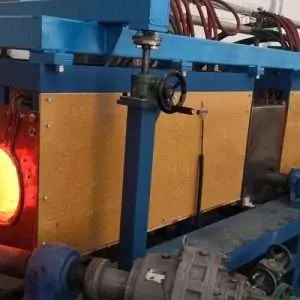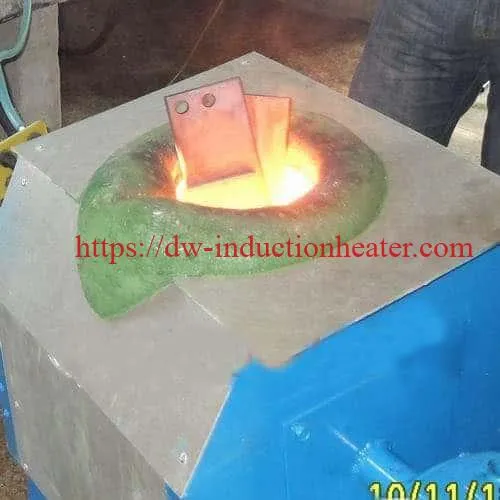
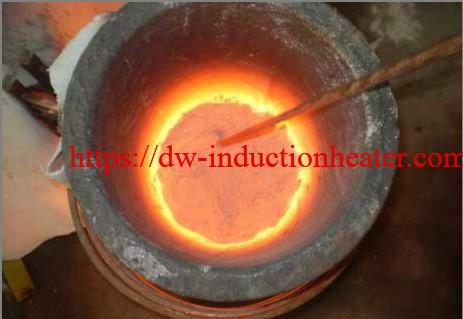

Induction Melting Copper
Induction Melting Copper, Brass and Bronze in Small-Batch Furnaces
Quick Answer
Induction melting copper uses an IGBT medium-frequency power supply and a water-cooled coil to induce eddy currents in the copper charge. The charge is heated by Joule heating, melts, and is stirred electromagnetically.
For small batches, HLQ data gives:
- 5–100 kg furnaces: 15–75 kW at 2,000–8,000 Hz, about 15–45 minutes per heat
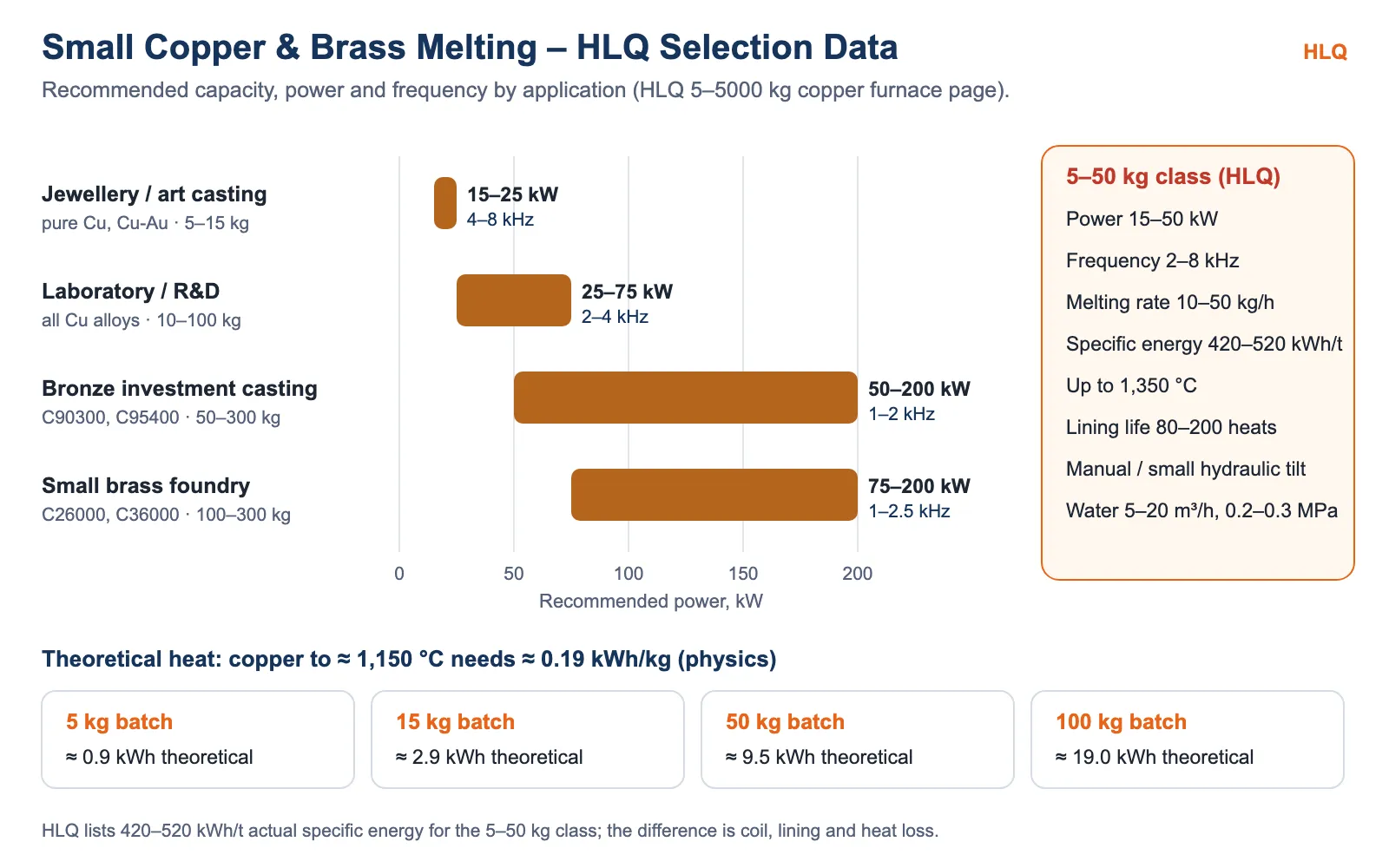
- 5–15 kg jewelry and art casting: 15–25 kW at 4–8 kHz
- 10–100 kg laboratory melting: 25–75 kW at 2–4 kHz
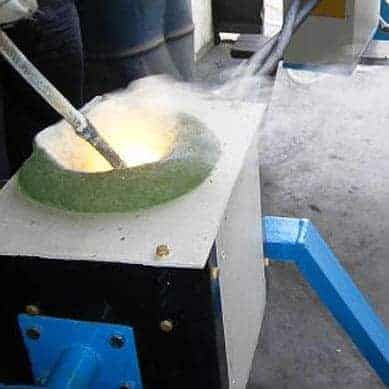
Use a magnesia lining for pure copper and a silica lining for brass. For brass, keep the melt at 950–1,020 °C to limit zinc loss.
What is Induction Melting Copper?
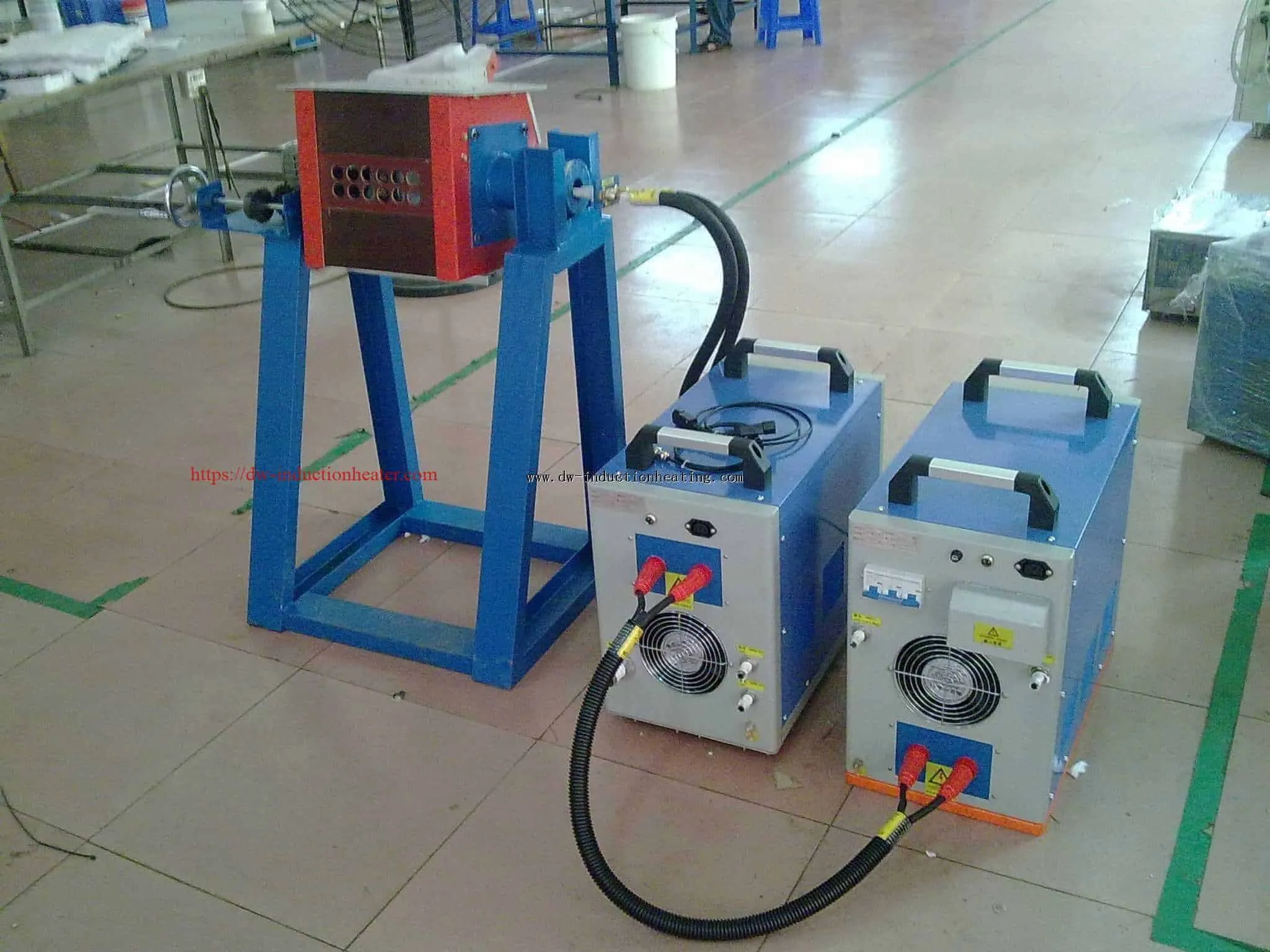
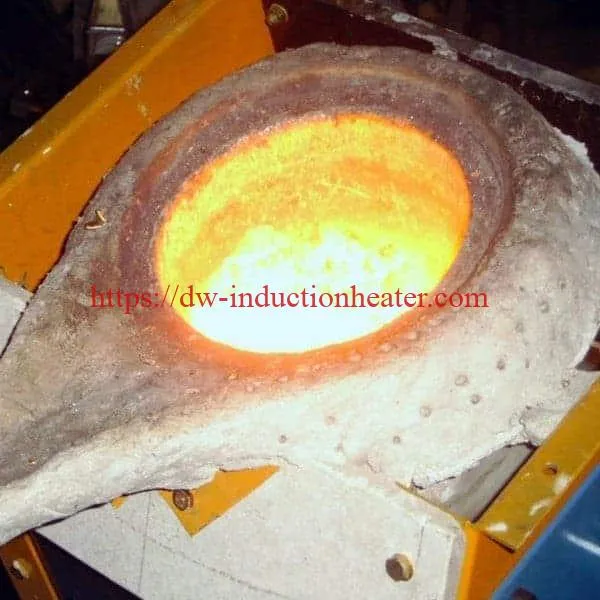
Induction melting copper is coreless crucible melting of copper and copper alloys with electromagnetic induction. The system has three parts: an IGBT solid-state power supply, a water-cooled copper coil, and a refractory-lined furnace body with a tilting mechanism.
This page covers the small capacity class. For the full 5–5,000 kg range, see the copper melting induction furnace page.
| Capacity tier | Capacity | Power | Frequency | Typical cycle | Primary market |
|---|---|---|---|---|---|
| Small / laboratory | 5–100 kg | 15–75 kW | 2,000–8,000 Hz | 15–45 min/heat | Jewelry, R&D, art casting, small foundry |
| Medium / workshop | 100–1,000 kg | 75–750 kW | 500–2,500 Hz | 45–120 min/heat | Brass/bronze foundry, die casting, valves |
| Large / industrial | 1,000–5,000 kg | 750–3,500 kW | 250–1,000 Hz | 90–240 min/heat | Recycling, wire rod, continuous casting |
Key Applications
| Application | Alloy | Capacity | Key requirement |
|---|---|---|---|
| Jewelry and art casting | Pure Cu, Cu-Au alloys | 5–30 kg | Precise temperature, small batch, clean melt |
| Metallurgical R&D, alloy development | All Cu alloys | 5–100 kg | Flexible alloy switching, composition control |
| Investment casting of precision parts | Bronze, Al-bronze, Cu-Ni | 50–300 kg | Melt cleanliness, temperature uniformity |
| Bronze bearing and bushing casting | C93200, C90500, C95400 | 100–500 kg | Tin and aluminum distribution, low porosity |
| Brass valves and fittings | C36000, C28000, C37700 | 200–1,000 kg | Zinc-loss control, consistent chemistry |
Suitable Materials
| Material | Grade | Melting range | Recommended lining | Special handling |
|---|---|---|---|---|
| ETP copper | C11000 | 1,083–1,100 °C | Magnesia (MgO ≥ 90%) | Oxygen control; charcoal cover |
| Oxygen-free copper | C10200 | 1,083–1,095 °C | Magnesia or alumina-magnesia | Inert gas blanket |
| Cartridge brass 70/30 | C26000 | 915–955 °C | Silica (SiO₂ ≥ 97%) | Zinc fuming; fume extraction |
| Free-cutting brass | C36000 | 885–900 °C | Silica or alumina-silica | Lead content; ventilation |
| Tin bronze | C90300, C90500 | 850–1,000 °C | Silica or alumina | Phosphorus deoxidation |
| Aluminum bronze | C95400, C95500 | 1,030–1,100 °C | Alumina (Al₂O₃ ≥ 90%) | Al₂O₃ inclusion control; careful skimming |
| Cupronickel 90/10 | C70600 | 1,100–1,145 °C | Magnesia or chrome-magnesia | Nickel addition sequence |
| Silicon bronze | C65500 | 970–1,025 °C | Silica or alumina | Good fluidity |
| Beryllium copper | C17200 | 870–980 °C | High-purity alumina | BeO fume is toxic; sealed enclosure mandatory |
Brass details: induction melting brass.
Working Principle
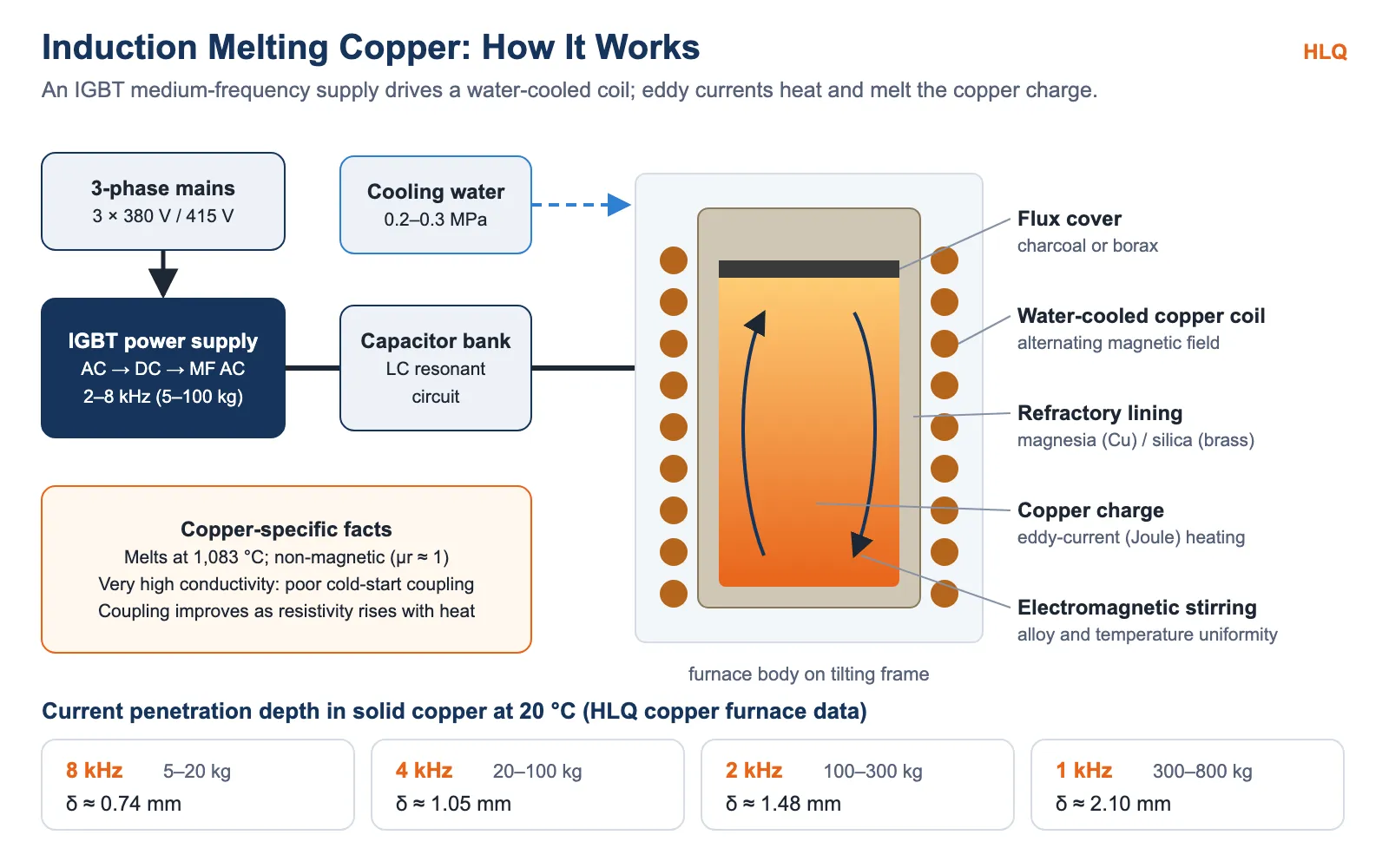
- Power conversion: 3-phase AC is converted to DC, then to medium-frequency AC by the IGBT inverter.
- Resonant circuit: The coil and capacitor bank form an LC tank circuit.
- Magnetic field: The coil current creates an alternating field in the crucible bore. Copper is non-magnetic (µr ≈ 1).
- Eddy currents: Currents are induced in the surface layer of the charge.
- Joule heating: As copper heats, its resistivity rises and coupling improves through the melt cycle.
- Electromagnetic stirring: Lorentz forces circulate the bath, distributing zinc, tin and alloying elements.
- Temperature control: Feedback from a thermocouple adjusts the power output.
Background: how an induction heater works.
Current penetration depth in solid copper at 20 °C
| Frequency | Penetration depth | Best-suited capacity |
|---|---|---|
| 8,000 Hz | 0.74 mm | 5–20 kg |
| 4,000 Hz | 1.05 mm | 20–100 kg |
| 2,000 Hz | 1.48 mm | 100–300 kg |
| 1,000 Hz | 2.10 mm | 300–800 kg |
The very shallow penetration in cold copper is why a solid copper charge couples poorly at a cold start.
Technical Specifications
| Parameter | 5–50 kg class (HLQ data) |
|---|---|
| Rated power | 15–50 kW |
| Operating frequency | 2,000–8,000 Hz |
| Input voltage | 3 × 380 V / 415 V |
| Power factor | ≥ 0.93 |
| Melting rate (pure Cu) | 10–50 kg/h |
| Specific energy (Cu ingot) | 420–520 kWh/t |
| Operating temperature | Up to 1,350 °C |
| Temperature accuracy | ±8 °C |
| Lining material | Alumina / magnesia |
| Lining life | 80–200 heats |
| Tilting | Manual or small hydraulic |
| Cooling water | 5–20 m³/h at 0.2–0.3 MPa |
| Control interface | Digital panel / 7″ HMI |
| Protection class | IP23 |
Theoretical heat demand
| Batch | 5 kg | 15 kg | 50 kg | 100 kg |
|---|---|---|---|---|
| Copper heated to ≈ 1,150 °C (≈ 0.19 kWh/kg) | ≈ 0.9 kWh | ≈ 2.9 kWh | ≈ 9.5 kWh | ≈ 19 kWh |
Physical values: sensible heat plus latent heat. HLQ lists 420–520 kWh/t actual specific energy for this class; the difference is coil, lining and heat loss.
Recommended Model Selection
| Application | Material | Capacity | Power | Frequency | Key feature |
|---|---|---|---|---|---|
| Jewelry / art casting | Pure Cu, Cu-Au | 5–15 kg | 15–25 kW | 4,000–8,000 Hz | Compact; tilt pour; inert gas option |
| Laboratory / R&D | All Cu alloys | 10–100 kg | 25–75 kW | 2,000–4,000 Hz | Wide alloy flexibility |
| Bronze investment casting | C90300, C95400 | 50–300 kg | 50–200 kW | 1,000–2,000 Hz | Melt cleanliness; tight temperature control |
| Small brass foundry | C26000, C36000 | 100–300 kg | 75–200 kW | 1,000–2,500 Hz | Zinc-loss control; fume extraction |
Example power supply: DW-MF-110KW
| Parameter | Published value |
|---|---|
| Maximum oscillation power | 110 kW |
| Frequency | 1–20 kHz |
| Input | 3-phase 380 V ±10%, 50/60 Hz; maximum input current 170 A |
| Inverter | IGBT, parallel inverter |
| Cooling water | > 0.3 MPa, 10 L/min |
| Duty cycle | 100% at 40 °C |
| Generator / transformer size | 560 × 270 × 470 mm / 550 × 300 × 420 mm |
| Protection | Over-voltage, over-current, over-temperature, phase loss, water shortage |
Details: DW-MF-110KW copper melting power supply. For 100–1,000 kg, see the induction copper melter for brass and bronze.
Process Workflow
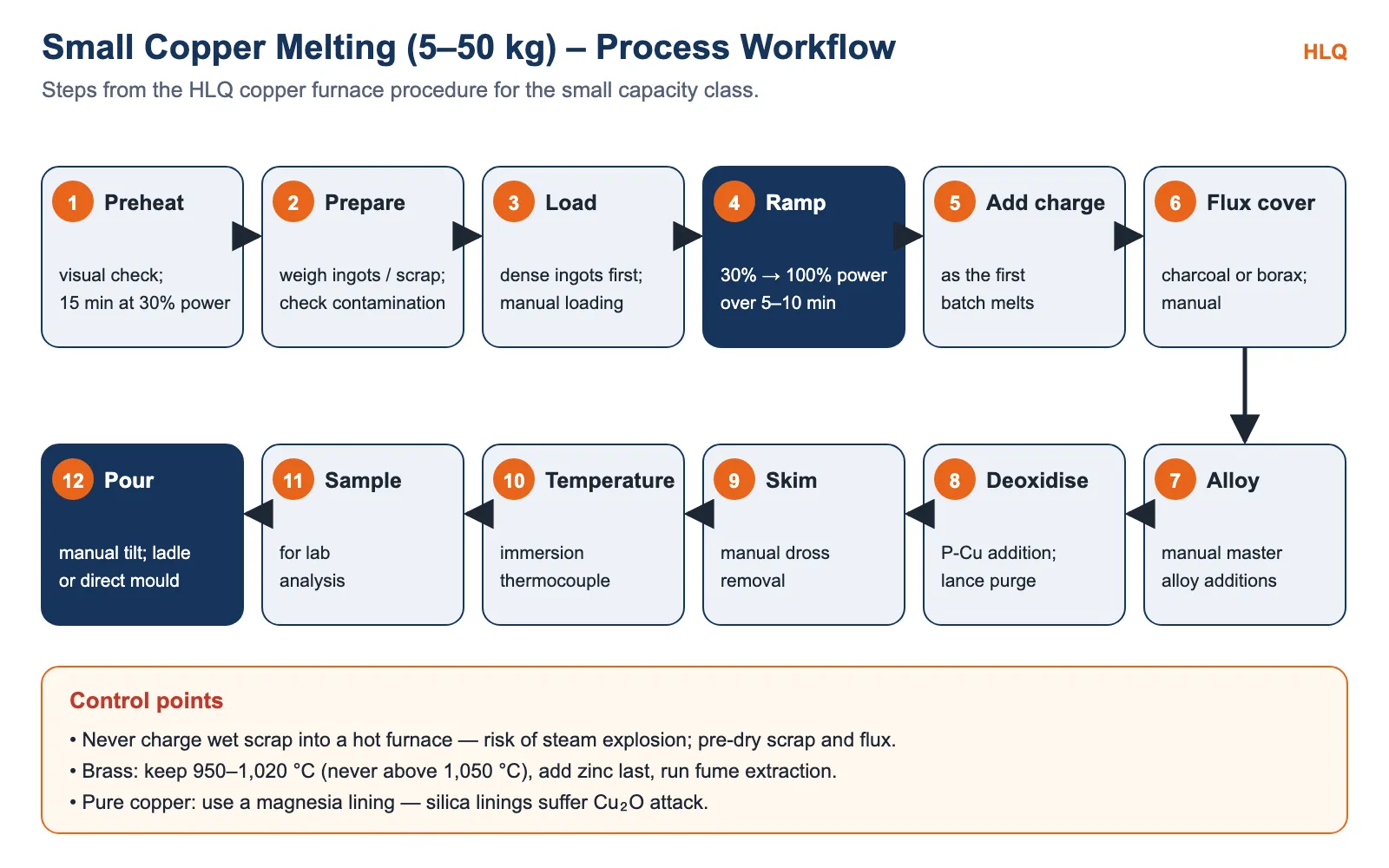
| Step | 5–50 kg furnace practice |
|---|---|
| 1. Preheat and inspection | Visual check; 15 min preheat at 30% power |
| 2. Charge preparation | Weigh ingots or scrap; check for contamination |
| 3. Initial loading | Dense ingots first; manual loading |
| 4. Power ramp-up | 30% → 100% over 5–10 min |
| 5. Progressive charging | Add the remaining charge as the first batch melts |
| 6. Flux | Charcoal or borax cover, applied manually |
| 7. Alloying | Manual master-alloy additions |
| 8. Deoxidation | P-Cu addition; manual lance purge |
| 9. Dross removal | Manual skimming |
| 10. Temperature check | Immersion thermocouple |
| 11. Composition check | Sample for laboratory analysis |
| 12. Pouring | Manual tilt; ladle or direct mould pour |
Workshop layout
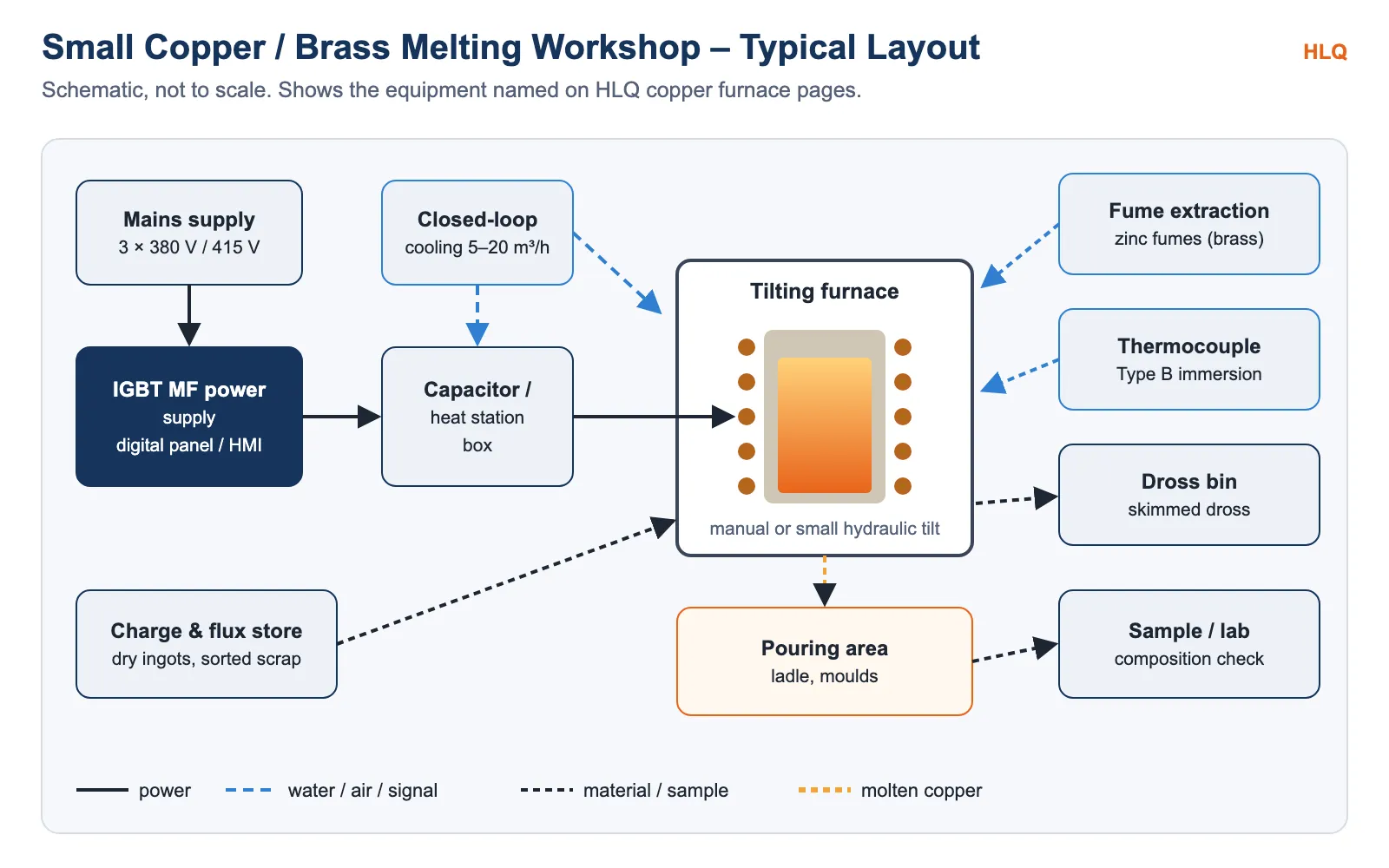
For larger batches with hydraulic pouring, see the hydraulic tilting copper melting furnace. For rod, bar or strip output, see the continuous copper casting furnace.
Common Problems and Solutions
| Problem | Likely cause | Solution |
|---|---|---|
| Excessive red Cu₂O dross | Poor flux cover, overheating, air exposure | Apply charcoal or borax after each charge; lower the holding temperature; inert gas for pure copper |
| Hydrogen porosity in castings | Wet or oily scrap, damp flux, poor deoxidation | Pre-dry scrap and flux; add 0.02–0.05% P-Cu; purge with dry argon |
| Zinc fuming with brass | Above 1,050 °C, long holding | Keep 950–1,000 °C, minimize holding, add zinc last, run fume extraction |
| Rapid lining erosion | Wrong lining for the alloy, overheating, poor sintering, thermal shock | Choose the lining by alloy; follow the sintering protocol; preheat the charge |
| Furnace fails to start | Coil insulation fault, water flow alarm, IGBT or capacitor fault | Check coil insulation (> 1 MΩ), water flow, IGBT diagnostics and capacitor fuses |
| Slow melting on a cold start | Solid copper’s shallow penetration depth gives poor coupling | Start with a dense, clean charge; keep a molten heel; ramp power gradually |
| Alloy out of specification | Charge error, volatile element loss, contaminated scrap | Recalculate the charge; add volatile elements last; use certified scrap |
Engineering Selection Guide
| Step | Parameter | Decision criteria | Impact |
|---|---|---|---|
| 1 | Required throughput | Net kg/h needed, with a 70% utilization factor | Minimum capacity and power |
| 2 | Alloy family | Pure Cu, brass, bronze, Cu-Ni, specialty | Lining, atmosphere, temperature range |
| 3 | Charge form | Ingot, returns, mixed or fine scrap | Energy use, coupling, charge preparation |
| 4 | Atmosphere | Open air, flux cover, inert gas, sealed | Oxygen-free and specialty alloys need sealed designs |
| 5 | Electrical supply | Voltage, capacity, harmonic limits | Cable, transformer and filter sizing |
| 6 | Temperature measurement | Copper at 1,083–1,300 °C | Type B thermocouple; Type K only marginal for brass and bronze |
Throughput example: 800 kg of molten copper per 8-hour shift ÷ (8 h × 0.70) ≈ 143 kg/h of net melting rate.
Advantages and Limitations
| Advantages | Limitations |
|---|---|
| No combustion, so no flue gas in contact with the melt | Higher capital cost than gas-fired furnaces |
| Electromagnetic stirring distributes zinc, tin and alloying elements | Solid copper couples poorly at a cold start |
| Precise temperature control (±8 °C in the small class) | Lining chemistry must match the alloy |
| One platform from pure copper to cupronickel | Brass melting needs fume extraction |
| No gas lines, flue stacks or combustion-air systems | Cooling water failure stops the furnace immediately |
| Scalable from 5 kg to 5,000 kg on the same technology | Beryllium copper needs a sealed enclosure and full exhaust filtration |
Why Choose HLQ?
| Strength | What it means |
|---|---|
| 5–5,000 kg copper range | Small to industrial furnaces on one IGBT platform |
| Alloy-specific linings | Magnesia, silica, alumina or chrome-magnesia chosen by alloy |
| Published power supplies | For example DW-MF-110KW, 1–20 kHz, 100% duty at 40 °C |
| Protection functions | Over-voltage, over-current, over-temperature, phase loss, water shortage |
| Tilting options | Manual, small hydraulic or hydraulic |
| Process guidance | Flux, deoxidation, zinc-loss and lining practice for each alloy |
10 Core FAQs
1. At what temperature does copper melt?
Pure copper melts at 1,083 °C. ETP copper is melted at about 1,083–1,100 °C, and brass at about 885–955 °C depending on grade.
2. How much power does a small copper furnace need?
15–25 kW for 5–15 kg jewelry casting and 25–75 kW for 10–100 kg laboratory melting.
3. Which frequency is used?
4–8 kHz for 5–15 kg, 2–4 kHz for 10–100 kg, and 1–2.5 kHz for 100–300 kg brass and bronze.
4. How long does a small heat take?
About 15–45 minutes per heat in the 5–100 kg class. The 5–50 kg class melts about 10–50 kg/h of pure copper.
5. Which lining should I use for pure copper?
Magnesia. Silica linings suffer chemical attack from Cu₂O. Brass normally uses silica.
6. How do I limit zinc loss when melting brass?
Keep the melt at 950–1,020 °C and never above 1,050 °C, minimize holding time, add zinc last, keep a flux cover and run fume extraction.
7. Which thermocouple should I use?
Type B for 1,083–1,300 °C. Type K is only marginal for lower-temperature brass and bronze.
8. Why is cold-start melting slow?
Solid copper is highly conductive, so the induced current flows in a very thin layer (0.74 mm at 8 kHz). Coupling improves as the copper heats.
9. Can copper scrap be melted?
Yes. Clean, large-section scrap can be charged directly. Fine scrap must be dried, and wet scrap must never go into a hot furnace.
10. How much energy does copper need?
In theory about 0.19 kWh/kg to heat copper to about 1,150 °C. HLQ lists 420–520 kWh/t actual specific energy for the 5–50 kg class.
Related products
-

Industrial Forging Furnace With Induction
-
Induction Aluminum Billet Rod Heating Furnace
-
Induction Furnace for Metal Melting | Steel, Iron, Copper and Aluminum Melting
-
Copper Zinc Separation Furnace with Induction Melting-Vacuum Distillation Furnace
-
Steel Billet Heating Furnace with Induction For forging rolling mills and extrusion bars-billets-rods