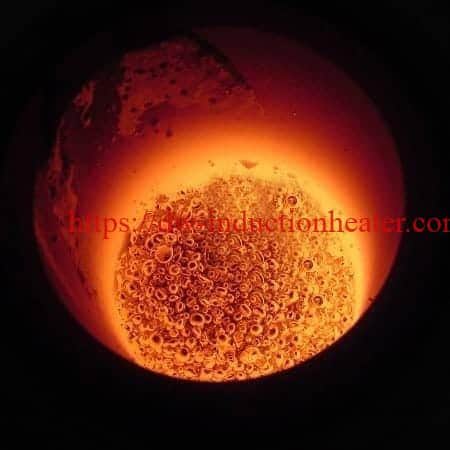




Induction Melting Silver
Induction Melting Silver: Furnace Models, Capacities and Process
Quick Answer
Induction melting silver uses a medium-frequency current in a water-cooled coil to induce eddy currents in the silver charge and the crucible. The silver melts at about 962 °C.
HLQ options:
- DW-MF furnaces: 15–160 kW at 1–20 kHz, with published gold/silver capacities from 5–10 kg up to 150–250 kg. A melt takes about 20–30 minutes once the furnace is hot.
- BF-series PLC furnaces: 10–60 kg of silver, 15–70 kW, with electric motor tilting.
Silver is about half as dense as gold, so size the crucible by volume, not by kilograms of gold.

What is Induction Melting Silver?
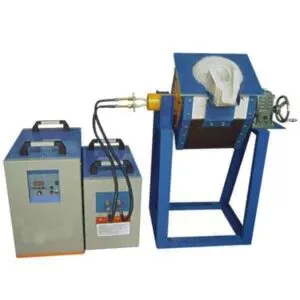
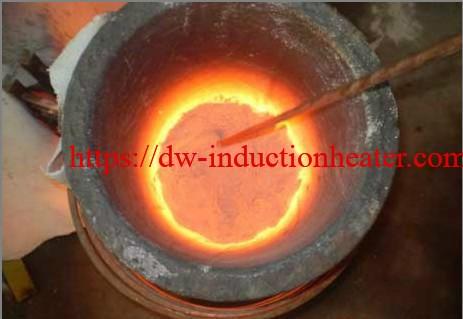
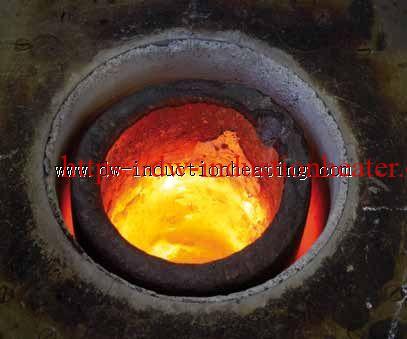
Induction melting silver is the melting of silver and silver alloys in an induction crucible furnace. The system has three parts: a medium-frequency generator, compensating capacitors and the melting furnace. An infrared temperature sensor and controller can be added.
The magnetic force stirs the melt pool, which helps flux and oxides float to the surface and gives cleaner castings.
The same medium frequency melting metal induction furnace also melts steel, stainless steel, copper, brass, gold and aluminum.
| Property | Silver | Gold (comparison) |
|---|---|---|
| Melting point | ≈ 962 °C | ≈ 1,064 °C |
| Density (physics) | ≈ 10.5 kg/L | ≈ 19.3 kg/L |
| Theoretical heat to melt (physics) | ≈ 0.1 kWh/kg | ≈ 0.06 kWh/kg |
| HLQ engineering focus | Temperature and metal recovery | Purity and crucible contamination |

Key Applications

| Application | Material | Objective | Quality requirement |
|---|---|---|---|
| Silver casting | Silver alloys | Controlled casting preparation | Oxidation and porosity control |
| Jewelry manufacturing | Gold and silver | Precious-metal casting | Purity and metal recovery |
| Precious-metal recycling | Gold and silver returns | Remelting identified materials | Traceability and metal yield |
| Small jewelry batches | Gold / silver, 5–10 kg class | DW-MF-15 | Confirm the operating point within 1–20 kHz |
| Laboratory alloy development | Specialty alloys | Experimental batch melting | Traceability and repeatability |
Suitable Materials
| Material | Notes |
|---|---|
| Silver (granules, scrap, bars) | Melts at about 962 °C; charge must be dry |
| Silver alloys | Alloying metals added after melting |
| Gold and gold alloys | Same furnaces; melts at about 1,064 °C |
| Copper, brass, bronze | Within furnace temperature and crucible limits |
| Steel, stainless steel, aluminum | DW-MF furnaces, with their own capacity ratings |
Crucibles
| Crucible | Notes |
|---|---|
| Graphite-based | Check alloy compatibility and oxidation |
| SiC / alumina | Options on the BF series |
| Dedicated precious-metal crucible | Keeps contamination and metal loss to a minimum |
Working Principle

- The IGBT generator converts mains power into 1–20 kHz current. Typical operating points are about 4, 8, 11, 15 or 20 kHz, depending on the application.
- The coil and compensating capacitors form a resonant circuit, and the coil produces an alternating magnetic field.
- Eddy currents are induced in the silver and the conductive crucible, and electrical resistance turns them into heat.
- The magnetic force stirs the melt, evening out the temperature and helping oxides float.
Background: how an induction heater works.
Current penetration depth in solid silver at 20 °C (physics reference)
| Frequency | 20 kHz | 11 kHz | 8 kHz | 4 kHz |
|---|---|---|---|---|
| Depth δ (ρ ≈ 0.016 µΩ·m) | ≈ 0.45 mm | ≈ 0.60 mm | ≈ 0.71 mm | ≈ 1.00 mm |
Technical Specifications
DW-MF medium-frequency melting furnaces
| Model | Max input power | Gold / silver (published) | Steel / stainless | Aluminum |
|---|---|---|---|---|
| DW-MF-15 | 15 kW | 5 or 10 kg | — | 3 kg |
| DW-MF-25 | 25 kW | 10 or 20 kg | 4 or 8 kg | 6 kg |
| DW-MF-35 | 35 kW | 20 or 30 kg | 10 or 14 kg | 12 kg |
| DW-MF-45 | 45 kW | 40 or 50 kg | 18 or 22 kg | 21 kg |
| DW-MF-70 | 70 kW | 60 or 80 kg | 28 kg | 30 kg |
| DW-MF-90 | 90 kW | 80 or 100 kg | 50 kg | 40 kg |
| DW-MF-110 | 110 kW | 100 or 150 kg | 75 kg | 50 kg |
| DW-MF-160 | 160 kW | 150 or 250 kg | 100 kg | 75 kg |
| Parameter | DW-MF series |
|---|---|
| Input | 3 × 380 V ±20%, 50 or 60 Hz |
| Oscillation frequency | 1–20 kHz, by application |
| Duty cycle | 100%, 24-hour operation |
| Melt time | 30–50 min for the first (cold) melt; 20–30 min when hot |
| Generator weight | 50 kg (DW-MF-15) to 145 kg (DW-MF-160) |
Published capacities list gold and silver together. Because silver is about half as dense as gold, confirm the silver kg for your crucible volume before ordering.
Recommended Model Selection
BF-series PLC induction melting furnaces
| Model | Output power | Silver capacity | Gold capacity | Weight |
|---|---|---|---|---|
| BF-15 | 15 kW | 10 kg | 15 kg | 285 kg |
| BF-25 | 25 kW | 25 kg | 38 kg | 295 kg |
| BF-35 | 35 kW | 30 kg | 45 kg | 295 kg |
| BF-45 | 45 kW | 35 kg | 55 kg | 300 kg |
| BF-70 | 70 kW | 60 kg | 80 kg | 310 kg |
The BF series has a 7-inch PLC touchscreen, electric motor tilting, and a three-phase 220 / 380 / 460 V, 50/60 Hz supply. Thermocouple or optical temperature measurement is optional. Details: PLC induction melting furnace for gold and silver.
Choosing by batch
| Silver batch | Option |
|---|---|
| Small batches up to 8 kg (gold ratings) | DW-SGM stationary or DW-TGM tilting furnaces (2–8 kg); see the stationary gold and silver melting furnace |
| 10–60 kg with PLC records | BF-15 to BF-70 |
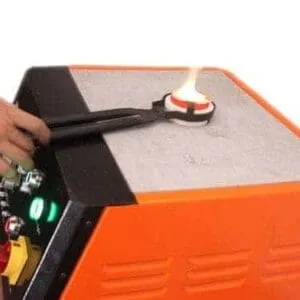
| 5–250 kg (published gold/silver range) | DW-MF-15 to DW-MF-160; see the tilting induction melting furnace |
Process Workflow

| Step | Action |
|---|---|
| 1 | Verify the alloy and weight; check the charge is dry |
| 2 | Inspect the crucible; check the cooling system and the PLC or safety interlocks |
| 3 | Load the charge; add flux (borax, silica, soda ash) if refining |
| 4 | Start at low power, then go to full power; monitor power and alarms |
| 5 | Verify the melt temperature; add alloying metals if required; stir with an inert rod and skim |
| 6 | Prepare dry, preheated moulds or ladle; wear full PPE |
| 7 | Tilt (manual, gearbox or motor) or lift the crucible; pour smoothly |
| 8 | Record energy and yield; reduce power to zero; keep cooling water running |
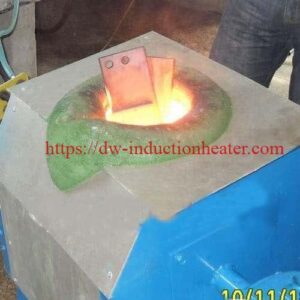
Workshop layout

Common Problems and Solutions
| Problem | Likely cause | Solution |
|---|---|---|
| Splashing or eruption | Wet tools, moulds or charge | Keep everything dry; preheat moulds; charge in a controlled way |
| Crucible over-filled with silver | Gold kg rating applied to silver | Size by volume: silver ≈ 10.5 kg/L, gold ≈ 19.3 kg/L |
| Low metal yield | Overheating; no recovery records | Control temperature; record energy and yield per batch |
| Contamination | Crucible shared with other metals | Use a dedicated precious-metal crucible |
| Flux fumes | Refining fluxes | Provide local exhaust |
| Cooling alarm | Low water flow or high temperature | Check the chiller; keep water running after shutdown |
| Melting slower than listed | Cold furnace; coil or crucible mismatch | Expect 30–50 min cold and 20–30 min hot; confirm frequency under load |
Engineering Selection Guide
| Factor | What to confirm |
|---|---|
| Batch size | Silver kg per batch, checked against crucible volume |
| Throughput | Batches per day; cold and hot melt times |
| Control | Manual or digital panel, or PLC with batch records (BF series) |
| Pouring | Stationary (lift the crucible), manual or gearbox tilt, or electric motor tilt |
| Power supply | Single phase for small melters; three phase for DW-MF and BF |
| Frequency | Within the 1–20 kHz series; ask for the measured value under load |
| Other metals | Gold, copper or brass in the same furnace means using dedicated crucibles |
Gold melting: induction melting gold and the induction gold melting furnace guide.
Advantages and Limitations
| Advantages | Limitations |
|---|---|
| No open flame or combustion gases | Needs reliable electricity and cooling water |
| Stirring helps flux and oxides float, for cleaner castings | Published gold/silver capacities must be checked by volume |
| Precise, repeatable temperature control | Frequency under load must be confirmed for each model |
| One furnace melts silver, gold, copper and other alloys | Dedicated crucibles are recommended for each metal |
| PLC control and batch records on the BF series | Higher investment than simple gas furnaces |
Why Choose HLQ?
| Strength | What it means |
|---|---|
| DW-MF series | 15–160 kW, 1–20 kHz, 100% duty, 24-hour operation |
| BF PLC series | 7-inch PLC touchscreen, electric motor tilting, 10–60 kg of silver |
| Small melters | DW-SGM, DW-TGM and M.MF.ML001 for small precious-metal batches |
| Protections | Over-voltage, over-current, insufficient water, over-heating |
| Multi-metal | Silver, gold, copper, brass, aluminum and steel |
| Crucible options | Graphite, SiC or alumina |
10 Core FAQs
1. At what temperature does silver melt?
About 962 °C.
2. How much silver can a DW-MF furnace melt?
Published gold/silver capacities range from 5 or 10 kg (DW-MF-15) to 150 or 250 kg (DW-MF-160). Confirm the silver figure against the crucible volume.
3. Why size silver by volume?
Silver is about 10.5 kg/L and gold about 19.3 kg/L, so the same crucible holds fewer kilograms of silver.
4. Which models have PLC control?
The BF series (BF-15 to BF-70). It has a 7-inch PLC touchscreen and electric motor tilting, with silver capacities of 10–60 kg.
5. How long does a silver melt take?
On DW-MF furnaces, about 30–50 minutes for the first (cold) melt and 20–30 minutes once the furnace is hot.
6. Which frequency is used?
DW-MF supplies run at 1–20 kHz, typically around 4, 8, 11, 15 or 20 kHz depending on the application.
7. What power supply is needed?
DW-MF: 3 × 380 V, 50/60 Hz. BF series: three-phase 220 / 380 / 460 V.
8. Which crucible should I use?
A graphite-based, SiC or alumina crucible. Keep a dedicated precious-metal crucible to limit contamination and metal loss.
9. Can the same furnace melt gold?
Yes. The furnaces are rated for both gold and silver; use separate crucibles to avoid cross-contamination.
10. How much energy does silver need?
In theory about 0.1 kWh/kg to melt. HLQ has not published a measured kWh/t figure for silver; ask for a sample melting test.