
What Is an Induction Heater? How Does It Work?
An induction heater is an industrial electromagnetic heating machine used to heat conductive metals such as carbon steel, alloy steel, stainless steel, copper, brass, aluminum and carbide assemblies. It is widely used for brazing, hardening, forging, melting, annealing, shrink fitting, pipe preheating and heat treatment. Instead of using flame or furnace air to transfer heat from the outside, an induction heater generates heat directly inside the metal workpiece through eddy currents. This makes the process fast, clean, controllable and suitable for modern automated production lines.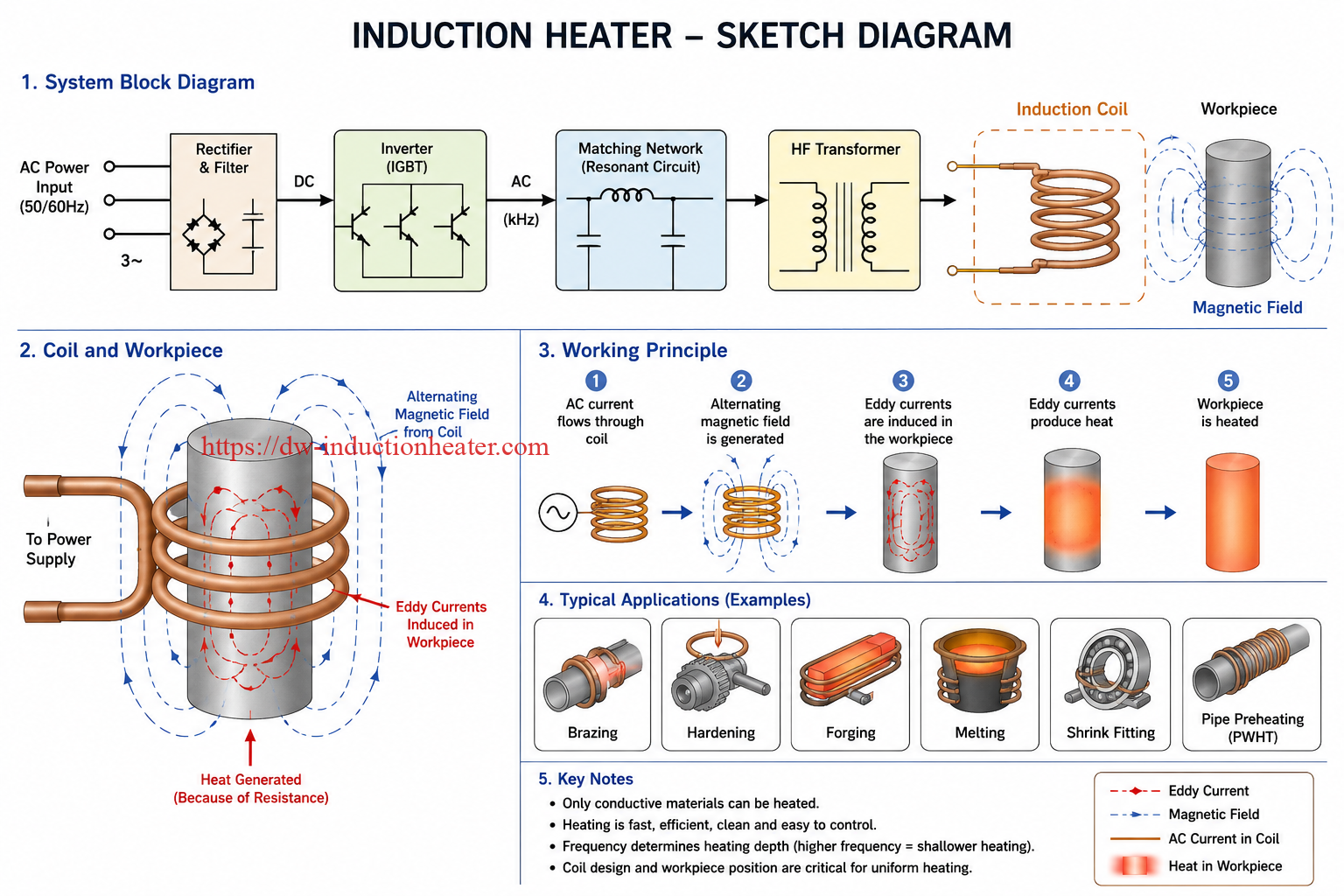
Quick Answer
An induction heater is a non-contact metal heating system that uses an alternating magnetic field to generate heat inside a conductive workpiece. It works by sending medium-frequency, high-frequency or ultra-high-frequency current through a copper induction coil. The coil produces a changing magnetic field, which induces eddy currents inside the metal. These eddy currents generate heat because of the electrical resistance of the material. Induction heaters are best used for fast, localized and repeatable industrial heating processes such as brazing, hardening, forging, melting, annealing, shrink fitting and preheating.
Table of Contents
- What Is an Induction Heater?
- How Does an Induction Heater Work?
- Main Components of an Induction Heater
- Working Principle Step by Step
- Main Types of Induction Heaters
- Suitable Materials
- Industrial Applications
- How to Choose the Right Induction Heater
- Advantages
- Limitations
- Common Problems and Solutions
- Why Choose HLQ Induction Equipment?
- FAQ
What Is an Induction Heater?
An induction heater is a power-driven heating system that uses electromagnetic induction to heat metal parts without direct contact. In industrial use, the term “induction heater” can refer to a compact handheld heater, a high-frequency brazing machine, a medium-frequency forging heater, an induction hardening machine, an induction melting furnace, a PWHT preheating system or a customized automated heating line.
The key difference between induction heating and conventional heating is where the heat is generated. In flame heating, furnace heating or resistance heating, heat is generated outside the workpiece and then transferred into the part. In induction heating, electrical energy is converted into heat inside the conductive workpiece itself. This direct internal heat generation gives induction heaters high heating speed, high energy concentration and excellent process repeatability.
In a typical industrial induction heating system, the power supply converts standard factory electricity into a selected frequency. This frequency may be low, medium, high or ultra-high depending on the application. The current is delivered to a copper induction coil. When the metal workpiece is placed inside or near the coil, the alternating magnetic field induces current inside the metal and the part heats rapidly.
| Term | Meaning | Industrial Example |
|---|---|---|
| Induction Heater | Complete heating machine using electromagnetic induction. | Brazing heater, forging heater, hardening heater. |
| Induction Heating Power Supply | Electrical generator that powers the induction coil. | MF, HF, UHF, SRF or KGPS generator. |
| Induction Coil | Water-cooled copper coil that creates the magnetic field. | Helical coil, pancake coil, split coil, custom brazing coil. |
| Workpiece | The conductive metal part being heated. | Steel shaft, copper tube, aluminum billet, brass fitting. |
How Does an Induction Heater Work?
An induction heater works through electromagnetic induction. When alternating current flows through a copper coil, a changing magnetic field forms around the coil. When a conductive metal workpiece is placed in this magnetic field, circulating currents called eddy currents are induced inside the metal. These eddy currents meet electrical resistance in the workpiece and produce heat.
For magnetic materials such as carbon steel and many alloy steels, another heating effect also exists below the Curie temperature: hysteresis heating. The magnetic domains inside the steel repeatedly change direction under the alternating magnetic field, producing additional heat. Above the Curie temperature, the material loses most of its magnetic response, and eddy current heating becomes the dominant mechanism.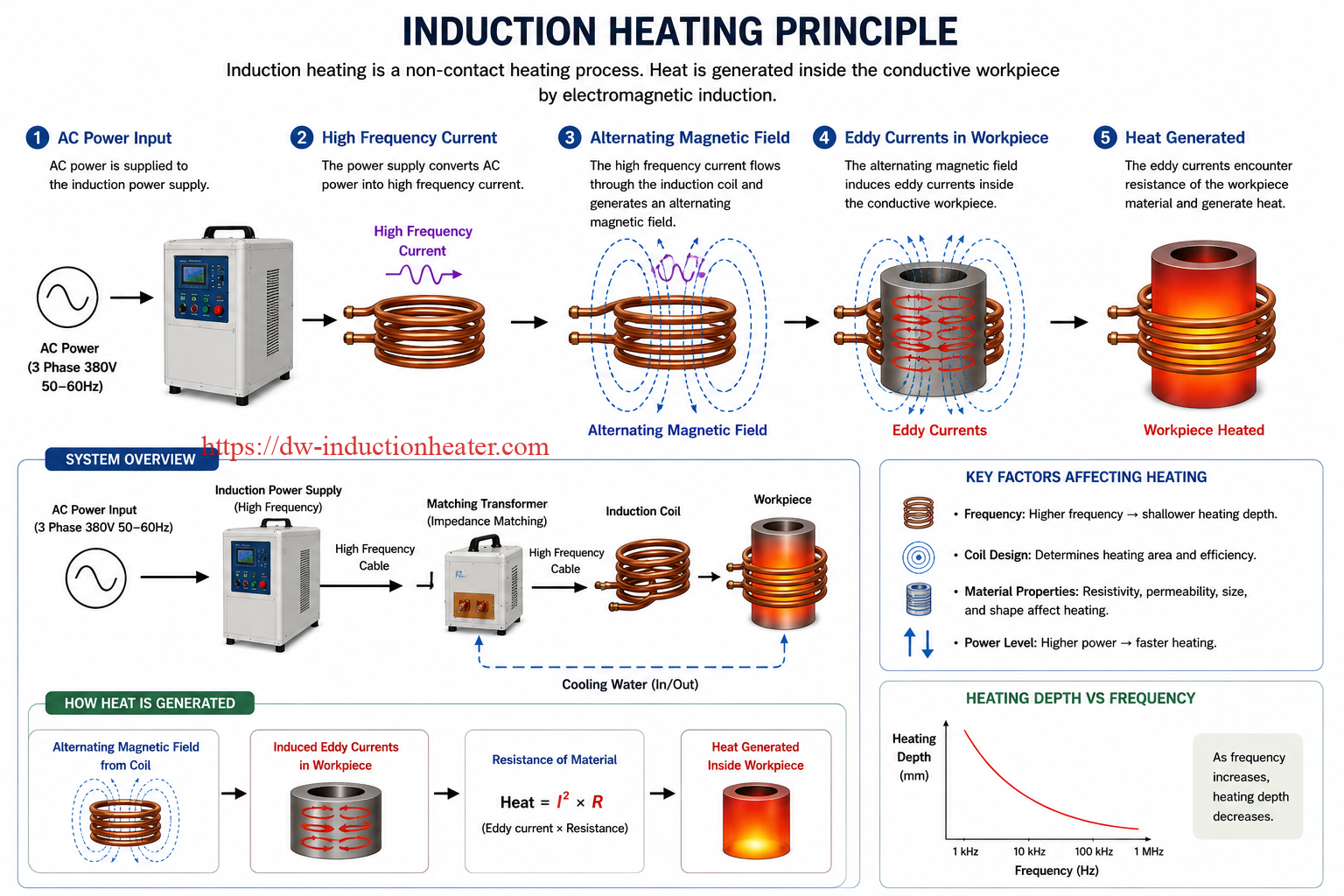
The heating depth depends strongly on frequency. Lower frequency penetrates deeper into the workpiece and is usually selected for billet heating, forging, melting and large-part heating. Higher frequency produces shallower heating and is better for brazing, surface hardening, small parts and precision heating.
| Heating Mechanism | Where It Happens | Best Material Type | Engineering Meaning |
|---|---|---|---|
| Eddy Current Heating | Inside conductive metals | Steel, copper, brass, aluminum, stainless steel | Main heat source in almost all induction heating applications. |
| Resistance Heating | Inside the workpiece | All conductive materials | Eddy currents generate heat as they flow through material resistance. |
| Hysteresis Heating | Inside magnetic materials | Carbon steel and magnetic alloy steels | Additional heating effect below Curie temperature. |
| Heat Conduction | From heated zone into surrounding material | All metals | Affects temperature uniformity and heating time. |
Main Components of an Induction Heater
A reliable induction heater is not just a power cabinet. It is a complete engineered system. The performance depends on the correct combination of power supply, coil, transformer, cooling system, control method and workpiece fixture.
| Component | Function | Engineering Notes |
|---|---|---|
| Induction Power Supply | Converts factory AC power into controlled frequency output. | Select by power, frequency, duty cycle and control mode. |
| Matching Transformer | Matches the power supply to the coil load. | Improves energy transfer and stable operation. |
| Induction Coil | Generates the magnetic field around the workpiece. | Usually made of water-cooled copper tube. |
| Cooling System | Cools the power supply, transformer, cable and coil. | Closed-loop chiller is recommended for continuous production. |
| Control System | Controls power, time, temperature, movement and safety logic. | Can be manual, PLC-based or fully automatic. |
| Fixture | Positions the workpiece accurately inside the coil. | Critical for repeatable heating quality. |
| Temperature Sensor | Measures surface or process temperature. | Pyrometer or thermocouple feedback can improve accuracy. |
Working Principle Step by Step
| Step | Process | Explanation |
|---|---|---|
| 1 | AC Power Input | The heater receives single-phase or three-phase factory electricity. |
| 2 | Power Conversion | The power supply converts the input into controlled medium-frequency, high-frequency or ultra-high-frequency output. |
| 3 | Resonant Circuit Operation | Capacitors, transformer and coil form a resonant circuit for efficient power transfer. |
| 4 | Coil Energizing | High current flows through the copper induction coil. |
| 5 | Magnetic Field Formation | The coil creates a rapidly changing magnetic field. |
| 6 | Eddy Current Generation | The magnetic field induces circulating currents inside the metal workpiece. |
| 7 | Heat Generation | The induced current produces heat due to electrical resistance. |
| 8 | Process Control | Power, frequency, time, coil design and temperature feedback control the final result. |
Simple Energy Flow Diagram
| Input | Conversion | Magnetic Field | Workpiece Reaction | Result |
|---|---|---|---|---|
| AC electricity | Induction power supply | Induction coil | Eddy currents inside metal | Fast controlled heat |
Main Types of Induction Heaters
Different applications require different frequency ranges and power levels. A small copper tube brazing job does not need the same machine as a steel billet forging line or a metal melting furnace. Choosing the correct frequency series is one of the most important engineering decisions.
| Series | Typical Frequency | Heating Depth | Best-Fit Applications |
|---|---|---|---|
| KGPS Induction Heater | 0.1kHz–10kHz | Deep furnace heating | Melting furnace, smelting, large thermal load. |
| MF Induction Heater | 0.2kHz–20kHz | Deep to medium-deep | Forging, billet heating, melting, deep hardening. |
| SRF Induction Heater | 20kHz–50kHz | Medium | Automotive parts, medium-depth hardening, billet heating. |
| HF Induction Heater | 30kHz–80kHz | Shallow to medium | Brazing, soldering, surface hardening, shrink fitting. |
| UHF Induction Heater | 50kHz–2MHz | Very shallow to shallow | Precision brazing, micro soldering, small parts heating. |
Suitable Materials
Induction heating is suitable for electrically conductive materials. The most common industrial materials include carbon steel, alloy steel, stainless steel, copper, brass, aluminum, titanium and carbide assemblies. However, heating speed and efficiency vary by material.
| Material | Induction Heating Performance | Recommended Series | Typical Applications |
|---|---|---|---|
| Carbon Steel | Excellent | MF / HF / SRF / KGPS | Forging, hardening, melting, shrink fitting. |
| Alloy Steel | Excellent | MF / HF / SRF | Gears, shafts, tools, automotive parts. |
| Stainless Steel | Good | HF / MF / SRF | Brazing, annealing, pipe heating, vessel heating. |
| Copper | Good but requires strong coupling | HF / MF | Brazing, annealing, melting, electrical parts. |
| Brass | Good | HF / MF | Fittings, valves, brazing, forging, melting. |
| Aluminum | Moderate to good | MF / SRF / KGPS | Billet heating, melting, shrink fitting. |
| Titanium | Good | MF / HF | Forging, annealing, aerospace components. |
| Carbide Assembly | Good for brazing | HF / UHF | Carbide tool brazing, diamond segment brazing. |
Industrial Applications
Induction heaters are used wherever fast and controlled metal heating is required. In production workshops, they can replace flame torches, resistance furnaces, salt baths or gas-fired heaters in many localized heating processes. In heavy industry, induction heating systems are used for large billets, pipes, shafts, bearings, gears and melting furnaces.
| Application | Material | Recommended Frequency Type | Engineering Notes |
|---|---|---|---|
| Induction Brazing | Copper, brass, steel, stainless steel, carbide | HF / UHF | Fast joint heating with stable filler flow. |
| Induction Hardening | Carbon steel, alloy steel | HF / SRF / MF | Frequency depends on required case depth. |
| Induction Forging | Steel, copper, brass, aluminum | MF / SRF | Deep heating improves billet temperature uniformity. |
| Induction Melting | Aluminum, copper, brass, steel, iron | MF / KGPS | Power depends on furnace capacity and melting time. |
| Induction Annealing | Copper, stainless steel, carbon steel, brass | HF / MF / SRF | Used to reduce hardness and improve ductility. |
| Shrink Fitting | Bearings, gears, rings, couplings | HF / MF | Controlled expansion for assembly and disassembly. |
| Pipe Preheating and PWHT | Carbon steel, alloy steel, stainless steel | MF / flexible cable system | Useful for welding preheat and post-weld heat treatment. |
How to Choose the Right Induction Heater
A common mistake is to choose an induction heater only by power rating. In real engineering projects, power is only one factor. The correct selection depends on material, part size, target temperature, heating time, heating depth, production rate, coil design and cooling capacity.
| Selection Factor | What to Confirm | Engineering Recommendation |
|---|---|---|
| Material | Steel, stainless steel, copper, aluminum, brass or carbide. | Magnetic steel is easier to heat; copper and aluminum require stronger coupling. |
| Workpiece Size | Diameter, length, thickness, weight and heating zone. | Larger parts usually need higher power and lower frequency. |
| Heating Depth | Surface heating, medium-depth heating or through heating. | Use higher frequency for shallow heating and lower frequency for deep heating. |
| Target Temperature | Brazing, hardening, forging, annealing or melting temperature. | Select enough power with a margin for heat loss. |
| Heating Time | Required cycle time per piece or per batch. | Shorter cycle time requires higher power density. |
| Production Capacity | Pieces per hour, kilograms per hour or tons per day. | Continuous production needs strong cooling and stable duty cycle. |
| Automation Level | Manual, semi-automatic or fully automatic. | Use PLC and temperature feedback for repeatable production. |
Recommended Model Selection
| Application | Material | Recommended Power | Frequency |
|---|---|---|---|
| Small copper tube brazing | Copper / brass | 15kW–35kW | HF / UHF |
| Carbide tool brazing | Carbide + steel | 15kW–60kW | HF |
| Shaft surface hardening | Carbon steel / alloy steel | 45kW–200kW | HF / SRF / MF |
| Gear tooth hardening | Carbon steel / alloy steel | 60kW–160kW | HF / SRF |
| Steel billet forging | Carbon steel / alloy steel | 100kW–1000kW | MF / SRF |
| Aluminum billet heating | Aluminum alloy | 100kW–800kW | MF / SRF |
| Aluminum melting | Aluminum scrap / ingot | 70kW–2000kW | MF / KGPS |
| Pipe preheating | Carbon steel pipe | 30kW–300kW | MF / flexible cable system |
Advantages of Induction Heaters
| Advantage | Engineering Meaning | Buyer Value |
|---|---|---|
| Fast Heating | Heat is generated directly inside the metal. | Shorter cycle time and higher productivity. |
| Localized Heating | The coil focuses heat on the required zone. | Less distortion and lower heat-affected area. |
| Clean Process | No open flame and less smoke. | Improved workshop safety and environment. |
| High Repeatability | Power, time and temperature can be controlled. | More stable product quality. |
| Automation Friendly | Can connect with PLC, robot, conveyor or quenching system. | Suitable for mass production. |
| Energy Concentration | Energy is focused on the workpiece, not the whole furnace chamber. | Reduced heat loss in localized heating applications. |
Limitations of Induction Heating
Induction heating is highly effective, but it is not the best choice for every process. It works directly only on conductive materials. It also requires a properly designed coil and cooling system. For very large batch heating, long soaking cycles or special atmosphere heat treatment, a furnace may still be needed.
| Limitation | Reason | Engineering Solution |
|---|---|---|
| Only conductive materials heat directly | The process depends on induced electrical currents. | Use a conductive susceptor for some non-conductive materials if suitable. |
| Coil design is application-specific | Different parts need different magnetic field patterns. | Provide drawings or samples for custom coil design. |
| Water cooling is usually required | Power electronics and copper coils carry high current. | Use stable water supply or closed-loop industrial chiller. |
| High-frequency heating may be too shallow | Skin effect limits penetration depth. | Select lower frequency for larger or thicker parts. |
| Initial cost can be higher than flame tools | Power supply, coil, cooling and control system are required. | Evaluate ROI by quality, cycle time, energy, labor and scrap reduction. |
Common Problems and Solutions
| Problem | Possible Cause | Engineering Solution |
|---|---|---|
| Heating speed is too slow | Power is too low, coil coupling is poor, or frequency is not suitable. | Increase power, reduce coil gap or redesign the coil. |
| Surface overheats but core is cold | Frequency is too high for the workpiece thickness. | Use lower frequency or increase heating time. |
| Heating is not uniform | Incorrect coil shape or unstable workpiece positioning. | Improve fixture, use rotation or redesign coil geometry. |
| Coil overheats | Insufficient water flow or blocked cooling channel. | Increase water flow and clean the coil circuit. |
| Power supply alarm occurs | Load mismatch, poor cooling, unstable voltage or incorrect coil connection. | Check cooling, input power, transformer ratio and coil connection. |
| Brazing quality is unstable | Temperature variation, poor filler placement or inconsistent part position. | Use fixed tooling, temperature feedback and optimized coil design. |
| Hardening depth is incorrect | Frequency, heating time or quenching process is not matched. | Adjust frequency, scan speed, heating power and quench pattern. |
Why Choose HLQ Induction Equipment?
HLQ Induction Equipment focuses on industrial induction heating machines and customized electromagnetic heating solutions. Its product range covers induction brazing machines, induction hardening systems, induction forging heaters, induction melting furnaces, handheld induction heaters, PWHT machines, induction heating coils and industrial heating power supplies.
For buyers, the value of choosing an experienced induction heater manufacturer is not only the machine price. The key is engineering matching: the right power, right frequency, correct coil geometry, stable cooling, practical fixture design and process parameters that can run repeatedly in real production.
| HLQ Capability | Customer Benefit | Typical Application |
|---|---|---|
| Wide Product Range | One supplier for multiple induction heating processes. | Brazing, hardening, forging, melting, PWHT. |
| Power and Frequency Selection | Reduces wrong model selection risk. | MF, HF, UHF, SRF, KGPS systems. |
| Custom Coil Design | Improves heating speed and uniformity. | Special joints, shafts, billets, pipes, tools. |
| Automation Support | Improves repeatability and production efficiency. | PLC control, temperature feedback, fixtures, conveyors. |
| Industrial Application Experience | Helps customers build practical heating processes. | Automotive, HVAC, metalworking, foundry, oil and gas. |
 FAQ
FAQ

1. What is an induction heater?
An induction heater is an electromagnetic heating machine that heats conductive metal parts by inducing eddy currents inside the workpiece. It is used for brazing, hardening, forging, melting, annealing, shrink fitting and industrial heat treatment.
2. How does an induction heater work?
It sends alternating current through a copper coil. The coil produces a changing magnetic field. When a metal part is placed in the field, eddy currents form inside the metal and generate heat through electrical resistance.
3. Does the induction coil get hot?
The coil carries high current and must be water cooled, but the main heat is generated inside the workpiece rather than by direct contact from the coil.
4. What metals can be heated by induction?
Induction can heat conductive metals such as carbon steel, alloy steel, stainless steel, copper, brass, aluminum, titanium and carbide assemblies. Heating efficiency depends on magnetic properties, electrical resistivity, thermal conductivity and part geometry.
5. Is induction heating better than flame heating?
For many industrial localized heating processes, induction heating is faster, cleaner, safer and more repeatable than flame heating. It is also easier to automate and control.
6. What is the best induction heater for brazing?
HF or UHF induction heaters are usually best for brazing because they provide fast, localized heating around the joint area.
7. What is the best induction heater for forging?
MF or SRF induction heaters are commonly used for billet, bar and rod forging because they provide deeper heat penetration and high thermal capacity.
8. What is the best induction heater for melting?
MF or KGPS induction furnace systems are usually selected for melting aluminum, copper, brass, steel, iron and other metals.
9. Why is frequency important?
Frequency controls heating depth. Higher frequency produces shallower heating and is suitable for brazing or surface hardening. Lower frequency penetrates deeper and is suitable for forging, melting and large parts.
10. What information is needed to choose a machine?
To select the right induction heater, provide the workpiece material, size, weight, target temperature, heating time, required heating depth, production capacity, local voltage and cooling water condition.
Conclusion
An induction heater is one of the most efficient and controllable technologies for modern metal heating. It works by converting electrical energy into an alternating magnetic field and generating heat directly inside the workpiece through eddy currents. The result is fast heating, clean operation, precise control and excellent repeatability.
For industrial buyers, the most important step is not simply choosing a high-power machine. The correct induction heater must match the material, part size, heating depth, target temperature, production rate and automation requirement. With the right power supply, frequency, coil design and cooling system, induction heating can improve product quality, reduce cycle time and support stable long-term production.