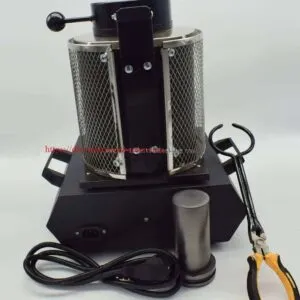
PLC Melting Furnace With Induction
PLC Induction Melting Furnace for Gold and Silver Casting
What Is the PLC Induction Melting Furnace?
The HLQ BF-Series PLC Induction Melting Furnace is an IGBT-powered industrial melting system designed for
gold, silver, jewelry alloys and compatible nonferrous metals. It combines electromagnetic induction heating with a PLC touchscreen control system, fault diagnostics, safety interlocks and an electric motor tilting mechanism.
The published product range includes BF-15, BF-25, BF-35, BF-45 and BF-70, with nominal output-power classes of 15–70kW. The original product page lists gold melting capacities from 15kg to 80kg and silver capacities from 10kg to 60kg.A 7-inch Siemens PLC touchscreen is listed as a main feature.
Thermocouple and optical temperature measurement are offered as optional equipment. Buyers should verify the actual
control functions, operating frequency and electrical input requirements before ordering.
Product Overview
| Parameter | Specification |
|---|---|
| Product | PLC Induction Melting Furnace |
| Model Series | BF-15 to BF-70 |
| Power Technology | IGBT Induction Generator |
| Published Output Power | 15–70kW |
| Input Supply | Three-phase 220V / 380V / 460V, 50/60Hz |
| Control Panel | 7-inch Siemens PLC Touchscreen |
| Tilting | Electric Motor Tilting Device |
| Gold Capacity | 15–80kg |
| Silver Capacity | 10–60kg |
| Temperature Measurement | Optional Thermocouple or Optical Sensor |
Key Applications
PLC-controlled induction melting equipment is suitable for manufacturers seeking controlled melting sequences, operator supervision and repeatable batch records.
| Application | Material | Production Objective | Quality Requirement |
|---|---|---|---|
| Jewelry Casting | Gold Alloys | Controlled Melting and Pouring | Alloy Composition and Casting Quality |
| Gold Ingot Production | Gold | Batch Melting | Metal Recovery and Purity |
| Silver Casting | Silver Alloys | Controlled Casting Preparation | Oxidation and Porosity Control |
| Precious Metal Recycling | Gold and Silver Returns | Remelting Identified Materials | Traceability and Metal Yield |
| Alloy Development | Selected Nonferrous Alloys | Repeatable Melting Trials | Temperature and Chemistry |
For additional gold melting applications, explore HLQ’s
induction gold smelter and gold melting furnace systems.
Suitable Materials
The published BF-series capacity table specifically covers gold and silver. Other conductive metals require crucible compatibility and factory melting trials.
| Material | Melting Characteristics | Engineering Consideration |
|---|---|---|
| Pure Gold | Melting Point Approximately 1064°C | Crucible Cleanliness and Recovery |
| Gold Alloys | Composition-Dependent Melting Range | Alloy Chemistry and Pouring Temperature |
| Pure Silver | Melting Point Approximately 962°C | Oxidation and Porosity |
| Sterling Silver | Alloy-Dependent Melting Range | Copper Oxidation |
| Copper | Melting Point Approximately 1085°C | Separate Crucible and Load Matching |
| Brass | Composition-Dependent | Zinc Fume Extraction |
Crucible Materials
| Crucible | Engineering Consideration |
|---|---|
| Graphite | Conductive crucible; verify metal compatibility and oxidation. |
| Silicon Carbide | Check thermal shock resistance and electrical coupling. |
| Alumina | Verify temperature limits, insulation and charge coupling. |
For copper-specific melting applications, see HLQ’s
induction copper melting furnace equipment.
Working Principle
The IGBT induction generator supplies alternating current to
a matched induction coil. The changing magnetic field induces
eddy currents inside conductive metal or a compatible
conductive crucible.
Electrical resistance converts these currents into heat,
progressively melting the charge.
The PLC touchscreen provides operator control and supervision
of configured machine functions, including alarms, interlocks
and electric tilting.
The PLC is a control system. It does not replace the IGBT
power inverter or the electrical matching network.
Figure 1. Working Principle Diagram
       THREE-PHASE AC INPUT
                 |
                 v
       +------------------+
       | IGBT GENERATOR   |
       +------------------+
                 |
                 v
       +------------------+
       | MATCHING NETWORK |
       +------------------+
                 |
                 v
       +------------------+
       | INDUCTION COIL   |
       +------------------+
                 |
                 v
       ALTERNATING MAGNETIC
               FIELD
                 |
                 v
       METAL / CRUCIBLE
                 |
                 v
          EDDY CURRENTS
                 |
                 v
         HEAT GENERATION
                 |
                 v
          MOLTEN METAL
                 |
                 v
       TEMPERATURE CHECK
                 |
                 v
       ELECTRIC MOTOR TILT
                 |
                 v
          SAFE POURING
Technical Specifications
The following data are based on the original product listing.
Several values require clarification before being used as
guaranteed equipment specifications.
| Parameter | Specification | Notes |
|---|---|---|
| Models | BF-15 / BF-25 / BF-35 / BF-45 / BF-70 | Five published models |
| Output Power | 15–70kW | Input power and efficiency must be confirmed |
| Input Voltage | Three-phase 220V / 380V / 460V | 50/60Hz mains supply |
| Inverter Output Frequency | Not Published | Confirm kHz under load |
| Melting Temperature | 1600°C Advertised | Maximum operating conditions require verification |
| Efficiency | ≥95% Advertised | Measurement definition not provided |
| PLC | 7-inch Siemens Touchscreen | Exact hardware model to confirm |
| Tilting | Electric Motor | Torque and braking data required |
| Crucible | Graphite / SiC / Alumina Options | Material-specific selection |
| Temperature Sensor | Optional Thermocouple / Optical Sensor | Not automatically included |
| Cooling Requirements | Not Published | Request hydraulic specifications |
BF-Series Model Comparison
| Model | Output Power | Gold Capacity | Silver Capacity | Published Weight |
|---|---|---|---|---|
| BF-15 | 15kW | 15kg | 10kg | 285kg |
| BF-25 | 25kW | 38kg | 25kg | 295kg |
| BF-35 | 35kW | 45kg | 30kg | 295kg |
| BF-45 | 45kW | 55kg | 35kg | 300kg |
| BF-70 | 70kW | 80kg | 60kg | 310kg |
Important: Crucible Volume Verification
| Model | Volume Printed on Original Page | Gold Capacity | Approximate Gold Volume |
|---|---|---|---|
| BF-15 | 1500L | 15kg | 0.78L |
| BF-25 | 4600L | 38kg | 1.97L |
| BF-35 | 6300L | 45kg | 2.33L |
| BF-45 | 8200L | 55kg | 2.85L |
| BF-70 | 11000L | 80kg | 4.14L |
The published crucible-volume units are inconsistent with
the metal capacities. Calculated gold volumes use an
approximate density of 19.3kg/L.
The correct crucible volume units and working capacities
must be confirmed by HLQ before publication as guaranteed data.
Recommended Model Selection
| Application | Material | Recommended Power | Frequency |
|---|---|---|---|
| 15kg Gold / 10kg Silver Batch | Gold / Silver | BF-15, Published 15kW Output Class | Not Published; Verify Under Load |
| 38kg Gold / 25kg Silver Batch | Gold / Silver | BF-25, Published 25kW Output Class | Not Published; Verify Under Load |
| 45kg Gold / 30kg Silver Batch | Gold / Silver | BF-35, Published 35kW Output Class | Not Published; Verify Under Load |
| 55kg Gold / 35kg Silver Batch | Gold / Silver | BF-45, Published 45kW Output Class | Not Published; Verify Under Load |
| 80kg Gold / 60kg Silver Batch | Gold / Silver | BF-70, Published 70kW Output Class | Not Published; Verify Under Load |
The published capacities must be verified against the corrected
crucible dimensions, safe filling level and actual melting tests.
For smaller precious-metal batches, compare HLQ’s
small induction gold melting furnace.
Process Workflow
      VERIFY ALLOY AND WEIGHT
                 |
                 v
       CHECK CHARGE DRYNESS
                 |
                 v
       INSPECT CRUCIBLE
                 |
                 v
       CHECK COOLING SYSTEM
                 |
                 v
       VERIFY PLC INTERLOCKS
                 |
                 v
         LOAD METAL CHARGE
                 |
                 v
       START INDUCTION HEATING
                 |
                 v
       MONITOR POWER AND ALARMS
                 |
                 v
       VERIFY MELT TEMPERATURE
                 |
                 v
       PREPARE DRY LADLE
                 |
                 v
       ELECTRIC MOTOR TILTING
                 |
                 v
         CONTROLLED POURING
                 |
                 v
       RECORD ENERGY AND YIELD
Production Quality Control
| Process Stage | Inspection | Required Record |
|---|---|---|
| Charge Preparation | Metal Grade, Weight and Dryness | Batch Record |
| Pre-Start | Cooling, Crucible and Interlocks | Inspection Checklist |
| Heating | Electrical Power and Alarms | Operating Record |
| Melting | Temperature and Chemistry | Quality Record |
| Pouring | Tilting and Ladle Position | Pouring Record |
| Completion | Accepted Metal and Residues | Yield Report |
For an alternative tilting configuration, review HLQ’s
electric tilting induction melting furnace.
Coil and Fixture Design
The induction coil, crucible, matching network and electric
tilting frame must be designed as an integrated system.
| Component | Engineering Requirement | Potential Failure |
|---|---|---|
| Induction Coil | Correct Turns, Copper Conductor and Cooling | Overheating or Short Circuit |
| Compensation Network | Suitable Resonant Matching | Unstable Generator Operation |
| Crucible | Compatible Material and Working Capacity | Cracking or Contamination |
| Electric Tilting Motor | Correct Torque and Travel | Uncontrolled Movement |
| Brake and Stops | Safe Holding Under Rated Load | Unexpected Tilting |
| Cooling Hoses | Adequate Flow and Flexible Routing | Leakage or Fatigue |
Cooling Water Calculation
For ordinary water, the illustrative heat-removal calculation is:
Q(kW) = 1.163 × Flow(m³/h) × Temperature Rise(°C)
| Assumed Flow | Assumed Temperature Rise | Calculated Heat Removal |
|---|---|---|
| 0.5m³/h | 5°C | 2.9kW |
| 1.0m³/h | 5°C | 5.8kW |
| 2.0m³/h | 5°C | 11.6kW |
| 3.0m³/h | 5°C | 17.4kW |
These figures are theoretical examples, not confirmed
BF-series cooling requirements.
Control System and Automation
The published BF series includes a 7-inch Siemens PLC
touchscreen, diagnostics, interlocks and electric motor tilting.
Temperature measurement using a thermocouple or optical sensor
is optional. Closed-loop temperature regulation should not
be assumed unless the sensor and control function are included
in the actual order.
PLC Control Functions
| Control Function | Engineering Purpose | Status |
|---|---|---|
| Siemens Touchscreen | Operator Interface | Listed Main Feature |
| IGBT Power Control | Adjust Induction Heating | Power Regulation Details to Confirm |
| Fault Diagnostics | Identify Equipment Faults | Listed Main Feature |
| Safety Interlocks | Supervise Operating Conditions | Actual Interlock List Required |
| Electric Tilting | Control Furnace Pouring | Listed Main Feature |
| Thermocouple | Temperature Measurement | Optional |
| Optical Sensor | Noncontact Temperature Measurement | Optional |
| Data Logging | Record Melting Performance | Specify Separately |
Recommended PLC Monitoring Parameters
| Parameter | Unit | Purpose |
|---|---|---|
| Batch Weight | kg | Material Tracking |
| Electrical Input | kW | Energy Monitoring |
| Electrical Consumption | kWh | Operating Cost |
| Temperature | °C | Melting Quality |
| Heating Time | min | Process Repeatability |
| Cooling Flow | m³/h | Equipment Protection |
| Tilt Position | Status | Mechanical Safety |
| Accepted Metal | kg | Yield Calculation |
Common Problems and Solutions
| Problem | Possible Cause | Recommended Action |
|---|---|---|
| Slow Melting | Insufficient Power or Poor Matching | Measure Actual kW and kWh |
| IGBT Overcurrent Trip | Electrical Fault or Load Mismatch | Follow Approved Diagnostics |
| Temperature Reading Incorrect | Sensor Missing or Incorrectly Calibrated | Verify Temperature Instrument |
| Cooling Alarm | Low Flow or Blocked Water Passage | Check Cooling Circuit |
| Crucible Cracking | Thermal Shock or Material Incompatibility | Use Approved Crucible Procedure |
| Electric Tilting Instability | Motor, Gearbox or Brake Problem | Stop and Inspect the Mechanism |
| Gold Contamination | Mixed Alloy or Incorrect Crucible | Separate Charges and Tools |
| Silver Casting Porosity | Oxidation or Casting Process Issue | Check Metal and Mold Conditions |
| Inconsistent Melting Time | Different Charge or Furnace Conditions | Standardize and Record Each Batch |
| Incorrect Crucible Capacity | Published Volume Unit Error | Request Corrected Factory Datasheet |
Engineering Selection Guide
1. Calculate Gold Melting Energy
For a preliminary pure-gold calculation, assume:
- Initial temperature: approximately 25°C
- Useful enthalpy to a moderately superheated liquid state: 0.060kWh/kg
- Illustrative overall mains-to-metal thermal efficiency: 30%
Useful Heat (kWh) = Gold Mass (kg) × 0.060
Illustrative Electrical Energy (kWh) =
Useful Heat / 0.30
| Gold Charge | Useful Heat | Illustrative Electrical Energy |
|---|---|---|
| 15kg | 0.90kWh | 3.00kWh |
| 38kg | 2.28kWh | 7.60kWh |
| 45kg | 2.70kWh | 9.00kWh |
| 55kg | 3.30kWh | 11.00kWh |
| 80kg | 4.80kWh | 16.00kWh |
All values above are calculation examples, not tested BF
furnace energy consumption. The assumed 30% overall
thermal efficiency is unrelated to the source’s undefined
advertised efficiency of at least 95%.
2. Estimate Energized Melting Time
Time (min) =
60 × Electrical Energy (kWh) / Average Real Input Power (kW)
Illustrative Power and Melting Time
| Gold Charge | Assumed Energy | Assumed Average Real Input | Calculated Time |
|---|---|---|---|
| 15kg | 3.00kWh | 10kW | 18.0min |
| 38kg | 7.60kWh | 20kW | 22.8min |
| 45kg | 9.00kWh | 25kW | 21.6min |
| 55kg | 11.00kWh | 35kW | 18.9min |
| 80kg | 16.00kWh | 50kW | 19.2min |
These are theoretical power-balance scenarios.
Actual melting time requires measurement of real mains
input power, charge temperature, crucible losses and
process conditions.
3. Calculate Production Capacity
Gross Production (kg/h) =
60 × Batch Mass (kg) / Tap-to-Tap Time (min)
| Charge | Assumed Full Batch Cycle | Calculated Gross Production |
|---|---|---|
| 15kg | 40min | 22.5kg/h |
| 38kg | 40min | 57.0kg/h |
| 45kg | 40min | 67.5kg/h |
| 55kg | 40min | 82.5kg/h |
| 80kg | 40min | 120.0kg/h |
All batch cycles in this table are assumed examples.
The values do not represent guaranteed BF-series productivity.
4. Electrical Infrastructure
For a balanced three-phase electrical supply:
Apparent Power (kVA) =
1.732 × Voltage (V) × Current (A) / 1000
The actual feeder, transformer and protection devices must be selected using manufacturer-certified input power, operating current, power factor and harmonic data.
5. Factory Acceptance Test
| Test Item | Required Verification |
|---|---|
| Machine Model | Exact BF Model and Nameplate |
| Crucible | Corrected Volume and Working Capacity |
| Electrical Performance | Input kW, kWh, Current and Output Frequency |
| Melting Performance | Actual Charge, Temperature and Melting Time |
| PLC Control | Interlocks, Alarms and Operating Sequence |
| Electric Tilting | Loaded Test, Limits and Braking |
| Cooling | Flow, Pressure and Protection Functions |
| Metal Quality | Composition, Yield and Repeatability |
Advantages
| Advantage | Engineering Benefit |
|---|---|
| PLC Touchscreen | Operator Interface and Configured Process Supervision |
| IGBT Technology | Controllable Induction Power |
| Electric Tilting | Motor-Assisted Pouring |
| Multiple Models | 15–70kW Published Output Classes |
| Fault Diagnostics | Operating Alarm Information |
| Optional Temperature Feedback | Potential Process Temperature Regulation |
Limitations
| Limitation | Recommended Action |
|---|---|
| Crucible Volume Units Inconsistent | Obtain Corrected Manufacturer Data |
| Efficiency Definition Unclear | Request Measurement Basis |
| Actual Output Frequency Not Published | Obtain Operating kHz Data |
| Temperature Sensors Optional | Specify Required Measurement and Control |
| Continuous Duty Not Independently Verified | Perform Full-Load Testing |
| Molten Metal Safety Risks | Use Approved Protective Procedures |
Why Choose HLQ Induction Equipment?
HLQ Induction Equipment Co., Ltd. supplies induction heating generators and melting systems for industrial metal processing.
The BF-series product listing combines IGBT power technology, a 7-inch Siemens PLC touchscreen and electric motor tilting.
For purchasing decisions, customers should request a corrected technical datasheet, complete equipment drawings,
model-specific electrical parameters and representative melting-test results.
For related electrical technologies, review HLQ’s
industrial induction heating power supply systems.
Technical RFQ Checklist
| Customer Requirement | Information Required |
|---|---|
| Metal | Gold, Silver or Alloy Grade |
| Charge | kg per Batch |
| Production | kg/h or Batches per Shift |
| Electrical Supply | Voltage, Phase and Transformer Capacity |
| Temperature Control | Sensor and Required Accuracy |
| PLC | HMI, Communication and Alarm Requirements |
| Tilting | Pouring Height, Travel and Load |
| Cooling | Water Flow, Pressure and Temperature |
Core FAQs
FAQ 1. What is a PLC-controlled induction melting furnace?
It is an induction melting system combining electrical induction heating with PLC/HMI process supervision. The BF series includes IGBT technology, a Siemens touchscreen and an electric motor tilting mechanism.
FAQ 2. Which BF furnace models are available?
The published series includes BF-15, BF-25, BF-35, BF-45 and BF-70, with output-power classes of 15, 25, 35, 45 and 70kW.
FAQ 3. Does the Siemens PLC automatically control melting temperature?
Not necessarily. The original page lists thermocouple and optical temperature sensors as optional equipment.
A complete closed-loop temperature-control system must be specified and verified separately.
FAQ 4. Why do the crucible volumes need verification?
The published volumes of 1500–11000L are inconsistent with the stated gold capacities of 15–80kg.
The correct volume units and working capacity must be confirmed by the manufacturer.
FAQ 5. Can the furnace melt gold, silver, copper and steel?
The original product table provides reference capacities for gold and silver. Copper and other nonferrous alloys require compatible crucibles and process trials. Steel melting is not established by the original model table.
FAQ 6. What does the advertised efficiency of at least 95% mean?
The original page does not define the measurement boundary. The figure must not be treated as whole-furnace thermal efficiency without a documented test.
FAQ 7. How long does the BF-35 take to melt 45kg of gold?
The original page does not publish a verified cycle time. An illustrative calculation using 0.060kWh/kg useful metal enthalpy, 30% assumed overall efficiency and 25kW average real mains input produces approximately 21.6 minutes of energized heating. This is not a factory performance guarantee.
FAQ 8. What should buyers verify before purchasing?
Buyers should confirm the exact BF model, corrected crucible capacity, input/output power, output frequency,
PLC hardware, temperature sensor, cooling requirements, electric tilting safety and factory melting performance.