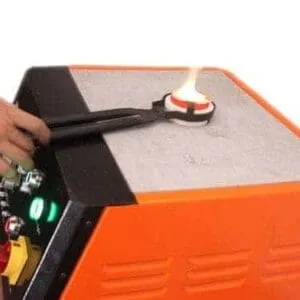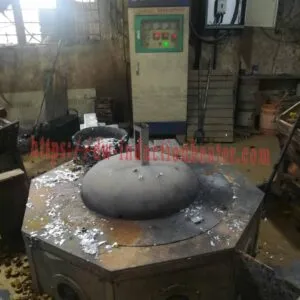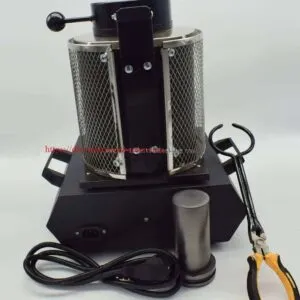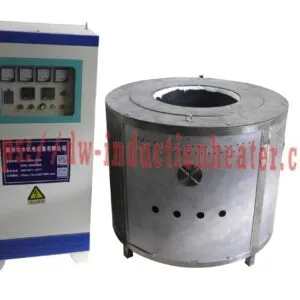
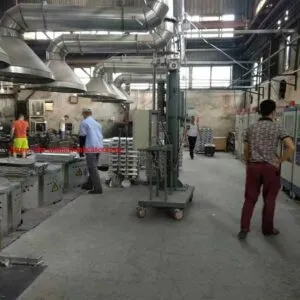
Aluminum Can Recycling Machine
Aluminum Scrap Recycling Furnace: 200–1500 kg Induction Melting for Scrap, Ingots and Cans
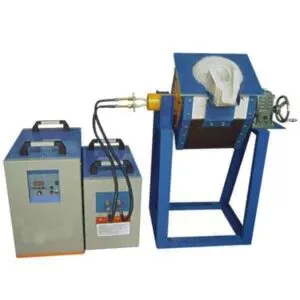
An aluminum scrap recycling furnace melts aluminium scrap back into usable metal without a flame. Medium-frequency current runs through a water-cooled copper coil around a conductive crucible; the alternating magnetic field induces eddy currents in the crucible wall, and the heat passes from the crucible into the charge. HLQ Induction Equipment builds these furnaces in the SMJD series — 13 models from 60 kW to 200 kW, with an aluminium melting capacity from 150 kg to 1,200 kg per heat and a maximum temperature of 1800 °C.
What makes a recycling furnace different from a general-purpose melting furnace is the charge. Scrap arrives coated, painted, oxidised and mixed, and the process has to deal with the residue. At 660 °C the aluminium turns liquid while the coating and paint residue floats to the surface as dross, which is skimmed off with a steel ladle and processed separately. This page covers the equipment, the published specifications, the dross and its effect on yield, the process step by step, and a selection guide for sizing a cell.
Quick Answer
An aluminum scrap recycling furnace heats scrap with an electromagnetic field rather than a flame, so no combustion product enters the melt. Aluminium melts at 660.32 °C (1220.6 °F) and is held for pouring in the 680–760 °C range. The medium-frequency supply runs at 1–20 kHz, with a published band of 0.5–20 kHz for aluminium. The rotating field stirs the melt as it heats, so temperature and composition are uniform before the pour. Coating and paint residue floats up as dross and is skimmed off; the dross still contains recoverable metal and is processed rather than discarded. Melting and heating aluminium to 720 °C costs a theoretical 0.30 kWh/kg before furnace losses.
| Parameter | Value |
|---|---|
| Melting point, pure aluminium | 660.32 °C (1220.6 °F) |
| Production melt range | 680 – 760 °C |
| Supply frequency | 1 – 20 kHz medium frequency |
| Published frequency band for aluminium | 0.5 – 20 kHz |
| Model range (SMJD series) | 60 – 200 kW input, 13 models |
| Aluminium melting capacity | 150 kg to 1,200 kg per heat |
| Maximum furnace temperature | 1800 °C |
| Crucible materials | Graphite, SiC-graphite, high-alumina |
| Dross handling | Skimmed with a steel ladle; cooled before processing |
| Metal filtration | Ceramic foam filters where clean metal is required |
| Metal loss to dross in the melt shop | 5 – 15 % (industry data) |
| Recoverable metal in white dross | 20 – 45 % (industry data) |
For the underlying technology, see what is an induction melting furnace. For the wider HLQ melting range, see induction melting equipment.
Table of Contents
- Quick Answer
- What is the Aluminum Scrap Recycling Furnace?
- Key Applications
- Suitable Materials
- Working Principle
- Technical Specifications
- Recommended Model Selection
- Process Workflow
- Common Problems and Solutions
- Engineering Selection Guide
- Advantages and Limitations
- Why Choose HLQ?
- 6 Core FAQs
What is the Aluminum Scrap Recycling Furnace?
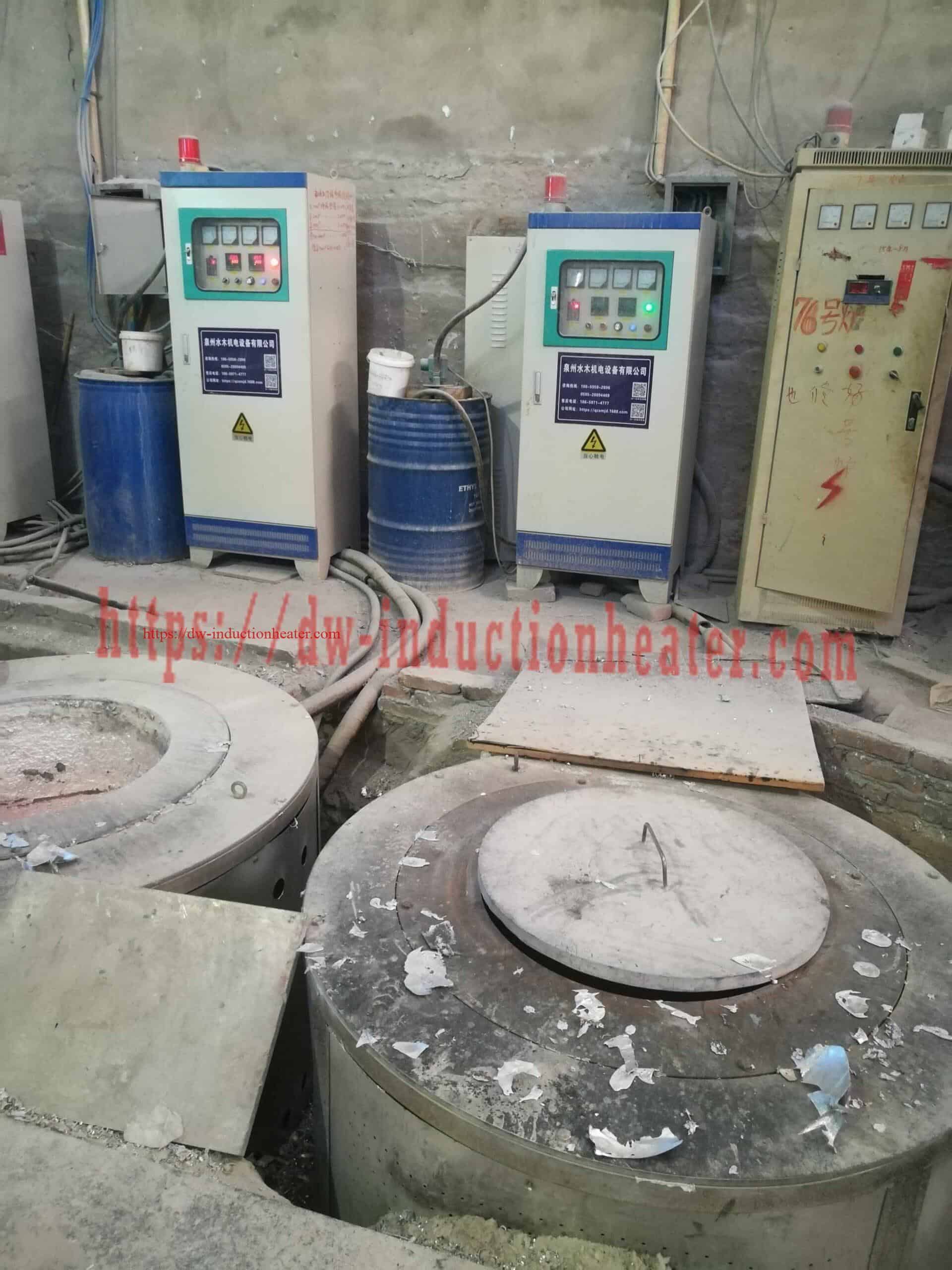
An aluminum scrap recycling furnace is a batch induction melting furnace built for a feedstock that is not clean metal. The principle is the same as any induction melting furnace: a medium-frequency power supply drives alternating current through a water-cooled copper coil that encircles a conductive crucible, the coil’s alternating magnetic field induces eddy currents in the crucible wall, and the resistance of the metal converts that energy into heat, which passes into the charge. What differs is everything around the melt — the charge is heterogeneous, the residue has to go somewhere, and yield rather than temperature alone determines whether the operation makes money.
Three features distinguish the recycling duty. First, the residue. Can coatings, paint, printing inks and the surface oxide on the scrap do not melt with the aluminium; they float to the surface and form a dross layer that is skimmed off with a steel ladle. Second, the yield. Aluminium expands about 12 % in volume as it melts, and during the melt metal droplets become trapped in the oxide lattice of the dross; melt shops typically lose 5–15 % of the metal this way. Third, the alloy mix. Scrap arrives as a blend of alloys, and sorting the charge before it goes in is usually worth more than any efficiency gain inside the furnace.
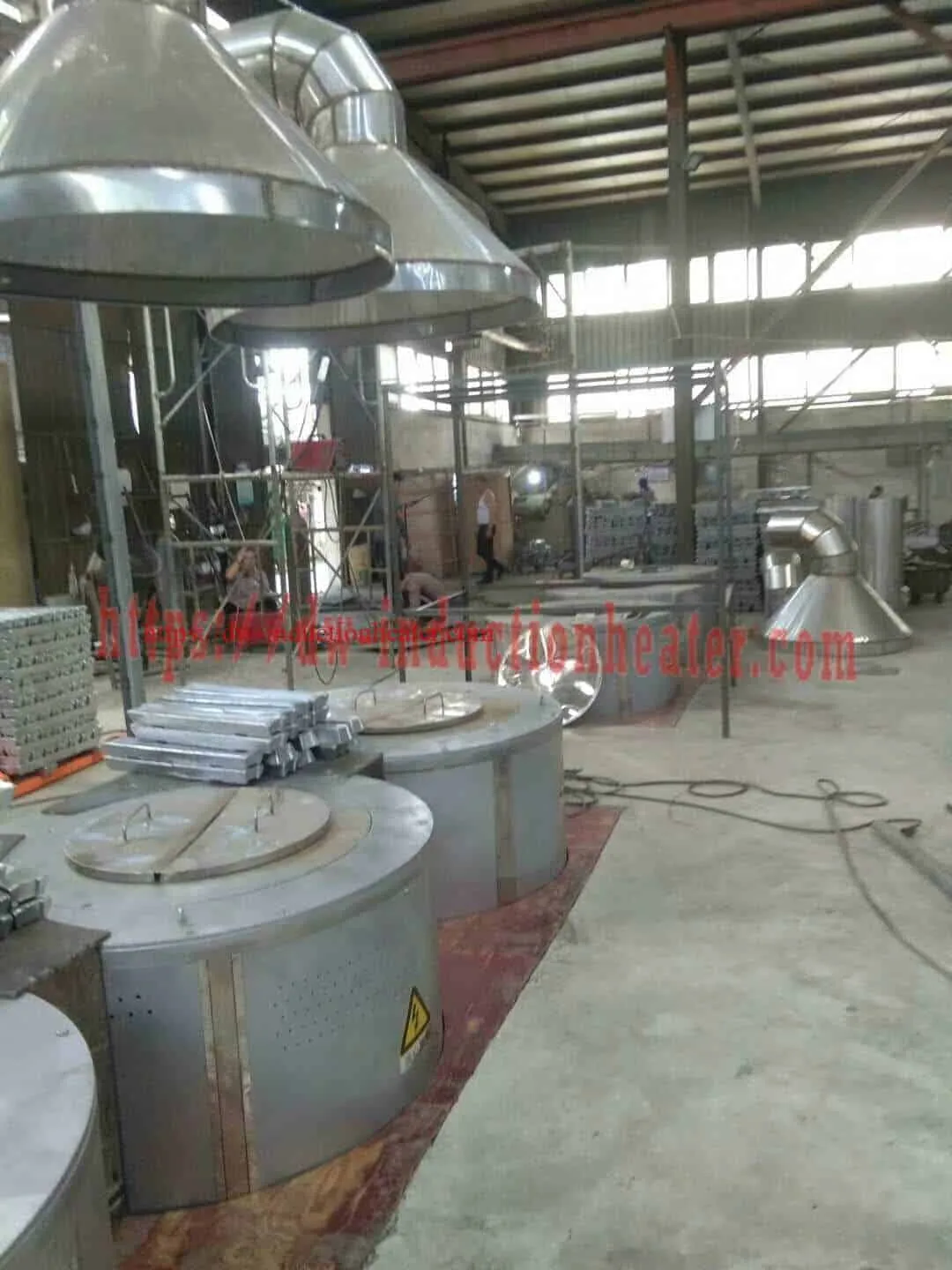
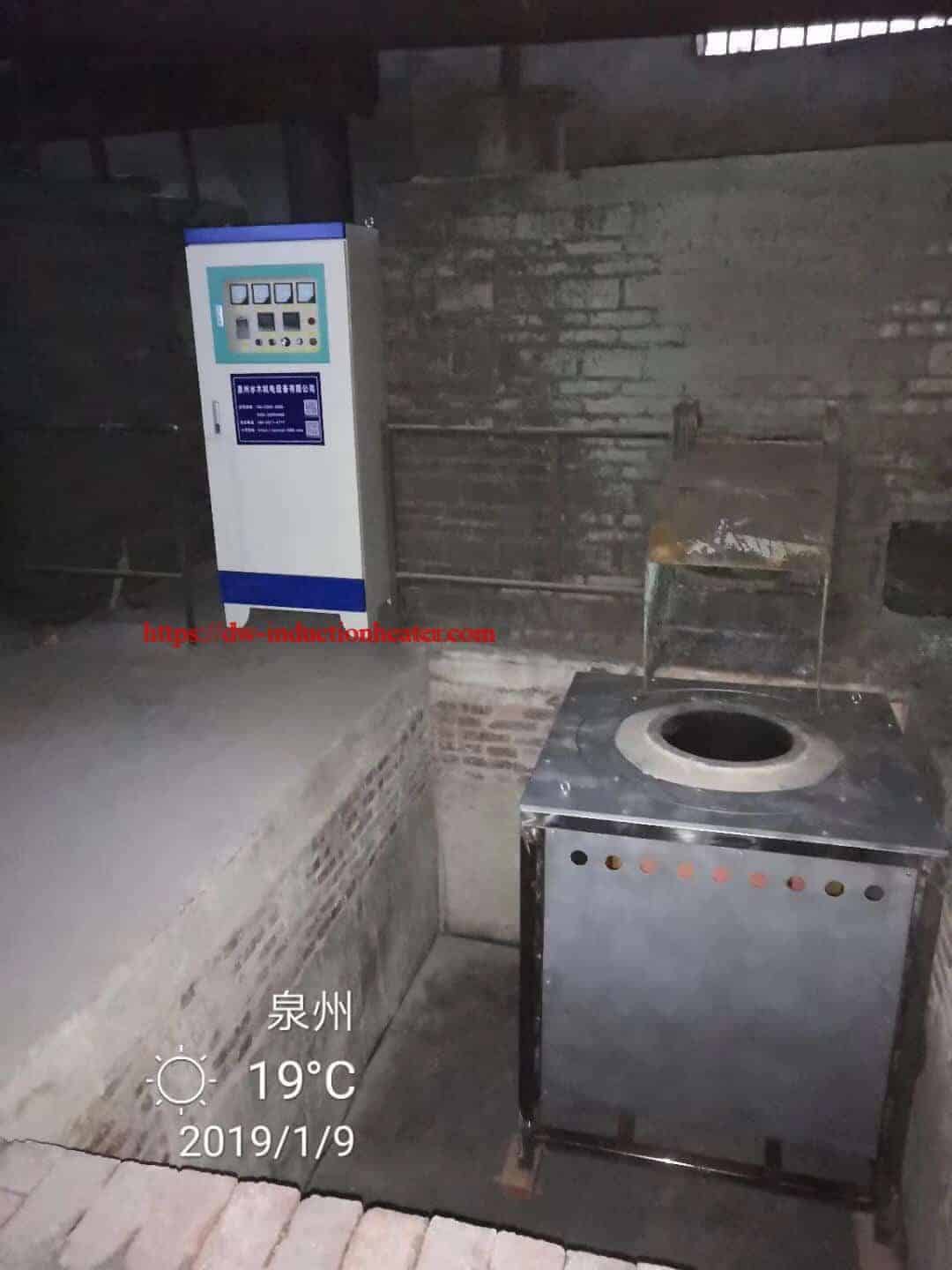
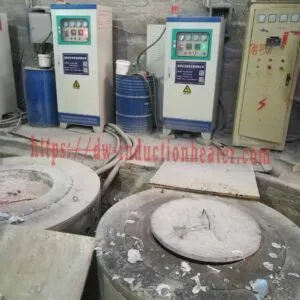
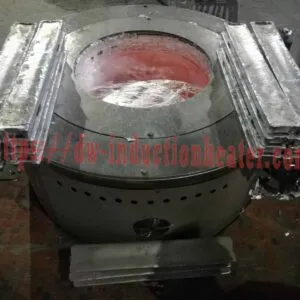
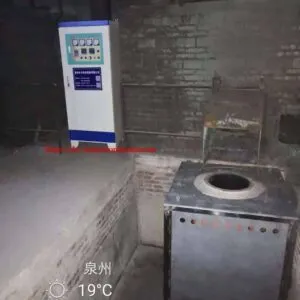
HLQ publishes this furnace in the SMJD series, in capacities from 150 kg to 1,200 kg of aluminium per heat, with input power from 60 kW to 200 kW and a maximum furnace temperature of 1800 °C. The published case study describes a 160 kW generator with a 500 kg crucible, a hydraulically tilting furnace, a closed water-tower cooling circuit, ceramic foam filters on the pour and a 2 t overhead crane serving the cell.
One term is worth separating clearly, because the equipment differs. An induction furnace melts metal in a crucible. An induction heater heats a formed part in a coil. They are not the same machine and one does not substitute for the other: reprocessing dross, for example, needs dedicated hot dross processing or rotary equipment, not an induction melting furnace. The site’s aluminum recycling equipment overview sets out where each belongs.
Key Applications
Aluminium scrap recycling furnaces are used wherever aluminium returns to the market in a form that has to be melted again. The applications HLQ publishes for this equipment are:
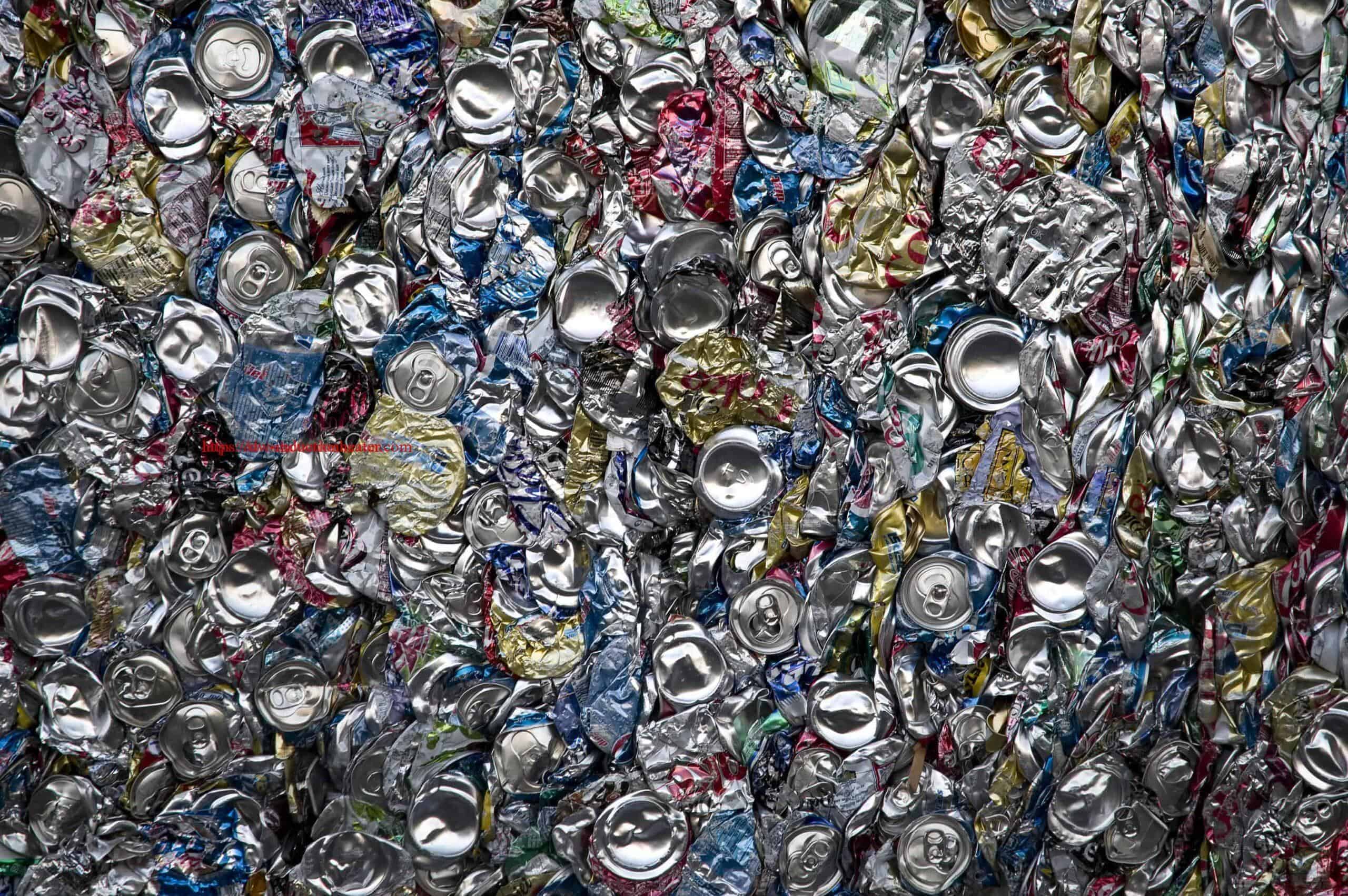
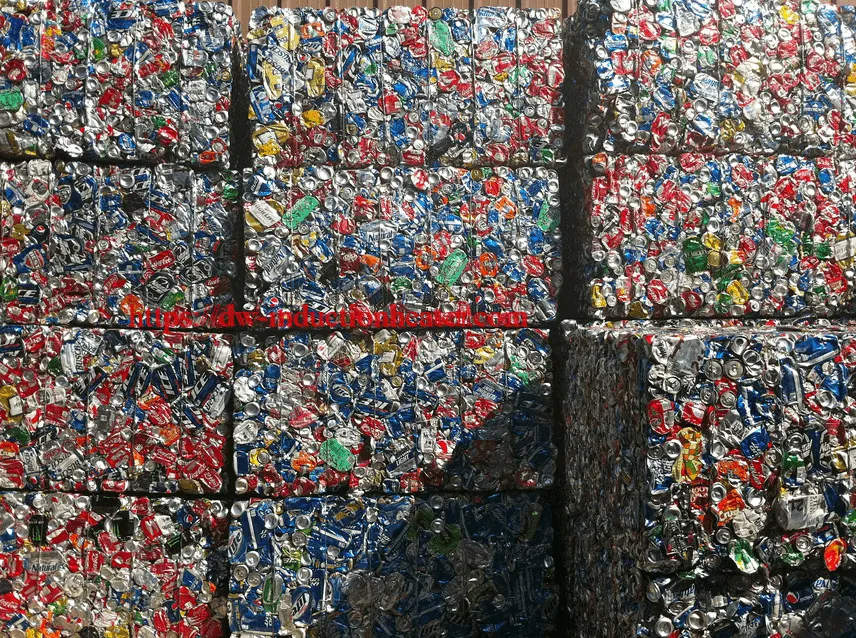
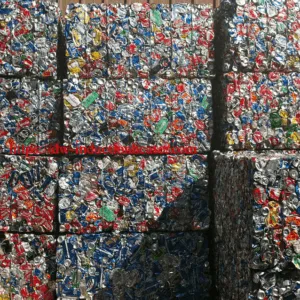
- Used beverage container recycling. Shredded cans are the largest single component of processed aluminium scrap. The coating and the lacquer become dross, and the metal underneath is remelted into ingot for the alloying and casting market. HLQ publishes this duty on the aluminum can recycling furnace page and in the aluminium cans recycling melting note.
- General scrap and remelt processing. Extrusion scrap, machining swarf, turnings, window and door profiles, and foundry returns are melted back to usable metal. This is the duty described on the aluminum scrap melting furnace page.
- Ingot production for alloying. Clean remelt and primary ingot are combined in the crucible to bring the melt to the alloy the customer needs, at the 680–760 °C production range, ready to cast.
- Secondary smelting of low-grade material. The published SMJD table lists aluminium scrap, aluminium slag and pop cans explicitly in the aluminium capacity column, so the equipment is specified for mixed and contaminated feed.
- Dross and slag reprocessing. The published range covers aluminium slag as a charge material, so dross streams can be returned to the cell as part of a remelt rather than treated as waste. This is a secondary duty that requires the metallurgy to be right; see the limitations section below.

Related HLQ melting equipment: the series connection mid frequency aluminium melting furnace for continuous remelt work, the aluminium scraps recycling furnace variant of this page, and the tilting crucible melting furnace for pouring directly to moulds.
Suitable Materials
Any conductive metal can be melted, but a recycling furnace is only as good as its feedstock. The table below lists the metals published for these furnaces, with the melting points that set the crucible and the furnace design.
| Metal | Melting point | Published frequency band | Theoretical heat content | Notes for the recycling duty |
|---|---|---|---|---|
| Aluminium and alloys | 660.32 °C (1220.6 °F) | 0.5 – 20 kHz | ≈ 0.30 kWh/kg | The primary duty for this furnace. Non-magnetic and very conductive, so coupling is strong at low frequency. Expands about 12 % in volume on melting. |
| Aluminium alloy scrap | Alloy dependent | 0.5 – 20 kHz | ≈ 0.30 kWh/kg | Published in the SMJD aluminium capacity column. Sorting the alloys before charging controls the melt composition. |
| Pop cans (used beverage containers) | 660.32 °C | 0.5 – 20 kHz | ≈ 0.30 kWh/kg | Published in the SMJD aluminium capacity column. The coating is what becomes dross, so decoating before charging improves yield. |
| Copper | 1084.62 °C | 0.25 – 8 kHz | ≈ 0.19 kWh/kg | Published in the SMJD copper, gold and silver capacity column, together with scrap and slag. |
| Gold and silver | 1064.18 °C / 961.78 °C | 1 – 80 kHz | ≈ 0.06 kWh/kg (gold) | Published in the SMJD copper, gold and silver capacity column with scrap and slag. |
| Steel and stainless steel | Liquidus depends on grade | 0.5 – 2.5 kHz | ≈ 0.40 kWh/kg | Published in the SMJD steel and stainless column; the same cells run at a lower frequency for this duty. |
| Brass and bronze | Alloy dependent | Published for the DW-MF series | — | Covered by the medium-frequency DW-MF melting furnaces. |
Melting points are standard reference data; the frequency bands and theoretical heat contents are as published by HLQ. The theoretical heat content is the energy to bring the metal from 20 °C to the stated temperature and complete the melt, before any furnace loss.
Two properties of aluminium matter directly in a recycling furnace. It expands about 12 % in volume on melting, from 2.699 g/cm³ solid to 2.375 g/cm³ liquid, so the crucible must carry pour space for it and the dross layer has room to form. And the electrical resistivity of liquid aluminium is roughly an order of magnitude higher than that of solid aluminium, so the coil loading changes completely between the cold charge and the full bath. A supply matched only for the solid state will trip or under-run once the metal is liquid — which is why HLQ’s published closed-loop power control with PLL frequency tracking and automatic load impedance matching matters here, where the charge is variable and the melt is not a steady load.
Working Principle
Induction melting works on the transformer principle. Alternating current in the coil produces an alternating magnetic field; that field links the conductive crucible and induces circulating eddy currents in it; the resistance of the crucible metal converts that current into heat; and the heat conducts into the charge. Nothing touches the metal, and the energy goes into the metal rather than into the surrounding air.
- Skin effect. The induced current concentrates in a surface layer of the crucible. Because the crucible wall is thin relative to the skin depth at medium frequency, the wall becomes a near-uniform thermal source around the charge.
- Electromagnetic stirring. The same rotating field exerts a force on the conducting melt and circulates it. In a recycling duty this is what stops the newly charged cold scrap from sitting in a lump in the middle of a bath, and what keeps the alloy composition uniform across the melt.
- Load matching. The impedance changes continuously from a cold solid charge through melting to a full bath of liquid metal. Variable scrap makes it harder still, because each batch brings a different mix.
- Segregation and dross formation. The residue does not dissolve; it floats. The oxide skin on every piece of scrap, together with the coating and paint, forms a surface layer that is skimmed off. Aluminium oxidises readily — the reaction is 4Al + 3O₂ → 2Al₂O₃ — and the alumina formed is what traps metal droplets as the dross cools.

The physics of the field is set out on HLQ’s induction heating principle page, and the technology in general in the induction melting furnace explainer.
Technical Specifications
SMJD mid-frequency aluminium series — published data
| Model | Input power | Aluminium, alloy, scrap, slag, pop can | Steel and stainless | Cu / Au / Ag (scrap, slag) | Max temperature |
|---|---|---|---|---|---|
| SMJD-463 | 60 kW | 200 kg | 200 kg | 500 kg | 1800 °C |
| SMJD-480 | 60 kW | 150 kg | 150 kg | 500 kg | 1800 °C |
| SMJD-580 | 80 kW | 200 kg | 200 kg | 600 kg | 1800 °C |
| SMJD-600 | 60 kW | 230 kg | 230 kg | 560 kg | 1800 °C |
| SMJD-900 | 120 kW | 300 kg | 300 kg | 900 kg | 1800 °C |
| SMJD-905 | 80 kW | 300 kg | 300 kg | 900 kg | 1800 °C |
| SMJD-1250 | 80 kW | 400 kg | 400 kg | 1200 kg | 1800 °C |
| SMJD-1250 | 120 kW | 450 kg | 450 kg | 1350 kg | 1800 °C |
| SMJD-1500 | 120 kW | 500 kg | 500 kg | 1500 kg | 1800 °C |
| SMJD-1550 | 120 kW | 520 kg | 520 kg | 1560 kg | 1800 °C |
| SMJD-1700 | 160 kW | 600 kg | 600 kg | 1700 kg | 1800 °C |
| SMJD-2300 | 160 kW | 800 kg | 800 kg | 2000 kg | 1800 °C |
| SMJD-3100 | 200 kW | 1200 kg | 1200 kg | 3000 kg | 1800 °C |
Source: HLQ’s published SMJD table, reproduced in the parameter PDF at SMJD melting aluminium furnace parameters. Two caveats on the published table: the first and third numeric columns carry identical values in every row under a merged header, and the header wording differs between the English and Chinese versions, so the PDF is the authoritative version. The page also publishes two different overall capacity ranges for the same series — 200^1200 kg on the newer pages and 200^1500 kg on the legacy ones — which should be reconciled. The aluminium column shown here matches the 200^1200 kg range and is the one relevant to this duty.
Published operating steps
- The operator charges aluminium parts, ingots or scrap into the induction melting furnace and starts the furnace.
- Additional charge is advisable, because molten aluminium transmits heat better than solid metal.
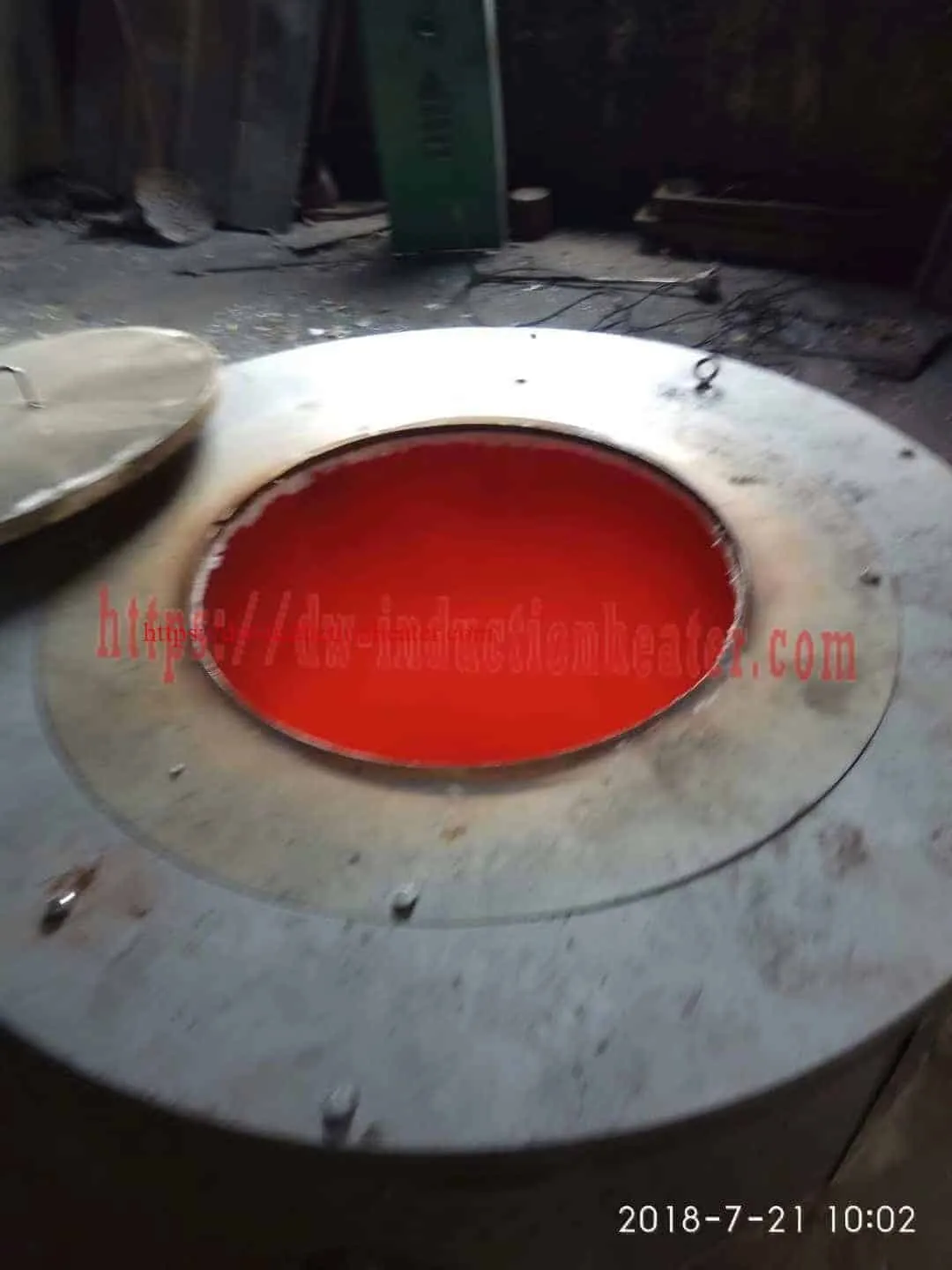
- At the melting point the aluminium turns liquid.
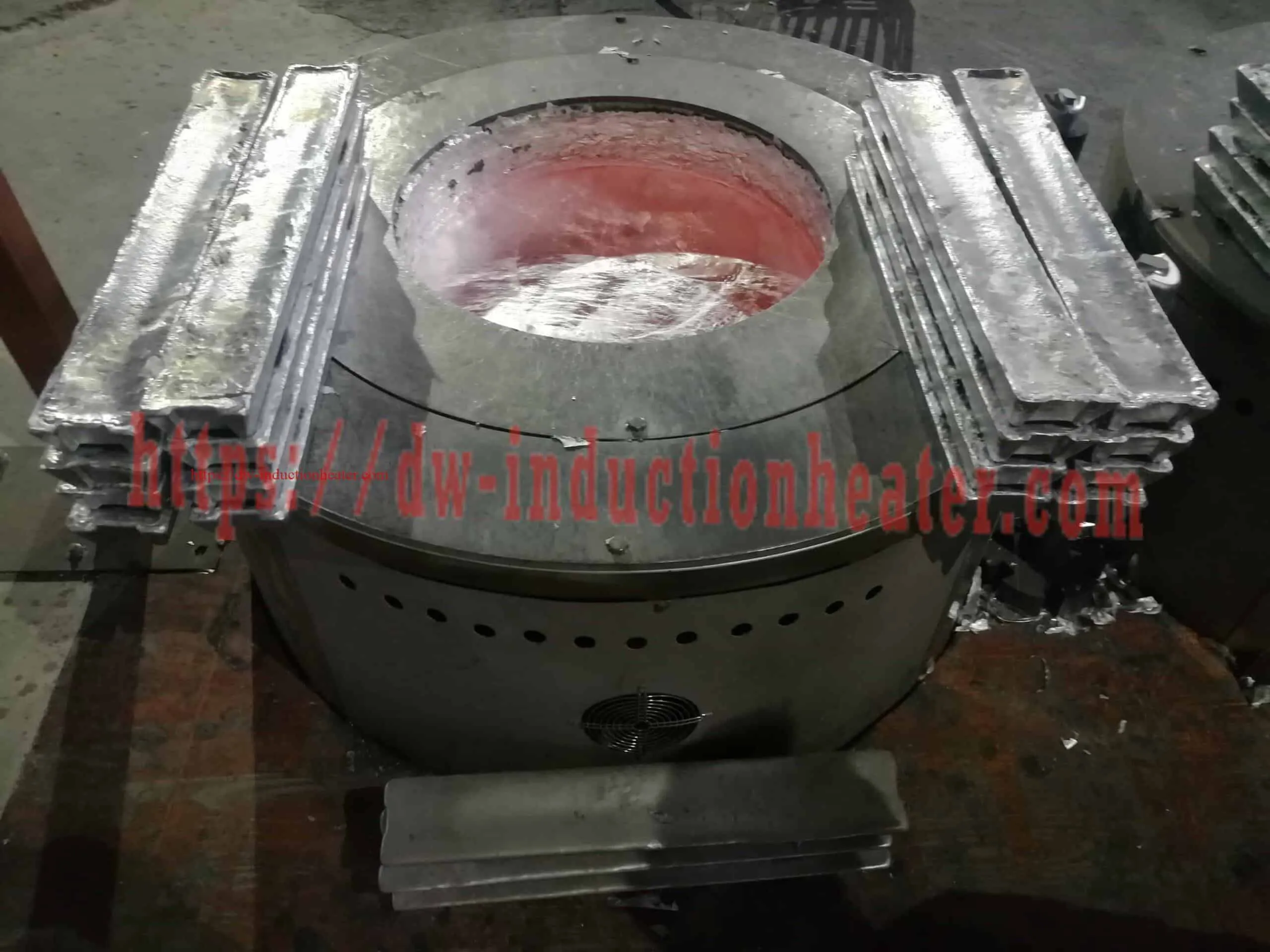
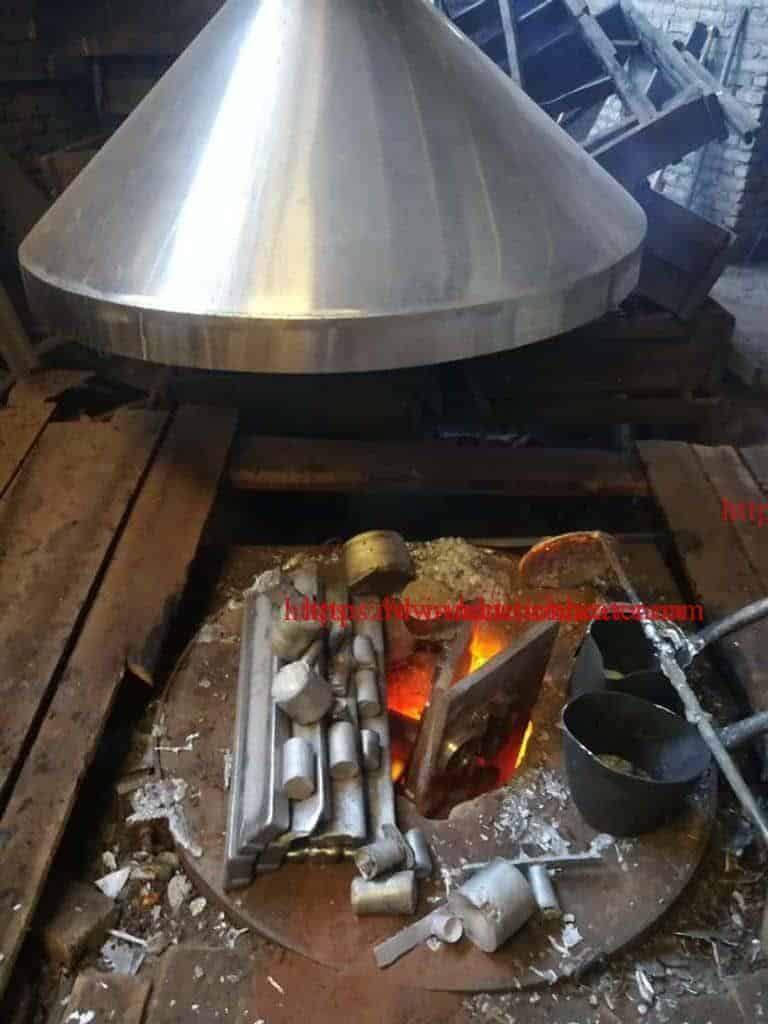
- Residue from can coatings and paint floats to the surface; this byproduct is dross, and it is skimmed off with a steel ladle.
- The dross must be cooled before it is handled or disposed of.
Step 5 is the point at which the original pages stop. Dross is not simply waste: it retains recoverable metal and is a saleable or reprocessable product. See the dross section below.
Published cell features
| Feature | Published specification |
|---|---|
| Furnace structure | Integral polycrystalline mullite fibre; small volume, good insulation, low energy consumption, rated for temperatures above 1200 °C, long service life |
| Heating control | PID heating control system; even heating, prevents melt temperature drift, uniform metal composition, higher product yield |
| Temperature controller | LED digital, measurement and control accuracy up to ±3 °C |
| Duty cycle | 100 % load duration at maximum power, supporting 24-hour continuous operation |
| Power | Adjustable to the working condition; simple operation |
| Protection | Over-voltage, under-voltage, phase loss, over-current and over-temperature; real-time parameter display, fault diagnosis and alarm; leakage auto-alarm with automatic power cut-off |
| Published application case | 160 kW generator, 500 kg crucible, hydraulic tilting induction furnace, closed water tower cooling, ceramic foam filters, 2 t overhead crane |
Aluminium melting reference data
| Property | Value | Note |
|---|---|---|
| Melting point | 660.32 °C (1220.6 °F) | The original pages quote 1220.66 °F, which corresponds to about 650 °C. The standard value is 1220.58 °F. |
| Production melt range | 680 – 760 °C | Practical range for pouring. |
| Specific heat capacity | 0.897 kJ/kg·K | Standard reference value. |
| Latent heat of fusion | 390 kJ/kg (10.71 kJ/mol) | Standard reference value. |
| Density, solid at 20 °C | 2.699 g/cm³ | Standard reference value. |
| Density, liquid at melting point | 2.375 g/cm³ | A 12 % loss of density, so the metal expands on melting. |
| Theoretical heat content at 720 °C | ≈ 0.30 kWh/kg | Computed: 1,071 kJ/kg, which matches HLQ’s published 0.30 kWh/kg. Real consumption is higher because of crucible, lining and holding losses. |
Dross reference data
| Property | Value | Note |
|---|---|---|
| Formation reaction | 4Al + 3O₂ → 2Al₂O₃ | Aluminium oxidises readily at melt temperature. |
| Metal loss in the melt shop | 5 – 15 % | Industry data. The main mechanism is metal droplets trapped in the lattice-like oxide structure as the dross cools. |
| White dross, recoverable metal | 20 – 45 % | From primary smelting and clean scrap remelting. The highest recovery potential of the dross types. |
| Black dross, Al₂O₃ content | 20 – 50 % | From secondary melting with flux. |
| Black dross, salt and flux | 40 – 55 % | Same source. Requires salt cake processing to recover the remaining metal. |
| Recovery routes | Hot dross processing machine or rotary furnace | Not an induction melting furnace. The dross is melted out to give metal, and the oxide residue goes to refractory, abrasive, ceramic or cement applications. |
| Safety | Salt cake and black dross can release ammonia gas on contact with water | Dry covered storage and dust control are required. |
| Indicative value | Approximately $500 – $1,800 per metric tonne | Tracks the base aluminium price and the regional scrap market. Untreated dross trades around $900 per tonne. |
Melting and dross composition figures are standard industry and academic reference data, not HLQ specifications. The dross values are drawn from the peer-reviewed review “Valorization of Residue from Aluminum Industries” in Materials (2024) and from commercial industry sources; they are indicative and vary with the feed.

The wider HLQ melting range is covered on the induction melting product overview and on the induction heating systems page.
Recommended Model Selection
Selection for a recycling duty starts with the throughput and the feed, not with the kW rating. The table below maps the published duties to the published equipment.
| Requirement | Published equipment | Notes |
|---|---|---|
| Small remelt shop, 150 kg heats | SMJD-480, 60 kW, 150 kg | Or SMJD-463 at 60 kW for 200 kg if the batch can be larger. |
| General scrap remelt, 200 kg | SMJD-463, 60 kW, 200 kg | Also available at 80 kW as SMJD-580 when the cycle has to be shorter. |
| Mid-volume recycling, 300 kg | SMJD-900, 120 kW, 300 kg | Or SMJD-905 at 80 kW for the same 300 kg capacity if the power supply is limited. |
| Foundry-grade recycling, 500 kg | SMJD-1500, 120 kW, 500 kg | The published case study uses a 160 kW generator with a 500 kg crucible, hydraulic tilting and ceramic foam filtration. |
| High-volume recycling, 800 – 1,200 kg | SMJD-2300, 160 kW, 800 kg; SMJD-3100, 200 kW, 1,200 kg | 100 % load duration at maximum power supports 24-hour operation. |
| Continuous remelt line | Series-connected mid-frequency build | Published as a separate configuration for low-density, low-melting-point non-ferrous metals. |
| Cell also handling other metals | DW-MF-15 to DW-MF-160, 1 – 20 kHz | Published for steel, copper, bronze, gold, silver, tin, magnesium and stainless steel as well as aluminium. |
Three practical selection points. First, size on the tonnes of saleable metal per day, then work back through the yield loss to the tonnes of scrap consumed — at 5–15 % lost to dross, a 500 kg cell needs roughly 530–590 kg of clean-equivalent charge per heat. Second, note that the same SMJD model appears at two different power ratings (SMJD-1250 at both 80 kW and 120 kW); the higher build exists to shorten the cycle, and the choice should be made against the cycle time the operation actually needs. Third, specify the dross handling and the filtration at the same time as the furnace, because they determine the yield the cell delivers, and they are the two items the published product pages leave out.
The 2025-built configuration — hydraulic, gearbox or manual tilting, closed-loop cooling tower or industrial chiller, thermocouple, immersion probe or IR pyrometer, manual, timer, PLC or HMI control, and 3-phase 380 / 415 / 440 / 480 V 50 / 60 Hz configurable by country — is documented on the induction aluminium melting furnace for melting and recycling page.
Process Workflow

- Sort. Separate the scrap by alloy and remove non-aluminium material. Sorting before the charge is worth more than any efficiency gain inside the furnace, because it controls the melt composition and removes the material that would otherwise end up in the dross.
- Decoat. Strip the can coating and the paint. Everything removed here is material that would otherwise burn into the melt, oxidise and end up as dross — that is, it becomes a loss rather than a saleable residue.
- Charge. Load the scrap into the crucible and start the furnace. As the melt forms, add further charge, because molten aluminium transmits heat better than solid metal — this is the published operating practice and it shortens the cycle.
- Melt. The medium-frequency field heats the crucible and the charge turns liquid at 660 °C. The supply manages the impedance change from cold solid scrap through to a full liquid bath.
- Skim. Coating residue and oxide float to the surface as dross and are skimmed off with a steel ladle. Skim promptly and skim clean: every droplet of metal left in the dross is metal that will be hard to recover, because the oxide lattice traps it as the dross cools.
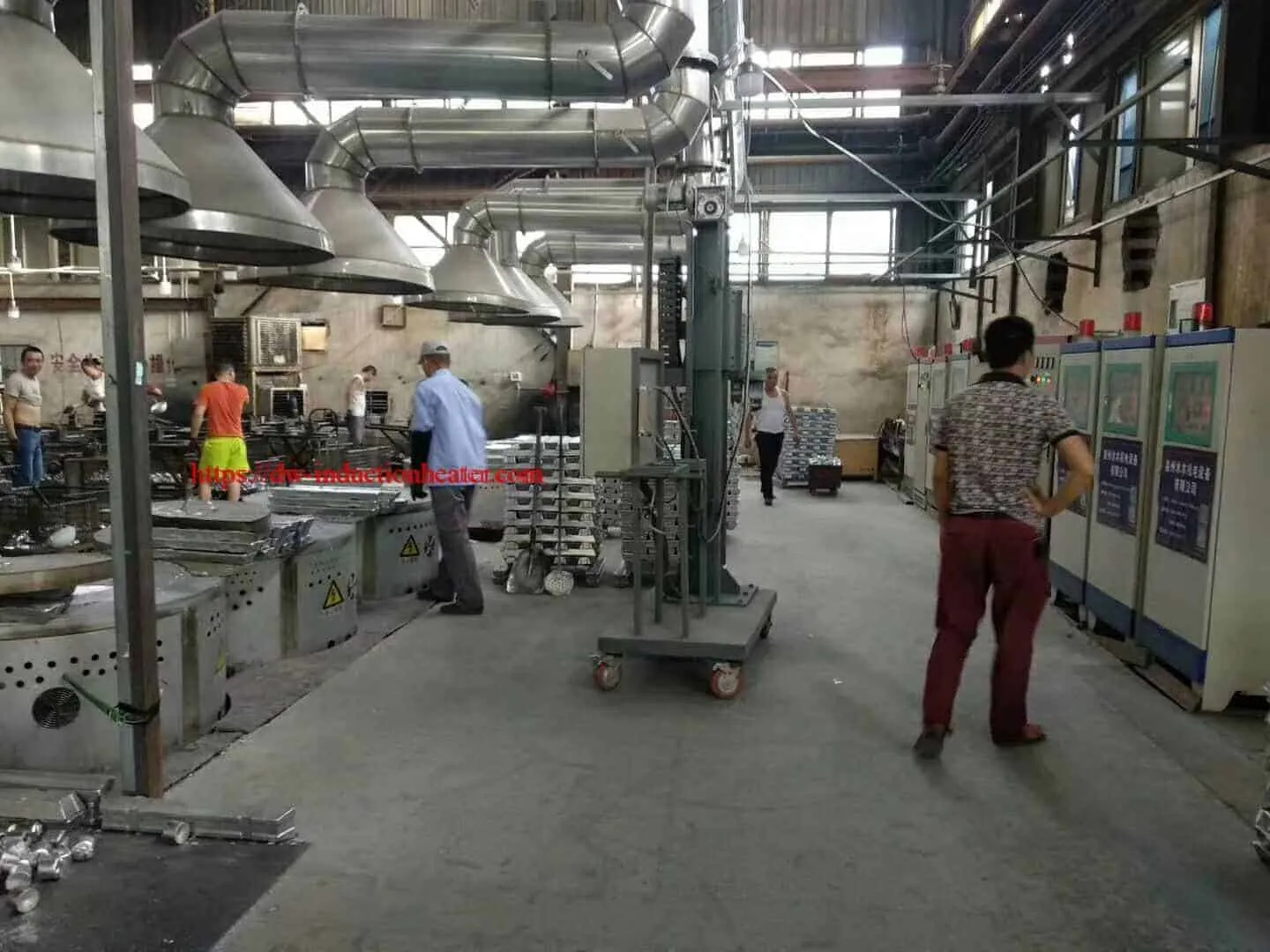
- Pour. Tilt the furnace and pour the metal. Where the metal has to come out clean, filter the pour stream through ceramic foam, which is what the published 500 kg case does.
The dross then goes to its own process: cool it, then recover the metal from it in a hot dross processing machine or a rotary furnace, and sell or reuse the recovered metal. The dross itself is worth roughly $500–$1,800 per tonne, which is why this branch is part of the economics rather than a disposal problem. HLQ publishes more on the recycling route on the aluminium recycling melting page and on the aluminium scraps recycling melting and process note.
Common Problems and Solutions
| Problem | Likely cause | Corrective action |
|---|---|---|
| Supply trips as the metal becomes liquid | Impedance changes sharply between the solid charge and the liquid bath, and scrap makes the load variable | Use automatic load impedance matching and closed-loop power control; verify the compensation capacitor bank matches the coil |
| Coil overheats or scales | Cooling flow or pressure too low, or the loop is fouled | Check flow, pressure and temperature monitoring; clean the circuit; confirm the chiller or tower capacity for full duty |
| Excessive dross and metal loss | Coated scrap charged without decoating, or the melt held too long or too hot | Decoat before charging, pour within 680–760 °C, avoid long holds, skim promptly and thoroughly |
| Dross carries too much recoverable metal | Metal droplets trapped in the oxide as the dross cools, or poor skimming | Skim while the dross is still fluid; process the dross promptly in a dedicated recovery route rather than letting it cool in the ladle |
| Pour stream breaks or the furnace will not hold the tilt | Tilt mechanism overloaded or not centred | Use hydraulic tilting for larger batches; verify trunnion alignment and crucible seating |
| Oxide inclusions in the cast product | Entrained dross carried into the pour | Skim the bath clean immediately before the pour and filter the pour stream through ceramic foam |
| Melt composition off target | Scrap not sorted by alloy before charging | Sort the charge; do not rely on the furnace to correct the alloy |
| Contamination in the melt | Oil, paint or non-metal debris in the charge | Decoat and clean the charge; keep ferrous and non-aluminium items out of the crucible |
| Crucible wear or cracking | Over-stirring, thermal cycling from varied charges, or a degraded lining | Inspect the crucible and lining at every changeover and replace on a defined schedule |
| Power factor and energy consumption worsen over time | Capacitor bank degraded, or cooling performance degraded | Test the capacitor bank and the cooling loop together; both degrade the same way |
| Cell cannot meet the required throughput | Batch size, melt rate and yield do not match the shift pattern | Size on saleable metal per day, not on scrap consumed; consider two smaller cells rather than one large one |
Engineering Selection Guide
- Define the throughput in saleable metal. Kilograms of metal poured per day, not kilograms of scrap charged. Work back from there through the 5–15 % dross loss to size the cell.
- Characterise the feed. Alloy mix, coating weight, moisture, contamination rate, and how much of it is decoated before it arrives. The feed variation, not the furnace, is usually the largest variable in the operation.
- Decide the sorting and decoating step. This is upstream of the furnace and it determines the yield. A cell cannot recover value from metal that was never charged, or from residue that was allowed to burn into the melt.
- Choose the series and model on the aluminium column of the SMJD table. SMJD-480 to SMJD-3100 cover 150 kg to 1,200 kg per heat at 60–200 kW.
- Choose the frequency from the bath size and the feed. The published band for aluminium is 0.5–20 kHz. Lower frequency gives deeper penetration and stronger stirring, which matters when the charge is a heavy mass of mixed scrap; higher frequency heats a smaller bath faster.
- Choose the crucible and the lining to suit the charge. Graphite, SiC-graphite or high-alumina. A variable scrap charge with coating residue is a hard duty on the crucible, because the thermal cycling from cold scrap into a hot bath is severe.
- Design the cooling circuit as part of the cell. A cooling tower or industrial chiller, a pump, and monitoring of flow, pressure and temperature on the coil, the capacitors and the power supply. The published 100 % load duration at maximum power assumes this loop is correctly sized.
- Design the dross handling and the filtration. A skimming station, a covered and cooled dross bin, and — where the metal has to come out clean — ceramic foam filtration on the pour. This is where the yield is won or lost, and it is absent from the published product pages.
- Decide the tilt and the pour method. Manual, gearbox or hydraulic, against how much metal is poured at once and how the dross is skimmed during and after the pour.
- Define the measurement method and the acceptance criteria. Immersion probe for the melt temperature, the calibration interval, and the pour temperature window — before the first heat, not after. Without this, the furnace produces metal but not a repeatable specification.
- Plan the maintenance around the consumables. Crucible wear, lining condition, capacitor condition and cooling performance all degrade together. The published melt times of 30–50 minutes from cold and 20–30 minutes hot only hold if the cell is in the condition it was in when those figures were measured.
Advantages and Limitations
Advantages
- No combustion in the metal. No flame, no flue gas, no soot, no combustion air. In a recycling duty this is decisive, because a fuel-fired furnace would add combustion products to a charge that is already dirty.
- No combustion plant to run. No gas line, no burner to maintain, no flue to duct, no chimney, and no fuel price exposure. For a recycling operation that has to control what leaves the site, that removes a whole permit and maintenance category.
- Fast cycle and high availability. Published melt times of 30–50 minutes from cold and 20–30 minutes hot, with 100 % load duration at maximum power for 24-hour continuous operation.
- Electromagnetic stirring as standard. The rotating field circulates the melt, so cold scrap is incorporated into the bath instead of sitting in it, and composition is even across the melt.
- Precise control. PID heating control and an LED digital temperature controller with ±3 °C accuracy, keeping the melt in the production window and off the dross-generating overheat.
- Compact and low ambient loss. Because the heat is in the metal and not in a combustion chamber, the workshop stays cooler and there is no large refractory mass to heat up and hold heat.
- Fully automatic control available. Manual, timer, PLC or HMI control, with protections for over/under-voltage, phase loss, over-current, over-temperature and leakage detection with automatic power cut-off.
- Clean metal on demand. With ceramic foam filtration in the pour stream, as used in the published 500 kg case, the metal can go straight to the alloying or casting stage.
Limitations
- The furnace does not sort, clean or decoat. All three are upstream. A cell fed unsorted, coated scrap will produce dross and an off-spec melt, and no setting on the furnace will fix it.
- 5 – 15 % of the metal is lost to dross. This is industry data, and it is the single largest cost in the operation. It is a metallurgical consequence of aluminium oxidising readily and trapping droplets in the oxide lattice.
- The dross needs its own process. Recovering the metal from dross requires hot dross processing equipment or a rotary furnace. An induction melting furnace is not that equipment, and the published pages do not draw the distinction.
- Published specification gaps. For the SMJD range the electrical input in volts, amps and kVA, the output frequency, the cooling-water flow and pressure, the crucible dimensions and the energy consumption in kWh per kg are not published, and the capacity table header is ambiguous. These have to be obtained from HLQ and confirmed against the parameter PDF.
- Two conflicting capacity ranges are published for the same series — 200^1200 kg and 200^1500 kg — which is a credibility problem for a buyer comparing quotations.
- Variable feed makes the load variable. A cell running a single alloy at a fixed batch size is a much easier duty to control than one running mixed scrap, and the published 100 % duty figure assumes the equipment is being used as intended.
- Batch economics. A batch furnace sits idle between the pour and the next charge. For a low-volume remelt operation, that idle time can dominate the cost per kilogram of saleable metal.
- No recovery from a failed heat. A power interruption mid-melt leaves a partly melted, oxidised charge in the crucible that has to be dug out.
Why Choose HLQ?
- A recycling furnace and the rest of the melting range from one supplier. The SMJD aluminium series from 60 kW to 200 kW and 150 kg to 1,200 kg, the series-connected mid-frequency build for continuous remelt, and the DW-MF medium-frequency line from 15 kW to 160 kW at 1–20 kHz for steel, copper, bronze, gold, silver, tin, magnesium and stainless steel as well as aluminium. A recycler that also melts copper or steel does not have to change supplier or re-engineer the cell — see the induction heating systems overview.
- Both supply technologies. IGBT medium-frequency, SCR/KGPS and dual-output supplies for running two furnaces from one cabinet, with PLL frequency tracking, automatic load impedance matching and closed-loop power control. In a recycling duty, where the load changes with every batch of scrap, that tracking is what keeps the melt stable.
- Published application data. The published 500 kg case gives the generator rating, the crucible capacity, the tilting arrangement, the cooling circuit, the ceramic foam filtration and the crane capacity — the details an engineer needs to plan a cell around, and the details most competitor pages omit.
- Process and equipment engineering as a package. The furnace body is an integral polycrystalline mullite fibre structure rated above 1200 °C, the crucible is specified to the batch and the metal, and the control is available from manual through to PLC and HMI.
- 24-hour duty as a designed specification. 100 % load duration at maximum power is a published product claim with a published control system behind it, which matters for a recycling operation that runs a full shift and cannot afford to stop.
- Manufacturing base and application support. HLQ / DW Induction Equipment is based in Chang’an, Dongguan, Guangdong, with an engineering team supporting specification, crucible selection and supply matching, and technical content published across multiple language versions for the plant floor.

6 Core FAQs
1. What temperature does aluminium scrap get melted at?
Pure aluminium melts at 660.32 °C (1220.58 °F). In production it is held slightly above that — HLQ publishes a melt range of 680–760 °C — because pouring exactly at the melting point risks incomplete mould fill, while pouring well above it accelerates oxidation and dross formation, and in a recycling duty that directly costs yield. The 1800 °C maximum quoted for the SMJD furnaces is the furnace and crucible limit, not a setpoint.
2. What is dross and how much metal is lost to it?
Dross is the layer of oxide, coating residue and paint that floats to the surface of the melt, skimmed off with a steel ladle. Aluminium oxidises readily — 4Al + 3O₂ → 2Al₂O₃ — and as the dross cools, metal droplets become trapped in the lattice-like oxide structure, which is where the loss comes from. Melt shops typically lose 5–15 % of the metal this way. White dross from primary smelting still holds 20–45 % recoverable metal; black dross from secondary melting with flux contains 20–50 % Al₂O₃ and 40–55 % salt and flux.
3. Is the dross waste or a product?
A product. Untreated dross trades at roughly $500–$1,800 per metric tonne, with the price tracking the base aluminium market. It is reprocessed in hot dross processing machines or rotary furnaces to melt out the remaining metal, leaving a salt cake and an oxide residue that goes into refractory, abrasive, ceramic or cement applications. What the original pages describe as “cool before disposal” leaves the single largest economic lever in the recycling operation undocumented — and salt cake and black dross can release ammonia gas on contact with water, so they need dry covered storage and dust control regardless.
4. Which furnace do I need for my scrap volume?
Size on the tonnes of saleable metal per day, then work back through the 5–15 % dross loss to the charge needed. On the published SMJD range: SMJD-480 (60 kW, 150 kg) and SMJD-463 (60 kW, 200 kg) for small remelt shops; SMJD-900 (120 kW, 300 kg) for mid-volume; SMJD-1500 (120 kW, 500 kg) for foundry-grade recycling — the published case study runs a 160 kW generator with a 500 kg crucible, hydraulic tilting, closed water-tower cooling and ceramic foam filtration; and SMJD-2300 (160 kW, 800 kg) and SMJD-3100 (200 kW, 1,200 kg) for high volume.
5. Does induction melting contaminate recycled aluminium?
Not the way a fuel-fired furnace can. No combustion product and no flue gas enters the melt, and the crucible is a separate, replaceable consumable rather than a source of the charge. The contamination risks that remain are in the feed, not in the furnace: paint, oil and non-metal debris in the scrap, and oxide inclusions carried into the pour by incompletely skimmed dross. Decoating and sorting the charge before it goes in, skimming the bath clean immediately before the pour, and filtering the pour stream through ceramic foam are the three controls that address this.
6. How much energy does it take to recycle aluminium this way?
Melting and heating aluminium to 720 °C costs a theoretical 0.30 kWh per kilogram — 1,071 kJ per kilogram using a specific heat of 0.897 kJ/kg·K and a latent heat of fusion of 390 kJ/kg, which matches HLQ’s own published figure. A real cell consumes more because of crucible, lining and holding losses. Set against primary production, the advantage of recycling is large: remelting scrap requires only about 5 % of the energy used to make new aluminium from bauxite through the Bayer process and electrolysis of Al₂O₃. The one statistic on the original pages that has dated is the claim that about 36 % of US aluminium comes from scrap — current industry data puts recycled content in US aluminium consumption nearer 50 %.