


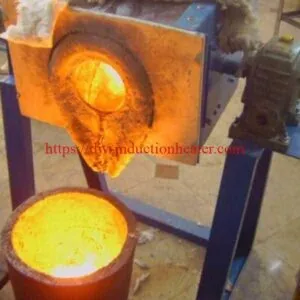
Induction Melting
Induction Melting Furnaces for Steel, Iron, Copper, Aluminium and Gold
Quick Answer
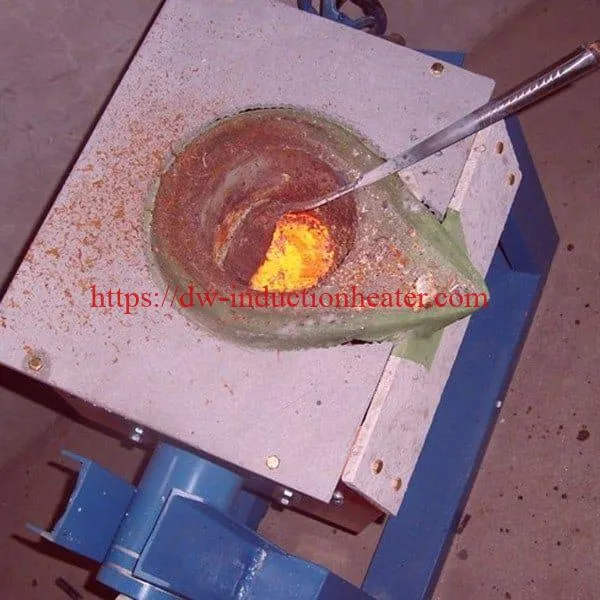
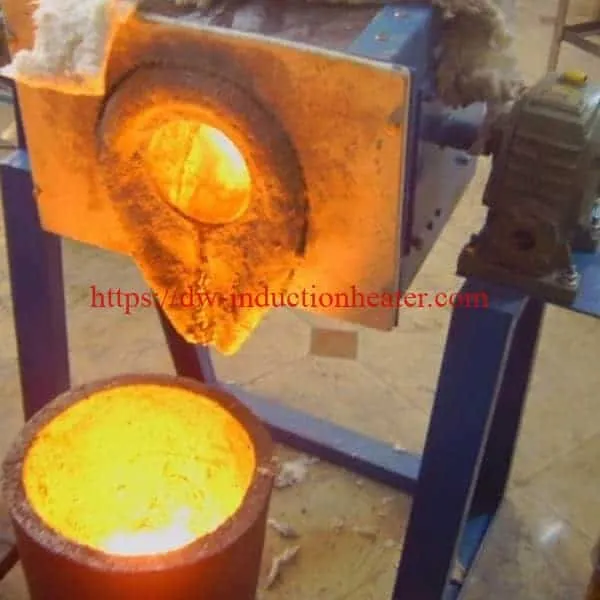
Induction melting melts metal in a crucible using eddy currents induced by a water-cooled copper coil. The molten metal is then poured into a ladle or moulds. There is no burner, and the electromagnetic field also stirs the melt.
HLQ induction melting furnaces cover 0.5 kg to 5,000 kg per batch: small gold melters, crucible furnaces, and steel-shell hydraulic-tilting foundry furnaces. They use IGBT power supplies for small and medium furnaces and SCR/KGPS supplies for large capacities. As an example of melting time, a 50 kg hydraulic tilting furnace takes about 20–60 minutes per batch with 30–80 kW, and a 3,000 kg furnace takes about 100–180 minutes with 1,500–2,500 kW.

What is Induction Melting?
Induction melting is a process in which metal is melted to a liquid in the crucible of an induction furnace, and is then poured from the crucible, usually into a mould.
The heat is generated inside the metal charge itself, so the melt is fast, clean and uniform, and the temperature is set by the power supply rather than by a flame. HLQ induction melting systems are used in foundries, casting workshops, recycling plants, jewellery workshops, universities and laboratories.

| Furnace size | Capacity | Power supply | Tilting | Cooling | Control |
|---|---|---|---|---|---|
| Small | 50–250 kg | IGBT / medium frequency | Hydraulic | Water cooling | Manual or digital |
| Medium | 500–1000 kg | IGBT or SCR | Hydraulic | Closed-loop water cooling | Digital |
| Large | 2000–3000 kg or more | SCR / high-power MF | Heavy-duty hydraulic | Industrial cooling system | PLC automatic |
Key Applications
| Industry | Metals | Typical furnace |
|---|---|---|
| Iron and steel foundries | Gray and ductile iron, carbon and alloy steel, stainless steel | Steel-shell hydraulic tilting furnace |
| Copper and brass foundries | Copper, brass, bronze, cupronickel | Tilting crucible furnace |
| Aluminium casting and recycling | Aluminium ingots, Al-Si / Al-Mg / Al-Cu alloys, clean scrap | Hydraulic tilting furnace |
| Jewellery and precious metals | Gold, silver | Small gold melter, 0.5–30 kg |
| Laboratories and R&D | Trial alloys | Small crucible furnace, 10–100 kg |
| Scrap recycling | Clean, dry iron, steel, copper and aluminium scrap | Medium-frequency tilting furnace |
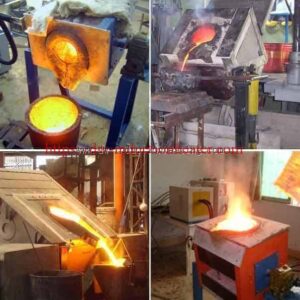
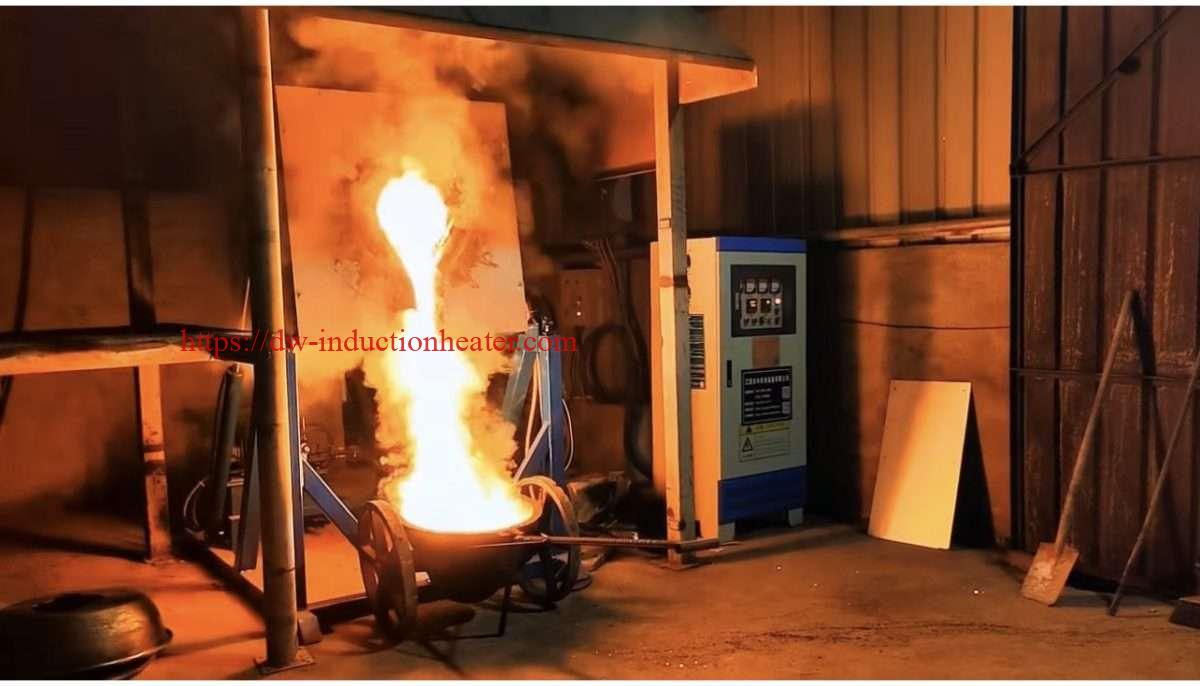
Application cases


Suitable Materials
| Metal | Typical melting / operating temperature | Recommended lining or crucible |
|---|---|---|
| Gray cast iron | ≈ 1150–1400 °C | Acidic, neutral or basic refractory lining |
| Ductile iron | ≈ 1300–1500 °C | Acidic, neutral or basic refractory lining |
| Carbon steel / low-alloy steel | ≈ 1450–1650 °C | Acidic, neutral or basic refractory lining |
| Stainless steel | ≈ 1400–1550 °C | Neutral or basic lining |
| Copper (Cu-ETP) | ≈ 1083–1100 °C | Magnesia lining; graphite or SiC crucible on small furnaces |
| Brass / tin bronze | ≈ 850–1000 °C | Silica or alumina; graphite or SiC crucible |
| Aluminium alloys | Pure Al melts at about 660 °C; usual operating range 680–760 °C | Graphite, SiC-graphite or high-alumina |
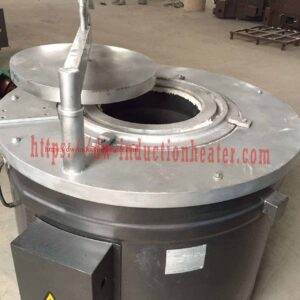
| Gold | Furnace maximum about 1200–1400 °C | Graphite or clay-graphite crucible |
| Zinc alloy | Low temperature | Low-temperature-compatible refractory lining |
Values are from HLQ’s iron/steel, copper, aluminium, gold and hydraulic tilting furnace pages. The actual temperature depends on the alloy and the casting process. For aluminium, see the induction aluminum melting furnace.
Working Principle
- Power conversion: The power supply (IGBT, or SCR/KGPS) converts 3-phase mains into medium-frequency or high-frequency current.
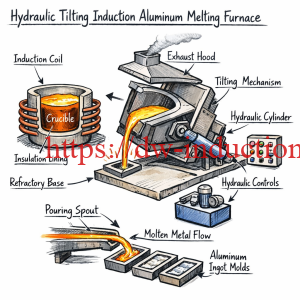
- Coil: A water-cooled copper coil surrounds the crucible and produces an alternating magnetic field.
- Heating: The field induces eddy currents in the metal charge. The charge heats from within until it melts.
- Stirring: Electromagnetic forces stir the melt, mixing the alloy and evening out the temperature.
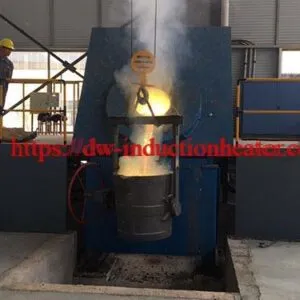
- Pouring: The furnace is tilted (hydraulic, gearbox or manual) to pour into a ladle or moulds.
- Cooling and protection: Closed-loop cooling protects the coil, power supply and capacitors. Alarms cover over-current, water failure and leakage.

Background: how induction heating works.
Power supply types
| Power supply | Features |
|---|---|
| IGBT medium-frequency | High efficiency, stable control; suits small and medium furnaces |
| SCR / KGPS | Mature technology; suits large melting capacity |
| Digital induction power supply | Better control, monitoring and protection |
| Dual-output power supply | One power supply serves two furnace bodies alternately |
Theoretical heat content of the melt
| Metal | Heated to | Theoretical heat (rounded) |
|---|---|---|
| Gold | 1100 °C | ≈ 0.06 kWh/kg |
| Copper | 1150 °C | ≈ 0.19 kWh/kg |
| Aluminium | 720 °C | ≈ 0.30 kWh/kg |
| Cast iron | 1450 °C | ≈ 0.38 kWh/kg |
| Steel | 1600 °C | ≈ 0.40 kWh/kg |
These are physical values: specific heat plus latent heat of melting, rounded. Actual furnace energy use is higher because of coil, lining and radiation losses.
Technical Specifications
| Parameter | Range | Notes |
|---|---|---|
| Batch capacity | 0.5 kg (gold) to 5,000 kg | Customised to batch weight and daily output |
| Power | 3 kW (small gold melters) to 3,500 kW (large copper furnaces) | Set by batch weight and target melting time |
| Frequency | Gold ≈ 1–80 kHz; aluminium ≈ 0.5–20 kHz; copper ≈ 0.25–8 kHz; iron and steel ≈ 0.5–2.5 kHz | Lower frequency is used for larger furnaces |
| Input voltage | 380 V, 660 V, 750 V, 1000 V or customised | Depends on power level and plant supply |
| Furnace body | Steel shell or aluminium shell | Steel shell for larger, heavy-duty furnaces |
| Tilting | Hydraulic, gearbox or manual; fixed design possible | Hydraulic tilting recommended for medium and large furnaces |
| Cooling | Closed-loop cooling tower or industrial chiller | For coil, power supply, capacitors and cables |
| Temperature measurement | Thermocouple, immersion probe or infrared pyrometer | Immersion measurement is common for molten metal |
| Control | Manual, digital, PLC or HMI | Automation improves repeatability |
| Protection | Over-current, over-voltage, water pressure, phase loss; leak alarm optional | Full protection recommended for large iron and steel furnaces |

Recommended Model Selection

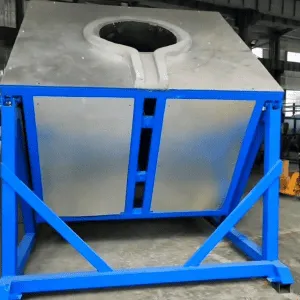
Hydraulic tilting induction furnaces
| Capacity | Recommended power | Suitable metals | Approx. melting time per batch | Typical application |
|---|---|---|---|---|
| 50 kg | 30–80 kW | Aluminium, copper, brass, small steel batches | 20–60 min | Lab, small casting |
| 100 kg | 60–120 kW | Aluminium, copper, brass, iron | 30–70 min | Small foundry |
| 250 kg | 120–250 kW | Steel, iron, copper, aluminium | 40–90 min | Medium casting |
| 500 kg | 250–500 kW | Steel, cast iron, copper alloys | 45–100 min | Industrial foundry |
| 1000 kg | 500–1000 kW | Steel, iron, copper, brass, aluminium | 60–120 min | Large production |
| 2000 kg | 1000–1600 kW | Steel, iron, copper alloys | 90–150 min | Heavy foundry |
| 3000 kg | 1500–2500 kW | Steel, iron, copper, aluminium | 100–180 min | High-capacity melting |
Full details: hydraulic tilting induction furnace.
Gold melting furnaces
| Range | Capacity (pure Au) | Rated power | Frequency | Typical melt time (full load) |
|---|---|---|---|---|
| Small | 0.5–5 kg | 3–15 kW | 20–80 kHz | 3–10 min |
| Medium | 5–30 kg | 15–60 kW | 3–30 kHz | 8–20 min |
| Large | 30–200 kg+ | 60–300 kW+ | 1–10 kHz | 20–45 min |
Process Workflow

| Step | Action | Control point |
|---|---|---|
| 1 | Prepare the charge: clean, dry and sorted by alloy | No water, oil or sealed cavities |
| 2 | Check the furnace: lining, cooling water and alarms | Water flow and pressure |
| 3 | Charge the crucible; add more charge as it melts | Correct charge order |
| 4 | Melt at full power with electromagnetic stirring | Power and time |
| 5 | Check temperature and chemistry | Immersion probe or pyrometer |
| 6 | Skim slag or dross; add flux if required | Melt cleanliness |
| 7 | Tilt and pour into a ladle or moulds | Pouring temperature |
| 8 | Re-charge or hold; inspect the lining after each shift | Lining wear |
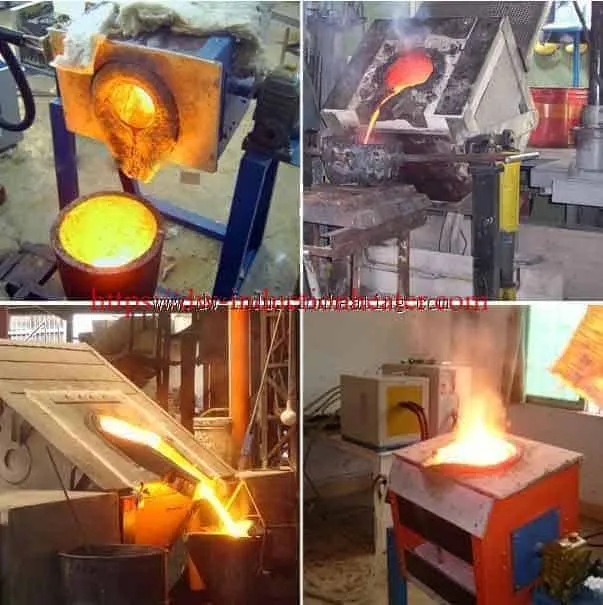
Typical workshop layout

Common Problems and Solutions
| Problem | Likely cause | Solution |
|---|---|---|
| Violent eruption when charging | Wet, oily or sealed scrap | Charge only clean, dry material; remove sealed cavities |
| Melting slower than expected | Power too low for the batch, or poor charge packing | Check power against the capacity table; improve charge density |
| Short lining life | Wrong lining chemistry for the metal or slag | Choose an acidic, neutral or basic lining to suit the metal |
| Zinc loss and fume with brass | Overheating; zinc fuming | Control temperature; use fume extraction |
| Dross and burning loss with aluminium | Thin, dirty or coated scrap; high temperature | Clean and dry the charge; control the temperature; use flux |
| Water alarm or trip | Low flow or pressure, or blocked circuits | Check the cooling tower or chiller, water quality and filters |
Engineering Selection Guide
| Selection factor | What to confirm | Recommendation |
|---|---|---|
| Metal type | Iron, steel, copper, aluminium, gold or other alloy | Select lining chemistry and power density by metal |
| Batch capacity | Kilograms or tons per melt | Allow a practical loading and pouring margin |
| Target melting time | Minutes per batch | Higher power shortens melting but needs a larger supply |
| Daily production | Tons per shift or per day | Decide on one furnace, several furnaces or dual output |
| Power supply | Plant voltage, transformer capacity, cable size | Confirm electrical capacity before ordering |
| Tilting | Manual, mechanical or hydraulic | Hydraulic for medium and large furnaces |
| Cooling | Water flow, pressure, temperature and quality | Closed-loop cooling tower or industrial chiller |
| Layout | Charging area, crane, ladle path, mould area | Plan the layout before fixing furnace dimensions |
| Continuous casting | Rod, bar, strip or wire output | See the small induction melting and continuous casting furnace |
Advantages and Limitations
| Advantages | Limitations |
|---|---|
| Fast, clean, uniform melting; heat is produced in the charge | Needs a large electrical supply for big furnaces |
| Electromagnetic stirring mixes the alloy | The refractory lining is a consumable and must suit the metal |
| No burner or combustion gas in contact with the melt | Continuous cooling water is required |
| Temperature set by the power supply; easy to control | Charge must be dry and clean for safety |
| Scalable from 0.5 kg to 5,000 kg | Highly volatile alloys (brass, Be-Cu) need fume extraction |
Why Choose HLQ?
| Strength | What it means for you |
|---|---|
| Full capacity range | 0.5 kg gold melters to 5,000 kg foundry furnaces |
| IGBT and SCR/KGPS power supplies | Power supply matched to furnace size |
| Hydraulic tilting | Safer, smoother pouring |
| Lining and crucible guidance | Chosen by metal and process |
| Protection systems | Over-current, water, phase-loss and leak alarms |
| Layout support | Power, cooling and pouring planned together |
10 Core FAQs
1. What is induction melting?
Melting metal in a crucible using eddy currents from a water-cooled coil, then pouring it into a ladle or moulds.
2. Which metals can be melted?
Iron, carbon and alloy steel, stainless steel, copper, brass, bronze, aluminium, gold, silver and zinc alloys, with the lining and power chosen for each metal.
3. What capacities does HLQ offer?
From 0.5 kg gold melters up to 5,000 kg per batch for industrial furnaces.
4. How much power do I need?
On the hydraulic tilting range: 30–80 kW for 50 kg, 500–1000 kW for 1,000 kg, and 1,500–2,500 kW for 3,000 kg.
5. How long does a melt take?
About 20–60 minutes for 50 kg and 100–180 minutes for 3,000 kg, depending on power and metal. Small gold melters take about 3–10 minutes at full load.
6. IGBT or SCR power supply?
IGBT for small and medium furnaces; SCR/KGPS for large melting capacity.
7. Which frequency is used?
Lower frequency for larger furnaces. For example, about 0.5–2.5 kHz for iron and steel, 0.25–8 kHz for copper, and up to 80 kHz for small gold melters.
8. Which lining should I use?
An acidic, neutral or basic lining for iron and steel; magnesia, silica or alumina for copper alloys; graphite, SiC-graphite or high-alumina for aluminium.
9. Why must the charge be dry and clean?
Water, oil or sealed cavities in scrap can cause violent eruptions in molten metal.
10. Does the furnace need cooling water?
Yes. The coil, power supply and capacitors need a closed-loop cooling tower or an industrial chiller. Small gold melters may be air-cooled.