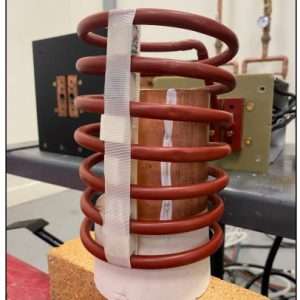
Induction Annealing of Copper Tubing
Induction Annealing of Copper Tubing for Power Components
Objective
Evaluate copper tube induction annealing for two tubing sizes used in power component manufacturing. The proposed HLQ configuration pairs a DW-HF-60KW Induction Heater with a multi-turn helical coil to bring a defined section of each tube to the reference temperature.
End Product
Annealed copper tubing for power component manufacturing.
Equipment
- HLQ DW-HF-60KW Induction Heater.
- Induction workhead matched to the power supply and coil.
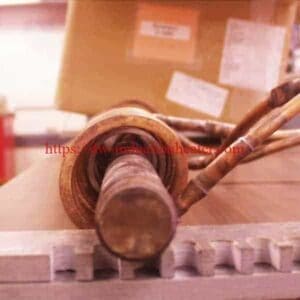
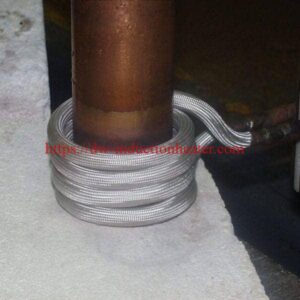
- Custom multi-turn helical coil sized for the tube and required heated length.
Materials
Copper tubing in two reference sizes, identified as smaller and larger tubing. Record the outside diameter, wall thickness, and incoming temper of each tube before starting trials.
Temperature
The reference target temperature is 1,200 °F (649 °C) for both tubing sizes. Confirm the final annealed condition against the material requirements after cooling.
Frequency
The specified application frequency range is 40–80 kHz. Confirm the operating frequency with the workhead, coil, and copper tube in place.
Testing
Center the tube within the active turns of the coil. Alternating current through the coil creates a changing magnetic field. The field induces eddy currents in the copper tube wall, where electrical resistance generates heat. The induction heating coil design helps determine the heated length and temperature distribution.

The reference time to reach 1,200 °F (649 °C) is 5 seconds for the smaller tubing and 15 seconds for the larger tubing. During trials on the HLQ setup, adjust power delivery for each size and record the measured time to temperature. After cooling, check hardness or the specified material property before approving each cycle.
Benefits
- Size-specific heating cycles. Separate reference times give operators a starting point for qualifying each tube size.
- Repeatable positioning. A fixture can hold the same section of each tube in the active coil zone.
- Flameless heating. Induction delivers energy to the tube without an open flame at the heating station.
- Localized energy input. A matched coil concentrates heat in the intended zone, and power can be switched off at the end of the heating stage.
For production induction annealing, verify the heated length, cycle time, and final material condition for each tube size across consecutive parts.