Induction Preheating Before Hot Forming
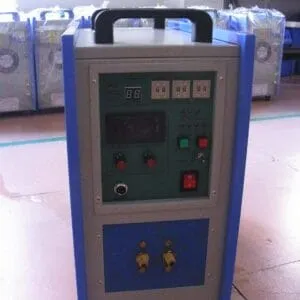
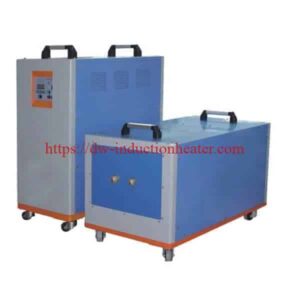
Induction Preheat for Hot Forming with the DW-MF-110KW Medium Frequency Induction Heater
Preheating a heavy carbon steel weldment before hot forming is, in most plants, still a batch operation. The parts go into a gas furnace, the furnace runs for hours while the whole load soaks through, and every piece waits for the slowest one in the batch. The metal then spends the rest of the hold time sitting in a flame and in combustion gas, and arrives at the forming tools with an oxide layer on it and a temperature that varies from piece to piece.
The trial described here replaces that batch step with a controlled induction cycle. Using the DW-MF-110KW induction heater, a four-turn flexible induction cable and a high-temperature insulation blanket, a carbon steel pipe weldment of approximately 260 kg reached the 800 °C forming temperature in a single 27 minute heating cycle at 10-20 kHz, inside the 25-30 minute window used for this class of workpiece. The measured spread across the band was 13 K at the end of the cycle and 6 K after the soak, and the surface left the coil clean, with no oxide layer and no decarburised skin.
The DW-MF series is the medium frequency branch of the HLQ range, and the configurations, the control options and the recording accessories are described on the medium frequency induction heating pages and on the medium frequency induction generator page.
Application overview
| Application | Induction preheating of a heavy carbon steel pipe weldment prior to hot forming |
|---|---|
| Equipment | DW-MF-110KW induction heater (medium frequency, IGBT) |
| Frequency | 10-20 kHz |
| Heating time | 25-30 minutes (27 minutes recorded in the trial) |
| Preheat target | 800 °C, with a minimum of 780 °C at the coldest point |
| Base material | Carbon steel E235 / ASTM A106 Gr. B pipe, ∅273 mm outside diameter, 9.5 mm wall, with a heavy reinforcing ring |
| Heated band | 1,400 mm, covered by a high-temperature insulation blanket |
| Heated mass | Approximately 260 kg of steel |
| Heating coil | Flexible induction cable, 4 turns, matched to the pipe outside diameter |
| Measurement | K-type thermocouples at three positions, with the heating curves recorded |
| Average useful power | Approximately 57 kW over the 27 minute cycle |
| Soak | 8 minutes under insulation after power off, reducing the spread from 13 K to 6 K |
| Result | 805 °C at the pipe crown, 748 °C behind the ring, 782 °C at the side, 796 °C minimum after the soak |
Why the preheat step matters before hot forming
Hot forming is a forming operation on a material whose flow stress depends strongly on its temperature. If the section entering the tools is at 750 °C in one place and 805 °C in the next, the two places do not flow the same way: the colder one needs more load, thins differently and can crack, while the hotter one loses dimensional accuracy. The practical result is a wider spread on the finished part, more scrap, and forming tools that have to be derated to survive the coldest piece in the batch.
A controlled preheat removes that variable. Every part arrives at the forming station with the same temperature in the same place, so the forming parameters can be set for the material rather than for the worst case in the load.
The second benefit comes from how the heat is delivered. A gas furnace heats the outside of the part, in an oxidising atmosphere, for a long time. The result is an oxide layer on the surface and, at 800 °C, some decarburisation of the outermost metal. Induction heating deposits the energy inside the steel, so the surface stays clean and the material that reaches the tooling is the material that was specified. For a forming operation, where the surface condition of the workpiece is what the die sees, this is not a cosmetic difference.
Working principle
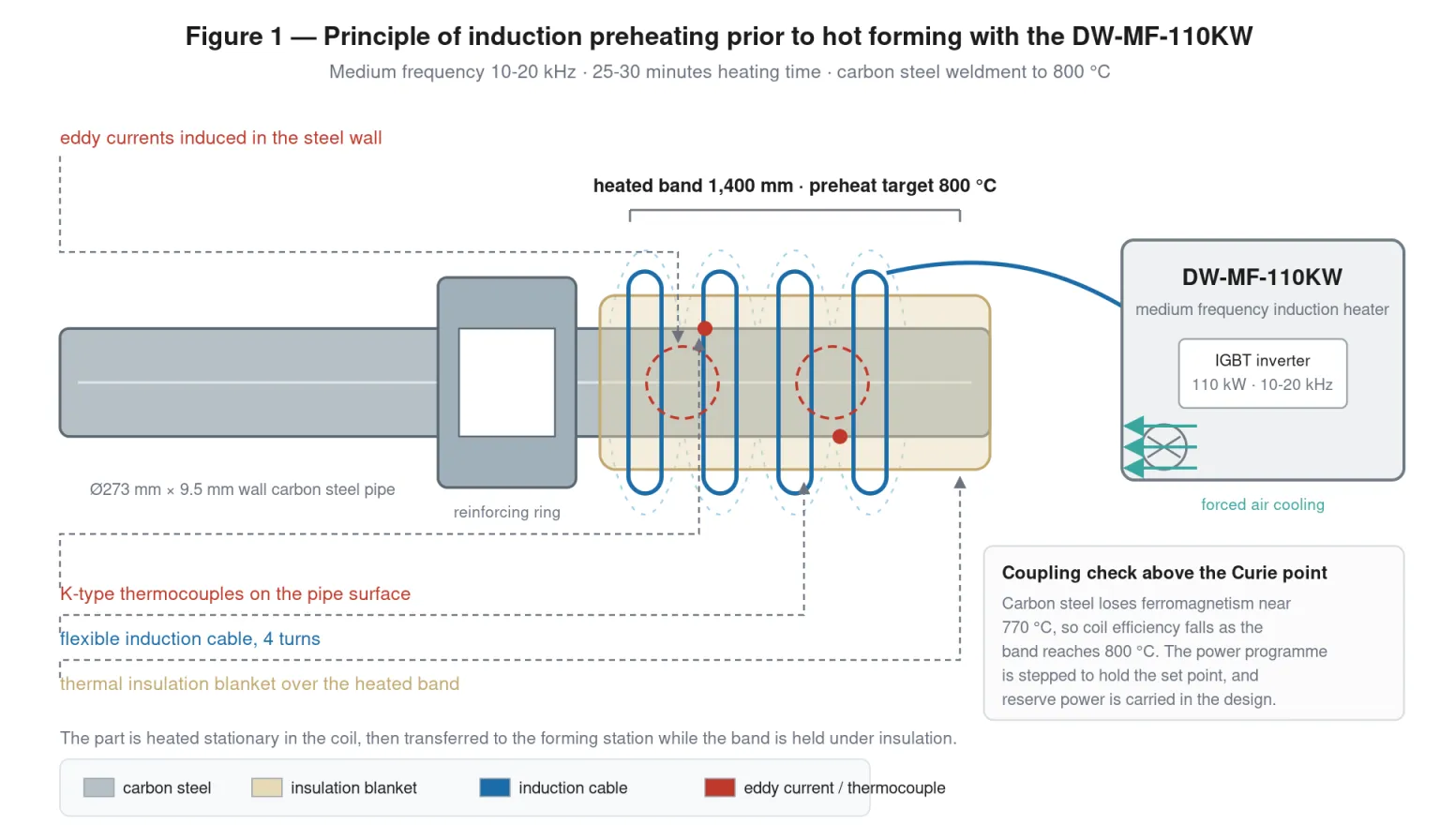
Alternating current in the coil produces an alternating magnetic field around the pipe. That field induces eddy currents in the steel, and the resistance of those currents turns electrical energy into heat inside the wall itself. The coil does not touch the part, no flame is present, and the heat is generated where it is needed rather than being applied to the surface and conducted inwards.
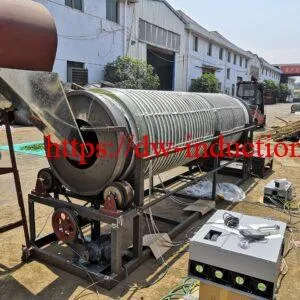
Because the workpiece is heavy and the band is long, the coil is a multi-turn flexible cable arranged over the heated zone, with the turns spaced so that the field is distributed along the band instead of being concentrated in one place. The insulation blanket covers the same zone, so the energy is not lost to the air before it reaches the metal, and the whole band can be held at temperature after the power is cut.
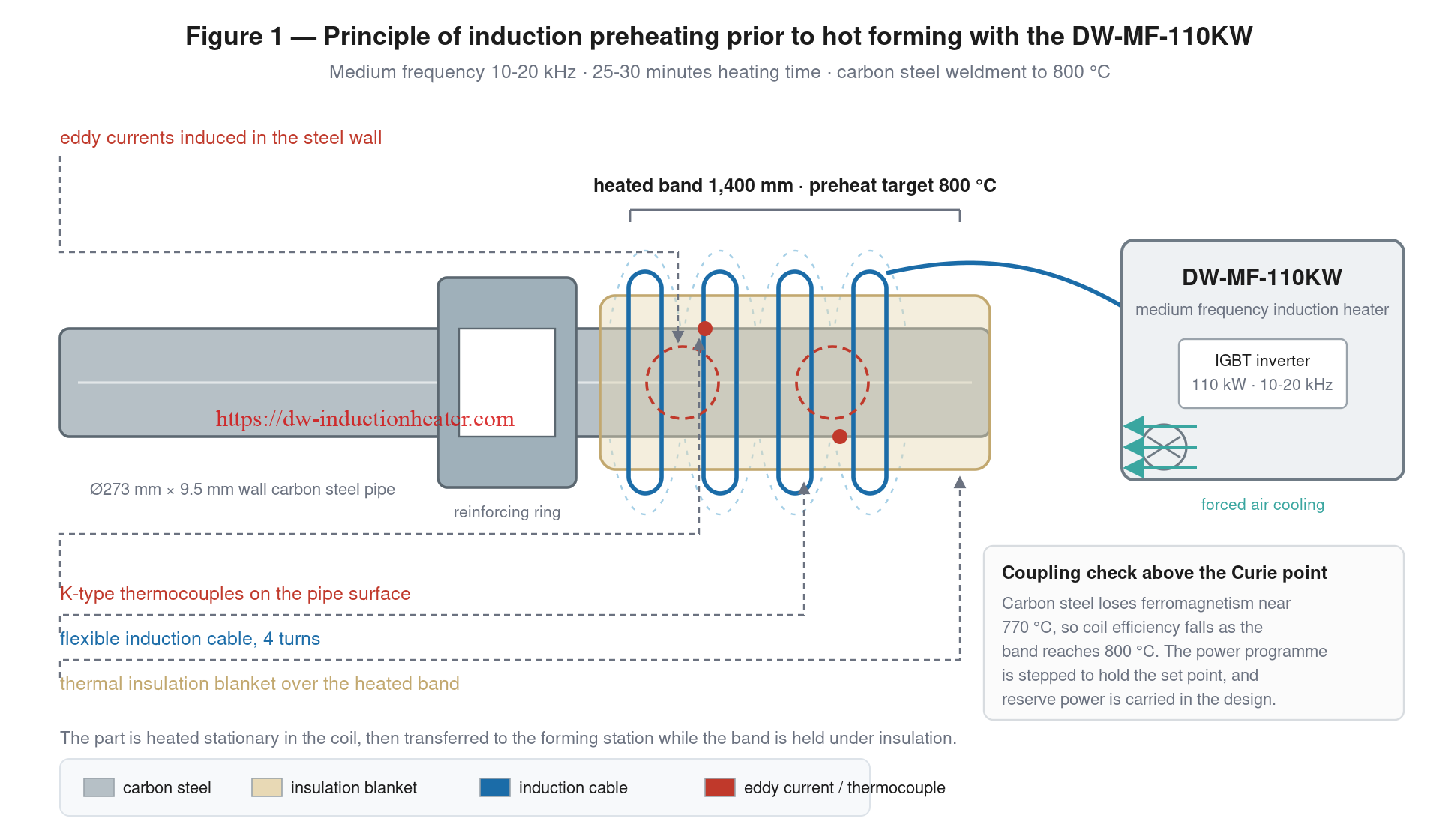
The arrangement and the electrical matching of the working inductor are the parts of the system that decide the result. The same cable families used for post weld heat treatment, where the geometry and the cooling are handled in the same way, are covered under flexible induction heating cable, and the general selection method for a hot working duty is set out in the HLQ note on induction heating for billet forging and design selection.
Why 10-20 kHz, and what happens at the Curie point
Skin depth grows as frequency falls, and the workpiece here is a pipe wall of 9.5 mm with a heavy reinforcing ring, not a thin sheet. At 10-20 kHz the induced current penetrates far enough into the section to heat it through the wall rather than only at the outer surface, which is what allows a 1,400 mm band to reach 800 °C with a flat axial profile. It also keeps the load in the medium frequency band, where the generator, the connection cable and the inductor can be matched to a large and well-coupled load.
There is a specific effect that has to be allowed for at this temperature, and it is the single most important engineering point in the cycle. Carbon steel is ferromagnetic below roughly 770 °C and loses that property as it approaches the Curie point. Because the induced current depends on the magnetic properties of the material, the coupling and the efficiency of the coil fall as the band rises through that point towards 800 °C.
The consequence is that a fixed power setting does not deliver a constant rate of heating. The cycle is therefore run as a stepped programme: the output is raised as the band approaches the target so that the rate of temperature rise is maintained, and the generator rating carries reserve power so that the set point can still be held after the coupling loss. The same physics governs the design of any hot working duty above the Curie point, which is why the equipment choice for these applications is discussed together with induction heating for forging and hot forming rather than as a separate subject.
The 27 minute heating cycle and the power programme
Figure 2 shows the temperature recorded at the three monitored positions together with the power programme on the right-hand scale. The three curves follow each other closely through the bulk of the cycle and separate as the target is approached, because the sections shadowed by the reinforcing ring and the band edges receive less energy than the pipe under the turns. The power step at 20 minutes compensates for the coupling loss above the Curie point. At 27 minutes the power is cut, the assembly is left under the insulation blanket, and the temperature equalises during an 8 minute soak before the transfer to the forming station.
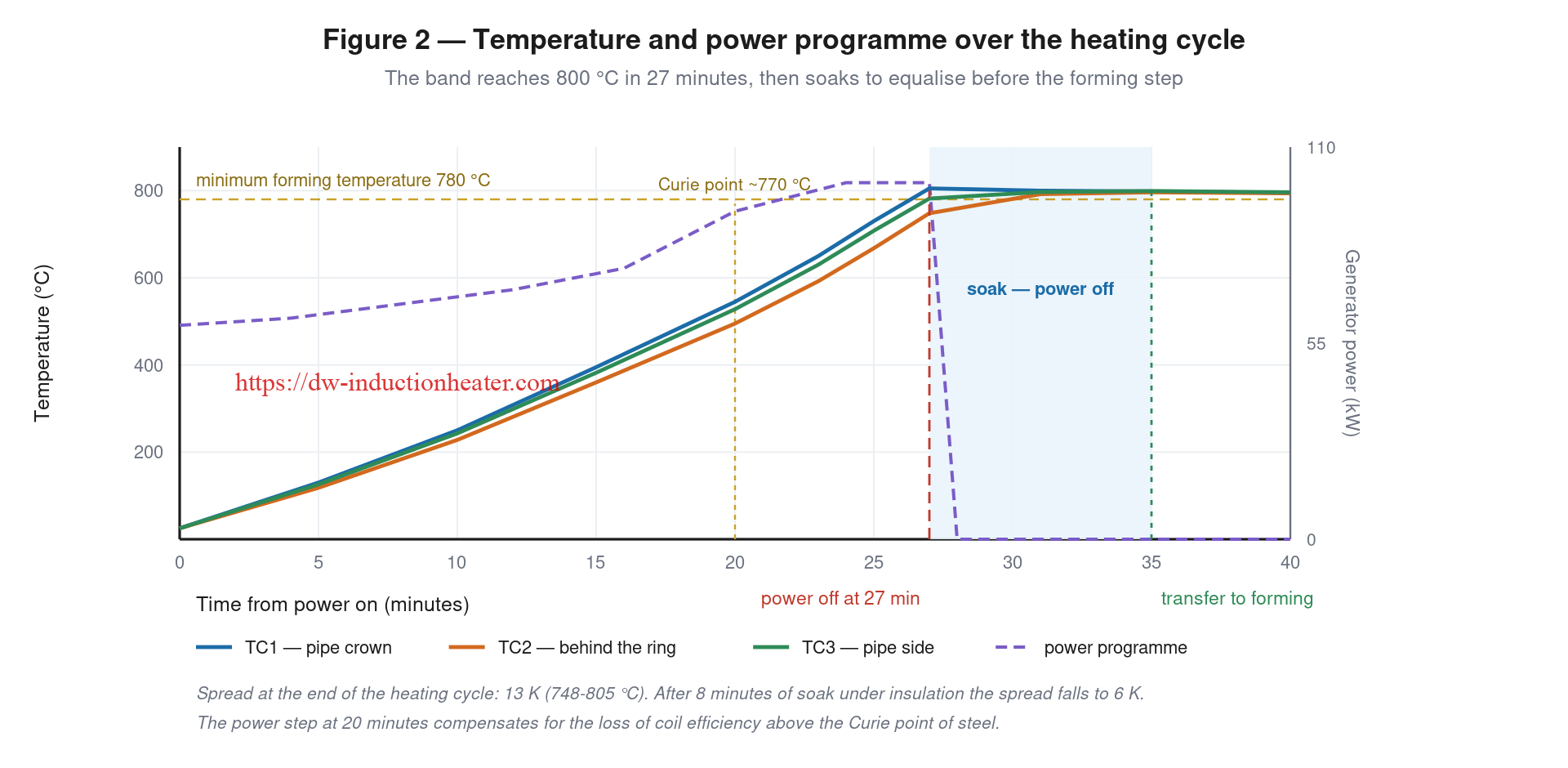
Control is closed-loop on the measured temperatures, with the generator following the programmed power profile rather than a single fixed output. That is what makes the cycle repeatable from one part to the next and it is also what produces the record that belongs with the forming and inspection documentation for each piece.
Uniformity across the band and the energy balance
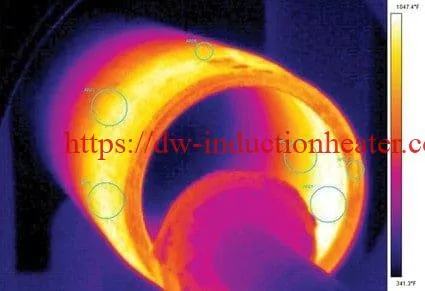
Preheat is judged on the coldest point of the band, not on the average. Figure 3 shows the axial temperature profile at the end of the heating cycle: a flat plateau across the 1,400 mm band, with 805 °C at the pipe crown, 748 °C in the shadow of the reinforcing ring and 782 °C at the side of the pipe, a spread of 13 K, and a sharp fall away outside the band.
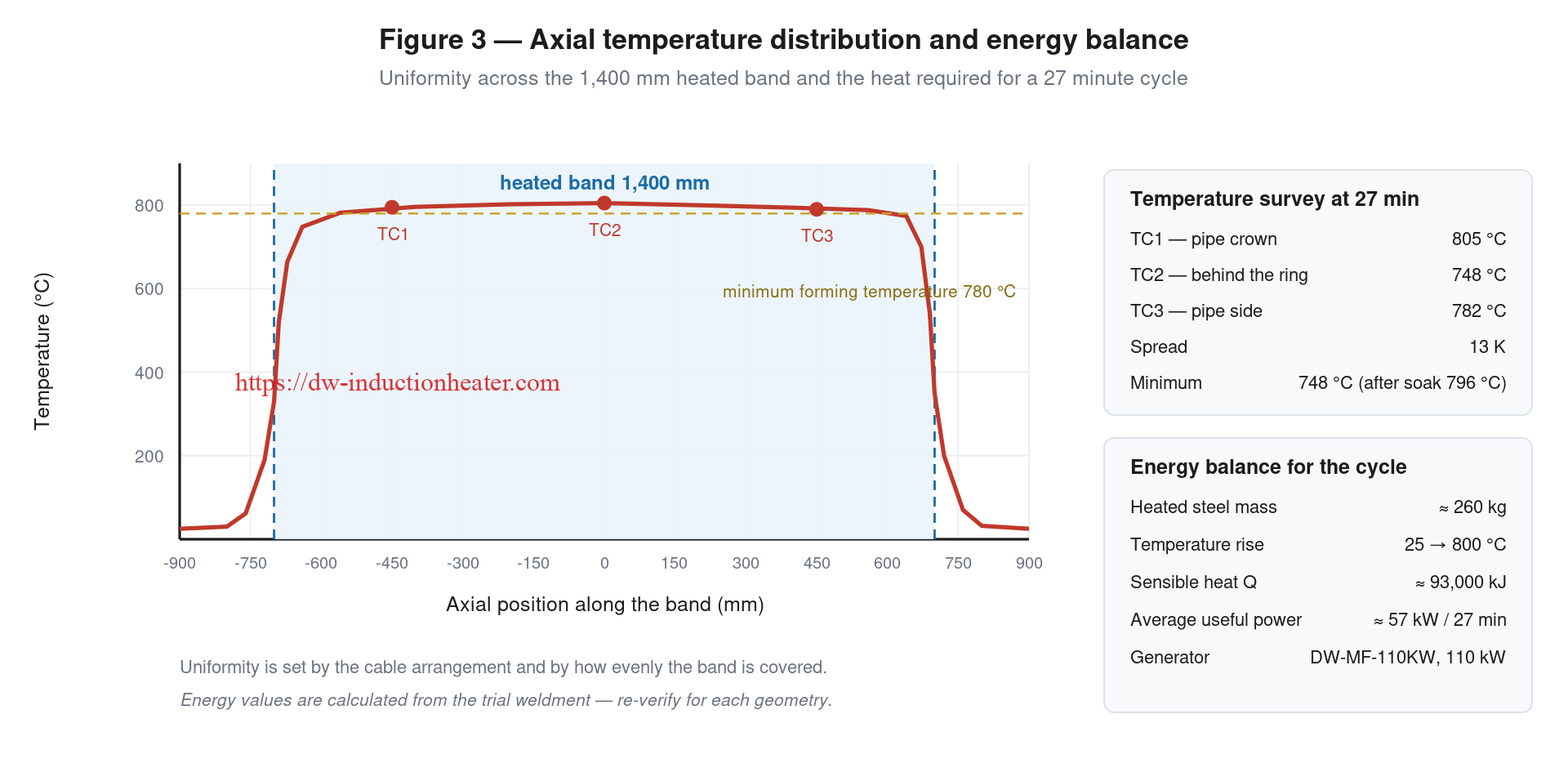
The energy side of the cycle is straightforward to check. A heated steel mass of about 260 kg raised from 25 °C to 800 °C needs roughly 93,000 kJ of sensible heat, which over 27 minutes is an average useful power of about 57 kW. With coil, cable and radiation losses the electrical demand sits close to the 110 kW rating of the generator, which is why this duty belongs at the lower end of the DW-MF range rather than above it. A heavier section, a longer band or a higher target changes the requirement and the calculation has to be repeated for each job.
Station configuration
- Define the thermal cycle. Set the preheat target, the minimum acceptable temperature, the band length and the heating window from the forming specification and the material data.
- Position the workpiece. Place the weldment in the station so that the band to be heated is centred in the coil, and confirm that the reinforcing ring, the flange and any attachment fall where the cable can reach them.
- Arrange the coil. Install the flexible cable over the band with even turn spacing and the specified clearance to the pipe, and secure it with non-metallic restraints so that no conductive loop is created around the workpiece.
- Fit the insulation. Cover the heated band with the high-temperature blanket, leaving the thermocouple leads and the cable entry clear, so that the losses during the cycle and the soak are as small as possible.
- Install the instrumentation. Attach the K-type thermocouples at the crown, at the side and in the shadowed zone behind the ring, and confirm the recording channel for each one.
- Run the programme. Start with the programmed power ramp and let the controller hold the set point through the Curie point transition, then cut the power at the end of the cycle and start the soak timer.
- Verify before forming. Check the recorded profile against the survey positions, confirm the minimum temperature across the band after the soak, and inspect the surface condition before the part is moved to the forming station.
Results and observations
| Preheat target | 800 °C, minimum 780 °C at the coldest point |
|---|---|
| Heating time | 27 minutes at 10-20 kHz, inside the 25-30 minute window |
| Temperature survey at 27 min | 805 °C at the crown, 748 °C behind the ring, 782 °C at the side |
| Spread | 13 K at the end of heating, 6 K after the 8 minute soak |
| Heated band | 1,400 mm, flat axial profile inside the band |
| Surface condition | Clean and bright, no oxide layer and no decarburised skin |
| Coupling behaviour | Loss of efficiency above the Curie point, compensated by the stepped power programme |
| Operator factor | Low — the cycle follows the programme and the recorded temperatures |
| Main control point | Turn spacing and blanket coverage, which set the axial profile |
Three observations carry into production planning. First, the soak is not optional: 13 K of spread at the end of the heating cycle would have put the coldest part of the band below the minimum forming temperature, and the 8 minute soak under insulation is what brings it to 796 °C everywhere. Second, the reserve power in the generator is what makes the top of the cycle possible, because the coupling loss above the Curie point has to be paid for with energy rather than with time. Third, the uniformity was set by the coil and the blanket, not by the power setting, which is the usual finding and the reason the geometry is where the engineering work is done.
Advantages over batch gas furnace preheating
- No flame and no combustion gas. No burner, no ignition source and no hot gas plume in the forming hall, and no exhaust or combustion air to accommodate around the station.
- No scale and no decarburisation. The heat is generated inside the steel, so the surface that reaches the tooling is the surface that was specified.
- Cycle time instead of hold time. A 27 minute cycle on one part replaces the hours that a whole batch spends in a furnace, and the parts no longer wait for each other.
- Closed-loop and recorded. The temperatures are measured, logged and held to a set point rather than being inferred from a furnace thermostat, so the preheat condition of every part is documented.
- Only the band is heated. The 1,400 mm that the forming operation needs is brought to temperature; the rest of the weldment stays close to ambient, which reduces the energy input and the handling time per part.
- No fuel handling. There is no gas supply, no burner maintenance and no combustion inspection on the preheat station, and the energy is electricity with a recorded consumption per part.
Frequently asked questions
How long does it take to preheat a carbon steel weldment for hot forming?
In this trial the band reached the 800 °C forming temperature in 27 minutes of power-on at 10-20 kHz with the DW-MF-110KW generator, which sits inside the 25-30 minute heating window used for this class of workpiece. The cycle ends with the power cut and an 8 minute soak under insulation, during which the temperature spread across the band falls from 13 K to 6 K, before the assembly is transferred to the forming station.
What happens to coil efficiency when the steel is heated above the Curie point?
Carbon steel is ferromagnetic below roughly 770 °C and loses that property as it approaches the Curie point. Because the induced current depends on the magnetic properties of the material, the coupling and the efficiency of the coil fall as the band reaches 800 °C. The control system therefore uses a stepped power programme that increases the output as the temperature approaches the target, and the generator rating carries reserve power so that the set point can still be held at the top of the cycle.
Why use 10-20 kHz for a heavy carbon steel section?
Skin depth grows as frequency falls, and the workpiece here is a heavy pipe weldment with a 9.5 mm wall rather than a thin sheet. At 10-20 kHz the induced current penetrates far enough into the section to heat it through the wall instead of only the outer skin, which is what makes a 1,400 mm band reach 800 °C with a flat axial profile. It also keeps the operating point in the medium frequency band, where the generator, the cable and the coil can be matched to a large, well-coupled load.
Why is a soak period needed after the power is switched off?
A heavy weldment does not heat evenly in one pass. The pipe under the cable runs hot while the sections shadowed by the reinforcing ring and the band edges lag behind, and at the end of the heating cycle the monitored points differed by 13 K. Holding the assembly under insulation after the power is cut allows conduction to even out the difference, and the recorded spread falls to 6 K with a minimum of 796 °C, so the whole band arrives at the forming station above the minimum forming temperature.
How much power is needed to preheat 260 kg of steel to 800 °C?
The sensible heat requirement is approximately 93,000 kJ, calculated from a heated mass of about 260 kg raised from 25 °C to 800 °C. Spread over a 27 minute cycle this is an average useful power of roughly 57 kW, and with coil, cable and radiation losses the electrical demand sits close to the 110 kW rating of the DW-MF-110KW. Larger sections, longer bands or higher targets change the requirement and the calculation has to be repeated for each job.
How does induction preheating compare with batch gas furnace preheating?
A gas furnace heats the whole load in an oxidising atmosphere for hours, so the parts wait for the slowest one in the batch and the surface picks up an oxide layer and some decarburisation. Induction heating puts the energy inside the steel in a controlled 27 minute cycle over a defined band, with no flame and no combustion gas in contact with the surface. The temperature is measured and recorded instead of being held by a thermostat, and only the band the forming operation needs is heated, which keeps the energy input and the handling time per part down.
Summary
Preheating a heavy carbon steel pipe weldment with the DW-MF-110KW medium frequency induction heater at 10-20 kHz delivered the 800 °C forming temperature in a 27 minute heating cycle, within the 25-30 minute window, with a 13 K spread at the end of heating reduced to 6 K after an 8 minute soak. The average useful power was about 57 kW for a heated mass of 260 kg, and the coupling loss above the Curie point of steel was absorbed by a stepped power programme backed by reserve generator power. The surface left the coil clean and free of scale, and the recorded cycle replaced a multi-hour batch furnace operation on a single part.