Induction Annealing Both Ends of Copper Tubing for Refrigeration
Induction Annealing Both Ends of Copper Tubing for Refrigeration
Note: Induction Annealing Both Ends of Copper Tubing for Refrigeration
Objective:
To heat both ends of a copper tube to anneal as soft as possible 1.5 in (38.1 mm) from end and retain full hardness next to anneal
End Product:
refrigeration tube
Equipment:
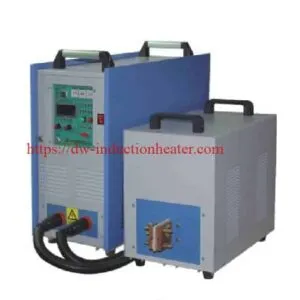
DW-HF-45KW Induction Heater, equipped with a remote workhead containing eight 1.0 μF capacitors for a total of 8.0 μF
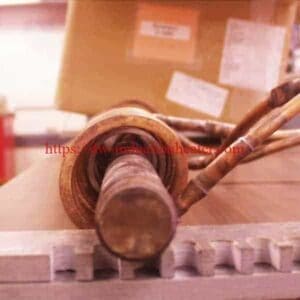
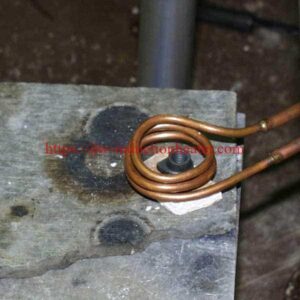
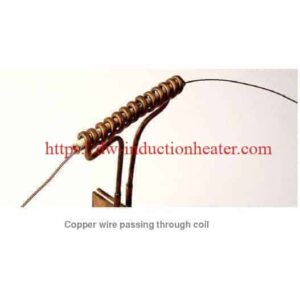
An induction heating coil designed and developed specifically for this application.
Materials:
1.625 in (41.275 mm) ∅ x 24 in (609.6 mm) long copper tube
Temperature:
1500 °F (815.5 °C)
Frequency:
75 kHz
Testing:
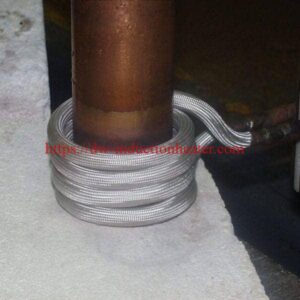
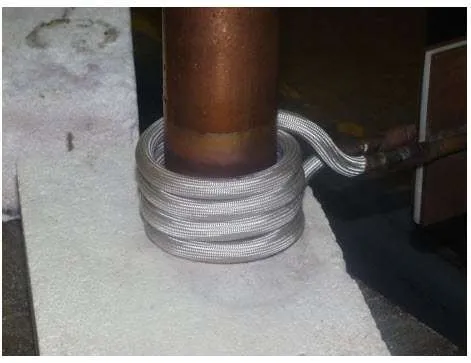
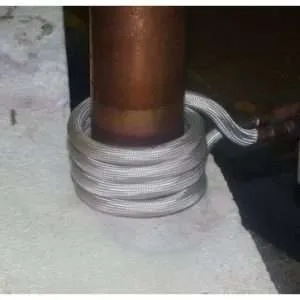
A four turn helical coil is used for this annealing process. The copper tube is placed in the coil and power is applied for a total of 7.5 seconds. At 3.75 seconds the copper tube is rotated half a turn to insure uniform annealing. The copper tube is immediately quenched to guarantee the annealed area is only 1.5 in (38.1 mm) from end of tube. The tube is then flipped to anneal the other end.
Benefits:
Induction heating provides:
- Controlled application of heat to a very specific area
- Faster process time, increased production
- High efficiency, low energy cost
- Hands-free heating that involves no operator skill for manufacturing
Key parameters
| Application | Annealing both ends of a refrigeration copper tube |
|---|---|
| Equipment | DW-HF-45KW Induction Heater (high frequency, IGBT, water cooled) |
| Frequency | 75 kHz |
| Temperature | 1500 °F (815.5 °C) annealing temperature |
| Material | 1.625 in (41.275 mm) ∅ x 24 in (609.6 mm) long copper tube |
| Annealed length | 1.5 in (38.1 mm) from each end, fully annealed |
| Heating pulse | 7.5 s per end, with a 180° rotation at 3.75 s, then immediate water quench |
| Coil | Four turn helical coil designed for this application |
| Remote workhead | Eight 1.0 μF capacitors, 8.0 μF total |
| Energy delivered | Approximately 200 kJ per pulse, of which about 15 kJ stays in the annealed 38.1 mm |
| Skin depth | Approximately 1.4 mm at 75 kHz, against a 1.2 mm wall |
Working principle
Alternating current in the helical coil produces an alternating magnetic field around the end of the tube. The field induces eddy currents in the copper, and the resistance of those currents generates heat inside the wall. Copper is not a magnetic material, so none of the heating comes from magnetic attraction: the energy is deposited directly in the metal, and because copper has a very low electrical resistivity, a comparatively small current produces a large amount of heat in a very short time.
The requirement that makes this application different is the combination of a very soft zone and a very hard zone on the same part. The end of the tube has to be soft enough to be formed or expanded, and the material immediately next to it has to stay at full hardness so that the tube keeps its strength and its dimensional accuracy. That is why the heating is applied with a short pulse rather than with a soak, why the tube is turned during the pulse, and why the quench follows immediately. The induction heating coil in this application is a four turn helical coil placed over the tube end, and the DW-HF-45KW induction heater drives it from a remote workhead.

The temperature profile along the tube
Figure 2 shows what the pulse actually leaves behind. The end of the tube is at the annealing temperature, the fully annealed length runs to 38.1 mm, and then the temperature falls away quickly, so that by roughly 60 mm from the end the tube is back at the hardness it started with. The transition is sharp rather than gradual, and that sharpness is the signature of a short pulse: if the heating had been applied for several seconds longer, the profile would have flattened out over a much longer length.

Two things make that profile possible. The first is the pulse length: at 7.5 seconds there is simply no time for the heat to travel far down the tube. The second is the quench: the moment the power is cut, the tube goes into water, and the thermal arrest stops the anneal from continuing. Copper at 815.5 °C also oxidises rapidly, so the short cycle and the immediate quench protect the surface of a tube that is about to be formed, brazed and sealed.
The 7.5 second cycle and the energy balance
Figure 3 sets out the cycle for one end of the tube. Power is applied at zero seconds, the tube is rotated half a turn at 3.75 seconds so that the whole circumference is annealed to the same depth, the power is cut and the tube is quenched at 7.5 seconds, the tube is then flipped and the second end is annealed in the same way.

The energy balance explains the whole design. The generator delivers 45 kW, and over a 7.5 second pulse that is roughly 200 kJ. Only about 15 kJ of it stays in the annealed zone, because the metal that is actually softened weighs only 0.051 kg. The largest part of the pulse is conducted away along the tube, and a further part is radiated from a surface that is at 815.5 °C. The machine is therefore sized for the power and the pulse, not for the mass that is being annealed, and the requirement to keep the neighbouring material at full hardness is met by keeping the pulse short rather than by controlling the power more accurately.
The frequency plays its part too. At 75 kHz the skin depth in copper is about 1.4 mm, which is slightly more than the 1.2 mm wall of this tubing, so the current fills the wall and the metal is heated directly rather than through a thin skin inside it. That is what allows the end to reach 815.5 °C inside seven and a half seconds.
Results and observations
| Annealing temperature | 1500 °F (815.5 °C) |
|---|---|
| Heating pulse | 7.5 s per end, rotation at 3.75 s, immediate water quench |
| Fully annealed length | 38.1 mm (1.5 in) from each end |
| Material beyond the anneal | Full hardness retained, with a short transition zone |
| Energy delivered | Approximately 200 kJ per pulse, about 15 kJ retained in the annealed zone |
| Average delivered power | Approximately 27 kW of the 45 kW rating during the pulse |
| Both ends | Processed in one handling cycle by flipping the tube |
| Operator involvement | None during the heating; the cycle is defined by the programme |
Three observations carry into production. First, the annealed length is set by the pulse and the quench, not by the power setting, so the process cannot be dialled in by turning the power down; it is dialled in by timing the pulse and quenching faster. Second, the rotation is not optional on a four turn coil, because the closest and the farthest turn see the tube differently. Third, the second end is not a separate operation: flipping the tube and running the same 7.5 second cycle produces an identical result at the other end, which is what keeps the two ends of the tube consistent with each other.
Advantages over torch annealing
- Heat exactly where it is needed. Only the 38.1 mm that has to be soft is heated, and the rest of the tube is untouched by the process.
- Seconds instead of a furnace cycle. Each end takes a 7.5 second pulse and a quench, so the whole tube is processed in one handling cycle with no furnace, no atmosphere and no cooling soak.
- Hands-free and repeatable. The result is set by the programme and the coil geometry, with no operator skill involved in judging how long to hold the heat.
- No flame near the tube. No burner, no combustion products and no risk of a hot flame touching an already finished part or an insulation on the same line.
- High efficiency and low energy cost. The power is on for 7.5 seconds and then off, so nothing is spent holding the part at temperature.
- Both ends identical. The same coil and the same cycle are used for both ends, so the two ends of a tube match.
Frequently asked questions
How are both ends of a refrigeration copper tube annealed at the same time?
They are not annealed at the same time, they are annealed in one handling cycle. The first end is placed in the four-turn helical coil, power is applied for 7.5 seconds with a 180 degree rotation at 3.75 seconds, the tube is quenched immediately and then flipped so that the second end occupies the same position. Both ends are therefore produced with the same coil, the same programme and the same 7.5 second cycle, which is what makes the two ends identical.
How is the annealed length limited to 1.5 inch from the end of the tube?
Three things do it together. The heating pulse is only 7.5 seconds, so there is no time for the heat to conduct further along the tube. The tube is quenched immediately after the power is cut, which stops the soak that would otherwise continue the annealing. And the tube is rotated half a turn at 3.75 seconds, so the whole circumference of the end is annealed to the same depth rather than one side being deeper than the other. The result is a fully annealed length of 38.1 mm with a short transition zone and full hardness retained beyond it.
Why is the tube rotated during the heating pulse?
Because the coil does not see the circumference evenly, and a tube sitting in a four-turn helical coil has a closest turn and a farthest turn. Rotating the tube by half a turn at the mid point of the pulse averages the heating over the full 360 degrees, so the annealed length is the same all the way round. Without the rotation the annealed zone would be deeper where the coupling is strongest and the hardness profile around the tube would not be uniform.
Why does the cycle have to be so short?
Copper conducts heat along the tube very quickly, and at 815.5 °C it also oxidises quickly. A longer pulse would conduct heat further into the tube, softening more of it than the process allows, and it would build a heavy oxide layer on a surface that is about to be formed and brazed. The short pulse, the rotation and the immediate quench together keep the anneal local, and they are what make the requirement of full hardness next to the anneal achievable at all.
How much power does the annealing pulse need?
The DW-HF-45KW delivers 45 kW of oscillating power and the pulse is 7.5 seconds long, so roughly 200 kJ is delivered in total. Only a small part of that ends up in the annealed zone itself, about 15 kJ for the 0.051 kg of metal in the 38.1 mm annealed length; most of the rest is conducted away along the tube and radiated from the hot surface. The machine is therefore sized for the power and the pulse, not for the mass that is actually annealed.
What are the advantages of induction annealing for refrigeration copper tube?
The heat is applied only to the 38.1 mm that has to be soft, the cycle for both ends is a few seconds of power rather than a trip to a furnace, and there is no open flame anywhere near the tube, which matters on a line that carries refrigerant. The result does not depend on the judgement of an operator, the annealed length is measured and repeatable, and because the tube is turned during the pulse and quenched immediately afterwards, the hardness profile along the tube is controlled rather than incidental.
Summary
Annealing both ends of a refrigeration copper tube with the DW-HF-45KW high frequency induction heater at 75 kHz brought each end of a 1.625 in × 24 in copper tube to the 1500 °F (815.5 °C) annealing temperature in a 7.5 second pulse, with a 180° rotation at 3.75 seconds and an immediate water quench. The fully annealed length was limited to 38.1 mm (1.5 in) from each end, a short transition zone separated it from material that kept its full hardness, and both ends were produced in one handling cycle by flipping the tube. Of the roughly 200 kJ delivered per pulse, about 15 kJ remained in the annealed zone and the rest conducted away along the tube or radiated from the hot surface, which is precisely why the pulse is short, the tube is turned and the quench is immediate.