Induction Annealing Nuts
Induction Annealing Nuts: Waspaloy Locknut Heating Process, Equipment and Engineering Guide
Quick Answer
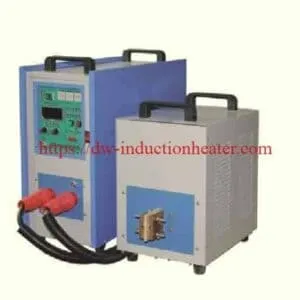
Induction heating is a non-contact electromagnetic heating process that can be used to deliver concentrated thermal energy to electrically conductive nuts and fasteners. In the published HLQ application, a Waspaloy locknut is positioned inside a three-turn helical induction coil and heated using a DW-UHF-6kW-III high-frequency induction heating system.
The original application specifies a target temperature of 2150°F (approximately 1177°C), an operating frequency of 300 kHz, a remote workhead containing one 0.66 µF capacitor, and a heating time of five seconds.
These values describe the original published application configuration. They have not been independently verified as the results of an HLQ production qualification test.
Important metallurgical distinction: Waspaloy is a precipitation-hardenable nickel-based superalloy. A five-second induction heating pulse must not be assumed to provide a complete solution-annealing treatment. The required thermal cycle depends on the alloy specification, starting material condition, workpiece dimensions, temperature uniformity, holding time and cooling requirements.
For the engineering design of an induction heating process, power supply selection, coil design and temperature measurement must be evaluated together with the required final material properties.
Table of Contents
- What Is Induction Annealing for Nuts?
- Key Applications
- Suitable Materials
- Working Principle
- Technical Specifications
- Recommended Model Selection
- Process Workflow
- Common Problems and Solutions
- Engineering Selection Guide
- Advantages and Limitations
- Why Choose HLQ?
- 6 Core FAQs
What Is Induction Annealing for Nuts?
Induction annealing for nuts is an application of electromagnetic heating in which a specially designed induction coil transfers energy to a conductive nut or threaded fastener.
Alternating current passing through the induction coil creates a time-varying magnetic field. This field induces electrical currents inside the workpiece. Electrical resistance converts the induced current energy into heat.
Unlike a conventional heating method that relies on external thermal transfer, induction heating produces heat directly within the electrically conductive workpiece.
However, electromagnetic heating and metallurgical annealing are not interchangeable terms. Annealing describes a defined heat-treatment process intended to obtain specified material properties.
A short heating pulse may deliver the required thermal energy for a particular operation, but the resulting material condition must be demonstrated by appropriate testing.
Published Waspaloy Nut Heating Application
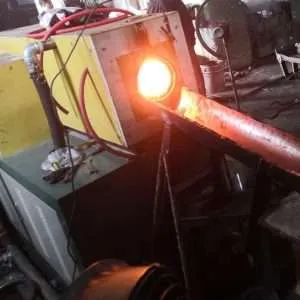
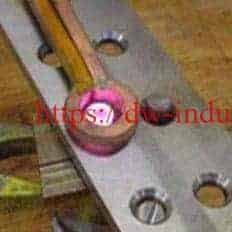
The original HLQ product page describes the heating of a Waspaloy locknut using a compact high-frequency induction heating system.
Waspaloy is a nickel-based superalloy strengthened by the precipitation of gamma-prime phases. The alloy is associated with applications requiring mechanical strength at elevated temperatures, including selected fasteners and other high-temperature components.
Its heat-treatment response differs from ordinary carbon steel, making alloy-specific process control especially important.
Original Induction Heating Photograph

For more information about the differences between localized heating and complete metallurgical treatment, see the induction annealing process.
Key Applications
1. High-Frequency Heating of Waspaloy Locknuts
The primary application documented on this page is the short-duration induction heating of a Waspaloy locknut.
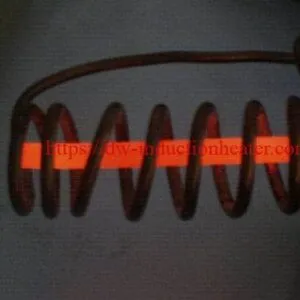
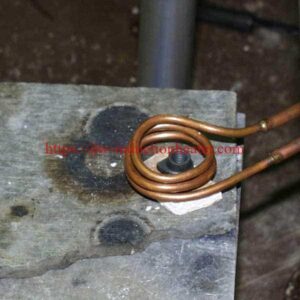
A three-turn helical induction coil surrounds the component and provides electromagnetic coupling to the metal.
The published heating target is approximately 1177°C with a five-second heating time. These are original page values, not independently verified metallurgical results.
2. Localized Thermal Processing of Nickel Alloy Fasteners
Induction heating can be evaluated for the localized thermal processing of electrically conductive nickel alloy fasteners.
Potential applications depend on the required material properties, component dimensions and the feasibility of obtaining a controlled temperature distribution.
Each alloy and fastener configuration requires independent engineering verification.
3. Heating Before Selected Manufacturing Operations
Induction heating may be considered where a manufacturing operation requires controlled thermal input before subsequent processing.
The suitability of this approach depends on the alloy condition and the intended manufacturing operation. It should not be assumed that a thermal cycle suitable for one fastener can be used for another.
4. Controlled Heating of Small Superalloy Components
Small superalloy components can be evaluated for induction heating when electromagnetic coupling, required penetration and coil accessibility permit.
For each application, the equipment must produce the required temperature-time profile without unacceptable surface damage or material-property changes.
5. Integration with Automated Part Handling
A suitable induction heating station may be incorporated into a production system with component positioning, temperature monitoring, controlled heating and subsequent handling.
The complete production rate depends on the heating cycle, fixture design, handling time and any required holding or cooling stages.
No automated production capacity has been verified for the original Waspaloy nut application.
Suitable Materials
The original published application identifies Waspaloy as the workpiece material.
Waspaloy is a nickel-based precipitation-hardenable superalloy, commonly designated UNS N07001. Its strength is developed through alloy chemistry and controlled thermal processing.
The original page does not identify a specific material specification, incoming heat-treatment condition or fastener mechanical-property requirement.
Waspaloy Material Characteristics
| Property | Published Reference Information | Engineering Significance |
|---|---|---|
| Alloy designation | Waspaloy / UNS N07001 | Identify the exact alloy and applicable product specification |
| Alloy family | Nickel-based superalloy | Requires alloy-specific thermal processing |
| Strengthening mechanism | Precipitation strengthening, including gamma-prime phases | Final properties depend on thermal history |
| Published density | 8.20 g/cm³ | Useful for calculating workpiece mass from geometry |
| Published melting range | 1329–1407°C | Heating must remain compatible with material and process limits |
| Heat-treatment condition | Depends on the applicable material specification | Must be established before process qualification |
The physical-property values are published material-reference values and are not measurements from the original induction heating demonstration.
Suitable Workpiece and Material Assessment
| Workpiece / Material | Induction Heating Assessment | Heat-Treatment Status |
|---|---|---|
| Waspaloy locknut | Original page application | Published heating pulse; metallurgical result not independently established |
| Other Waspaloy fastener geometries | Potentially suitable for engineering evaluation | Requires separate coil design and process qualification |
| Other nickel-based superalloy nuts | Electromagnetic heating may be technically feasible | No common universal annealing recipe can be assigned |
| Carbon steel or stainless steel nuts | Conductive materials can be heated by induction | Not covered by the original Waspaloy application data |
Engineering note: Other material families are included only to distinguish the scope of induction heating from the specific Waspaloy application. No unverified temperature, power or heating-time recommendations are assigned to those materials.
Working Principle
Induction heating transfers electrical energy to the workpiece through electromagnetic coupling.
Electromagnetic Heating Sequence
- The power supply generates alternating current at the operating frequency of the matched induction system.
- Alternating current passes through the induction coil.
- A changing magnetic field is generated around the coil.
- The magnetic field induces electrical currents within the electrically conductive Waspaloy nut.
- Electrical resistance converts part of the induced-current energy into heat.
- Heat conducts through the nut, producing a temperature distribution determined by the material properties and process conditions.


Waspaloy is a nickel-based alloy. Its electromagnetic response and thermal properties must be evaluated over the temperature range of the intended process.
For further technical background, see the basic principles of induction heating.
Original Coil Configuration
The original application uses a three-turn helical induction coil surrounding the Waspaloy locknut.
A helical coil can provide electromagnetic coupling around the external surface of a compact conductive workpiece.
The actual heating distribution depends on the coil dimensions, turn spacing, electrical matching, workpiece position and operating conditions.
Engineering Factors Affecting the Heating Pattern
| Parameter | Physical Effect | Engineering Requirement |
|---|---|---|
| Operating frequency | Affects induced-current distribution and electromagnetic penetration | Select according to workpiece geometry and the required thermal profile |
| Coil diameter | Affects electromagnetic coupling to the nut | Maintain appropriate clearance and positioning |
| Number of coil turns | Influences coil inductance and coupling | Match the coil to the power supply and workhead |
| Coil-to-part gap | Affects coupling and heating repeatability | Use a consistent positioning fixture |
| Applied electrical power | Affects the rate of energy transfer | Verify actual temperature response rather than relying only on generator rating |
| Heating duration | Affects temperature rise and thermal diffusion | Verify the complete temperature-time history |
| Workpiece geometry | Affects electrical current paths and heat distribution | Account for outer diameter, height, thread geometry and mass |
| Cooling conditions | Influence the material’s thermal history | Follow the applicable heat-treatment requirements |
Correct induction heating coil design is essential when evaluating small threaded components and high-frequency heating systems.
Technical Specifications
Original Published HLQ Application Parameters
The following table preserves the original product-page values. The distinction between published figures and verified performance is important.
| Parameter | Original Published Value | Verification Status |
|---|---|---|
| Product application | Induction Annealing Nuts | Original page title |
| Workpiece material | Waspaloy | Published material identification |
| Component | Locknut | Published workpiece description |
| Induction equipment model | DW-UHF-6kW-III | Original page model; equipment revision requires confirmation |
| Nominal equipment power | 6 kW | Model designation; actual delivered heating power not provided |
| Operating frequency | 300 kHz | Original case value; model-specific frequency compatibility requires confirmation |
| Remote workhead | One capacitor | Original case configuration |
| Workhead capacitance | 0.66 µF | Original published value |
| Induction coil | Three-turn helical coil | Original published configuration |
| Target temperature | 2150°F / approximately 1177°C | Published target; actual temperature measurement not supplied |
| Heating duration | 5 seconds | Published heating pulse; not verified as a complete annealing cycle |
| Nut outside diameter | Not specified | Required for engineering calculations |
| Nut height | Not specified | Required for coil and thermal-load selection |
| Nut mass | Not specified | Required for thermal-energy calculation |
| Temperature measurement method | Not specified | Required for process verification |
| Cooling procedure | Not specified | Required for heat-treatment qualification |
| Production throughput | Not specified | No verified production capacity available |
Waspaloy Heat-Treatment Reference Data
Published Waspaloy material literature describes solution treatment, stabilization and precipitation-aging operations. These processes cannot be replaced automatically by an arbitrarily selected induction heating pulse.
| Thermal Treatment | Published Temperature | Published Holding Period | Published Cooling Method |
|---|---|---|---|
| Solution treatment — reference route A | 996–1038°C | 4 hours | Water or oil quench |
| Solution treatment — reference route B | 1079°C | 0.5 or 4 hours | Air cool |
| Stabilization treatment | 843°C | 4 or 24 hours | Air cool |
| Precipitation aging | 760°C | 16–24 hours | Air cool |
| Original HLQ page heating pulse | Approximately 1177°C | 5 seconds | Not specified |
Reference qualification: The first four rows reproduce published Waspaloy alloy heat-treatment references. They are informational material data, not qualified production recipes for the locknut described on this page. The final row reproduces the original application claim.
The five-second pulse is substantially shorter than the published solution-treatment holding periods. It is also above the temperatures in the listed reference solution-treatment routes.
Consequently, the original application requires investigation of the actual temperature distribution, possible grain growth, surface condition and final mechanical properties before the term “qualified annealing” can be used.
Published Material Properties Relevant to Equipment Design
| Material Property | Reference Value / Information | Equipment Selection Relevance |
|---|---|---|
| Density | 8.20 g/cm³ | Supports mass estimation when geometry is known |
| Melting range | 1329–1407°C | Provides a material-reference limit, not a recommended heating temperature |
| Electrical conductivity | Temperature dependent | Affects induced-current distribution and coupling |
| Specific heat capacity | Temperature dependent | Required for accurate thermal-energy calculations |
| Thermal conductivity | Temperature dependent | Affects heat spreading and temperature uniformity |
| Microstructure | Precipitation-hardened nickel-base alloy system | Thermal history influences mechanical properties |
No unverified numerical electrical resistivity, specific heat capacity, penetration depth or thermal efficiency has been assumed for the original nut.
Recommended Model Selection
Induction heating equipment for Waspaloy nuts should be selected from the required heating duty rather than from nominal generator power alone.
The correct selection depends on nut geometry, mass, material condition, target temperature, heating time, electromagnetic coupling, required thermal uniformity and cooling conditions.
Published HLQ Equipment Comparison
| Model | Published Nominal Power | Published Frequency | Selection Assessment |
|---|---|---|---|
| DW-UHF-6kW-III | 6 kW | 300 kHz stated in original application | Original application model; verify exact equipment revision and matching configuration |
| DW-UHF-6.0KW | 6 kW | 1.1–2.0 MHz in HLQ equipment summary | Must not be assumed to operate at 300 kHz without model-specific verification |
| DW-UHF-10KW | 10 kW | 100–500 kHz | Alternative model for engineering evaluation where 300 kHz operation is required |
| DW-UHF-20KW | 20 kW | 50–250 kHz | Published frequency range does not include 300 kHz |
These values are published HLQ equipment ratings and frequency ranges. They do not establish a specific heating capacity, efficiency or production result for a Waspaloy locknut.
Preliminary selection: The original DW-UHF-6kW-III configuration should be checked against its actual technical documentation. A DW-UHF-10KW system may also be evaluated because its published frequency range includes 300 kHz. However, no final power rating can be recommended without the missing workpiece and process information.
For additional published equipment configurations, see the HLQ high-frequency induction heating power supplies.
Model Selection Inputs
| Required Input | Why It Matters |
|---|---|
| Nut outside diameter | Determines workpiece size and coil clearance |
| Nut height | Affects heating-zone length and coil geometry |
| Thread geometry | Influences component geometry and dimensional acceptance criteria |
| Workpiece mass | Determines the sensible thermal-energy requirement |
| Starting temperature | Establishes the required temperature rise |
| Target temperature and allowable variation | Defines the thermal requirement |
| Required holding period | Determines whether the equipment and process arrangement can meet the specified treatment |
| Cycle time and production quantity | Influences required generator capacity and automation design |
| Electrical supply | Must match the selected generator |
| Cooling and atmosphere requirements | Determine auxiliary systems and process controls |
Process Workflow
Waspaloy nut induction heating should be organized as a controlled manufacturing process with defined material identification, electrical settings, temperature verification and acceptance testing.
Step 1 — Confirm Material Specification
Identify the Waspaloy grade, material specification, incoming heat-treatment condition and required final properties.
The starting condition is especially important for precipitation-hardened superalloys because the thermal history affects subsequent mechanical performance.
Step 2 — Inspect and Prepare the Nut
Check the nut dimensions, thread condition and surface cleanliness. Confirm that the component can be correctly positioned within the induction coil.
Step 3 — Prepare the Heating System
Install the induction coil, verify the electrical matching arrangement and check cooling-water operation.
Confirm the positioning fixture, temperature measurement system and electrical safety functions before heating.
Step 4 — Apply the Induction Heating Cycle
Apply the selected frequency, power and heating duration while monitoring the actual thermal response.
The original page specifies 300 kHz and five seconds, but these settings must not be assumed to be suitable for an unverified nut geometry or material condition.
Step 5 — Complete the Required Thermal Treatment
If the process requires solution treatment, stabilization, aging or another metallurgical operation, complete the specified thermal cycle according to the applicable material and product requirements.
Do not substitute a short heating pulse for the required holding period without formal process validation.
Step 6 — Cool and Inspect
Apply the approved cooling procedure and inspect the finished component for dimensional condition, surface integrity and the specified material properties.
Where applicable, confirm hardness, microstructure or other acceptance criteria defined by the relevant material specification.
Process Inspection Checklist
| Inspection Item | Required Verification |
|---|---|
| Material identification | Confirm the correct material specification and certificate |
| Starting condition | Verify the incoming material condition |
| Workpiece dimensions | Check outside diameter, height and thread geometry |
| Induction coil | Inspect electrical connections, clearance and mechanical condition |
| Cooling system | Verify operating flow, temperature, pressure and interlocks |
| Temperature measurement | Use a validated measurement method appropriate to the surface and temperature range |
| Thermal cycle | Confirm time, temperature distribution and cooling requirements |
| Finished component | Check specified dimensions, surface condition and material acceptance criteria |
Common Problems and Solutions
| Problem | Possible Cause | Recommended Engineering Action |
|---|---|---|
| Uneven heating | Incorrect coil coupling, positioning or workpiece geometry | Review coil design and fixture alignment; verify the temperature distribution |
| Heating time is too short for the specified treatment | Pulse duration does not satisfy the required thermal cycle | Review the material specification and qualify the complete heating process |
| Excessive temperature | Incorrect electrical settings or inadequate temperature feedback | Validate the measurement method and adjust the process under controlled conditions |
| Surface oxidation | Exposure to an unsuitable atmosphere during high-temperature heating | Review atmosphere requirements, exposure duration and surface preparation |
| Possible grain growth | Unsuitable high-temperature exposure | Evaluate microstructure and use a qualified material-specific thermal cycle |
| Thread distortion | Thermal gradients, restraint or unsuitable cooling conditions | Inspect dimensional stability and review the heating and cooling arrangement |
| Unstable electrical matching | Incorrect coil and workhead configuration | Verify the resonant matching arrangement and equipment operating limits |
| Coil overheating | Inadequate cooling or unsuitable coil construction | Check cooling conditions and inspect the coil |
| Inconsistent material properties | Variations in material condition or thermal cycle | Improve traceability and apply the required metallurgical acceptance tests |
Engineering Selection Guide
1. Define the Actual Heat-Treatment Objective
Establish whether the required operation is localized heating, full solution annealing, stress relief, stabilization or precipitation aging.
These are different technical requirements and may require different thermal profiles and equipment arrangements.
2. Confirm the Material and Its Starting Condition
Obtain the correct Waspaloy specification and material certificate.
Identify the incoming heat-treatment condition and required final mechanical properties before determining a heating cycle.
3. Determine the Nut Geometry
Record the nut outside diameter, height, internal thread size, mass and any geometrical features that affect induction coupling or temperature uniformity.
4. Estimate the Required Thermal Energy
The sensible thermal energy required to increase the material temperature can be expressed as:
Q = m × ∫cp(T)dT
The integral is evaluated from the initial temperature to the final temperature.
Where:
- Q = sensible thermal energy, J
- m = heated workpiece mass, kg
- cp(T) = temperature-dependent specific heat capacity, J/(kg·K)
The actual electrical energy required will also depend on electromagnetic coupling, equipment losses, heat conduction, convection, radiation and other process conditions.
Because the original page does not disclose the nut dimensions, mass or measured temperature response, a reliable thermal-load calculation cannot be completed from the published information alone.
5. Select the Appropriate Operating Frequency
The alternating-current frequency influences induced-current distribution and electromagnetic penetration.
Frequency selection should therefore consider the workpiece dimensions, material properties at the relevant temperatures and desired heating distribution.
The original 300 kHz frequency must be verified against the specific DW-UHF-6kW-III equipment configuration.
6. Select the Induction Coil
Use a coil geometry suitable for the nut size and intended heating region.
The original page describes a three-turn helical coil, but the exact coil diameter, copper-tube dimensions, spacing and electrical characteristics are not provided.
These values must be established during actual coil engineering and matching.
7. Verify the Temperature Measurement Method
Temperature measurement at elevated temperatures can be affected by material emissivity, surface condition, measurement position and instrument response.
Select and validate the measurement system for the actual workpiece and expected temperature range.
8. Define Atmosphere and Surface Requirements
Surface oxidation and other contamination mechanisms should be evaluated according to the material specification, thermal cycle and final part requirements.
A protective atmosphere may be considered where required, but no specific gas flow rate, oxygen concentration or shielding configuration has been established for the original application.
9. Determine the Required Cooling Method
Cooling is part of the metallurgical process. It must be selected according to the approved material treatment rather than assumed from the heating method.
Air cooling, liquid quenching or another procedure should only be specified where the applicable process documentation requires it.
10. Qualify the Process Before Production
Representative application trials should be used to establish the required electrical settings, thermal response, metallurgical condition and production repeatability.
Final acceptance should be based on the specified material properties and component requirements.
Conceptual Induction Heating Station Layout
A possible equipment arrangement includes an induction heating power supply, remote matching workhead, water-cooled copper coil, workpiece positioning fixture, cooling circuit and temperature monitoring system.
For automated operation, part feeding and unloading may be added when the complete production cycle has been established.
Actual line dimensions, equipment guarding, cooling requirements and production rates must be determined by the final engineering design.
Additional models and specifications can be reviewed in the HLQ induction heating equipment selection guide.
Advantages and Limitations
Advantages
- Non-contact heating: Electromagnetic energy is transferred without requiring direct contact between the coil and the nut.
- Localized energy delivery: The coil can be designed to concentrate energy around a selected component region.
- Adjustable heating conditions: Electrical power and process duration can be controlled within the equipment’s operating limits.
- Process integration potential: Induction heating equipment can be incorporated into suitable industrial manufacturing systems.
- Repeatable positioning: A controlled fixture can support consistent workpiece placement.
- Flameless heating: Heating is produced through electromagnetic induction rather than direct flame impingement.
Limitations
- Coil geometry must be matched to the workpiece.
- The generator and workhead require compatible electrical matching.
- Temperature uniformity cannot be determined from rated generator power alone.
- High-temperature processing may affect the material microstructure.
- Waspaloy requires alloy-specific thermal treatment and verification.
- Short-duration heating does not establish completion of a standard annealing cycle.
- Heating and cooling can affect component dimensions and surface condition.
- The original published application does not include a verified metallurgical inspection report.
Why Choose HLQ?
HLQ Induction Equipment Co., Ltd. publishes induction heating equipment for metal heating, annealing, hardening, brazing and related industrial applications.
The published equipment range includes medium-frequency, high-frequency and ultra-high-frequency induction heating systems.
For the Waspaloy nut application, the original page identifies a DW-UHF-6kW-III power supply with a remote matching workhead and a custom three-turn helical coil.
The appropriate technical evaluation should focus on equipment compatibility, workpiece-specific coil design, temperature monitoring, cooling arrangements and the required metallurgical process.
Published Equipment Information
| Technical Area | Relevant HLQ Information |
|---|---|
| Original application equipment | DW-UHF-6kW-III induction heating system |
| Published application frequency | 300 kHz, subject to equipment-version verification |
| Original workhead configuration | Remote workhead with one 0.66 µF capacitor |
| Original induction coil | Three-turn helical coil |
| Other published UHF equipment | Models with different ratings and frequency ranges |
| Application engineering | Final equipment suitability depends on actual workpiece and process testing |
No unverified customer installation, production throughput, equipment efficiency or completed Waspaloy heat-treatment qualification is claimed.
Published Waspaloy Nut Application — Reference Summary
The following application summary reproduces the original published page values and distinguishes them from the results that remain to be verified.
| Reference Item | Published Information |
|---|---|
| Workpiece | Waspaloy locknut |
| Induction heating model | DW-UHF-6kW-III |
| Frequency | 300 kHz |
| Capacitance | 0.66 µF |
| Coil | Three-turn helical coil |
| Published target temperature | 2150°F / approximately 1177°C |
| Published heating time | 5 seconds |
| Verified final material condition | Not provided |
| Qualified production capacity | Not provided |

Related HLQ Induction Annealing Applications
Other published HLQ application pages cover different conductive materials and workpiece geometries. Their process parameters should not be transferred directly to the Waspaloy nut application.
- Annealing Brass Tubing With Induction
- Induction Annealing Copper Wire
- Annealing Titanium Fasteners With Induction
- Induction Annealing Copper Tube
- Induction Annealing Steel Pipe and Tube
6 Core FAQs
1. What is induction annealing of nuts?
Induction annealing of nuts is a metal heat-treatment application that uses an alternating electromagnetic field to heat an electrically conductive nut. The required thermal cycle depends on the material, initial condition and desired final properties. Induction heating alone does not automatically guarantee that a specified annealing process has been completed.
2. Can Waspaloy nuts be heated using induction heating?
Yes. Waspaloy is electrically conductive and can be heated by electromagnetic induction. The original HLQ page describes a Waspaloy locknut positioned inside a three-turn induction coil. However, the actual thermal distribution and resulting material condition must be verified for the workpiece and process.
3. What temperature is required for Waspaloy nut annealing?
There is no single universal temperature for every Waspaloy fastener treatment. Published material references include solution-treatment temperatures of 996–1038°C and 1079°C under specified conditions, followed by other thermal operations where required. The original page reports heating to approximately 1177°C for five seconds, but that pulse must not be treated as a qualified complete solution-annealing schedule.
4. Which induction heating equipment is suitable for Waspaloy nuts?
The original HLQ page identifies the DW-UHF-6kW-III model operating at a reported frequency of 300 kHz. The exact model revision and frequency compatibility require confirmation. Alternative equipment must be assessed using the nut geometry, required thermal cycle, coil design, material properties and measured heating response.
5. Can a Waspaloy nut be fully annealed in five seconds?
A five-second heating pulse does not, by itself, establish complete metallurgical annealing. Published Waspaloy solution-treatment processes generally specify defined holding periods and cooling conditions. Any proposed rapid thermal process requires experimental qualification and testing of the resulting material properties.
6. Can an induction heating system be integrated into automated nut production?
Yes. Induction heating equipment can be integrated with appropriate feeding, positioning, temperature monitoring, cooling and part-handling systems. The achievable throughput depends on the complete thermal and handling cycle. The original Waspaloy nut page does not provide a verified production capacity, so no specific parts-per-minute rate can be claimed.