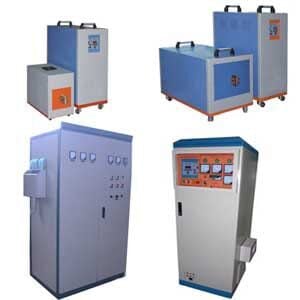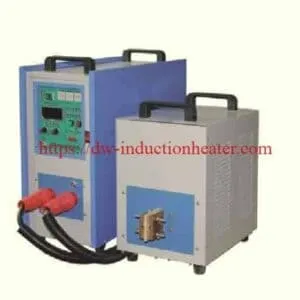
DW-HF-45kw High Frequency Induction Heater
DW-HF-45kW High Frequency Induction Heater for Brazing, Hardening and Metal Heating
Table of Contents
- Quick Answer
- Product Overview
- Key Applications
- Suitable Materials
- Working Principle
- Technical Specifications
- Recommended Applications and Model Selection
- Engineering Selection Guide
- Process Workflow
- Induction Coil Design
- Cooling Water Requirements
- Common Problems and Solutions
- Why Choose HLQ Induction Equipment?
- FAQ
The DW-HF-45kW high frequency induction heating equipment is a compact industrial induction heater designed for brazing, soldering, surface hardening, annealing, shrink fitting, preheating and localized metal heating. With 45KVA maximum oscillation power and 30–80kHz operating frequency, it is suitable for copper, brass, steel, stainless steel, carbide tools, small gears, shafts, tubes, fittings and mechanical components. The system provides fast heating, stable power output, continuous working capability and easy integration with manual or semi-automatic fixtures. It helps manufacturers replace flame heating, improve process repeatability and reduce heating defects.
Quick Answer
The DW-HF-45kW induction heating equipment is a high frequency induction heater used for fast and localized heating of conductive metal parts. It is best suited for copper tube brazing, brass fitting brazing, carbide tool brazing, small gear hardening, shaft surface hardening, stainless steel heating, annealing, shrink fitting and welding preheating. Compared with flame heating, it provides cleaner operation, faster heating, better temperature repeatability and easier automation. For buyers who need more power than a 25kW or 35kW model but still want a compact high frequency machine, the DW-HF-45kW is a practical choice for workshop and production-line applications.
Product Overview
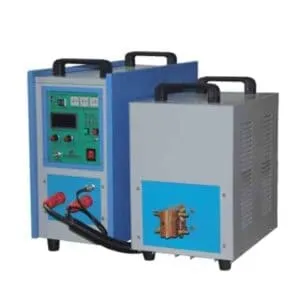
The DW-HF-45kW high frequency induction heating equipment is a water-cooled induction power system designed for industrial metal heating. It converts three-phase industrial power into high frequency current. This current flows through a customized copper induction coil and creates an alternating magnetic field. When a conductive metal workpiece is placed inside or near the coil, eddy currents are generated in the workpiece, causing rapid and localized heating.
| Model | DW-HF-45KW | |
| Input power desire | 3X380V 50-60HZ | |
| Oscillate power max | 45KVA | |
| Oscillate frequency | 30K-80KHZ | |
| Input power max | 50KVA | |
| Cooling water max | 0.3Mpa≥6L/MIN | |
| Oscillating current | 15-90A | |
| Duty cycle | 100%30 °C | |
| Weight | 75KG | |
| Cubage | Host computer | 550X240X535mm |
| Extension | 470X265X440mm | |
| Cable length | 2m | |
Key Applications
The DW-HF-45kW induction heater is suitable for many industrial heating applications where rapid, localized and controllable heat is required. It is commonly used for brazing, hardening, annealing, shrink fitting, soldering and preheating. The current product page already identifies applications such as induction brazing, industrial metal heating, induction forging, PWHT, preheat welding, shrink fitting and surface hardening.
| Application | Typical Workpiece | Recommended Use | Buyer Benefit |
|---|---|---|---|
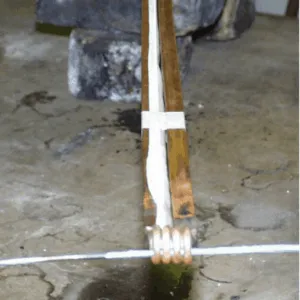
| Induction Brazing | Copper tubes, brass fittings, carbide tools, stainless joints | Fast localized joint heating | Cleaner, safer and more repeatable than flame brazing |
| Carbide Tool Brazing | Carbide tips, saw blades, cutting tools, drill tools | Heating steel holder and brazing filler zone | Improves joint strength and reduces operator dependency |
| Small Gear Hardening | Gears, sprockets, pinions, toothed wheels | Surface hardening of tooth area | Improves wear resistance and service life |
| Shaft Hardening | Small shafts, pins, rollers, journals | Localized surface hardening | Creates hard surface while keeping core tough |
| Induction Annealing | Copper, brass, stainless steel, small steel parts | Softening and stress relief | Improves ductility and reduces residual stress |
| Shrink Fitting | Bearings, gears, bushings, sleeves, rings | Thermal expansion before assembly | Fast assembly without open flame or oven heating |
| Welding Preheating | Small steel parts, pipe sections, welded joints | Preheat before welding | Reduces thermal shock and improves weld quality |
| Induction Soldering | Electrical connectors, terminals, copper contacts | Precise low-to-medium temperature joining | Stable joint quality and better process control |
Suitable Materials
The DW-HF-45kW high frequency induction heating equipment can heat many conductive metals. Heating efficiency depends on magnetic property, electrical resistivity, thermal conductivity, workpiece size, coil shape and coupling distance. Magnetic steels usually heat efficiently. Copper and aluminum require stronger coil coupling because of their high electrical and thermal conductivity.
| Material | Heating Suitability | Typical Application | Engineering Notes |
|---|---|---|---|
| Carbon Steel | Very good | Hardening, preheating, shrink fitting | Magnetic steel heats efficiently below Curie temperature. |
| Alloy Steel | Very good | Shaft hardening, gear hardening, pin hardening | Suitable for surface hardening and heat treatment. |
| Stainless Steel | Good | Brazing, annealing, shrink fitting | Requires correct coil design and heating time. |
| Copper | Medium | Copper tube brazing, terminal heating, annealing | High conductivity requires good coil coupling and sufficient power. |
| Brass | Good | Brass fitting brazing, valve component heating | Common material for induction brazing applications. |
| Carbide Tools | Suitable with steel holder | Carbide tip brazing | Heating usually focuses on steel tool body and brazing area. |
| Aluminum | Application dependent | Small parts heating and special brazing | Requires careful coil design due to high conductivity and non-magnetic behavior. |
Working Principle
The DW-HF-45kW induction heater uses electromagnetic induction to heat metal without direct flame contact. The power supply converts industrial AC power into high frequency current. This current passes through a water-cooled copper induction coil. The coil generates an alternating magnetic field. When a conductive metal part is placed in the magnetic field, eddy currents are induced in the workpiece. The electrical resistance of the metal converts these currents into heat.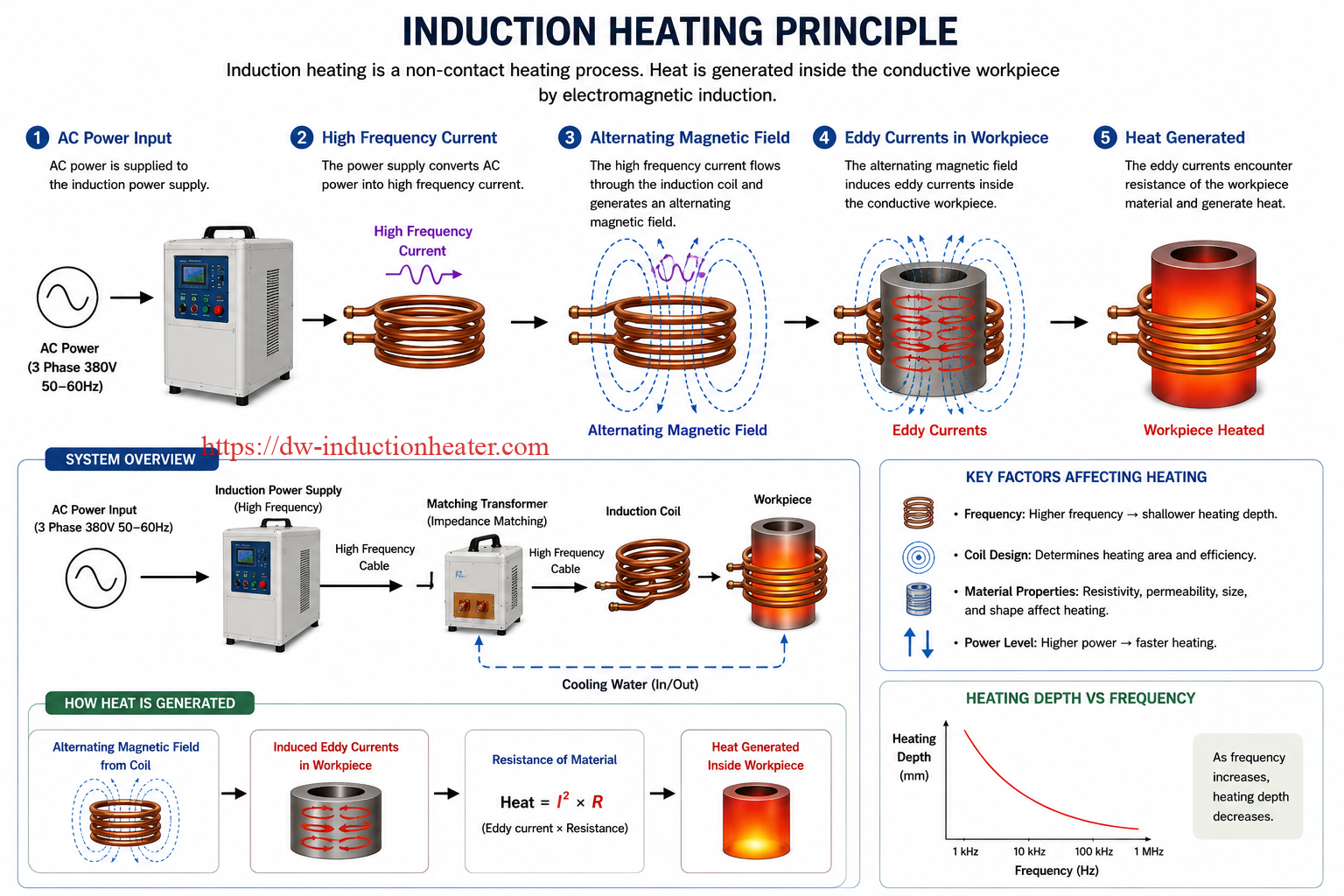
High frequency induction heating is especially useful for localized surface heating, brazing and small-to-medium components. The 30–80kHz frequency range of the DW-HF-45kW model is suitable for many applications where controlled surface or near-surface heating is required. [oai_citation:3‡dw-inductionheater.com](https://dw-inductionheater.com/product/dw-hf-45kw-induction-heating-equipment)
| Process Stage | What Happens | Control Parameter |
|---|---|---|
| Power conversion | Industrial power is converted to high frequency output | Input voltage, power setting, frequency range |
| Magnetic field generation | Current flows through the induction coil | Coil turns, coil diameter, cooling water |
| Eddy current heating | Induced current heats the workpiece | Workpiece material, coil gap, heating time |
| Temperature rise | Workpiece reaches brazing, hardening or assembly temperature | Power, time, temperature monitoring |
| Cooling or quenching | Workpiece is cooled naturally, sprayed or quenched | Cooling method depends on application |
Technical Specifications
| Parameter | Specification | Notes |
|---|---|---|
| Model | DW-HF-45KW | High frequency induction heating equipment |
| Input Power | 3×380V, 50–60Hz | Other voltage options may require customization |
| Maximum Oscillation Power | 45KVA | Suitable for medium localized heating applications |
| Oscillation Frequency | 30–80kHz | Good for brazing, surface heating and small part hardening |
| Maximum Input Power | 50KVA | Power supply capacity should be confirmed before installation |
| Cooling Water Pressure / Flow | Max 0.3MPa, ≥6L/min | Clean cooling water is required for stable operation |
| Oscillating Current | 15–90A | Depends on load and coil design |
| Duty Cycle | 100% at 30°C condition | Continuous working is allowed under proper cooling condition |
| Weight | Approx. 75kg | Compact industrial design |
| Main Unit Size | 550×240×535mm | Host computer / main power unit |
| Extension Unit Size | 470×265×440mm | Extension / transformer unit |
| Cable Length | 2m | Allows flexible workstation layout |
Recommended Applications and Model Selection
The DW-HF-45kW model is suitable when the workpiece is not too large and the required heating zone is localized. Compared with a 35kW model, it provides stronger heating capacity for larger joints or faster production cycles. For large billets, deep hardening, heavy forging or melting, a medium-frequency or higher-power system may be more suitable.
| Application | Material | Recommended Power | Frequency | DW-HF-45kW Suitability |
|---|---|---|---|---|
| Copper tube brazing | Copper / brass | 15–60kW | 30–100kHz | Very suitable |
| Carbide tool brazing | Carbide + steel holder | 15–80kW | 20–100kHz | Very suitable |
| Small shaft hardening | 45 steel, 40Cr, 4140 | 25–100kW | 20–100kHz | Suitable for small and medium diameters |
| Small gear hardening | 40Cr, 42CrMo, 4140 | 30–150kW | 10–80kHz | Suitable for small and medium gears |
| Bearing shrink fitting | Steel bearing / shaft | 20–80kW | 20–80kHz | Suitable |
| Small metal annealing | Copper, brass, steel, stainless steel | 15–80kW | 30–100kHz | Suitable |
| Large billet forging | Steel, copper, aluminum | 100–1000kW+ | 1–10kHz | Not recommended; choose medium frequency system |
| Industrial metal melting | Aluminum, copper, brass, steel | Depends on furnace capacity | Medium frequency preferred | Not the best choice for production melting |
Engineering Selection Guide
To select the correct induction heating equipment, buyers should not only compare machine power. The correct model depends on material, workpiece size, heating temperature, heating time, coil design, production rhythm and cooling condition.
| Selection Factor | Why It Matters | What Buyer Should Provide |
|---|---|---|
| Material | Different metals absorb induction energy differently | Steel, copper, brass, aluminum, stainless steel, carbide tool |
| Workpiece Size | Determines power and coil size | Diameter, length, thickness, weight |
| Heating Area | Determines coil geometry | Joint area, tooth area, shaft surface, ring inner diameter |
| Target Temperature | Determines heating energy requirement | Brazing temperature, hardening temperature, annealing temperature |
| Heating Time | Determines required power margin | Seconds per part or production cycle time |
| Production Mode | Determines automation level | Manual, semi-automatic, robotic or inline production |
| Cooling Water | Protects power supply and coil | Water pressure, flow rate, chiller availability |
Process Workflow
- Confirm the material, workpiece size and heating objective.
- Select or design a suitable induction coil according to workpiece geometry.
- Connect clean cooling water and confirm water flow before power-on.
- Place the workpiece inside or near the induction coil.
- Set heating power, time and working mode.
- Start induction heating and observe the heating zone.
- Stop heating when the target temperature or process condition is reached.
- Apply brazing filler, quenching, cooling or assembly operation as required.
- Inspect joint quality, hardness, fit quality or heating result.
- Record process parameters for repeatable production.
Induction Coil Design
The induction coil is the key component that determines heating efficiency and heating pattern. Even with the correct 45kW power supply, a poorly designed coil can cause slow heating, uneven temperature or low efficiency. Coil design should match the workpiece shape, required heating area and production method.
| Coil Type | Best Application | Design Notes |
|---|---|---|
| Single-turn coil | Ring heating, shrink fitting, local heating | Simple structure and strong localized heating |
| Multi-turn coil | Brazing, annealing, small shaft heating | Improves heating length and uniformity |
| U-shaped coil | Partial heating and special-shaped parts | Useful when workpiece cannot pass through a closed coil |
| Pancake coil | Flat surface heating | Used for plates, discs and surface heating |
| Split coil | Large or assembled parts | Allows easy loading without removing the workpiece |
Cooling Water Requirements
The DW-HF-45kW induction heating equipment requires stable cooling water to protect the power supply, transformer and induction coil. The current specification requires cooling water flow of at least 6L/min and pressure not exceeding 0.3MPa. Clean water and proper filtration are recommended to reduce scale, blockage and overheating risk. [oai_citation:4‡dw-inductionheater.com](https://dw-inductionheater.com/product/dw-hf-45kw-induction-heating-equipment)
| Cooling Item | Recommendation | Reason |
|---|---|---|
| Water Flow | ≥6L/min | Ensures coil and power components are properly cooled |
| Water Pressure | ≤0.3MPa | Prevents damage to internal cooling channels |
| Water Quality | Clean, filtered, low scale | Reduces blockage and improves equipment life |
| Cooling Method | Industrial chiller or closed-loop cooling | Recommended for continuous production |
| Protection | Water flow and temperature monitoring | Prevents overheating and unexpected shutdown |
Common Problems and Solutions
| Problem | Possible Cause | Engineering Solution |
|---|---|---|
| Heating speed is too slow | Coil gap too large, wrong coil design, workpiece too large | Optimize coil shape, reduce coil gap or choose higher power equipment |
| Uneven heating | Workpiece not centered, coil field uneven, material thickness variation | Improve fixture, redesign coil and rotate workpiece if needed |
| Brazed joint quality is unstable | Wrong filler, poor flux, insufficient heating or overheating | Control heating time, joint clearance, filler placement and temperature |
| Hardness is too low after hardening | Temperature too low, heating time too short or poor quenching | Increase power/time and improve quenching flow |
| Coil overheats | Insufficient cooling water or blocked cooling channel | Check water flow, pressure, water quality and coil connections |
| Equipment alarms frequently | Water shortage, overload, unstable power supply or poor load matching | Check utilities, coil matching and machine protection settings |
| Workpiece surface oxidizes | Overheating or long exposure in air | Reduce heating time, use flux or protective atmosphere if needed |
Why Choose HLQ Induction Equipment?
HLQ Induction Equipment provides induction heating systems for brazing, hardening, forging, melting, annealing, shrink fitting, preheating and customized industrial heating applications. For the DW-HF-45kW model, HLQ can help users select the correct induction coil, heating process, cooling system and fixture according to material, workpiece size and production target.
| HLQ Capability | Customer Value |
|---|---|
| High frequency induction heating equipment manufacturing | Provides reliable machines for brazing, hardening and metal heating |
| Customized induction coil design | Improves heating efficiency and process repeatability |
| Application engineering support | Helps buyers select suitable power, frequency and process parameters |
| Compact industrial equipment | Suitable for workshop, production line and maintenance use |
| OEM and project support | Can support distributors, factories and custom heating projects |
FAQ
1. What is the DW-HF-45kW induction heating equipment used for?
It is used for induction brazing, surface hardening, annealing, shrink fitting, soldering, preheating and localized metal heating. Common workpieces include copper tubes, brass fittings, carbide tools, small shafts, small gears, bearings, sleeves and metal joints.
2. What frequency does the DW-HF-45kW induction heater use?
The DW-HF-45kW model operates in the 30–80kHz frequency range, which is suitable for many high frequency induction heating applications such as brazing, small part hardening and localized surface heating.
3. Can this machine be used for copper tube brazing?
Yes. The 45kW high frequency induction heater is suitable for many copper tube brazing and brass fitting brazing applications. The final heating result depends on tube size, joint clearance, filler metal, coil design and production cycle time.
4. Can it be used for induction hardening?
Yes. It can be used for small shaft hardening, pin hardening, small gear hardening and other surface hardening applications. For large shafts, deep case hardening or heavy-duty gears, a higher power or medium frequency induction hardening system may be required.
5. What cooling water is required?
The equipment requires clean cooling water with flow of at least 6L/min and pressure not exceeding 0.3MPa. For continuous production, a closed-loop industrial water chiller is recommended.
6. Is the DW-HF-45kW machine suitable for continuous operation?
Yes. The product specification lists 100% duty cycle at 30°C condition. Continuous operation requires stable input power, sufficient cooling water and correct coil matching.
7. What is the difference between DW-HF-35kW and DW-HF-45kW?
The DW-HF-45kW model provides higher maximum oscillation power than the 35kW model, so it is better for larger brazing joints, faster heating cycles and workpieces that need more thermal energy. The correct choice still depends on material, heating area, coil design and production speed.
8. What information is needed for a quotation?
Please provide the material, workpiece size, heating area, target temperature, required heating time, production quantity, voltage, cooling water condition and photos or drawings of the workpiece. This information helps select the correct coil and machine configuration.
9. Can HLQ design a custom induction coil for this machine?
Yes. HLQ can design different coils for brazing, hardening, annealing, shrink fitting and special-shaped workpieces. Coil design is critical for heating speed, uniformity and efficiency.
10. Is this model suitable for metal melting?
The DW-HF-45kW can heat metals, but it is not the best choice for industrial melting production. For melting aluminum, copper, brass, steel or iron, a dedicated induction melting furnace is usually recommended.
11. Why choose induction heating instead of flame heating?
Induction heating provides faster heating, cleaner operation, less open-flame risk, better repeatability, easier automation and more localized energy delivery. It is especially useful for brazing, hardening and precision metal heating.