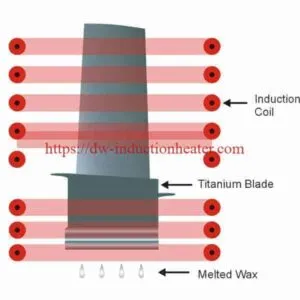
Induction Heating Titanium Blade
Induction Heating Titanium Blades to Melt and Drain Wax
Quick Answer
Induction heating of a titanium blade heats the blade without contact so that the wax inside melts and drains out.
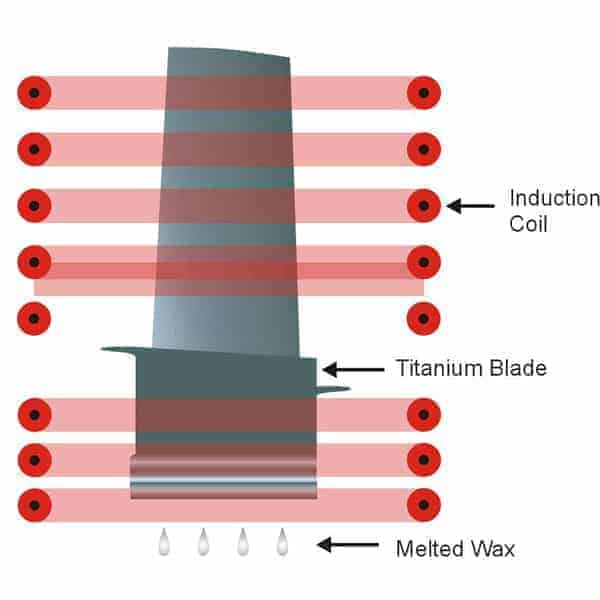
In this HLQ case, 4 in (101.6 mm) titanium blades were placed in a specially designed eight-turn helical coil. A DW-HF-15kW system with a remote workhead heated them at 60 kHz to a target of 500 °F. Power was applied for 3.5 minutes, and the wax melted and dripped out of the blade. The process was uniform and repeatable, faster, and non-contact.
What is Induction Heating of a Titanium Blade?
Titanium is electrically conductive, so an alternating magnetic field induces eddy currents in the blade and heats it directly. Nothing touches the blade, and the coil is shaped to cover the zone that must be heated.
| Item | HLQ case data |
|---|---|
| Objective | Heat a titanium blade to melt and drain the wax from inside the blade |
| Material | 4 in (101.6 mm) long titanium blades with a 1.5 × 0.25 in (38.1 × 6.4 mm) metering area |
| Temperature | 500°F (200°C) |
| Frequency | 60 kHz |
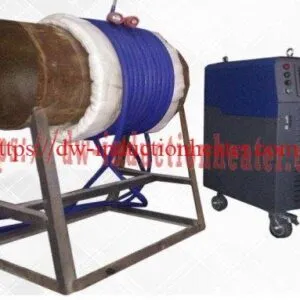
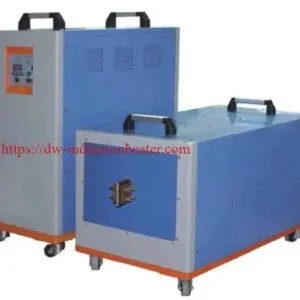
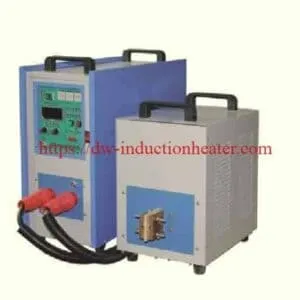
| Equipment | DW-HF-15kW induction heating system with a remote workhead, plus a coil designed for this application |
| Coil | Specially designed eight-turn helical coil |
| Process | Power applied for 3.5 minutes; the wax melts and drips out of the blade |
| Results | Uniform and repeatable performance; faster application time; non-contact heating |
Key Applications
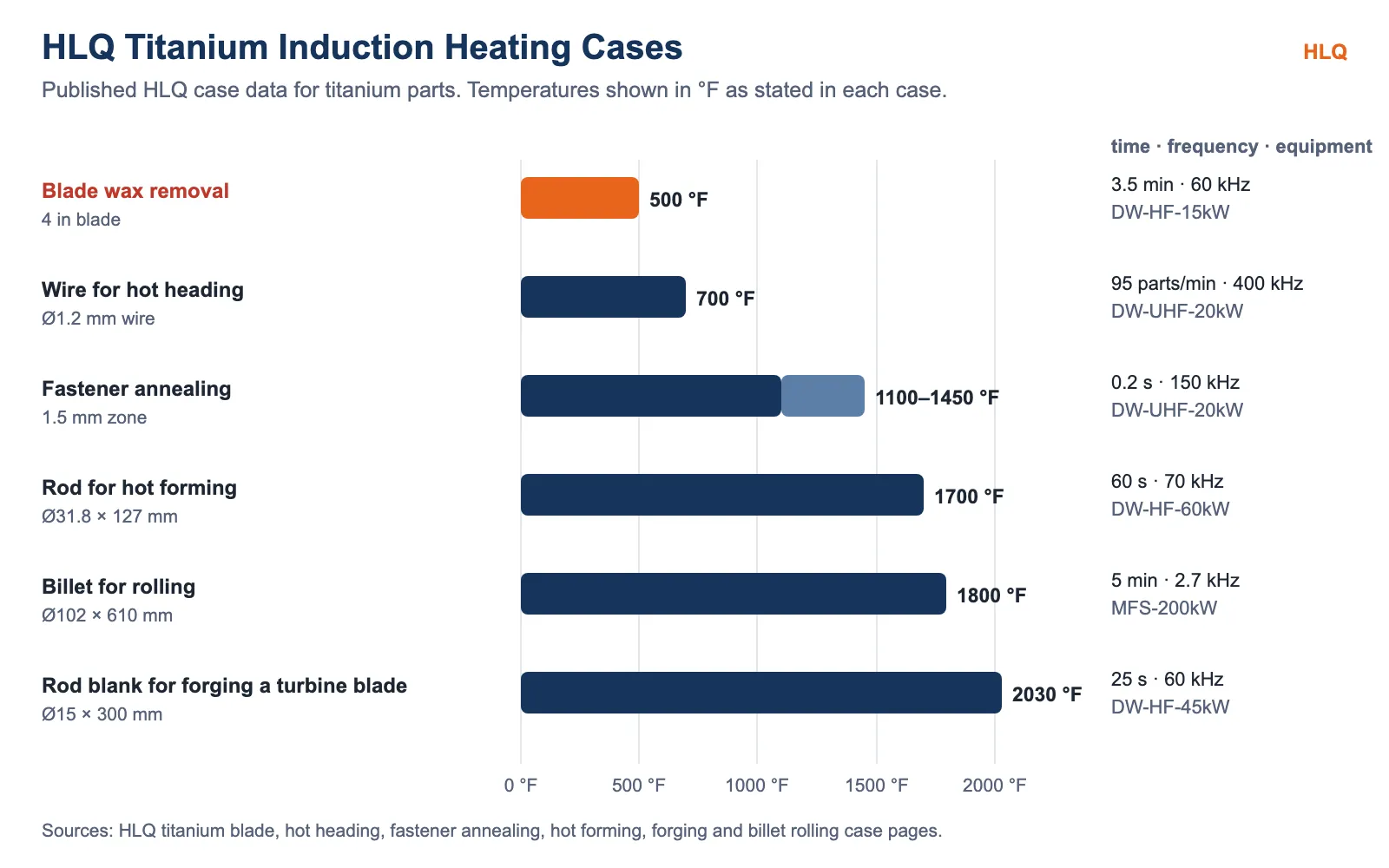
| Titanium application | Part | Temperature | Time / rate | Frequency | Equipment |
|---|---|---|---|---|---|
| Blade wax removal (this page) | 4 in blade | 500 °F | 3.5 min | 60 kHz | DW-HF-15kW |
| Wire for hot heading | Ø1.2 mm wire | 700 °F (371 °C) | 95 parts/min | 400 kHz | DW-UHF-20kW |
| Fastener annealing | 1.5 mm zone on Ø4.14–9.52 mm fasteners | 1100–1450 °F (593–788 °C) | 0.2 s; 1,000 parts/min | 150 kHz | DW-UHF-20kW |
| Rod for hot forming | Ø31.8 × 127 mm | 1700 °F (926.7 °C) | 60 s | 70 kHz | DW-HF-60kW |
| Billet for rolling | Ø102 × 610 mm | 1800 °F | 5 min | 2.7 kHz | MFS-200kW |
| Rod blank for forging into a turbine blade | Ø15 × 300 mm | 2030 °F (1110 °C) | 25 s | 60 kHz | DW-HF-45kW |
Case pages:
Suitable Materials
| Material / part | HLQ case | Notes |
|---|---|---|
| Titanium blades with internal wax | This page | Wax melts and drains out |
| Titanium wire | Hot heading | Continuous heating |
| Titanium fasteners | Annealing | Argon flooded to prevent oxidation |
| Titanium rods and rod blanks | Hot forming, forging | Surface and centre heated |
| Titanium billets | Rolling | Low frequency for a large diameter |
The titanium grade is not stated in the blade case. Confirm the grade before selecting frequency and power.
Working Principle
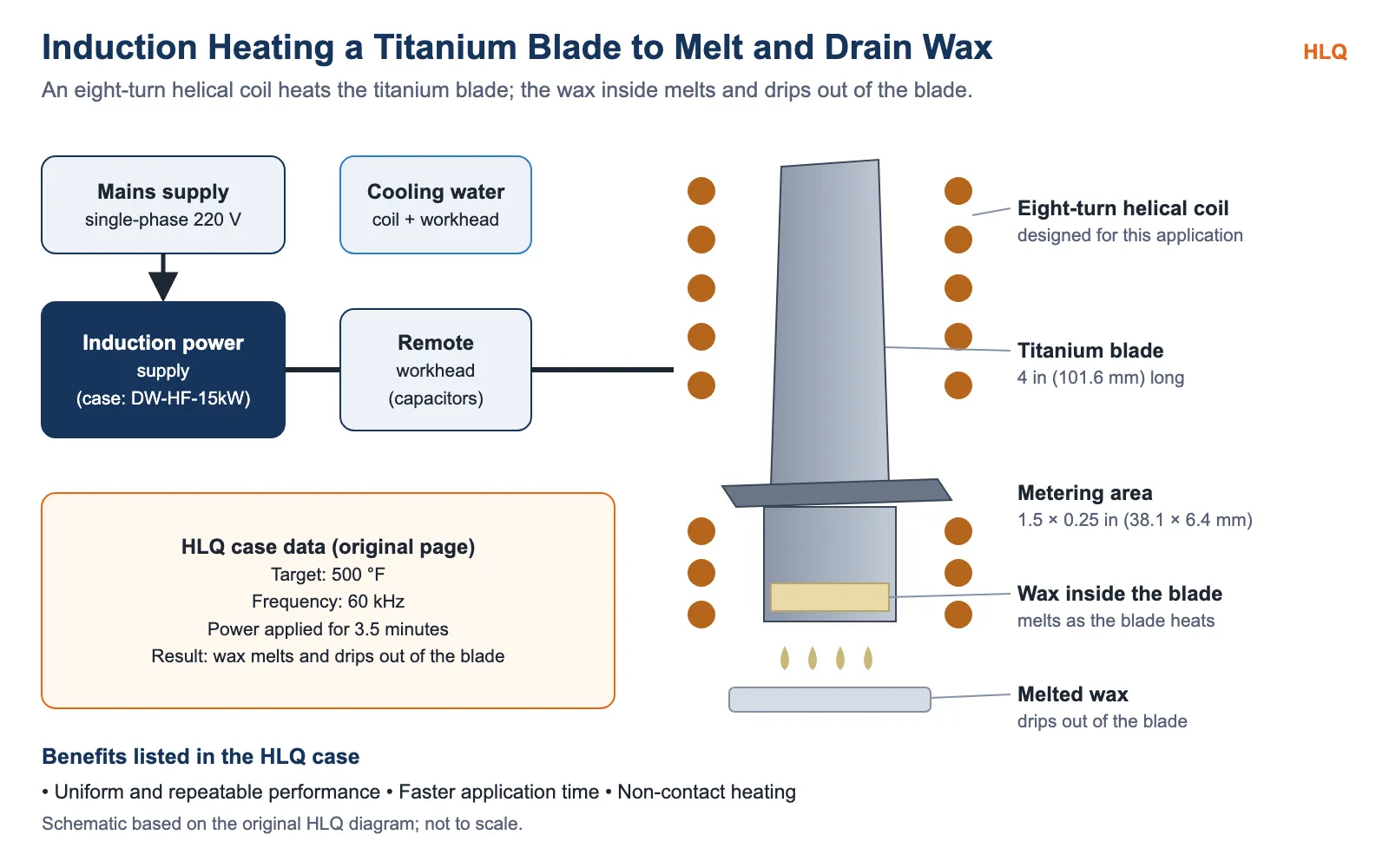
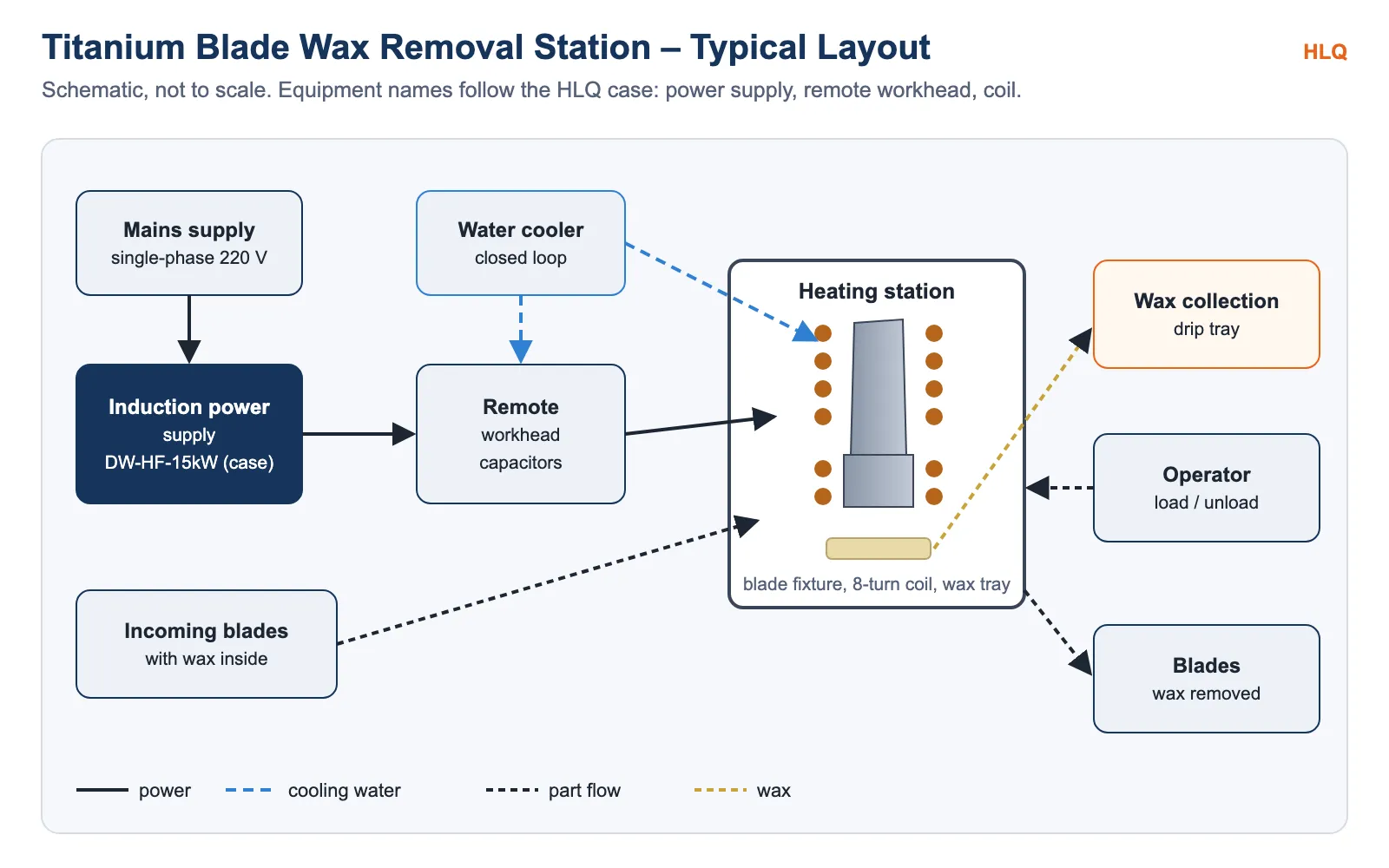
- The DW-HF-15kW power supply feeds a remote workhead that holds the capacitors.
- The eight-turn helical coil around the blade produces a 60 kHz alternating magnetic field.
- Eddy currents heat the titanium blade directly, with no contact.
- The heated blade melts the wax inside it.
- The melted wax drips out of the blade.
Background: understanding the skin effect and how an induction heater works.
Current penetration depth at 60 kHz (physics reference)
| Material (20 °C) | Resistivity | Depth δ at 60 kHz |
|---|---|---|
| Commercially pure titanium | ≈ 0.42 µΩ·m | ≈ 1.3 mm |
| Ti-6Al-4V | ≈ 1.7 µΩ·m | ≈ 2.7 mm |
Calculated with δ = 503·√(ρ / (µr·f)). Titanium is non-magnetic (µr ≈ 1).
Technical Specifications
| Parameter | Value in the HLQ case |
|---|---|
| Part | Titanium blade, 4 in (101.6 mm) long |
| Metering area | 1.5 × 0.25 in (38.1 × 6.4 mm) |
| Target temperature | 500 °F |
| Frequency | 60 kHz |
| Heating time | 3.5 minutes |
| Coil | Eight-turn helical, designed for the application |
| Power supply | DW-HF-15kW with remote workhead |
DW-HF-15kW (published data)
| Rated input | Maximum current | Frequency | Supply | Duty cycle |
|---|---|---|---|---|
| 15 kVA | 32 A | 30–100 kHz | Single-phase 220 V | 80% |
Recommended Model Selection
| Titanium job (HLQ case) | Power supply used | Frequency |
|---|---|---|
| Blade wax removal | DW-HF-15kW | 60 kHz |
| Ø1.2 mm wire for hot heading | DW-UHF-20kW | 400 kHz |
| Fastener annealing zone | DW-UHF-20kW | 150 kHz |
| Rod blanks for turbine blade forging | DW-HF-45kW | 60 kHz |
| Ø31.8 mm rod for hot forming | DW-HF-60kW | 70 kHz |
| Ø102 mm billet for rolling | MFS-200kW | 2.7 kHz |
Smaller sections use higher frequency, and large billets use low frequency. Full model data: HLQ induction heating device models.

Process Workflow
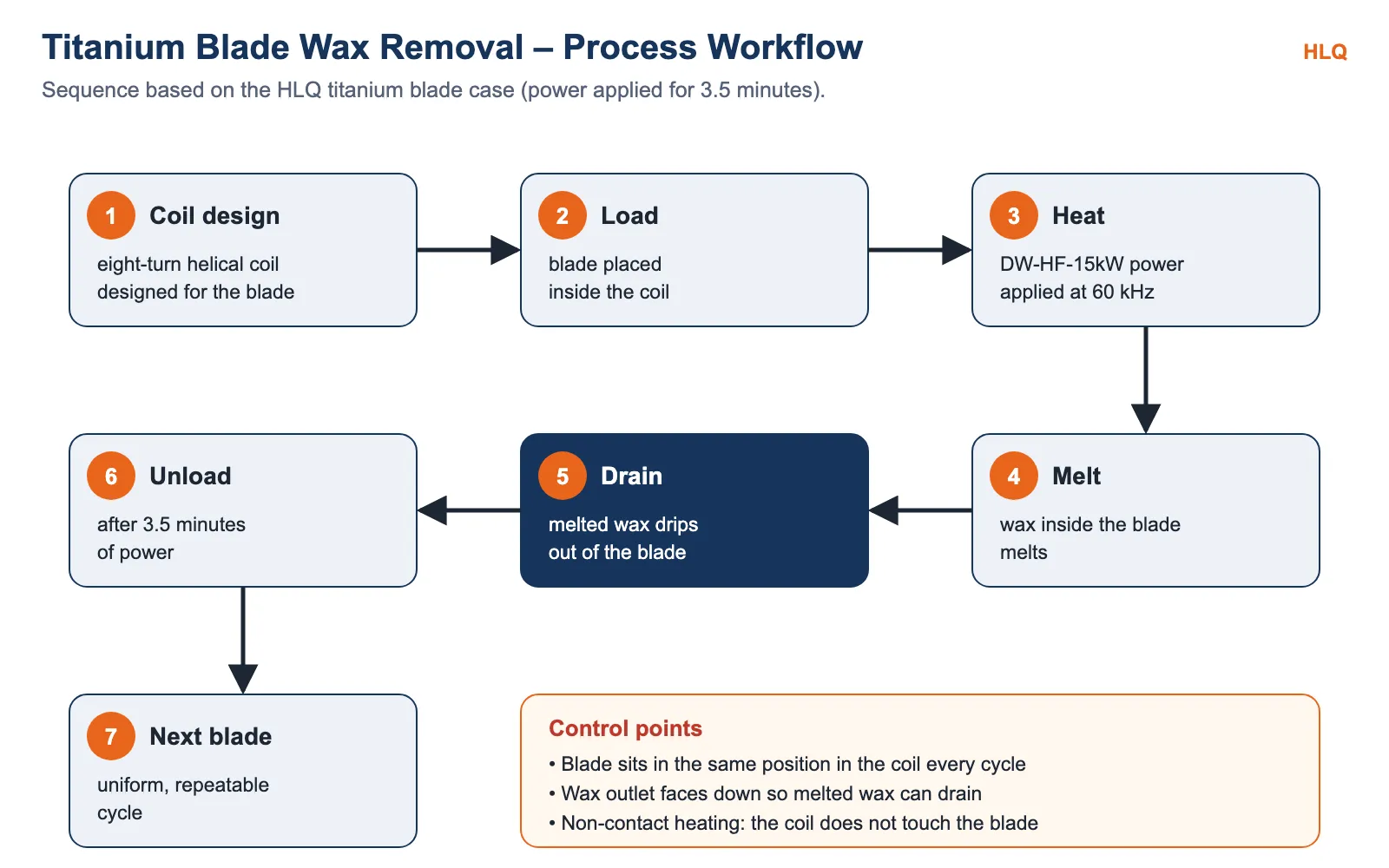
| Step | Action | Case reference |
|---|---|---|
| 1 | Design a coil for the blade | Eight-turn helical coil |
| 2 | Place the blade inside the coil | Same position every cycle |
| 3 | Apply power | DW-HF-15kW, 60 kHz |
| 4 | The wax inside the blade melts | Target 500 °F |
| 5 | The melted wax drips out | Collected below the coil |
| 6 | Unload the blade | After 3.5 minutes of power |
| 7 | Next blade | Uniform, repeatable cycle |
Station layout
Common Problems and Solutions
| Problem | Likely cause | Solution |
|---|---|---|
| Wax does not drain fully | Blade orientation or heating time | Keep the outlet facing down; confirm heating time by test |
| Uneven heating | The coil does not cover the zone holding wax | Use a coil designed for the blade (eight-turn helical in the case) |
| Results not repeatable | Blade position varies | Use a fixture so the blade sits in the same position every cycle |
| Cycle slower than required | Power or frequency not matched to the blade | Confirm the power supply and frequency by test |
Engineering Selection Guide
| Factor | What to confirm | Why it matters |
|---|---|---|
| Blade size and titanium grade | For example, a 4 in blade with a 1.5 × 0.25 in metering area | Sets coil size and frequency |
| Target temperature | For example, 500 °F | Sets power and heating time |
| Cycle time | For example, 3.5 minutes | Sets the power rating |
| Supply voltage | Single-phase or three-phase | DW-HF-15kW runs on single-phase 220 V |
| Atmosphere | Air or argon | Argon was used in the titanium fastener case to prevent oxidation |
| Related blade processes | Welding preheat | See induction heating turbine fan blades for welding |
Advantages and Limitations
| Advantages | Limitations |
|---|---|
| Uniform and repeatable performance | The coil must be designed for each blade |
| Faster application time | Heating time must be confirmed by test |
| Non-contact heating | The titanium grade affects the choice of frequency |
| Flameless heating in a compact station | DW-HF-15kW duty cycle is 80% |
Why Choose HLQ?
| Strength | Evidence |
|---|---|
| Titanium experience | Six published titanium cases, from 500 °F to 2030 °F |
| Application coils | Helical, concentrator-plate and multi-turn designs |
| Power range | DW-HF-15kW to MFS-200kW; 2.7–400 kHz |
| Remote workhead | Heating station placed at the part |
| Automation | Continuous and robotic titanium processes in other cases |
| Non-contact heating | Flameless, repeatable cycles |
10 Core FAQs
1. What was the purpose of heating the titanium blade?
To melt and drain the wax from inside the blade.
2. What was the target temperature?
500 °F.
3. How long was power applied?
3.5 minutes.
4. Which coil was used?
A specially designed eight-turn helical coil.
5. Which equipment and frequency?
A DW-HF-15kW induction heating system with a remote workhead, at 60 kHz.
6. What size were the blades?
4 in (101.6 mm) long, with a 1.5 × 0.25 in (38.1 × 6.4 mm) metering area.
7. What are the benefits?
Uniform and repeatable performance, faster application time and non-contact heating.
8. Can titanium be heated by induction?
Yes. Titanium is electrically conductive. HLQ cases cover 500 °F up to 2030 °F (1110 °C).
9. Which frequency suits titanium?
It depends on section size: 400 kHz for 1.2 mm wire, 60–70 kHz for blades and rods, and 2.7 kHz for a 102 mm billet in the HLQ cases.
10. What is needed for a quotation?
The titanium grade and part drawing, the zone to heat, the target temperature, the cycle time, the atmosphere and the available supply voltage.