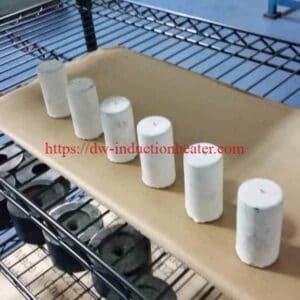

Induction Forging Titanium Rods
Induction Forging Titanium Rods: Turbine Blade Blanks to 2030 °F in 25 Seconds
Quick Answer
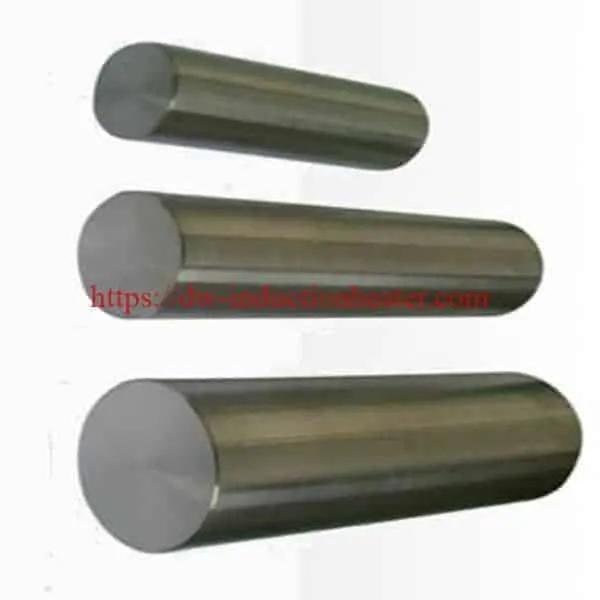
Induction forging of titanium rods heats titanium rod blanks with an induction coil to forging temperature immediately before they are forged. In this HLQ case, titanium rod blanks 0.591″ (15.01 mm) OD by 11.8″ (299.7 mm) long were heated to 2030 °F (1110 °C) in 25 seconds before forging into a turbine blade. The equipment was a DW-MF-25kW medium frequency induction heating system at 13 kHz, with a remote workhead of eight capacitors totaling 0.66 µF and a nineteen-turn helical coil designed for the application. Induction heating gave increased production rates, repeatable, reliable and consistent heat without flame, and hands-free heating that needs no operator skill.
Table of Contents
- What is Induction Forging of Titanium Rods?
- Key Applications
- Suitable Materials
- Working Principle
- Technical Specifications
- Recommended Model Selection
- Process Workflow
- Common Problems and Solutions
- Engineering Selection Guide
- Advantages and Limitations
- Why Choose HLQ?
- 10 Core FAQs
What is Induction Forging of Titanium Rods?
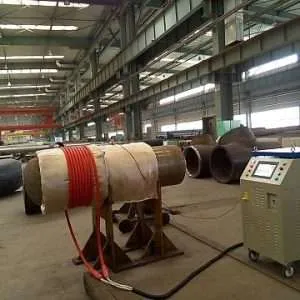
Induction forging of titanium rods heats each rod blank to forging temperature in an induction coil before it is forged. Titanium is electrically conductive, so the alternating magnetic field induces eddy currents that heat the blank directly, without flame or contact. In this HLQ case the blanks were heated before forging into a turbine blade. For the general process, see induction forging and hot forming.
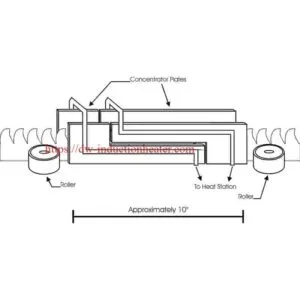
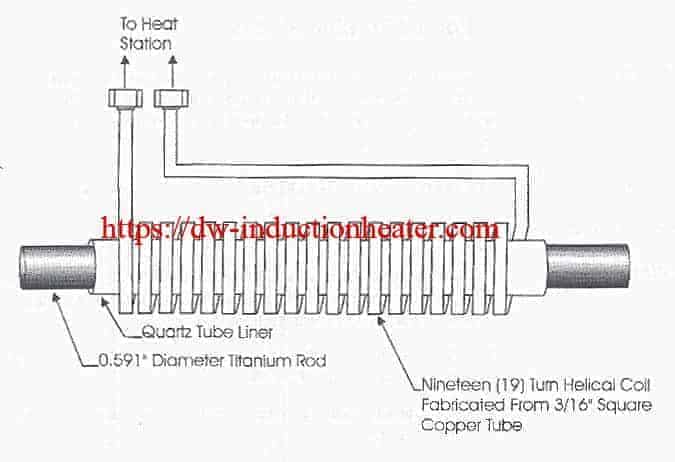
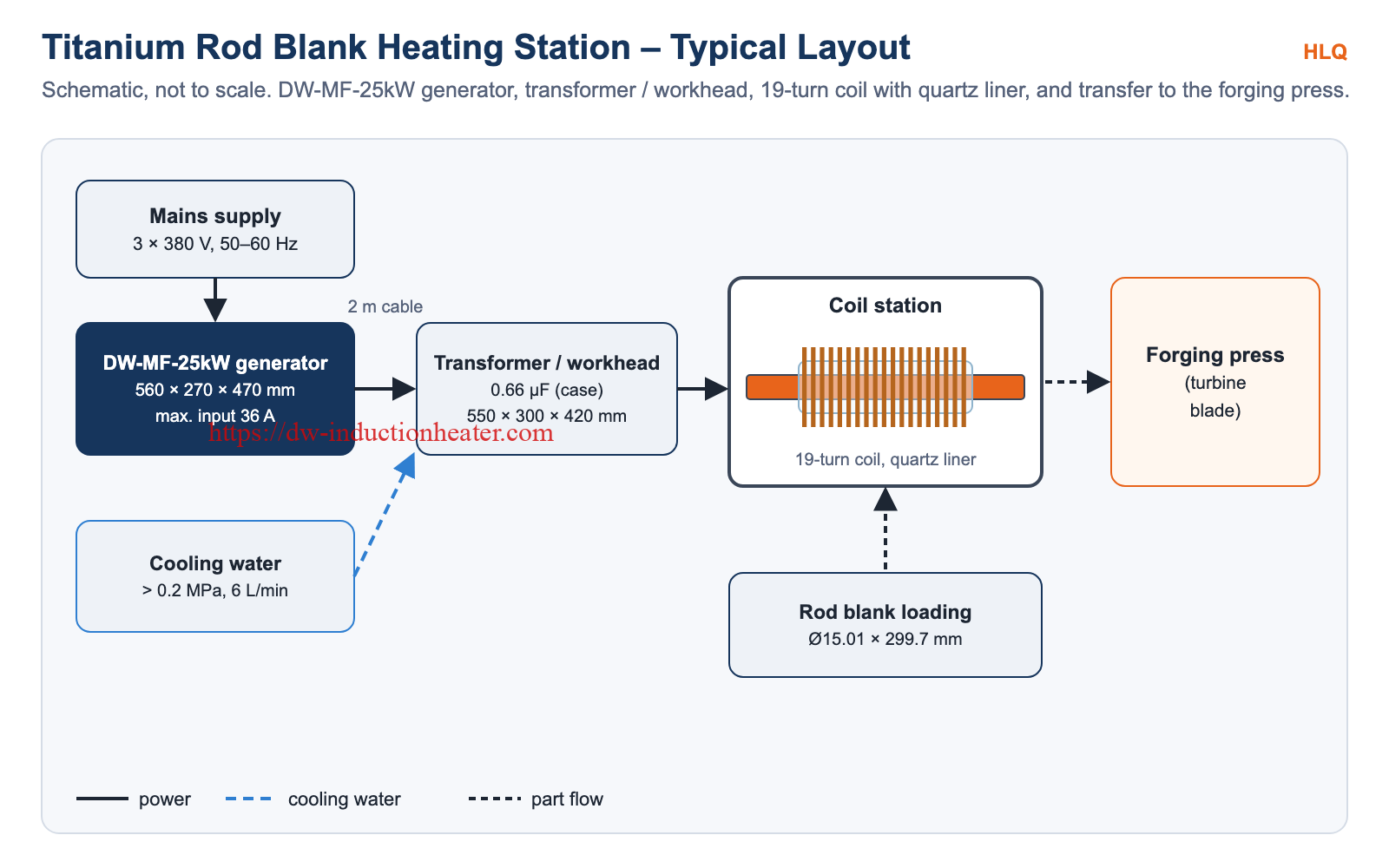
 The case drawing shows a 0.591″ diameter titanium rod inside a quartz tube liner and a nineteen-turn helical coil fabricated from 3/16″ square copper tube, connected to the heat station.
Key Applications
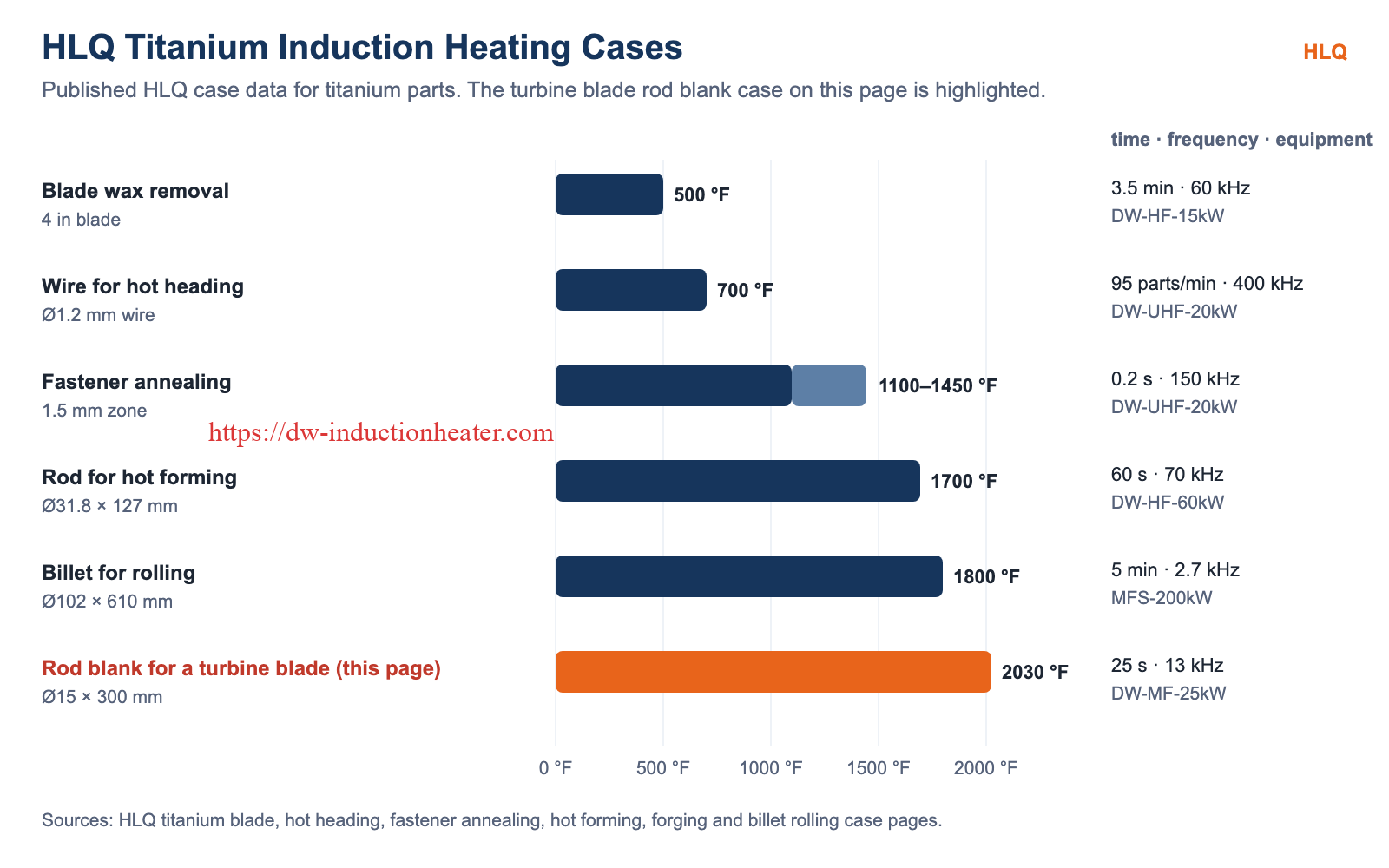
| Titanium application | Part | Temperature | Time / rate | Frequency | Equipment |
|---|---|---|---|---|---|
| Rod blank for forging a turbine blade (this page) | Ø15.01 × 299.7 mm | 2030 °F (1110 °C) | 25 s | 13 kHz | DW-MF-25kW |
| Induction hot forming titanium rod | Ø31.8 × 127 mm | 1700 °F (926.7 °C) | 60 s | 70 kHz | DW-HF-60kW |
| Induction preheating titanium billet for rolling | Ø102 × 610 mm | 1800 °F | 5 min | 2.7 kHz | MFS-200kW |
| Fastener annealing | 1.5 mm zone on Ø4.14–9.52 mm fasteners | 1100–1450 °F (593–788 °C) | 0.2 s; 1,000 parts/min | 150 kHz | DW-UHF-20kW |
| Wire for hot heading | Ø1.2 mm wire | 700 °F (371 °C) | 95 parts/min | 400 kHz | DW-UHF-20kW |
| Blade wax removal | 4 in blade | 500 °F | 3.5 min | 60 kHz | DW-HF-15kW |
Suitable Materials
| Material | Data | Source |
|---|---|---|
| Titanium rod blanks (grade not stated) | Heated to 2030 °F (1110 °C) for turbine blade forging | This case |
| Titanium alloy | Typical heating range 850–1100 °C; non-magnetic, low-medium conductivity; narrow temperature window, tight control required | HLQ induction forging billet heating guide |
| Ti-6Al-4V | Forging temperature 900–1,000 °C; aerospace and medical applications | HLQ titanium billet forging heater page |
The correct forging temperature depends on the titanium grade and the forging operation; send the grade with your inquiry.

Working Principle
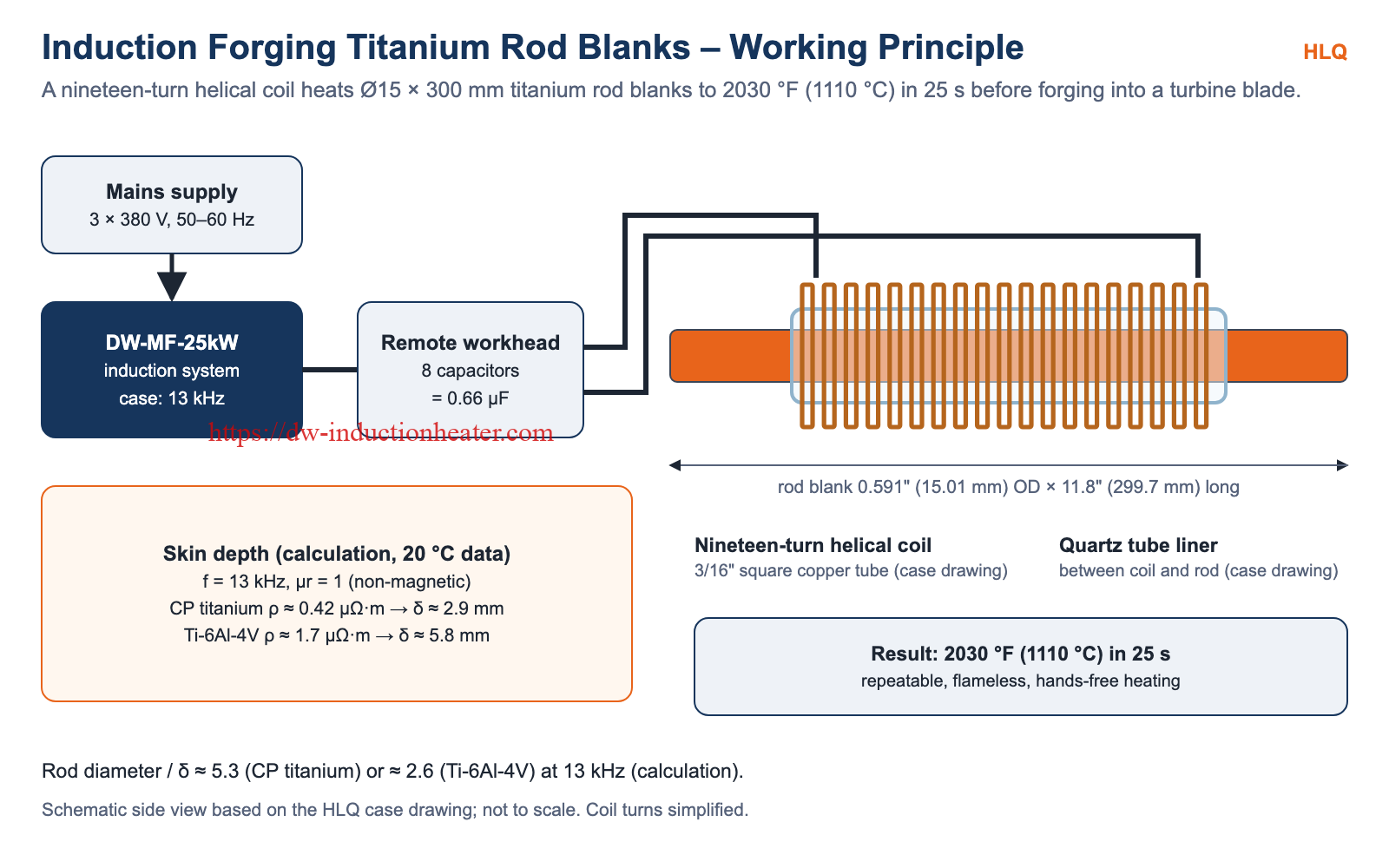
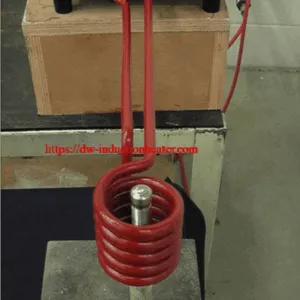
The DW-MF-25kW medium frequency system supplies 13 kHz current through the remote workhead to the nineteen-turn helical coil. The coil surrounds the rod blank, with a quartz tube liner between coil and rod in the case drawing. Eddy currents heat the titanium, and the blank reaches 2030 °F (1110 °C) in 25 seconds.
Heating depth follows the skin effect. Calculation (δ = 503·√(ρ/f), 20 °C resistivity data, µr = 1):
| Material | Resistivity (20 °C) | δ at 13 kHz | Rod diameter / δ |
|---|---|---|---|
| Commercially pure titanium | ≈ 0.42 µΩ·m | ≈ 2.9 mm | ≈ 5.3 |
| Ti-6Al-4V | ≈ 1.7 µΩ·m | ≈ 5.8 mm | ≈ 2.6 |
At 13 kHz the induced current penetrates deeper into the Ø15 mm blank than at higher frequencies, which favours heating through the cross-section.
Technical Specifications
| Parameter | Case data |
|---|---|
| Objective | Heat titanium rod blanks prior to forging into a turbine blade |
| Material | Titanium rod blanks, 0.591″ (15.01 mm) OD × 11.8″ (299.7 mm) long |
| Temperature | 2030 °F (1110 °C) |
| Frequency | 13 kHz |
| Equipment | DW-MF-25kW induction heating system with a remote workhead of eight (8) capacitors totaling 0.66 µF |
| Coil | Nineteen-turn helical coil, designed and developed specifically for this application |
| Coil details (case drawing) | 3/16″ square copper tube; quartz tube liner |
| Heating time | 25 seconds |
| Average heating rate (calculation) | (1110 − 20) °C / 25 s ≈ 44 °C/s |
| Benefits | Increased production rates; repeatable, reliable and consistent heat without flame; hands-free heating that involves no operator skill |
Recommended Model Selection
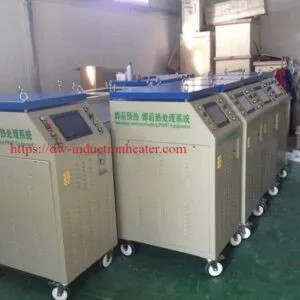
Specifications of the DW-MF-25kW medium frequency induction heater:
| Parameter | DW-MF-25kW |
|---|---|
| Input power supply | 3 phase 380 V, 50/60 Hz |
| Oscillating power max. | 25 kW |
| Max. input current | 36 A |
| Oscillating frequency | 1–20 kHz |
| Duty cycle | 100% at 40 °C |
| Cooling water | > 0.2 MPa, 6 L/min |
| Generator / transformer size | 560 × 270 × 470 mm / 550 × 300 × 420 mm |
| Net weight / cable length | 30 kg / 35 kg; 2 m |
DW-MF series from the HLQ induction heating device model table (1–20 kHz, 3 phases 380 V ±10%, 100% duty):
| Model | Max. input power | Max. input current |
|---|---|---|
| DW-MF-15 | 15 kW | 23 A |
| DW-MF-25 (this case) | 25 kW | 36 A |
| DW-MF-35 | 35 kW | 51 A |
| DW-MF-45 | 45 kW | 68 A |
| DW-MF-70 | 70 kW | 105 A |
| DW-MF-90 | 90 kW | 135 A |
| DW-MF-110 | 110 kW | 170 A |
| DW-MF-160 | 160 kW | 240 A |
| Titanium job (HLQ case) | Power supply | Frequency |
|---|---|---|
| Ø15 mm rod blanks for forging | DW-MF-25kW | 13 kHz |
| Ø31.8 mm rod for hot forming | DW-HF-60kW | 70 kHz |
| Ø102 mm billet for rolling | MFS-200kW | 2.7 kHz |
| Ø1.2 mm wire for hot heading | DW-UHF-20kW | 400 kHz |
Process Workflow
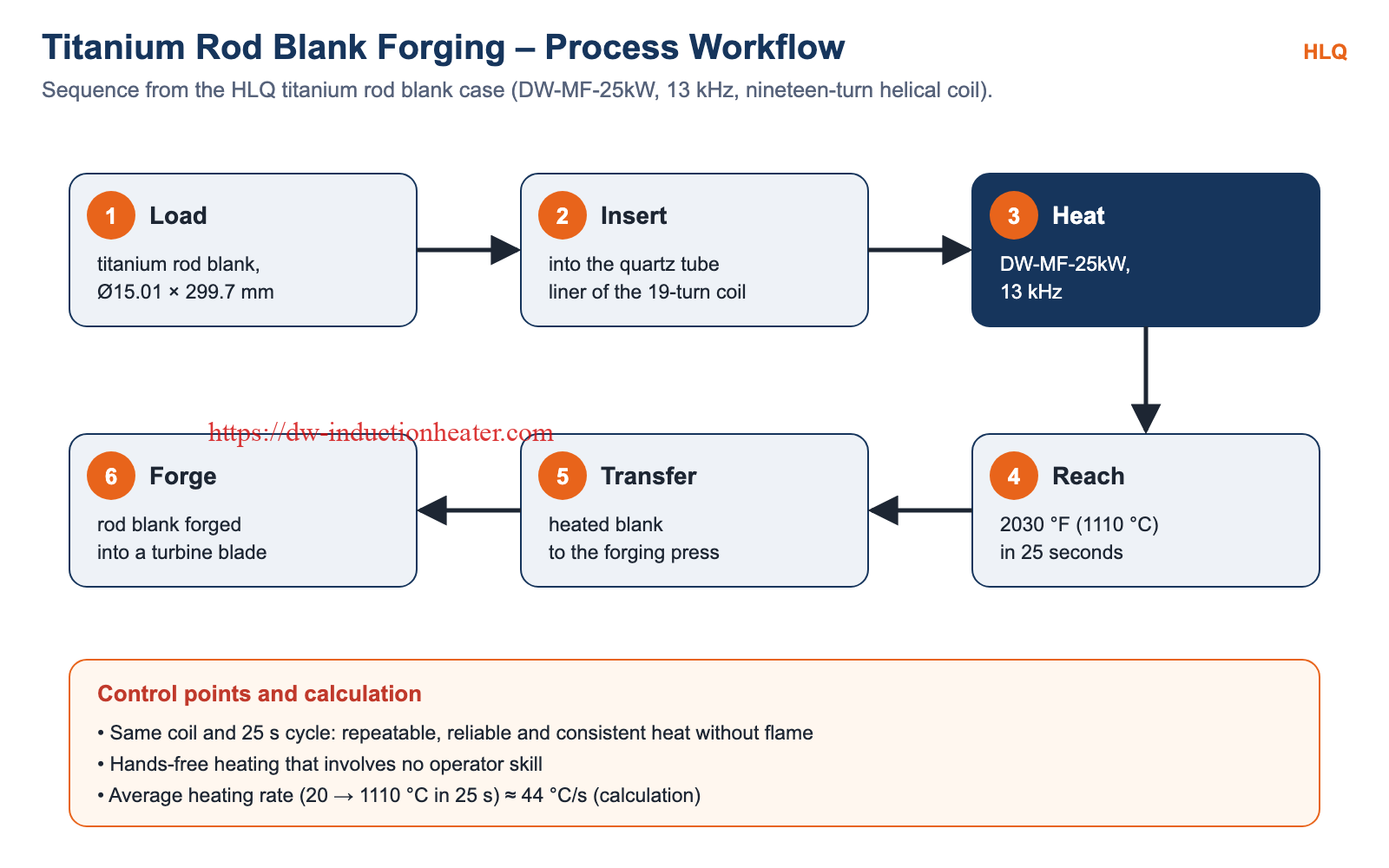
- Load – a titanium rod blank, Ø15.01 × 299.7 mm.
- Insert – place it in the quartz tube liner inside the nineteen-turn coil.
- Heat – the DW-MF-25kW applies power at 13 kHz.
- Reach temperature – 2030 °F (1110 °C) in 25 seconds.
- Transfer – the heated blank goes to the forging press.
- Forge – the rod blank is forged into a turbine blade.
Common Problems and Solutions
| Problem | Possible cause | Solution |
|---|---|---|
| Temperature outside the forging window | Titanium has a narrow temperature window | Tight temperature control (HLQ forging guide); use the same coil, position and 25 s cycle |
| Poor heating efficiency | Titanium is non-magnetic | Optimized coil design and appropriate frequency selection (HLQ billet forging heater page) |
| Heating speed too slow | Coil gap too large, wrong coil design or workpiece too large | Optimize coil shape, reduce the coil gap or choose higher power |
| Uneven heating | Workpiece not centred or coil field uneven | Improve the fixture; a quartz tube liner is shown between coil and rod in this case |
| Surface oxidation | Overheating or long exposure in air | Reduce heating time; in the HLQ titanium fastener case, argon was flooded across the part |
| Coil or power supply overheats | Insufficient cooling water | Supply cooling water above 0.2 MPa at 6 L/min (DW-MF-25kW requirement) |
Engineering Selection Guide
| HLQ titanium case | Diameter | Frequency | δ, CP titanium (calc.) | δ, Ti-6Al-4V (calc.) |
|---|---|---|---|---|
| Billet for rolling | 102 mm | 2.7 kHz | ≈ 6.3 mm | ≈ 12.6 mm |
| Rod for hot forming | 31.8 mm | 70 kHz | ≈ 1.2 mm | ≈ 2.5 mm |
| Rod blank for forging (this page) | 15 mm | 13 kHz | ≈ 2.9 mm | ≈ 5.8 mm |
| Wire for hot heading | 1.2 mm | 400 kHz | ≈ 0.5 mm | ≈ 1.0 mm |
- Rod blanks for forging: DW-MF medium frequency units (1–20 kHz), such as the DW-MF-25kW at 13 kHz in this case.
- Higher output or larger blanks: larger DW-MF models up to 160 kW, or high-power systems such as the MFS-200kW used for a Ø102 mm titanium billet; see the HLQ titanium billet forging heater.
- Coil length: a long nineteen-turn helical coil was used for the 11.8″ blank.
- Data to send: titanium grade, blank diameter and length, forging temperature, cycle time, parts per hour, supply voltage and cooling water.
Advantages and Limitations
| Advantages | Limitations |
|---|---|
| Increased production rates | Titanium has a narrow temperature window; tight control is needed |
| Repeatable, reliable and consistent heat without flame | The coil must be designed for the blank size |
| Hands-free heating that involves no operator skill | Larger blanks or higher output need more power |
| 2030 °F (1110 °C) in 25 seconds | Water cooling is required |
Why Choose HLQ?
- Six published titanium induction cases, from 500 °F to 2030 °F.
- Coils designed for each blank, such as the nineteen-turn helical coil in this case.
- DW-MF medium frequency systems from 15 to 160 kW, plus DW-HF and DW-UHF series for smaller titanium parts.
- Flameless, hands-free heating for forging lines.
10 Core FAQs
1. What was heated in this case?
Titanium rod blanks, 0.591″ (15.01 mm) OD by 11.8″ (299.7 mm) long.
2. What were the blanks forged into?
A turbine blade.
3. What temperature was reached?
2030 °F (1110 °C).
4. How long did heating take?
25 seconds.
5. Which induction machine was used?
A DW-MF-25kW medium frequency induction heating system with a remote workhead.
6. What frequency was used?
13 kHz.
7. Which coil was used?
A nineteen-turn helical coil designed for the application; the case drawing shows 3/16″ square copper tube and a quartz tube liner.
8. Can titanium be heated by induction although it is non-magnetic?
Yes. Titanium is conductive, so eddy currents heat it directly; the coil and frequency must be optimized.
9. What are the benefits for forging?
Increased production rates, repeatable heat without flame, and hands-free heating that involves no operator skill.
10. What information is needed for a quotation?
The titanium grade, blank diameter and length, forging temperature, cycle time, output, and available power supply and cooling water.