Induction Hot Forming Titanium Rod
Induction Hot Forming Titanium Rod: Surface and Centre to 1700 °F in 60 Seconds
Quick Answer
Induction hot forming of titanium rod means heating the rod through with an induction coil before it is formed. In this HLQ case, a titanium rod 1.25″ (31.8 mm) in diameter and 5″ (127 mm) long was heated in a specially designed thirteen-turn helical coil at 70 kHz. The equipment was a DW-HF-60kW induction heating system with a remote workhead. Two optical pyrometers measured the surface and centre of the part, and both reached 1700 °F (926.7 °C) within 60 seconds. Induction heating gave improved production rates with minimal defects, improved mechanical properties and even distribution of heating.
Table of Contents
- What is Induction Hot Forming of Titanium Rod?
- Key Applications
- Suitable Materials
- Working Principle
- Technical Specifications
- Recommended Model Selection
- Process Workflow
- Common Problems and Solutions
- Engineering Selection Guide
- Advantages and Limitations
- Why Choose HLQ?
- 10 Core FAQs
What is Induction Hot Forming of Titanium Rod?
Induction hot forming of titanium rod uses an alternating magnetic field to heat a titanium rod to forming temperature before it is shaped. Titanium is electrically conductive, so eddy currents generate heat inside the rod without flame or contact. For hot forming, the whole cross-section must reach temperature, which is why this case measured both the surface and the centre. For the general process, see induction forging and induction hot forming.
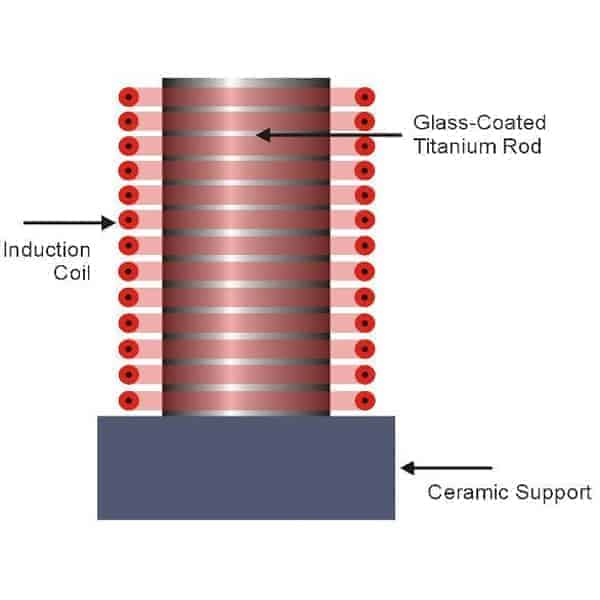
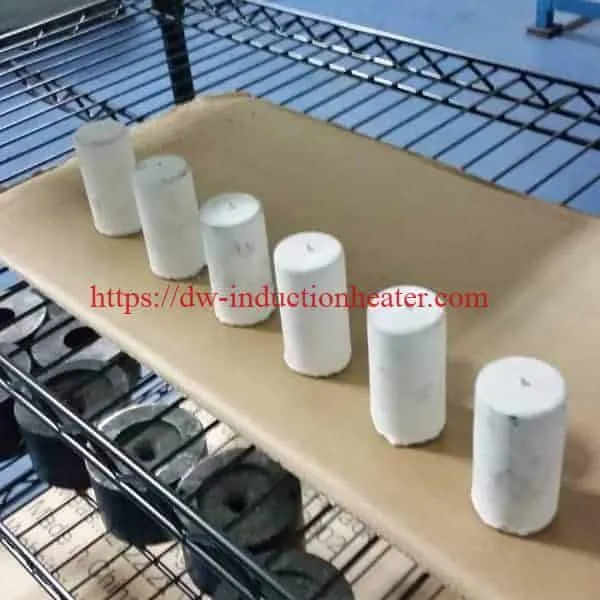
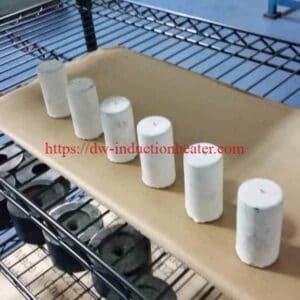
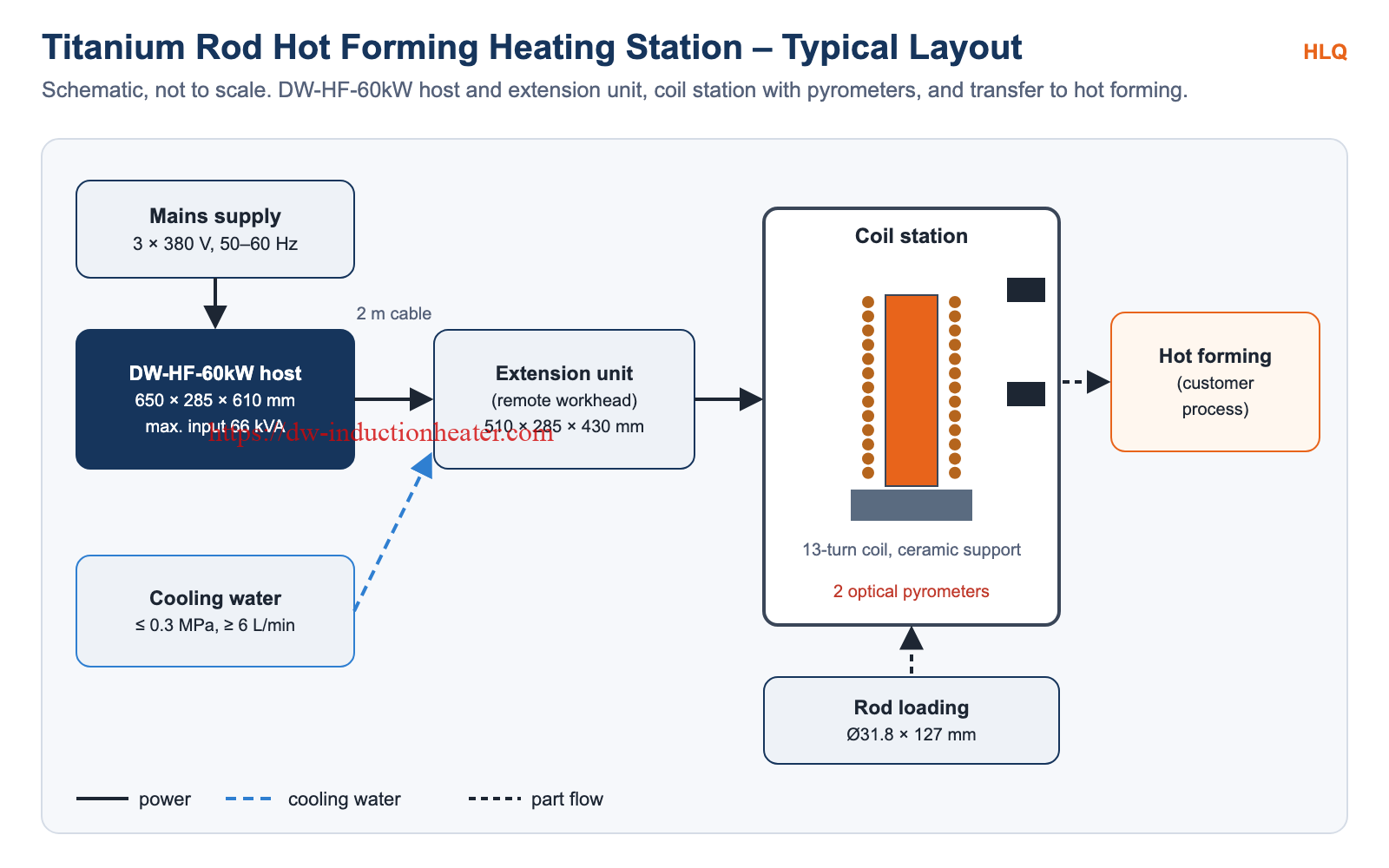
 The photo shows coated titanium rods. In the HLQ case drawing, the glass-coated titanium rod stands on a ceramic support inside the induction coil.

Key Applications
| Titanium application | Part | Temperature | Time / rate | Frequency | Equipment |
|---|---|---|---|---|---|
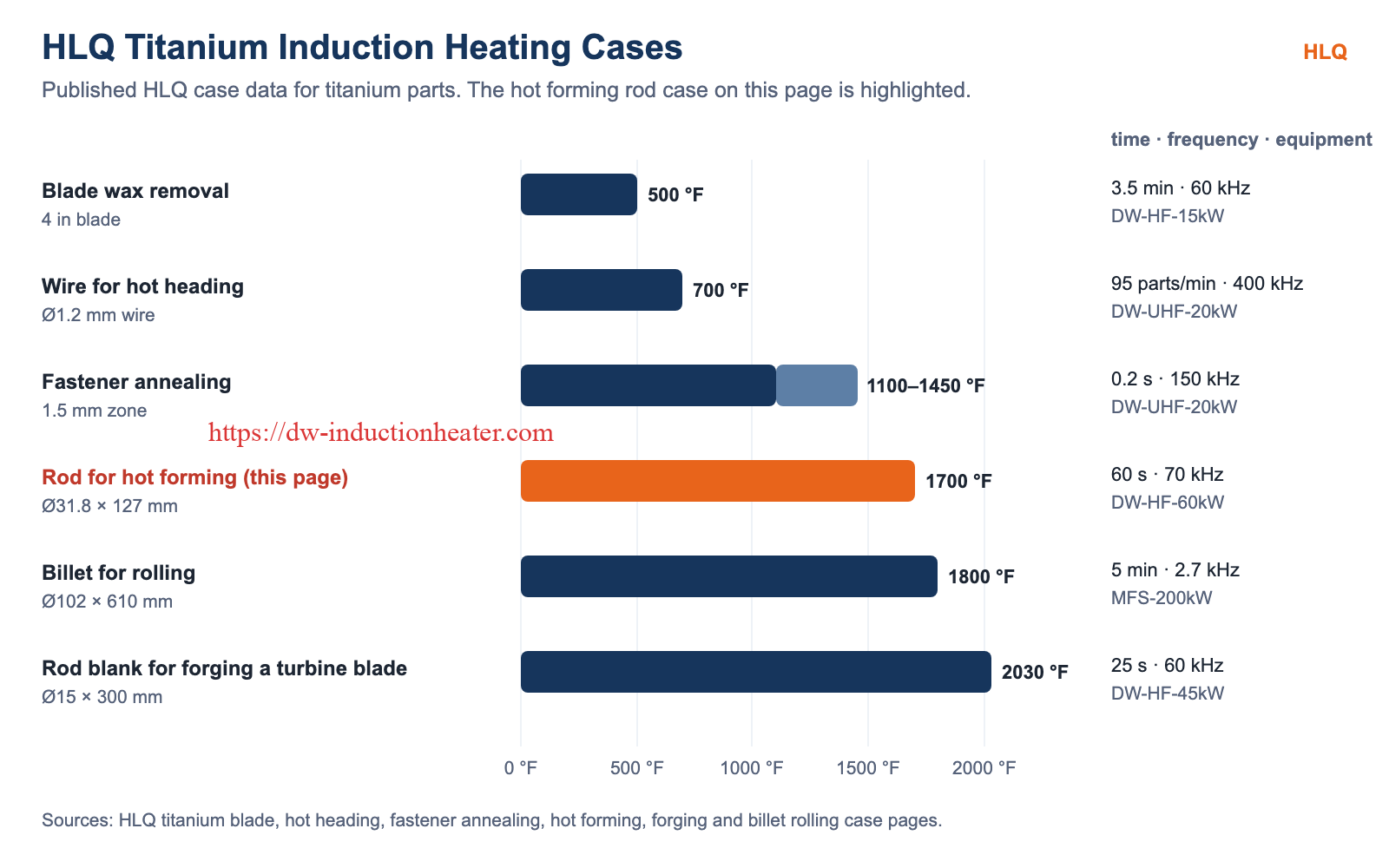
| Rod for hot forming (this page) | Ø31.8 × 127 mm | 1700 °F (926.7 °C) | 60 s | 70 kHz | DW-HF-60kW |
| Induction forging titanium rods (turbine blade blanks) | Ø15 × 300 mm | 2030 °F (1110 °C) | 25 s | 60 kHz | DW-HF-45kW |
| Billet for rolling | Ø102 × 610 mm | 1800 °F | 5 min | 2.7 kHz | MFS-200kW |
| Fastener annealing | 1.5 mm zone on Ø4.14–9.52 mm fasteners | 1100–1450 °F (593–788 °C) | 0.2 s; 1,000 parts/min | 150 kHz | DW-UHF-20kW |
| Wire for hot heading | Ø1.2 mm wire | 700 °F (371 °C) | 95 parts/min | 400 kHz | DW-UHF-20kW |
| Blade wax removal | 4 in blade | 500 °F | 3.5 min | 60 kHz | DW-HF-15kW |
For continuous wire heating before forming, see induction heating titanium and stainless steel for hot heading.
Suitable Materials
| Material | HLQ data | Notes |
|---|---|---|
| Titanium rod (this case) | 1700 °F (926.7 °C) for hot forming | Surface and centre both measured |
| Titanium alloy Ti-6Al-4V | Typical heating range 850–1100 °C (HLQ forging guide); forging temperature 900–1,000 °C (HLQ billet heater page) | Non-magnetic; tight temperature control required |
| Titanium fasteners | 1100–1450 °F (593–788 °C), annealing titanium fasteners with induction | Argon flooded across the part to prevent oxidation |
Titanium is non-magnetic (µr = 1), so it heats by eddy currents only. Coil design and frequency must be matched to the rod diameter.
Working Principle
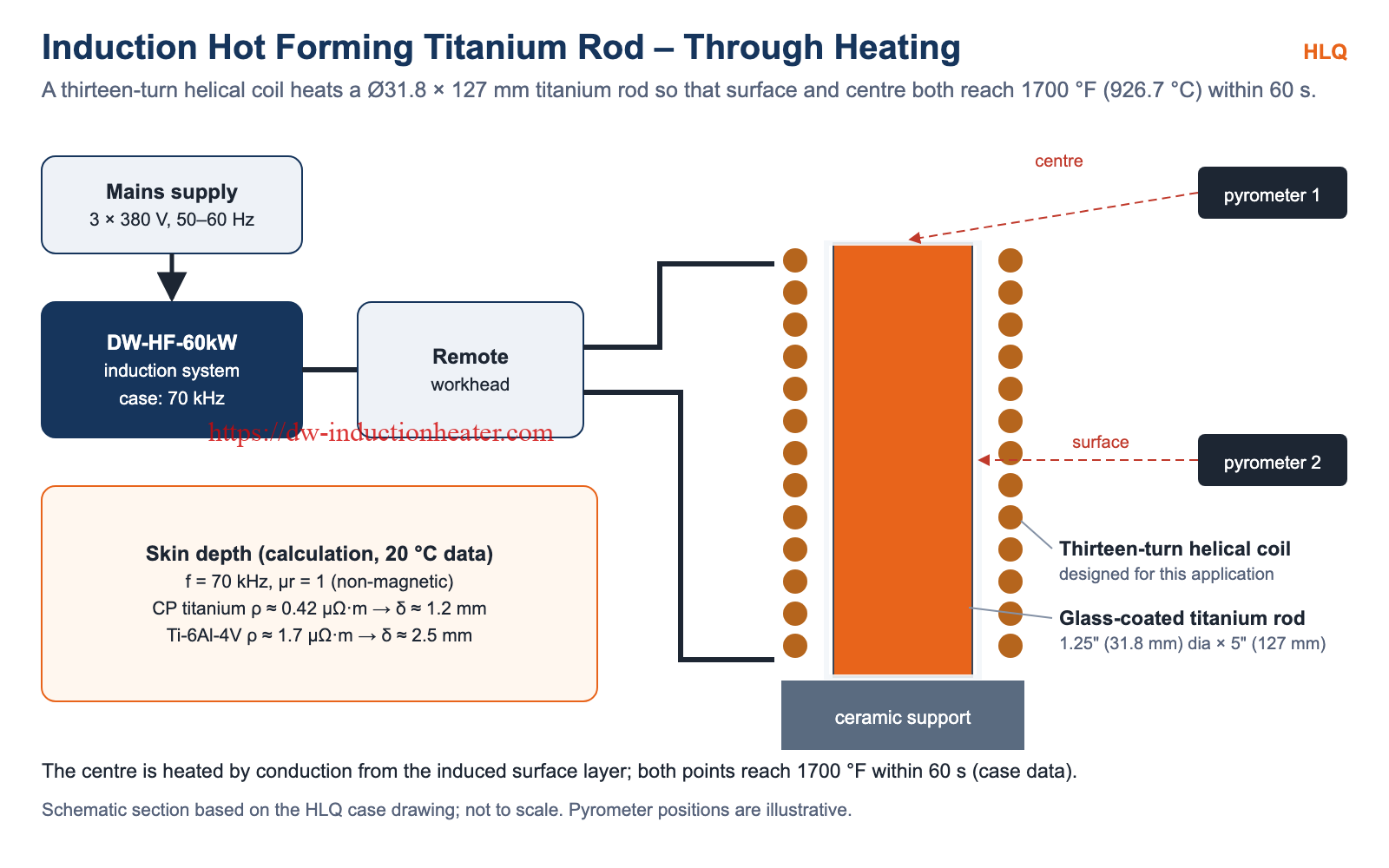
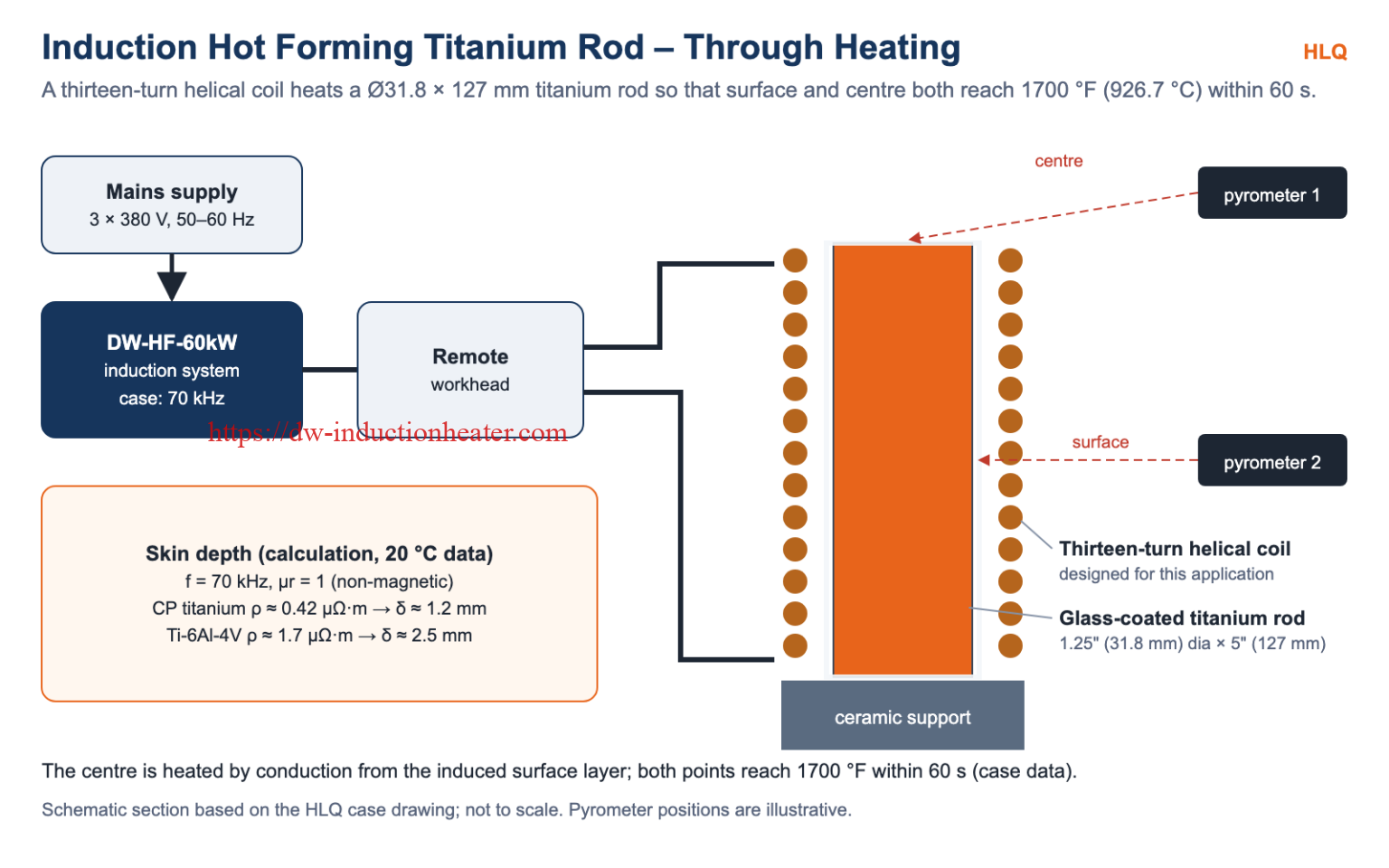
The DW-HF-60kW sends 70 kHz current through the remote workhead to the thirteen-turn helical coil. The alternating magnetic field induces eddy currents in the outer layer of the rod, and heat conducts towards the centre. The two optical pyrometers confirm that the surface and centre both reach 1700 °F (926.7 °C) within 60 seconds.
The heated layer follows the skin effect. Calculation (δ = 503·√(ρ/f), 20 °C resistivity data, µr = 1) at 70 kHz:
| Material | Resistivity (20 °C) | Skin depth δ at 70 kHz | Rod diameter / δ |
|---|---|---|---|
| Commercially pure titanium | ≈ 0.42 µΩ·m | ≈ 1.2 mm | ≈ 26 |
| Ti-6Al-4V | ≈ 1.7 µΩ·m | ≈ 2.5 mm | ≈ 13 |
Technical Specifications
| Parameter | Case data |
|---|---|
| Objective | Heat a titanium rod to 1700 °F (926.7 °C) within 60 seconds for hot forming |
| Material | Titanium rods, 1.25″ (31.8 mm) diameter, 5″ (127 mm) length |
| Temperature | 1700 °F (926.7 °C) |
| Frequency | 70 kHz |
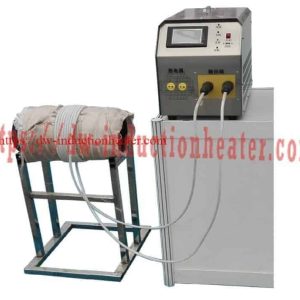
| Equipment | DW-HF-60kW induction heating system, equipped with a remote workhead |
| Coil | Specially designed thirteen-turn helical induction coil |
| Temperature measurement | Two optical pyrometers at the surface and centre of the part |
| Heating result | Surface and centre both at 1700 °F (926.7 °C) within 60 seconds |
| Set-up shown in the case drawing | Glass-coated titanium rod on a ceramic support |
| Benefits | Improved production rates with minimal defects; improved mechanical properties; even distribution of heating |
Recommended Model Selection
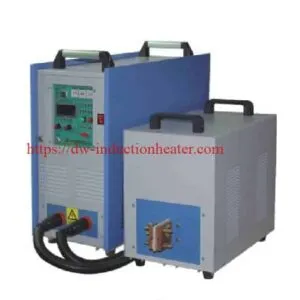
This case used the DW-HF-60kW. Specifications from the HLQ product page:
| Parameter | DW-HF-60kW |
|---|---|
| Input power supply | 3 × 380 V, 50–60 Hz |
| Oscillating power | Max. 60 kVA |
| Max. input power | 66 kVA |
| Oscillating frequency | 30–80 kHz |
| Oscillating current | 20–120 A |
| Duty cycle | 100% at 30 °C |
| Cooling water | ≤ 0.3 MPa, ≥ 6 L/min |
| Host size | 650 × 285 × 610 mm |
| Extension size | 510 × 285 × 430 mm |
| Weight / cable length | 90 kg / 2 m |
| Titanium job (HLQ case) | Power supply | Frequency |
|---|---|---|
| Ø31.8 mm rod for hot forming | DW-HF-60kW | 70 kHz |
| Ø15 mm rod blanks for forging | DW-HF-45kW | 60 kHz |
| Ø102 mm billet for rolling | MFS-200kW | 2.7 kHz |
| Ø4.14–9.52 mm fastener zone | DW-UHF-20kW | 150 kHz |
| Ø1.2 mm wire | DW-UHF-20kW | 400 kHz |
For larger titanium billets, see the titanium billet forging heater.
Process Workflow
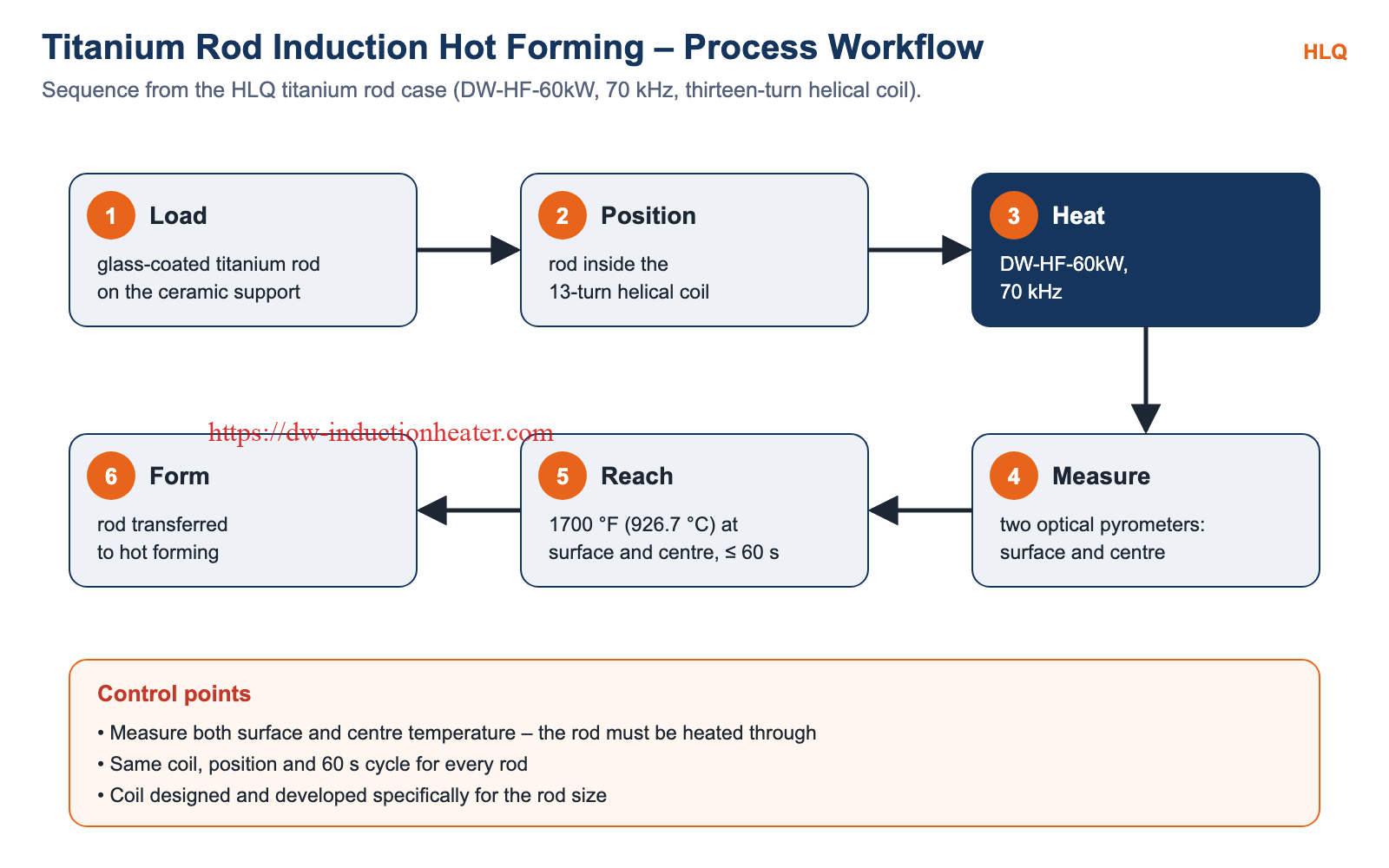
- Load – place the glass-coated titanium rod on the ceramic support.
- Position – the rod sits inside the thirteen-turn helical coil.
- Heat – the DW-HF-60kW applies power at 70 kHz.
- Measure – two optical pyrometers read the surface and centre temperatures.
- Reach temperature – surface and centre at 1700 °F (926.7 °C) within 60 seconds.
- Form – the heated rod goes to hot forming.
Common Problems and Solutions
| Problem | Possible cause | Solution |
|---|---|---|
| Centre colder than surface | Heating time too short for the diameter | Measure both points, as in this case with two optical pyrometers; in the HLQ titanium billet case, heating time was set to reduce the centre-to-surface difference |
| Surface overheats | Heating time too long or power density too high | Reduce power, shorten heating time or use temperature feedback |
| Heating too slow | Coil too far from the workpiece, power too low or unsuitable coil geometry | Reduce the coil gap, redesign the coil or increase the power setting |
| Uneven part temperature | Coil shape or workpiece position not consistent | Fixed support (ceramic support in this case) and redesigned coil turns |
| Coil overheats | Insufficient cooling water or a blocked coil tube | Check water flow and pressure (≤ 0.3 MPa, ≥ 6 L/min) and clean the coil |
Engineering Selection Guide
Larger rods and billets need lower frequencies for deeper penetration. Calculated skin depth (20 °C data, µr = 1) for the diameters in HLQ titanium cases:
| HLQ case | Diameter | Frequency | δ, CP titanium | δ, Ti-6Al-4V |
|---|---|---|---|---|
| Billet for rolling | 102 mm | 2.7 kHz | ≈ 6.3 mm | ≈ 12.6 mm |
| Rod for hot forming (this page) | 31.8 mm | 70 kHz | ≈ 1.2 mm | ≈ 2.5 mm |
| Rod blank for forging | 15 mm | 60 kHz | ≈ 1.3 mm | ≈ 2.7 mm |
| Wire for hot heading | 1.2 mm | 400 kHz | ≈ 0.5 mm | ≈ 1.0 mm |
- Large diameters: the Ø102 mm billet used a high-power, low-frequency MFS-200kW at 2.7 kHz (induction preheating titanium billet for rolling).
- Medium rods: DW-HF-60kW at 70 kHz for Ø31.8 mm (this case).
- Through heating: confirm that the centre reaches temperature, not only the surface.
- Data to send: titanium grade, rod diameter and length, target temperature, cycle time, parts per hour, supply voltage and cooling water.
Advantages and Limitations
| Advantages | Limitations |
|---|---|
| Improved production rates with minimal defects | DW-HF high frequency is not ideal for large billet through-heating; use MF systems |
| Improved mechanical properties | The coil must be customized for each rod size |
| Even distribution of heating, surface and centre at 1700 °F in 60 s | Water cooling is required |
| Non-contact, flameless heating | Temperature may vary without feedback; add pyrometers or PLC control |
Why Choose HLQ?
- Six published titanium cases, from 500 °F to 2030 °F and from 2.7 kHz to 400 kHz.
- Coils designed for each part, such as the thirteen-turn helical coil in this case.
- Power supplies from DW-UHF and DW-HF to MF systems for titanium wire, rods and billets.
- Temperature verification with optical pyrometers.
10 Core FAQs
1. What was heated in this case?
Titanium rods, 1.25″ (31.8 mm) in diameter and 5″ (127 mm) long.
2. What temperature was required?
1700 °F (926.7 °C) for hot forming.
3. How long did heating take?
Both the surface and the centre reached 1700 °F within 60 seconds.
4. Which induction machine was used?
A DW-HF-60kW induction heating system with a remote workhead.
5. What frequency was used?
70 kHz.
6. Which coil was used?
A specially designed thirteen-turn helical induction coil.
7. How was the temperature measured?
Two optical pyrometers measured the temperature at the surface and centre of the part.
8. Can titanium be heated by induction although it is non-magnetic?
Yes. Titanium is electrically conductive, so eddy currents heat it directly; coil design and frequency must be matched to the part.
9. What are the benefits for hot forming?
Improved production rates with minimal defects, improved mechanical properties and even distribution of heating.
10. What information is needed for a quotation?
The titanium grade, rod diameter and length, target temperature, cycle time, output, and available power supply and cooling water.