Annealing Titanium Fasteners With Induction
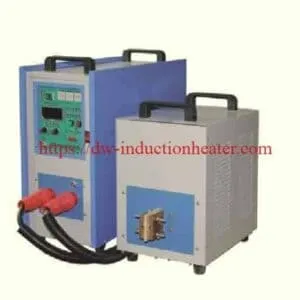
Titanium Fastener Induction Annealing – DW-UHF-20kW High-Frequency Heating System
Quick Answer
Induction annealing of titanium fasteners uses an alternating electromagnetic field to heat selected regions of electrically conductive titanium components. When the process is properly qualified, induction heating can support localized thermal treatment, including selected stress-relief applications.
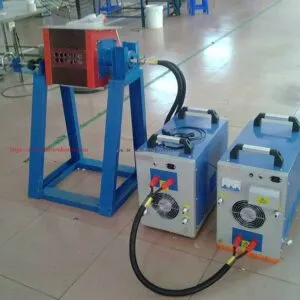
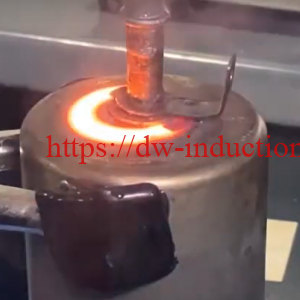
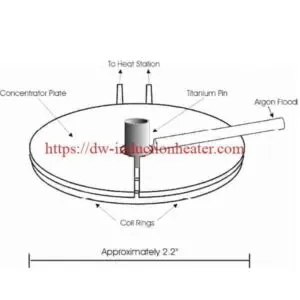
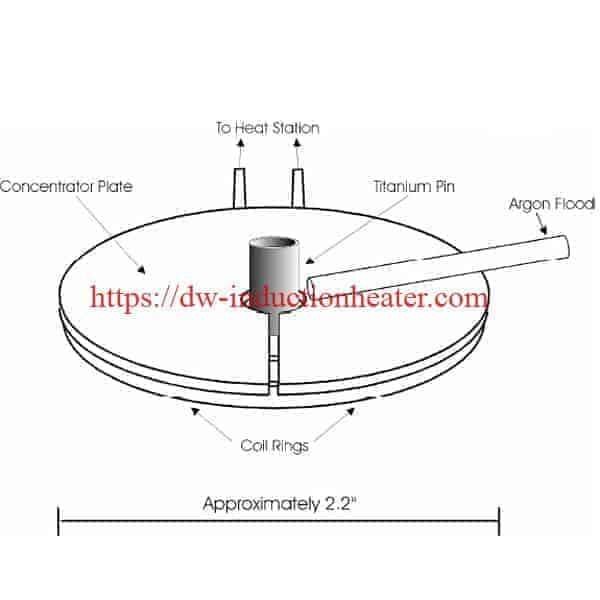
The original HLQ application describes a DW-UHF-20kW induction heating system operating at 150 kHz, with a three-turn concentrator plate coil, a 0.66 μF capacitor and argon shielding. Its reported target temperature is 593–788°C (1100–1450°F), applied to a localized 1.5 mm zone of titanium fasteners.
The source application reports a 0.2-second heating interval and a production rate of 1,000 parts per minute. These are historical source-page figures, not independently verified process capabilities. Actual annealing quality requires an approved alloy-specific temperature-time cycle and metallurgical validation.
| Key Parameter | Original Application Data |
|---|---|
| Equipment | DW-UHF-20kW induction heating system |
| Rated power | 20 kW |
| Operating frequency | 150 kHz |
| Temperature range | 593–788°C (1100–1450°F) |
| Fastener diameter | 4.14–9.52 mm |
| Fastener length | 12.7–76.2 mm |
| Localized heating zone | 1.5 mm |
| Heating interval | 0.2 second, as reported |
| Protective atmosphere | Argon flood |
Table of Contents
- What Is Titanium Fastener Induction Annealing?
- Key Applications
- Suitable Materials
- Working Principle
- Technical Specifications
- Recommended Model Selection
- Process Workflow
- Common Problems and Solutions
- Engineering Selection Guide
- Advantages and Limitations
- Why Choose HLQ?
- 6 Core FAQs
What Is Titanium Fastener Induction Annealing?
Titanium fastener induction annealing is a thermal processing method in which an induction coil generates an alternating magnetic field, inducing electrical currents within the fastener. The resulting resistive heating raises the temperature of the selected metal region.
Annealing and stress relief are different metallurgical treatments. Their temperature, holding time and cooling requirements depend on titanium alloy grade, previous processing history, part geometry and the required final properties.
Induction heating can heat a small region quickly, but achieving a measured temperature does not by itself prove successful annealing. Fasteners used in critical assemblies must meet the applicable material, manufacturing and heat-treatment specifications.
For a broader introduction, see HLQ’s induction annealing process information.
Original Titanium Fastener Heating Application
Key Applications
Localized induction heating may be evaluated for the following titanium fastener manufacturing operations. Suitability depends on the alloy and the specified metallurgical outcome.
| Application | Engineering Objective | Qualification Requirement |
|---|---|---|
| Localized fastener heating | Heat a selected region rather than the entire component | Verify temperature distribution and dimensional stability |
| Stress relief after forming | Reduce residual stresses generated by forming operations | Use a qualified alloy-specific stress-relief cycle |
| Stress relief after machining | Address residual stress where permitted by the component specification | Verify heating time, temperature and final properties |
| Heat treatment before further forming | Modify material condition for subsequent operations | Confirm the required annealing treatment and ductility |
| Automated fastener processing | Integrate localized heating with part handling and inspection | Validate station cycle time and process repeatability |
Titanium alloys are used in aerospace and other high-performance fastener applications. The ATI Ti-6Al-4V Grade 5 material datasheet identifies fasteners among the applications of this alloy.
However, an application category is not evidence that the original DW-UHF-20kW process has been qualified for aerospace production.
Suitable Materials
Induction heating can be applied to electrically conductive titanium and titanium alloys. Whether the resulting thermal treatment is suitable must be established separately for each grade and component specification.
| Material | Material Classification | Process Considerations |
|---|---|---|
| Commercially Pure Titanium, Grade 1 | Commercially pure titanium | Evaluate stress relief or annealing using its specified material condition |
| Commercially Pure Titanium, Grade 2 | Commercially pure titanium | Confirm previous cold work and the approved heat-treatment requirements |
| Ti-6Al-4V, Grade 5 | Alpha-beta titanium alloy | Differentiate annealing, stress relief, solution treatment and aging |
| Ti-6Al-4V ELI, Grade 23 | Extra-low-interstitial alpha-beta titanium alloy | Use grade-specific requirements; do not automatically substitute Grade 5 cycles |
These grades are material candidates for engineering evaluation, not a list of materials independently tested on the original HLQ equipment.
Reference Heat-Treatment Conditions for Ti-6Al-4V Grade 5
The following values are taken from the ATI Ti-6Al-4V Grade 5 technical datasheet. They describe published alloy heat-treatment practices, not guaranteed cycle settings for the original fastener application.
| Treatment | Temperature | Holding Time | Cooling Method |
|---|---|---|---|
| Annealing | 691–760°C (1275–1400°F) | 0.5–2 hours | Air or furnace cooling |
| Stress-relief annealing | 538–649°C (1000–1200°F) | 1–8 hours | Air or furnace cooling |
| Solution heat treatment | 913–954°C (1675–1750°F) | 1 hour | Water quenching |
| Aging | 524–552°C (975–1025°F) | 4–8 hours | Air cooling |
Important: These treatments are not interchangeable. The published Grade 5 soaking periods also demonstrate why a 0.2-second local heating interval cannot independently establish completion of a conventional annealing treatment.
Working Principle
Induction heating operates through electromagnetic induction. Alternating current flowing through the induction coil produces a time-varying magnetic field. This field induces electrical currents in the titanium fastener, and electrical resistance converts part of the induced electrical energy into heat.
Titanium does not require ferromagnetic behavior for induction heating. The relevant heating mechanism is primarily induced-current resistance heating.
Further background is available in the basic principles of induction heating.
Induction Heating Principle Diagram
| Stage | Physical Process |
|---|---|
| 1. Power conversion | The induction power supply provides high-frequency alternating current. |
| 2. Electromagnetic field | Current through the concentrator plate coil generates an alternating magnetic field. |
| 3. Induced current | Electric currents are induced in the electrically conductive titanium fastener. |
| 4. Resistive heating | Induced current produces heating within the workpiece. |
| 5. Heat transfer | Conduction redistributes heat away from the initially heated region. |
| 6. Process control | Heating time, temperature and atmosphere must be controlled to meet the specified treatment. |
Why Coil Geometry Matters
The original application uses a three-turn concentrator plate coil. Coil shape, workpiece position, electrical coupling and process frequency influence the heating pattern.
For a 1.5 mm localized heating zone, the electromagnetic heating profile and subsequent heat conduction are both important. The electrical heating zone is not necessarily identical to the final metallurgical heat-affected region.
Coil design therefore requires experimental temperature mapping before production acceptance.
Technical Specifications
Original DW-UHF-20kW Application Parameters
| Parameter | Reported Specification | Verification Status |
|---|---|---|
| Model | DW-UHF-20kW | Original product page |
| Power | 20 kW | Original product page |
| Frequency | 150 kHz | Original application setting |
| Remote workhead | Included | Original description |
| Capacitor | One 0.66 μF capacitor | Original description |
| Coil | Three-turn concentrator plate coil | Original description |
| Material | Titanium fastener | Specific grade not stated |
| Diameter | 4.14–9.52 mm | Original product page |
| Length | 12.7–76.2 mm | Original product page |
| Heating zone height | 1.5 mm | Original product page |
| Target temperature | 593–788°C | Original application target |
| Heating time | 0.2 second | Reported, not independently verified |
| Protective gas | Argon | Original product page |
| Part handling | Bowl-fed track and robotic placement | Original description |
| Production rate | 1,000 parts/min | Requires station configuration verification |
Production Rate Verification
The theoretical rate for one sequential heating station with a 0.2-second occupancy time is:
60 seconds/min ÷ 0.2 seconds/part = 300 parts/min
This theoretical value excludes unloading, loading, transfer delays and other machine-cycle losses.
A reported throughput of 1,000 parts/min would therefore require multiple simultaneous heating positions or another arrangement that processes more than one part during an equivalent heating interval.
| Configuration | Ideal Capacity at 0.2 s/Part |
|---|---|
| One equivalent heating position | 300 parts/min |
| Two equivalent heating positions | 600 parts/min |
| Four equivalent heating positions | 1,200 parts/min |
The table shows mathematical upper limits only. It does not establish the production capacity of any existing HLQ machine. Actual throughput requires a verified machine layout and cycle-time study.
Ti-6Al-4V Grade 5 Material Reference Data
| Property | Published Reference |
|---|---|
| Material designation | Ti-6Al-4V, UNS R56400 |
| Microstructure class | Alpha-beta titanium alloy |
| Density | 4.47 g/cm³ |
| Melting range | 1538–1649°C |
| Nominal beta transus | 999°C ± 14°C |
| Typical annealed hardness | 30–34 HRC |
| Typical solution-treated and aged hardness | 35–39 HRC |
Source: ATI Ti-6Al-4V Grade 5 technical datasheet. These are alloy reference properties, not test results for the original fasteners.
Recommended Model Selection
The original application identifies the DW-UHF-20kW induction heater. That is the only specifically documented model for this application on the source page.
Other induction heating systems may be considered for different part dimensions or thermal requirements, but alternative model selection must be supported by workpiece calculations and heating trials.
| Selection Factor | Original Application | Engineering Decision |
|---|---|---|
| Power supply | DW-UHF-20kW | Documented model; validate actual power demand |
| Frequency | 150 kHz | Retain the original setting for the referenced application |
| Induction coil | Three-turn concentrator plate coil | Custom geometry requires part-specific verification |
| Material | Titanium, grade unspecified | Identify alloy grade before process qualification |
| Heating objective | Localized heating for annealing | Confirm whether annealing or stress relief is actually required |
| Temperature measurement | Not specified on original page | Select and calibrate a measurement method during engineering development |
| Atmosphere | Argon flood | Validate coverage and surface-condition requirements |
For comparison with equipment categories, review HLQ’s ultra-high-frequency induction heating systems.
The original 150 kHz setting should not be interpreted as the universally optimal frequency for all titanium fasteners. Frequency selection also depends on workpiece geometry, electrical properties, coupling and required heating uniformity.
Process Workflow
The original source describes bowl feeding, robotic positioning, argon flooding and localized induction heating. The complete qualification and inspection sequence below is a recommended engineering workflow rather than a documented original installation procedure.
Induction Annealing Process Flow Diagram
| Step | Operation | Verification |
|---|---|---|
| 1 | Identify and clean titanium fasteners | Material identification and surface cleanliness |
| 2 | Feed and orient parts | Correct orientation and part tracking |
| 3 | Position fastener at coil | Correct workpiece alignment |
| 4 | Establish argon shielding | Validate shielding conditions |
| 5 | Apply induction heating | Record time, power and temperature |
| 6 | Complete required thermal cycle | Verify qualified holding and cooling conditions |
| 7 | Inspect the treated fastener | Check appearance, dimensions and required material properties |
Conceptual Production Cell Layout
| Production Section | Function |
|---|---|
| Part feeder | Supply and orient titanium fasteners |
| Robotic handling | Transfer and position individual parts |
| Induction workhead | Apply controlled localized heating |
| Induction power supply | Deliver high-frequency electrical power |
| Argon supply | Provide protective gas to the heating region |
| Temperature monitoring | Measure or verify the required heating conditions |
| Inspection and discharge | Check and transfer processed fasteners |
Localized Titanium Fastener Heating – Application Illustration
For engineering interpretation, the localized heated band must be distinguished from the actual metallurgical treatment zone. Heat conduction, holding time and cooling conditions can alter the final temperature distribution and material properties.
Common Problems and Solutions
| Problem | Potential Cause | Engineering Response |
|---|---|---|
| Uneven heating | Part misalignment, coupling variation or coil geometry | Check centering, coil condition and temperature distribution |
| Surface oxidation or contamination | Inadequate atmosphere protection or contaminated surfaces | Improve cleaning and validate shielding conditions |
| Target temperature not reached | Insufficient absorbed energy or unsuitable coupling | Measure actual temperature and review the heating setup |
| Unwanted heating outside the target zone | Heat conduction or unsuitable field distribution | Review thermal cycle and inductor design |
| Inconsistent results | Part-position variation or uncontrolled process inputs | Use repeatable positioning and process monitoring |
| Unexpected hardness or properties | Inappropriate temperature-time cycle or alloy identification | Verify grade and perform metallurgical qualification |
| Lower throughput than expected | Transfer delays or insufficient simultaneous heating positions | Perform a station-level cycle-time analysis |
Titanium is sensitive to contamination during elevated-temperature processing. Cleaning, atmosphere selection and surface-condition acceptance criteria should follow the applicable material and heat-treatment requirements.
Engineering Selection Guide
1. Establish the Required Metallurgical Treatment
Before selecting an induction heater, distinguish among localized heating, stress relief, annealing, solution treatment and aging.
A fastener exposed briefly to an annealing-range temperature has not necessarily achieved the specified metallurgical condition.
2. Determine the Heat Input
A preliminary sensible-heat estimate can be expressed as:
Q = m × ∫Cp(T) dT
Where Q is the required sensible heat, m is the heated mass and Cp(T) is the temperature-dependent specific heat capacity.
Actual machine power selection must also consider electromagnetic coupling, energy losses, heating duration and the amount of material heated by conduction.
No universal power requirement per fastener can be calculated from the source data alone because the exact shape, heated mass, alloy grade and measured heating efficiency are not provided.
3. Validate Coil and Heating Zone
The inductor should be evaluated for electromagnetic field distribution, mechanical clearance, fastener positioning and temperature uniformity.
The original three-turn concentrator plate geometry is specific to the documented application and should not automatically be applied to other fastener designs.
4. Control the Atmosphere
The original application uses argon flooding to limit oxidation. Required gas coverage and permissible surface contamination depend on the actual process temperature, exposure time, material grade and product specification.
Argon shielding should be validated instead of assuming that gas flow alone guarantees protection.
5. Verify Temperature Measurement
Thermocouples or noncontact optical temperature measurement may be evaluated, depending on part geometry and process conditions. Optical measurement requires attention to emissivity and surface-condition changes.
For production qualification, the measurement method must be calibrated and demonstrated to represent the relevant fastener temperature.
6. Verify Production Throughput
Production capacity must consider heating position count, robot transfer time, feeder reliability, inspection time and process interruptions.
For related technical background, see HLQ’s induction heating technologies resources.
7. Validate the Finished Fasteners
Depending on the governing specification, qualification may require temperature records, hardness testing, dimensional checks, microstructural examination, surface contamination assessment or mechanical testing.
For safety-critical fasteners, the applicable engineering authority must approve the process and acceptance criteria before production use.
Advantages and Limitations
Potential Advantages
| Advantage | Technical Explanation |
|---|---|
| Localized heating | The electromagnetic field can concentrate energy within a selected workpiece region. |
| Noncontact energy transfer | The induction coil does not need direct mechanical contact with the fastener. |
| Automation compatibility | Induction heating can be integrated with robotic part handling. |
| Repeatable electrical input | Power, frequency and heating intervals can be controlled. |
| No combustion flame at the workpiece | Heating is generated electrically rather than by direct flame impingement. |
| Targeted process design | Coil geometry can be engineered for particular part shapes and heating requirements. |
Additional discussion is available in advantages of induction heating.
Engineering Limitations
| Limitation | Engineering Implication |
|---|---|
| Rapid heating does not guarantee annealing | A qualified thermal cycle and material verification are still required. |
| Thermal gradients | Localized energy deposition may produce nonuniform workpiece temperatures. |
| Coil sensitivity | Different fastener geometries can require different coil arrangements. |
| Surface contamination | Protective atmospheres and cleaning controls may be necessary. |
| Process qualification | Safety-critical products may require extensive testing and documentation. |
| Equipment cost and complexity | Automated feeding, shielding, cooling and controls increase system scope. |
Why Choose HLQ?
HLQ Induction Equipment Co., Ltd. publishes induction heating equipment and application information covering a range of industrial heat-treatment processes.
For this titanium fastener application, the documented equipment configuration includes a DW-UHF-20kW power supply, remote workhead, matching capacitor and application-specific induction coil.
The original application also describes integration with robotic handling and argon flooding.
These published configuration details provide a starting point for engineering review. They should not be interpreted as independently verified production-test results, customer acceptance records or certification of a particular titanium heat-treatment process.
Equipment suitability should be established using confirmed operating specifications, representative workpieces, measured temperature profiles and agreed acceptance requirements.
6 Core FAQs
1. Can titanium fasteners be heated by electromagnetic induction?
Yes. Titanium is electrically conductive, allowing alternating magnetic fields to induce currents that generate resistive heating. Titanium does not need to be ferromagnetic for induction heating to operate.
2. What temperature is required for titanium fastener annealing?
The required temperature depends on the titanium alloy and treatment objective. The original HLQ application reports 593–788°C. As a separate material reference, ATI lists 691–760°C for Ti-6Al-4V Grade 5 annealing and 538–649°C for stress-relief annealing, with specified holding periods. These values are not interchangeable.
3. Is a 0.2-second heating interval sufficient for titanium annealing?
Not necessarily. The original application reports 0.2 seconds for localized heating, but this does not establish the completed metallurgical treatment. Conventional alloy annealing cycles may require substantially longer holding periods. The necessary thermal cycle must be qualified for the actual fastener and specification.
4. Why is argon used during titanium induction heating?
Argon is an inert shielding gas that can reduce contact between the heated titanium surface and the surrounding atmosphere. Its effectiveness depends on gas coverage, flow arrangement, temperature and processing conditions. Surface condition and contamination still need to be verified.
5. What induction heater is documented for this application?
The original HLQ application specifies a DW-UHF-20kW induction heating system operating at 150 kHz, with a remote workhead containing one 0.66 μF capacitor and a three-turn concentrator plate coil. This configuration is application-specific and should not be considered universally suitable for every titanium fastener.
6. Can the system process 1,000 titanium fasteners per minute?
The original page reports a production rate of 1,000 parts per minute. However, a single sequential heating position occupied for 0.2 seconds per fastener would have a theoretical maximum of 300 parts per minute, excluding handling delays. The higher reported rate therefore requires clarification of the number of heating positions, simultaneous processing method and complete machine cycle. The 1,000-parts-per-minute figure should not be treated as independently validated.