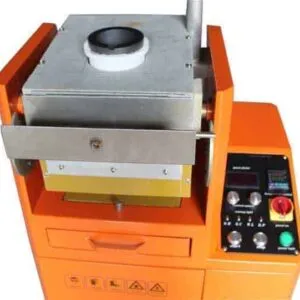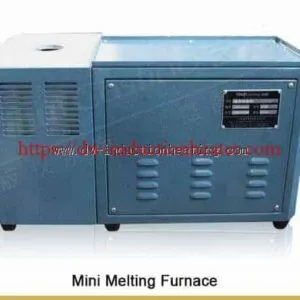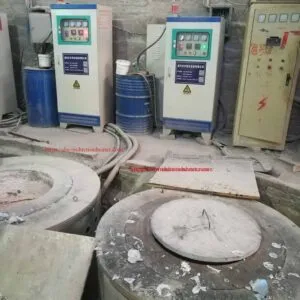


Aluminum Cans Recycling Furnace
Aluminum Cans Recycling Furnace — 150–1200 kg SMJD Induction Melting Furnace
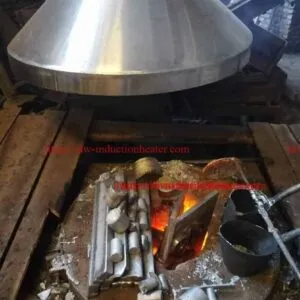
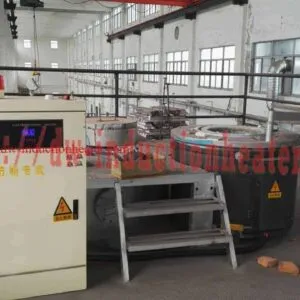
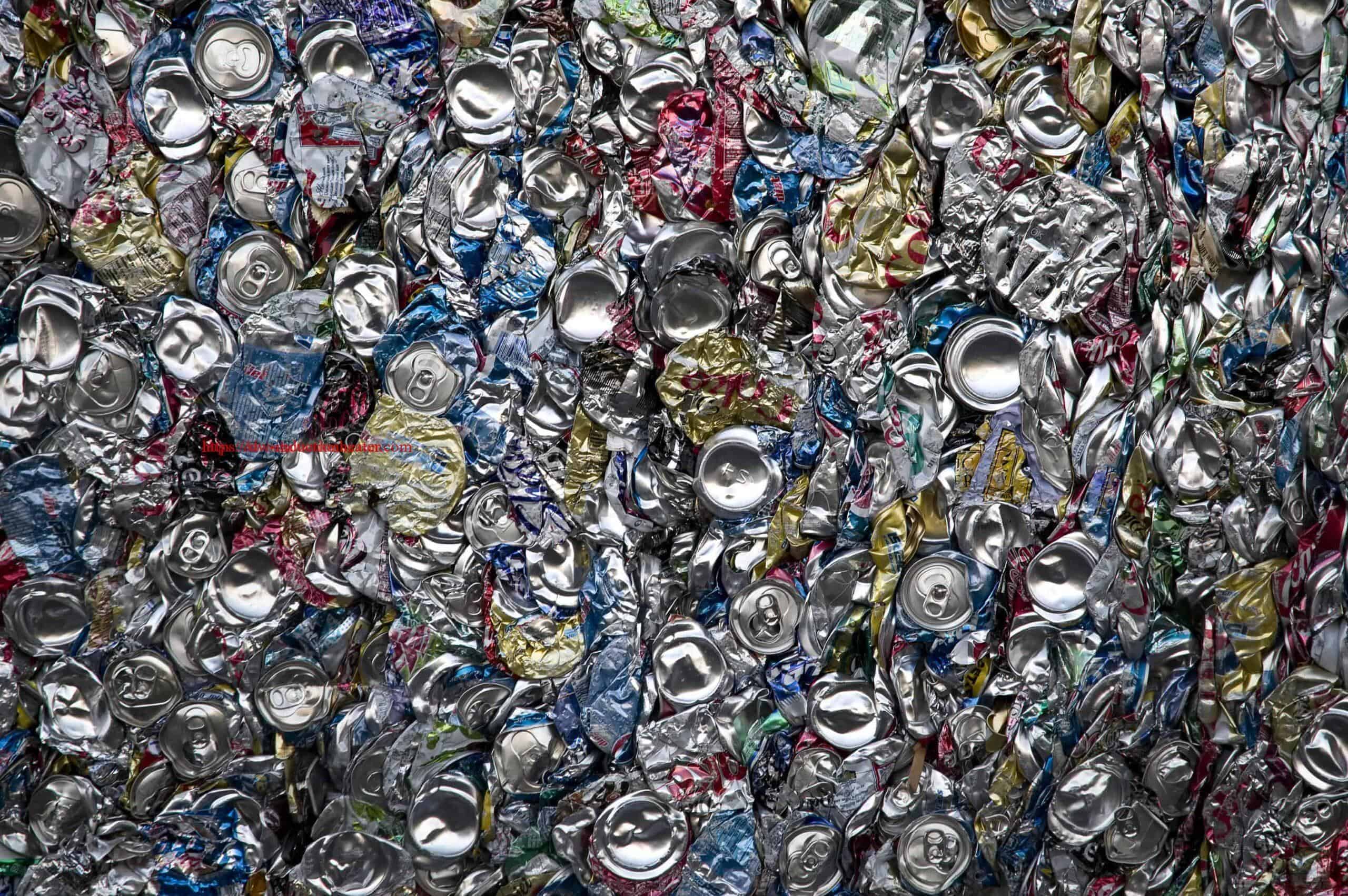
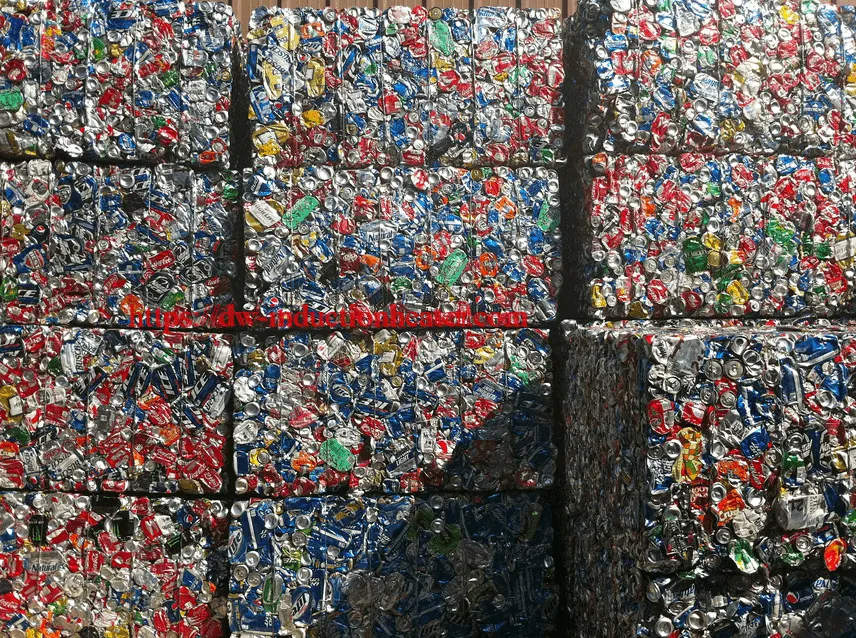
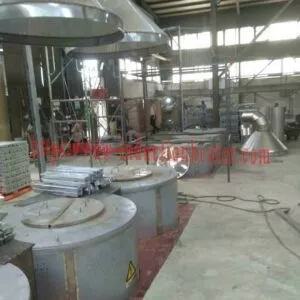
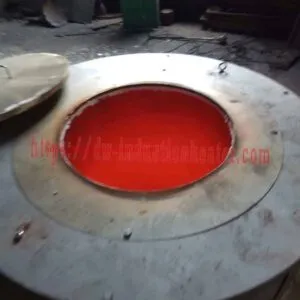
The aluminum cans recycling furnace is a medium-frequency induction melting furnace built for a feedstock that is not clean metal: shredded beverage cans, aluminum scrap, ingots and dross material. Instead of a flame, a power supply drives an alternating current through a copper coil around a conductive crucible; the alternating magnetic field induces eddy currents in the crucible wall, the resistance of the metal turns that current into heat, and the heat passes into the charge. Aluminium turns liquid at 1220.66 °F (660 °C), the coating and paint residue floats to the surface as dross, and the dross is skimmed off with a steel ladle before the metal is poured.
HLQ builds this furnace in the SMJD series: 13 models, 60 kW to 200 kW input, aluminium melting capacity from 150 kg to 1,200 kg per heat, maximum furnace temperature 1800 °C. Every figure on this page comes from HLQ’s published SMJD parameter sheet and furnace manual — the SMJD induction melting furnace parameter sheet and the Aluminum, Copper, Iron induction melting furnace manual.
Quick Answer
The aluminum cans recycling furnace melts beverage-can scrap back into usable ingot without a combustion flame. The charge — shredded cans, aluminum scrap, ingots or dross material — is placed in the crucible and melted by electromagnetic induction. At 1220.66 °F (660 °C) the aluminium turns to liquid. Coating and paint residue does not melt with the metal: it floats on the surface as dross, which is skimmed off with a steel ladle and cooled before it is disposed of or processed separately. The crucible is then emptied, usually by a hydraulic tilting mechanism for large quantities of liquid metal, and the molten aluminium is poured into a mould, cooled and slid out for use.
Aluminum cans recycling furnace — key figures at a glance
| Parameter | Published value |
|---|---|
| Model series | SMJD, 13 models (SMJD-463 to SMJD-3100) |
| Input power range | 60 kW – 200 kW |
| Input current range | 90 A – 300 A |
| Supply | 3-phase 380 V, 50–60 Hz |
| Oscillation frequency | 1 kHz – 100 kHz, custom frequency according to customer request |
| Aluminium melting capacity | 150 kg – 1,200 kg per heat (aluminium, aluminium alloy, aluminum scrap, aluminum slag, pop can) |
| Steel / stainless steel capacity | See the capacity table below |
| Copper, gold, silver (scrap, slag) capacity | 500 kg – 3,000 kg per heat |
| Maximum furnace temperature | 1800 °C |
| Aluminium melting point | 1220.66 °F (660 °C) |
| Furnace lining | Integral polycrystalline mullite fibre, rated above 1200 °C |
| Temperature control | PID heating control, LED digital controller, accuracy up to 3 °C |
| Power devices | IGBT |
| Load duration | 100 %, 24 hours continuous operation |
| Dross handling | Skimmed with a steel ladle, cooled before disposal |
| Pour method | Hydraulic tilting crucible for large quantities of liquid metal |
| Published product range | Electromagnetic 5 – 5,000 kg aluminum induction melting furnace |
For the wider HLQ range see induction heating equipment, and for the rest of the melting line see induction melting furnace manufacturer and supplier.
Table of Contents
- Quick Answer
- What is the Aluminum Cans Recycling Furnace?
- Key Applications
- Suitable Materials
- Working Principle
- Technical Specifications
- Recommended Model Selection
- Process Workflow
- Common Problems and Solutions
- Engineering Selection Guide
- Advantages and Limitations
- Why Choose HLQ?
- 6 Core FAQs
What is the Aluminum Cans Recycling Furnace?
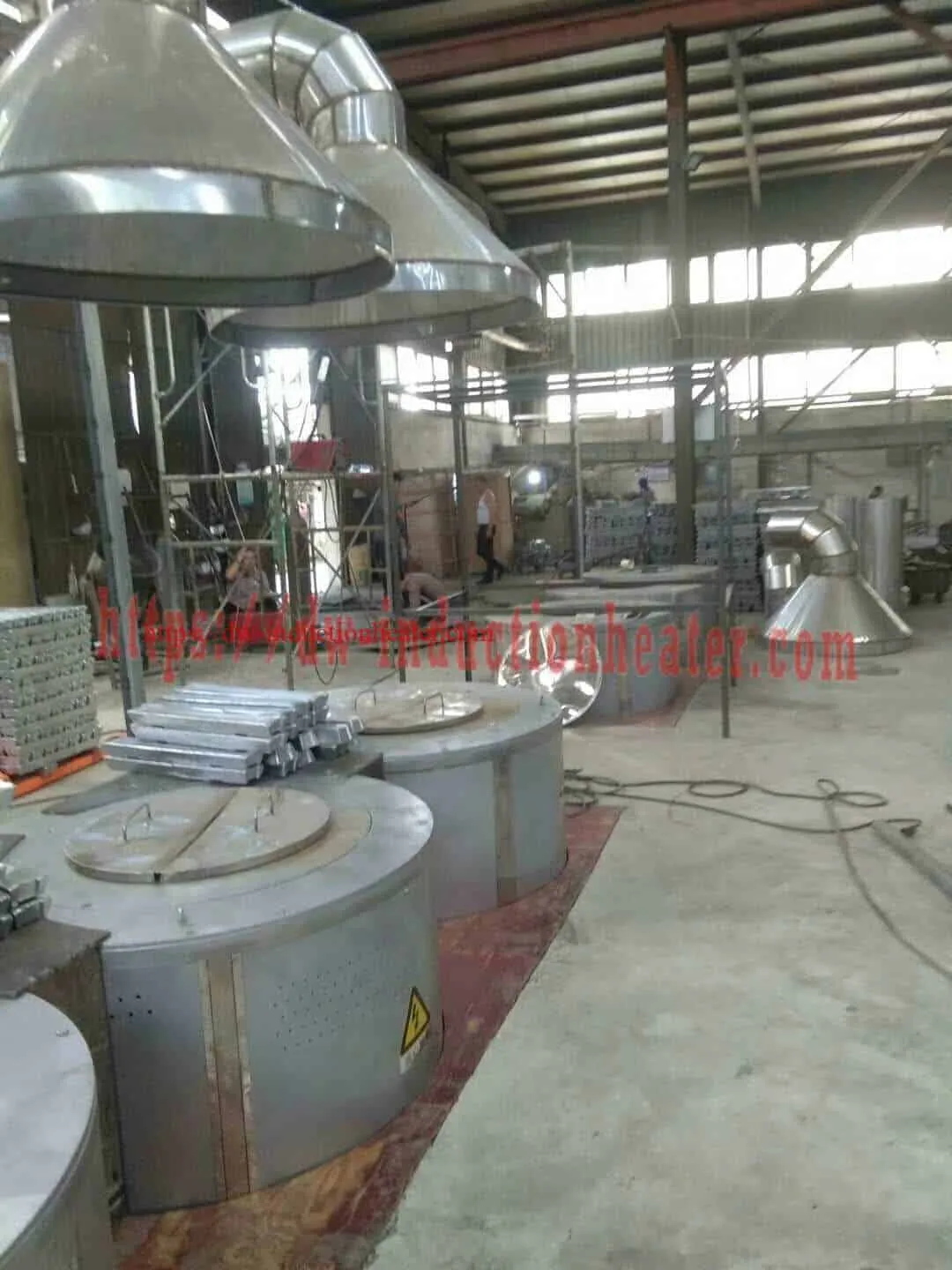
An aluminum cans recycling furnace is a batch induction melting furnace designed around a charge of mixed, coated, painted and oxidised material rather than clean ingot. The principle is the same as any induction melting furnace: a medium-frequency power supply drives alternating current through a water-cooled copper coil that encircles a conductive crucible, the coil’s alternating magnetic field induces eddy currents in the crucible wall, and the resistance of the metal converts that energy into heat which passes into the charge. What differs is everything around the melt.
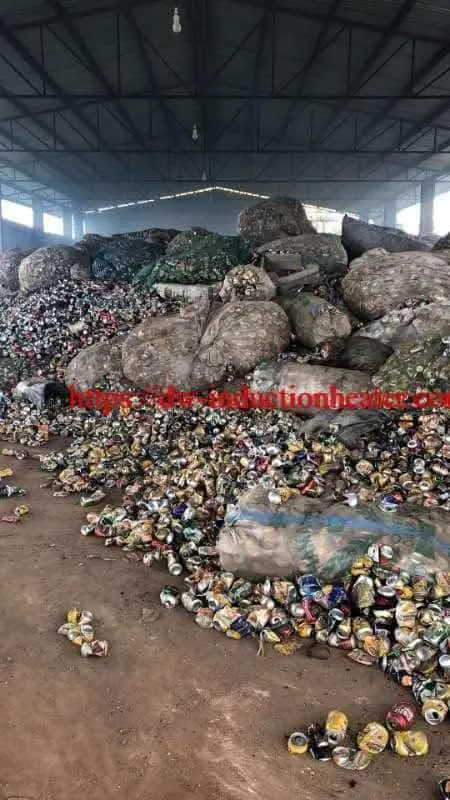
Three things make the recycling duty its own application. First, the residue. Beverage-can coatings, printing inks and the surface oxide on the scrap do not melt with the aluminium — they float to the surface and form a dross layer that is skimmed off with a steel ladle. Second, the alloy mix. Scrap arrives as a blend of alloys and shapes, and the charge has to be brought to a liquid state before the residue can be separated from it. Third, the yield. Every kilogram of dross that leaves the crucible is a kilogram of metal that has to be recovered separately, so the furnace has to reach temperature fast, hold it accurately, and keep the operator able to skim cleanly.
HLQ publishes this furnace in the SMJD series. Thirteen models cover 60 kW to 200 kW, aluminium melting capacity from 150 kg to 1,200 kg per heat, and a maximum furnace temperature of 1800 °C. The published operating steps are short and deliberate: charge, melt, skim the dross, pour, cast.


Key Applications
Published applications for the SMJD series cover the full secondary aluminium chain and several neighbouring duties:
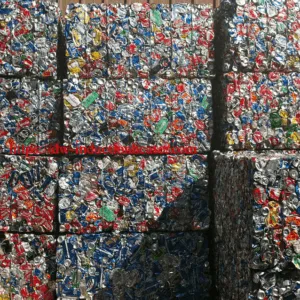
- Beverage container recycling — shredded aluminum cans, the largest single component of processed aluminium scrap, melted back to ingot. The coating and lacquer become dross; the metal underneath is remelted.
- General aluminum scrap recycling — mixed scrap, alloy swarf, profiles and offcuts remelted for casting.
- Aluminum ingot production — foundry-grade ingot cast directly from the furnace. HLQ also builds a dedicated aluminum ingot induction melting furnace production line and an aluminum ingot casting machine for the same line.
- Aluminum slag and dross reprocessing — the melting capacity table lists aluminum slag among the standard charges for the series.
- Same furnace, other non-ferrous metals — the same SMJD series is published for melting aluminum and aluminium alloy, copper, gold, silver, zinc, steel and stainless steel. For the full non-ferrous range see the induction melting furnace category and the aluminium scraps recycling furnace process note.
- Alloy preparation before casting and hot forming — the SMJD series is published as a melting furnace used ahead of forging, sintering and hot rolling in casting and melting industries.


Suitable Materials
The SMJD series is published for three material families. The aluminium family is the duty this page is built around; the steel and precious-metal families run on the same furnaces and the same crucible sizes.
| Material family | Published charges | Capacity range across the series |
|---|---|---|
| Aluminium | Aluminium, aluminium alloy, aluminum scrap, aluminum slag, pop can | 150 kg – 1,200 kg per heat |
| Steel | Steel, stainless steel | See the capacity table below |
| Copper, gold, silver | Scrap and slag | 500 kg – 3,000 kg per heat |
For aluminium specifically, the published charge list covers the whole secondary-material chain: shredded beverage cans, mixed aluminium scrap, aluminium alloy offcuts, foundry returns and aluminum slag. If you need a dedicated comparison of the equipment used for the different aluminium duties, HLQ also publishes an aluminum scrap recycling furnace and a aluminum can recycling machine.


Working Principle
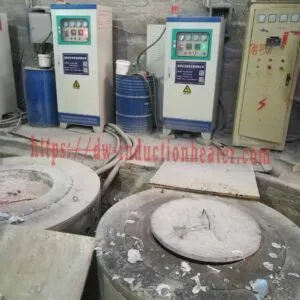
The heating principle is the same for every SMJD furnace. Through the internal rectifier and filter circuit the AC supply is converted into DC power; the control circuit then converts that DC power into high-frequency magnetic energy. The high-speed changing current in the coil produces a high-speed changing magnetic field. When the magnetic field lines pass through the crucible, numerous small eddy currents are generated inside it, so the crucible itself is heated at high speed, and that heat is transferred to the aluminum alloy and melted into a liquid state.
Two consequences follow directly from that principle, and both matter in a recycling cell. First, there is no flame and no combustion air, so nothing enters the melt from the burner side. Second, because the heating element is the metal itself, the thermal path is short — there is no furnace wall to conduct through, which is the main reason induction melting avoids the conduction losses of a conventional fuel-fired furnace.
For the underlying theory, see how does induction heating work.

Technical Specifications
All values in the three tables below are reproduced from HLQ’s published SMJD induction melting furnace parameter sheet and the Aluminum, Copper, Iron induction melting furnace manual.
1. Melting capacity of the SMJD series
| Type | Input power | Melting capacity — steel, stainless steel | Melting capacity — copper, gold, silver (scrap, slag) | Melting capacity — aluminium, aluminium alloy, aluminum scrap, aluminum slag, pop can | Max temperature |
|---|---|---|---|---|---|
| SMJD-463 | 60 kW | 200 kg | 500 kg | 200 kg | 1800 °C |
| SMJD-480 | 60 kW | 150 kg | 500 kg | 150 kg | |
| SMJD-580 | 80 kW | 200 kg | 600 kg | 200 kg | |
| SMJD-600 | 60 kW | 230 kg | 560 kg | 230 kg | |
| SMJD-900 | 120 kW | 300 kg | 900 kg | 300 kg | |
| SMJD-905 | 80 kW | 300 kg | 900 kg | 300 kg | |
| SMJD-1250 | 80 kW | 400 kg | 1,200 kg | 400 kg | |
| SMJD-1250 | 120 kW | 450 kg | 1,350 kg | 450 kg | |
| SMJD-1500 | 120 kW | 500 kg | 1,500 kg | 500 kg | |
| SMJD-1550 | 120 kW | 520 kg | 1,560 kg | 520 kg | |
| SMJD-1700 | 160 kW | 600 kg | 1,700 kg | 600 kg | |
| SMJD-2300 | 160 kW | 800 kg | 2,000 kg | 800 kg | |
| SMJD-3100 | 200 kW | 1,200 kg | 3,000 kg | 1,200 kg |
Note on the table above: the “steel, stainless steel” column is printed identically to the aluminium column in all thirteen rows, in the published sheet and in HLQ’s own manual. The two columns should be confirmed with HLQ before the table is quoted commercially.
2. Main technical parameters of the SMJD series
| Type | Output power | Input current | Input voltage | Oscillation frequency |
|---|---|---|---|---|
| SMJD-463 | 60 kW | 90 A | 3-phase 380 V, 50–60 Hz | 1 kHz – 100 kHz, custom frequency according to customer request |
| SMJD-480 | 60 kW | 90 A | ||
| SMJD-580 | 80 kW | 120 A | ||
| SMJD-600 | 60 kW | 90 A | ||
| SMJD-900 | 120 kW | 180 A | ||
| SMJD-905 | 80 kW | 120 A | ||
| SMJD-1250 | 80 kW | 120 A | ||
| SMJD-1250 | 120 kW | 180 A | ||
| SMJD-1500 | 120 kW | 180 A | ||
| SMJD-1550 | 120 kW | 180 A | ||
| SMJD-1700 | 160 kW | 240 A | ||
| SMJD-2300 | 160 kW | 240 A | ||
| SMJD-3100 | 200 kW | 300 A |
3. Crucible specification
| Type | Specification | Upper mouth outer diameter (A), ±10 mm | Upper mouth inner diameter (B), ±5 mm | Bottom outer diameter (C), ±10 mm | Total height (H), ±10 mm |
|---|---|---|---|---|---|
| SMJD-463 | 463# | 565 mm | 500 mm | 310 mm | 617 mm |
| SMJD-480 | 480# | 510 mm | 420 mm | 400 mm | 710 mm |
| SMJD-580 | 580# | 420 mm | 360 mm | 300 mm | 840 mm |
| SMJD-600 | 600# | 620 mm | 525 mm | 620 mm | 470 mm |
| SMJD-900 | 900# | 520 mm | 425 mm | 510 mm | 960 mm |
| SMJD-905 | 905# | 620 mm | 530 mm | 620 mm | 650 mm |
| SMJD-1250 | 1250# | 620 mm | 535 mm | 620 mm | 850 mm |
| SMJD-1500 | 1500# | 735 mm | 640 mm | 460 mm | 900 mm |
| SMJD-1550 | 1550# | 775 mm | 682 mm | 400 mm | 750 mm |
| SMJD-1700 | 1700# | 610 mm | 500 mm | 610 mm | 1,200 mm |
| SMJD-2300 | 2300# | 880 mm | 775 mm | 355 mm | 1,000 mm |
| SMJD-3100 | 3100# | 780 mm | 645 mm | 780 mm | 1,400 mm |
4. Technical documents
- SMJD induction melting furnace parameter — capacity, electrical parameters and crucible specification.
- Aluminum, Copper, Iron induction melting furnace manual — heating principle, packing, storage and warranty.
- Aluminium scraps recycling melting process — background document on secondary aluminium melting and scrap behaviour, hosted on dw-inductionheater.com.


Recommended Model Selection
Start from the charge, not from the power. The published aluminium capacity of each model is the number that sets the size of the heat, and the crucible dimensions determine what physically fits into the mouth. Use the table below as a starting point and confirm the final selection against your own charge — basket size, density and the proportion of can fines.
| Your charge per heat | Model candidates (published aluminium capacity) | Published input power / current | Crucible mouth (inner Ø B) |
|---|---|---|---|
| Up to 150 kg | SMJD-480 (150 kg) | 60 kW / 90 A | 420 mm |
| Up to 200 kg | SMJD-463 (200 kg), SMJD-580 (200 kg) | 60 kW / 90 A · 80 kW / 120 A | 500 mm · 360 mm |
| Up to 230 kg | SMJD-600 (230 kg) | 60 kW / 90 A | 525 mm |
| Up to 300 kg | SMJD-900 (300 kg), SMJD-905 (300 kg) | 120 kW / 180 A · 80 kW / 120 A | 425 mm · 530 mm |
| Up to 400 kg | SMJD-1250 (80 kW version, 400 kg) | 80 kW / 120 A | 535 mm |
| Up to 450 kg | SMJD-1250 (120 kW version, 450 kg) | 120 kW / 180 A | 535 mm |
| Up to 520 kg | SMJD-1500 (500 kg), SMJD-1550 (520 kg) | 120 kW / 180 A | 640 mm · 682 mm |
| Up to 600 kg | SMJD-1700 (600 kg) | 160 kW / 240 A | 500 mm |
| Up to 800 kg | SMJD-2300 (800 kg) | 160 kW / 240 A | 775 mm |
| Up to 1,200 kg | SMJD-3100 (1,200 kg) | 200 kW / 300 A | 645 mm |
Two points worth flagging before you order. First, SMJD‑1250 is published twice, once at 80 kW / 400 kg and once at 120 kW / 450 kg, with the same crucible specification — ask HLQ to confirm the power configuration of the unit you are quoting. Second, the model numbers are not a monotonic size scale: SMJD‑480 is the smallest aluminium heat in the range at 150 kg, and SMJD‑600 gives a larger aluminium capacity than SMJD‑580 while drawing less power. Select on capacity and on crucible mouth diameter, not on the number.
Process Workflow
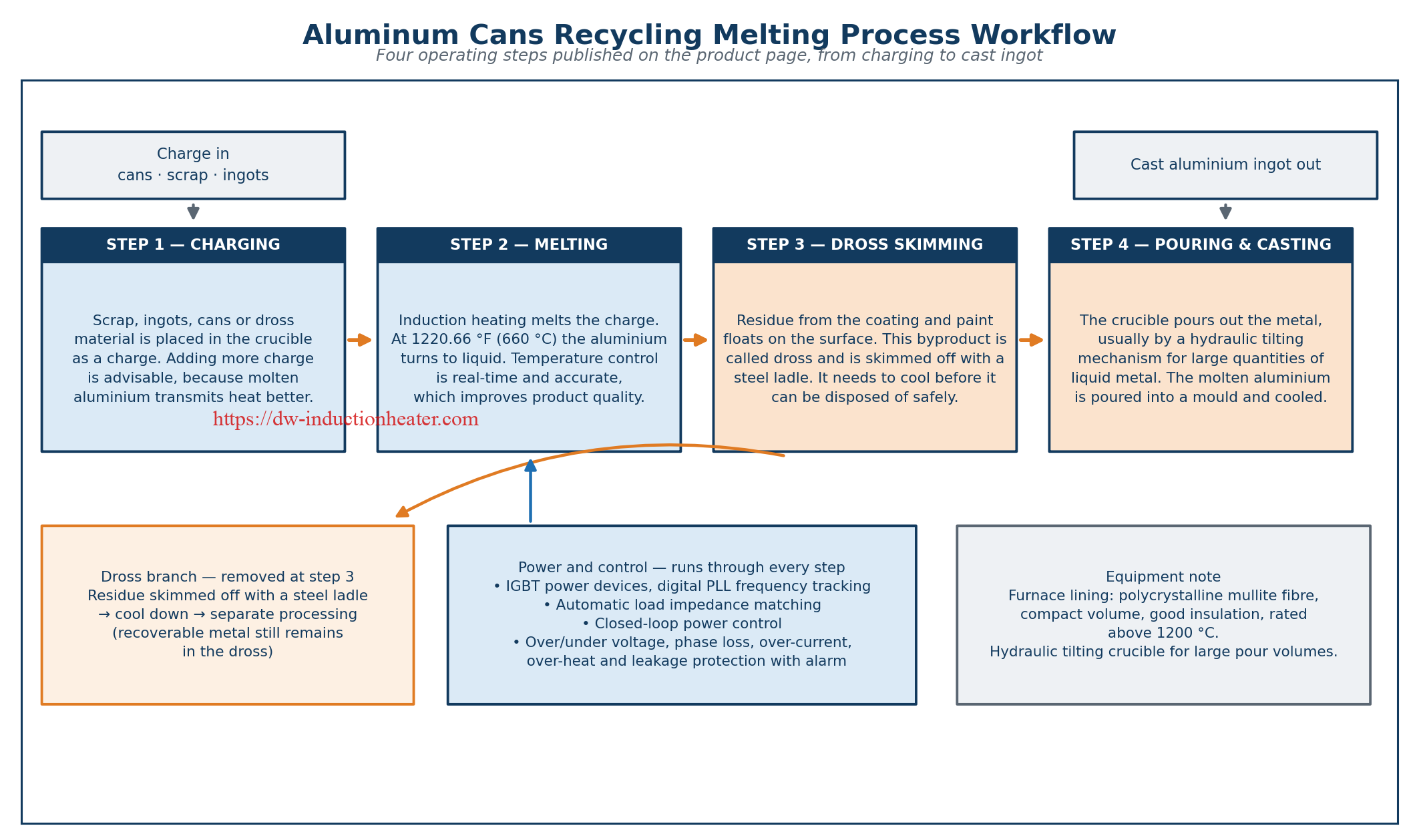
The published operating steps are the same for every capacity in the series.
- Charge. The operator places aluminum parts, ingots, scrap or cans into the induction melting furnace as a charge and starts the furnace to begin the melting process. Adding more aluminum charge during this process is advisable, because molten aluminum transmits the heat better.
- Melt. Induction heating brings the charge up to temperature. When the temperature of the aluminum reaches 1220.66 °F it turns to liquid. Any residue from the coating and paint from the cans floats on the surface — this byproduct is called dross.
- Skim the dross. The dross is skimmed off with a steel ladle. It needs to cool before it can be disposed of safely.
- Pour and cast. The crucible pours out the metal, usually by a hydraulic tilting mechanism provided for large quantities of liquid metals. With care, the molten aluminum is poured into a mould to cool down and then slid out for use.


Common Problems and Solutions
| Problem | Cause | Published solution on the SMJD furnace |
|---|---|---|
| Dross layer builds up fast and carries metal out of the melt | Coating, paint and printing ink on beverage cans do not melt with the aluminium and float to the surface | Skim the dross with a steel ladle at temperature and cool it before disposal; the published operating procedure separates dross handling from the metal handling step |
| Melt temperature drifts during the heat | Load changes as the charge melts and more aluminium is added | PID heating control for uniform heating temperature and prevention of molten aluminum temperature drift; LED digital temperature controller with accuracy up to 3 °C |
| Power fluctuates or the furnace does not hold the set point | Load impedance changes as the charge melts | Digital phase-locked-loop frequency tracking with automatic load impedance matching, plus closed-loop power control to avoid temperature change caused by power down |
| Uneven melt quality, low product qualification rate | Temperature non-uniformity across the charge | PID heating control gives uniform heating temperature, homogeneous metal components and a higher product qualification rate |
| Coil or furnace damage from overheating | Cooling or protection failure during a 24 h duty cycle | Over-voltage, under-voltage, phase-loss, over-current, over-heat and leakage protection, with automatic alarm, power cut-off, real-time working-state display and fault diagnosis |
| High energy cost per heat | Conduction losses of a conventional fuel-fired furnace, and heat escaping into the workshop | Electromagnetic heating of the metal itself, with a polycrystalline mullite fibre lining for good insulation and low energy consumption |
| Coil and lining maintenance burden | Resistance elements degrade in a high-temperature atmosphere | The induction coil is made of insulating material and high temperature wire, giving a long service life with no maintenance; the integral mullite fibre furnace structure has a long service life |
Engineering Selection Guide
Six questions decide the model. Work through them in order and the specification follows directly from the published tables above.
- What is the charge weight per heat? This sets the heat size, and therefore the model. The published aluminium capacity band is 150 kg to 1,200 kg.
- What is the shape of the charge? Shredded can fines, profiles and plate all behave differently when charged. The crucible mouth inner diameter (B) and the bottom outer diameter (C) in the crucible table are the constraints — a wide, flat basket needs a large bottom, not just a large mouth.
- What is the available electrical supply? Every model in the series runs on 3-phase 380 V, 50–60 Hz. The published input current for each model (90 A to 300 A) is what the incoming supply and the cabling must be sized for.
- What frequency is required? The published band is 1 kHz – 100 kHz, with custom frequency available according to customer request. Confirm the frequency with HLQ at order stage rather than assuming it.
- How is the melt discharged? The published procedure uses a hydraulic tilting mechanism for large quantities of liquid metal. Confirm the pour arrangement and the mould handling for your heat size.
- What is the duty cycle? The published load duration is 100 %, so the furnace is specified for 24 hours continuous operation. Check that the cooling circuit, the dross handling station and the casting station are sized for the same continuous duty.
For the wider equipment context — where melting fits against heating, and how the ranges compare — see the aluminum melting furnace category and the high frequency heating furnace line.
Advantages and Limitations
Advantages
- Energy saving. Published figures put the power saving at 20 %–40 % compared with a diesel-fired workshop furnace (the product page) and at 20 %–30 % compared with gas and oil (the published manual). The difference is a matter of which baseline document is quoted; both are HLQ’s own published numbers.
- Rapid heating and accurate, real-time temperature control, which improves product quality and production efficiency.
- Long service life and simple maintenance. The electromagnetic heating coil is made of insulating material and high-temperature wire, so it does not oxidise in the furnace atmosphere the way a resistance element does.
- Compact footprint and easy installation — the integral polycrystalline mullite fibre furnace structure is small in volume, well insulated, energy efficient and rated above 1200 °C.
- Operating safety. The induction arrangement keeps the machine surface temperature low, reduces the risk of burn and scald accidents compared with traditional heating modes, and protects the safety of employees.
- No combustion products. Electricity-powered operation with no air pollution, no dust and little noise.
- Continuous production. 100 % load duration at maximum power for 24-hour operation.
- One furnace, several metals. The same SMJD series is published for aluminium, copper, gold, silver, zinc, steel and stainless steel, so a cell can change duty without changing equipment.
Limitations and things to plan for
- Dross still has to be handled. The coating and paint residue does not disappear; it has to be skimmed, cooled and then disposed of or processed separately, and metal entrained in it is not recovered in the furnace.
- Capacity is per heat, not per hour. The published figures are heat sizes. Cycle time depends on the charge, the charge weight and the skimming and pouring time.
- Two published tables need confirming before commercial use. The steel/stainless column in the capacity table is printed identically to the aluminium column in all thirteen rows, and SMJD‑1250 appears twice with two different power ratings. Both are upstream publication errors, not transcription errors.
- Published energy-saving percentages differ between documents — quote the20 %–30 % figure from the manual if a single number is needed.
- Maximum furnace temperature is not the pour temperature. 1800 °C is the furnace rating; the aluminium liquidus in the published process is 1220.66 °F (660 °C).
- Frequency is customisable, which means it has to be specified at order stage rather than discovered at commissioning.
Why Choose HLQ?
- Direct manufacturer, not a trading company. HLQ Induction Equipment has25 years of R&D, design and production experience in high-frequency and medium-frequency induction heating and melting equipment, based in the Quanzhou high-tech industrial development zone.
- IGBT power devices with high reliability, stable operation and low maintenance cost.
- A published 13-model range covering 60–200 kW and 150–1,200 kg of aluminium per heat, with published input current, input voltage, oscillation frequency and crucible dimensions for every model.
- Full protection package — over-voltage, under-voltage, phase-loss, over-current, over-heat and leakage protection, with automatic alarm, power cut-off and real-time working-state display.
- Self-protection and fault diagnosis as a design principle across the HLQ induction heating range, not an add-on.
- Documented packing, storage and warranty. The machine is wrapped with a waterproof film layer, packed in a paper box, then placed in a wooden exporting case with foam around it for shockproof. Storage: clean, dry environment, −20…60 °C, 0 %–95 % humidity with no dew, away from corrosive gases and liquids. The heating power is warranted for 12 months from the date the contract is signed.
- Tested before shipment — HLQ’s technical staff test and run every machine before it leaves the factory, and photographs and video are available on request.
- One supplier across the whole recycling cell — melting furnace, power supply, cooling tower, ingot casting machine and the tilting and handling equipment around it. See the full range of induction heating equipment.
6 Core FAQs
1. How much aluminum can one SMJD furnace melt in a single heat?
Between 150 kg and 1,200 kg of aluminium per heat across the series. The published model-by-model figures are in the capacity table above: SMJD‑480 at 150 kg, SMJD‑463 and SMJD‑580 at 200 kg, SMJD‑600 at 230 kg, SMJD‑900 and SMJD‑905 at 300 kg, SMJD‑1250 at 400 kg and 450 kg depending on power configuration, SMJD‑1500 at 500 kg, SMJD‑1550 at 520 kg, SMJD‑1700 at 600 kg, SMJD‑2300 at 800 kg and SMJD‑3100 at 1,200 kg.
2. What power supply does the furnace need?
3-phase 380 V, 50–60 Hz for every model in the series. Output power ranges from 60 kW to 200 kW, with published input currents from 90 A to 300 A. The oscillation frequency band is 1 kHz – 100 kHz, and HLQ publishes custom frequency according to customer request — specify it at order stage.
3. What happens to the paint and coating on the beverage cans?
It does not melt with the aluminium. Any residue from the coating and paint floats on the surface of the melt and forms the dross layer. The dross is skimmed off with a steel ladle, and it has to cool before it can be disposed of safely. The metal underneath is poured out separately and cast into ingots.
4. At what temperature does aluminum melt in this furnace?
The published operating procedure states that when the temperature of the aluminum reaches 1220.66 °F (660 °C) it turns to liquid. The 1800 °C figure in the specification table is the maximum furnace temperature rating, not the aluminium pour temperature.
5. How much energy does it save compared with a conventional furnace?
HLQ’s published figures are 20 %–40 % power saving against a diesel-fired workshop furnace on the product page, and 20 %–30 % against gas and oil in the published manual. The saving comes from electromagnetic heating of the metal itself, which removes the conduction loss of a flame-heated furnace wall, and from the well-insulated polycrystalline mullite fibre lining.
6. Can it run continuously, and how long does the guarantee run?
The published load duration is 100 % at maximum power, so the furnace is specified for 24 hours continuous operation. The heating power is warranted for 12 months from the date the contract is signed, and machines are test-run by HLQ’s technical staff before shipment.