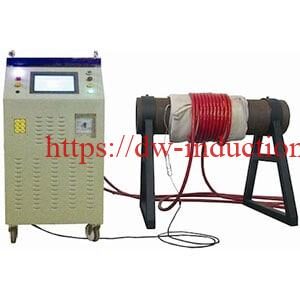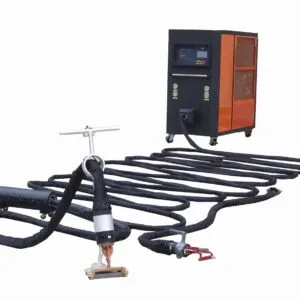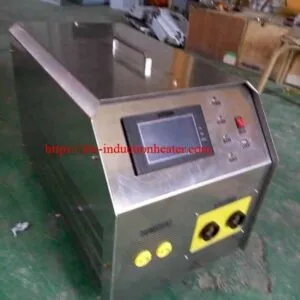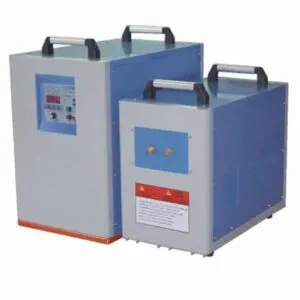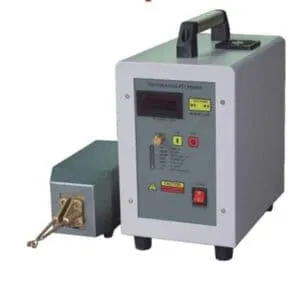


Portable Induction Brazing Units
Portable Induction Brazing Units for Precision Metal Joining | DW-UHF-4.5KW
Quick Answer
What are Portable Induction Brazing Units?
HLQ Portable Induction Brazing Units are compact induction heating systems designed for localized heating and precision metal joining. The main model presented on this product page is the DW-UHF-4.5KW, an ultra-high-frequency induction heating unit with a manufacturer-published output rating of 4.5kW, single-phase 220V AC input, and an oscillation-frequency range of 1100–2000kHz (1.1–2.0MHz). It uses an IGBT inverter, a compact heating station, and an application-specific induction coil to heat small electrically conductive metal components.
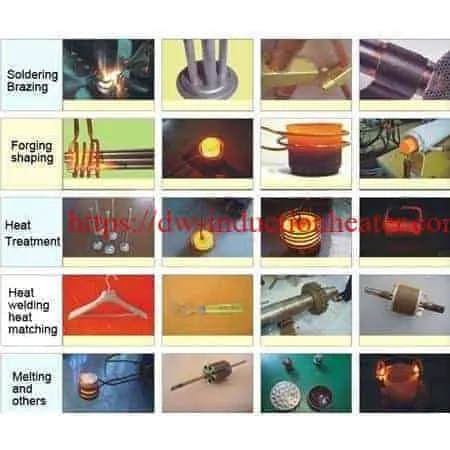
Best-Fit Applications: Miniature steel-part brazing, small cutting-tool tips, fine metal wire heating, precision annealing, small copper connectors, localized metal heating, and selected micro-component heat-treatment applications.
Engineering Selection: The DW-UHF-4.5KW is most relevant to applications requiring concentrated heating of relatively small metal components. Equipment selection should consider material properties, effective heated mass, joint geometry, required temperature, heating time, induction frequency, coil design, and cooling conditions.
Specification Notice: The original manufacturer page contains inconsistencies between the published 4.5kW output rating and 220V/20A input figures, as well as conflicting 80% and 100% duty-cycle claims. These parameters must be verified for the supplied machine.
Table of Contents
- What Is the Portable Induction Brazing Unit?
- Key Applications
- Suitable Materials
- Working Principle
- Technical Specifications
- Recommended Model Selection
- Process Workflow
- Common Problems and Solutions
- Engineering Selection Guide
- Advantages and Limitations
- Why Choose HLQ?
- 10 Core FAQs
What Is the Portable Induction Brazing Unit?
A portable induction brazing unit is a compact electromagnetic heating system designed to deliver localized heat to conductive metal components through an induction coil.
The HLQ DW-UHF-4.5KW uses an ultra-high-frequency inverter to generate alternating electrical current. When this current flows through the induction coil, it produces a changing magnetic field around the workpiece.
The alternating magnetic field induces electrical currents inside electrically conductive materials. These currents produce heat through electrical resistance.
During induction brazing, the workpiece is heated to the temperature required by a compatible brazing filler metal. The filler metal melts, wets the prepared joining surfaces, and solidifies to form the joint.
Unlike fusion welding, induction brazing does not require the base materials to melt.
The DW-UHF-4.5KW is particularly relevant to small components because its published operating frequency is in the megahertz range.
However, high frequency alone does not guarantee a particular heating time, joint quality, or hardened case depth. These results depend on the complete heating process.
DW-UHF-4.5KW Product Overview
| Item | Published Information | Engineering Consideration |
|---|---|---|
| Model | DW-UHF-4.5KW | Primary model on the original page |
| Equipment Category | Ultra-High-Frequency Induction Heating | Precision localized metal heating |
| Input Supply | Single-phase 220V, 50/60Hz | Confirm actual full-load current |
| Published Output Power | 4.5kW | Rating definition requires verification |
| Oscillation Frequency | 1100–2000kHz | Equivalent to 1.1–2.0MHz |
| Published Input Current | 5–20A | Inconsistent with a continuous 4.5kW active output claim |
| Published Weight | 21kg | Confirm whether the weight includes the heating station |
| Cooling Method | Water Cooling | Verify flow, pressure, temperature, and water quality |
| Primary Applications | Precision brazing, fine wire heating, localized heat treatment | Requires application-specific coil selection |
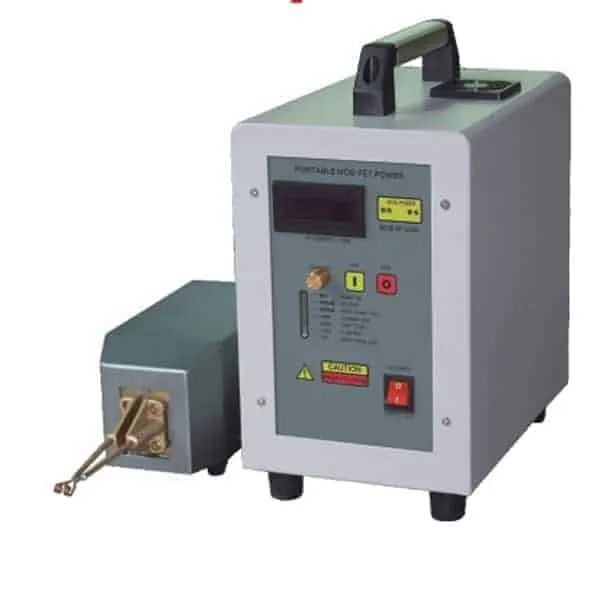
Main Components of a Portable UHF Induction Brazing System
| Component | Function | Engineering Requirement |
|---|---|---|
| Electrical Input | Supplies electrical energy to the induction generator | Correct voltage, current capacity, grounding, and protection |
| IGBT Inverter | Generates high-frequency alternating electrical power | Suitable rated load and frequency configuration |
| Resonant Matching Circuit | Matches the induction load to the inverter | Compatible induction coil and operating frequency |
| Heating Station | Provides the connection between the power supply and heating coil | Correct electrical arrangement and cooling |
| Induction Coil | Produces the alternating magnetic field | Application-specific dimensions and geometry |
| Workpiece Fixture | Positions the component during heating | Repeatable alignment and suitable clearance |
| Cooling System | Removes heat from designated equipment components | Manufacturer-approved flow, temperature, and pressure |
| Control System | Regulates the available operating parameters | Confirm actual control modes and timer configuration |
Compact UHF Units vs. Mobile Handheld Brazing Systems
The DW-UHF compact equipment range and the DWS mobile induction brazing range are designed around different operating arrangements.
The DW-UHF-4.5KW focuses on high-frequency precision heating of relatively small components.
The DWS mobile equipment range uses remote handheld heating heads connected through longer cables and is intended for suitable on-site joining tasks.
| Comparison | DW-UHF Compact Equipment | DWS Mobile Equipment |
|---|---|---|
| Primary Positioning | Small-part precision heating | On-site localized metal joining |
| Main Product Example | DW-UHF-4.5KW | DWS-10 to DWS-100 |
| Published Electrical Input | Single-phase 220V for DW-UHF-4.5KW | Three-phase 380V for published DWS models |
| Published Frequency | 1.1–2.0MHz for DW-UHF-4.5KW | Not specified on the DWS mobile product page |
| Heating Arrangement | Compact heating station and induction coil | Remote handheld heating head |
| Typical Application Focus | Micro brazing, fine wires, miniature metal parts | Installed pipes, copper connectors, industrial maintenance |
| Equipment Selection | Frequency, micro-coil design, workpiece mass | Head accessibility, cable length, heating demand, ergonomics |
Key Applications
The DW-UHF-4.5KW is intended for selected small-component heating applications that benefit from concentrated electromagnetic energy.
Each application requires a compatible induction coil, correct material selection, suitable heating temperature, and validated operating procedure.
1. Induction Brazing of Miniature Steel Components
Small steel tips, pins, shanks, and precision metal assemblies can be joined through induction brazing when suitable base materials and filler alloys are used.
A small induction coil can concentrate heating around the joining interface.
For miniature components, coil geometry and positioning can strongly influence the heating result.
HLQ has published a separate DW-UHF-4.5kW application involving a steel tip and shank with a diameter of approximately 0.1 inch (2.54mm).
The reported test used a two-turn induction coil, a brazing ring, and black flux. It reached a reported temperature of approximately 704°C in 3 seconds.
However, that case reports 800kHz operation, which differs from the current product page’s 1.1–2.0MHz range.
Therefore, the test should be treated as a related model-class reference rather than a guarantee for the currently published configuration.
Read the related induction brazing small steel tips application.
2. Precision Brazing of Copper Components
Induction heating may be used to braze small copper components, electrical contacts, connectors, and other compatible joints.
Because copper has high electrical and thermal conductivity, effective coil coupling and heat transfer must be evaluated carefully.
The brazing process also requires appropriate filler metal, surface preparation, joint clearance, and temperature control.
The DW-UHF-4.5KW should not be assumed capable of brazing all copper tube sizes or joint masses.
3. Fine Wire Induction Heating
The original product page identifies heating of metal wires smaller than 1mm as a potential application.
High-frequency induction heating may be useful for certain fine-wire operations where a localized or short heating zone is required.
However, performance depends on the wire diameter, material, electrical conductivity, operating frequency, coil design, feed speed, and required temperature.
4. Continuous Fine Wire Annealing
Continuous induction annealing can be used to apply controlled heat to moving metal wire.
The heating system must provide the required temperature rise within the available heating length and wire residence time.
The final annealing result depends on material grade, temperature, heating duration, and cooling conditions.
5. Small-Part Surface Heating
The ultra-high-frequency DW-UHF equipment range can be evaluated for localized surface heating of small conductive metal components.
For steel hardening, the material must be suitable for the intended heat-treatment process.
Actual surface hardness and case depth depend on austenitizing conditions, heating duration, material grade, and quenching.
6. Precision Induction Soldering
Selected small electrical connectors and metal contacts may be joined through induction soldering using suitable solder alloys.
Unlike brazing, soldering uses a filler metal with a liquidus temperature at or below 450°C.
Very small electronic assemblies may require additional temperature-control equipment, specialized coils, and protection of nearby temperature-sensitive components.
7. Specialized Laboratory Heating
The original product page also lists selected laboratory heating and floating-melting applications.
These are specialized processes that require dedicated electromagnetic coil configurations and additional engineering validation.
The standard brazing equipment configuration should not be assumed capable of unsupported levitation-melting operations.
| Application | Material | Heating Objective | Important Requirement |
|---|---|---|---|
| Miniature Steel Tip Brazing | Steel and compatible filler metal | Localized heating of a small joining interface | Coil alignment, filler selection, temperature control |
| Small Copper Connector Brazing | Copper and compatible alloys | Heat the joint for filler flow | Coil coupling and effective heated mass |
| Fine Wire Heating | Suitable conductive wire | Raise wire temperature within a short heating zone | Wire diameter and feed speed |
| Fine Wire Annealing | Copper, steel, and selected alloys | Apply a controlled thermal cycle | Material properties and cooling conditions |
| Precision Soldering | Small metal contacts | Provide localized solder reflow | Temperature-sensitive surrounding components |
| Small Steel Surface Heating | Suitable carbon or alloy steel | Heat a defined surface region | Frequency, coil geometry, and process verification |
| Specialized Laboratory Heating | Application-specific metals | Controlled electromagnetic heating | Dedicated fixtures and safety assessment |
Suitable Materials
Ultra-high-frequency induction heating can be applied to electrically conductive metals.
However, different materials respond differently to the same electromagnetic field because electrical resistivity, magnetic permeability, thermal conductivity, and temperature-dependent properties vary.
| Material | Heating Characteristics | Potential Application | Engineering Consideration |
|---|---|---|---|
| Carbon Steel | Temperature-dependent magnetic behavior | Miniature steel brazing and localized heating | Material grade, magnetic transition, and heating duration |
| Alloy Steel | Properties depend on alloy composition | Precision tool and small-part heating | Grade-specific temperature and metallurgical requirements |
| Stainless Steel | Electromagnetic properties vary by grade | Selected precision joining applications | Actual stainless steel grade and filler compatibility |
| Copper | High electrical and thermal conductivity | Small connectors and fine wire heating | Coil coupling and heat dissipation |
| Brass | Conductive copper-zinc alloy | Small precision fittings | Temperature control and zinc-related process considerations |
| Aluminum | Nonferromagnetic and highly conductive | Selected localized heating operations | Alloy-specific temperature limits and heating efficiency |
| Nickel Alloys | Composition-dependent properties | Specialized precision heating | Material compatibility and process atmosphere |
Brazing and Soldering Filler Metal Selection
For brazing, the filler metal must have a liquidus temperature above 450°C and below the solidus temperature of the base metals.
For soldering, the filler metal has a liquidus temperature at or below 450°C.
The induction power supply does not determine the correct filler metal. Filler selection depends on base materials, required joint properties, service conditions, and applicable standards.
| Joint Materials | Potential Filler Family | Engineering Consideration |
|---|---|---|
| Steel-to-Steel | Qualified silver-based or other suitable brazing alloy | Wetting, strength, flux or atmosphere requirements |
| Copper-to-Copper | Qualified copper-phosphorus or other compatible brazing alloy | Joint clearance and service suitability |
| Copper-to-Brass | Suitable silver-based or other qualified filler | Flux selection and heat distribution |
| Copper-to-Stainless Steel | Compatible qualified filler metal | Avoid unsuitable phosphorus-bearing fillers on ferrous or nickel-containing materials |
| Small Electrical Contacts | Application-qualified solder alloy | Joint temperature and protection of nearby components |
Working Principle
The DW-UHF-4.5KW operates according to electromagnetic induction.
Incoming single-phase electrical power is converted by the induction power supply into ultra-high-frequency alternating current.
This alternating current flows through the compatible induction heating coil.
The coil generates a changing magnetic field around the metal component.
When an electrically conductive workpiece is positioned within the magnetic field, electrical currents are induced inside the metal.
The electrical resistance of the workpiece converts the induced currents into heat.
During brazing, this heat raises the joining surfaces to the temperature required for the selected filler metal to melt and flow.
Electromagnetic Induction Heating Process
| Step | Component | Function |
|---|---|---|
| 1 | Single-Phase AC Power | Provides electrical input energy |
| 2 | IGBT Inverter | Generates ultra-high-frequency electrical output |
| 3 | Resonant Heating Circuit | Matches the induction load to the inverter |
| 4 | Copper Induction Coil | Generates an alternating magnetic field |
| 5 | Conductive Workpiece | Absorbs electromagnetic energy and generates heat |
| 6 | Brazing Filler Metal | Melts and wets the prepared joining surfaces |
| 7 | Cooling and Solidification | Completes the brazed joint |
| 8 | Quality Inspection | Verifies the required joint characteristics |
Ultra-High Frequency and the Skin Effect
The operating frequency influences the distribution of induced electrical currents inside the workpiece.
Under simplified electromagnetic conditions, higher frequencies produce smaller reference electrical penetration depths.
The reference electrical skin depth can be estimated using:
δ = √[ρ / (π × f × μ)]
Where:
- δ = Reference electrical skin depth, meters.
- ρ = Electrical resistivity, Ω·m.
- f = Operating frequency, Hz.
- μ = Absolute magnetic permeability, H/m.
The final thermal penetration depth can be much different from the reference electrical skin depth because heat also spreads through thermal conduction.
The actual result depends on heating duration, workpiece geometry, and temperature-dependent material properties.
Illustrative Copper Skin Depth at UHF Frequencies
Using an approximate room-temperature copper electrical resistivity of 1.72 × 10⁻⁸ Ω·m and a relative magnetic permeability of 1:
| Operating Frequency | Approximate Electrical Skin Depth | Engineering Interpretation |
|---|---|---|
| 800kHz | 0.074mm | Frequency reported in a separate DW-UHF-4.5kW brazing case |
| 1100kHz | 0.063mm | Lower end of the current product-page range |
| 1500kHz | 0.054mm | Intermediate UHF reference |
| 2000kHz | 0.047mm | Upper end of the current product-page range |
Engineering Qualification: These values describe theoretical electrical current penetration in copper at approximately room temperature. They are not a guarantee of brazing temperature, hardened case depth, or total thermal penetration.
Induction Coil Design for Miniature Parts
Coil geometry is critical for precision induction heating.
A coil designed for a miniature steel tip may not be suitable for a copper connector, fine wire, or small shaft.
The coil should be designed according to component geometry, electrical matching, heating-zone dimensions, available clearance, and cooling requirements.
| Application | Coil Concept | Design Priority |
|---|---|---|
| Miniature Steel Tip Brazing | Short helical coil | Concentrate heating at the joining interface |
| Fine Wire Heating | Single-turn or compact multi-turn coil | Provide suitable heating within the available residence time |
| Small Copper Connector | Short helical or U-shaped coil | Manage copper thermal conductivity and component accessibility |
| Precision Soldering | Compact profile coil | Limit thermal exposure of sensitive components |
| Small Steel Surface Heating | Encircling or specialized coil | Control the selected surface-heating pattern |
| Specialized Laboratory Heating | Purpose-designed electromagnetic coil | Validate the complete experimental configuration |
For more information about inductor design, see HLQ’s custom induction brazing coils and related engineering considerations.
Technical Specifications
The following specifications preserve the original manufacturer’s published information.
Where the original page contains contradictory or incomplete parameters, the required clarification is identified instead of introducing unverified values.
DW-UHF-4.5KW Technical Specifications
| Parameter | Published Specification | Engineering Notes |
|---|---|---|
| Model | DW-UHF-4.5KW | Primary product model |
| Equipment Category | Ultra-High-Frequency Induction Heating | Precision localized metal heating |
| Input Supply | Single-Phase 220V | Confirm allowable voltage tolerance |
| Utility Frequency | 50/60Hz | Correct mains-frequency unit |
| Published Output Power | 4.5kW | Requires confirmation against input electrical ratings |
| Oscillation Frequency | 1100–2000kHz | Equivalent to 1.1–2.0MHz |
| Published Input Current | 5–20A | Inconsistent with continuous 4.5kW active output at 220V |
| Published Weight | 21kg | Confirm equipment assembly included in this weight |
| Main Unit Dimensions | 330 × 310 × 155mm | Manufacturer-published dimensions |
| Heating Station Dimensions | 125 × 60 × 95mm | Manufacturer-published dimensions |
| Cooling Method | Water Cooling | Model-specific cooling circuit |
| Published Cooling Pressure | 0.2MPa | Confirm minimum and maximum operating pressure |
| Published Cooling Temperature | Below 30°C | Confirm whether this is the inlet-water limit |
| Published Cooling Flow | 5L/min | Confirm required flow through all cooling branches |
| Published Duty Cycle | 80% in the model table | Prose elsewhere claims 100% |
| Inverter Technology | IGBT | Confirm actual supplied inverter version |
| Control Modes | Constant-current or constant-power functions described | Confirm the available machine functions |
| Timer Functions | Available on timer-equipped configurations | Confirm standard or optional status |
Critical Specification Verification
| Parameter | Published Information | Required Verification |
|---|---|---|
| Output Power | 4.5kW | Actual active output and measurement method |
| Input Current | Maximum 20A | Actual full-load input current and input power factor |
| Input Power | Not separately defined | Rated input kW and kVA |
| Operating Frequency | 1.1–2.0MHz on this page | Confirm actual range for the supplied variant |
| Published Brazing Case Frequency | 800kHz in a separate DW-UHF-4.5kW case | Confirm different equipment or resonant configuration |
| Duty Cycle | 80% and 100% appear on the same page | Confirm continuous operating conditions |
| Cooling Requirements | 0.2MPa, below 30°C, 5L/min | Confirm allowable operating range and cooling-unit capacity |
| Timer Control | Available on some configurations | Confirm the selected control version |
Input Power and Current Relationship
The original product page publishes a 4.5kW output rating, a single-phase 220V supply, and an input-current range of 5–20A.
For single-phase AC electrical input:
S = V × I
At 220V and 20A, the theoretical input apparent power is:
S = 220 × 20 = 4400VA = 4.4kVA
The input active power cannot exceed the apparent power.
Therefore, a continuous 4.5kW active output rating is incompatible with the published 220V/20A maximum input figures when both apply to the same operating condition.
The actual equipment rating should be verified from the latest technical datasheet, input power measurements, and output-rating method.
Published UHF Equipment Family
The original page includes a comparison table covering several DW-UHF models.
The following table preserves the published frequencies while identifying obvious data-entry problems.
| Model | Published Oscillation Frequency | Published Power Class | Engineering Notes |
|---|---|---|---|
| DW-UHF-4.5KW | 1100–2000kHz | 4.5kW | Primary model on this page |
| DW-UHF-6KW-I | 9000–2000kHz | 6kW | Invalid published frequency range; verification required |
| DW-UHF-6KW-III | 150–500kHz | 6kW | Frequency differs from other HLQ series information |
| DW-UHF-10KW | 100–300kHz | 10kW | Published on the target page |
| DW-UHF-20KW | 50–250kHz | 20kW | Published on the target page |
| DW-UHF-30KW | 50–200kHz | 30kW | Published on the target page |
| DW-UHF-40KW | 50–200kHz | 40kW | Published on the target page |
| DW-UHF-60KW | 50–150kHz | 60kW | Published on the target page |
| DW-UHF-100KW | 50–150kHz | 100kW | Published on the target page |
Important: The original comparison table also contains values written as 3 × 3800V and 50/60kHz for utility input. These should be corrected in the official equipment datasheet before the complete UHF series is promoted internationally. Do not treat those printed values as verified electrical installation requirements.
Recommended Model Selection
Selecting the correct portable induction brazing unit requires a review of the material, effective heated mass, target temperature, heating time, and induction coil design.
Higher equipment power does not automatically produce better results for miniature components.
The appropriate frequency and coil geometry are particularly important for precision heating.
Preliminary UHF Equipment Selection
| Application | Equipment Class to Evaluate | Frequency Consideration | Engineering Requirement |
|---|---|---|---|
| Miniature Steel Tip Brazing | DW-UHF-4.5KW candidate | MHz or application-specific loaded frequency | Small joint geometry and qualified filler metal |
| Fine Metal Wire Heating | DW-UHF-4.5KW or suitable small UHF unit | Selected for wire diameter and heating length | Feed speed and required thermal cycle |
| Small Copper Connector Brazing | Low-power UHF candidate | Selected for coupling and joint dimensions | Copper mass and heating time |
| Small Copper Tube Brazing | DW-UHF-10KW or suitable alternative may be evaluated | Matched to actual joint mass | Coil geometry and filler-metal flow |
| Larger Industrial Tube Brazing | Higher-power UHF or HF system | Application-specific | Heating time and production rate |
| Large Steel Component Hardening | Dedicated induction hardening equipment | Selected for required case depth | Quench system and metallurgical requirements |
For a broader comparison of generator classes and frequencies, review HLQ’s UHF induction heating power supplies and industrial generator selection information.
When Is the DW-UHF-4.5KW a Suitable Candidate?
The DW-UHF-4.5KW may be evaluated when:
- The effective heated mass is relatively small.
- The heating zone is localized.
- The workpiece can be positioned within or close to a compatible micro-induction coil.
- The selected material responds appropriately to the operating frequency.
- The heating process can be completed within the approved electrical and cooling limits.
- Representative application testing confirms the required result.
When Should a Different Model Be Considered?
A different induction heating system may be more suitable when the workpiece has a large thermal mass, requires deeper heating, has restricted coil accessibility, or must be heated at a high production rate.
Similarly, larger copper or steel joints may require a different operating frequency, greater useful power, or a special heating station.
Process Workflow
Precision induction brazing requires correct workpiece preparation, coil selection, heating control, and quality inspection.
Precision Induction Brazing Process
| Step | Operation | Engineering Objective |
|---|---|---|
| 1 | Material Identification | Confirm base materials and joint requirements |
| 2 | Joint Preparation | Clean surfaces and establish suitable joint clearance |
| 3 | Filler Metal Selection | Use a qualified filler compatible with the base materials |
| 4 | Coil Selection | Choose a compatible small induction coil |
| 5 | Workpiece Positioning | Maintain repeatable coil-to-joint alignment |
| 6 | Cooling Inspection | Confirm water circulation within approved limits |
| 7 | Electrical Inspection | Verify electrical supply, grounding, and protection |
| 8 | Induction Heating | Raise the joint to the required brazing temperature |
| 9 | Filler Flow | Allow wetting and capillary distribution |
| 10 | Controlled Cooling | Allow satisfactory joint solidification |
| 11 | Inspection | Verify the required joint quality |
Micro-Brazing Quality Control
| Parameter | Purpose | Verification |
|---|---|---|
| Base-Metal Grade | Ensure suitable metallurgical compatibility | Material identification |
| Joint Clearance | Support appropriate filler-metal flow | Dimensional inspection |
| Filler Alloy | Provide the required joint properties | Verify filler specification |
| Induction Coil | Produce the required heating distribution | Coil and electrical matching verification |
| Heating Time | Control the thermal cycle | Record representative heating cycles |
| Joint Temperature | Confirm suitable brazing conditions | Appropriate calibrated temperature measurement |
| Cooling Conditions | Protect equipment and control joint solidification | Verify coolant and process conditions |
| Joint Quality | Verify mechanical or functional requirements | Application-specific inspection |
Published Copper Tubing Brazing Reference
HLQ has also published a copper-tubing brazing test using a DW-UHF-10kW induction system.
The reported test used heavy-wall 5/16-inch copper tubing, an available split laboratory coil, and brazing paste.
The reported temperature reference was approximately 815°C, with a heating time of approximately 5.0–5.2 seconds.
This is a useful example of induction brazing process development, but it does not establish equivalent DW-UHF-4.5KW performance.
See the published copper tubing induction brazing case study for the original application details.
Common Problems and Solutions
Precision induction heating performance can be affected by workpiece positioning, coil coupling, resonant matching, cooling conditions, and the selected process recipe.
| Problem | Possible Cause | Recommended Solution |
|---|---|---|
| Slow Heating | Insufficient useful power, poor coupling, or excessive heated mass | Verify loaded power, workpiece size, and induction coil geometry |
| Uneven Heating | Incorrect coil positioning or asymmetric workpiece geometry | Review coil shape and fixture alignment |
| Excessive Local Heating | High local power density or excessive heating time | Adjust the heating cycle and coil geometry |
| Incomplete Brazing Filler Flow | Insufficient joint temperature or poor wetting | Verify filler alloy, surface preparation, and heating conditions |
| Weak Brazed Joint | Incorrect filler or unsuitable joint clearance | Review joint design and metallurgical compatibility |
| Excessive Oxidation | Overheating or inadequate oxide control | Review temperature, heating time, and atmosphere |
| Cooling Alarm | Insufficient water flow, blockage, or high coolant temperature | Stop heating and restore approved cooling conditions |
| Unstable Output | Electrical mismatch or changing load conditions | Verify coil and resonant matching compatibility |
| Overcurrent Alarm | Electrical mismatch or equipment fault | Isolate equipment and arrange qualified inspection |
| Inconsistent Heating Time | Variable coil position, workpiece geometry, or process settings | Improve fixture repeatability and process control |
| Unexpected Hardening Result | Unsuitable steel grade, thermal cycle, or quenching | Validate the complete metallurgical process |
Engineering Selection Guide
Correct induction brazing equipment selection begins with the complete joining process rather than only the equipment power rating.
Step 1: Identify the Workpiece
Specify the metal grade, workpiece dimensions, weight, joining geometry, and required heating zone.
Step 2: Select the Joining Process
Determine whether the application requires brazing, soldering, localized heat treatment, or another thermal process.
Step 3: Confirm the Target Temperature
For brazing, use the temperature required by the qualified filler metal and joint design.
For steel heat treatment, use the temperature required by the material grade and metallurgical objective.
Step 4: Calculate the Effective Heated Mass
The effective heated mass includes the material that becomes hot during the required heating cycle.
For a localized precision process, the effective heated mass may be much smaller than the total assembly mass.
Step 5: Estimate the Theoretical Heating Energy
For a simplified sensible-heating calculation:
Q = m × Cp × ΔT
Where:
- Q = Theoretical useful thermal energy, kJ.
- m = Effective heated mass, kg.
- Cp = Approximate mean specific heat capacity, kJ/kg·K.
- ΔT = Temperature increase, K.
Engineering Calculation Example: Miniature Steel Component
Consider a hypothetical steel assembly with an effective heated mass of 0.012kg.
Assume the joint is heated from 25°C to 700°C using an approximate mean specific heat capacity of 0.55kJ/kg·K.
The theoretical sensible-heating energy is:
Q = 0.012 × 0.55 × 675 = 4.455kJ
This is equivalent to approximately 0.00124kWh of useful thermal energy.
| Parameter | Value | Data Status |
|---|---|---|
| Material | Steel | Illustrative example |
| Effective Heated Mass | 0.012kg | Assumed |
| Initial Temperature | 25°C | Assumed |
| Target Temperature | 700°C | Assumed |
| Temperature Increase | 675K | Calculated |
| Mean Specific Heat | 0.55kJ/kg·K | Approximate assumption |
| Theoretical Thermal Energy | 4.455kJ | Calculated |
| Equivalent Thermal Energy | 0.00124kWh | Calculated |
Step 6: Compare Heating Time and Power
For the same theoretical thermal energy, average useful thermal power increases as the heating time decreases.
The following comparison uses an illustrative electrical-to-workpiece heating efficiency of 45%.
| Heating Time | Average Useful Thermal Power | Illustrative Electrical Input at 45% Efficiency |
|---|---|---|
| 3 seconds | 1.485kW | 3.300kW |
| 5 seconds | 0.891kW | 1.980kW |
| 8 seconds | 0.557kW | 1.238kW |
| 10 seconds | 0.446kW | 0.990kW |
| 15 seconds | 0.297kW | 0.660kW |
| 20 seconds | 0.223kW | 0.495kW |
Engineering Qualification: These figures are theoretical estimates, not measured DW-UHF-4.5KW performance. The assumed 45% efficiency is used only for comparison. Actual heating power and time depend on coil coupling, workpiece properties, filler melting, fixture losses, and electrical operating conditions.
Step 7: Evaluate the Operating Frequency
The original DW-UHF-4.5KW product page lists an oscillation-frequency range of 1.1–2.0MHz.
However, a separate published steel-tip brazing application reports 800kHz using a DW-UHF-4.5kW unit.
The actual operating frequency and electrical configuration should therefore be verified for the selected machine.
Step 8: Select the Induction Coil
Choose an induction coil according to the workpiece geometry, required heating zone, coupling clearance, operating frequency, and electrical matching requirements.
Step 9: Verify Electrical Requirements
Confirm the supply voltage, actual rated input current, input power factor, output rating, and electrical protection.
Do not size the electrical circuit solely from the 4.5kW product name.
Step 10: Verify Cooling Requirements
The original model table lists 0.2MPa, water below 30°C, and 5L/min.
These values should be confirmed from the installation manual for the selected machine.
Illustrative Cooling Water Calculation
Cooling-water heat transfer can be estimated from:
P = mflow × Cp × ΔT
For an illustrative water flow of 5L/min and a water-temperature rise of 5°C, the theoretical heat-transfer rate is approximately 1.74kW.
This calculation does not establish the actual waste-heat output of the DW-UHF-4.5KW or determine the required chiller capacity.
Step 11: Verify the Duty Cycle
The original product page lists both 80% and 100% duty-cycle claims.
The actual continuous-operation capability must be confirmed for the selected machine, coolant conditions, electrical load, and ambient temperature.
Step 12: Conduct a Representative Heating Test
For production applications, use representative components to verify the heating cycle, actual loaded frequency, workpiece temperature, input power, cooling conditions, and required process result.
Published HLQ Steel Micro-Brazing Application
HLQ has published a steel-tip brazing application using a DW-UHF-4.5kW induction heating system.
The reported test involved a 0.1-inch-diameter steel tip and shank with a brazing ring approximately 0.07 inches in diameter.
The application used a two-turn helical induction coil and black flux.
The reported heating conditions were approximately 704°C, 800kHz, and 3 seconds.
| Parameter | Published Information | Engineering Qualification |
|---|---|---|
| Application | Steel Tip Brazing | Related published test |
| Equipment | DW-UHF-4.5kW | Same named model class |
| Steel Component Diameter | 0.1 inch (2.54mm) | Specific test geometry |
| Brazing Ring Diameter | 0.07 inch (1.78mm) | Reported filler geometry |
| Induction Coil | Two-Turn Helical Coil | Application-specific |
| Flux | Black Flux | As reported in the test |
| Temperature | Approximately 704°C | Reported test temperature |
| Frequency | 800kHz | Different from the current product-page frequency range |
| Heating Time | 3 Seconds | Specific reported test result |
| Current Equipment Version | Not independently verified | Confirm circuit configuration before applying the data |
Case Interpretation: The test demonstrates the feasibility of precision induction brazing of miniature steel components. However, the reported frequency differs from the target product page, and the 3-second heating time cannot be generalized to other components or current machine variants.
Recommended Factory Acceptance Tests
| Test Item | Verification Method | Acceptance Basis |
|---|---|---|
| Input Voltage | Measure the actual electrical supply | Verified machine operating range |
| Input Current | Measure current under representative load | Approved rated conditions |
| Input Power | Measure active power and power factor | Verified electrical specifications |
| Output Power | Verify using the manufacturer’s defined measurement method | Approved equipment rating |
| Operating Frequency | Record actual loaded frequency | Verified model operating range |
| Heating Time | Measure representative heating cycles | Agreed process duration |
| Workpiece Temperature | Use a suitable calibrated measurement method | Specified process temperature |
| Coil Compatibility | Verify stable electrical operation and workpiece clearance | Approved coil and load arrangement |
| Cooling Water | Measure flow, pressure, and temperature | Manufacturer-approved limits |
| Protection Functions | Test the required alarms and interlocks | Safe fault response |
| Joint Quality | Perform the specified visual, mechanical, or functional inspection | Agreed acceptance criteria |
Advantages and Limitations
Advantages of Portable UHF Induction Brazing Equipment
| Advantage | Engineering Benefit |
|---|---|
| Compact Equipment | Suitable for selected small-part heating workstations |
| Ultra-High-Frequency Operation | Supports highly localized electromagnetic heating |
| Single-Phase Supply | Can use a suitable industrial 220V single-phase electrical installation |
| Localized Heating | Allows heating of selected small workpiece regions |
| Application-Specific Coils | Supports different compatible miniature part geometries |
| No Direct Burner Flame | Eliminates the need for direct combustion at the heating station |
| Precision Heating Applications | Can be evaluated for miniature brazing and fine wire heating |
| IGBT Inverter Technology | Provides electronically controlled high-frequency heating |
| Process Repeatability | Can support consistent heating when operating conditions are controlled |
Limitations and Engineering Considerations
| Limitation | Engineering Consideration |
|---|---|
| Limited Power Class | Larger joint masses may require higher-power equipment |
| Very High Frequency | Not automatically suitable for deep through-heating of large components |
| Input/Output Rating Conflict | 4.5kW output and 220V/20A input figures require verification |
| Duty-Cycle Conflict | The original page publishes both 80% and 100% claims |
| Workpiece-Specific Coil | Different components may require dedicated induction coils |
| Cooling Requirements | Water-cooled components require reliable circulation |
| Hardening Depth | Cannot be guaranteed from frequency alone |
| Specialized Melting | Levitation melting requires a dedicated configuration |
| Production Capacity | Depends on actual material, mass, coil, and heating cycle |
| Process Qualification | Critical applications require representative testing |
Why Choose HLQ?
HLQ Induction Equipment Co., Ltd. provides industrial induction heating equipment for brazing, hardening, annealing, forging, melting, and other metalworking applications.
The DW-UHF series is intended for precision heating applications requiring higher operating frequencies and application-specific induction coils.
Ultra-High-Frequency Equipment Selection
Equipment can be evaluated according to the workpiece dimensions, material properties, required temperature, heating time, and available electrical supply.
Custom Induction Coil Design
Different miniature parts may require different induction coil geometries to achieve effective coupling and localized heating.
Precision Brazing Applications
The equipment can be considered for small steel tips, copper connectors, miniature joints, and other compatible metal assemblies.
Industrial Process Integration
Depending on the supplied configuration, the heating unit may be integrated with suitable fixtures, process timers, temperature measurements, and automated handling equipment.
Engineering Validation
Representative application testing can help determine the required heating time, operating frequency, workpiece temperature, and process quality.
For a broader comparison of industrial joining equipment, review HLQ’s industrial induction brazing machine solutions.
10 Core FAQs
1. What are portable induction brazing units?
Portable induction brazing units are compact electromagnetic heating systems designed for localized heating and metal joining. The HLQ DW-UHF-4.5KW is an ultra-high-frequency model intended for selected small-part heating and precision brazing applications.
2. What is the published power rating of the DW-UHF-4.5KW?
The original product page lists 4.5kW as output power. However, this rating requires verification because the same page publishes a maximum input current of 20A at 220V, which is insufficient to support 4.5kW of continuous active output after conversion losses.
3. What electrical supply does the DW-UHF-4.5KW require?
The manufacturer publishes single-phase 220V, 50/60Hz input. The actual rated input current, voltage tolerance, power factor, and electrical protection should be confirmed before installation.
4. What is the operating frequency of the DW-UHF-4.5KW?
The target product page lists 1100–2000kHz, equivalent to 1.1–2.0MHz. A separate HLQ steel-tip brazing application reports 800kHz using the same named power class, so the exact operating range must be confirmed for the supplied configuration.
5. Can the DW-UHF-4.5KW braze miniature steel components?
It can be considered for suitable miniature steel brazing applications. HLQ has published a related steel-tip brazing test reporting a 3-second heating cycle, but the actual equipment version and process conditions should be verified before treating the result as representative of the supplied machine.
6. Can the machine braze copper tubes and connectors?
Selected small copper components and connectors may be suitable for induction brazing. Actual performance depends on joint mass, copper thermal conductivity, filler metal, induction coil, and required heating time. The equipment should not be assumed suitable for all copper tube sizes.
7. Can the DW-UHF-4.5KW be used for fine wire heating?
The original manufacturer page identifies fine metal wire heating as a potential application. The correct coil and operating settings must be selected according to wire diameter, material, feed speed, required temperature, and cooling conditions.
8. Does the DW-UHF-4.5KW require cooling water?
Yes. The original model table lists 5L/min, 0.2MPa, and water below 30°C. The exact cooling requirements, permitted pressure, and temperature limits should be confirmed from the current equipment installation manual.
9. Can the DW-UHF-4.5KW operate continuously?
The original page contains conflicting 80% and 100% duty-cycle claims. Continuous-duty capability must therefore be confirmed under defined electrical load, ambient temperature, and cooling conditions.
10. How should the correct UHF induction brazing unit be selected?
Selection should consider the base materials, joint geometry, effective heated mass, filler metal, target temperature, heating time, required production rate, coil design, operating frequency, electrical supply, and cooling conditions. Engineering calculations and representative application testing should be used to validate the final configuration.