


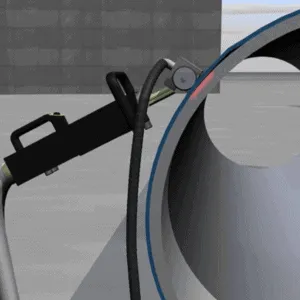
Induction Coating Removal Heater
Induction Coating Removal Heater-Induction Rust Paint Coating Removal Heating Machine
What Is an Induction Coating Removal Machine?
An induction coating removal machine is a specialized induction heating system developed for thermal coating disbonding from electrically conductive substrates such as carbon steel.
The equipment generates an alternating electromagnetic field through an induction coil. When the heating head is positioned close to a steel surface, eddy currents are induced in the substrate. Electrical resistance within the steel converts this energy into heat.
The coating itself does not need to be electrically conductive. Instead, heat generated in the underlying steel is transferred toward the coating interface, weakening adhesion and making mechanical lifting or peeling considerably easier.
This operating principle makes induction coating removal particularly useful where thick or strongly bonded industrial coatings need to be removed from steel without relying solely on blasting, grinding or high-pressure water.
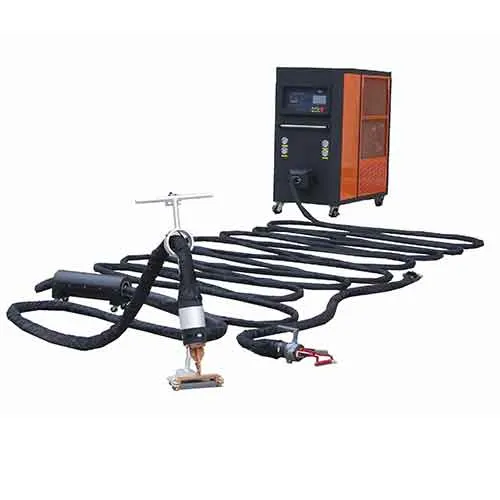
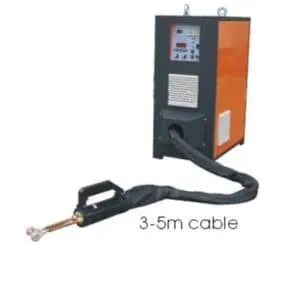
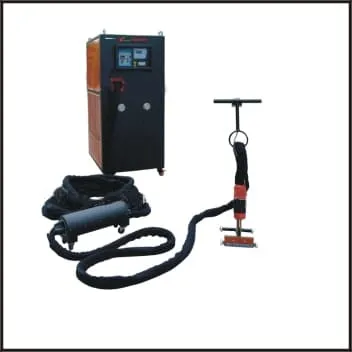
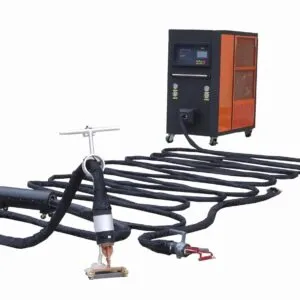
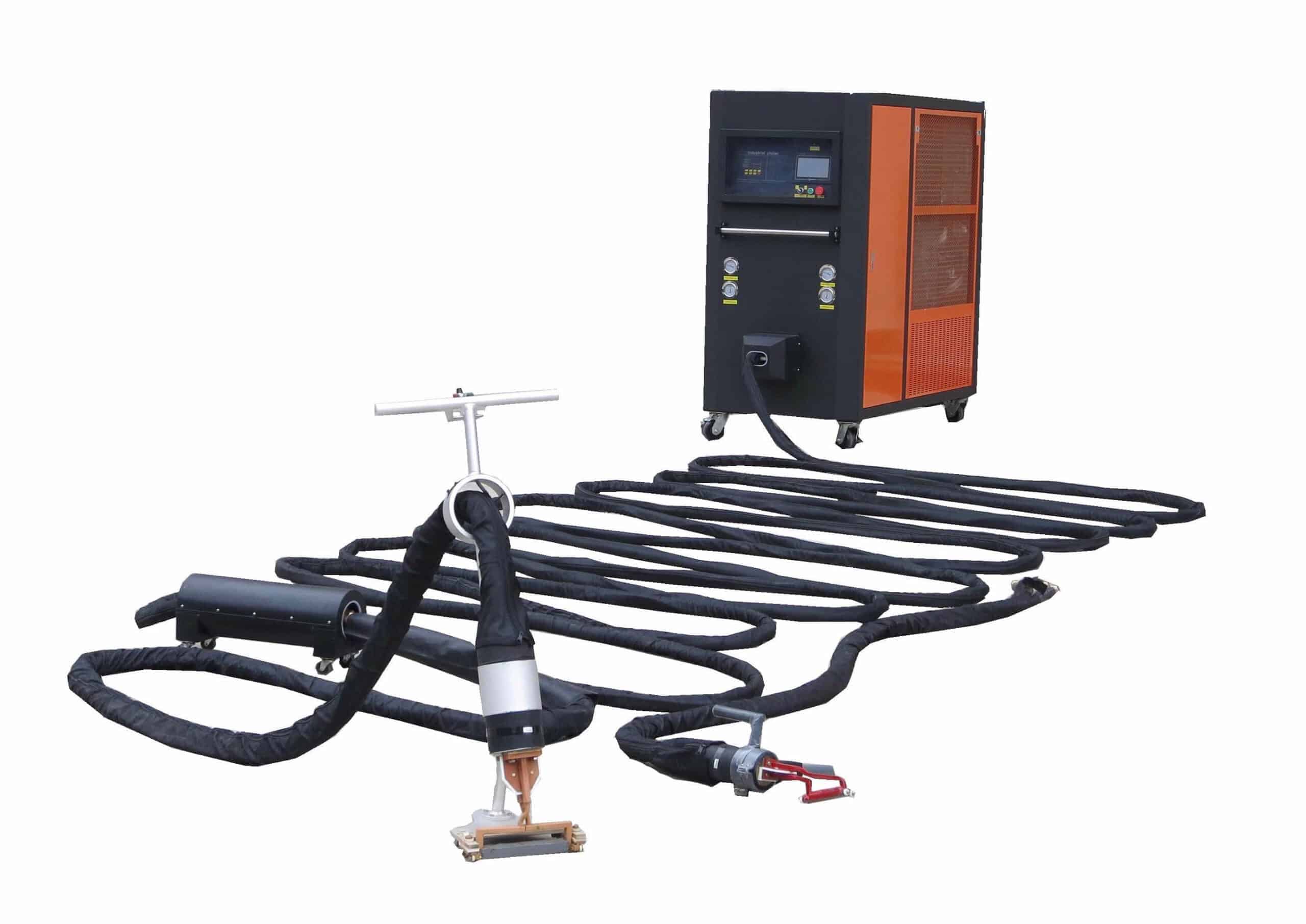
HLQ Long distance induction coating removal heater is consisted of medium frequency induction heating generator, long distance cable and hand-held heating head. Power ranges from 30 to 60KW, and output frequency 20KHz around, cable length can be 20 or 40m long. HLQ induction coating removal heater can be used for heating for coatings removing,rubber removal,paint removal,copper connector brazing, copper tube brazing, surface heating,etc.

Working theory and acteristics
HLQ induction heating machines adopt series oscillating circuit, inverting high frequency power is output through transformer and oscillating cap to the heating head, and then output to coil for heating.
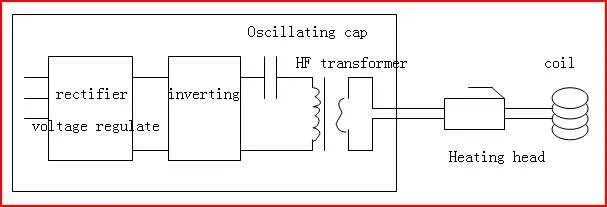
In HLQ induction coating removal heaters, our latest third generation inverting and adjust technologies are adopted to realize soft switching of the IGBT components and independent adjusting of the power and frequency, so as to reach a marvelous heating feature of the machine.
| Model | DWS-25P | DWS-30P | DWS-60P | |
| Max input power | 25kw | 30kw | 60kw | |
| Length of heating head | 20M | 20-40M | ||
| Output frequency | 20-50KHz | |||
| Output current | 5~45A | 6-54A | 12-108A | |
| Output voltage | 70~520V | |||
| Input voltage | 380V,3phases,50/60Hz | |||
| Duty cycle | 50% | |||
| Cooling water | ≥0.5MPa ≥30L/min | |||
| Inner water chiller | Yes | |||
| Weight | Generator | 280KG | 316KG | 580KG |
| Heating head | 2.2KG | 2.7KG | 4.5KG | |
| Size/cm | Generator | 103L×750W×156.6H | 103L×750W×156.6H | 70L×40W×103.5H |
| Heating head | Ф6.5×16.5L | Ф8×18.5L | Ф11.8×24L | |
How induction coating removal | Induction Stripping Works?
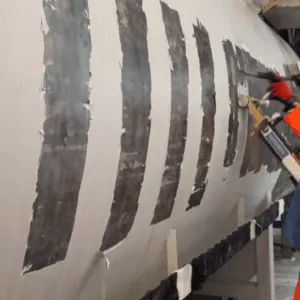
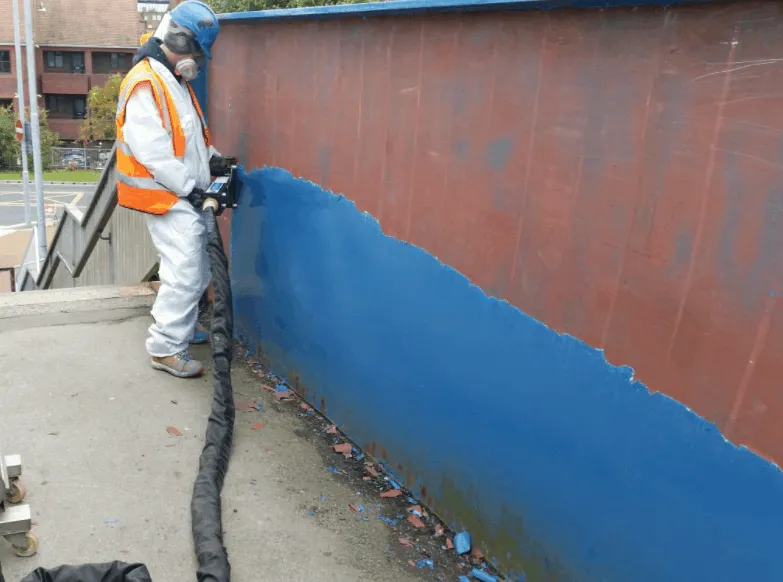
induction coating removal | Induction stripping is a hot surface preparation process.An induction heating generator sends alternating current through an induction coil, which generates an electromagnetic field. This field induces currents that are converted into heat in contact with conducting materials such as steel. The heat is generated beneath the coating, causing the coating to peel rapidly. This method is suitable for treating flat or curved surfaces on the jobsite and does not require any confinement.
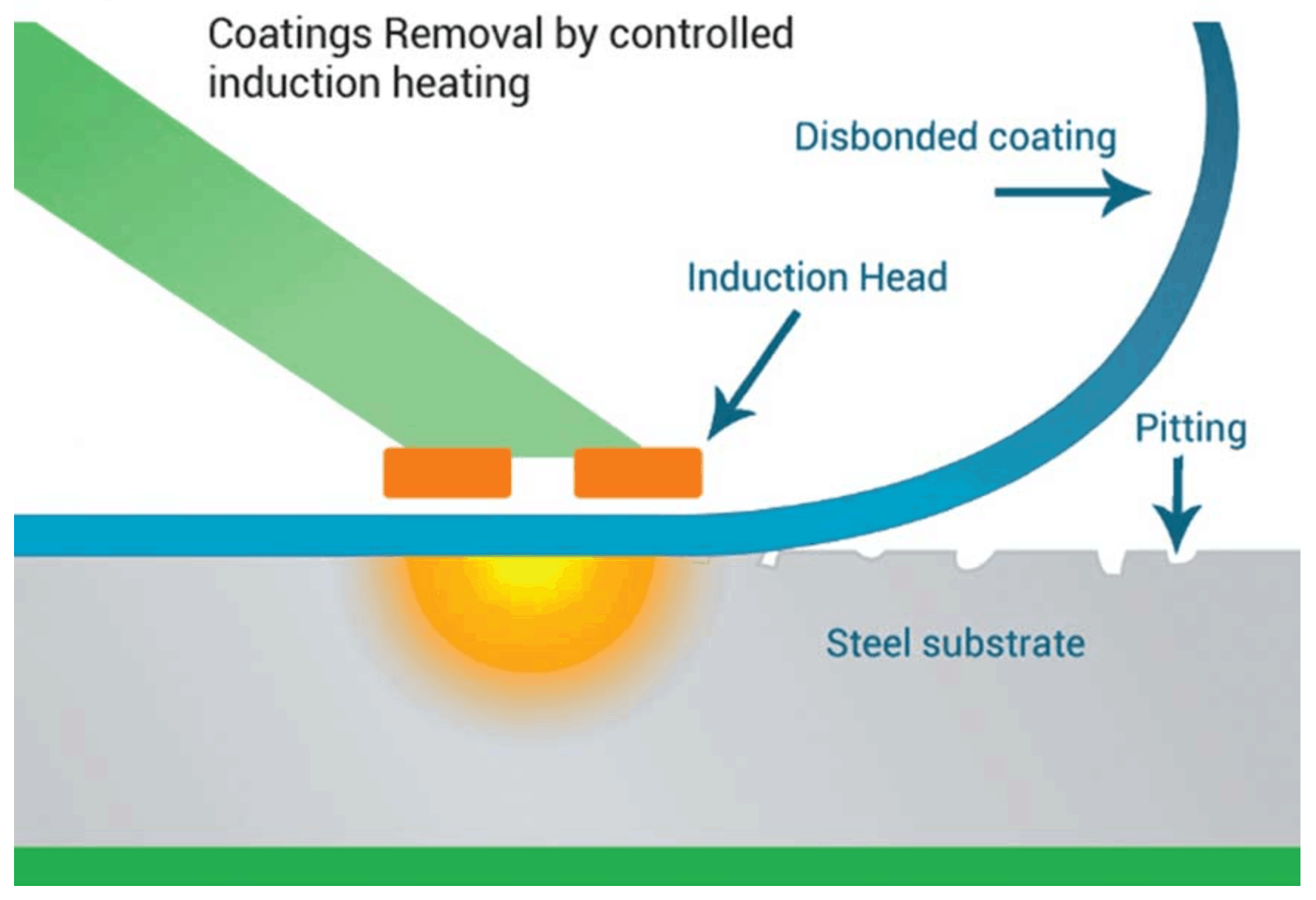
The induction coating removal|induction stripping system will strip paint, other coatings, heavy rust, bacterial corrosion and oil and grease electrically conductive surfaces (ferromagnetic steel) breaking the interfacial bonding between the material and the substrate etch residues, induction heating localized and controlled which consumes minimal energy.
HLQ simplifies your coatings removal needs with yet another revolutionary technology: Induction Stripping! HLQ’s induction stripping equipment removes your toughest coatings from steel structures with no noise or secondary waste—getting right down to the steel.
If you have ever wished for a magic wand to solve your coatings removal headaches, HLQ has the next best thing. HLQ technician can wave our induction wand over your coating catastrophe and dis-bond some of the hardest to remove coatings at rates that are up to 10 times faster than competing technologies like sandblasting.It’s not magic, but our induction stripping technology is a close second! When HLQ technicians move our induction head over a steel surface, it creates sufficient heat (typically 300 to 400 degrees) to quickly unbond most coatings from tanks, tankers, pipelines, ships and offshore platforms, allowing coatings (up to 1-inch thick) to be removed in sheets.
RPR Heat Induction Coating Removal
RPR Heat Induction coating removal works by the principle of induction. Heat is generated in the steel substrate and the bond at the steel and coating interface is broken. The coating is then removed entirely without disintegrating and completely free from contaminating agents, i.e.. blast media. This makes disposal and recycling of waste easier and more cost effective.
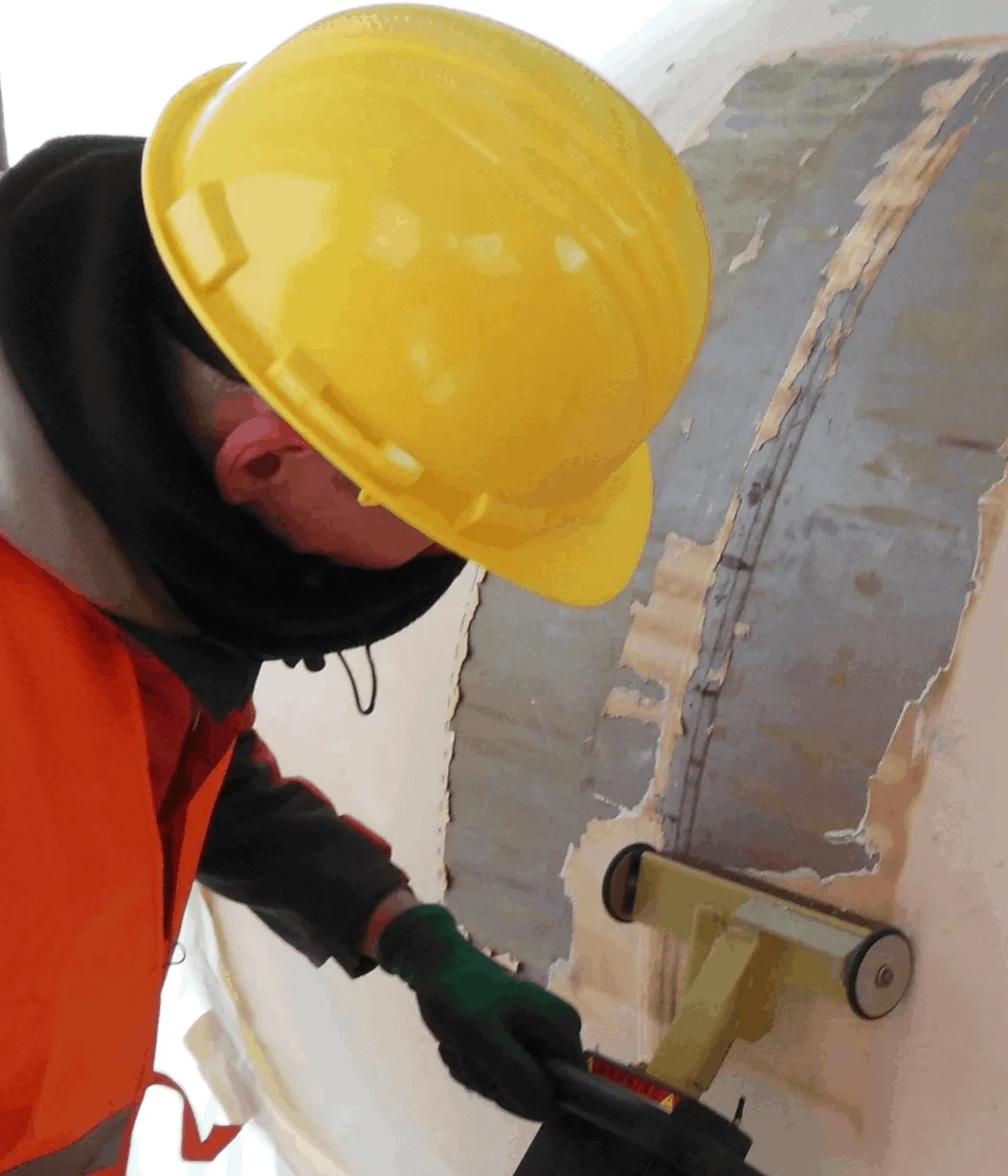
With minimum power consumption even the thickest and hardest coatings can be completely removed. RPR Heat Induction is faster than conventional methods. A silent method of coating removal means that our engineers can operate day or night with no noise pollution.
Because of the many advantages of our induction heating process, we’ve been able to provide a wide range of Alliance customers with the service they need. We’ve worked with customers in industries such as:
- Oil & gas
- Financial
- Food & beverage processing
- Retail and food services
- Marine
- Hotels & hospitality
- Commercial pools and aquariums
HLQ’s jaw-dropping induction dis-bonding process removes most coating types, including:
- Coal Tar Epoxy
- Polyethylene
- Fiberglass
- Anti-skid
- Rubber
- Chartek fireproofing or other intumescent coatings
Faster, Quieter, Cleaner, Safer Surface Preparation
A faster, safer and cleaner method for removing industrial coatings from steel surfaces.
Some might say induction stripping is the “quick and dirty” way to get the job done, but truthfully it’s quick, and not messy at all. Because induction stripping creates no secondary waste, cleanup is simplified. Dealing with sheets or strips of coating is infinitely easier than dealing with blast media and dust.
In many cases, containment can be simplified or eliminated altogether. Imagine eliminating a costly scaffolding and containment project and replacing it with a snorkel lift and a drop cloth!
Other trades can work in close proximity to HLQ’s induction stripping activities because it is a very quiet process that will not create obnoxious noises that disrupt the productivity of other contractors you may have working on your project.
Our induction stripping equipment has no moving parts, making our process much safer than hydro-blasting or sandblasting for your employees, other contractors, customers and passersby.

RPR induction removes paint, coatings, thick rust, bacterial corrosion and oil & grease residues from electrically conductive surfaces (steel, etc.) by breaking the interfacial bonding between the material to be removed and the substrate using controlled, localized induction heating with a mini- mum consumption of energy.
The induction heating principle
The RPR induction generator sends alternating current through an induction heating coil, which gener- ates an electro-magnetic field. This magnetic field induces eddy currents in a conductive mate- rial like steel. Due to the resistance of the steel, these currents are converted to heat = induction heating. The heat is generated below the coat- ing, resulting in quick and clean disbonding.
RPR Heat Induction works by the principle of induction. Heat is generated in the steel substrate and the bond at the steel and coating interface is broken. The coating is then removed entirely without disintegrating and completely free from contaminating agents, i.e.. blast media. This makes disposal and recycling of waste easier and more cost effective.
 With minimum power consumption even the thickest and hardest coatings can be completely removed. RPR Heat Induction heating is faster than conventional methods. A silent method of coating removal means that our engineers can operate day or night with no noise pollution.
The RPR system is ideal for the removing paint, rust, and other coatings (vulcanized rubber, fire protectant, epoxies, etc. with control possibili- ties for the following functions:
• Energy consumption
• Disbonding temperature range
• Heat penetration
• Removal speed
With above setting possibilities, RPR delivers unequalled performance and is the system of choice for cost-effective, safe and environmentally friendly surface coating removal from steel substrates.
RPR is ideal for: marine, tanks, offshore and land-based pipelines
What Coatings Can Be Removed by Induction Heating?
Induction thermal disbonding can be considered for many coatings bonded to conductive steel substrates. Typical examples include:
- Industrial paint systems
- Epoxy coatings
- Coal-tar epoxy coatings
- Polyethylene coatings
- Pipeline protective coatings
- Rubber linings
- Anti-skid coatings
- Fiberglass-reinforced coating systems
- Fire-protective and intumescent coatings
- Corrosion-protection coating systems
- Heavy protective coatings on tanks and steel structures
The feasibility and operating parameters should always be evaluated according to coating chemistry, coating thickness, substrate thickness, substrate temperature limits and the requirements of the subsequent surface-preparation process.
Induction Paint Removal from Steel Surfaces
Paint removal from large steel structures is one of the most common applications of induction disbonding technology.
Instead of mechanically cutting through every coating layer, an induction heating head moves over the coated steel surface. Heat develops underneath the coating and reduces adhesion at the steel/coating interface.
The operator can then remove the loosened coating using a suitable scraper or peeling method.
This approach is particularly attractive for:
- Large carbon-steel surfaces
- Thick multi-layer coating systems
- Localized repair zones
- Maintenance projects requiring controlled heat input
- Applications where reducing abrasive media is desirable
Pipeline Coating Removal with Induction Heating
Pipeline repair and rehabilitation frequently require the removal of external coatings before inspection, welding, cut-back preparation, recoating or maintenance.
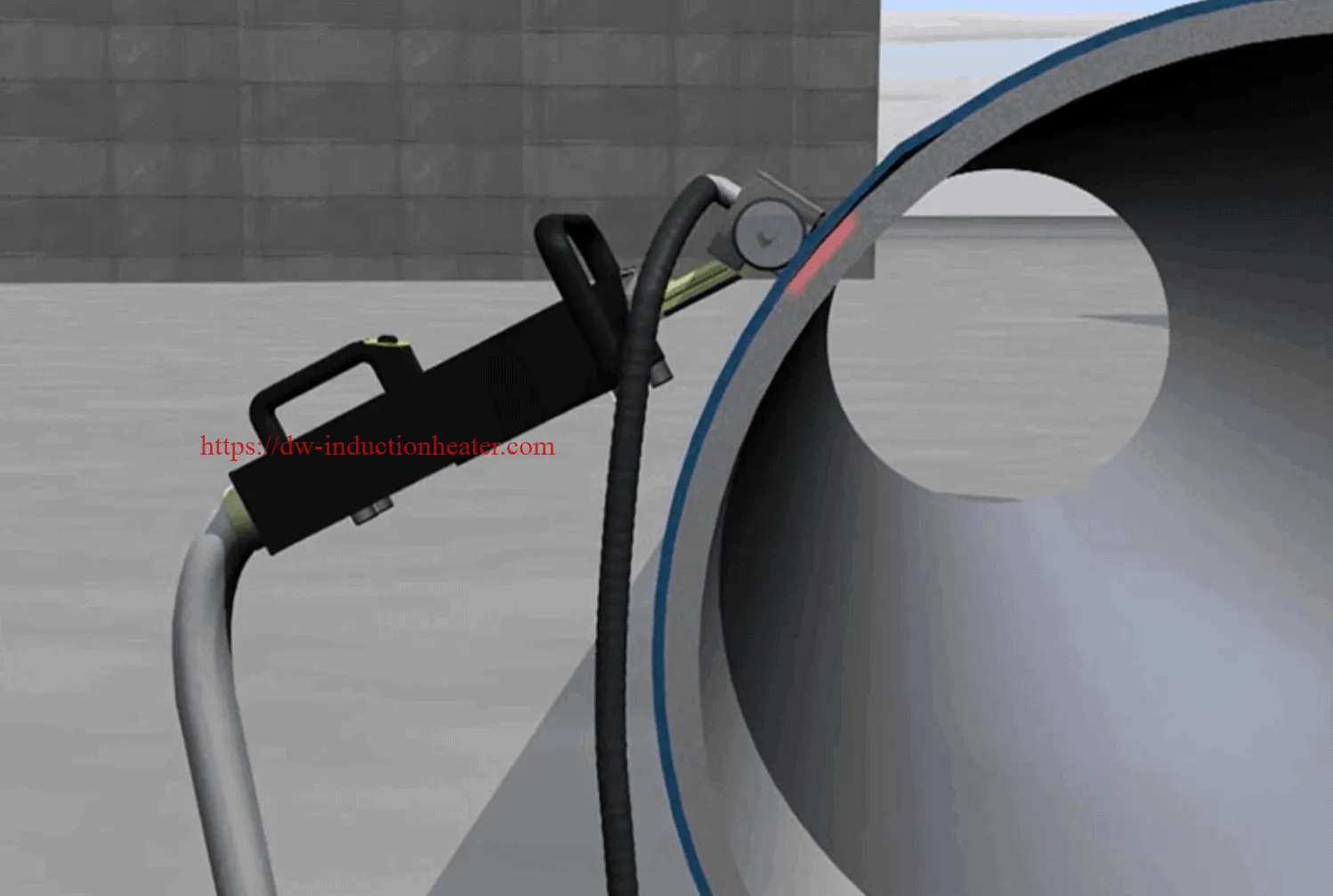
The induction coating removal process can be adapted to curved pipe surfaces by designing the heating head and coil geometry around the pipe diameter and coating configuration.
Typical pipeline coating-removal applications may include:
- Pipeline coating cutback
- Repair-zone coating removal
- External pipeline rehabilitation
- Weld-area preparation
- Inspection-zone preparation
- Epoxy coating removal
- Polyethylene coating removal
- Thick protective coating removal
3LPE and Polyethylene Pipeline Coating Removal
Three-layer polyethylene (3LPE) pipeline systems normally contain an epoxy layer, adhesive layer and polyethylene outer layer. Their combination can make conventional removal labor-intensive, particularly when localized removal is required.
Induction heating can transfer energy through the coating toward the steel interface. Controlled heating helps reduce the interfacial bond, after which the coating layers can be mechanically removed.
For 3LPE applications, the optimum heating parameters must be determined from pipe diameter, wall thickness, coating thickness, coating condition and the required removal width.
Epoxy Coating Removal from Steel
Epoxy coatings are widely used for corrosion protection because of their strong adhesion to steel. The same adhesion that provides good protection can make maintenance removal difficult.
RPR Heat Induction coating removal generates heat within the steel substrate, concentrating thermal energy close to the epoxy/steel interface.
This can assist in disbonding thick industrial epoxy coatings while reducing dependence on abrasive removal techniques.
Rubber Lining Removal by Induction Heating
Rubber linings are commonly bonded to steel in tanks, vessels, mining equipment and industrial process systems.
Where the steel substrate is accessible to the electromagnetic field, induction heating can be used to heat the metal beneath the rubber. The resulting interface temperature weakens the adhesive bond and can make mechanical separation easier.
A suitable coil and heating-head design is essential because rubber thickness and steel geometry vary significantly between applications.
Applications of an Induction Coating Removal Heater
Industrial induction coating-removal systems can be applied across a wide range of maintenance and refurbishment projects.
Pipeline Maintenance
For removing external coatings from carbon-steel pipelines before inspection, repair, welding or recoating.
Storage Tanks
For localized or large-area removal of protective coatings from steel tank walls, roofs and other accessible surfaces.
Shipbuilding and Marine Maintenance
For removing bonded coatings from steel decks, hull sections and structural components where controlled localized heating is suitable.
Offshore Structures
For maintenance of coated steel components on offshore platforms and related oil-and-gas infrastructure.
Industrial Steel Structures
For stripping paint and corrosion-protection systems from beams, plates, frames and fabricated steel components.
Mining and Heavy Equipment
For removal of selected rubber linings and protective coating systems from conductive steel components.
Induction Coating Removal vs. Abrasive Blasting
| Factor | Induction Coating Removal | Abrasive Blasting |
|---|---|---|
| Primary mechanism | Thermal disbonding at steel/coating interface | Mechanical abrasion |
| Energy location | Generated directly in conductive substrate | Applied to coating surface |
| Abrasive media | Not required for the induction-disbonding stage | Normally required |
| Coating waste | May often be removed in larger pieces or strips | Typically mixed with spent abrasive media |
| Dust generation | Low from the induction process itself | Can be significant without containment |
| Localized treatment | Highly suitable | Possible but requires blasting control |
| Suitable substrate | Electrically conductive metal, especially steel | Broad range of surfaces |
The two technologies can also complement one another. Induction may be used first to remove the bulk coating, followed by another surface-preparation process when a specified surface cleanliness or profile is required before recoating.
Key Advantages of Induction Coating Disbonding
- Localized heating: Energy is concentrated in the conductive substrate close to the coating interface.
- Non-contact energy transfer: The induction coil does not rely on direct flame heating.
- Controlled heat input: Power and travel speed can be adjusted according to the application.
- No abrasive media required for disbonding: This can simplify handling of coating-removal waste.
- Suitable for thick coatings: Particularly useful for strongly bonded industrial coating systems.
- Reduced process noise: The induction heating stage does not require high-velocity abrasive blasting.
- Flexible field operation: Long cables allow the handheld heating head to operate some distance from the generator.
- Flat and curved surfaces: Customized induction heads can be developed for plates, tanks and pipelines.
Induction Heating Principle for Coating Removal
The basic induction heating principle is based on electromagnetic energy transfer.
An alternating electrical current passes through an induction heating coil, producing a rapidly changing magnetic field. When conductive steel enters this field, eddy currents are generated within the material.
Because steel has electrical resistance, these currents generate heat directly inside the workpiece.
For coating removal, the objective is not to heat the entire steel structure uniformly. Instead, the induction head moves across the surface so that a controlled zone beneath the coating receives sufficient heat to reduce adhesion.
This localized energy delivery is one of the principal differences between induction disbonding and conventional external heating methods.
How to Select the Right Induction Coating Removal Machine
To select a suitable system, provide the following technical information:
- Substrate material: carbon steel, stainless steel or another metal.
- Steel thickness: influences heating response and energy requirement.
- Coating type: epoxy, rubber, polyethylene, paint, fireproofing, etc.
- Coating thickness: preferably in millimeters.
- Workpiece geometry: flat plate, pipe, tank, curved surface or irregular structure.
- Pipe diameter: if the application involves pipeline coating removal.
- Required stripping width: determines heating-head and coil design.
- Required productivity: square meters per hour or linear meters per hour.
- Working distance: determines cable requirements.
- Site power supply: voltage, frequency and phase.
With these parameters, HLQ can select an appropriate generator power level and design the induction heating head for the specific coating-removal application.
Why Heating-Head and Coil Design Matters
The induction generator alone does not determine performance. The heating head and coil determine how the electromagnetic field couples with the steel surface.
Important design variables include:
- Coil-to-surface distance
- Effective heating width
- Pipe curvature
- Steel thickness
- Required heat penetration
- Travel speed
- Cooling-water flow
- Coating removal pattern
A flat steel plate may use a different heating-head geometry from a large-diameter pipeline. Customized coil design is therefore an important part of optimizing an induction coating-removal system.
Process Workflow for Induction Coating Removal
- Identify the coating material and substrate.
- Measure coating thickness and steel thickness.
- Select the induction power level and heating-head design.
- Set suitable heating power and operating parameters.
- Position the induction head over the coated steel.
- Move the heating head at a controlled travel speed.
- Allow the interface bond to weaken.
- Mechanically lift or peel the loosened coating.
- Inspect the exposed steel substrate.
- Perform any additional surface preparation required by the recoating specification.
RPR Induction Coating Removal for Industrial Surface Preparation
The term RPR induction coating removal is commonly associated with using electromagnetic induction to thermally disbond industrial coatings from conductive metal substrates.
Rather than pulverizing the coating, the objective is to weaken adhesion at the substrate interface so that the coating can be separated more efficiently.
The process is particularly relevant to industrial assets where coating removal is part of inspection, corrosion control, repair or recoating operations.
For a more detailed explanation of the underlying technology, see our guide to Induction heating.
Frequently Asked Questions About Induction Coating Removal
What is an induction coating removal heater?
An induction coating removal heater is an electromagnetic heating system designed to generate localized heat in a conductive metal substrate. The heat reduces the bond between the substrate and the coating, helping operators remove paint, epoxy, rubber and other bonded coating systems.
Can induction heating remove paint from steel?
Yes. Carbon steel is particularly suitable for induction heating. Heat generated beneath the paint layer can weaken adhesion and assist mechanical removal.
Can induction heating remove epoxy coating?
It can be suitable for many industrial epoxy coatings bonded to steel. Actual performance depends on epoxy chemistry, coating thickness, steel thickness and operating parameters.
Can induction remove rubber from steel?
Induction heating can be used to heat the steel beneath bonded rubber linings, helping weaken the interface. The appropriate process depends on rubber thickness, adhesive system and steel geometry.
Can an induction coating removal machine be used on pipelines?
Yes. Pipeline coating removal is an important application. Heating-head geometry can be adapted to different pipe diameters and required stripping widths.
Can it remove 3LPE pipeline coating?
Induction heating can be applied to localized removal of multi-layer pipeline coating systems such as 3LPE when the underlying steel can be effectively coupled to the induction field. Process settings should be established for the specific pipe and coating construction.
What power is available?
The current HLQ DWS range shown on this page includes 25kW, 30kW and 60kW induction coating-removal configurations.
How long can the heating cable be?
The existing configurations shown on this page use long-distance heating-head cables, including approximately 20m and 20–40m options depending on model.
Does induction coating removal generate heat in the coating?
The primary induction heating effect occurs in the conductive metal substrate. Heat is then transferred toward the coating/substrate interface, where it assists disbonding.
Does induction stripping completely replace surface preparation?
Not necessarily. Induction is highly effective for bulk coating disbonding, but the final surface cleanliness and profile required for a new coating system may require an additional preparation step according to the applicable coating specification.
What information is required for a quotation?
Please provide the substrate material, steel thickness, coating type, coating thickness, workpiece dimensions or pipe diameter, required removal width, desired productivity, available electrical supply and required working cable length.
Induction Coating Removal Heater Manufacturer
HLQ Induction Equipment supplies induction heating systems for industrial heating and surface-treatment applications. For coating-removal projects, equipment can be configured according to power requirement, workpiece geometry, coating type, heating-head design and operating distance.
For pipelines, tanks, steel structures, marine equipment, offshore installations or other industrial coating-removal applications, send us your technical parameters so that the appropriate generator and heating-head configuration can be evaluated.
Recommended information for technical evaluation: substrate material, substrate thickness, coating type, coating thickness, workpiece size, required stripping width, expected production rate, power supply and working-site conditions.