
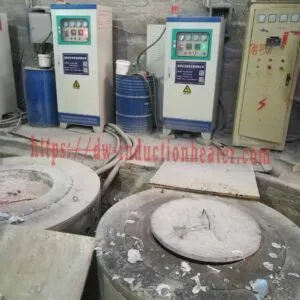
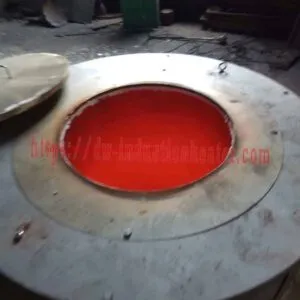
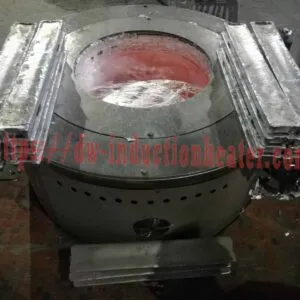
Melting Aluminum Furnace
Melting Aluminum Furnace – SMJD Induction Melting, 150 to 1,200 kg Capacity
Quick Answer
The melting aluminum furnace described here is the HLQ SMJD series: an electric crucible induction furnace that melts an aluminium charge from solid to a molten bath and then holds that bath at the pouring temperature while metal is cast. It is supplied as a complete cell – IGBT or KGPS power supply, capacitor cabinet, furnace body with a water-cooled copper coil, crucible and lining, hydraulic tilting frame, water-cooled cable, water distributor and control cabinet – and it is the same machine on which HLQ publishes a full parameter sheet and an operating manual.
The published aluminium capacity is 150 kg to 1,200 kg per batch, from a 60 kW SMJD-480 to a 200 kW SMJD-3100. Output power runs 60-200 kW, input current 90-300 A, the supply is 3-phase 380 V, 50-60 Hz with neutral, and the oscillation band is 1 kHz to 100 kHz, customisable to the customer request. Pure aluminium melts at 660.32 °C and is normally held at 680-760 °C for casting. The furnace rating is 1800 °C.
Thirteen model entries are published, and SMJD-1250 appears twice – at 80 kW and at 120 kW – because one crucible is listed for both ratings and the two differ only in the power supply fitted.
The furnace is electric only. The product manual answers the question “Which kind of power supply do you supply? Electricity or gas?” with a single word – Electricity. There is no separate gas or oil variant in this series, so “electric” and “induction” describe one technology here, not two.
Table of Contents
- What is the Melting Aluminum Furnace?
- Key Applications
- Suitable Materials
- Working Principle
- Technical Specifications
- Recommended Model Selection
- Process Workflow
- Common Problems and Solutions
- Engineering Selection Guide
- Advantages and Limitations
- Why Choose HLQ?
- 6 Core FAQs
What is the Melting Aluminum Furnace?
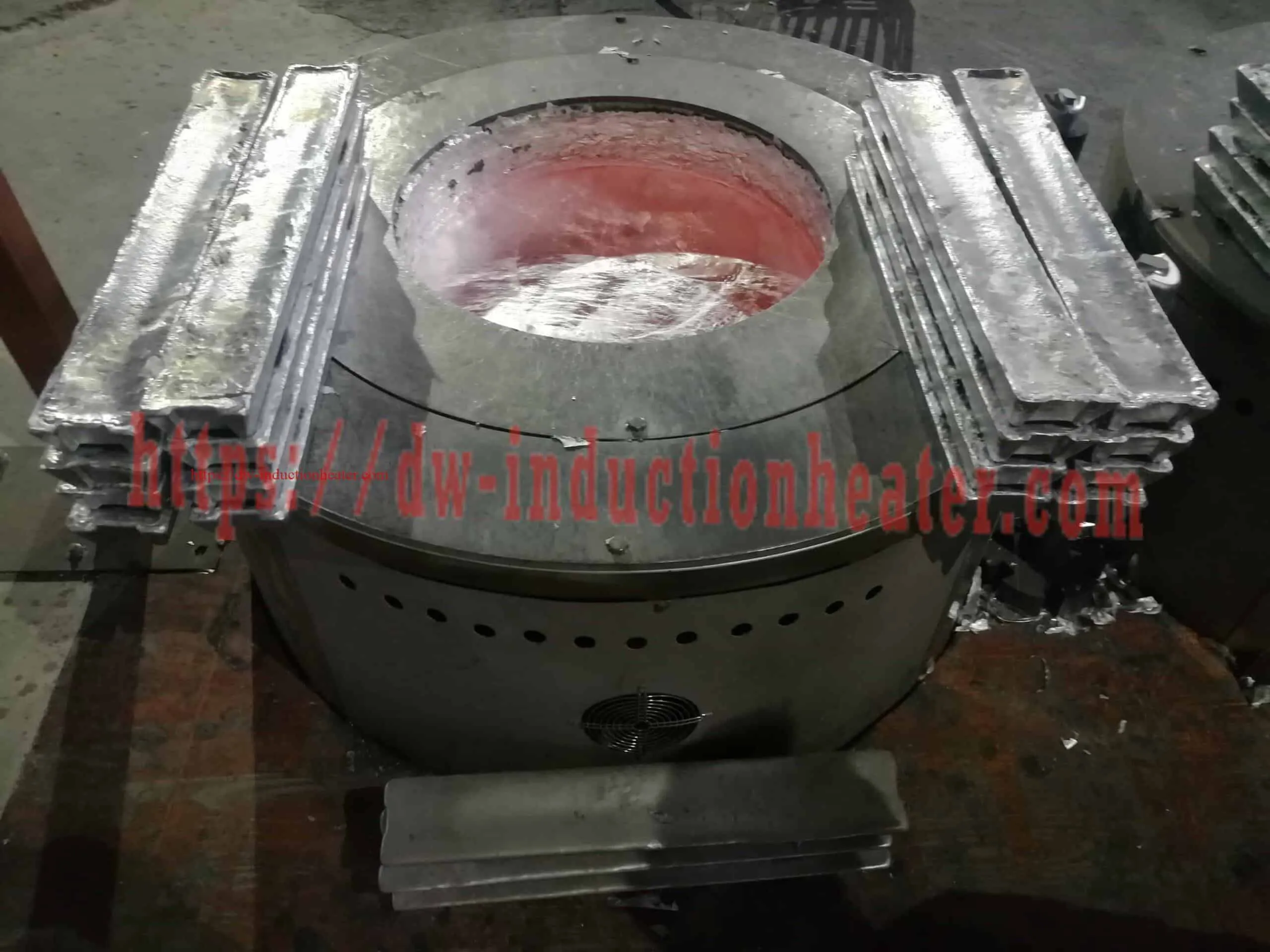
A melting aluminum furnace of this type is a crucible furnace: the metal sits inside a conducting vessel, and a coil around that vessel is driven at a medium frequency by a solid‑state power supply. The alternating field of that coil induces eddy currents in the crucible wall, the wall resists the induced current and heats, and the heat passes from the wall into the metal. There is no flame, no burner and no fuel line anywhere in the furnace body.
That arrangement suits aluminium particularly well. Aluminium is a good electrical conductor, so it heats efficiently by eddy current, and it is non‑magnetic, so there is no hysteresis heating in the way there is with steel. Its melting point is low at 660.32 °C, and once the first bath has formed the high thermal conductivity of the liquid metal moves heat quickly through the melt. The same field that does the heating also stirs the bath, so the temperature and the composition stay even across the whole pool – which is why an induction bath casts more consistently than a flame‑heated one.
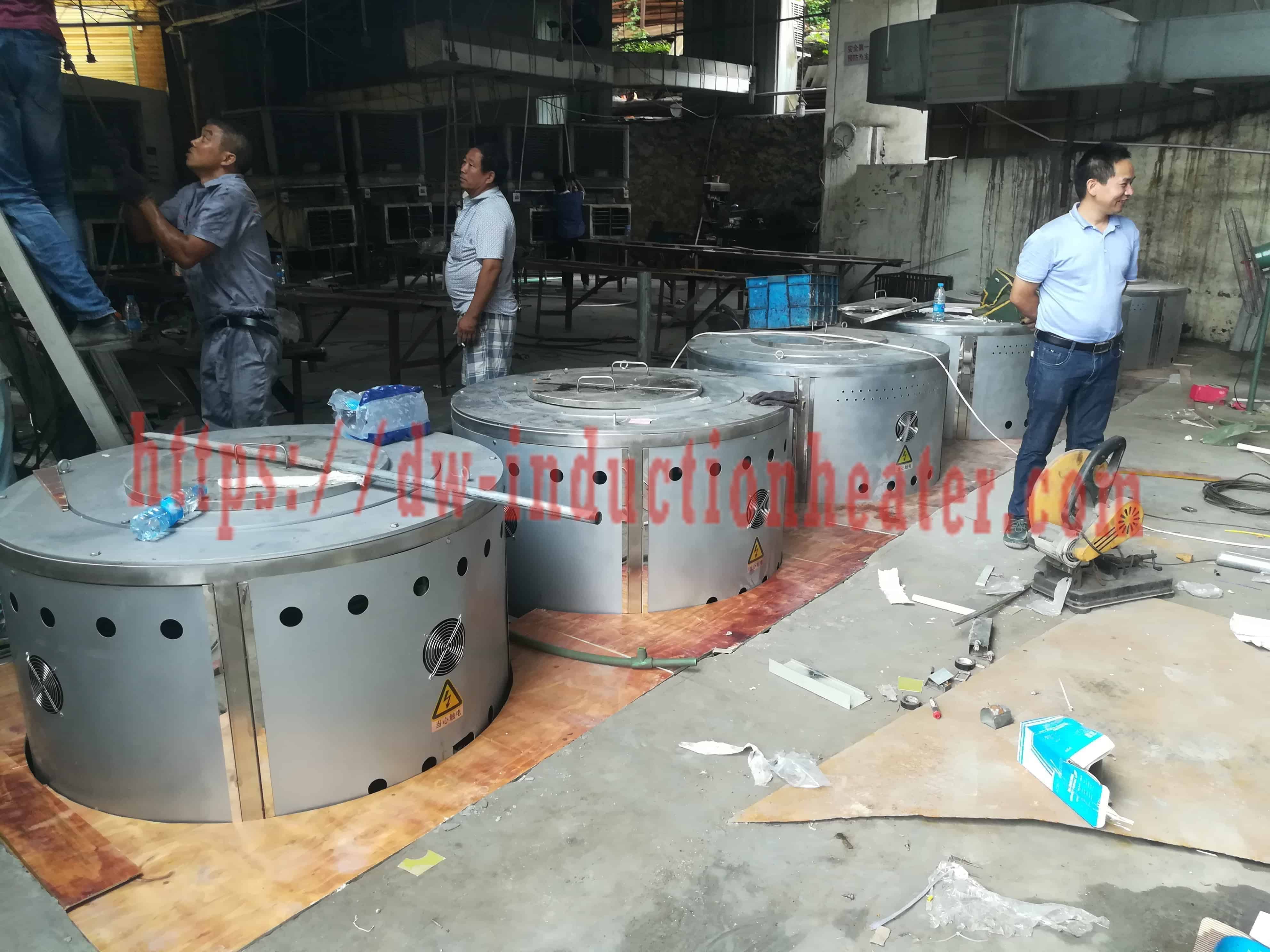
What arrives on site is not a bare furnace body. The published furnace structure lists eight components: the IF or KGPS power supply, the capacitor cabinet, the furnace body, the induction coil, the crucible and lining, the hydraulic tilting mechanism, the water‑cooled cable and the water distributor. They are built and tested as one cell, which is why the electrical, cooling and mechanical questions all have to be answered together before the model is fixed.
If the deciding factor for your installation is the frequency class rather than the supply arrangement, the mid frequency aluminum melting furnace page covers the penetration depth, the stirring behaviour and the frequency-versus-capacity ladder in more depth.

Key Applications
The published application for the SMJD series is “melting of aluminum, copper, zinc etc” – that is, metallic melting rather than primary smelting. The manual describes it as the heat treatment prior to forging, sintering and hot rolling in the casting and melting industries.
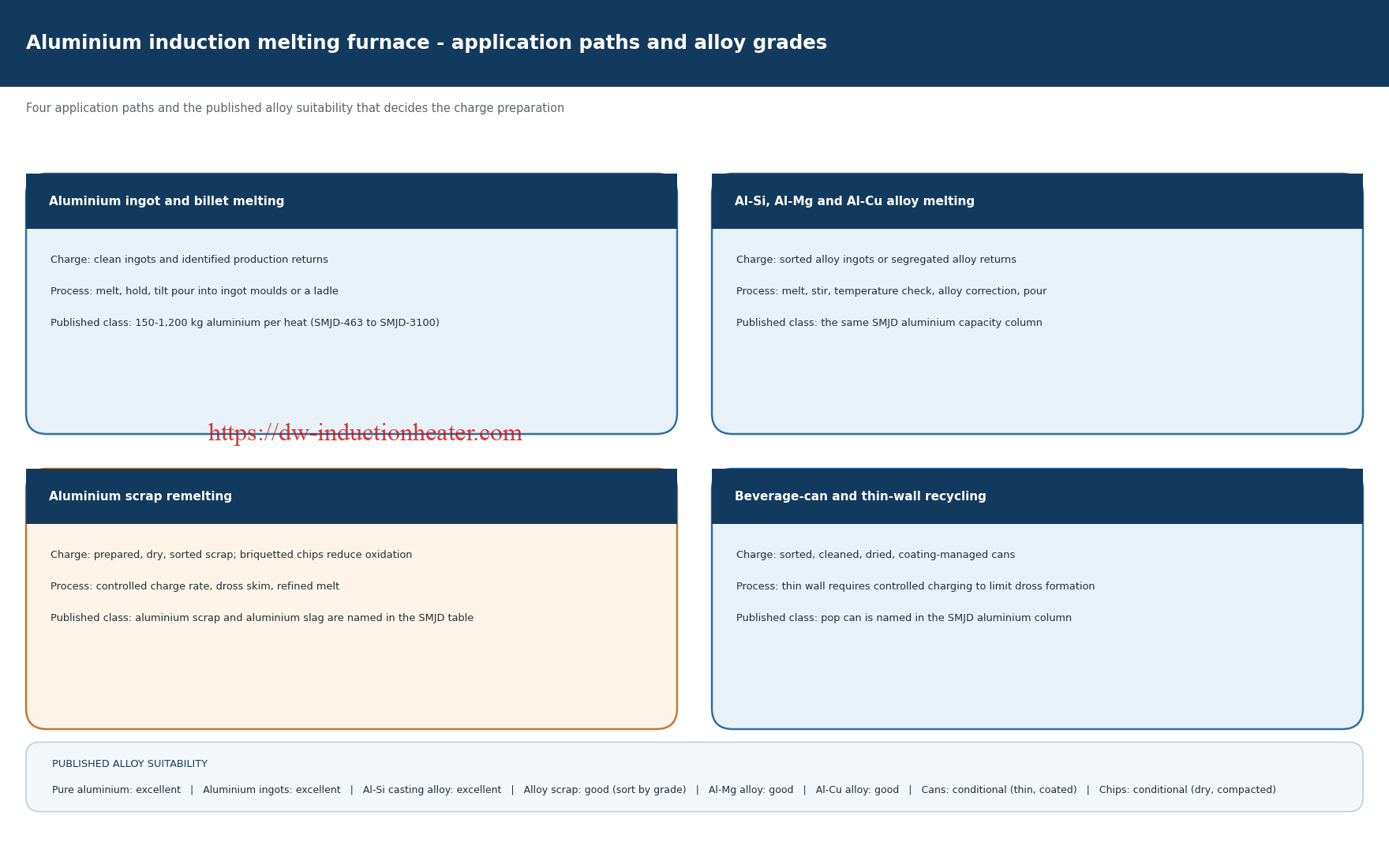
1. Aluminium ingot casting. Primary aluminium, returned ingots and clean production returns are melted and cast into ingot. This is the cleanest duty, because a dry, sorted charge gives the most predictable melt and the lowest dross.
2. Aluminium alloy remelting. Sorted alloy scrap, chips and turnings are remelted for die casting and general casting work. Published named alloys include ADC12, A356, 6061 and 7075. Dross rises quickly when thin, coated, damp or mixed material is charged, so charge preparation – clean, dry, sorted by grade, compacted where possible – governs the yield more than any furnace setting does.
3. Melting and keep-warm holding. Once the bath has formed, the output is reduced and the melt is held at the pouring temperature while the electromagnetic stirring keeps it uniform. That holding duty is what turns the machine into a working furnace rather than a batch melter, and it is the duty used for low-melting-point non-ferrous metals where the melt must stay fluid between charges.
4. Small-batch and laboratory work. For batches from 5 kg upward, HLQ publishes a separate induction melting aluminium for laboratories and small batch casting range of 15-120 kW units – the same principle and the same medium-frequency band at a smaller scale.
The wider aluminium recycling chain is covered on the aluminium smelter with induction heating page, and the remelting sequence in more detail in the aluminium scrap recycling melting process reference document.
Suitable Materials
For each model the published table gives the melting capacity in kilograms for four feed families: steel and stainless steel; copper, gold and silver scrap and slag; aluminium including aluminium alloy, aluminium scrap, aluminium slag and pop can; and the common 1800 °C furnace rating.
| Feed family | Published capacity across the SMJD series | Engineering notes |
|---|---|---|
| Pure aluminium | 150 – 1,200 kg | Excellent. Easy to melt, good fluidity, lowest dross, most predictable result. The reference charge for every model. |
| Aluminium ingots | 150 – 1,200 kg | Excellent. The recommended feedstock: stable melting and predictable composition. |
| Al-Si casting alloy (ADC12, A356) | 150 – 1,200 kg | Excellent. Die casting, automotive and general casting work. |
| Al-Mg alloy | 150 – 1,200 kg | Good. Temperature control and fluxing are needed to limit oxidation and burning loss. |
| Al-Cu alloy | 150 – 1,200 kg | Good. Temperature uniformity and alloy mixing determine the casting quality. |
| Aluminium alloy scrap | 150 – 1,200 kg | Good, if sorted by alloy grade. Mixed grades give an unstable melt composition. |
| Aluminium cans | 150 – 1,200 kg | Conditional. Thin and coated: clean, dry and charge carefully to limit dross. |
| Aluminium chips and turnings | 150 – 1,200 kg | Conditional. Dry and compacted, with oil, water and cutting fluid removed. Pre-compaction is recommended to improve yield. |
| Steel and stainless steel | 150 – 1,200 kg | Identical capacity column to aluminium in every model, but at a much higher melt temperature. |
| Copper, gold and silver scrap and slag | 500 – 3,000 kg | The middle column of the published table. Dense metals with a completely different thermal load. |
Low-melting-point non-ferrous metals such as zinc, tin and lead are melted and held on this type of furnace, and HLQ publishes a dedicated lead, tin and zinc smelting furnace for 100-5,000 kg batches. Metals such as cadmium, lead and mercury need dedicated handling, extraction and containment that a general aluminium installation is not designed for, and they are not treated as standard applications here.
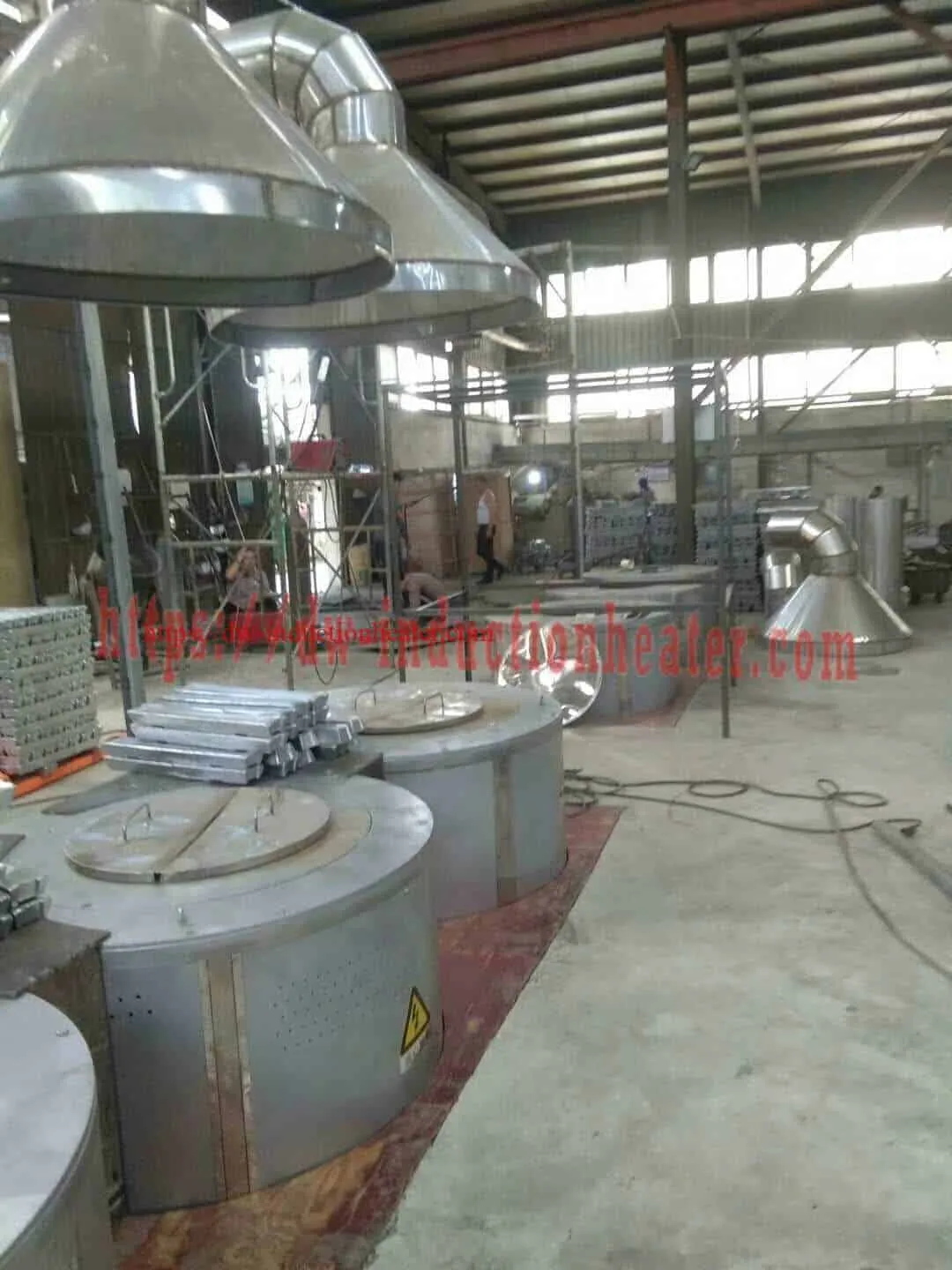
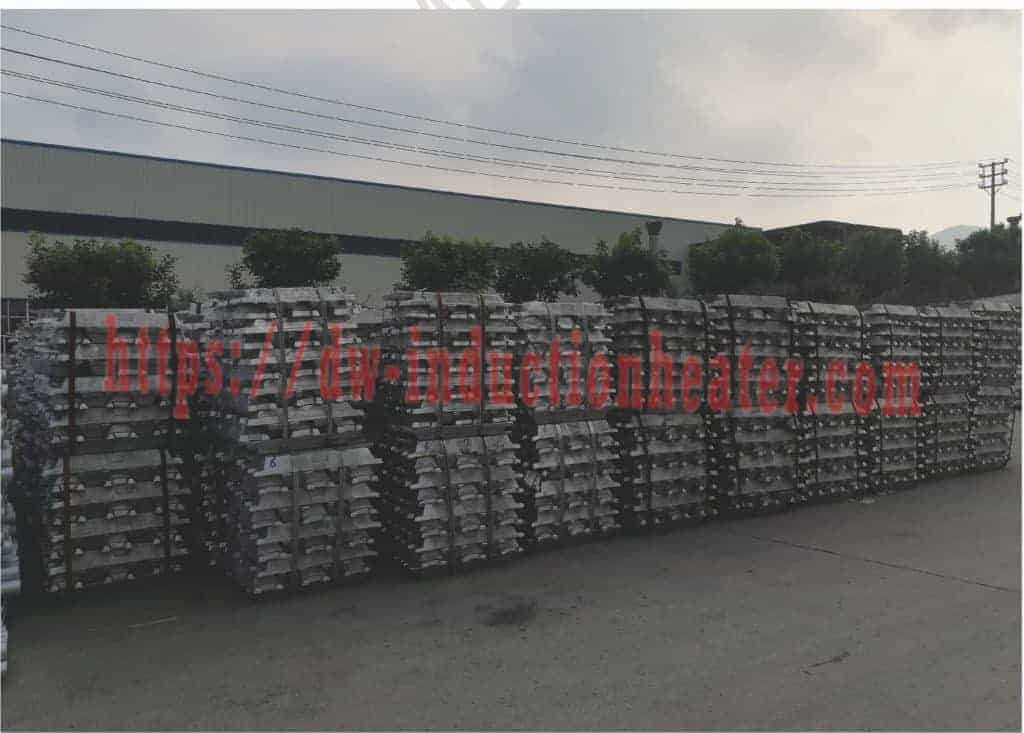
One published figure is worth stating plainly because it is quoted so often: the aluminium column starts at 150 kg, at SMJD-480. Listings that describe this machine as a 100 kg or a 1,000 kg furnace are not using the published table.

Working Principle
The published heating principle is stated in full in the product manual. Electromagnetic melting furnaces use electromagnetic induction heating to convert electrical energy into thermal energy through an induction heating controller. First, the internal rectifier filter circuit converts AC power into DC. Then the control circuit converts that DC power into high-frequency magnetic energy. A high-speed changing current through the coil produces a high-speed changing magnetic field. When the field lines pass through the crucible, numerous small eddy currents are generated inside the crucible, so that the crucible itself is heated at high speed – and the heat is transferred to the aluminium alloy, which melts into a liquid state.
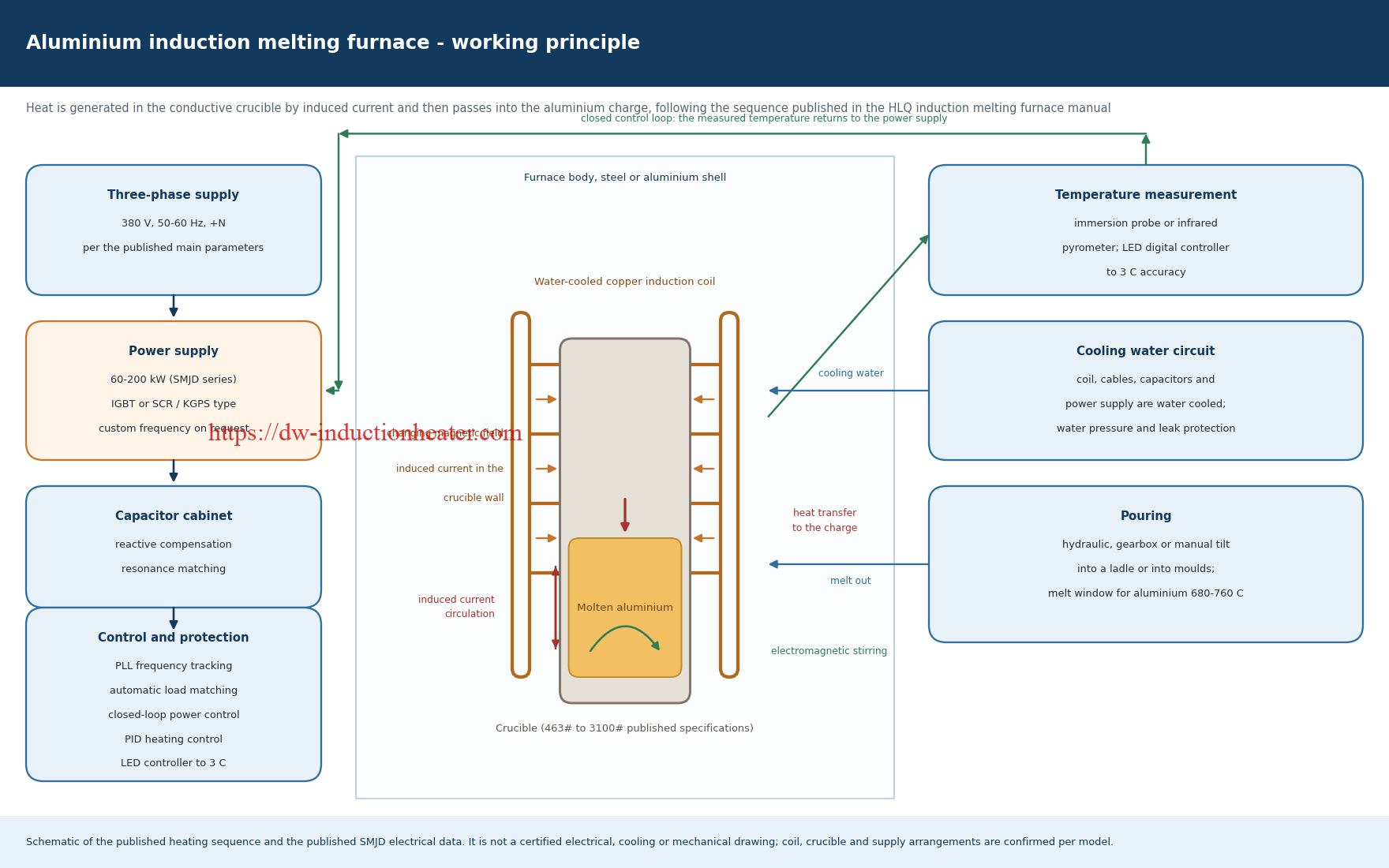
Two consequences follow from that description, and they drive every operating decision on the machine. First, heat enters the metal through the crucible wall, so the crucible grade and the wall thickness set the melt rate limit – the wall is a heat exchanger, not just a container. Second, the same alternating field stirs the bath, so temperature and composition stay even, and the melt does not need to be stirred by hand.
On the electrical side, the medium-frequency IGBT supply uses current inverting control with soft-switching resonance dual-control and frequency tracking, giving an output range of 1 kHz to 20 kHz in the standard medium-frequency series with automatic tracking across the band and no scene adjustment needed. The frequency is not a fixed property of the furnace; it is set to match the batch size and the crucible, which is why the parameter sheet quotes an oscillation band of 1 kHz to 100 kHz customisable to the customer request. A published reference for a 300 kW set gives the generator as 560 x 560 x 1,750 mm and the compensating capacitor cabinet as 1,060 x 460 x 670 mm, with constant output-voltage or constant output-power control modes and published duties of up to 500 kg for gold, silver, copper and brass, up to 200 kg for steel and stainless steel, and up to 200 kg for aluminium and aluminium alloy. The full medium frequency induction heating power supply data is published on its own page.
The frequency also sets how deep the current penetrates into the crucible wall. Using the published relation delta = 503 x square root of (rho / (mu-r x f)), with rho approximately 0.25 micro-ohm-metre for molten aluminium and mu-r = 1, the reference penetration depths for molten aluminium are approximately 4.0 mm at 4 kHz, 2.5 mm at 10 kHz, 1.8 mm at 20 kHz and 0.9 mm at 80 kHz. Lower frequency drives current deeper into the wall and suits a larger batch and a thicker crucible; higher frequency concentrates the heating near the surface and suits small batches with faster response.
Technical Specifications
The three tables below are reproduced from the published SMJD induction melting furnace parameter document. Nothing in them is estimated.
SMJD series melting capacity
| Type | Input power | Steel and stainless steel | Copper, gold, silver (scrap, slag) | Aluminium, aluminium alloy, aluminium scrap, aluminium slag, pop can | Max temperature |
|---|---|---|---|---|---|
| SMJD-463 | 60 kW | 200 kg | 500 kg | 200 kg | 1800 °C |
| SMJD-480 | 60 kW | 150 kg | 500 kg | 150 kg | 1800 °C |
| SMJD-580 | 80 kW | 200 kg | 600 kg | 200 kg | 1800 °C |
| SMJD-600 | 60 kW | 230 kg | 560 kg | 230 kg | 1800 °C |
| SMJD-900 | 120 kW | 300 kg | 900 kg | 300 kg | 1800 °C |
| SMJD-905 | 80 kW | 300 kg | 900 kg | 300 kg | 1800 °C |
| SMJD-1250 | 80 kW | 400 kg | 1,200 kg | 400 kg | 1800 °C |
| SMJD-1250 | 120 kW | 450 kg | 1,350 kg | 450 kg | 1800 °C |
| SMJD-1500 | 120 kW | 500 kg | 1,500 kg | 500 kg | 1800 °C |
| SMJD-1550 | 120 kW | 520 kg | 1,560 kg | 520 kg | 1800 °C |
| SMJD-1700 | 160 kW | 600 kg | 1,700 kg | 600 kg | 1800 °C |
| SMJD-2300 | 160 kW | 800 kg | 2,000 kg | 800 kg | 1800 °C |
| SMJD-3100 | 200 kW | 1,200 kg | 3,000 kg | 1,200 kg | 1800 °C |
The 1800 °C figure is the furnace’s maximum temperature rating, not an aluminium melt temperature. Aluminium melts at 660.32 °C and is normally held at 680-760 °C for casting.
SMJD series main technical parameters
| Type | Output power | Input current | Input voltage | Oscillation frequency |
|---|---|---|---|---|
| SMJD-463 | 60 kW | 90 A | 3-phase 380 V, 50-60 Hz +N | 1 kHz – 100 kHz, custom frequency per customer request |
| SMJD-480 | 60 kW | 90 A | 3-phase 380 V, 50-60 Hz +N | 1 kHz – 100 kHz, custom frequency per customer request |
| SMJD-580 | 80 kW | 120 A | 3-phase 380 V, 50-60 Hz +N | 1 kHz – 100 kHz, custom frequency per customer request |
| SMJD-600 | 60 kW | 90 A | 3-phase 380 V, 50-60 Hz +N | 1 kHz – 100 kHz, custom frequency per customer request |
| SMJD-900 | 120 kW | 180 A | 3-phase 380 V, 50-60 Hz +N | 1 kHz – 100 kHz, custom frequency per customer request |
| SMJD-905 | 80 kW | 120 A | 3-phase 380 V, 50-60 Hz +N | 1 kHz – 100 kHz, custom frequency per customer request |
| SMJD-1250 | 80 kW | 120 A | 3-phase 380 V, 50-60 Hz +N | 1 kHz – 100 kHz, custom frequency per customer request |
| SMJD-1250 | 120 kW | 180 A | 3-phase 380 V, 50-60 Hz +N | 1 kHz – 100 kHz, custom frequency per customer request |
| SMJD-1500 | 120 kW | 180 A | 3-phase 380 V, 50-60 Hz +N | 1 kHz – 100 kHz, custom frequency per customer request |
| SMJD-1550 | 120 kW | 180 A | 3-phase 380 V, 50-60 Hz +N | 1 kHz – 100 kHz, custom frequency per customer request |
| SMJD-1700 | 160 kW | 240 A | 3-phase 380 V, 50-60 Hz +N | 1 kHz – 100 kHz, custom frequency per customer request |
| SMJD-2300 | 160 kW | 240 A | 3-phase 380 V, 50-60 Hz +N | 1 kHz – 100 kHz, custom frequency per customer request |
| SMJD-3100 | 200 kW | 300 A | 3-phase 380 V, 50-60 Hz +N | 1 kHz – 100 kHz, custom frequency per customer request |
SMJD series crucible specification
| Type | Specification | Upper mouth outer diameter A (+/-10 mm) | Upper mouth inner diameter B (+/-5 mm) | Bottom outer diameter C (+/-10 mm) | Total height H (+/-10 mm) |
|---|---|---|---|---|---|
| SMJD-463 | 463# | 565 mm | 500 mm | 310 mm | 617 mm |
| SMJD-480 | 480# | 510 mm | 420 mm | 400 mm | 710 mm |
| SMJD-580 | 580# | 420 mm | 360 mm | 300 mm | 840 mm |
| SMJD-600 | 600# | 620 mm | 525 mm | 620 mm | 470 mm |
| SMJD-900 | 900# | 520 mm | 425 mm | 510 mm | 960 mm |
| SMJD-905 | 905# | 620 mm | 530 mm | 620 mm | 650 mm |
| SMJD-1250 | 1250# | 620 mm | 535 mm | 620 mm | 850 mm |
| SMJD-1500 | 1500# | 735 mm | 640 mm | 460 mm | 900 mm |
| SMJD-1550 | 1550# | 775 mm | 682 mm | 400 mm | 750 mm |
| SMJD-1700 | 1700# | 610 mm | 500 mm | 610 mm | 1,200 mm |
| SMJD-2300 | 2300# | 880 mm | 775 mm | 355 mm | 1,000 mm |
| SMJD-3100 | 3100# | 780 mm | 645 mm | 780 mm | 1,400 mm |
Note on the fill limit: the schedule above gives the physical vessel, and the capacity in the first table is the working charge. Confirm the maximum safe fill for the specific vessel with HLQ before the first charge, and never charge above the fill line with cold metal.
Control, protection and construction
| Function | Published specification |
|---|---|
| Power device | IGBT |
| Frequency control | Digital phase-locked-loop tracking with automatic load impedance matching |
| Power control | Closed-loop power control, avoiding temperature change caused by power down |
| Temperature control | PID heating control system; LED digital temperature controller with control accuracy up to 3 °C |
| Protection | Over-voltage, under-voltage, phase loss, over-current, over-heat protection; leakage automatic alarm with power cut-off; real-time parameter display, fault diagnosis and alarm |
| Furnace lining | Integral polycrystalline mullite fibre structure, rated above 1200 °C |
| Duty | 100% load duration, 24 hours continuous working at maximum power |
| Control functions | Automatic load matching, digital non-relay control, PLC interface, HMI interface, temperature feedback |
| Cooling and safety | Cooling water system with water-pressure protection, leak-furnace alarm, hydraulic tilting safety interlock |
| Furnace structure | IF/KGPS power supply, capacitor cabinet, furnace body, induction coil, crucible and lining, hydraulic tilting, water-cooled cable, water distributor |
| Crucible options | Graphite, silicon-carbide graphite or refractory-lined, selected by capacity, alloy and service life |
| Pouring method | Fixed crucible with manual ladling, manual or gearbox tilting, or hydraulic tilting |
| Temperature measurement | Thermocouple, immersion probe or infrared pyrometer; immersion measurement is common for molten aluminium |
| Supply input | 3-phase 380 / 415 / 440 / 480 V, 50/60 Hz, customisable to country and factory |
| Melting temperature | Pure aluminium 660.32 °C; production melts normally held at 680-760 °C |

The published advantages of the medium-frequency induction melting furnace, as listed in the manual, are: high efficiency, because the induction power transfers to the furnace in a short time; energy saving, quoted as 20-30% against traditional melting methods using gas and oil; easy and safe to use, with an all-round indicator lights controller; stability in use, because the products are tested at every level; environmental friendliness, being electricity-powered with no air pollution, no dust and little noise; and easy installation, as the machine is portable and saves room.

Recommended Model Selection
Choose the furnace by the hourly output and the pouring method, not by the batch size alone. A 150 kg furnace holds a 150 kg batch; it does not melt 150 kg per hour. The published selection data for aluminium work gives the power and frequency pairing for each scale.
| Application | Material | Recommended power | Frequency |
|---|---|---|---|
| Laboratory aluminium melting | Pure aluminium, small alloy samples | 15 – 30 kW | 10 – 20 kHz |
| Small jewellery or sample casting | Aluminium alloy, small ingots | 25 – 60 kW | 8 – 20 kHz |
| 50 – 100 kg workshop melting | Aluminium ingots, clean scrap | 60 – 120 kW | 4 – 10 kHz |
| 150 – 300 kg foundry furnace | Aluminium alloy, casting returns | 120 – 250 kW | 2 – 8 kHz |
| 300 – 500 kg production melting | Aluminium ingots, sorted scrap | 200 – 400 kW | 1 – 6 kHz |
| 500 – 1,000 kg recycling furnace | Aluminium scrap, chips, cans | 350 – 800 kW | 0.8 – 4 kHz |
| 1 – 2 tonne melting | Aluminium alloy production | 700 – 1,500 kW | 0.5 – 3 kHz |
| 2 – 5 tonne melting | Primary aluminium and large scrap remelt | 1,200 – 3,000 kW | 0.5 – 2 kHz |
Within the SMJD range the aluminium capacity runs from 150 kg at SMJD-480 to 1,200 kg at SMJD-3100, with input power rising from 60 kW to 200 kW across the same span. Because the published capacity is a batch weight, the useful comparison is the charge rate against the published power density for the charge type.
| Charge type | Published power density |
|---|---|
| Rapid batch ingot | 450 – 600 kW per tonne |
| Standard mixed charge | 350 – 450 kW per tonne |
| Scrap remelting | 300 – 400 kW per tonne |
| Holding at pouring temperature | 100 – 200 kW per tonne |
| Continuous casting | 250 – 350 kW per tonne |
Two honest readings of that table are worth making. The smallest published model, SMJD-480, is 60 kW for 150 kg of aluminium – 400 kW per tonne, squarely inside the scrap remelting band. The largest, SMJD-3100, is 200 kW for 1,200 kg – 167 kW per tonne, below the published rapid ingot band. A buyer who needs 1,200 kg of fast ingot production per hour is therefore not served by the standard SMJD-3100 rating, and should discuss the duty rather than assume the nameplate answers it.
For the pouring method, the published options are a fixed crucible furnace with manual ladling for small batches, a manual or gearbox tilting furnace for small-to-medium pouring, and a hydraulic tilting furnace for larger batches, safer and smoother pouring.
Below the SMJD range, the smaller DW-MF medium-frequency metals melting series is published with a 1-20 kHz oscillation band (normally 4, 8, 11, 15 or 20 kHz), a generator input of 70-550 V, a desired input of 3 x 380 V +/-20% at 50/60 Hz, 100% duty for 24 hours, weights from 50 kg to 145 kg, and published aluminium melting abilities of 3, 6, 12, 21, 30, 40, 50 and 75 kg across DW-MF-15 to DW-MF-160. Melting takes about 30-50 minutes for the first melt in a cold furnace and about 20-30 minutes for later charges into a hot one.

Process Workflow
There are two workflows for this machine, and both matter. The first is the ten-step melting sequence that governs every charge. The second is the route the equipment itself takes – from the specification being agreed, through the factory test and the packing, to the first melt on the customer’s floor – because that is where most commissioning problems are actually created.
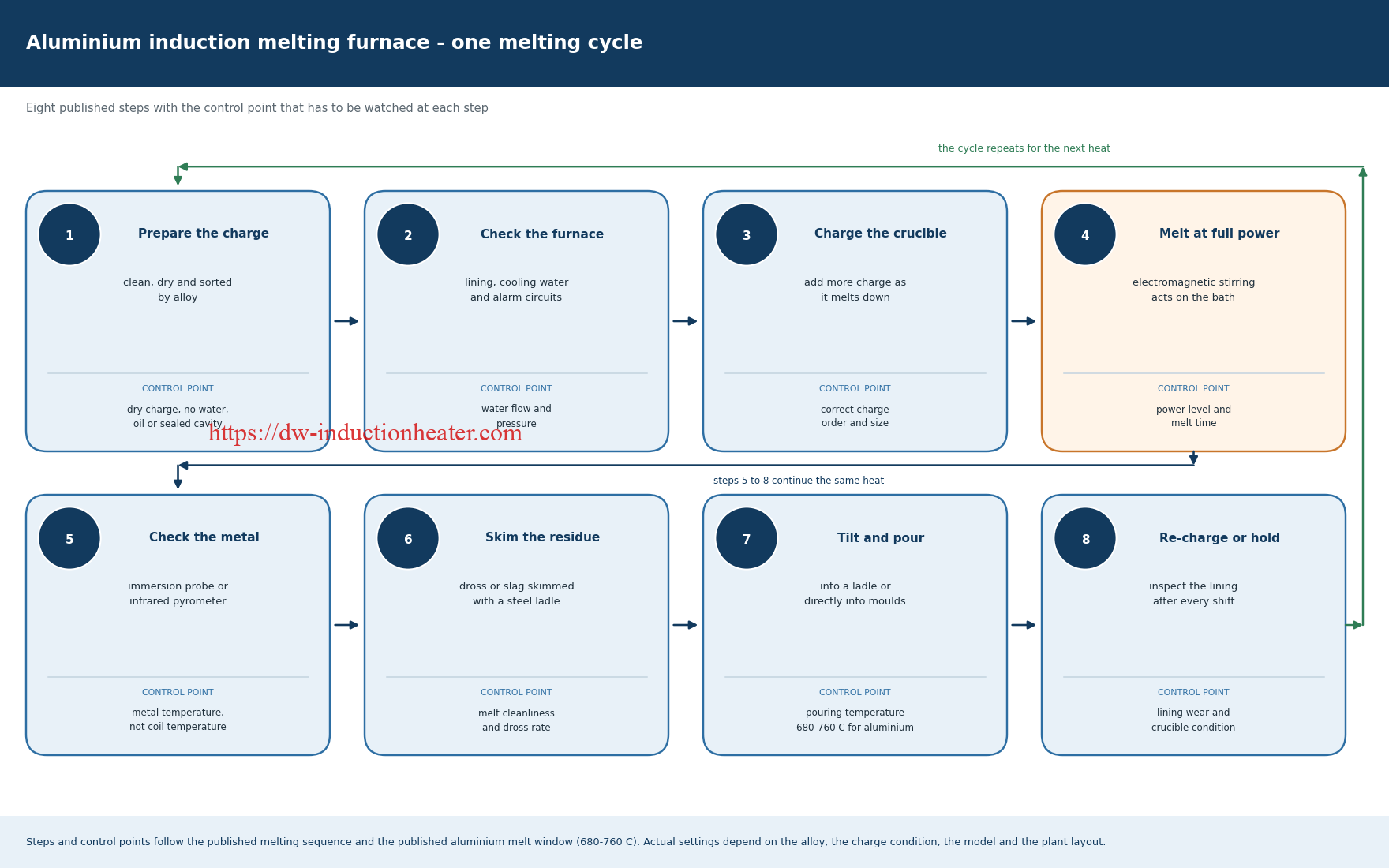
The ten-step melting sequence
| Step | Action | Control point |
|---|---|---|
| 1 | Inspect the power supply, cooling water, crucible, hydraulics and emergency stop | Water flow and alarms |
| 2 | Preheat the crucible gradually (new crucible or after a long shutdown) | Avoid thermal shock |
| 3 | Charge dry ingots or clean scrap | No wet, oily or sealed items |
| 4 | Increase power gradually | Follow the operating procedure |
| 5 | Melt until the charge collapses into a bath | First collapse complete |
| 6 | Add more charge after the first collapse | Respect safe fill limits |
| 7 | Apply refining flux if required and remove dross | Melt cleanliness |
| 8 | Measure the temperature | Immersion probe or sensor |
| 9 | Reduce power and hold at the pouring temperature | Avoid overheating |
| 10 | Tilt and pour; clean and inspect the crucible | Smooth pouring |
Two safety rules run through the sequence and are not optional. Every aluminium charge must be completely dry – moisture, sealed containers, oil and trapped liquid can cause dangerous explosions when placed into molten aluminium. And cold metal must never be dropped into a hot bath; the crucible is preheated gradually and the charge is added in stages to avoid thermal shock and crucible cracking.
On the equipment side, the published order-to-running route is: specification and model confirmed; manufacture of the furnace body, coil and capacitor cabinet; a factory test run by technical staff; quality control with photographs and video available on request; packing as film, then a paper box, then a wooden exporting case, then foam for shockproof; shipping either free to the buyer’s shipper in China or direct to any main port of China. On site, the engineers sent by the manufacturer carry out installation, commissioning and training until the machine runs normally.

Common Problems and Solutions
| Problem | Possible cause | Solution |
|---|---|---|
| Melting is too slow | Power too low, charge too large, poor crucible or low coupling | Increase power, optimise charge size, check the crucible, confirm capacity |
| Excessive dross | Overheating, dirty scrap, thin cans, excessive stirring, long holding | Control temperature, clean and sort scrap, reduce holding time, use flux |
| Crucible cracks | Thermal shock, poor preheating, impact, wrong crucible | Preheat gradually, do not drop charge, select the correct crucible |
| Coil overheating | Insufficient cooling water, scale, pump failure, high inlet temperature | Check flow, clean the circuit, maintain the pump, use closed-loop cooling |
| Unstable temperature | Poor measurement, unstable power, uneven charging, heat loss | Use a reliable probe, stabilise power, improve insulation, standardise charging |
| Molten metal contamination | Mixed scrap, dirty charge, wrong flux, damaged crucible, contaminated tools | Sort materials, clean the charge, use dedicated tools, maintain the crucible |
| Tilting is not smooth | Air in hydraulics, cylinder leak, misalignment, overload | Bleed the system, check seals, align the shaft, avoid overfilling |
| Frequency will not lock or no output | Capacitor bank out of tune, coil fault, cooling-water fault | Check the capacitor cabinet, verify cooling-water flow and the water-pressure interlock |
| Leakage or earth fault alarm | Moisture in the coil, damaged insulation, water in the cabinet | Isolate and dry the coil, inspect the water-cooled cable and cabinet, do not reset repeatedly |
Two of these destroy furnaces rather than merely slowing production. Crucible cracks come from thermal shock, and thermal shock comes from charging cold metal into a hot vessel. Coil overheating is a cooling circuit fault, not a heating fault – the coil is water-cooled and it will fail if the flow is restricted, if the circuit scales up or if the pump stops, whatever the furnace is doing at the time. Both are cheaper to prevent at commissioning than to repair afterwards, which is why the water circuit and the emergency stop are the first two items in the ten-step inspection.

Engineering Selection Guide
The arrangement below is how the cell is normally installed in a foundry. Power, cooling, control and metal handling are separated so that heat, noise and flux fume are kept away from the operator, and the delivery route is shown because the furnace arrives as a wooden exporting case that has to be moved into position.
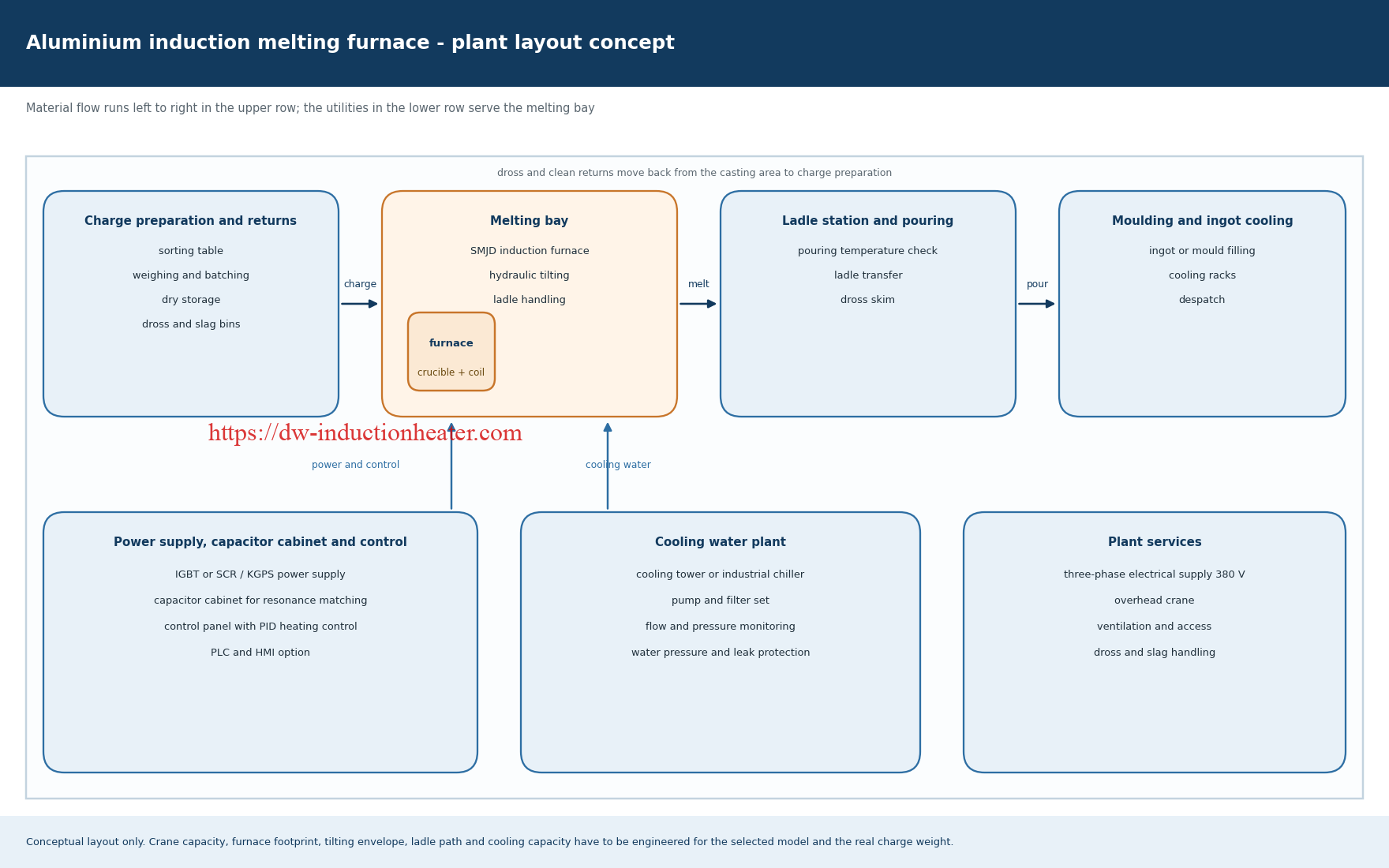
The following factors have to be confirmed before a model is fixed. Each one is a published selection factor rather than a general observation.
| Factor | What to confirm | Recommendation |
|---|---|---|
| Capacity | Batch weight and kg/h | A 150 kg furnace is not 150 kg per hour; size the power for the hourly rate |
| Power | Heat to melt and superheat, plus losses and holding | Theoretical approximately 0.29-0.30 kWh/kg; add a design margin |
| Frequency | Batch and crucible size | 10-20 kHz for laboratory size; 4-10 kHz for 50-100 kg; lower as the batch grows |
| Furnace structure | Pouring method | Fixed for ladling; manual or gearbox tilting for small pours; hydraulic for larger batches |
| Crucible | Grade and life | Use a suitable graphite grade; low-quality crucibles may crack or contaminate the melt |
| Factory supply | Transformer, cable, voltage | Confirm before ordering – 3-phase 380 V, 50-60 Hz +N is the published input |
| Cooling | Closed tower or chiller | A closed loop avoids scale and unstable water temperature in the coil and capacitors |
| Safety | Dry charging, PPE, ventilation | Include emergency stop, spill protection and flux-fume ventilation |
| Automation | Level of control required | PLC and HMI interface are published; manual, timer, PLC or HMI are all supported |
| Energy budget | Consumption reference | Aluminium 500-780 kWh per tonne in practice; confirm by testing on your own charge |
| Delivery | Route and unloading | The furnace arrives in a wooden exporting case – confirm the route to the furnace bay and the hoist access for crucible changes |
| Storage | Conditions before installation | Clean and dry, -20 to 60 °C, 0-95% humidity with no dew, no corrosive gases or liquids |
On the energy figures it is worth being precise. The theoretical heat to melt and hold aluminium at about 720 °C is approximately 0.29-0.30 kWh/kg. The published practical consumption reference for aluminium is 500-780 kWh per tonne, against 560-900 for steel, 550-850 for cast iron and 310-500 for copper. Actual consumption is always higher than the theoretical figure because of coil, crucible and heat losses, so confirm by measuring on your own charge rather than by calculation alone.
On transformer and cable sizing there is a published arithmetic caveat worth reading before the order is placed. At 380 V the published output kW and the published input current are only consistent at a power factor of one – which is 59.2 kVA at 90 A, 79.0 kVA at 120 A, 118.5 kVA at 180 A, 158.0 kVA at 240 A and 197.5 kVA at 300 A. Real inverters never hold a power factor of exactly one, so at a power factor of 0.95 the same powers would draw roughly 96, 128, 192, 256 and 320 A. Size the transformer, cable and breaker on the higher figure and confirm with HLQ before the switchgear is ordered.
If the specification has to be built up from the process rather than from a model number, the published aluminium melting furnace selection guide works through the same choice by alloy, kg/h, melting time, power supply and pouring method.

Advantages and Limitations
| Advantages | Limitations |
|---|---|
| No open flame, less smoke, no dust and little noise in the workshop | Higher initial investment than a simple gas furnace |
| Energy saving of 20-30% against gas and oil melting, as published in the manual | Needs sufficient transformer and supply capacity |
| High efficiency – the induction power transfers to the furnace in a short time | The coil, capacitors and power supply all need cooling water |
| Lower oxidation and dross than flame heating when operated correctly | Graphite crucible life must be managed and budgeted for |
| Electromagnetic stirring evens temperature and composition across the bath | Wet, oily or contaminated scrap causes safety and quality problems |
| Electronic power control with a PID system and a 3 °C controller accuracy | Mixed alloy scrap gives an unstable composition; operators need training |
| All-round indicator lights controller – easy and safe to operate | The published capacity is a batch weight, not an hourly rate |
| Products tested at every level, so a low failure rate in service | Published capacity and published power density do not always cover fast-ingot duty – confirm the duty |
| Easy to install, portable, and it saves floor space | The machine is a cell, not a single unit: power, cooling and gas or electrical supply must be sized together |
| 100% load duration, 24 hours continuous working at maximum power | Published capacity figures must be read as batch weights against the power density |
On the energy-saving figure, two published numbers exist and both are quoted here rather than resolved. The manual states 20-30% against traditional melting methods using gas and oil; the product pages state 20-40% against a diesel workshop furnace. The difference is the comparison baseline, not the machine. Whichever figure is quoted in your own proposal, name the baseline it is measured against.
On the “portable” wording in the manual, it is worth being careful: the machine saves floor space compared with a large gas furnace, but a 1,200 kg tilting furnace with its capacitor cabinet and its cooling plant is not a machine that one person moves. The published delivery method – a wooden exporting case with foam shockproof protection – reflects the weight involved.
Why Choose HLQ?
HLQ Induction Equipment is a direct manufacturer in Quanzhou, Fujian, with 25 years of experience in the research and development, design and production of high-frequency and medium-frequency induction heating machines. The published product range includes IGBT medium-frequency induction heating equipment, IGBT super-audio induction heating equipment, a CNC quenching machine tool, IGBT medium-frequency induction melting furnaces, KGPS medium-frequency induction melting furnaces, and open-type and closed water cooling towers – which means the power supply, the furnace and the cooling system on a cell all come from the same organisation.
The reasons to buy from the manufacturer are specific.
It is a manufacturer, not a trading company. The factory is in the high industry zone of Quanzhou city, Fujian province, and HLQ publishes professional research staff, strict production, inspection and debugging procedures, and a dedicated QC person on machinery production.
The machine is tested before it ships. After production, all machines are tested and debugged carefully before shipment, and the test machine running is carried out by HLQ’s own technical staff.
Quality control you can see. The QC team works to TQM with each step in compliance to the standards, and HLQ will take photos and shoot video of the build on request.
Installation, commissioning and training are included. After the customer receives the machine, HLQ’s engineers are sent to the customer’s workshop to supply installation, commissioning and training services until the machine is running normal production. Engineers are available to service overseas if needed.
Documented packing, shipping and storage. The induction melting furnace is wrapped with a film layer for waterproof and packed with a paper box, then placed into a wooden exporting case and wrapped with foam around it for shockproof. Shipping is free to the buyer’s shipper in China, or HLQ can send the machine directly to any main port of China. Storage conditions are a clean, dry environment at -20 to 60 °C, with humidity between 0% and 95% and no dew, avoiding corrosive gases and liquids.
A published warranty. The heating power carries a warranty of 12 months from the date the contract was signed, and the order can be followed at any time.
Full documentation before you commit. The parameter sheet and the aluminium, copper and iron induction melting furnace manual – which carries the heating principle, the capacity and parameter tables, the crucible specification, the packing, shipping, storage, warranty and the operating FAQ – are available to read before the order rather than after delivery. The same range can be reached from the HLQ induction heating home page.

One point of transparency about the manual itself, so it is not a surprise on delivery: its packing section is headed for an electromagnetic 5-5,000 kg aluminium induction melting furnace while the SMJD capacity table in the same document stops at 1,200 kg of aluminium. The two describe the wider published range rather than the same product, so confirm the model and its capacity against the parameter sheet, and confirm the vessel dimensions against the crucible schedule, before the order is released.

6 Core FAQs
1. What capacity can a melting aluminum furnace actually handle?
The published aluminium column for the SMJD series runs from 150 kg to 1,200 kg per batch, from the 60 kW SMJD-480 to the 200 kW SMJD-3100. What matters commercially is the charge rate rather than the batch weight: the published power densities are 450-600 kW per tonne for rapid batch ingot, 350-450 for a standard mixed charge, 300-400 for scrap remelting and 100-200 for holding at the pouring temperature. Divide your required tonnes per hour by the charge type to get the power you need, then choose the model whose published capacity covers the batch you intend to hold. Confirm the maximum safe fill with HLQ before the first charge.
2. What temperature does the aluminum melt at, and what does the furnace reach?
Two different numbers are involved and they are often confused. Pure aluminium melts at 660.32 °C, and production melts are normally held at 680-760 °C for casting. The 1800 °C figure in the specification table is the furnace’s maximum temperature rating – the capability of the power supply, the lining and the vessel – not a melt temperature for aluminium. Temperature is controlled by the PID heating control system and the LED digital temperature controller, whose published control accuracy is up to 3 °C, with measurement by thermocouple, immersion probe or infrared pyrometer; immersion measurement is the common choice for molten aluminium.
3. Can this furnace melt aluminium scrap and chips, or only ingots?
Both, but the preparation decides the yield. Pure aluminium and aluminium ingots are rated excellent because they melt cleanly and predictably. Sorted alloy scrap is rated good provided it is sorted by alloy grade – mixed grades give an unstable melt composition. Cans and chips are rated conditional: they are thin, coated or contaminated, so they must be cleaned, dried and charged carefully, and chips and turnings should be dry and completely free of oil, water and cutting fluid, with briquetting or pre-compaction recommended to improve yield and reduce oxidation. The single most important safety rule is that the charge must be dry, because moisture, sealed containers, oil and trapped liquid can cause dangerous explosions in molten aluminium.
4. What does the plant need besides the furnace?
Three utilities and one handling area. Electricity: 3-phase 380 V, 50-60 Hz with neutral, at 90-300 A depending on model – and size the transformer, cable and breaker on the higher current, because the published power and current pairs are only consistent at a power factor of one. Cooling water: the coil, the capacitors and the power supply all require it, and a closed-loop tower or industrial chiller is recommended, because an open loop scales up and destabilises the water temperature. Extraction: a hood over the furnace with flux-fume filtration. And a pouring area with a ladle, ingot moulds or a die-casting station, and a dross skimming point. Add the delivery and unloading route, and hoist access for crucible changes, to the plan before the order is placed.
5. Is this furnace suitable for keeping the melt hot rather than melting fresh metal every time?
Yes – that is the keep-warm duty, and it is what separates a working furnace from a batch melter. Once the bath has formed, the output is reduced and the melt is held at the pouring temperature while continuous electromagnetic stirring keeps it thermally and chemically uniform and metal is drawn off as required. This is the duty used for low-melting-point non-ferrous metals where the melt must stay fluid between charges. The published holding power density is 100-200 kW per tonne, far below the melting figure, which is why a holding furnace is inexpensive to run once it is up to temperature.
6. What is included with the machine, and what happens after delivery?
The cell is delivered with the IGBT or KGPS power supply, the capacitor cabinet, the furnace body, the induction coil, the crucible and lining, the hydraulic tilting mechanism, the water-cooled cable, the water distributor and the control cabinet. It is packed as film, then a paper box, then a wooden exporting case, then foam for shockproof, and shipped free to your shipper in China or directly to any main port of China. Before it leaves, the machine is test-run by HLQ technical staff and the build is photographed and filmed on request. HLQ’s engineers then travel to your workshop for installation, commissioning and training until the machine runs normally, and the heating power carries a 12-month warranty from the date the contract was signed. Storage conditions before installation are a clean, dry environment at -20 to 60 °C and 0-95% humidity with no dew and no corrosive gases or liquids.