

Induction Heating Aluminum Automotive Wheel Hub
Induction Heating Aluminum Automotive Wheel Hubs with Medium Frequency Equipment
Quick Answer
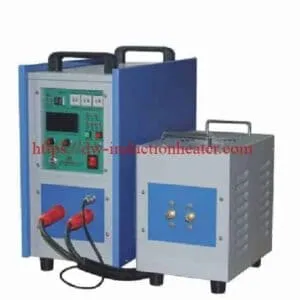
Induction heating an aluminum automotive wheel hub uses medium-frequency current in a coil to induce eddy currents in the aluminum rim, spokes and hub, so the wheel heats itself without a flame or an oven.
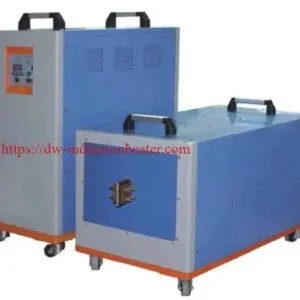
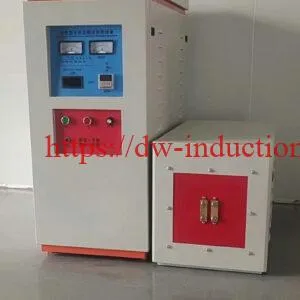
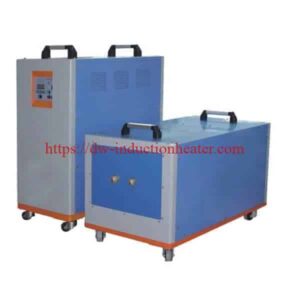
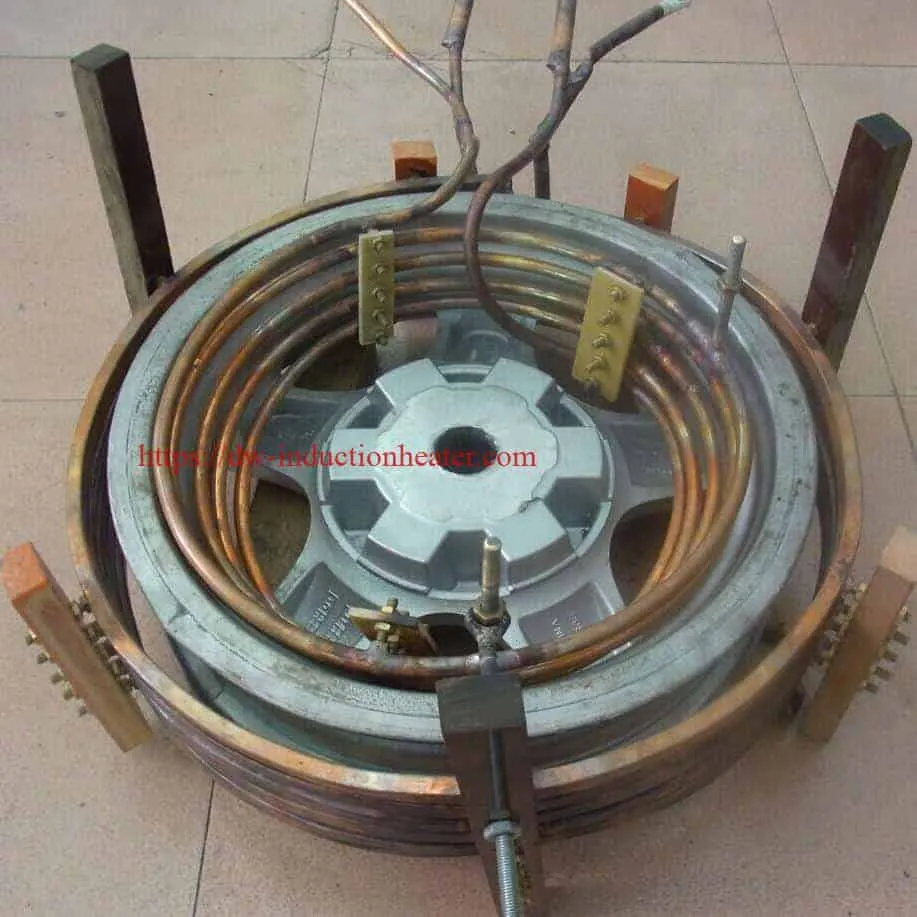
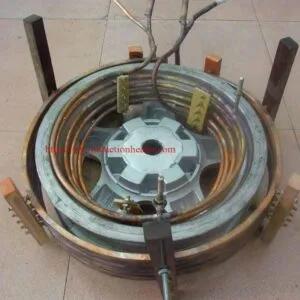
In the HLQ set-up shown below, a helical coil surrounds the rim, a second helical coil sits inside the rim, and the wheel rests on insulated supports. HLQ’s DW-MF medium-frequency power supplies cover 1–20 kHz and 15–160 kW. In a related HLQ case, a 22″ cast aluminum wheel reached 275 °F (135 °C) in 30 seconds with a DW-MF-70kW at 8 kHz.

What is Induction Heating of an Aluminum Wheel Hub?
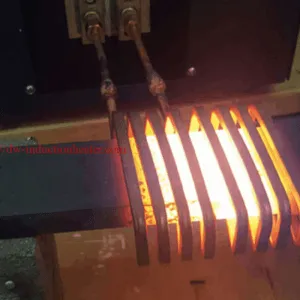
A medium-frequency power supply drives alternating current through coils placed around and inside the wheel rim. The changing magnetic field induces eddy currents in the aluminum. Their resistive (I²R) losses heat the rim directly, and heat then flows by conduction into the spokes and hub.
| Item | Shown on the original HLQ page |
|---|---|
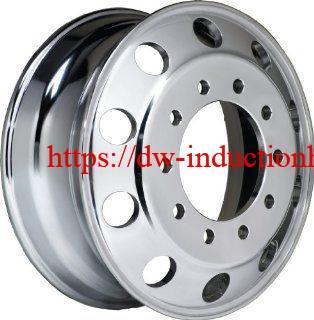
| Workpiece | Cast aluminum automotive wheel (rim, spokes and hub) |
| Equipment | Medium-frequency induction heating equipment |
| Coil arrangement | Helical coil around the rim and a helical coil inside the rim |
| Fixture | Wheel held on insulated supports, clear of the coils |

Key Applications
| Application | Purpose | HLQ reference |
|---|---|---|
| Preheating aluminum wheels before spray painting, powder coating or clear coating | Warm wheel for coating flow and curing | induction preheating aluminum wheels for spray painting |
| Preheating wheels before paint refinishing and wheel repair | Same preheat principle | Listed in the same HLQ case |
| Preheating other aluminum parts before coating, bonding or curing | Fast, repeatable heat | Listed in the same HLQ case |
| Preheating aluminum flanges and tube assemblies | Joint preheat | induction preheating aluminum flanges |
| Preheating automotive parts for welding | Automotive heating | induction preheating for welding automotive parts |
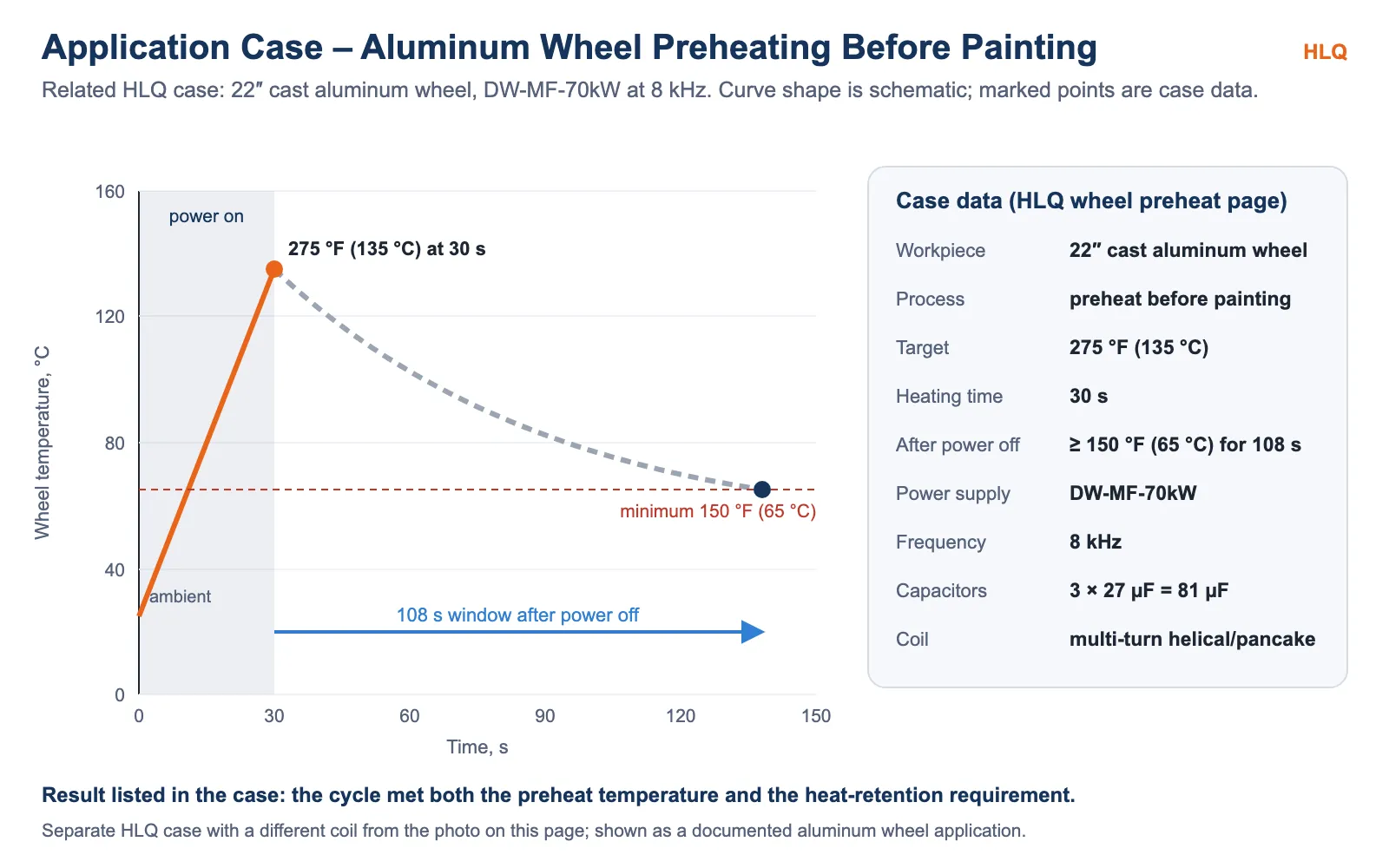
Application case: aluminum wheel preheating before painting
| Parameter | Related HLQ case data |
|---|---|
| Workpiece | 22″ cast aluminum automotive wheel |
| Target temperature | 275 °F (135 °C) |
| Heating time | 30 seconds |
| After power off | At or above 150 °F (65 °C) for 108 seconds |
| Power supply | DW-MF-70kW, 70 kW output |
| Frequency | 8 kHz |
| Capacitors | Remote work head, 3 × 27 µF = 81 µF |
| Coil | Custom multi-turn combination helical/pancake coil |
Suitable Materials
| Material / part | Notes | HLQ reference |
|---|---|---|
| Cast aluminum wheels | Non-magnetic, low resistivity; heated by eddy currents only | This page; wheel preheat case |
| Aluminum flanges and tubes | Preheated to 600 °F (315 °C) with a DW-UHF-20kW at 150 kHz | Aluminum flange case |
| Aluminum for melting | Separate process (furnace) | induction melting aluminum |
Working Principle

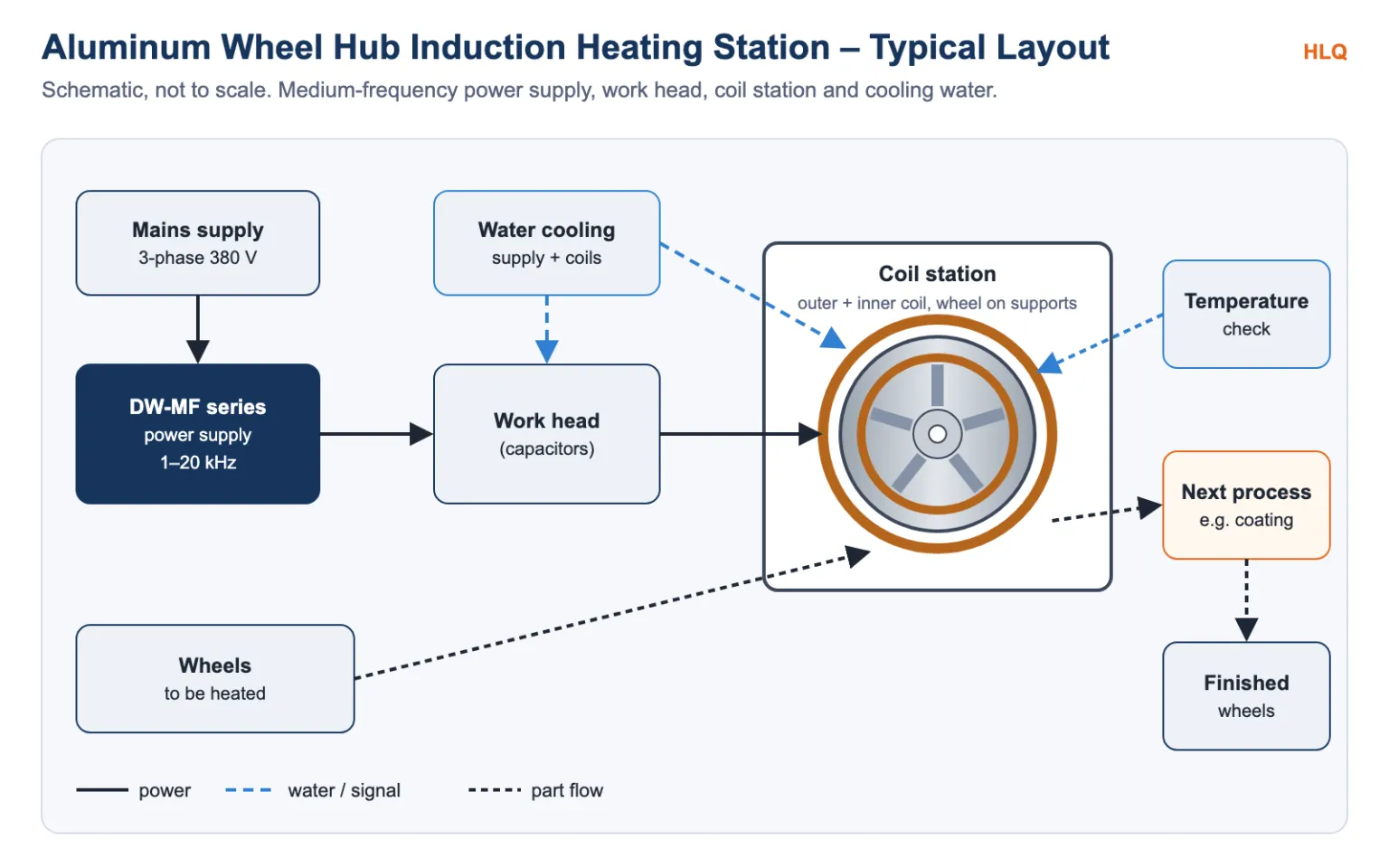
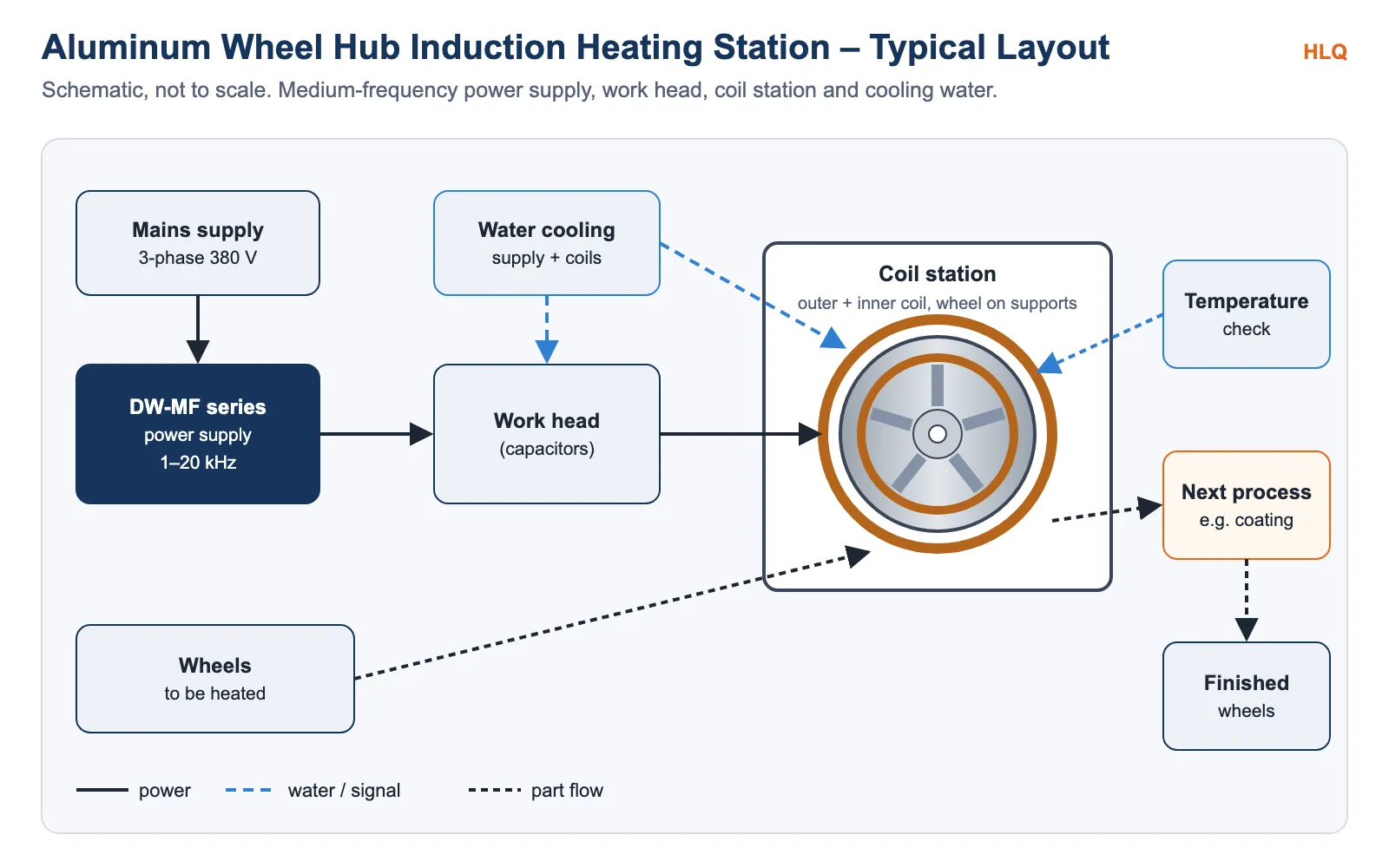
- The DW-MF power supply converts 3-phase 380 V into medium-frequency current (1–20 kHz).
- The work head (capacitors) feeds the outer and inner coils.
- Eddy currents flow in the rim surface layer. Their depth is set by the skin depth.
- Heat spreads by conduction into the spokes and hub.
| Frequency | Skin depth in aluminum (calculation) |
|---|---|
| 1 kHz | ≈ 2.6 mm |
| 8 kHz | ≈ 0.92 mm |
| 20 kHz | ≈ 0.58 mm |
Calculated with δ = 503·√(ρ/(µr·f)), using ρ ≈ 2.65×10⁻⁸ Ω·m (pure aluminum, 20 °C) and µr = 1. Cast wheel alloys have higher resistivity, so treat these values as a reference only. More: skin effect in induction heating and how an induction heater works.
Technical Specifications
| Parameter | Value | Source |
|---|---|---|
| Frequency range | 1–20 kHz | DW-MF series |
| Power range | 15–160 kW (see table) | DW-MF series |
| Supply | 3-phase 380 V | DW-MF series |
| Duty cycle | 100% | DW-MF series |
| Coil (this page) | Outer helical coil + inner helical coil | Original photo |
| Coil (related case) | Combination helical/pancake coil | Wheel preheat case |
| Example cycle | 22″ wheel to 135 °C in 30 s at 8 kHz | Wheel preheat case |
Recommended Model Selection
| Model | Power | Input current | Frequency | Supply | Duty |
|---|---|---|---|---|---|
| DW-MF-15 | 15 kW | 23 A | 1–20 kHz | 3-ph 380 V | 100% |
| DW-MF-25 | 25 kW | 36 A | 1–20 kHz | 3-ph 380 V | 100% |
| DW-MF-35 | 35 kW | 51 A | 1–20 kHz | 3-ph 380 V | 100% |
| DW-MF-45 | 45 kW | 68 A | 1–20 kHz | 3-ph 380 V | 100% |
| DW-MF-70 | 70 kW | 105 A | 1–20 kHz | 3-ph 380 V | 100% |
| DW-MF-90 | 90 kW | 135 A | 1–20 kHz | 3-ph 380 V | 100% |
| DW-MF-110 | 110 kW | 170 A | 1–20 kHz | 3-ph 380 V | 100% |
| DW-MF-160 | 160 kW | 240 A | 1–20 kHz | 3-ph 380 V | 100% |
The documented 22″ wheel case used the DW-MF-70kW. The wheel size, cycle time and line speed set the final power rating and coil design. Product details: medium frequency induction power generator. All models: HLQ induction heating device models.
Process Workflow

| Step | Action | Note |
|---|---|---|
| 1 | Coil set-up | Coils matched to the wheel (outer + inner) |
| 2 | Load | Wheel on insulated supports, centred |
| 3 | Set | Power and time on the DW-MF supply |
| 4 | Heat | Eddy currents heat the rim, spokes and hub |
| 5 | Verify | Temperature checked against the target |
| 6 | Unload | Wheel removed from the coil |
| 7 | Next process | For example, painting within the hold window (108 s in the related case) |
Heating station layout
Common Problems and Solutions
| Problem | Likely cause | Solution |
|---|---|---|
| Poor coating adhesion, orange peel or uneven curing | Wheel cooled below the target before coating | Confirm the hold window after heating (≥ 150 °F for 108 s in the related case) |
| Rim hot, face or spokes cooler | The coil covers only the rim | Add an inner coil (as in the photo) or a combination helical/pancake coil that covers the face |
| Low heating efficiency on aluminum | Frequency or coil not matched | Use a medium frequency (8 kHz in the case) and a coil matched to the wheel |
| Wheel touches a coil | Wheel not centred | Use insulated supports and a fixed loading position |
Engineering Selection Guide
| Factor | What to confirm | Why it matters |
|---|---|---|
| Wheel size and mass | For example, 22″ | Sets power and coil size |
| Target temperature | From the coating or process specification | Sets energy per wheel |
| Cycle time | For example, 30 s per wheel | Sets the power rating |
| Heated zone | Rim only, or rim plus face and spokes | Sets the coil type |
| Hold window | Time to the next station | Sets the preheat temperature |
| Supply and cooling | 3-phase 380 V; cooling water | Installation |
Advantages and Limitations
| Advantages | Limitations |
|---|---|
| Heat is generated in the wheel itself | The coil is matched to each wheel size |
| Power is drawn only while a wheel is in the coil | Aluminum needs a well-matched frequency and coil |
| Power, time and temperature are set digitally and repeat every cycle | Cooling water is required |
| No flame and no combustion gases; small footprint | Heating the face evenly may need an extra or combination coil |
Why Choose HLQ?
| Strength | Evidence |
|---|---|
| DW-MF series | 15–160 kW, 1–20 kHz, 100% duty |
| Wheel coil designs | Outer + inner helical; combination helical/pancake |
| Documented wheel case | 22″ wheel to 135 °C in 30 s |
| Aluminum experience | Wheels, flanges and melting |
| Automotive applications | Wheel preheating, weld preheating |
10 Core FAQs
1. Can aluminum wheels be induction heated?
Yes. Aluminum is electrically conductive, so it heats through eddy currents. It is non-magnetic, so there are no hysteresis losses.
2. Which equipment is used?
Medium-frequency induction heating equipment. HLQ’s DW-MF series covers 1–20 kHz and 15–160 kW.
3. What coil is shown on this page?
A helical coil around the rim and a second helical coil inside the rim, with the wheel on insulated supports.
4. Why use medium frequency for aluminum?
A lower frequency drives eddy currents deeper. By calculation, the skin depth is about 0.92 mm at 8 kHz in aluminum, compared with about 0.58 mm at 20 kHz.
5. How fast can a wheel be heated?
In a related HLQ case, a 22″ wheel reached 275 °F (135 °C) in 30 seconds with a DW-MF-70kW at 8 kHz.
6. How long does the wheel stay warm?
In that case, the wheel stayed at or above 150 °F (65 °C) for 108 seconds after power off.
7. What temperature should the wheel reach?
It depends on the next process. For coating, follow the coating supplier’s specification.
8. What capacitance was used in the case?
A remote work head with 3 × 27 µF = 81 µF.
9. What supply does a DW-MF unit need?
3-phase 380 V, plus cooling water.
10. What is needed for a quotation?
The wheel drawing, size and alloy, the target temperature and next process, the cycle time, the heated zone, and the available supply.