
Induction Preheating Welding Automotive Parts
Induction Preheating for Welding Automotive Parts: Axle Seam Case Study
Quick Answer
Induction preheating for welding automotive parts heats only the weld seam of an axle, transaxle or shaft in a few seconds, inside the welding cell, before the weld is made.
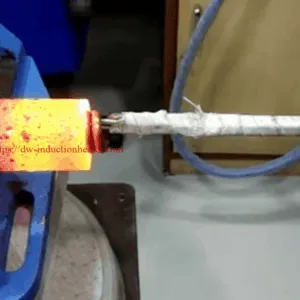
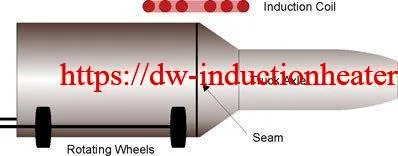
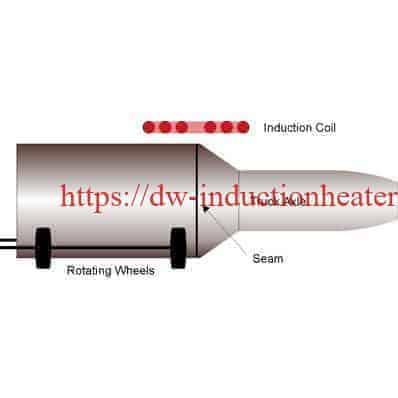
In HLQ’s truck axle test, a DW-HF-35kW generator at 75 kHz with a pancake coil above the rotating axle heated the seam to over 204 °C (400 °F) in 15 seconds. The seam then stayed above 177 °C (350 °F) for 30 seconds after power off. The requirement was ≥ 149 °C (300 °F), so it was met with a comfortable welding window.

What is Induction Preheating for Welding Automotive Parts?
Axles, transaxles, drive shafts and suspension parts are made from medium-carbon and alloy steels. These can crack or form hard zones at the weld if the joint cools too fast. Preheating the seam slows cooling and lets hydrogen escape. A torch or oven is too slow and too variable for a production cell. Induction heats only the seam, in 5–15 seconds, and controls the temperature with a timer or pyrometer, so it fits automotive cycle times.
For the general method and the equipment range, see induction preheating for welding.

| Method | Heat time | Repeatability | Fit for production cells |
|---|---|---|---|
| Induction (HF coil) | 5–15 s | High: timer or pyrometer | Excellent; can be automated |
| Gas torch | 30–120 s | Depends on the operator | Poor; open flame |
| Oven | 10–60 min | Good | Poor; heats the whole part, which cools during transfer |
| Resistance pads | Minutes | Good | Poor; slow, with contact wear |
Key Applications
| Part | Typical material | Typical preheat | Coil |
|---|---|---|---|
| Truck and trailer axles | Medium-carbon / alloy steel | 150–250 °C | Pancake, part rotating |
| Transaxles and axle housings | Alloy steel tube | 200–350 °C | Internal (ID) coil |
| Drive shafts and yokes | Carbon / alloy steel | 150–250 °C | Helical |
| Steel rods and bars | Carbon steel | 150–300 °C | Helical |
| Suspension arms and brackets | HSLA steel | 50–150 °C | Pancake or hairpin |
Application cases

Suitable Materials
| Material | Examples | Why preheat | Typical preheat |
|---|---|---|---|
| Medium-carbon steel | 1045, C45 | Hardenable heat-affected zone, cracking risk | 150–250 °C |
| Low-alloy Cr-Mo steel | 4130, 4140, 42CrMo4 | High hardenability | 200–350 °C |
| Mn steel tube | Axle housings | Thick sections, fast cooling | 150–250 °C |
| HSLA steel | Brackets, arms | Hydrogen control | 50–150 °C |
| Cast steel | Hubs, yokes | Section changes, residual stress | 150–250 °C |
Typical ranges only. The welding procedure specification (WPS) governs.
Working Principle
- Generator: The DW-HF IGBT generator produces 20–80 kHz current, here 75 kHz. A remote heat station with four 1.2 μF capacitors tunes it to the coil.
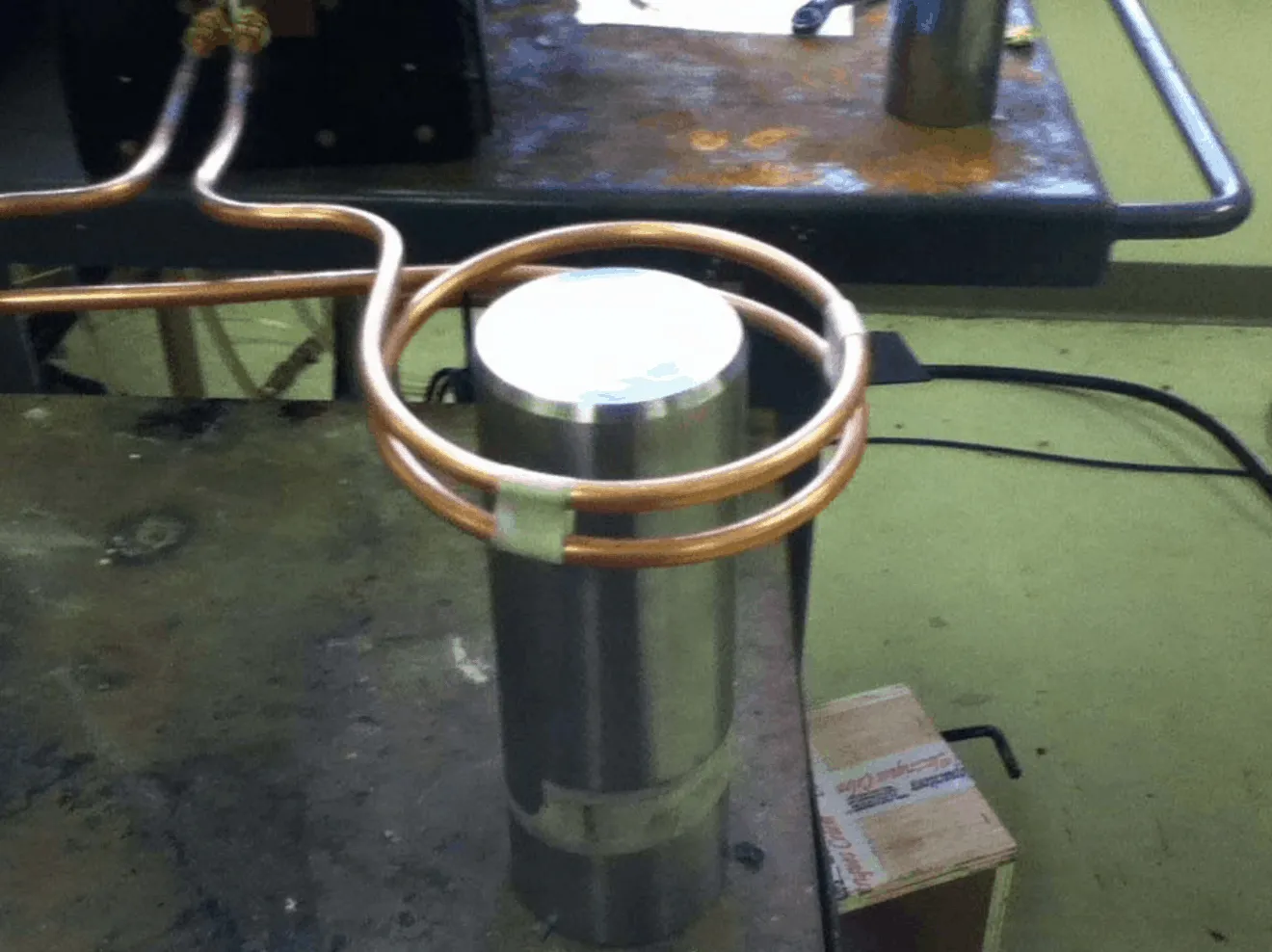
- Coil: A custom pancake coil sits a few millimetres above the axle seam.
- Rotation: The axle turns 400° in 15 s, so every point of the seam passes under the coil more than once.
- Heating: Eddy currents heat a thin surface layer, and the heat soaks inward between passes. The result is an even seam temperature.
- Holding: After the power is switched off, the heated mass stays above the required preheat long enough to weld.

Background: how induction heating works.
Technical Specifications
Application test: truck axle seam
| Item | Value |
|---|---|
| Objective | Preheat the seam to over 149 °C (300 °F) within 15 s and keep it hot for 15 s after the power is turned off |
| Part | Steel truck axle |
| Temperature indicators | Paint at 350 °F and 400 °F (177 / 204 °C); crayons at 350, 375 and 400 °F (177 / 191 / 204 °C) |
| Set temperature | 350 °F (177 °C) |
| Frequency | 75 kHz |
| Equipment | DW-HF-35kW power supply, remote heat station with four 1.2 μF capacitors, specially designed pancake induction coil |
| Fixture | Axle rotated 400° in 15 s, with the coil above the axle |
| Heating | 15 s; all 350 °F and 400 °F paint melted, so the seam was above 204 °C (400 °F) |
| After power off | 400 °F crayon did not melt; 375 °F crayon melted for 15 s; 350 °F crayon melted for 30 s |
| Result | Above 204 °C within 15 s, and above 177 °C (350 °F) for 30 s after power off. The welding requirement was met. |

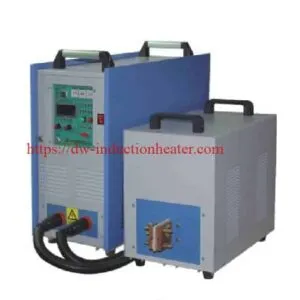
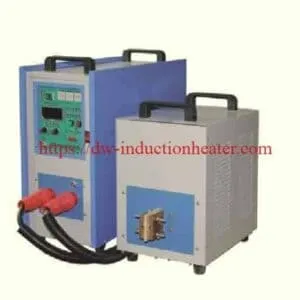
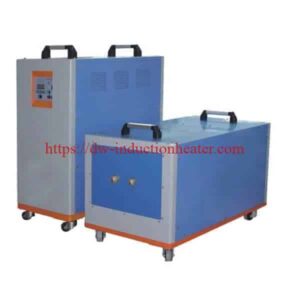
DW-HF high-frequency induction generators
| Model | Max input power | Max input current | Frequency | Input | Duty cycle |
|---|---|---|---|---|---|
| DW-HF-15KW | 15 kVA | 32 A | 30–100 kHz | 1-ph 220 V | 80 % |
| DW-HF-25KW | 25 kVA | 23 A | 20–80 kHz | 3-ph 380 V | 100 % |
| DW-HF-35KW | 35 kVA | 51 A | 20–80 kHz | 3-ph 380 V | 100 % |
| DW-HF-45KW | 45 kVA | 68 A | 20–80 kHz | 3-ph 380 V | 100 % |
| DW-HF-60KW | 60 kVA | 105 A | 20–80 kHz | 3-ph 380 V | 100 % |
| DW-HF-80KW | 80 kVA | 130 A | 20–80 kHz | 3-ph 380 V | 100 % |
| DW-HF-90KW | 90 kVA | 160 A | 20–80 kHz | 3-ph 380 V | 100 % |
| DW-HF-120KW | 120 kVA | 200 A | 20–80 kHz | 3-ph 380 V | 100 % |
| DW-HF-160KW | 160 kVA | 260 A | 20–80 kHz | 3-ph 380 V | 100 % |
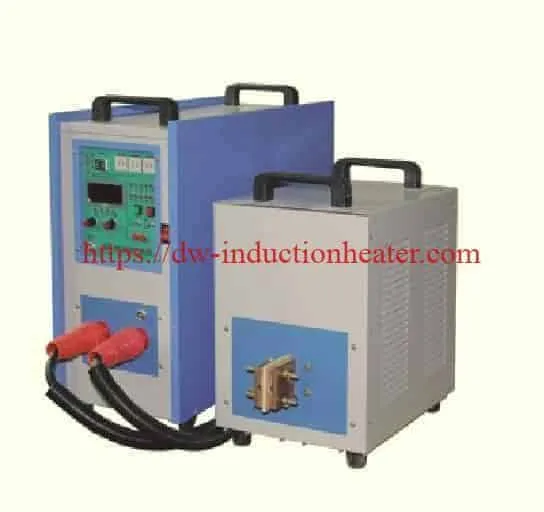
Full series details: high frequency induction heating device.
Recommended Model Selection
Power needed by heated-zone mass and heating time (20 → 200 °C, η 0.6)
| Heated zone mass | In 5 s | In 10 s | In 15 s |
|---|---|---|---|
| 0.5 kg | 15 kW | 7 kW | 5 kW |
| 1 kg | 29 kW | 15 kW | 10 kW |
| 2 kg | 59 kW | 29 kW | 20 kW |
| 4 kg | 118 kW | 59 kW | 39 kW |
P = m · c · ΔT / (t · η), with steel c = 0.49 kJ/kg·K. The axle test (35 kW for 15 s) corresponds to a heated zone of about 3.5 kg.
| Requirement | Recommended |
|---|---|
| Small seams, brackets, rods; 10–15 s cycles | DW-HF-15KW / DW-HF-25KW |
| Axle seams, 15 s cycles | DW-HF-35KW / DW-HF-45KW |
| Transaxles and heavy axles, 5–10 s cycles | DW-HF-60KW / DW-HF-80KW |
| Large housings or very short cycles | DW-HF-90KW to DW-HF-160KW; see the 90 kW high frequency induction heating equipment |
Process Workflow

| Step | Action | Control point |
|---|---|---|
| 1 | Load and clamp the part in the rotation fixture | Concentric, clean seam |
| 2 | Move the coil into position (pancake above the seam, or an ID coil in the bore) | Constant coil gap |
| 3 | Start rotation, e.g. 400° in 15 s | Constant speed |
| 4 | Switch on induction heating: 5–15 s timer or pyrometer cut-off | Seam temperature |
| 5 | Retract the coil and switch off the power; the welding window opens | PLC interlock |
| 6 | Weld within the hold window (≤ 30 s in the axle test) | Seam above the minimum preheat |
| 7 | Repeat for the next seam | Same recipe |
| 8 | Cool in still air and inspect | Visual, MT/UT as required |
Typical welding-cell layout

Common Problems and Solutions
| Problem | Likely cause | Solution |
|---|---|---|
| Seam too cold at weld start | Delay between heating and welding | Interlock the weld start with coil retraction; shorten the transfer |
| Uneven temperature around the seam | Rotation too slow, or the coil gap varies | Rotate at least one full turn during heating; keep a constant gap |
| Surface overheats | Power too high for the time | Lower the power and extend the time; pulse the power |
| Temperature drops too fast | Heated zone too thin | Lower the frequency or heat longer for a deeper soak |
| Readings differ between parts | Indicator paint is only a pass/fail check | Use a pyrometer cut-off in production |
| Generator fault | Coil–capacitor mismatch or a cooling problem | Check the tuning, water flow and chiller |
Engineering Selection Guide
| Factor | Question to answer | Guideline |
|---|---|---|
| Preheat temperature | What does the WPS require? | Typically 150–350 °C for axle and shaft steels |
| Cycle time | How many seconds per seam? | Size the power with the mass-and-time table |
| Seam geometry | Outside circumference, bore, or flat? | Pancake, ID, helical or hairpin coil |
| Hold time | How long does welding take? | Heat a deeper zone for a longer hold |
| Automation | Manual station or robot cell? | PLC with rotation, coil retraction and weld interlock |
| Related processes | Is hardening also needed? | See the induction shaft hardening machine |
Advantages and Limitations
| Advantages | Limitations |
|---|---|
| Seconds per seam; fits automotive cycle times | A coil is needed for each part family |
| Heats only the seam, so less distortion and energy use | The generator needs a water chiller |
| Repeatable timer or pyrometer control | The hold window is limited, so weld promptly |
| No flame, gas or smoke in the cell | Higher investment than a torch |
| Easy PLC integration with robots | Rotation or a shaped coil is needed for even heating |
Why Choose HLQ?
| Strength | What it means for you |
|---|---|
| DW-HF 15–160 kVA platform | One supplier from bench tests to production lines |
| Custom coils | Pancake, ID, helical and hairpin coils for your part |
| Seconds, not minutes | Fits automotive takt times |
| Cell integration | PLC, pyrometer and robot interlocks |
| Application testing | Proven on your part before delivery |

10 Core FAQs
1. Why preheat automotive parts before welding?
To slow cooling and let hydrogen escape. This prevents cracks and hard zones in medium-carbon and alloy steels.
2. How fast is induction preheating?
Seconds. A truck axle seam passed 204 °C (400 °F) in 15 s with a DW-HF-35kW at 75 kHz.
3. How long does the seam stay hot?
In the axle test, it stayed above 191 °C for 15 s and above 177 °C (350 °F) for 30 s after the power was switched off.
4. What temperature was required?
Over 149 °C (300 °F), with the set point at 350 °F (177 °C). The result exceeded both.
5. Why rotate the axle?
Rotation (400° in 15 s) passes every point of the seam under the pancake coil, which gives even heating.
6. Which frequency is used?
High frequency, 20–80 kHz on the DW-HF series: 75 kHz for this axle, and 121 kHz for a transaxle bore coil.
7. How is the temperature checked?
Temperature-indicating paint and crayons in testing; a pyrometer cut-off in production.
8. What capacitors were used?
A remote heat station with four 1.2 μF capacitors, tuned to the custom pancake coil.
9. Can it be built into a robot welding cell?
Yes. The cell PLC controls the heating time, rotation, coil retraction and weld-start interlock.
10. Which DW-HF model do I need?
Use the mass-and-time table. Axle seams heated in about 15 s usually need 35–45 kW; faster cycles or heavier parts need 60–160 kW.