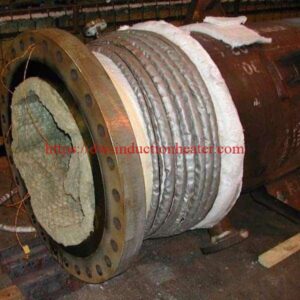
Induction Preheating
Induction Preheating for Welding, Forming and Assembly
Quick Answer
Induction preheating heats a workpiece by electromagnetic induction before the next process step: welding, bending, coating, assembly or repair.
For welding, preheat slows cooling and lets hydrogen escape, which prevents cracking in thick or hardenable steels. Typical minimum preheat is 10–110 °C for carbon steel, depending on thickness, and 120–200 °C for Cr-Mo steels such as P91.
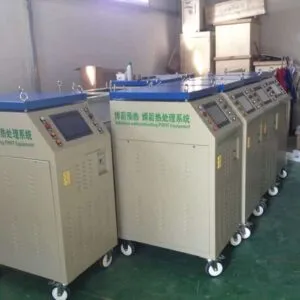
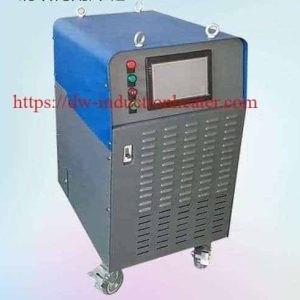
HLQ’s air-cooled MYD series (10–120 kW, 2–30 kHz) preheats pipes and plates with flexible cable coils. It holds the joint within ±3 °C on up to 6 thermocouples, needs no water, and the same unit can also perform PWHT up to 900 °C.

What is Induction Preheating?
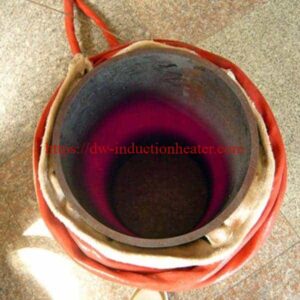
Induction preheating is a process in which a material or workpiece is heated by induction before further processing. The reasons vary by industry. Wire and cable cores are warmed before insulation is extruded. Steel strip is warmed before pickling and zinc coating. Bars and pipes are softened before bending. Most often, pipes, plates and vessels are preheated before welding. Mobile induction preheaters also allow on-site repairs, such as removing or fitting bearings.
Instead of heating from the outside with a flame or resistance pads, induction generates heat inside the steel itself. The heat is fast and even, it is set by a controller, and it is recorded. Because cycles are short and the system is compact, induction preheating fits into both production lines and field work.
| Method | Heat source | Uniformity and control | Typical drawbacks |
|---|---|---|---|
| Induction | Eddy currents in the steel | Even through the wall; ±3 °C closed loop | Higher upfront cost |
| Gas torch | Flame on the surface | Uneven; depends on the operator | Hot spots, gas handling, fire risk |
| Resistance pads | Conduction from ceramic pads | Good, but slow | Slow heat-up, pad burn-out, many consumables |
| Oven | Furnace atmosphere | Good for small parts | Not practical for large or site joints |
Key Applications
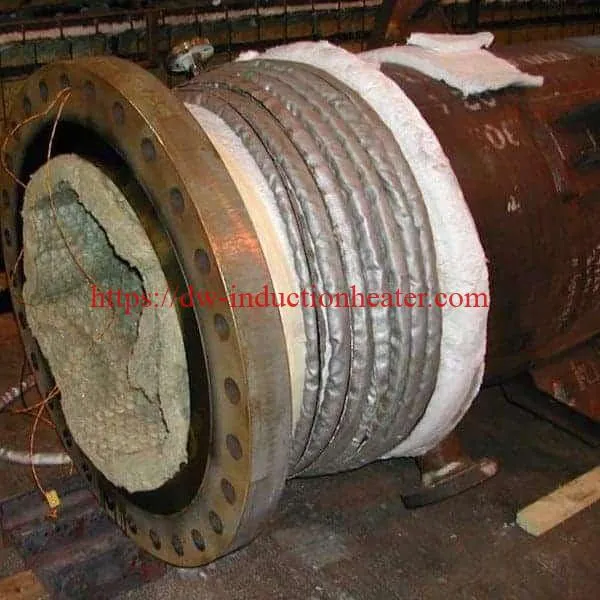
Induction preheating is used in the automotive, mechanical, aerospace, electrical, white-goods, shipbuilding and energy industries. The largest area of use is preheating for welding. HLQ’s MYD air-cooled induction heating systems are used offshore for on-site weld preheating, and are often shipped to oil platforms and remote sites for repair and maintenance work.
| Application | Why preheat | Typical temperature |
|---|---|---|
| Welding of pipes, plates and vessels | Prevent hydrogen cracking; reduce hardness and residual stress | 50–250 °C |
| Interpass temperature hold | Keep the joint between the WPS minimum and maximum | Per WPS |
| Bending and forming | Soften the metal and reduce springback | 300–1050 °C |
| Coating and curing | Preheat steel before coating | 180–250 °C |
| Wire, cable and strip | Preheat before extrusion, pickling or galvanising | Per process |
| Shrink fitting and bearing repair | Expand bores for assembly on site | 100–300 °C |
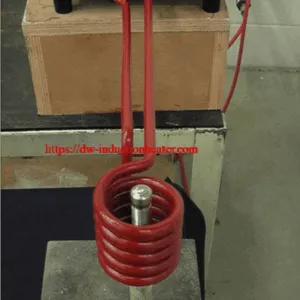
| Rivets and fasteners | Hot riveting and forming | Up to 1000 °C |
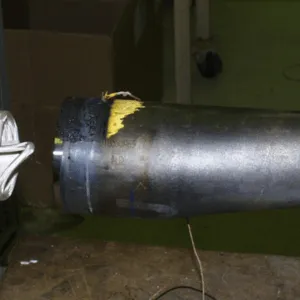
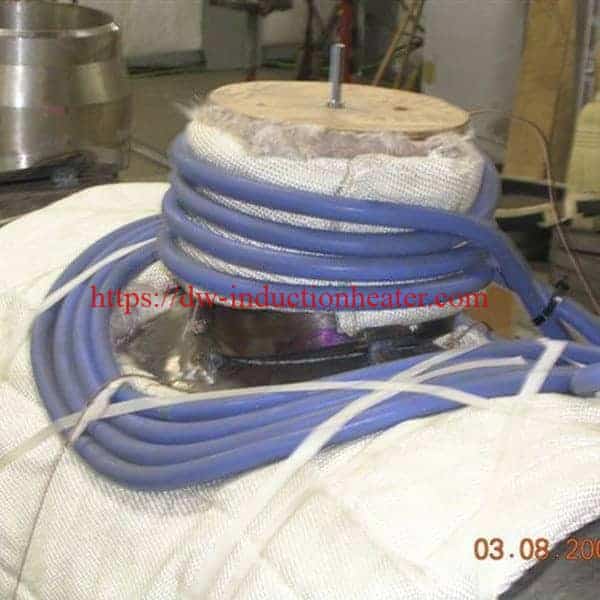
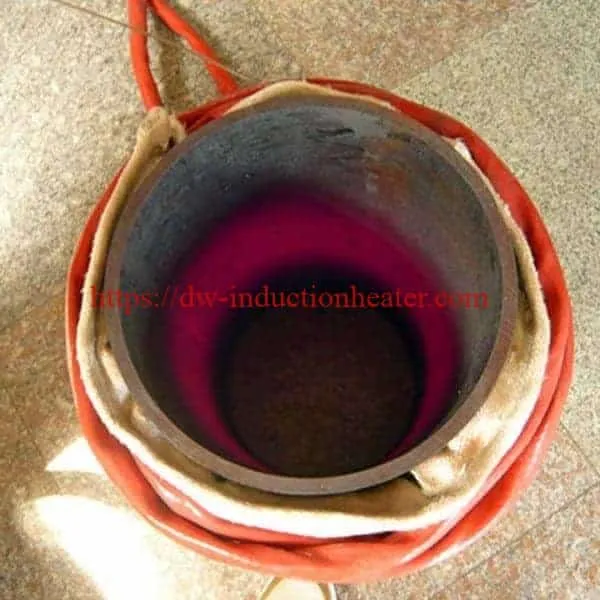
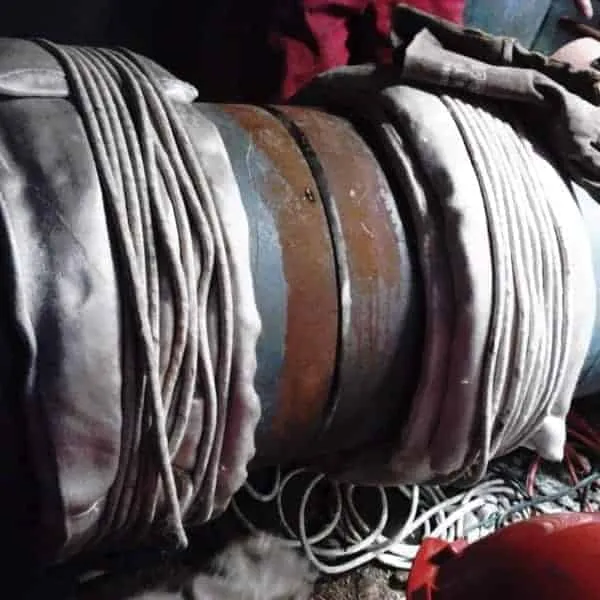
Application cases

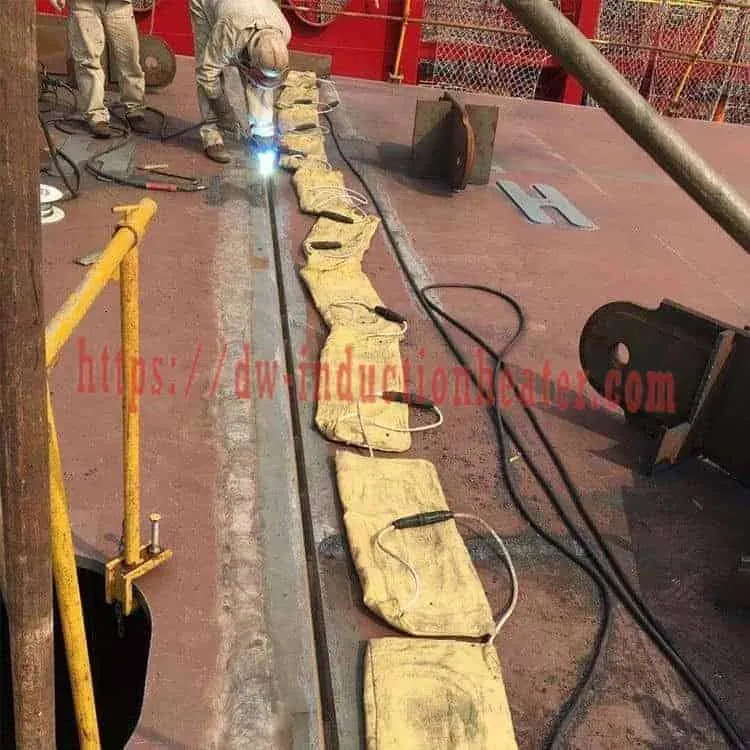

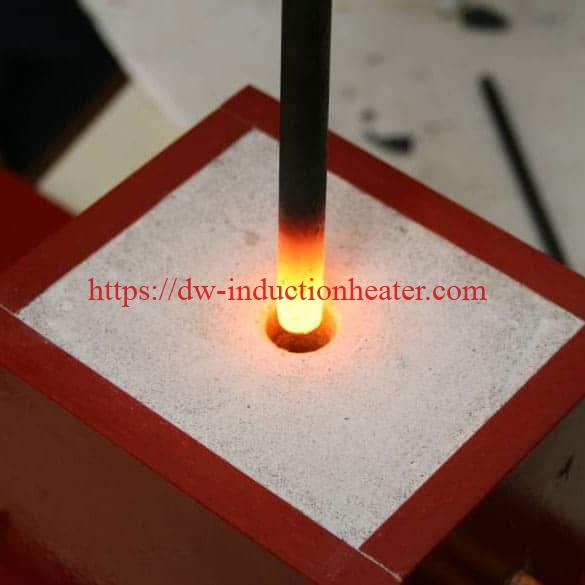
For bending applications, see the induction pipe bending machine.
Suitable Materials
Typical minimum preheat temperatures for welding
| Material / code group | Thickness | Typical minimum preheat | Reference |
|---|---|---|---|
| Carbon steel (e.g. A36, A572 Gr 50), low-hydrogen process | ≤ 20 mm | ≥ 10 °C (no preheat above 0 °C) | AWS D1.1, category B |
| Carbon steel, low-hydrogen process | 20–38 mm | 10 °C | AWS D1.1, category B |
| Carbon steel, low-hydrogen process | 38–65 mm | 65 °C | AWS D1.1, category B |
| Carbon steel, low-hydrogen process | > 65 mm | 110 °C | AWS D1.1, category B |
| P-No.1 carbon steel (C > 0.30 % or t > 25 mm) | All | 95 °C (recommended) | ASME B31.3 |
| 1¼Cr-½Mo (P-No.4, e.g. P11) | All | 120 °C | ASME B31.3 |
| 2¼Cr-1Mo (P-No.5A, e.g. P22) | All | 177 °C | ASME B31.3 |
| 9Cr-1Mo-V (P-No.15E, P91) | All | 200 °C | ASME B31.3 |
Typical values only. The qualified WPS and the current code edition always govern.
Material behaviour in induction preheating
| Material | Heats by induction? | Note |
|---|---|---|
| Carbon and low-alloy steels | Very well (magnetic) | Ideal for MYD cable coils |
| Cr-Mo steels (P11, P22, P91) | Very well | Preheat, interpass hold and PWHT on one unit |
| Austenitic stainless steel | Yes, less efficiently (non-magnetic) | Usually needs little or no preheat |
| Duplex stainless steel | Yes | Control the interpass maximum |
| Aluminium, copper | Yes, at higher frequency | Use HF/UHF equipment instead of MYD |
Working Principle

- Power: The air-cooled IGBT inverter converts 3-phase supply into 2–30 kHz current.
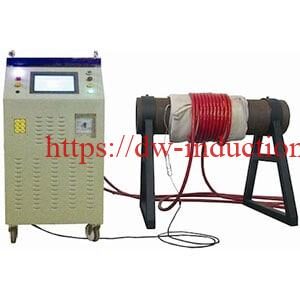
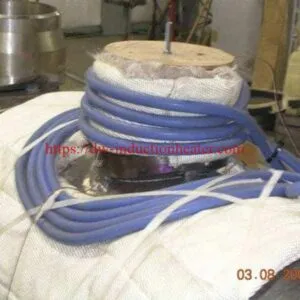
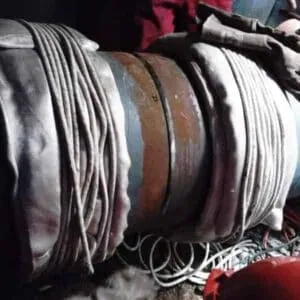
- Coil: A flexible air-cooled cable is wound over a ceramic-fibre blanket on both sides of the joint.
- Heating: The alternating field induces eddy currents in the steel, which heats from within. The insulation reduces heat loss.
- Control: K-type thermocouples feed the PLC, which holds the set preheat or interpass temperature within ±3 °C.
- Continuity: The coil stays in place during welding and can go straight into post-heat or PWHT.

Background: how induction heating works.
Technical Specifications
| Model | Output | Frequency | Max temperature | Input current (3 × 380 V) | Notes |
|---|---|---|---|---|---|
| MYD-10 / 20 / 30 (portable) | 10 / 20 / 30 kW | 5–30 kHz | 500 / 800 °C | — | Portable; single joints |
| MYD-40 | 40 kW | 2–30 kHz | 900 °C | 60 A | Cabinet |
| MYD-50 | 50 kW | 2–30 kHz | 900 °C | 75 A | Cabinet |
| MYD-60 | 60 kW | 2–30 kHz | 900 °C | 90 A | Cabinet |
| MYD-80 | 80 kW | 2–30 kHz | 900 °C | 120 A | Cabinet |
| MYD-100 | 100 kW | 2–30 kHz | 900 °C | 150 A | Cabinet |
| MYD-120 | 120 kW | 2–30 kHz | 900 °C | 180 A | Cabinet |
Common features
| Item | Specification |
|---|---|
| Power device | IGBT inverter, DSP control |
| Control | PLC touch screen with ramp and hold programs |
| Temperature control | Up to 6 K-type thermocouples, ±3 °C |
| Records | Curve storage, USB export, ER-1006 recorder |
| Cooling | Air-cooled power unit and cables (no water) |
| Coils | Flexible air-cooled cables over ceramic-fibre blankets |
| Input | 3 × 380 V standard (220 / 440 V optional) |
| Preheat-only version | MYDS, 4.3-inch screen, up to 600 °C |
Net power to preheat a pipe joint to 150 °C in 10 minutes
| Pipe | OD × wall | Steel mass in 300 mm band | Net heat-up power (η 0.6) |
|---|---|---|---|
| DN150 Sch 40 | 168.3 × 7.11 mm | 8.5 kg | 1.5 kW |
| DN300 STD | 323.9 × 9.53 mm | 22.2 kg | 3.9 kW |
| DN600 XS | 610 × 12.7 mm | 56.1 kg | 9.9 kW |
| DN1000 | 1016 × 19.05 mm | 140.5 kg | 24.9 kW |
| DN1200 | 1219 × 25.4 mm | 224.3 kg | 39.7 kW |
P = m · c · ΔT / (t · η), with steel c = 0.49 kJ/kg·K. Add a margin for heat losses during long holds and for wider heated bands.
Recommended Model Selection
| Joint | Recommended | Reason |
|---|---|---|
| Pipe ≤ DN300, plate ≤ 25 mm | MYD-10 / MYD-20 | Portable, with enough margin |
| Pipe DN300–DN600, plate 25–50 mm | MYD-20 / MYD-30 / MYD-40 | Wider bands and higher preheat |
| Pipe DN600–DN1200, thick plate | MYD-40 / MYD-60 | Heavy walls and long holds |
| Long seams, vessels, P91 with PWHT | MYD-80 / MYD-120 | Preheat and PWHT on one unit |
| Preheat only, no records required | MYDS series | Simpler controller, up to 600 °C |
Product details: MYD induction preheat welding machine and the portable induction preheat welding system.
Process Workflow
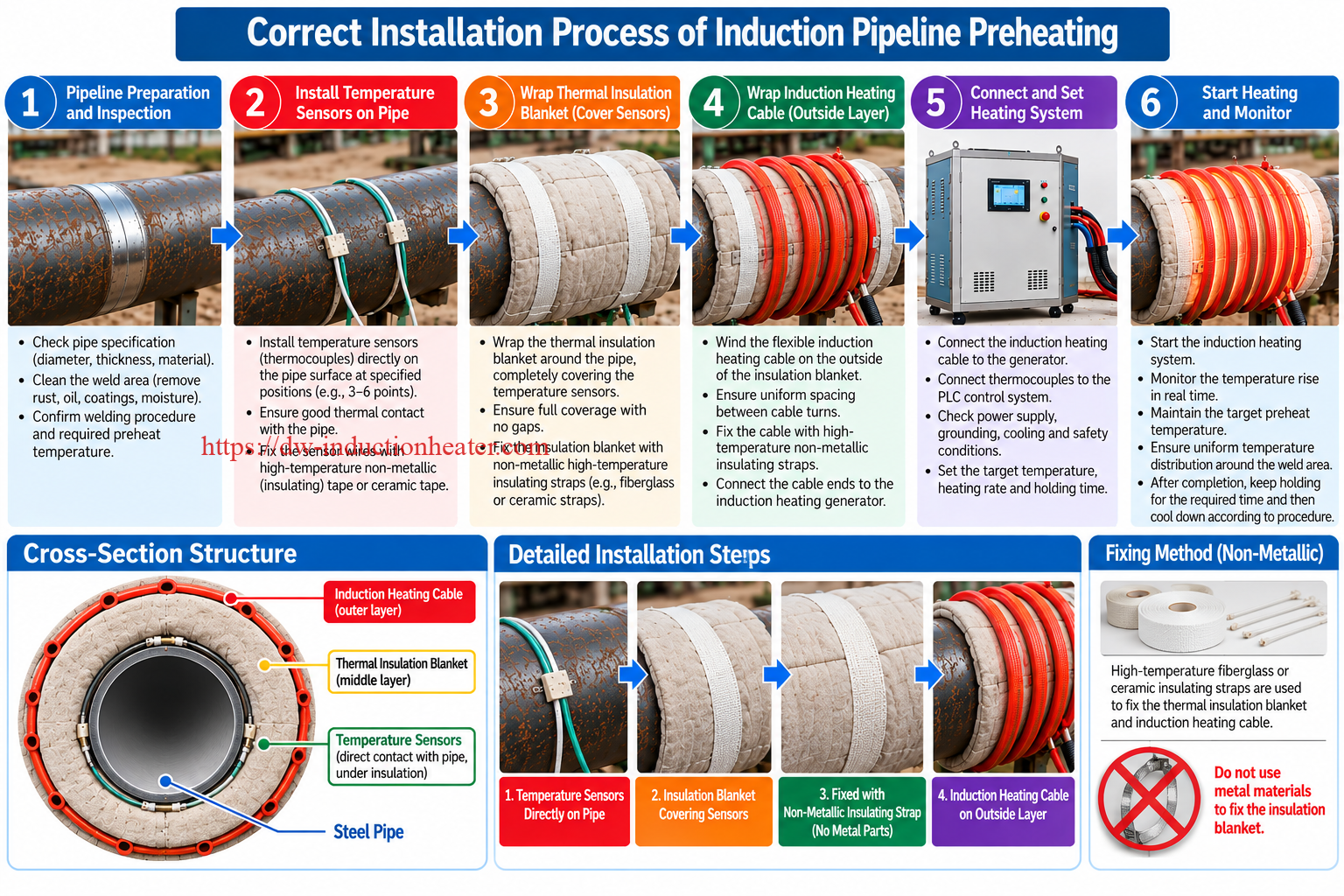
| Step | Action | Check |
|---|---|---|
| 1 | Read the WPS: minimum preheat, maximum interpass, post-heat or PWHT | Target temperatures defined |
| 2 | Clean the joint; attach thermocouples on both sides | Good contact, correct distance |
| 3 | Wrap the insulation blanket over the heated band | No gaps; weld gap left open |
| 4 | Wind the cable coil over the insulation on both sides of the joint | Even turns, secured with non-metallic straps |
| 5 | Connect the coil and thermocouples; load the program | Set point, ramp, hold |
| 6 | Heat to the preheat temperature and verify | ≥ 75 mm each side of the weld |
| 7 | Weld while the unit holds the interpass range | Below the WPS maximum |
| 8 | Post-heat or PWHT if required, then cool and record | Chart saved or printed |
Typical site layout


Common Problems and Solutions
| Problem | Likely cause | Solution |
|---|---|---|
| Preheat not reached at the weld edge | Coil too far from the joint, or the band is too narrow | Wind turns closer to the bevel; widen the insulation |
| Temperature drops during welding | Unit switched off, or no hold program | Keep the coil on; run a hold or interpass program |
| Interpass exceeds the WPS maximum | Heat input from welding plus induction | Set an upper limit in the PLC; pause induction |
| Uneven temperature around the pipe | Uneven turns, or thermocouple under a cable | Space turns evenly; move the thermocouple away from the conductor |
| Hydrogen cracking despite preheat | Preheat too low or removed too early | Follow the WPS; add post-heat (dehydrogenation) if required |
| Cable insulation damage | Contact with a hot surface without a blanket | Always wind over ceramic-fibre insulation |
Engineering Selection Guide
| Factor | Question to answer | Guideline |
|---|---|---|
| Preheat temperature | What does the WPS require? | Use the code tables above as a first check |
| Joint size | Pipe OD and wall, or plate thickness? | Size the power with the heat-up table |
| PWHT | Is PWHT needed after welding? | Choose MYD (900 °C, with records), not MYDS. See the induction post weld heat treatment machine |
| Site | Offshore, remote or workshop? | Air-cooled MYD; no water supply needed |
| Power supply | Grid or generator? | 60–180 A at 380 V for MYD-40 to MYD-120 |
| Pipelines | Girth welds in series? | See induction preheating before welding for oil and gas pipelines |
Advantages and Limitations
| Advantages | Limitations |
|---|---|
| Fast, even heating through the wall | Higher upfront cost than torches |
| ±3 °C control and recorded charts | Needs a 3-phase supply or generator |
| No gas, no flame; safer welding area | Operators need training in coil and thermocouple setup |
| Coil stays on during welding (interpass hold) | Non-ferrous metals need higher-frequency equipment |
| Air-cooled; also performs PWHT | Insulation blankets are consumables |
Why Choose HLQ?
| Strength | What it means for you |
|---|---|
| Air-cooled MYD platform | No water supply needed on site or offshore |
| One kit, three jobs | Preheat, interpass hold and PWHT |
| ±3 °C on 6 channels | Recorded charts for every joint |
| 10–120 kW range | From portable units to large cabinets |
| Complete kits | Cables, blankets and thermocouples sized to your joints |

10 Core FAQs
1. What is induction preheating?
Heating a workpiece by electromagnetic induction before welding, forming, coating or assembly.
2. Why preheat before welding?
To slow cooling, let hydrogen escape, and reduce hardness and residual stress, which prevents cracking in thick or hardenable steels.
3. What preheat temperature do I need?
The temperature in your WPS. As a guide: 10–110 °C for carbon steel depending on thickness, 120 °C for P11, 177 °C for P22 and 200 °C for P91.
4. Can welding continue while the coil is on?
Yes. The coil sits on insulation beside the joint, and the welder works on the open gap.
5. Do MYD units need water cooling?
No. Both the power unit and the cables are air-cooled.
6. How much power is needed?
For a 150 °C preheat in 10 minutes, a DN300 joint needs about 4 kW net and a DN1200 joint about 40 kW net, plus a margin for heat losses.
7. How is the temperature measured?
With K-type thermocouples (up to 6 channels) or a contact pyrometer, checked at least 75 mm on each side of the weld.
8. Can the same unit do PWHT?
Yes. MYD reaches 900 °C with programmed ramps and recorded charts. MYDS is limited to 600 °C for preheat only.
9. Is induction better than a gas torch?
Yes. It heats more evenly, is repeatable and recorded, has no open flame, and holds the temperature during welding.
10. What other jobs use induction preheating?
Bending and forming, coating, wire and strip lines, rivets, and on-site shrink fitting or bearing repair.