
Induction Preheating Blades And Knives
Induction Preheating of Blades and Knives for Hot Stamping
Quick Answer
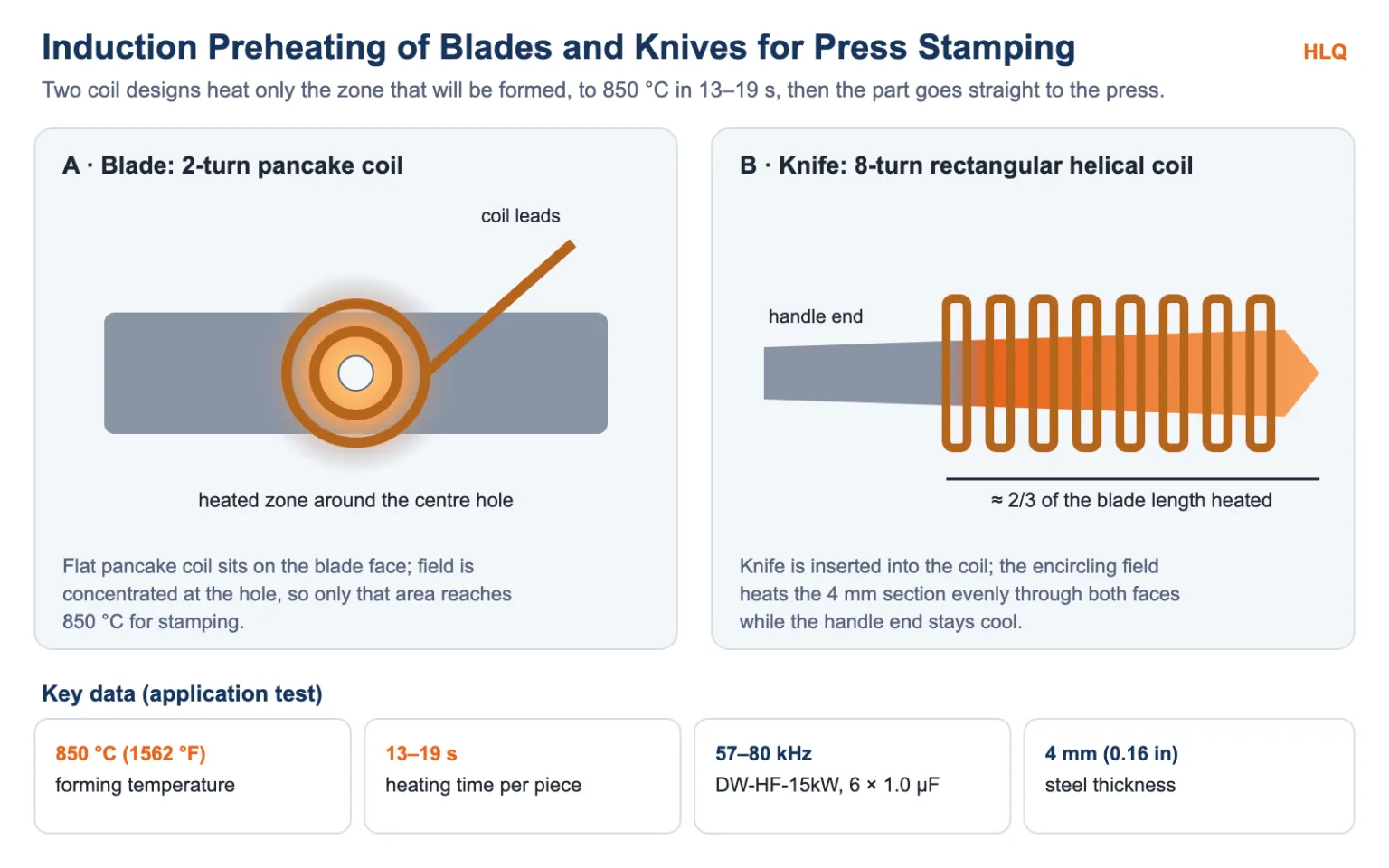
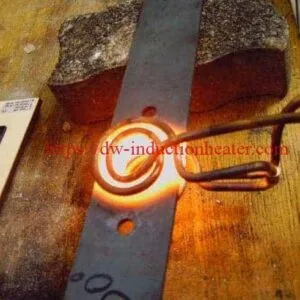
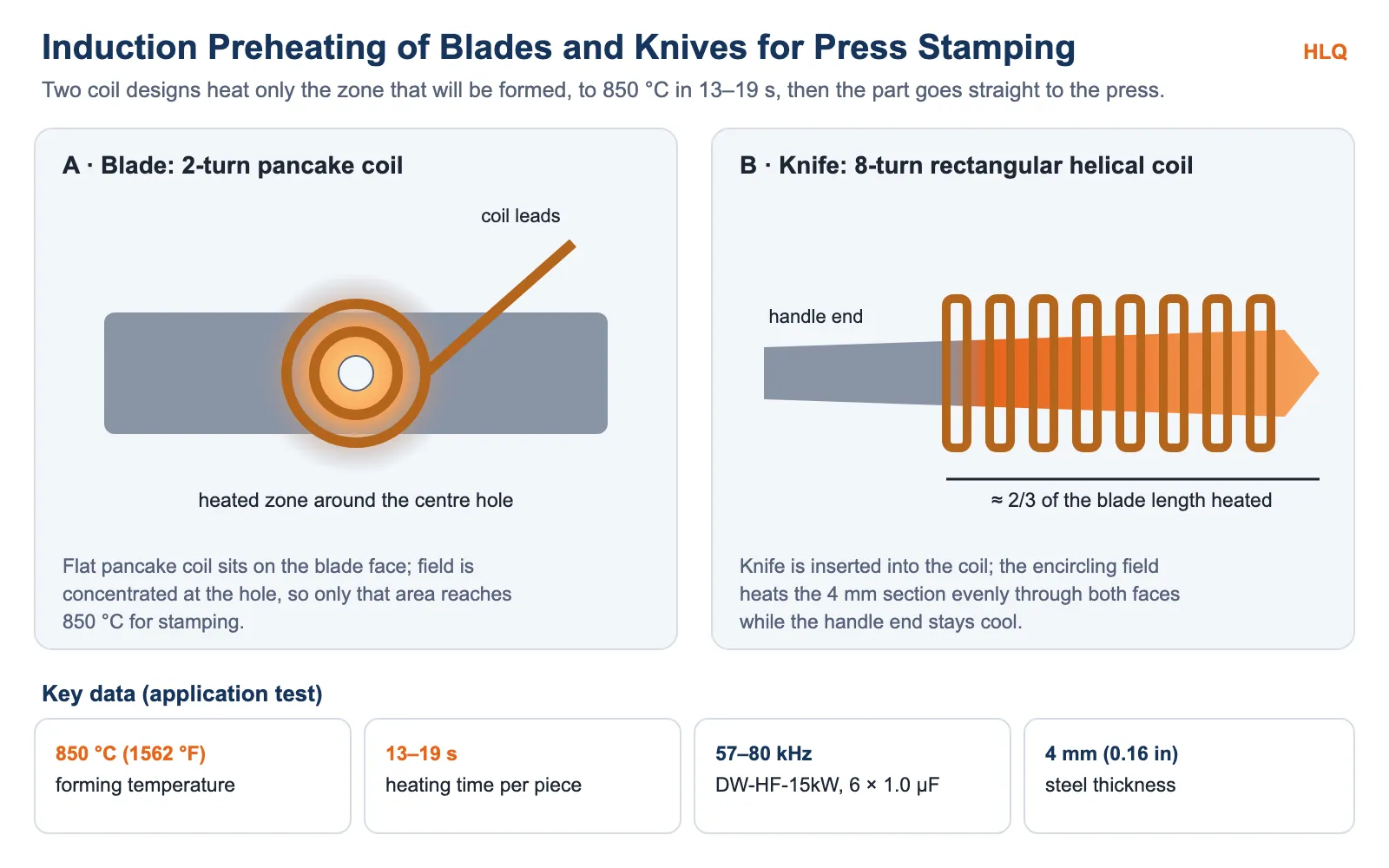
Induction preheating of blades and knives heats only the zone that will be formed to forging temperature, then the part goes straight to the stamping press. That zone is the centre-hole area of a garden-tool blade, or about two-thirds of a knife blade.
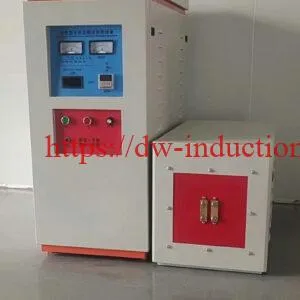
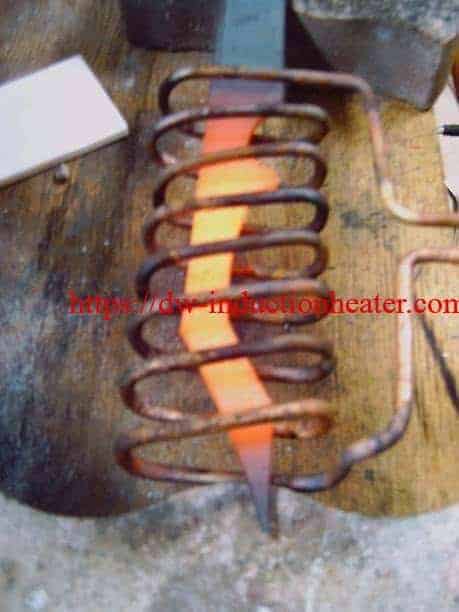
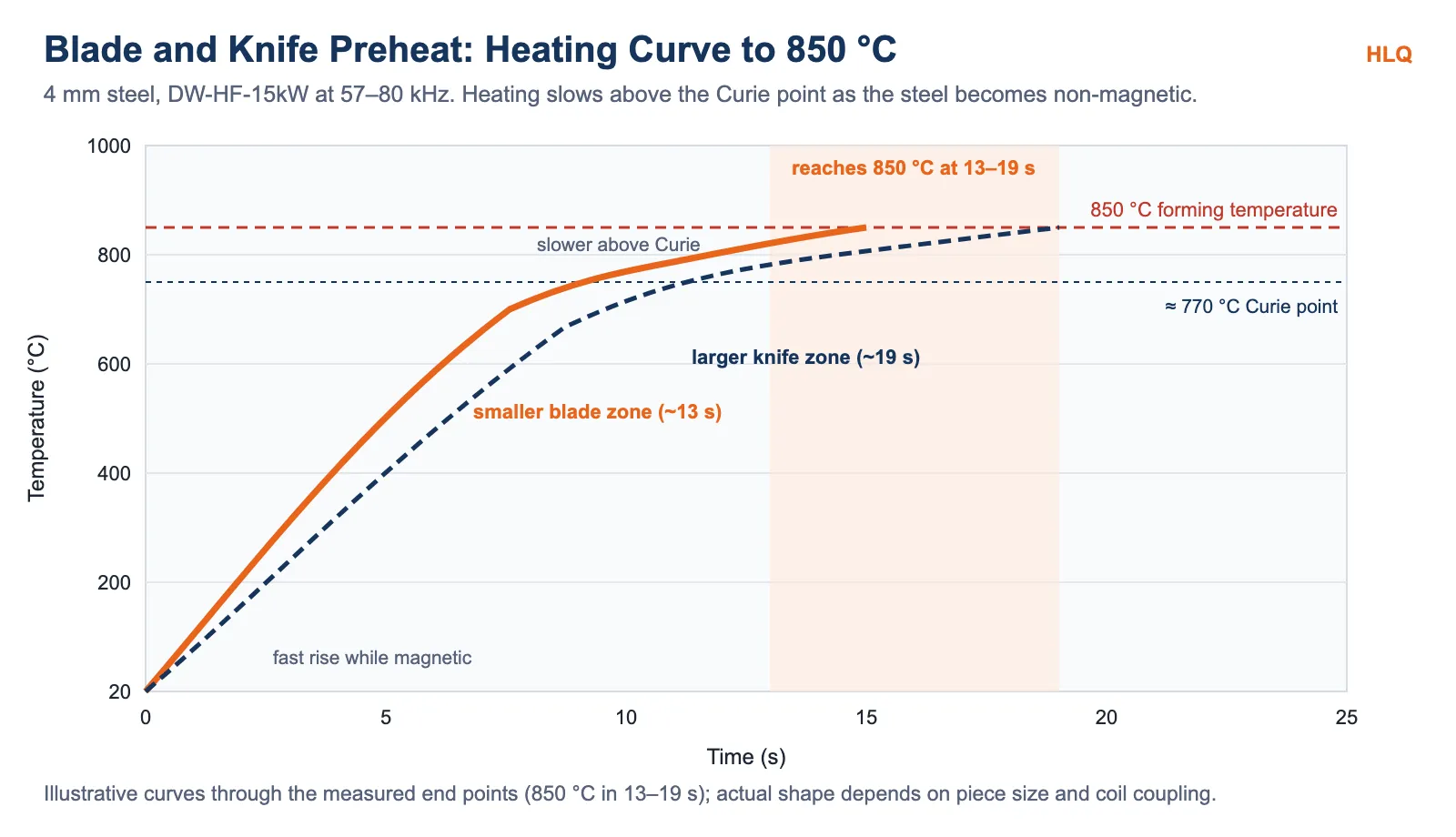
In HLQ’s application test, 4 mm (0.16 in) steel pieces reached 850 °C (1562 °F) in 13–19 seconds. The setup was a DW-HF-15kW generator at 57–80 kHz with a remote workhead (6 × 1.0 μF), a 2-turn pancake coil for blades and an 8-turn rectangular helical coil for knives. Heating is hands-free, repeatable and even.
What is Induction Preheating of Blades and Knives?
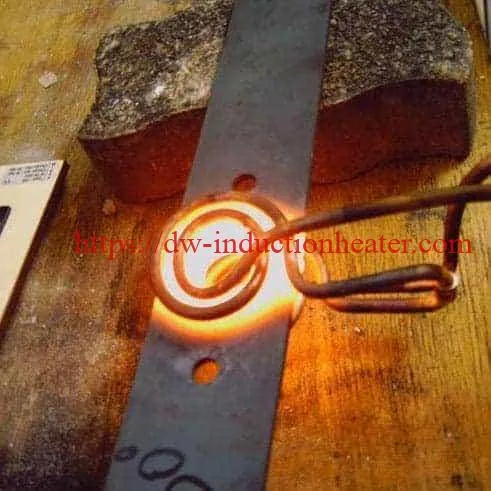
Garden-tool blades and knives are stamped from flat steel about 4 mm thick. Some features are formed hot, such as the area around a mounting hole or the profile of a knife blade. That needs only one local zone at forging temperature, not the whole part.
An induction coil shaped to that zone heats it to 850 °C in seconds, while the rest of the part stays cool and flat. The part is then press stamped. The heating time and power are set on the generator, so every piece is heated the same way without operator skill.
| Method | Heat time | Zone control | Repeatability |
|---|---|---|---|
| Induction (shaped coil) | 13–19 s | Only the coil zone | High; timer controlled |
| Gas forge or furnace | Minutes | Whole part | Medium; causes scaling |
| Torch | 30–90 s | Depends on the operator | Low |
| Cold stamping | — | — | Risk of cracking and high press force |
Key Applications
| Part | Process | Typical temperature | Coil |
|---|---|---|---|
| Garden-tool blades (mowers, trimmers, cultivators) | Hot stamping of the centre-hole area | ≈ 850 °C | 2-turn pancake |
| Knives, machetes, sickles | Hot forming of the blade (about 2/3 of its length) | ≈ 850 °C | 8-turn rectangular helical |
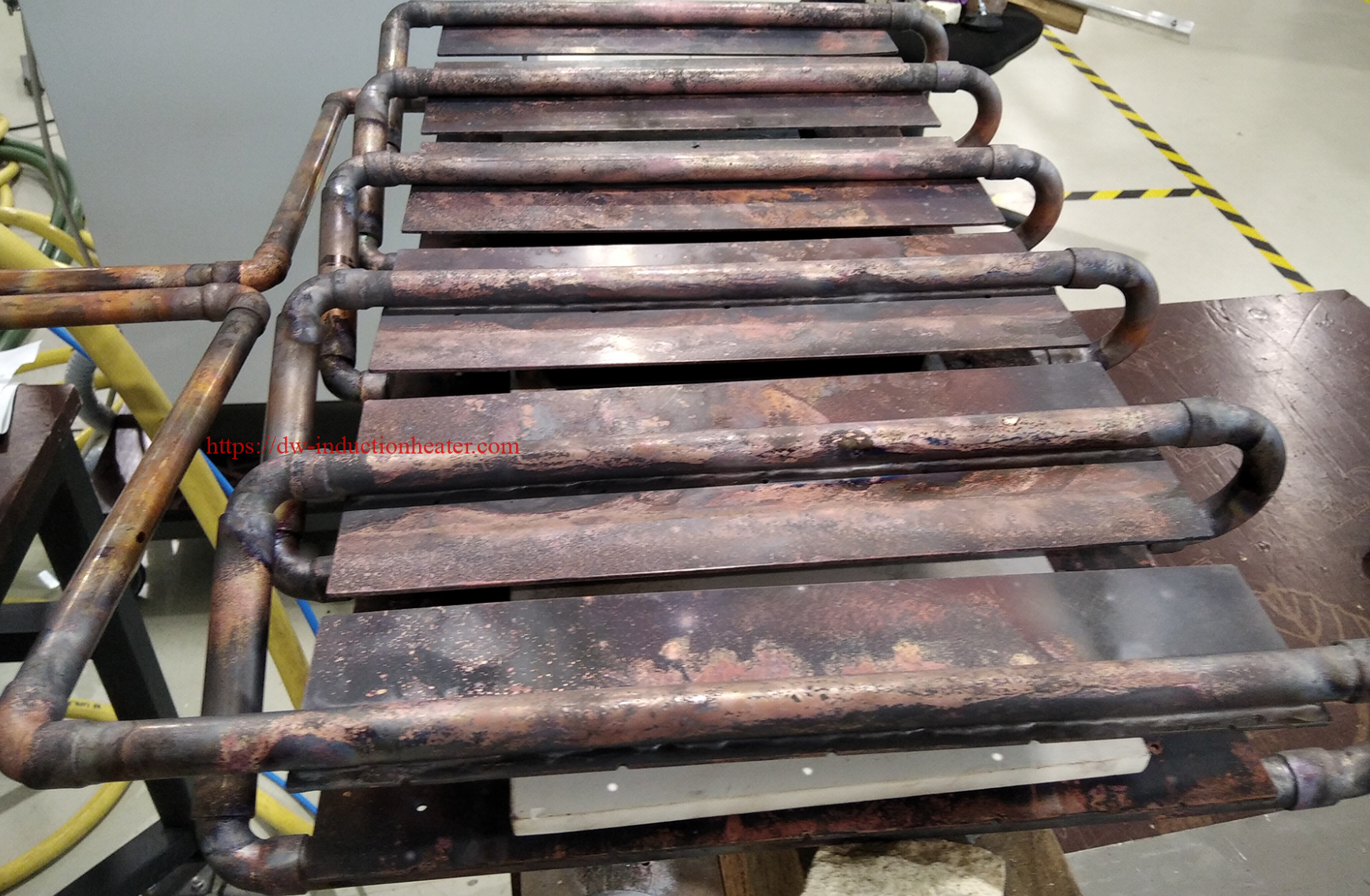
| Shovels and spades | Hot forming of plate blanks | 850–950 °C | Multi-turn rectangular |
| Saw blades | Tooth hardening | 820–880 °C, then quench | Hairpin or scanning coil |
| Bar and rod ends | Upsetting and forging | 1100–1250 °C | Helical |
Application cases
For tooth hardening, see induction hardening of saw blade teeth.
Suitable Materials
| Steel | Typical use | Hot forming range | Note |
|---|---|---|---|
| Medium/high-carbon steel (1050–1075, C55–C75) | Garden-tool blades, machetes | 800–950 °C | Heats fast; magnetic below about 770 °C |
| Spring steel (65Mn, 50CrV / 6150) | Blades, knives, shovels | 800–950 °C | Avoid overheating; keep cycles short |
| Boron steel (e.g. 30MnB5) | Agricultural blades | 850–950 °C | Can be hardened after forming |
| Martensitic stainless (420, 440A) | Kitchen and utility knives | 850–1000 °C | Lower heating efficiency; longer cycles |
| Low-carbon steel | Brackets, simple tools | 800–950 °C | Easy to form |
Typical ranges only. Follow the steel supplier’s forming data.
Working Principle
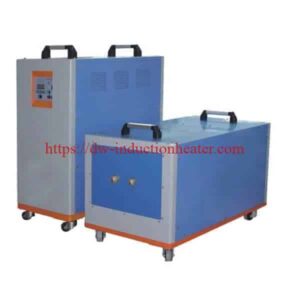
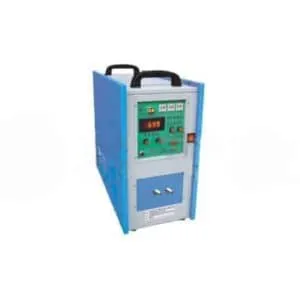
- Generator: The DW-HF-15kW IGBT generator produces 57–80 kHz current, tuned by a remote workhead with six 1.0 μF capacitors (6.0 μF in total).
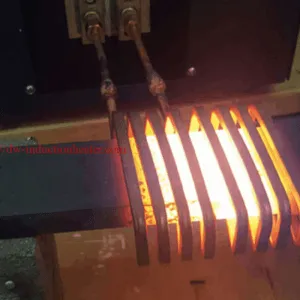
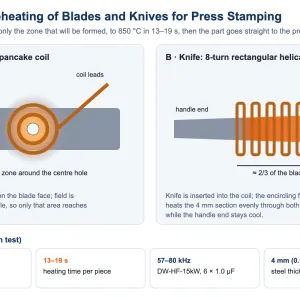
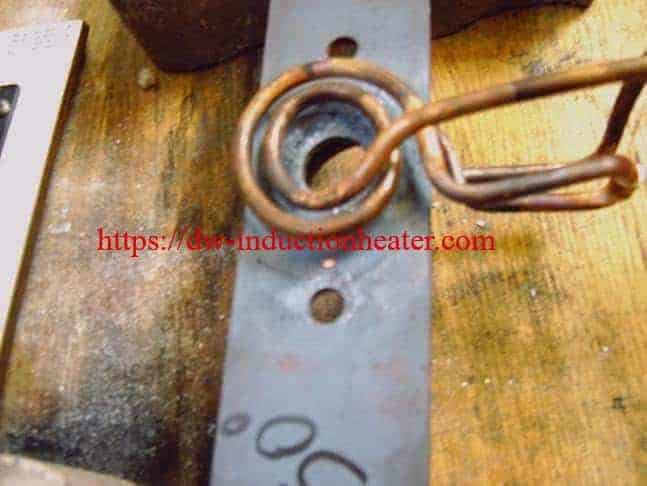
- Blade coil: A flat 2-turn pancake coil sits on the blade face. It concentrates the field around the centre hole, so only that area reaches 850 °C.
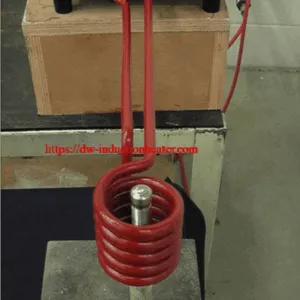
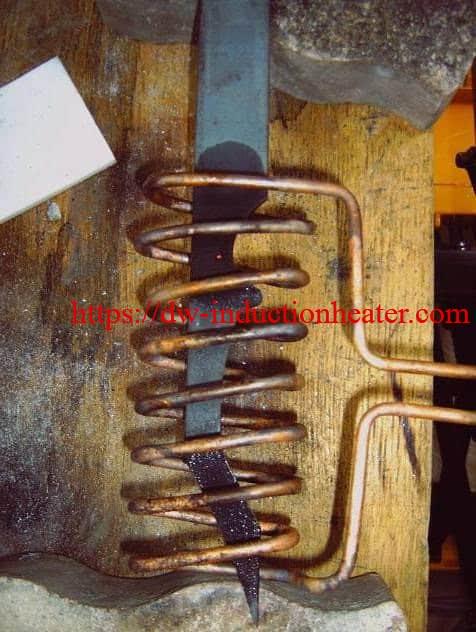
- Knife coil: An 8-turn rectangular helical coil surrounds about two-thirds of the knife blade and heats both faces evenly, while the handle end stays cool.
- Heating depth: Below the Curie point (about 770 °C) the steel heats quickly at the surface. Above it, the current flows about 2 mm deep from each face at 57–80 kHz, so a 4 mm section heats through.
- Forming: When the zone reaches 850 °C (after 13–19 s), the part is transferred to the press and stamped.

Skin depth in 4 mm steel
| Frequency | Cold steel (μr ≈ 100) | Above Curie (≈ 770 °C) | Comment |
|---|---|---|---|
| 30 kHz | 0.12 mm | 3.2 mm | Deep; less efficient on 4 mm |
| 57 kHz | 0.08 mm | 2.3 mm | 2δ ≈ 4.6 mm: good match |
| 80 kHz | 0.07 mm | 1.9 mm | 2δ ≈ 3.9 mm: good match |
| 100 kHz | 0.06 mm | 1.7 mm | Shallower; suits thinner blades |
δ = 503 · √(ρ / (μr · f)), with ρ ≈ 1.6 × 10⁻⁷ Ω·m (cold) and ≈ 1.2 × 10⁻⁶ Ω·m (hot).
Technical Specifications
Application test parameters
| Item | Value |
|---|---|
| Objective | Preheat blades and knives of various sizes for garden tools |
| Material | Steel pieces of various sizes, 0.16 in (4 mm) thick |
| Temperature | 1562 °F (850 °C) |
| Frequency | 57–80 kHz |
| Equipment | DW-HF-15kW induction heating system with a remote workhead containing six 1.0 μF capacitors (6.0 μF in total) |
| Coils | Custom designed: a 2-turn pancake coil for the blades and an 8-turn rectangular helical coil for the knives |
| Heated zone | Blades: the centre hole, heated to 850 °C. Knives: two-thirds of the blade. |
| Heating time | 13–19 s to 850 °C, depending on the piece |
| Next process | Press stamping |
| Results | Hands-free heating with no operator skill needed; configurable heating profiles; faster process times; even heat distribution |
DW-HF high-frequency induction generators
| Model | Max input power | Max input current | Frequency | Input | Duty cycle |
|---|---|---|---|---|---|
| DW-HF-15KW | 15 kVA | 32 A | 30–100 kHz | 1-ph 220 V | 80 % |
| DW-HF-25KW | 25 kVA | 23 A | 20–80 kHz | 3-ph 380 V | 100 % |
| DW-HF-35KW | 35 kVA | 51 A | 20–80 kHz | 3-ph 380 V | 100 % |
| DW-HF-45KW | 45 kVA | 68 A | 20–80 kHz | 3-ph 380 V | 100 % |
| DW-HF-60KW | 60 kVA | 105 A | 20–80 kHz | 3-ph 380 V | 100 % |

Full series details: high frequency induction heating device.
Recommended Model Selection
Power by heated-zone mass and heating time (20 → 850 °C, η 0.6)
| Heated zone mass | In 10 s | In 15 s | In 20 s |
|---|---|---|---|
| 0.05 kg | 4.7 kW | 3.1 kW | 2.3 kW |
| 0.1 kg | 9.3 kW | 6.2 kW | 4.7 kW |
| 0.2 kg | 18.7 kW | 12.4 kW | 9.3 kW |
| 0.4 kg | 37.3 kW | 24.9 kW | 18.7 kW |
P = m · Δh / (t · η), with Δh ≈ 560 kJ/kg for steel from 20 to 850 °C (including the Curie transformation). The test result (15 kW, 13–19 s) matches a heated zone of about 0.2–0.25 kg.
| Requirement | Recommended | Reason |
|---|---|---|
| Small blades and knives; batch work; single-phase supply | DW-HF-15KW | Proven in this test; 80 % duty cycle |
| Continuous production, zone ≤ 0.3 kg | DW-HF-25KW | 100 % duty cycle, 3-phase supply |
| Larger zones or cycles under 10 s | DW-HF-35KW / DW-HF-45KW | More power for shorter cycles; see the 45 kW induction heating equipment |
| Shovels and large plates | DW-HF-60KW or above | Larger heated area |
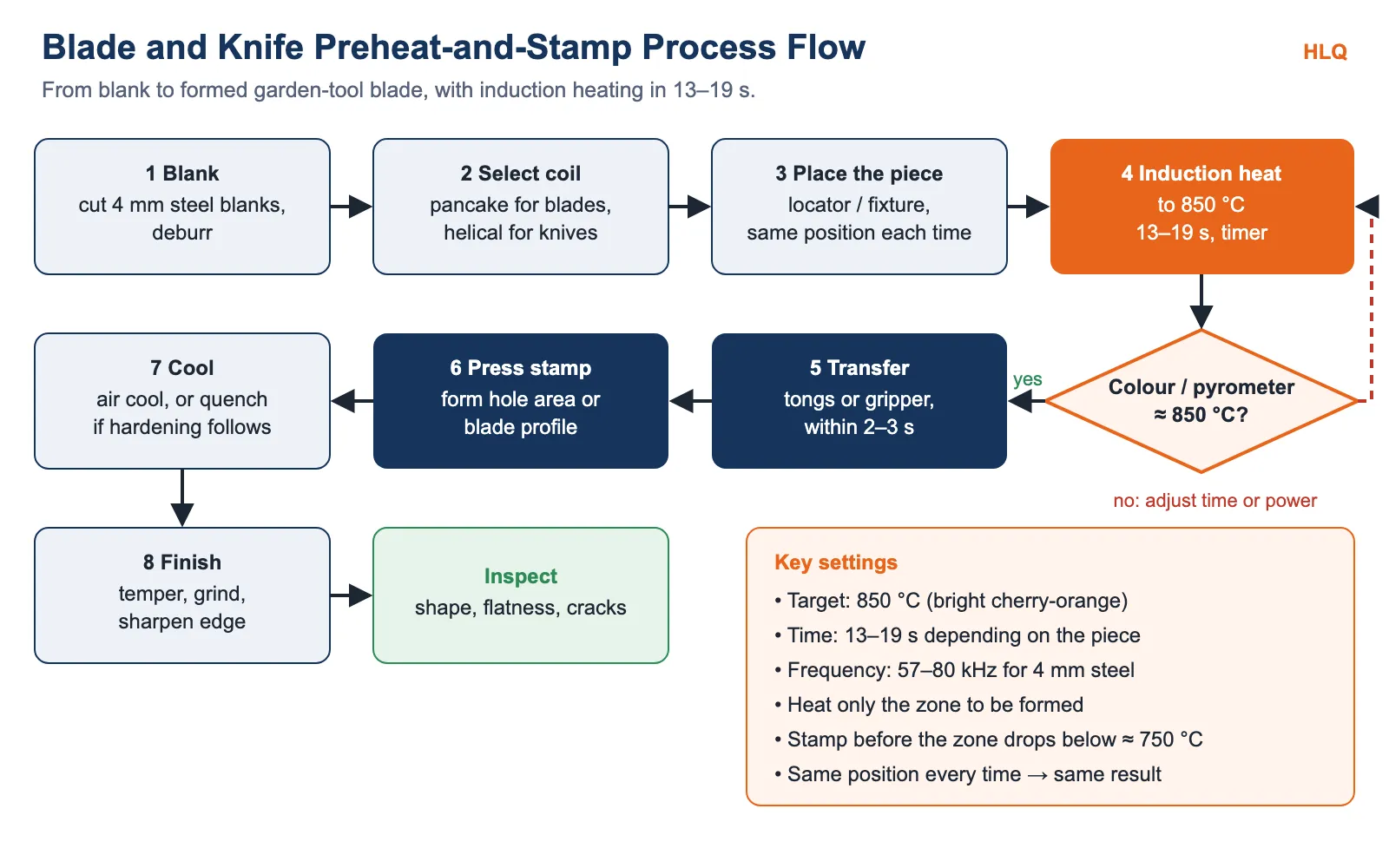
Process Workflow
| Step | Action | Control point |
|---|---|---|
| 1 | Cut and deburr the 4 mm steel blanks | Size and flatness |
| 2 | Fit the coil: pancake for blades, rectangular helical for knives | Correct coil and tuning |
| 3 | Place the piece against a locator | Same position every time |
| 4 | Heat to 850 °C (13–19 s by timer) | Colour check or pyrometer |
| 5 | Transfer to the press within 2–3 s | Zone still above about 750 °C |
| 6 | Press stamp the hole area or the blade profile | Die temperature and stroke |
| 7 | Cool in air, or quench if hardening follows | Cooling method |
| 8 | Temper, grind, sharpen and inspect | Shape, flatness, cracks |
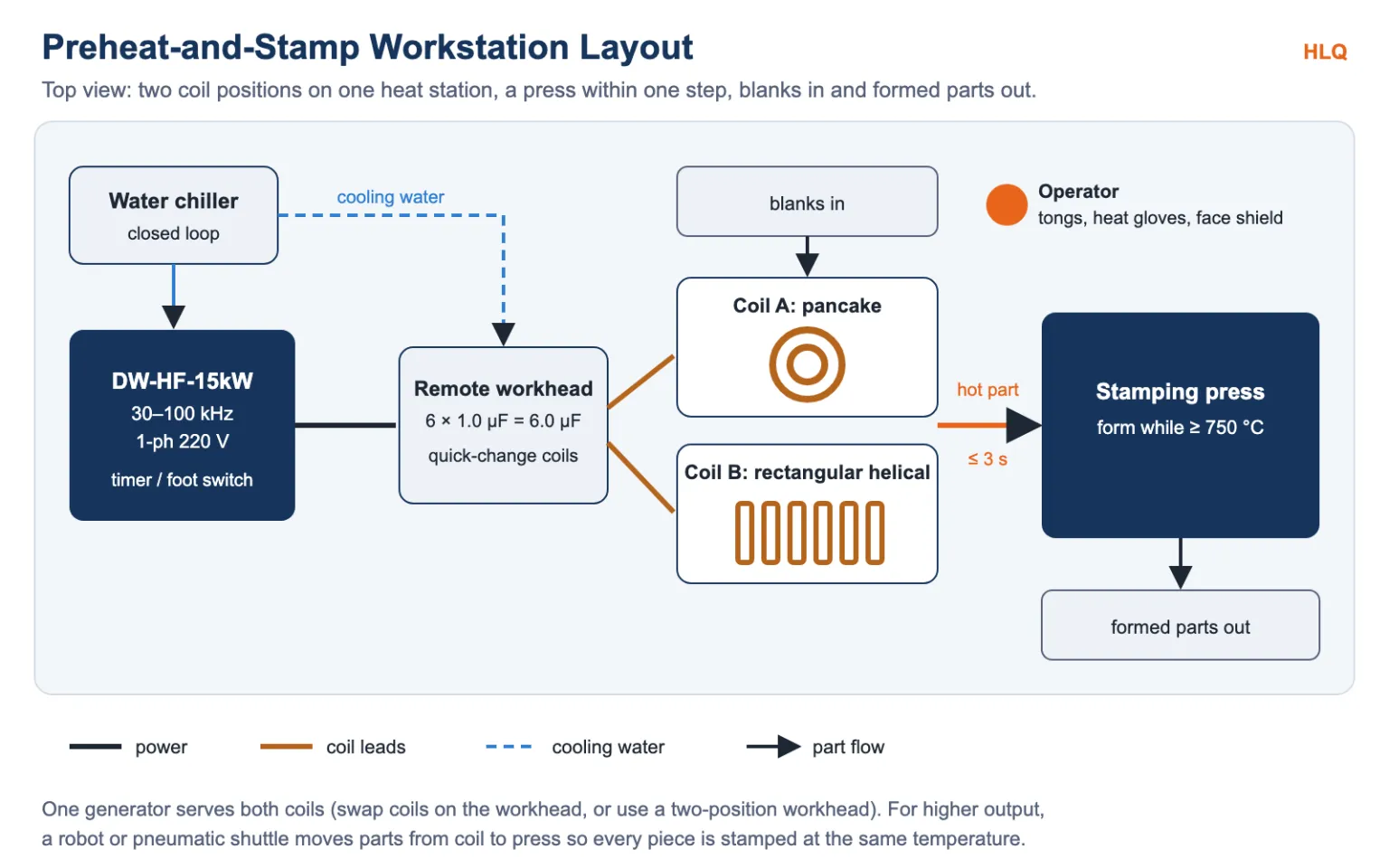
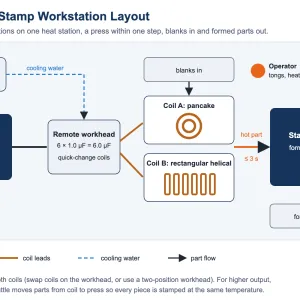
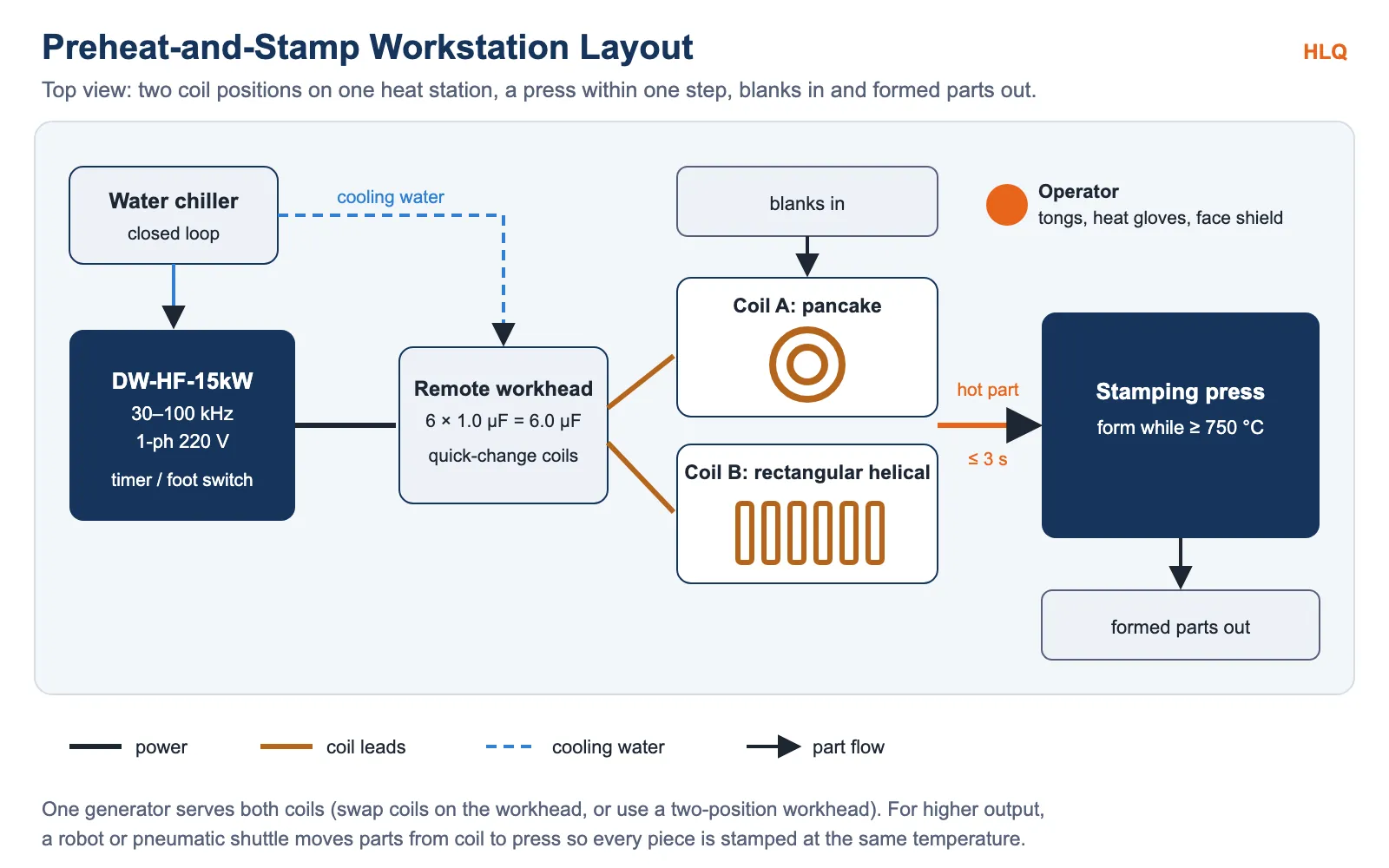
Typical workstation layout
Common Problems and Solutions
| Problem | Likely cause | Solution |
|---|---|---|
| Zone too cold at the press | Transfer takes too long | Move the press closer; use a shuttle; stamp within 2–3 s |
| Uneven heating around the hole | Part off-centre under the pancake coil | Add a locator pin or fixture |
| Knife tip overheats | Thin tip heats faster than the thicker spine | Space the coil turns more widely at the tip, or shorten the time |
| Heated zone too large; part distorts | Coil too wide or heating too long | Narrow the coil; reduce the time |
| Heavy scale | Overheating above 900 °C | Hold at 850 °C; avoid soaking |
| Generator stops on long runs | DW-HF-15KW duty cycle is 80 % | Add pauses or use DW-HF-25KW (100 %) |
Engineering Selection Guide
| Factor | Question to answer | Guideline |
|---|---|---|
| Zone to heat | Hole area, part of the blade, or the whole blank? | Pancake, helical or multi-turn rectangular coil |
| Thickness | 2, 4 or 6 mm? | Choose the frequency from the skin-depth table |
| Zone mass and cycle | How many grams, in how many seconds? | Size the power from the mass-and-time table |
| Output | Pieces per hour? | Over 100/h: 100 % duty model plus shuttle or robot |
| Supply | Single-phase or 3-phase? | Single-phase: DW-HF-15KW; 3-phase: DW-HF-25KW and above |
| Larger parts | Billets, bars or heavy forgings? | See the induction forge furnaces for hot forming and the induction billet heating system |
Advantages and Limitations
| Advantages | Limitations |
|---|---|
| Hands-free heating; no operator skill needed | One coil per part family |
| Configurable heating profiles (time and power) | Fast transfer to the press is required |
| Faster process times: 13–19 s per piece | The generator needs water cooling |
| Even heat distribution in the zone | Thin tips can overheat without coil tuning |
| Only the forming zone is heated, so less scale and distortion | Stainless grades heat less efficiently |
Why Choose HLQ?
| Strength | What it means for you |
|---|---|
| Custom coils | Pancake, rectangular helical, hairpin and multi-turn coils for your parts |
| DW-HF 15–160 kVA platform | From bench tests to production lines |
| Proven forming cycles | 850 °C in 13–19 s on 4 mm steel |
| Integration | Timer, pyrometer, shuttle and press interlocks |
| Application testing | Coils and cycles proven on your blanks |
For welding-related preheating, see induction preheating for welding.
10 Core FAQs
1. What temperature are the blades and knives heated to?
850 °C (1562 °F) in the zone to be formed.
2. How long does heating take?
13–19 seconds per piece with a DW-HF-15kW, depending on the piece.
3. Which parts of the blade and knife are heated?
For blades, the centre-hole area. For knives, about two-thirds of the blade. The rest of the part stays cool.
4. Which coils are used?
A 2-turn pancake coil for the blades and an 8-turn rectangular helical coil for the knives, both designed for this application.
5. Which frequency is used, and why?
57–80 kHz. Above the Curie point the current flows about 2 mm deep from each face, which heats a 4 mm section through.
6. What capacitors does the workhead use?
Six 1.0 μF capacitors, 6.0 μF in total.
7. What happens after heating?
The hot piece is press stamped. Hardening and tempering can follow if required.
8. Is DW-HF-15KW suitable for continuous production?
Its duty cycle is 80 %, so it suits batch work. For continuous lines, DW-HF-25KW (100 % duty, 3-phase) is recommended.
9. Can stainless steel knives be heated?
Yes. Martensitic stainless steels heat less efficiently, so expect longer cycles or more power.
10. What are the main benefits over a gas forge?
Hands-free and repeatable heating, configurable profiles, faster cycles, even heat in the zone, and less scale and distortion.