

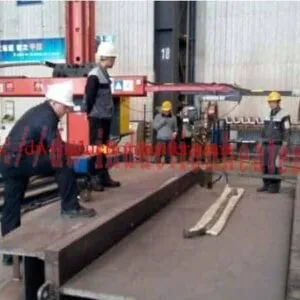
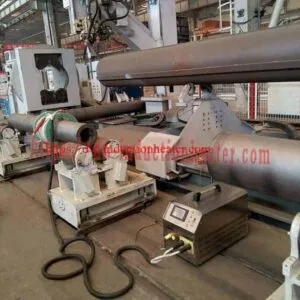

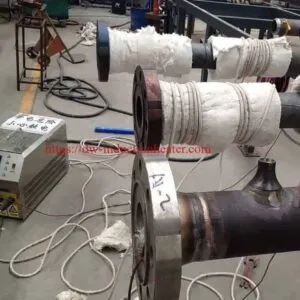
portable welding heater by induction
Portable Welding Heater by Induction: MYD Series Air-Cooled Weld Preheat Unit, 40–120 kW
A portable welding heater by induction is a self-contained induction heating power unit that goes to the joint. It takes three-phase electricity on site, drives a flexible cable coil that is wound around the pipe or laid along the plate seam, and induces the current in the steel itself, so the heat is generated in the metal that has to be preheated rather than in a burner flame beside it. HLQ builds this machine in the MYD series, and the published MYD catalogue covers six models from MYD-40KW to MYD-120KW in an air-cooled cabinet that needs no cooling-water plant below 100 kW.
What makes it a portable unit rather than a stationary furnace is published in three numbers: the cabinet is air-cooled and works in an ambient of -10 °C to 40 °C, the induction coil is 10 – 45 metres of high-temperature cable, so the power unit can stay in the vehicle or the site cabin while only the coil travels to the joint, and the machine itself weighs 120 kg net, 155 – 260 kg with parts, in a packing case of 900 × 660 × 1560 mm, with the published comparison table adding that the cooling type is air cooling below 100 kW and water cooling at 100 kW and above. The complete MYD series specification, the published parts list and the comparison against ceramic pad heating are set out below, together with the calculation that sizes a unit for a particular joint.

Quick Answer
The HLQ MYD series is an air-cooled, DSP-controlled induction heating system used for weld preheat, post-weld heat treatment, stress relief, coating, bending, fitting and unfitting, and pipeline material heating. The published MYD catalogue covers six models from 40 kW to 120 kW. The companion MYDS series is the simplified preheat-only version.
Portable welding heater — the key published figures at a glance
| Parameter | Published value |
|---|---|
| Model series | MYD-40KW, MYD-50KW, MYD-60KW, MYD-80KW, MYD-100KW, MYD-120KW |
| Output power | 40 kW – 120 kW |
| Input current | 60 A – 180 A |
| Output frequency | 2 kHz – 30 kHz |
| Electrical supply | 3 × 380 VAC (default), 3 × 220 VAC and 3 × 440 VAC optional, 50 / 60 Hz |
| Cooling | Air cooling; the published comparison table lists water cooling at 100 kW and above |
| Maximum temperature | 900 °C |
| Heating rate capability | 5 – 400 °C per minute |
| Heating parts size range | Ø 100 – 1500 mm |
| Control | DSP control with a PLC touch screen, 6 channels of temperature control, 10 stored curves |
| Temperature tolerance | ±3 °C |
| Thermocouple | K type, 5 – 45 metre link cable |
| Induction coil | 10 – 45 metre high-temperature cable, air cooled |
| Cabinet size | 800 × 560 × 1350 mm |
| Packing size | 900 × 660 × 1560 mm |
| Net weight / gross weight with parts | 120 kg / 155 – 260 kg |
| Published energy saving against resistance heating | 30 % – 80 % |
| Working ambient | -10 °C to 40 °C for the air-cooled unit |
The full published MYD catalogue is available as the MYD series induction heating machine catalogue.
Table of Contents
- Quick Answer
- What is the Portable Welding Heater by Induction?
- Key Applications
- Suitable Materials
- Working Principle
- Technical Specifications
- Recommended Model Selection
- Process Workflow
- Common Problems and Solutions
- Engineering Selection Guide
- Advantages and Limitations
- Why Choose HLQ?
- 6 Core FAQs
What is the Portable Welding Heater by Induction?
The published product name on this page is the portable welding heater, and the published alternative names are welding pre-heater and induction weld heater for pipeline. All three describe the same machine: an induction heating power unit that takes the electricity and the control to the work, rather than taking the work to the furnace. The MYD series is what HLQ publishes for that duty, and the catalogue states its scope directly: the MYD series of induction heating systems are used for weld, bending, piping, coating, fitting, stress relief, pre-weld heat and post-weld heat treatment.
Three published points separate this machine from a conventional resistance or flame heater, and each one is a decision the buyer makes on site rather than in the plant.
It is air-cooled, so it does not need a cooling-water plant. The MYD catalogue lists the cooling as air cooled and the features section states that the air cooling works well at -10 °C to 40 °C. The published MYD versus MYDS comparison table does add one qualification, and it matters at the top of the range: the cooling type is published as air cooling with water at 100 kW and above, so the MYD-100KW and MYD-120KW carry water cooling and the smaller models do not. On a pipeline site, on a ship or on a bridge, removing the cooling-water plant from the list of things that have to be trucked in, connected, monitored and winterised is the single biggest practical difference between a portable induction heater and a fixed resistance heater bank.
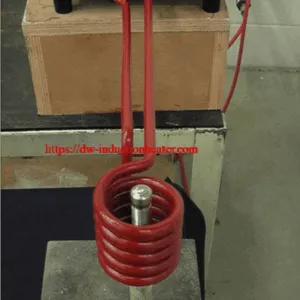
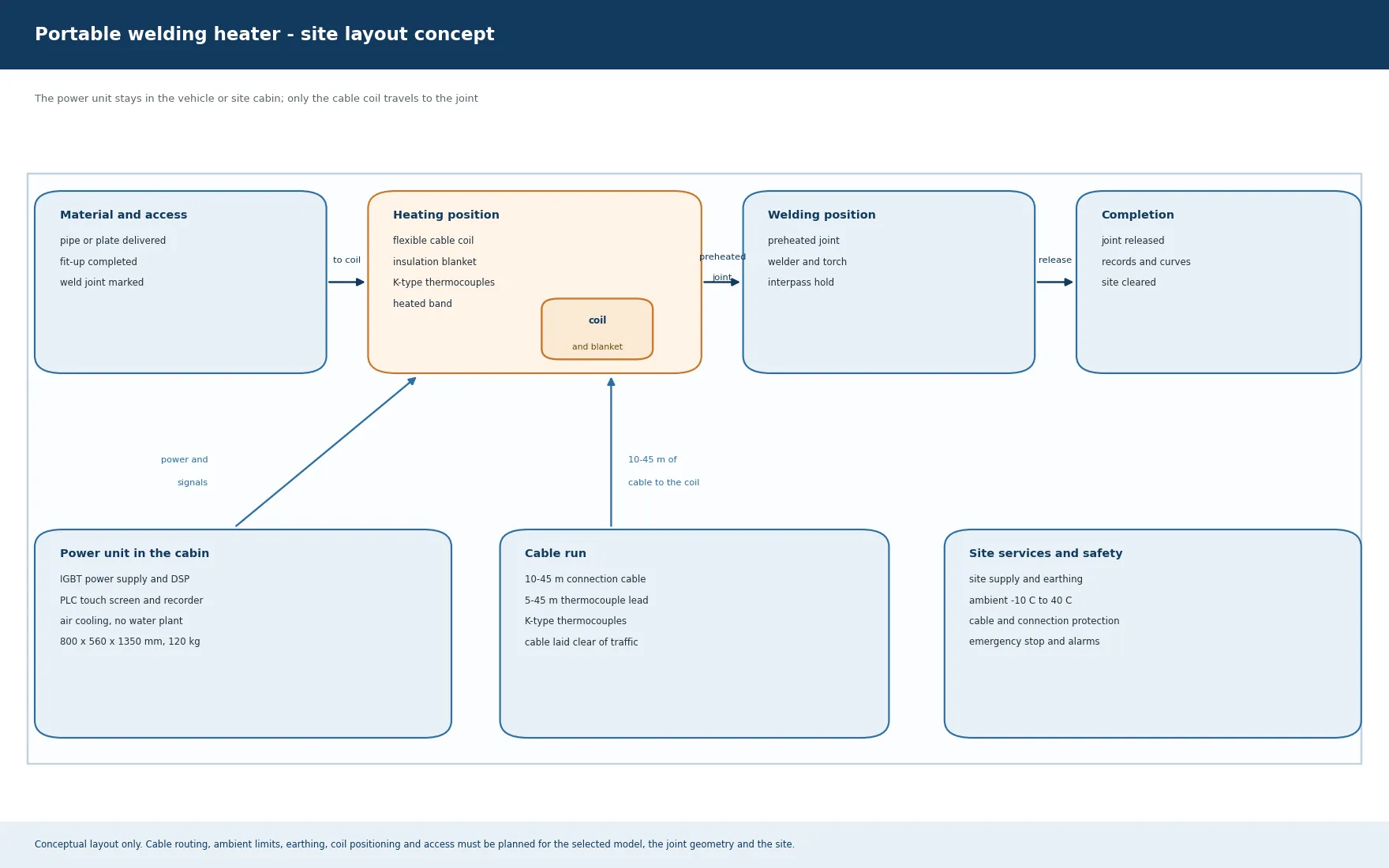
The coil travels; the machine does not have to. The published induction coil is 10 – 45 metres of high-temperature cable, and the thermocouple link cable is 5 – 45 metres. That reach is what makes the arrangement portable in the useful sense: the power unit, the PLC and the recorder can stay in the vehicle or the site cabin, and only a flexible coil, an insulation blanket and a few thermocouples go to the joint.
The control is a programmed cycle, not a hand on a dial. The MYD series is DSP controlled with a PLC touch screen, 6 channels of temperature control and 10 stored curves, and the published temperature tolerance is ±3 °C. The DSP tracks the resonant frequency as the load changes, which matters on a weld preheat because the coil is moved to a different joint and the inductance changes every time.
There is a second series worth knowing about, because the two are often confused. The published MYD versus MYDS comparison puts MYD at a 900 °C maximum temperature with curve storage, USB export, a recorder connector and remote control, and MYDS at 600 °C with a 4.3 inch screen and no recording functions. MYDS is the preheat-only version; MYD covers both preheat and post-weld heat treatment. If your procedure requires a recorded chart for every joint, that is the MYD decision, and it is covered in detail on the IGBT PWHT machine with DSP and PLC control page.
What the machine replaces is the other half of the question. HLQ publishes a direct comparison against ceramic pad heating elements, and the differences are mechanical as much as electrical:
| Item | Induction | Ceramic |
|---|---|---|
| Heat | Direct | Transfer |
| Insulation | Inner | Outer |
| Heating elements | Less hot | Hot |
| Heating lost | Less | More |
| Speed | High | Low |
| Efficiency | High | Low |
| Uniformity | More | Less |
For a welder, that comparison is the practical argument: the induction coil is the working element and it sits on the cold side of the insulation, whereas ceramic pads are the hot element and they sit outside it. On a joint that has to reach a preheat temperature quickly and then be welded, that difference is the difference between a short cycle and a long one.

Key Applications
The published main applications for this product are given as four duty groups:
| Published duty group | Published scope |
|---|---|
| Preheat | Weld heat, coating, spraying, bending, fitting and unfitting heat |
| Post-weld heat treatment | Tank, boiler, pipeline, steel sheet or other metal jobs |
| Induction heat | Mould heating, shipboard, zinc bath, large and irregular metal parts |
| Pipeline material heat | Pipeline oil, pipeline gas, pipeline water, pipeline petrochemical and other pipeline material |
The MYD series pages add a second, more specific list of the same machine’s jobs:
| No. | Published MYD application |
|---|---|
| 1 | Weld joint heating and heat treatment (PWHT): steel pipeline, steel structure and steel sheet |
| 2 | Heating and insulation: pipeline liquid, reactor, kettle, boiler, tank |
| 3 | Thermal assembly heating: bearing, axle sleeve, engine motor and motor shell |
| 4 | Hot drying: food material, metal, printing film drying and heat-shrink film |
| 5 | Factory warming: oil, gas and water heating |
| 6 | Coating heating: pipeline, steel board |
| 7 | Melting: copper, aluminium, tin, zinc, lead |
For the preheat side of the work, the published MYD-versus-MYDS application table shows both series covering preheat, weld heat, thermal assembly, reactor heating, tank heating, injection mould heating and heating of water, gas, oil and pipeline liquid, with the difference that MYD additionally covers post-weld heat treatment.
The published using fields for the series are: petrochemical, oil and gas pipelines, aerospace, shipbuilding, steel, tanks, boilers, vessels, pressure vessels, cylinders, metal structure, spatial structure, railway bridges, electricity water, mine construction, vehicle manufacturing, nuclear power, mining, plastics processing, energy saving process, mould and screw barrel industries.
Five field heating samples are published in the MYD catalogue: hot fitting and unfitting heating, post weld heat treatment, pre-weld heat, heat for coating and painting, and pipeline materials heating. The preheat duty that most often decides the purchase is the one that makes the weld possible in the first place — and for that, the published pipeline heating route is set out on the induction pipeline coating machine page, while the code-compliant post-weld side is covered on the induction PWHT system for oil and gas pipeline welding projects page.
The four duty groups above are the product page’s own summary. The diagram below sets the same four groups against the published class that covers each, and lists the industries HLQ names for the series.

Suitable Materials
Induction heating works on electrically conductive metal, so the workpiece has to be a metal that will carry an induced current: carbon steel, stainless steel, the alloy steels used in pressure equipment, copper, brass and aluminium. The published MYD melting application names copper, aluminium, tin, zinc and lead, which is the practical confirmation that the machine is not limited to ferrous work.
Two qualifications matter more for this application than for most, and both are published.
The lining and the coating are the real limit on temperature. The published maximum temperature of the MYD series is 900 °C, and the published insulation blanket options are rated 800 °C at 1500 × 600 × 50 mm and at 900 × 600 × 50 mm. A preheat job on a coated or lined pipe is therefore governed by the coating’s own temperature rating, not by the machine’s capability, and the published blanket rating is often the lower of the two.
The target temperature belongs to the welding procedure, not to the heater. The preheat temperature for a joint is set by the welding procedure specification for that material, thickness and joint design. What the machine is responsible for is reaching it, holding it while the welder works and recording that it did. Nothing published on this product page sets a preheat temperature, and no such figure should be taken from a supplier page in place of the procedure.
What the machine does publish is the capability envelope that the procedure has to fit inside: up to 900 °C, a heating rate of 5 – 400 °C per minute, and ±3 °C of temperature control on up to 6 channels. For a job with a code-limited heating rate — post-weld heat treatment on pressure equipment is the usual case — that capability has to be programmed down to the procedure’s rate, and the code limits are set out on the post weld heat treatment machine page.

Working Principle
The heating chain is the standard induction chain, and the published MYD architecture is a three-layer control system.
Power. Three-phase supply is rectified and filtered into a DC bus, and a full bridge of IGBT devices switches that bus into alternating current at the machine’s output frequency of 2 – 30 kHz. The alternating current feeds a resonant tank and then the flexible cable coil. The control architecture itself is described in the HLQ medium frequency series pages, which record that the inverter technology uses a parallel oscillating circuit with soft-switching resonance dual control and frequency tracking. The MYD catalogue itself lists the DSP control, the 6-channel control and the 10-curve recorder as the published features of this machine.
The inner loop. The DSP generates the gate signals, measures current and voltage, tracks the resonant frequency of the tank and regulates output power. On a portable preheat unit the load changes every time the coil is moved to a new joint — different diameter, different wall thickness, different distance between the coil and the steel — so automatic frequency tracking is what allows one program to be reused from joint to joint rather than retuned at each weld.
The outer loop. The PLC reads up to 6 K-type thermocouples and compares them with the programmed ramp, hold and cool, sends a power set point to the DSP, and holds every channel within ±3 °C. It stores up to 10 heating curves for USB export, and the published ER-1006 recorder keeps an independent log.
The physical mechanism at the joint is worth being precise about, because it is what makes the heat uniform in the band. The current is induced in the steel wall of the pipe or plate — the field does the work inside the metal, not around it. Because the induced current is concentrated near the surface, the heat is generated in a thin layer and then conducts inward. That is why the published heating rates are moderate rather than instantaneous, why the insulation blanket matters so much to the result, and why a code-limited heating rate is a sensible way to run the machine rather than a limitation imposed on it.
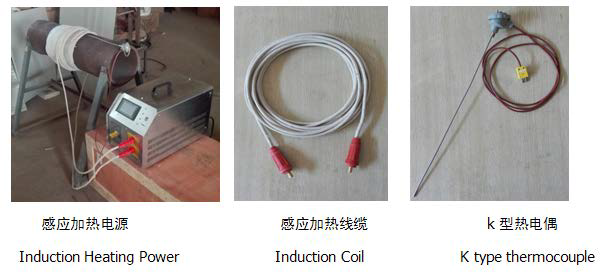
What makes the arrangement portable is the separation of the parts. The power unit, the DSP, the PLC and the recorder stay where the supply is. The coil, the blanket and the thermocouples travel to the joint on 10 – 45 metre leads. The published option parts are the induction heating power with DSP control, the induction coil as a clamp or soft coil, the connection cable linking the coil to the power, the temperature controller as a PLC touch screen, the temperature recorder with printer optional, the K-type thermocouple with its cable, and the insulation blanket. The complete published list, with the three coil versions and both blanket sizes, is in section 4.
The published features of the series make the same point in the manufacturer’s own terms: the air cooling works well at -10 °C to 40 °C; the induction heating power heats the work job with an insulation blanket around it, giving high heating speed and high heating efficiency with little energy lost; the PLC touch screen is intuitive to see and easy to operate; the soft induction coil is easy to wind on different work pieces; the removable opening induction coil is easy to operate and move; the temperature recorder records the whole heating curve; and the temperature controller heats according to the requirement details with a ±3 °C tolerance.

Read the diagram from the left. The site supply feeds the IGBT inverter and its DSP, the PLC and recorder hold the programmed cycle, and the cabinet stays where the supply is. The output cable runs out to the joint, where the flexible coil is wound around the pipe and the insulation blanket and K-type thermocouples sit over the band. The current is induced in the steel wall itself, and the heat then conducts inward to the root.

Technical Specifications
1. MYD series models — as published in the MYD catalogue
| Parameter | MYD-40KW | MYD-50KW | MYD-60KW | MYD-80KW | MYD-100KW | MYD-120KW |
|---|---|---|---|---|---|---|
| Output power | 40 kW | 50 kW | 60 kW | 80 kW | 100 kW | 120 kW |
| Input current | 60 A | 75 A | 90 A | 120 A | 150 A | 180 A |
| Input power | 3 × 380 VAC (default), 3 × 220 VAC (optional), 3 × 440 VAC (optional), 50 / 60 Hz | 3 × 380 VAC (default), 3 × 220 VAC (optional), 3 × 440 VAC (optional), 50 / 60 Hz | 3 × 380 VAC (default), 3 × 220 VAC (optional), 3 × 440 VAC (optional), 50 / 60 Hz | 3 × 380 VAC (default), 3 × 220 VAC (optional), 3 × 440 VAC (optional), 50 / 60 Hz | 3 × 380 VAC (default), 3 × 220 VAC (optional), 3 × 440 VAC (optional), 50 / 60 Hz | 3 × 380 VAC (default), 3 × 220 VAC (optional), 3 × 440 VAC (optional), 50 / 60 Hz |
| Output frequency | 2 kHz – 30 kHz | 2 kHz – 30 kHz | 2 kHz – 30 kHz | 2 kHz – 30 kHz | 2 kHz – 30 kHz | 2 kHz – 30 kHz |
| Cooling | Air cooling | Air cooling | Air cooling | Air cooling | Air cooling | Air cooling |
| Heating size range | Ø 100 – 1500 mm | Ø 100 – 1500 mm | Ø 100 – 1500 mm | Ø 100 – 1500 mm | Ø 100 – 1500 mm | Ø 100 – 1500 mm |
All six models share the published cabinet size of 800 × 560 × 1350 mm, the packing size of 900 × 660 × 1560 mm, the net weight of 120 kg and a gross weight with parts of 155 – 260 kg. The published DSP control specification is a maximum of 900 °C, a heating speed of 5 – 400 °C per minute, 6 channels of control and a 10-curve recorder. The published main parts are the induction coil, the connection cable, the insulation blanket, the K-type thermocouple, the thermocouple connection cable and the R-1006 temperature recorder.
One point on the input current column: the catalogue does not state the voltage basis or the rating method for these figures, so confirm the actual input demand, the power factor, the efficiency, the cable requirements and the protective devices from the final electrical documentation before they are used for cable sizing.
2. MYD shared specification — as published in the MYD catalogue
| Item | Published value |
|---|---|
| Input voltage | 380 V, 3 phase, 50 / 60 Hz |
| Output frequency | 2 kHz – 30 kHz |
| Output power | Listed in the catalogue bullet list as 2 kW – 40 kW |
| Cooling | Air cooled |
| Heating speed | 5 – 400 °C per minute |
| Heating temperature range | -30 °C – 900 °C |
| Heating parts size range | Ø 100 – 1500 mm or equal |
| Induction coil | 10 – 45 metres long high-temperature cable with air cooling |
| Temperature recorder | 6 channels for temperature controlling |
| Thermocouple | K type, 5 – 45 metres long link cable |
| Size | 800 × 560 × 1350 mm |
| Net weight | 120 kg |
| Packing size | 900 × 660 × 1560 mm |
| Gross weight | 155 kg in the bullet list, 155 – 260 kg with parts in the model table |
| Option parts | Induction heating power; induction coil (clamp or soft); connection cable; temperature controller; PLC touch screen; temperature recorder with printer; K-type thermocouple and connection cable; insulation blanket |
| Published comparison with resistance heating | Uniform; high speed; energy saving 30 % – 80 % |
3. MYD against MYDS — the published series comparison
| Item | MYD | MYDS |
|---|---|---|
| Power (kW) | ≦ 360 | ≦ 360 |
| PLC screen | 10 inch | 4.3 inch |
| Cooling type | Air cooling, water at 100 kW and above | Air cooling, water at 100 kW and above |
| Coil cooling | Air for preheat, water for PWHT | Air |
| Maximum temperature | 900 °C | 600 °C |
| Power size | 10 – 360 kW | 2.5 – 360 kW |
| Coil length | 10 – 50 m | 30 – 80 m |
| USB, recorder connector, curve storage, remote control | Yes | No |
| DSP, thermocouple connector, coil connector | Yes | Yes |
| Post-weld heat treatment | Yes | No |
| Preheat, weld heat, thermal assembly, reactor, tank and mould heating, water, gas, oil and pipeline liquid heating | Yes | Yes |
The published power size of 10 – 360 kW for MYD and 2.5 – 360 kW for MYDS is wider than the six-model catalogue listed in section 1. The catalogue covers MYD-40KW to MYD-120KW; the comparison table gives the series a larger published envelope. Confirm the model list for the configuration you are ordering.
4. Published optional parts list for the MYD series
| No. | Heater and parts | Remark |
|---|---|---|
| 1 | MYD-40KW heater | — |
| 2 | MYD-50KW heater | — |
| 3 | MYD-60KW heater | — |
| 4 | MYD-80KW heater | — |
| 5 | 25 m cable coil (air cooling) | Quick heat |
| 6 | 25 m cable coil (water cooling) | — |
| 7 | 25 m cable coil (high temperature) | — |
| 8 | Insulation blanket, 800 °C, 1500 × 600 × 50 mm | — |
| 9 | Insulation blanket, 800 °C, 900 × 600 × 50 mm | — |
| 10 | K-type thermocouple with 2 m cable | — |
| 11 | Thermocouple extension cable, 10 m | — |
| 12 | Connection cable for coil, 10 m | — |
| 13 | ER-1006 temperature recorder | — |
The published cable coil options are worth noting against the catalogue text: the parts list offers 25 m cable coils in three versions — air cooled for quick heat, water cooled, and high temperature — while the catalogue bullet list describes a single 10 – 45 metre high-temperature air-cooled cable. The insulation blanket options are both rated 800 °C, which is below the published 900 °C machine maximum, and the blanket is what limits a long-hold job in practice.
5. The smaller portable MYD unit
HLQ also publishes a smaller portable induction heater on the portable preheat welding machine with induction page. It is a different machine with a different specification, and it is worth keeping separate from the MYD table above:
| Item | MYD-20KW | MYD-10KW |
|---|---|---|
| Input voltage | 3 × 380 V, 50 / 60 Hz, 4 wires | 3 × 380 V, 50 / 60 Hz, 4 wires |
| Input current | 1 ~ 30 A | 1 ~ 15 A |
| Output current | 0 ~ 300 A | 0 ~ 200 A |
| Output power | 1 ~ 20 kW | 1 ~ 10 kW, max 15 kW at 150 % duty cycle |
| Output frequency | 5 – 30 kHz | 5 – 30 kHz |
| Heating temperature | Max 800 °C | Max 500 °C |
| Size | 700 × 330 × 410 mm | 650 × 310 × 410 mm |
| Weight | 32 kg | 26 kg |
| Induction heating coil | 10 – 20 m, 15 mm diameter, working -30 – 45 °C | 10 – 20 m, 15 mm diameter, working -30 – 45 °C |
| Pipeline size | OD 50 – 500 mm or equivalent | OD 50 – 500 mm or equivalent |
That machine is the bench unit: 26 kg or 32 kg, a 15 mm coil, and a pipeline range of OD 50 – 500 mm. The MYD-40KW to MYD-120KW machines above are the site units, and the full published specification of the small machine is on the portable preheat welding machine with induction page.
6. Published differences between the HLQ sources — read before quoting a figure
| Item | One published value | Another published value |
|---|---|---|
| Output power of the series | 40 – 120 kW across the six catalogue models | Power size 10 – 360 kW in the MYD versus MYDS comparison table |
| Output power in the catalogue bullet list | 2 kW – 40 kW | 40 – 120 kW in the catalogue model table |
| Converter cooling | Air cooling in the catalogue model table | Air cooling, water at 100 kW and above, in the comparison table |
| Coil length | 10 – 45 m in the catalogue bullet list | 10 – 50 m in the MYD row of the comparison table |
| Recorder designation | R-1006 in the catalogue main-parts list | ER-1006 in the published parts list |
| Gross weight | 155 kg in the catalogue bullet list | 155 – 260 kg with parts in the catalogue model table |
| The issuing branch named on the documents | HLQ Induction Equipment Co., Ltd, branch Quanzhou Shuimu Induction Equipment Co., Ltd, in the company manual | Qingdao Shuimu Induction Equipment Co., Ltd, in the letterhead of the MYD catalogue itself |
| Meaning of -30 °C | Heating temperature range -30 °C – 900 °C in the catalogue bullet list | The air-cooled unit works at an ambient of -10 °C to 40 °C, and the coil working temperature of the small MYD-10KW and MYD-20KW bench unit is published separately as -30 – 45 °C |
Every figure quoted in this page comes from one of those published sources, and where two of them disagree the disagreement is shown rather than resolved. Confirm the value you quote against the final datasheet for the model you are ordering.

Recommended Model Selection
Selection runs from the joint to the machine, not the other way round. The joint sets the heated mass; the heated mass sets the thermal demand; the thermal demand sets the output power; and the output power sets the model. The diameter alone will not do it, because a 500 mm pipe with a 6 mm wall and a 500 mm pipe with a 25 mm wall differ by a factor of four in mass, and a wide heated band costs power that a narrow one does not.
For a pipe band with outside diameter D, wall thickness t and heated width L, the heated mass and the thermal demand are:
| Quantity | Formula | Unit |
|---|---|---|
| Heated mass | m = ρ × π × (D × t – t²) × L | kg |
| Sensible heat | Q = m × cp × ΔT | kJ |
| Output power | P = Q / (ηeffective × τ) | kW |
Use metres, kg/m³, kJ/(kg·K) and seconds, and Q comes out in kJ and P in kW. For carbon steel the published assumptions used elsewhere on this site are a density of 7,850 kg/m³ and an average heat capacity of 0.490 kJ/(kg·K), with an effective output-to-steel heating factor of 70 % and an illustrative design allowance of 20 % on top.
Published worked example
| Input | Value |
|---|---|
| Workpiece | 508 mm outside diameter steel pipe, 12.7 mm wall |
| Heated band width | 300 mm |
| Temperature rise | 25 °C to an assumed 230 °C |
| Assumptions | Density 7,850 kg/m³, average heat capacity 0.490 kJ/(kg·K), 70 % effective output-to-steel heating factor |
| Heated mass | ≈ 46.54 kg |
| Sensible heat | ≈ 4,675 kJ |
Power-class screening for that joint
| Candidate model | Listed output | Calculated heating time |
|---|---|---|
| MYD-40KW | 40 kW | 167 seconds |
| MYD-50KW | 50 kW | 134 seconds |
| MYD-60KW | 60 kW | 111 seconds |
| MYD-80KW | 80 kW | 83 seconds |
| MYD-100KW | 100 kW | 67 seconds |
| MYD-120KW | 120 kW | 56 seconds |
Those times exclude handling, equalisation, hold, coating and inspection. On the same assumptions a 90-second heating allowance needs about 74.2 kW, and adding the illustrative 20 % design allowance gives 89.0 kW, which makes the MYD-100KW a candidate for evaluation rather than an automatic choice. The 230 °C in that example is a calculation input, not a universal preheat setpoint, and the effective factor represents simplified coupling and heat retention — it is separate from the converter’s electrical efficiency. A real trial has to account for the adjoining pipe, conduction, wind, insulation and any required hold.
Two further selection points are published. The heating parts size range of Ø 100 – 1500 mm is the coverage claim for the coil and cable set, not a guarantee that every pipe in that range can be preheated with the same unit — the power has to match the mass. And the coil, not the machine, is the part that is changed from job to job: the published options are a clamp induction coil and a soft induction coil, in 25 m lengths, in air-cooled, water-cooled and high-temperature versions.

Process Workflow
One preheat cycle on site, in eight steps, with the check that closes each step.
| Step | Action | Check |
|---|---|---|
| 1 | Prepare the joint: clean the steel, mark the band and complete the fit-up | Surface condition and fit-up |
| 2 | Fit the coil: wind the flexible coil on the pipe or lay it along the plate seam | Coil spacing and clearance |
| 3 | Wrap insulation: fit the ceramic-fibre blanket over the band | Insulation gaps closed |
| 4 | Attach sensors: fit K-type thermocouples at the control points | Sensor contact on clean steel |
| 5 | Connect and set: power, coil and sensor cables; enter the program | Supply phases and the ramp rate |
| 6 | Run the ramp: heat the band to the preheat temperature | Band temperature, not coil temperature |
| 7 | Hold and verify: hold at the preheat temperature and check the band | The whole band, hot and cold spots |
| 8 | Weld and release: weld with the interpass hold, then release the coil | Joint temperature and records |
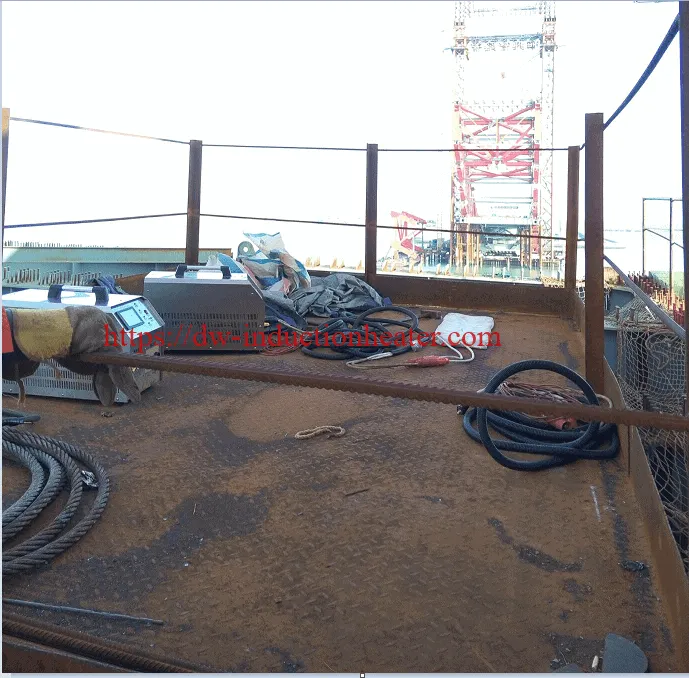
Steps 6 and 7 are where the quality of the joint is decided. The machine’s sensor is in the steel, not in the coil, and the published control tolerance is ±3 °C — but the tolerance is only achieved if the thermocouple is fixed to clean metal and is not sitting under the conductor path. The published fault list on this equipment includes channels that oscillate around the set point because the thermocouple is loose or has been placed under the cable, and a channel that lags behind the others because the coil spacing or the insulation gap is uneven. Both are operator problems rather than machine problems, and both are cheaper to fix on the ground than to diagnose in the cabinet.

The cycle above is the preheat side. The same machine and the same coil run the post-weld heat treatment cycle when the procedure calls for a ramp, a soak and a controlled cool; that duty, and the code ranges that go with it, are covered on the post weld heat treatment machine page.
Common Problems and Solutions
The rows below are consolidated from the published HLQ troubleshooting and fault guidance for the MYD series and for the induction heating equipment generally.
| Problem | Likely cause | Solution |
|---|---|---|
| Output power drops above about 750 °C | The steel passes the Curie point and the load changes | Normal: the DSP re-tracks. If power falls too far, check the coil turns and spacing |
| Channels oscillate around the set point | Thermocouple loose or placed under the cable | Re-attach the thermocouple on clean metal, outside the conductor path |
| One channel lags behind the others | Uneven coil spacing or an insulation gap | Even out the coil turns and close the insulation gaps |
| Fault alarm at start-up | Coil not connected, a phase missing, or the wrong load | Check the couplings and the supply phases, and read the on-screen error box |
| Heating rate exceeds the procedure limit | Program ramp not set; the machine capability is up to 400 °C/min | Enter the procedure rate in the program |
| Uneven band temperature | Variable coil spacing, asymmetric geometry or heat loss | Adjust the positioning and map temperatures around and along the band |
| Heating takes too long | High thermal mass, poor coupling or insufficient delivered power | Recalculate the load; check the supply under load and the coil matching |
| Temperature readings fluctuate | Unstable sensor contact, cable damage or electrical interference | Inspect the attachment, the compensation cable and the signal routing |
| Cooling or over-temperature alarm | Restricted airflow, a cooling-circuit fault or an unsuitable duty | Inspect the configured cooling system and confirm the permitted operating duty |
| Missing curve in the export | Recording not started, or the memory is full | Start recording before heating, and export and clear the stored curves |
| Process interrupted by a power cut | Site supply failure | The machine protects itself; resume according to the procedure’s interruption rules |
Most of these are set-up problems rather than machine faults, and the published guidance is consistent about that: check the coil spacing, the insulation gap, the thermocouple attachment and the supply before touching the controls. The one behaviour that looks like a fault but is not is the power drop as the steel passes the Curie point, because the DSP re-tracks the resonant frequency as the load changes and the output recovers on its own.

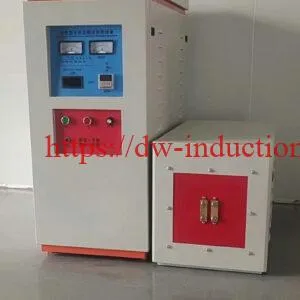
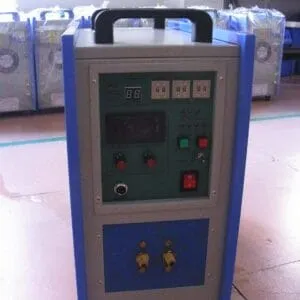
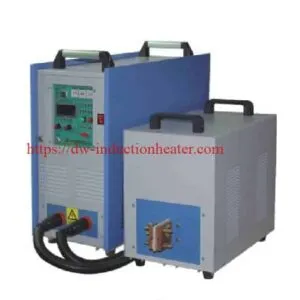
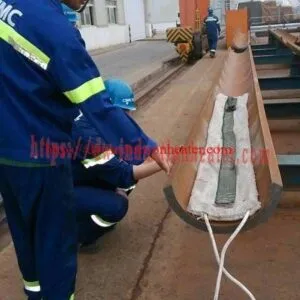
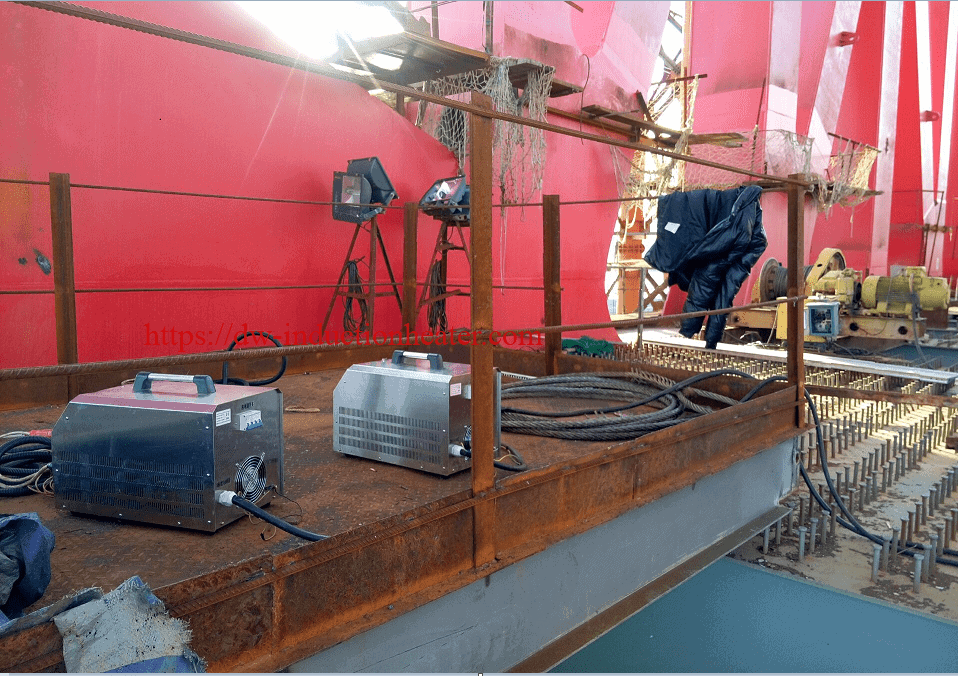
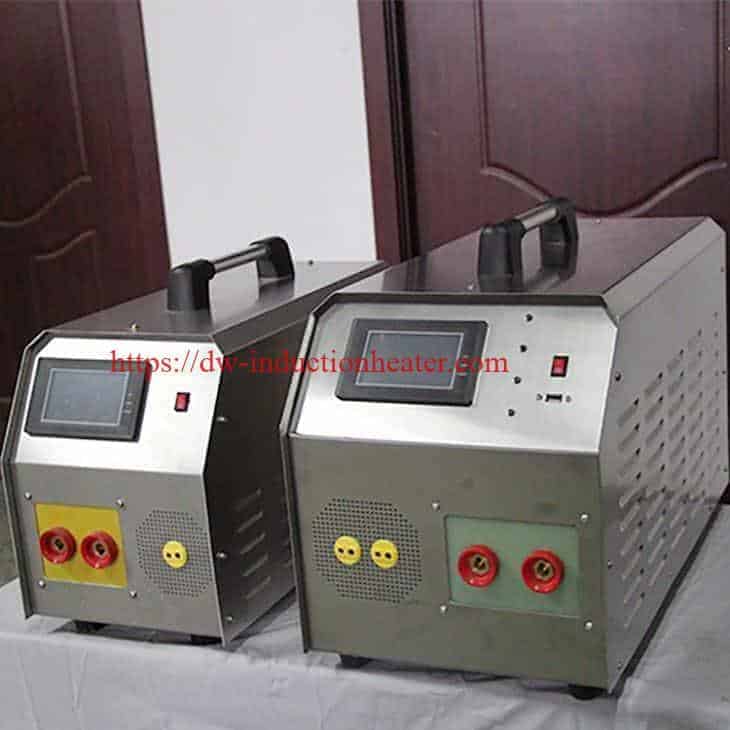
The two units above show the same machine in its two working arrangements: the power cabinet, the flexible coil and the blanket over the joint, with the cable run back to wherever the supply is.
Engineering Selection Guide
Before ordering, seven groups of information have to be confirmed. Each of them is a decision the machine cannot make for you.
| Factor | What to confirm | Guideline |
|---|---|---|
| Workpiece | Material grade, outside diameter, wall thickness, heated width, contents and parent coating | Sets the heated mass, and therefore the power |
| Process | Preheat or post-weld heat treatment, permitted temperature band, application delay and total cycle target | Decides MYD or MYDS, and whether a recorded chart is required |
| Temperature | The preheat temperature from the welding procedure | The machine reaches and holds it; the procedure sets it |
| Heating rate | The rate limit the procedure allows | Machine capability is 5 – 400 °C/min; program it down to the procedure rate |
| Utilities | Supply voltage and frequency, available kVA, earthing and ambient conditions | Published input is 3 × 380 VAC with 220 V and 440 V options; the air-cooled unit is published for -10 °C to 40 °C ambient |
| Coil and cable | Coil type, length, cooling version and the distance from the power unit to the joint | Published options are clamp or soft cable coils in 25 m air-cooled, water-cooled and high-temperature versions; the cable run is 10 – 45 m |
| Controls and records | Number of thermocouple channels, program requirements and data records | Up to 6 channels, ±3 °C, 10 stored curves, USB export and an independent recorder |
One sizing trap is worth calling out. A preheat job is often quoted by joint diameter alone, and diameter is the wrong starting point: the mass scales with the wall thickness and with the width of the band you intend to heat, and the band width is a choice. Heating a 150 mm band instead of a 75 mm band roughly doubles the load for the same joint. Decide the band width from the procedure and the weld pass size first, and then size the machine.
Advantages and Limitations
| Advantages | Limitations |
|---|---|
| Air-cooled: no cooling-water plant to transport, connect and winterise | The published comparison table lists water cooling at 100 kW and above, so the support services are not zero on the larger models |
| The power unit stays in the vehicle: 10 – 45 m of cable and 5 – 45 m of thermocouple lead | Long leads add losses and must be laid clear of traffic and damage |
| Heat is generated in the steel, so no burner flame at the joint | Hot surfaces, electrical systems and site conditions still require appropriate controls |
| ±3 °C control on up to 6 channels, with 10 stored curves and an independent recorder | The accuracy depends on the thermocouple being fixed to clean steel, not under the cable |
| Automatic frequency tracking, so the load change at each new joint does not need a manual retune | Coil design and the insulation gap still determine the uniformity of the band |
| 120 kg net, packed at 900 × 660 × 1560 mm | The gross weight with parts is published as 155 – 260 kg, so the lifting and handling plan is set by that figure rather than by the 120 kg cabinet |
| Published energy saving of 30 % – 80 % against resistance heating | The saving depends on the charge, the band width and the insulation; it is not a fixed project result |
| One machine covers preheat, weld heat, thermal assembly, coating, drying and melting duty | The preheat temperature, the heating rate and the hold time all come from the procedure, not from the machine |
| The coil and the blanket are consumable and are changed from job to job | Coil and cable lengths must be specified per project |
Why Choose HLQ?
HLQ Induction Equipment Co., Ltd, with its branch Quanzhou Shuimu Induction Equipment Co., Ltd, is located in the Quanzhou National High & New Technology and Industrial Development Zone at No.906 Zhaolian Industrial District, Beifeng Town, Quanzhou City, Fujian Province, China. The published company statement records 25 years of experience in the research, design and production of high frequency and medium frequency induction heating machines, with leading products including IGBT medium frequency induction heating equipment, IGBT super audio induction heating equipment, CNC quenching machine tool, IGBT medium frequency induction melting furnace, KGPS medium frequency induction melting furnace, and open type and closed water cooling towers.
| Strength | What it means for you |
|---|---|
| Direct manufacturer, 25 years of production experience | One supplier for the power unit, the coil, the blanket, the thermocouples and the recorder, so the kit arrives matched rather than assembled from several vendors |
| Two series for the two jobs | MYD for preheat and post-weld heat treatment with recording; MYDS for preheat only, with a 4.3 inch screen and a 600 °C maximum |
| Published parts list | The heater, three coil versions in 25 m, two blanket sizes rated 800 °C, the thermocouple and its extension and connection cables, and the ER-1006 recorder are all published as a kit |
| Air-cooled cabinet | No cooling-water plant is needed for the portable arrangement, which is what makes the machine usable on a pipeline, a bridge or a ship |
| Quality control to TQM | A QC person inspects machinery production; every machine is tested and debugged before shipment, with photos and video on request |
| Test machine running before shipment | The published statement is that the technical staff test the machine running before it leaves |
| Warranty | The heating power is warranted for 12 months from the date the contract is signed |
| Packing | Film layer for waterproof, then a paper box, then a wooden case, with foam wrapped around the machine for shockproof |
| Shipping | Free delivery to the buyer’s shipper in China, or direct delivery to any main port of China |
| Storage conditions | Clean, dry environment, -20 °C to 60 °C, humidity 0 % – 95 % with no dew, away from corrosive gases and liquids |
| After-sales service | Engineers are sent to the customer’s workshop for installation, debugging and training until the machine is in normal production |
6 Core FAQs
1. What is a portable welding heater by induction?
It is an induction heating power unit built to go to the joint rather than to bring the joint to the furnace. HLQ publishes it as the MYD series, and the catalogue states the scope: the MYD series of induction heating systems are used for weld, bending, piping, coating, fitting, stress relief, pre-weld heat and post-weld heat treatment. The unit takes three-phase electricity on site, drives a flexible cable coil wound around the pipe or laid along the plate seam, and the induced current heats the steel itself, so no flame touches the joint and no combustion gas reaches the metal.
2. Why is it called portable, and what does that mean in practice?
Three published numbers decide it. The cabinet is air cooled, so no cooling-water plant has to be transported, connected or winterised, and it is published as working at an ambient of -10 °C to 40 °C — with the published comparison table adding water cooling at 100 kW and above. The published induction coil is 10 – 45 metres of high-temperature cable and the thermocouple link cable is 5 – 45 metres, so the power unit, the PLC and the recorder can stay in the vehicle or the site cabin while only the coil, the blanket and the sensors travel to the joint. And the machine weighs 120 kg net in a 900 × 660 × 1560 mm packing case. HLQ also publishes a smaller bench unit at 26 kg and 32 kg with a 15 mm coil and an OD 50 – 500 mm pipeline range, if the job does not need the site capability.
3. How hot can it get, and how fast?
The published maximum temperature is 900 °C and the published heating rate capability is 5 – 400 °C per minute, with the temperature controller holding ±3 °C on up to 6 K-type thermocouple channels. Two things sit under those figures. The published insulation blanket options are rated 800 °C, so on a long hold the blanket rather than the machine is usually the limit. And the preheat temperature for a joint comes from the welding procedure specification — no preheat temperature is published on this product, and none should be taken from a supplier page in place of the procedure.
4. Which model do I need for my pipe?
Size from the joint, not from the diameter. The heated mass is m = ρ × π × (D × t – t²) × L, the thermal demand is Q = m × cp × ΔT, and the output power needed is P = Q / (ηeffective × τ). On the published worked example — a 508 mm outside diameter steel pipe with a 12.7 mm wall, a 300 mm heated band, 25 °C to an assumed 230 °C, density 7,850 kg/m³, average heat capacity 0.490 kJ/(kg·K) and a 70 % effective factor — the heated mass is about 46.54 kg and the sensible heat about 4,675 kJ, which gives a calculated heating time of 167 seconds on the MYD-40KW and 56 seconds on the MYD-120KW. A 90-second allowance needs about 74.2 kW, and with the illustrative 20 % design allowance that is 89.0 kW, making the MYD-100KW a candidate for evaluation.
5. Does it replace ceramic pad heating, and does it need water on site?
HLQ publishes a direct comparison against ceramic pad elements: induction heats directly and with the insulation on the inside, the elements stay less hot, less heat is lost, and the speed, efficiency and uniformity are all better. On the cooling question the published sources are not entirely consistent and the difference has to be read carefully. The catalogue model table lists the cooling as air cooling and the catalogue features section states that the air cooling works well at -10 °C to 40 °C, while the published MYD versus MYDS comparison table lists the cooling type as air cooling with water at 100 kW and above, and separately lists the coil cooling as air for preheat and water for PWHT. The published parts list also offers cable coils in air-cooled, water-cooled and high-temperature versions. Confirm the converter and coil cooling for the model and the duty you are ordering.
6. What has to be confirmed before ordering?
The material grade, outside diameter, wall thickness and the width of the band you intend to heat; whether the job is preheat or post-weld heat treatment, and whether a recorded chart is required for every joint; the preheat temperature and the permitted heating rate from the welding procedure; the site supply voltage, frequency, available kVA and earthing; the ambient conditions against the published -10 °C to 40 °C range; the coil type, cooling version and the cable run from the power unit to the joint; and the number of thermocouple channels and the record requirements. The published packing, shipping and storage terms, the 12-month heating power warranty and the published installation, debugging and training service are all part of the supply, and each is easier to agree before the order than after it.