

Portable Preheat Welding Machine with induction
Portable Induction Weld Preheater for Pipelines
Quick Answer
This HLQ product page presents MYD-10KW and MYD-20KW portable induction heaters for localized pipe weld preheating. Its published table lists three-phase 380 V input, 5–30 kHz output frequency, a flexible 10–20 m induction cable and K-type temperature sensing. The equipment supplies heat before or around a welding process; it does not make the weld. A required preheat temperature must come from the applicable material and weld procedure.

Table of Contents
- What is the Portable Induction Weld Preheater?
- Key Applications
- Suitable Materials
- Working Principle
- Technical Specifications
- Recommended Model Selection
- Process Workflow
- Common Problems and Solutions
- Engineering Selection Guide
- Advantages and Limitations
- Why Choose HLQ?
- 6 Core FAQs
What is the Portable Induction Weld Preheater?
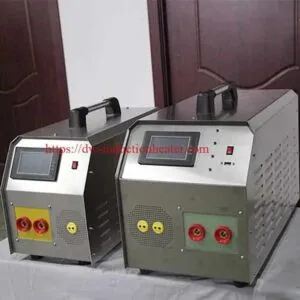
It is a portable induction heating system presented for raising the temperature of a conductive metal workpiece near a planned weld. The original page lists two MYD units, a flexible cable coil, a built-in temperature system and a K-type thermocouple. It also names post-weld and other local-heating tasks, but provides no qualified heating cycle for a specific material or joint.
The product name should be read as a weld-preheating heater, not as a machine that performs welding.

Key Applications
| Application | Page evidence | Project-specific information needed |
|---|---|---|
| Pipe weld preheating | Pipeline and weld heating are named; pipe setups are photographed. | Pipe grade, wall thickness, preheat target and measurement points. |
| Other pre-weld heating | Steel sheet and other metal jobs are named. | Part geometry, heated band and approved procedure. |
| Post-weld heating | Pipeline, tank and boiler work are named. | Whether the selected unit can meet the specified thermal cycle. |
| Other local heating | Coating, spraying, bending and fitting-related uses are listed. | Application-specific coil and process validation. |
HLQ places related products in its induction preheating and PWHT equipment range.

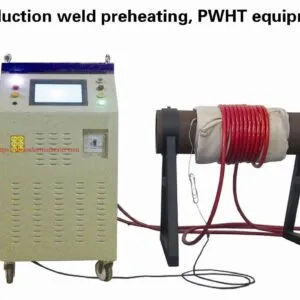
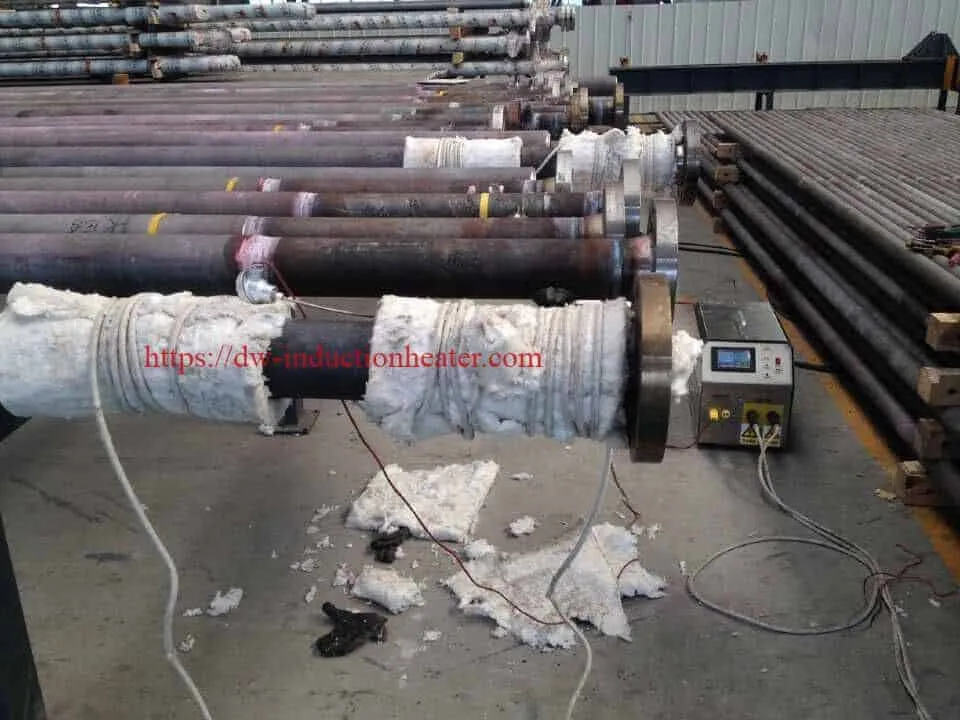
The following PNG assembles four photographs already on this page. It is a visual application overview, not a measured customer case.
Suitable Materials
Induction heating requires a conductive workpiece and effective coupling between the cable coil and the target area. The source page names pipelines, steel sheet, tanks and boilers, but it does not identify approved steel grades or material-specific preheat temperatures.
| Workpiece | Source-page basis | What remains unspecified |
|---|---|---|
| Pipeline or pipe section | Named and shown in original photographs. | Material grade, wall thickness and welding procedure. |
| Steel sheet or plate | Named in the application text. | Thickness and required heated area. |
| Tank or boiler metal work | Named as a related heating task. | Material, geometry and thermal cycle. |
| Other conductive parts | Described in broad terms only. | Compatibility cannot be confirmed from this page alone. |
Working Principle
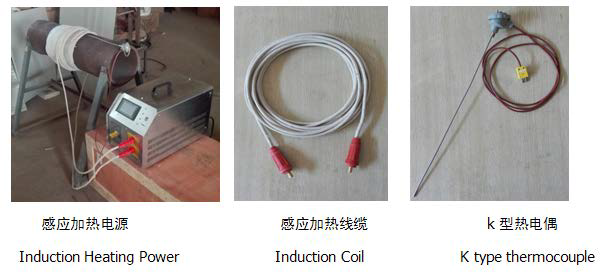
The MYD unit drives alternating current through a flexible induction cable positioned at the metal workpiece. The changing magnetic field induces currents in the conductive metal, generating localized heat. A K-type thermocouple provides a temperature input. Coil placement, material and geometry affect how the heat is distributed.
HLQ explains the underlying mechanism in its basic induction heating guide.
| Element | Function | Published detail |
|---|---|---|
| MYD power unit | Supplies induction heating output. | Two model names and their electrical ranges appear in the original table. |
| Induction cable | Places the heating field around or near the target zone. | 10–20 m length and 15 mm diameter are listed. |
| K-type thermocouple | Provides a temperature measurement point. | Listed in the table and shown in the original component image. |
Technical Specifications
The values below reproduce this product page’s published table. Another HLQ page lists different specifications for similarly named MYD models; the current machine data sheet should resolve the difference.
| Parameter | MYD-10KW | MYD-20KW |
|---|---|---|
| Input current | 1–15 A | 1–30 A |
| Output current | 0–200 A | 0–300 A |
| Output power | 1–10 kW | 1–20 kW |
| Additional output wording | “Max 15KW, 150% duty cycle” | No equivalent additional entry |
| Published heating-temperature ceiling | 500°C | 800°C |
| Unit dimensions | 650 × 310 × 410 mm | 700 × 330 × 410 mm |
| Unit weight | 26 kg | 32 kg |
The MYD-10KW “150% duty cycle” phrase is unclear. It does not establish that 15 kW is a continuous rated output or specify how long that output could be used.
| Parameter | Published value | Limit of interpretation |
|---|---|---|
| Input voltage | Three-phase 380 V, 50/60 Hz, 4 wires | No current revision date or alternative supply is given. |
| Output frequency | 5–30 kHz | No job-specific setting is published. |
| Thermocouple | K type | Measurement accuracy is not specified. |
| Temperature system | Built into the induction machine | Control and recording functions are not detailed. |
| Induction cable length | 10–20 m | Exact supplied length is not divided by model. |
| Induction cable diameter | 15 mm | Listed as a shared entry. |
| “Working temperature” | -30°C to 45°C | Source wording; this is not a weld-preheat setpoint range. |
| Pipeline size | Outside diameter 50–500 mm or equivalent | Not separated by model or wall thickness. |
Recommended Model Selection
Use the published values as an initial screening tool. Pipe outside diameter alone cannot determine whether either unit can reach and maintain a specified preheat temperature on a particular joint.
| Model | Source-listed output range | Source-listed temperature ceiling | Selection checks |
|---|---|---|---|
| MYD-10KW | 1–10 kW | Maximum 500°C | Thermal load, supply, cable arrangement and ambiguous 15 kW wording. |
| MYD-20KW | 1–20 kW | Maximum 800°C | Thermal load, pipe wall thickness and required temperature cycle. |
HLQ also publishes a portable induction PWHT machine page. Compare its stated configuration carefully because similarly named models may carry different published values elsewhere on the site.

Process Workflow
This is a general weld-preheating workflow, not a claim that the machine contains an automatic qualified recipe.
- Identify the workpiece material, joint dimensions and required preheat procedure.
- Check the electrical supply, unit condition, cable and thermocouple.
- Place the induction cable around the target zone and position the required temperature sensor.
- Heat while monitoring the workpiece temperature at the specified points.
- Verify the required preheat condition before welding and continue according to the weld procedure.
- Record any measurements required by the project.
A separate HLQ page covers flexible induction cable coils for weld preheating.
Common Problems and Solutions
The following checks are general process checks, not diagnoses of faults in the units pictured here.
| Observed issue | First checks | Reason |
|---|---|---|
| Temperature rises too slowly | Available supply, part size, cable position and selected output. | The page provides no measured heat-up time for a defined pipe. |
| Temperature varies around a joint | Cable spacing and temperature measurement locations. | Geometry and placement affect the local heating profile. |
| Temperature indication is unstable | Thermocouple contact and lead condition. | The source lists K-type sensing but no accuracy test. |
| Model choice is unclear | Wall thickness, heated band and approved preheat target. | The 50–500 mm pipe range is shared by both models. |
Engineering Selection Guide
| Input | Why it matters | Provided on this page? |
|---|---|---|
| Material grade and pipe wall thickness | They affect the required weld procedure and heating load. | No. |
| Pipe outside diameter and heated band | They determine cable fit and heating coverage. | Only a shared OD 50–500 mm entry. |
| Required preheat temperature | It defines the process target. | No qualified temperature is supplied. |
| Available electrical supply | It must suit the current machine configuration. | Three-phase 380 V, 50/60 Hz, 4 wires are listed. |
| Cable routing and thermocouple locations | They affect field access and measurement. | Cable dimensions and sensor type are listed, but no layout dimensions. |
| Current model data sheet | It resolves conflicting MYD values published on other HLQ pages. | No dated model sheet appears here. |
At the upper listed input currents, three-phase 380 V corresponds to approximately 9.9 kVA for MYD-10KW and 19.7 kVA for MYD-20KW. These are calculations from the source labels, not measured machine performance. The input and output ratings should be reconciled for the actual unit.
HLQ presents a separate pipeline preheat welding machine page for a broader pipeline-heating context.
Advantages and Limitations
| Source-supported characteristic | Information limit |
|---|---|
| Two portable models are listed at 26 kg and 32 kg. | No field productivity or transport test is supplied. |
| A 10–20 m flexible induction cable is listed. | Exact supplied length is not assigned to each model. |
| K-type temperature sensing is listed. | Controller accuracy and data-recording capability are not established here. |
| Maximum temperatures of 500°C and 800°C are listed. | Neither figure prescribes a weld-preheat setting. |
| Air cooling is mentioned in the product text. | No model-specific low-temperature operating test is supplied. |
| The page claims “High speed: 70%” and better uniformity. | It provides no comparison baseline or measurement method. |
Why Choose HLQ?
This HLQ page provides a two-model parameter table, original equipment and pipe-setup photographs, and a component image showing the power unit, coil and thermocouple. They support an initial engineering review of a portable weld-preheating setup. For a distinct, larger post-weld-treatment range, see HLQ’s induction post-weld heat treatment machine page; its model values should not be substituted for this page’s MYD-10KW and MYD-20KW data.
6 Core FAQs
1. Does this machine perform welding?
No. It supplies induction heat for weld-preheating and related heating tasks. Welding is a separate operation.
2. Which models are specified on this page?
MYD-10KW and MYD-20KW.
3. What pipe diameter is listed?
The source gives one shared outside-diameter entry of 50–500 mm or equivalent. It does not divide that range by model or pipe wall thickness.
4. Is the “680°C” photo filename a test result?
No. The photograph does not include a verifiable temperature record or test conditions.
5. Can MYD-10KW run continuously at 15 kW?
This page does not establish that. It lists 1–10 kW output and separately uses the unclear wording “Max 15KW, 150% duty cycle.”
6. Are 500°C and 800°C the required welding preheat temperatures?
No. They are source-listed equipment ceilings. The required preheat temperature comes from the applicable material and weld procedure.