

PWHT Equipment Manufacturer
PWHT Equipment Manufacturer – MYD Induction PWHT Equipment, 40 to 120 kW
Quick Answer
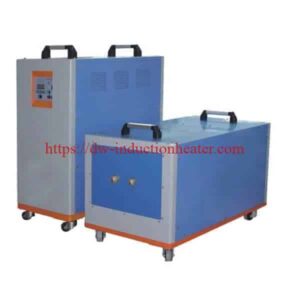
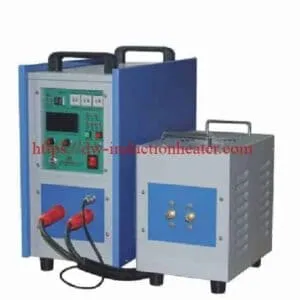
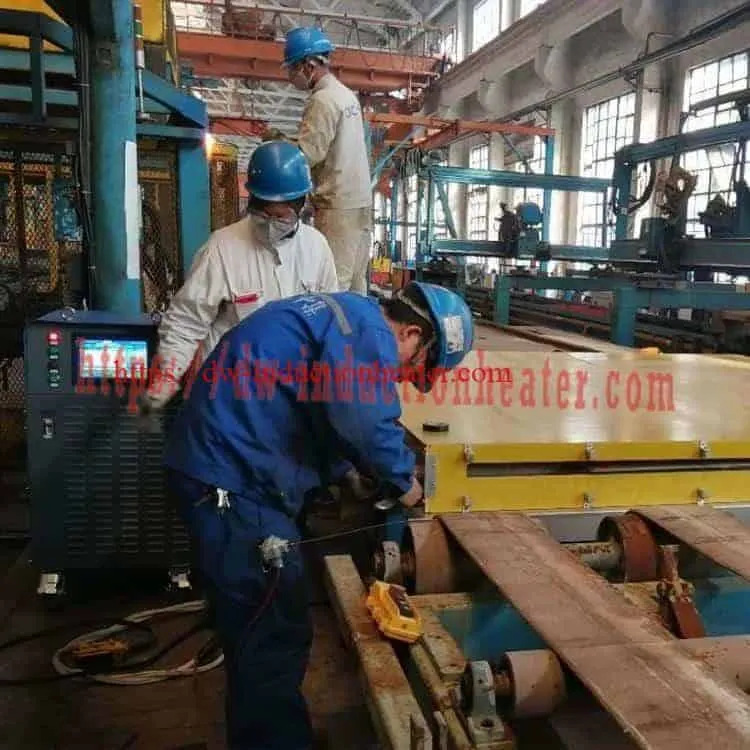
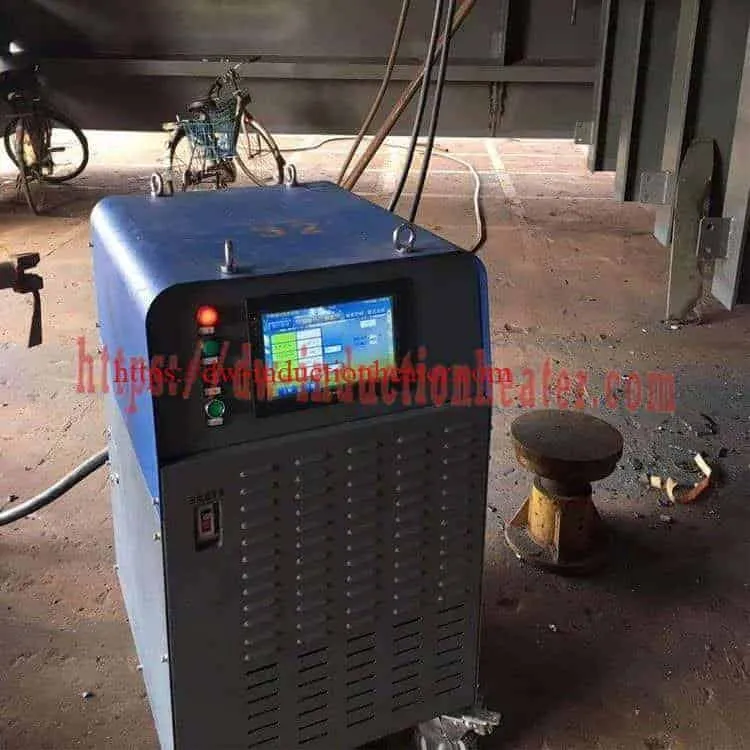
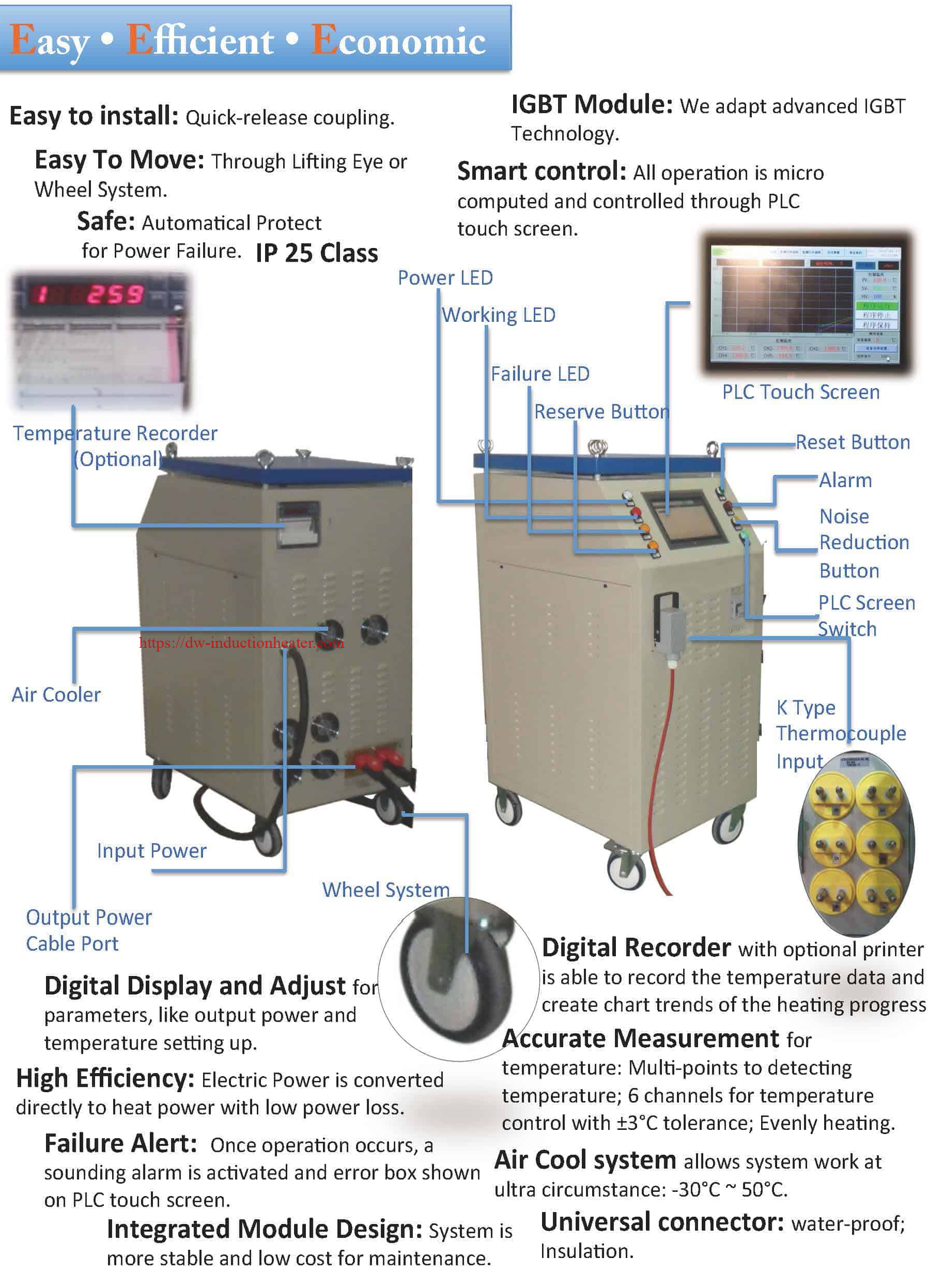
The MYD series is HLQ’s induction PWHT equipment: a 40 kW to 120 kW IGBT power unit with a DSP inner loop and a PLC 10‑inch touchscreen, sold with the cable coil, the insulation blanket, the thermocouples and the recorder that make it a working station rather than a bare machine.
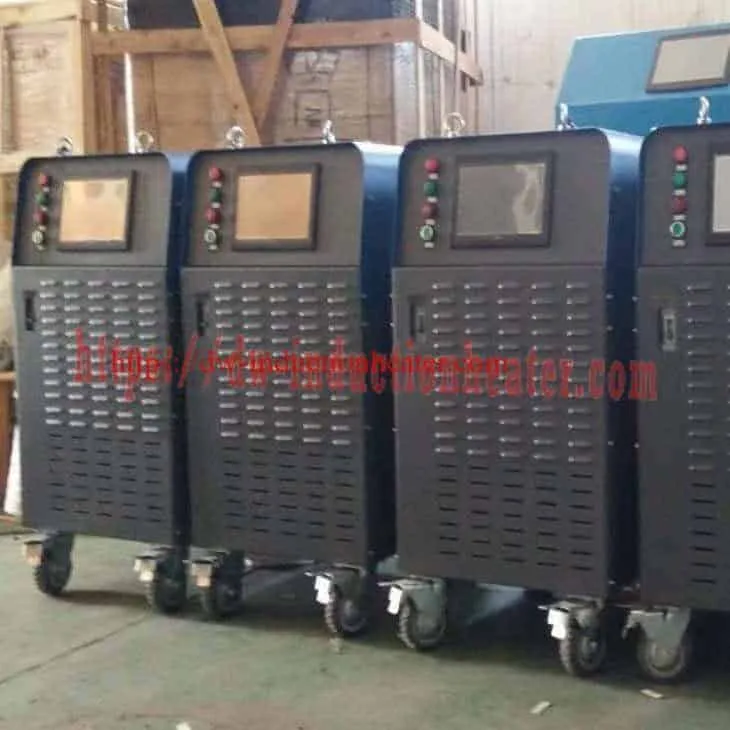
Published specification: output 40/50/60/80/100/120 kW at 60/75/90/120/150/180 A on 3‑phase 380 VAC (3 × 220 and 3 × 440 optional), oscillation 2–30 kHz, up to 6 K‑type thermocouple channels at ±3 °C, heating speed 5–400 °C per minute, maximum temperature 900 °C, a cabinet of 800 × 560 × 1350 mm at a net 120 kg, and heating parts up to Ø100–1500 mm or equal.
There are two controller levels, and the difference decides what a job can be qualified for. The MYD is the full machine: 10‑inch screen, heating‑curve storage, USB export, a recorder connection, remote control, 900 °C and suitable for PWHT. The MYDS is the simplified version: 4.3‑inch screen, no recording, no USB, no recorder, no remote control, 600 °C, and the published application matrix marks it unsuitable for PWHT.
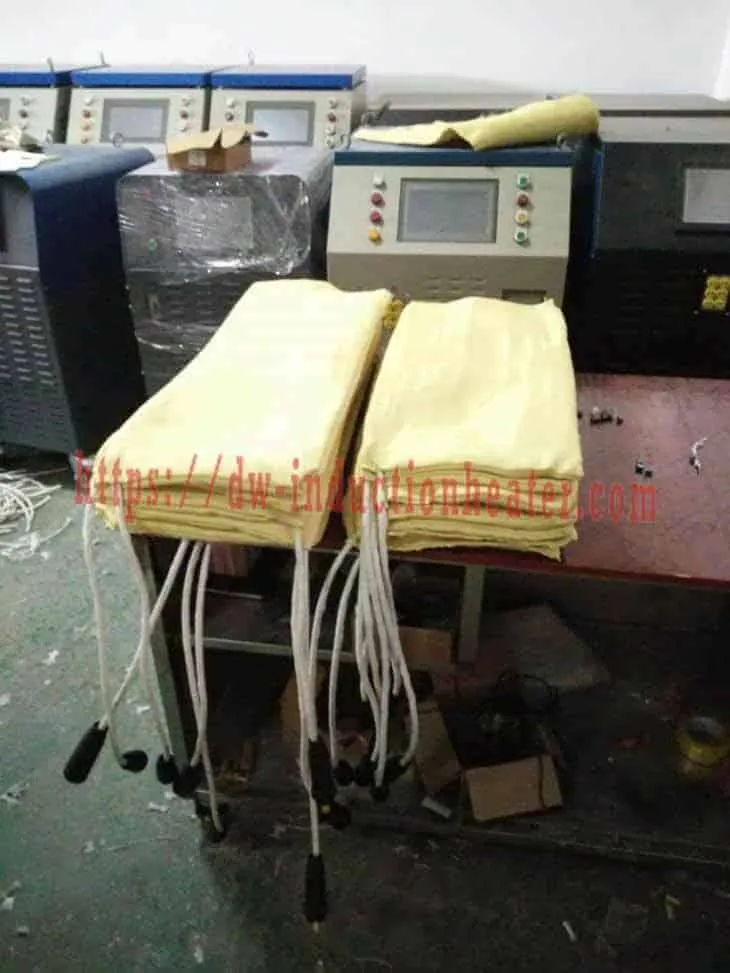
The complete orderable kit is thirteen items, published as the parts list: four heaters, three 25 m cable coils (air‑cooled, water‑cooled and high‑temperature), two 800 °C insulation blankets at 1500 × 600 × 50 mm and 900 × 600 × 50 mm, a K‑type thermocouple with 2 m cable, a 10 m thermocouple extension cable, a 10 m connection cable for the coil, and the ER‑1006 temperature recorder.
Table of Contents
- What is the PWHT Equipment?
- Key Applications
- Suitable Materials
- Working Principle
- Technical Specifications
- Recommended Model Selection
- Process Workflow
- Common Problems and Solutions
- Engineering Selection Guide
- Advantages and Limitations
- Why Choose HLQ?
- 6 Core FAQs
What is the PWHT Equipment?
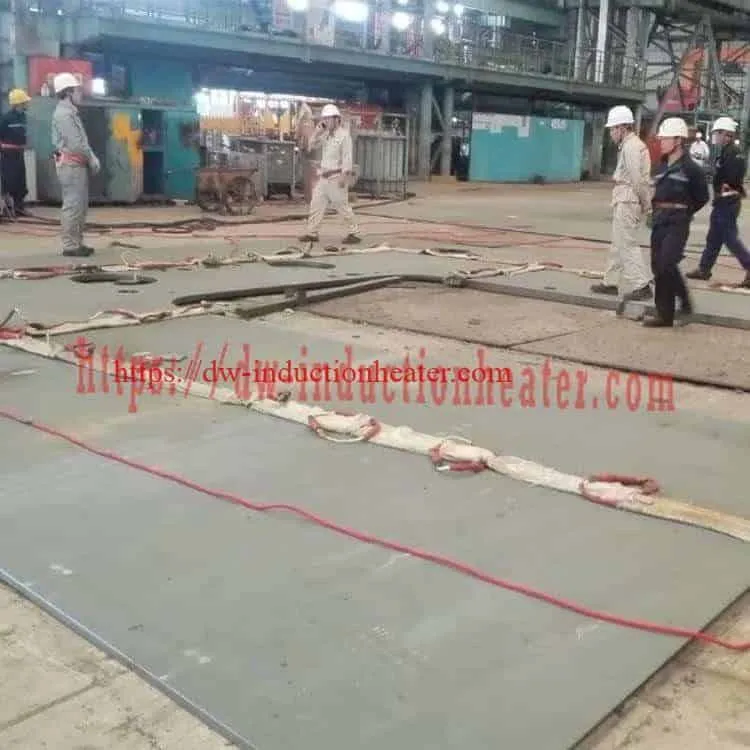
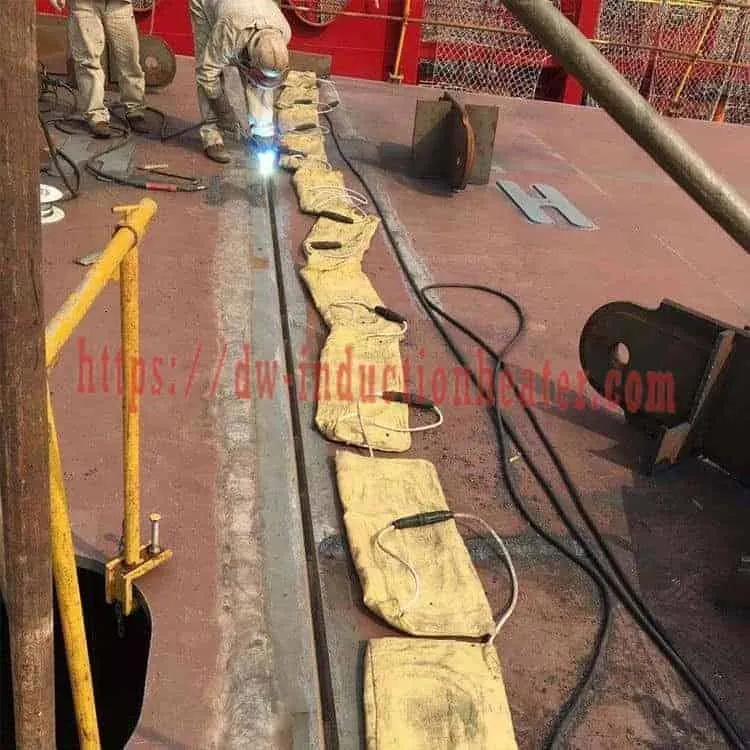
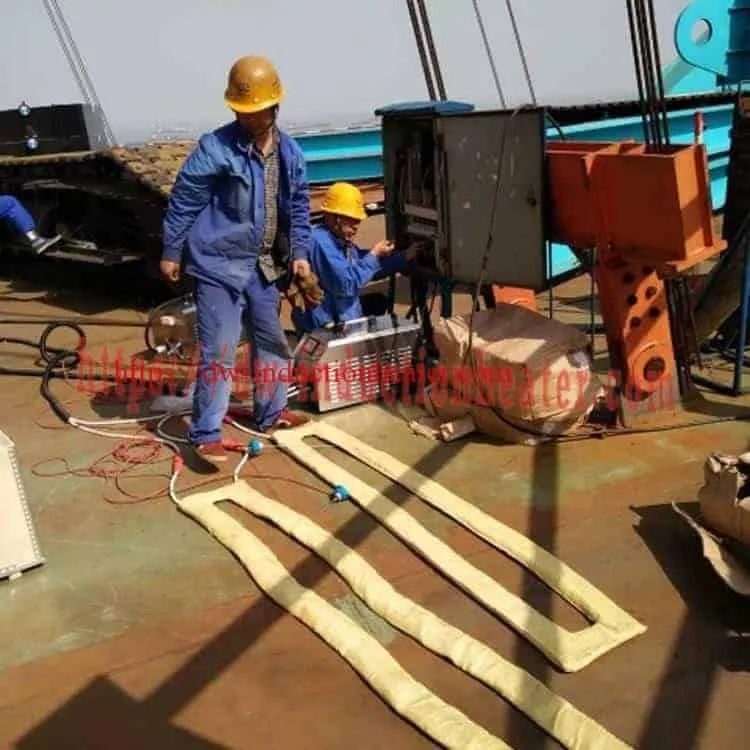
PWHT equipment is more than a heater. A post weld heat treatment machine heats the metal, but a qualified job also needs a way to put the heat into the joint, a way to keep it there, a way to know what the metal actually did, and a record that survives the inspection. That is why the published MYD parts list is a list of thirteen items and not one: the heater, the coil, the blanket, the thermocouples, the cables and the recorder are designed together, and the machine is the least interesting part of the order.
Two controller families cover the range, and the published comparison between them is the shortest way to understand it.
| Item | MYD (PWHT) | MYDS (preheat) |
|---|---|---|
| Power size | 10–360 kW | 2.5–360 kW |
| PLC screen | 10 inch | 4.3 inch |
| Cabinet cooling | Air cooling, water ≧ 100 kW | Air cooling, water ≧ 100 kW |
| Coil cooling | Air for preheat, water for PWHT | Air |
| Coil length | 10–50 m | 30–80 m |
| Maximum temperature | 900 °C | 600 °C |
| Heating-curve storage | Yes | No |
| USB export | Yes | No |
| Recorder connection | Yes | No |
| Remote control | Yes | No |
| Curve storage, USB, remote, DSP, thermocouple, coil | All provided | DSP, thermocouple and coil only |
| Suitable for PWHT | Yes | No |
The row that matters most is the last one. Everything else on the table is a convenience; this one is a qualification requirement. If the job needs a recorded soak, it is an MYD.
For the machine itself and the model-by-model data, HLQ’s IGBT PWHT machine with DSP and PLC control page is the detailed reference; the tube and pipe machine built on the same platform is the tube and pipe post weld heat treatment machine.
Key Applications
The published application list for the MYD covers seven classes of work, and the application matrix states which controller each one can be done on.
| Published application class | Published sub-text |
|---|---|
| Weld joint heating and heat treatment (PWHT) | steel pipeline, steel structure and steel sheet |
| Heating and insulation | pipeline liquid, reactor, kettle, boiler, tank |
| Thermal assembly heating | bearing, axle sleeve, engine motor and motor shell |
| Hot drying | food material, metal, printing film drying and heat-shrink film |
| Factory warming | oil, gas and water heating |
| Coating heating | pipeline, steel board |
| Melting | copper, aluminium, tin, zinc, lead |

Published application matrix, MYD against MYDS
| Series | Preheat | Weld heat | PWHT | Thermal assembly | Reactor heating | Tank heating | Injection mould heating | Water | Gas | Oil | Pipeline liquid |
|---|---|---|---|---|---|---|---|---|---|---|---|
| MYD | Yes | Yes | Yes | Yes | Yes | Yes | Yes | Yes | Yes | Yes | Yes |
| MYDS | Yes | Yes | No | Yes | Yes | Yes | Yes | Yes | Yes | Yes | Yes |
Read across that matrix and the pattern is clear: the two series cover the same eleven duties except one. Everything an MYD can do, a MYDS can also do – except post weld heat treatment, where the recording and the 900 °C rating are the whole point.
For the specific duty, the published reference pages carry the detail: the girth‑weld geometry and the measured field data are on the PWHT for oil and gas pipeline welding page, and the control architecture behind the whole machine is on the IGBT PWHT machine page linked above.
Suitable Materials
The MYD heats any conductive metal, and the published material range runs from structural carbon steel through the stainless grades to the non‑ferrous metals used in melting duties. The published soak windows, which are what actually decide the control requirement, are:
| Material | Typical PWHT soak | Magnetic at soak? | What it means for the equipment |
|---|---|---|---|
| Carbon steel (P-No.1) | 595–650 °C | Yes | Wide window; the standard program |
| P11 (1¼Cr-½Mo) | 650–745 °C | Yes | Recorded soak and a hardness check |
| P22 (2¼Cr-1Mo) | 675–760 °C | Yes | Tighter control recommended |
| P91 / P92 (9Cr-1Mo-V) | 730–775 °C | Close to Curie | Narrow window, must stay below Ac1: ±3 °C is essential |
| Austenitic stainless steel | By specification | No | Non-magnetic load, which the DSP tracks automatically |
These are typical ranges only, and the qualified procedure and the current code edition govern. The full table with the control notes, the skin depth across the MYD frequency range and the ASME VIII UCS‑56 heating and cooling rate limits are on the IGBT PWHT machine with DSP and PLC control page.
For the melting duties the published material list is copper, aluminium, tin, zinc and lead. Note that melting is a different job from PWHT – it needs a crucible and a container rather than a blanket and a cable coil – and the MYD melting capability is published separately as the DW-MF medium-frequency metals melting furnace.
Working Principle
The reason to buy induction rather than a ceramic pad comes down to where the heat is made. The published comparison between the MYD and ceramic pad heating is explicit about this, and it is the reason the MYD is published as uniform, high speed and 30–80 % more efficient.

| Item | Induction (MYD) | Ceramic pad |
|---|---|---|
| Heat | Direct | Transfer |
| Insulation | Inner | Outer |
| Surface | Less hot | Hot |
| Heating lost | Less | More |
| Speed | High | Low |
| Efficiency | High | Low |
| Uniformity | More | Less |
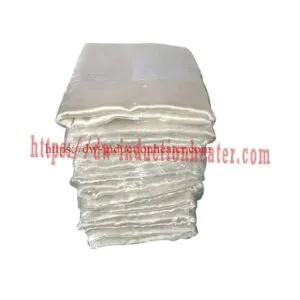
In practice that means the outer surface of the part stays cooler, less heat escapes into the workshop, the heating is faster and more even, and the recorded curve follows the metal rather than the pads. The published MYD system also states that the workpiece is heated with an insulation blanket around it – which is where the inner-insulation advantage comes from, and it is why the blanket is a specified item rather than an optional extra.
The machine’s own heating chain is a rectifier and DC bus, an IGBT full-bridge inverter switching the DC into 2–30 kHz into a resonant tank and the coil, and then the two control loops: the DSP generating the PWM gate signals and tracking the resonant frequency, and the PLC running the ramp–soak–cool program on up to six thermocouples. That chain is drawn in full on the IGBT PWHT machine with DSP and PLC control page.
Technical Specifications
MYD series power unit
| Parameter | Published specification |
|---|---|
| Models | MYD-40KW, MYD-50KW, MYD-60KW, MYD-80KW, MYD-100KW, MYD-120KW |
| Output power | 40 / 50 / 60 / 80 / 100 / 120 kW |
| Input power | 3 × 380 VAC (default), 3 × 220 VAC (optional), 3 × 440 VAC (optional) |
| Input voltage | 380 V, 3 phase, 50/60 Hz |
| Input current | 60 / 75 / 90 / 120 / 150 / 180 A |
| Output frequency | 2 kHz ~ 30 kHz |
| Cooling | Air cooled, working well at −10 °C to 40 °C (water cooling on MYD-100KW and MYD-120KW) |
| Heating speed | 5–400 °C per minute |
| Heating temperature range | maximum 900 °C |
| Heating parts size range | Ø100–1500 mm or equal |
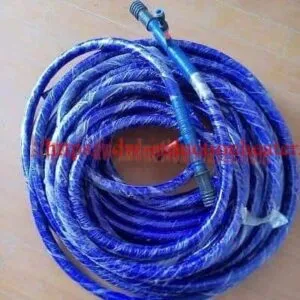
| Induction coil | 10–45 m long high-temperature cable, air cooled; 25 m cable coils in air-cooled, water-cooled and high-temperature forms |
| Temperature recorder | 6 channels for temperature controlling; R‑1006 / ER‑1006 recorder with printer |
| Thermocouple | K type, with a 5–45 m link cable |
| Control | DSP with PLC touch screen; ramp–soak–cool programming, curve storage, USB, remote control |
| Size / weight | 800 × 560 × 1350 mm, net weight 120 kg; packing size 900 × 660 × 1560 mm, gross weight 155 kg |
| Warranty | 12 months on the heating power from the date the contract is signed |
Heaters and parts for choice – the published 13-item list
| No. | Heater and part | Remark |
|---|---|---|
| 1 | MYD-40KW heater | – |
| 2 | MYD-50KW heater | – |
| 3 | MYD-60KW heater | – |
| 4 | MYD-80KW heater | – |
| 5 | 25 m cable coil (air cooling) | Quick heat |
| 6 | 25 m cable coil (water cooling) | – |
| 7 | 25 m cable coil (high temperature) | – |
| 8 | Insulation blanket (800 °C, 1500 × 600 × 50 mm) | – |
| 9 | Insulation blanket (800 °C, 900 × 600 × 50 mm) | – |
| 10 | K type thermocouple with 2 m cable | – |
| 11 | Thermocouple extension cable, 10 m | – |
| 12 | Connection cable for coil, 10 m | – |
| 13 | ER-1006 temperature recorder | – |
The blanket and the recorder are the two items most often specified separately, and each has its own published page: the PWHT insulation blanket and the PWHT chart recorder. The coil itself is covered on the PWHT flexible cable coil page, including the coupling distance and the pitch rules that decide where the heat lands.
The published option parts of the induction PWHT equipment
Induction heating power; induction coil, either a clamp induction coil or a soft induction coil; the connection cable that links the coil and the heating power; temperature controller; PLC touch screen; temperature recorder with printer; K type thermocouple and connection cable; insulation blanket; and other parts.
Where HLQ’s own published figures differ
Several of the documents that describe this equipment print slightly different numbers. Rather than pick one silently, here is what each source says – so the specification is settled before the order.
| Item | Model table and catalogue | Other published figures |
|---|---|---|
| Output frequency | 2–30 kHz | 2–40 kHz on the PWHT flexible cable coil page |
| Maximum temperature | 900 °C | 0–1100 °C on the PWHT flexible cable coil page |
| Heating temperature range | maximum 900 °C | −30 to 900 °C in the specification bullet block |
| Output power | 40–120 kW | “2KW ~ 40KW” in the specification bullet block; 10–360 kW in the MYD-versus-MYDS comparison |
| Cooling | Air cooled | “Air cooling, Water ≧100 kW” in the MYD-versus-MYDS comparison |
| Coil length | 10–45 m | 10–50 m in the comparison table; 25 m in the parts list |
| Gross weight | 155 kg | 155–260 kg with parts in the model table |
| Recorder designation | R-1006 in the catalogue parts list | ER-1006 in the parts list and on the recorder page |
Confirm the band, the temperature rating and the cooling arrangement with HLQ for the machine being quoted. The catalogue itself is available as the MYD series heating machine catalogue.
Recommended Model Selection
Three decisions, in order: the controller, then the model, then the coil and the kit.
| Requirement | Recommended | Reason |
|---|---|---|
| PWHT with recorded charts, pipe up to Ø610 × 50 mm | MYD-40 | Full control and recording; enough power for single joints |
| Pipe Ø610–Ø1219 or plate seams up to 3 m | MYD-60 / MYD-80 | Power margin for losses and wider heated bands |
| Long seams, vessels, heavy sections | MYD-100 / MYD-120 | High output on the same control platform |
| Preheat only, no records required | MYDS series | Simpler controller, up to 600 °C |
| Decision | Options on the parts list | Choose when |
|---|---|---|
| Coil | 25 m cable coil, air cooling / water cooling / high temperature | Air cooling is the standard; water cooling for the higher-power machines and continuous duty; high temperature when the soak temperature is the limit |
| Insulation blanket | 800 °C, 1500 × 600 × 50 mm or 900 × 600 × 50 mm | The blanket sets the band width, and the band width is what sets the power |
| Thermocouples | K type with 2 m cable, plus a 10 m extension cable | Up to 6 control points on the MYD; the extension cable is what makes the thermocouple reachable on a large joint |
| Coil connection | Connection cable for coil, 10 m | The distance from the cabinet to the joint |
| Record | ER-1006 recorder, printer optional | Every joint that needs a chart for the QA file |
On the electrical side, at 380 V the published input currents correspond to 39.4 kVA at 60 A, 49.3 kVA at 75 A, 59.2 kVA at 90 A, 78.9 kVA at 120 A, 98.6 kVA at 150 A and 118.4 kVA at 180 A, so size the supply and the generator on the kVA rather than on the output kW.
Process Workflow
The equipment workflow is the order, not the weld. A PWHT job that is specified, ordered and commissioned properly is straightforward to run; the difficulty is almost always in the specification stage.

The steps that are usually under-specified are steps 4 and 5. The coil is chosen for its length and its cooling rather than for the joint, and the blanket is chosen for its size rather than for the band the procedure requires – and the band width is the single number that drives the power demand, because it sets how much steel has to be heated at once.
On the delivery and commissioning side the published terms are: the machine is test-run by HLQ’s technical staff before shipment; the QC team works to TQM with photographs and video on request; packing is a film layer, a paper box, a wooden exporting case and foam for shockproof; shipping is free to the buyer’s shipper in China or direct to any main port of China; and engineers are sent to the customer’s workshop for installation, commissioning and training until the machine is running normal production.
The operating cycle on the joint itself – the ten steps from cleaning the joint to exporting the curve – is published on the IGBT PWHT machine with DSP and PLC control page.
Common Problems and Solutions
| Problem | Likely cause | Solution |
|---|---|---|
| The job is specified for PWHT and the machine cannot be qualified | An MYDS was supplied where a recorded soak is required | The published application matrix marks MYDS unsuitable for PWHT; move up to the MYD, which has curve storage, USB export, a recorder connection and a 900 °C rating |
| The machine will not reach the soak temperature | MYDS maximum is 600 °C, and a P91/P92 soak needs 730–775 °C | Check the controller class against the soak window before anything else |
| No cooling water at the machine | MYD-100KW and MYD-120KW carry water cooling as well as air cooling | Confirm the cooling arrangement for the model at the order stage and provide the service on site |
| The heated band is wider or narrower than the procedure | The insulation blanket size was not matched to the band | Choose the blanket size deliberately – 1500 × 600 × 50 mm or 900 × 600 × 50 mm – because the band width sets the power demand |
| The coil will not reach the joint | Cable length or connection length was not allowed for | The parts list publishes a 25 m cable coil and a 10 m connection cable for the coil, plus a 10 m thermocouple extension cable |
| No curve for the joint | Recording was not started, or the machine has no storage | MYD stores up to 10 curves for USB export and the ER-1006 keeps an independent log; MYDS has neither |
| The recorded temperature is not the temperature of the metal | The thermocouple is loose, is not on clean metal, or is under the cable | Attach the thermocouples to clean metal at the procedure positions, before the coil goes on; the published ER-1006 K-type accuracy is ±2.0 °C over the working range, excluding cold junction error |
| Output power falls above about 750 °C | The steel passes the Curie point and the load changes | Normal: the DSP re-tracks automatically. Only check the coil turns and spacing if the fall exceeds what the change explains |
| The heater arrived without the recorder or the blanket | The heater was ordered on its own | The heater is items 1–4 of a 13-item list; specify the whole list, not the cabinet |
Engineering Selection Guide

| Factor | Question to answer | Guideline |
|---|---|---|
| Controller | Does the job need a recorded soak? | MYD for PWHT and records; MYDS for preheat and interpass hold only |
| Soak window | How narrow is the permitted range? | Narrow windows such as P91 need ±3 °C closed-loop control and full recording |
| Control points | How many thermocouples? | Up to 6 on the MYD, with a 10 m extension cable to reach them |
| Band width | How wide is the heated band? | Set by the blanket size – 1500 × 600 × 50 mm or 900 × 600 × 50 mm – and it sets the power demand |
| Power | Steel mass, band width and losses? | Size from the heat load, then add the margin in the requirement table |
| Coil | Which of the three published variants? | Air-cooled, water-cooled or high-temperature, 25 m in each case |
| Records | Does the job need a chart per joint? | ER-1006 recorder, with USB export and 10-curve storage on the MYD |
| Site supply | Grid or generator? | 60–180 A at 380 V; generator ≥ 1.3 × input kVA |
| Cooling | Is there a cooling-water supply on site? | Air cooling from −10 °C to 40 °C; water cooling on MYD-100 and MYD-120 |
The heat load itself is straightforward to calculate and worth doing rather than guessing. For a cylindrical band the heated mass is m = ρ × π × (D·t − t²) × L, the energy is Q = m × cp × ΔT, and the power is P = Q / (η × τ), with η the coupling efficiency and τ the heating time. The published worked example – a 508 mm OD band with a 12.7 mm wall over a 300 mm heated length, from 25 °C to 230 °C, with ρ = 7850 kg/m³, cp = 0.490 kJ/kg·K and η = 70 % – gives a mass of 46.54 kg, 4,675 kJ of energy and, for a 90 second cycle, 74.2 kW, or 89.0 kW with a 20 % margin, which lands on the MYD-100KW. The full method, with all six candidate heating times worked through, is on the portable welding heater page.
Advantages and Limitations
| Advantages | Limitations |
|---|---|
| Heat is generated in the part, so the outer surface stays cooler and less heat is lost | The cable coil, the blanket and the thermocouples are separate items and have to be specified and matched to the joint |
| Uniform, high speed, and published energy saving of 30–80 % against resistance heating | A ceramic pad console is a different kind of installation; the two are not interchangeable in layout or in order |
| One machine covers eleven published duties from preheat to melting | The controller class cannot be changed afterwards – MYDS is marked unsuitable for PWHT |
| Air cooled on the smaller models, so no cooling-water plant has to be trucked in | MYD-100KW and MYD-120KW carry water cooling and need a supply on site |
| Ramp–soak–cool programming with up to 6 thermocouple channels at ±3 °C | The programming is only as good as the thermocouple placement |
| Records built in – 10-curve storage, USB export and an independent ER-1006 log | The record still has to be produced, signed off and filed per joint |
| Compact cabinet on wheels at a net 120 kg, with remote operation | Gross weight with parts is published at 155–260 kg, so it is a two-person lift on site |
| The full kit – coil, blanket, thermocouples, cables and recorder – is published as one parts list | Ordering the heater alone gives you a machine that cannot do a qualified job |
Why Choose HLQ?
HLQ Induction Equipment is a direct manufacturer in Quanzhou, Fujian, with 25 years of experience in the research and development, design and production of high-frequency and medium-frequency induction heating machines. IGBT medium-frequency induction heating equipment and medium-frequency induction melting furnaces are leading products in that range, together with open-type and closed water cooling towers – so the power supply, the coil and the cooling system on a station come from the same organisation rather than three suppliers.
The reasons to buy from the manufacturer are specific.
It is a manufacturer, not a trading company. The factory is in the high industry zone of Quanzhou city, Fujian province, with senior engineers and technical researchers, and engineers are available to service overseas if needed.
The machine is tested before it ships. After production, all machines are tested and debugged carefully before shipment, and HLQ’s own technical staff carry out the test machine running. A dedicated QC person inspects machinery production.
Quality control you can see. The QC team works to TQM with each step in compliance to the standards, and HLQ will take photos and shoot video of the build on request.
Installation, commissioning and training are included. HLQ’s engineers are sent to the customer’s workshop to supply installation, commissioning and training services until the machine is running normal production.
Documented packing, shipping and storage. A film layer for waterproof, a paper box, a wooden exporting case, then foam around the machine for shockproof. Shipping is free to the buyer’s shipper in China, or direct to any main port of China. Storage is a clean, dry environment at −20 to 60 °C and 0–95 % humidity with no dew and no corrosive gases or liquids.
A published warranty. The heating power carries a warranty of 12 months from the date the contract was signed, and the order can be followed at any time.
The published list of fields the equipment serves runs to petrochemical, oil and gas pipelines, aerospace, shipbuilding, steel, tanks, boilers, vessels, pressure vessels, cylinders, metal structure, spatial structure, railway bridges, electricity and water, mine construction, vehicle manufacturing, nuclear power, mining, plastics processing, energy saving processes, moulds and screw barrel industries. The MYD catalogue also publishes five field heating samples: hot fitting and unfitting heating, post weld heat treatment, pre-weld heat, heat for coating and painting, and pipeline materials heating.
6 Core FAQs
1. What is the difference between the MYD and the MYDS?
Six things, and only one of them is about price. The MYD has a 10-inch screen against 4.3 inches, heating-curve storage, USB export, a recorder connection and remote control, all of which the MYDS does not have; it reaches 900 °C against the MYDS’s 600 °C; and the published application matrix marks the MYDS as unsuitable for PWHT while the MYD covers all eleven listed duties. So the controller is decided by the job: a recorded soak at up to 900 °C has to be an MYD, and preheat and interpass hold can be done on the simpler MYDS.
2. What is actually in the box?
Thirteen published items, not one. Four heaters – MYD-40, 50, 60 and 80 kW – or the 100 and 120 kW models; three 25 m cable coils, one air-cooled, one water-cooled and one high-temperature; two 800 °C insulation blankets at 1500 × 600 × 50 mm and 900 × 600 × 50 mm; a K-type thermocouple with 2 m of cable; a 10 m thermocouple extension cable; a 10 m connection cable for the coil; and the ER-1006 temperature recorder. The heater alone is items 1–4 of that list, which is the most common reason a station arrives unable to do a qualified job.
3. Why does induction beat a ceramic pad?
Because of where the heat is made. The published comparison puts induction as direct heating with inner insulation, a less hot outer surface, less heat lost, high speed, high efficiency and more uniformity – against transfer heating from the outside with outer insulation, a hot surface, more heat lost, low speed, low efficiency and less uniformity. In practice it means the outer surface of the part stays cooler, less heat goes into the workshop, and the recorded curve follows the metal rather than the pads. The published MYD comparison against resistance heating adds the three summary points: uniform, high speed, and energy saving of 30–80 %.
4. Which coil and which blanket do I need?
Three coil variants are published – 25 m air-cooled, 25 m water-cooled and 25 m high-temperature – and two blanket sizes at 800 °C, 1500 × 600 × 50 mm and 900 × 600 × 50 mm. The blanket sets the heated band width, and the band width is what sets the power demand, so it is the number to fix first. The coil variant then follows: air cooling is the standard, water cooling is for the higher-power machines and continuous duty, and the high-temperature coil is for jobs where the soak temperature is the limit rather than the power.
5. What power supply does the site need?
Three-phase 380 V, 50/60 Hz by default, with 220 V and 440 V available as options, at 60 A on the MYD-40 up to 180 A on the MYD-120. At 380 V those currents are 39.4 kVA up to 118.4 kVA, so the transformer and the cable should be sized on the kVA rather than on the output kilowatts. If the site runs on a generator, the published guidance is to allow at least 1.3 times the input kVA. Note also that the MYD-100 and MYD-120 carry water cooling, so a cooling-water supply is needed on site for those two models.
6. What does HLQ do after the order?
Before it leaves, the machine is test-run by HLQ’s own technical staff, with the QC team working to TQM and photographs and video of the build available on request. It is packed as film, a paper box, a wooden exporting case and foam for shockproof, and shipped free to your shipper in China or direct to any main port of China. On site, HLQ’s engineers carry out the installation, commissioning and training until the machine is running normal production. The heating power carries a warranty of 12 months from the date the contract was signed, and storage in the meantime is a clean, dry environment at −20 to 60 °C and 0–95 % humidity with no dew and no corrosive gases or liquids.