

Induction Heating End of Rods,Billets,Bars
Induction Heating the End of Rods, Billets and Bars
Quick Answer
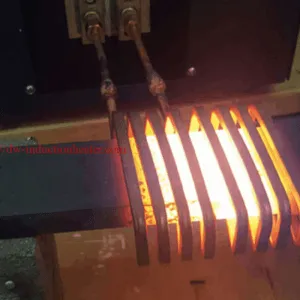
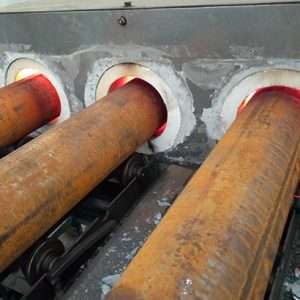
Induction bar end heating heats only the end of a metal rod, billet or bar for forging, upsetting, welding or forming. The bar end sits inside the induction coil, and the rest of the bar stays outside the magnetic field.
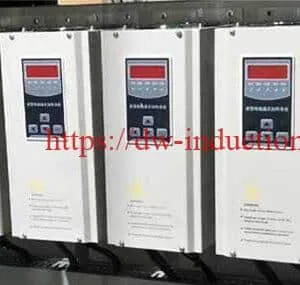
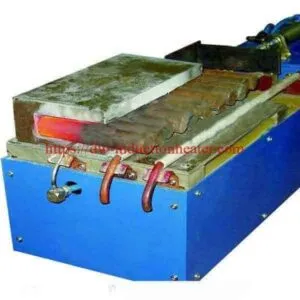
HLQ uses channel (C-shaped) coils, where chain conveyors feed long bars continuously through the coil, and multiple solenoid coils for higher production rates. The coils are powered by DW-MF medium-frequency power supplies: the DW-MF-200 to DW-MF-600 bar end heating models work at 0.5–20 kHz, with the frequency customised to the part size, and are rated for 100% duty, 24 hours of continuous work.
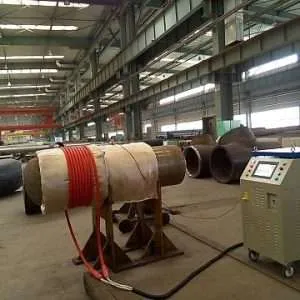
 Bar end heating machine: the bars rest on the feed line with only their ends inside the channel coil.
What is Induction Heating of the End of Rods, Billets and Bars?
It is localized induction heating of a bar end. An alternating current in the coil creates a changing magnetic field, which induces eddy currents in the conductive bar. The bar’s resistance to these currents generates heat. Read more in the fundamentals of induction bar end heating.
| Item | From HLQ photos and articles |
|---|---|
| Workpieces | Ends of rods, billets and bars |
| Coil types | Channel (C-shaped / slot) coil; multiple solenoid coils |
| Handling | Chain conveyors feed long bars continuously through the C-shaped coil |
| Coil lining | Refractory lining around the slot (photo) |
| Power supply | DW-MF medium-frequency series |

Key Applications

| Application | Purpose | Typical products |
|---|---|---|
| Forging | Preheat bar ends for hammering or pressing | Bolts, gears, axles, sockets |
| Upsetting | Enlarge the cross-section of a bar end | Bolts, rivets |
| Welding | Heat bar ends before joining to other parts | Welded assemblies |
| Forming | Shape metal ends | Fittings, flanges, machine parts |
Equipment for these uses: induction heater for billets, nuts and bolts.
Suitable Materials
| Material | Typical forging temperature (HLQ guide) | Notes |
|---|---|---|
| Steel | 1050–1250 °C | Steel bar forging example: 30–80 mm bars, 1100–1250 °C |
| Alloy steel | 1000–1200 °C | Forging, upsetting |
| Stainless steel | 1050–1180 °C | Forging |
| Titanium alloy | 850–1100 °C | Precision forging; tight temperature window |
| Copper, brass, aluminum bars | Process-specific | Non-ferrous; frequency and coil matched to conductivity |
Full guide: induction forging billet heating guide. Related: induction heating steel rods.
Working Principle

- The DW-MF power supply converts 3-phase mains into medium-frequency current.
- The capacitor unit and the channel coil form the resonant load.
- Bar ends inside the C-shaped coil carry eddy currents and heat up.
- A chain conveyor moves the bars through the coil; the rest of each bar stays outside.
| Frequency | Skin depth in hot steel (calculation) |
|---|---|
| 1 kHz | ≈ 17 mm |
| 3 kHz | ≈ 10 mm |
| 10 kHz | ≈ 5.5 mm |
| 20 kHz | ≈ 3.9 mm |
Calculated with δ = 503·√(ρ/(µr·f)), using ρ ≈ 1.2×10⁻⁶ Ω·m and µr = 1 (steel above the Curie point). Below the Curie point, steel is magnetic and the skin depth is much smaller. See skin effect in induction heating.

Technical Specifications
| Parameter | DW-MF-200 to DW-MF-600 (bar end heating furnace data) |
|---|---|
| Input voltage | 3 phases, 380 V / 410 V / 440 V, 50/60 Hz |
| Oscillating frequency | 0.5–20 kHz, customised according to the size of the heated parts |
| Duty cycle | 100%, 24 h continuous work |
| Cooling water | 0.1 MPa < water pressure < 0.3 MPa; water hardness < 50 |
| Extension (coil and handling) | Customised according to the material and size of the heated parts |
Source: induction bar end heating furnace.
Recommended Model Selection
Bar end heating furnace models
| Model | Max input current |
|---|---|
| DW-MF-200 | 320 A |
| DW-MF-250 | 400 A |
| DW-MF-300 | 480 A |
| DW-MF-400 | 640 A |
| DW-MF-500 | 800 A |
| DW-MF-600 | 960 A |
Smaller DW-MF models (1–20 kHz, 3-phase 380 V, 100% duty)
| Model | Power | Input current |
|---|---|---|
| DW-MF-15 | 15 kW | 23 A |
| DW-MF-25 | 25 kW | 36 A |
| DW-MF-35 | 35 kW | 51 A |
| DW-MF-45 | 45 kW | 68 A |
| DW-MF-70 | 70 kW | 105 A |
| DW-MF-90 | 90 kW | 135 A |
| DW-MF-110 | 110 kW | 170 A |
| DW-MF-160 | 160 kW | 240 A |
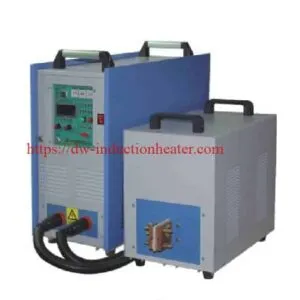
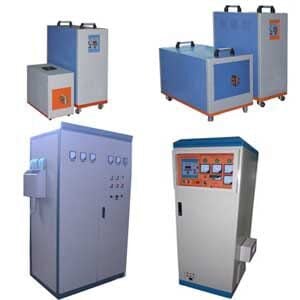
The smaller models list steel rod end heating and upsetting among their applications. Examples: DW-MF-35kW induction forging machine and 70kW induction forging machine. All power supplies: medium frequency induction power generator.
Process Workflow

| Step | Action |
|---|---|
| 1 | Load bars on the chain conveyor |
| 2 | Feed the bar ends into the C-shaped channel coil |
| 3 | Heat the ends while the conveyor moves the bars |
| 4 | The end reaches forging temperature at the coil exit |
| 5 | Transfer the hot bar to the press or hammer |
| 6 | Forge, upset or form the end |
| 7 | Cooling and further processing |
Line layout


Common Problems and Solutions
| Problem | Possible cause | Recommended solution |
|---|---|---|
| Uneven temperature | Poor coil design | Optimise the coil geometry |
| Surface overheating | Frequency too high | Adjust the frequency or power |
| Core underheating | Penetration too shallow | Increase the heating time or lower the frequency |
| High oxidation | Temperature too high | Optimise the set point and transfer speed |
| Equipment overheating | Poor water cooling | Keep the water at 0.1–0.3 MPa and hardness < 50 |
Engineering Selection Guide
| Bar diameter | Frequency trend | Typical use |
|---|---|---|
| 10–25 mm | Higher frequency | Small rods, local heating |
| 25–60 mm | Medium-high frequency | Bars and small billets |
| 60–120 mm | Medium frequency | Standard forging billets |
| 120 mm and above | Lower-medium / custom | Large-section ferrous billets |
| Factor | Influence |
|---|---|
| Frequency | Controls heating depth; must match the bar size |
| Power | Controls heating speed and throughput |
| Coil design | Controls coupling efficiency and uniformity |
| Heating time | Controls the final temperature; must match the line speed |
| Magnetic permeability / conductivity | Affect heating efficiency (steel vs copper and aluminum) |
| Temperature feedback | Improves control accuracy and reduces rejects |
Advantages and Limitations
| Advantages | Limitations |
|---|---|
| Selective heating of the bar end only | Coil design must suit the bar geometry |
| Fast heating and short cycle times | Material properties (permeability, resistivity) affect efficiency |
| Energy goes directly into the bar | Monitoring and control are needed for consistency |
| Repeatable cycles with controlled parameters | Cooling water is required |
| No open flame, reduced emissions | Initial equipment investment |
Why Choose HLQ?
| Strength | Evidence |
|---|---|
| Wide power range | DW-MF-15 to DW-MF-600 |
| Continuous operation | 100% duty, 24 h (DW-MF-200 to DW-MF-600) |
| Channel coils | Continuous feeding of long bars on chain conveyors |
| Custom frequency | 0.5–20 kHz matched to the part size |
| Forging experience | Bars, billets, nuts and bolts |
10 Core FAQs
1. What is induction bar end heating?
Localized induction heating of the end of a metal bar, rod or billet.
2. What is it used for?
Forging, upsetting for bolts and rivets, welding, and forming of fittings, flanges and machine parts.
3. Which coil is used?
Channel (C-shaped) coils with chain conveyors for long bars, or multiple solenoid coils for higher production rates.
4. Is only the end heated?
Yes. Only the part of the bar inside the coil is heated.
5. Which frequency should I use?
It depends on the bar diameter: a higher frequency for 10–25 mm, medium-high for 25–60 mm, and medium for 60–120 mm.
6. What temperature is used for steel?
HLQ’s guide gives 1050–1250 °C as the typical forging range for steel. The actual set point comes from the forging process.
7. What frequency range do the bar end heating models have?
0.5–20 kHz for DW-MF-200 to DW-MF-600, customised to the part size.
8. Can they run continuously?
The DW-MF-200 to DW-MF-600 are rated for 100% duty, 24 h continuous work.
9. What cooling water is needed?
Water pressure between 0.1 and 0.3 MPa, with hardness below 50.
10. What is needed for a quotation?
The material, the bar diameter and heated length, the target temperature and next process, the production rate, and the available supply.