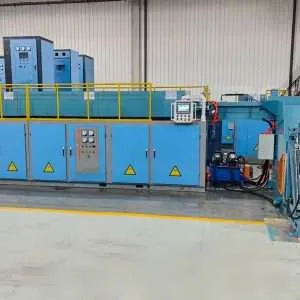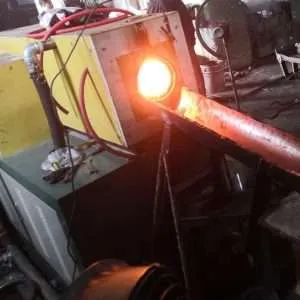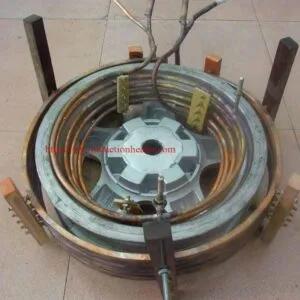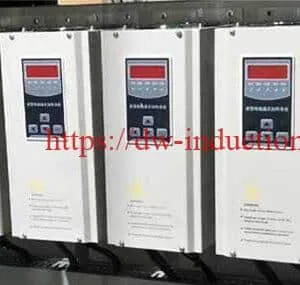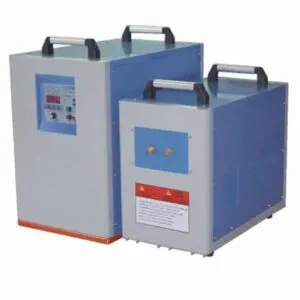
Magnetic Induction Forging Equipment
35kW Magnetic Induction Forging Equipment – Medium Frequency Induction Forging Machine
What Is Magnetic Induction Forging Equipment?
Magnetic induction forging equipment is an industrial electromagnetic heating system designed to heat steel rods, metal bars, billets, and other electrically conductive components to the required temperature before forging, hot forming, extrusion, or other manufacturing processes.
The HLQ DW-MF-35KW Magnetic Induction Forging Machine is a medium-frequency induction heating system featuring a published maximum oscillation power of 35kW and an operating frequency range of 1–20kHz.
Using solid-state IGBT inverter technology, the machine converts three-phase industrial electricity into medium-frequency alternating current. This current flows through an induction coil, generating an alternating magnetic field that produces heat directly within conductive metal workpieces.
Compared with high-frequency surface-heating systems, medium-frequency induction heating generally provides greater electromagnetic penetration and is therefore commonly selected for applications requiring deeper heating of steel rods, bars, and billets.
The DW-MF-35KW system is suitable for selected industrial applications, including:
- Steel rod induction heating for forging
- Steel bar and billet end heating
- Small-scale induction hot forging
- Carbon steel and alloy steel heating
- Metal tube-end heating for extrusion
- Induction shrink fitting and thermal assembly
- Small-scale induction metal melting with suitable furnace equipment
- Mold and die preheating
- Selected shaft and gear heat-treatment applications
- Localized welding preheating
Manufactured by HLQ Induction Equipment Co., Ltd., the DW-MF-35KW combines IGBT power conversion, water-cooled operation, a separate capacitor unit, and industrial protection functions.
For additional power ratings and configurations, explore HLQ’s
industrial induction heating power supplies.
Key Features of the DW-MF-35KW Induction Forging Machine
- 35kW Maximum Oscillation Power:
Designed for selected small-scale forging and industrial metal heating applications. - 1–20kHz Medium Frequency:
Suitable for applications requiring relatively deep electromagnetic penetration. - IGBT Inverter Technology:
Solid-state power conversion for controlled induction heating. - Three-Phase 380V Input:
Designed for industrial electrical installations. - Water-Cooled Operation:
Provides cooling for the induction heating equipment under specified operating conditions. - Continuous-Duty Design:
Published 100% duty-cycle rating at 40°C under specified conditions. - Customized Induction Coils:
Coil configurations can be selected according to workpiece geometry. - Multiple Protection Functions:
Overvoltage, overcurrent, overtemperature, phase-loss, and water-shortage protection. - Flexible Industrial Applications:
Forging, billet heating, metal forming, heat treatment, and shrink fitting.
DW-MF-35KW Magnetic Induction Forging Equipment Technical Specifications
The DW-MF-35KW medium frequency induction forging heater uses solid-state IGBT inverter technology to generate medium-frequency electrical power for industrial electromagnetic heating.
The following table lists the published technical parameters of the equipment.
| Technical Parameter | Specification |
|---|---|
| Product Name | Magnetic Induction Forging Equipment |
| Brand | HLQ |
| Manufacturer | HLQ Induction Equipment Co., Ltd. |
| Model Number | DW-MF-35KW |
| Published Maximum Oscillation Power | 35kW |
| Operating Frequency | 1–20kHz |
| Input Voltage | Three-Phase AC 380V ±10% |
| Input Frequency | 50/60Hz |
| Published Maximum Input Current | 51A |
| Power Electronics | IGBT |
| Inverter Technology | Solid-State Parallel Inverter |
| Heating Technology | Medium Frequency Electromagnetic Induction |
| Cooling Method | Water Cooling |
| Published Cooling Water Pressure | Greater Than 0.2MPa |
| Published Cooling Water Flow | 6L/min |
| Duty Cycle | 100% at 40°C Under Specified Conditions |
| Generator Dimensions | 560 × 270 × 470mm |
| Capacitor Unit Dimensions | 550 × 300 × 420mm |
| Generator Net Weight | Approximately 42kg |
| Capacitor Unit Net Weight | Approximately 50kg |
| Connecting Cable Length | 2m |
| Electrical Protection | Overvoltage, Overcurrent and Phase-Loss Protection |
| Thermal Protection | Overtemperature Protection |
| Cooling Protection | Water Shortage Alarm and Protection |
| Induction Coil | Customized According to Workpiece Dimensions |
| Suitable Materials | Carbon Steel, Alloy Steel, Copper, Brass, Aluminum and Other Conductive Metals |
| Primary Application | Induction Forging and Rod Heating |
| Additional Applications | Billet Heating, Shrink Fitting, Heat Treatment and Small-Scale Melting |
| Automation Integration | Application-Specific Configuration |
| Installation | Industrial Workshops and Manufacturing Facilities |
| Manufacturing Country | China |
Technical Note:
The published 35kW value refers to maximum oscillation power. The electrical input rating, actual continuous output capability, and complete-system cooling requirements should be confirmed against the supplied machine configuration before installation.
Actual heating capacity depends on workpiece material, dimensions, operating frequency, induction coil design, target temperature, and required heating time.
Advantages of the 35kW Medium Frequency Induction Forging Machine
1. Fast and Efficient Induction Heating for Metal Forging
The DW-MF-35KW uses electromagnetic induction to generate heat directly within electrically conductive metal workpieces.
Unlike conventional furnace heating, induction heating does not necessarily require the entire furnace chamber or surrounding structure to reach the workpiece temperature before useful heating begins.
For suitable applications, this can reduce heating time and improve the controllability of the forging preparation process.
2. Greater Electromagnetic Penetration
Medium-frequency induction heating is commonly selected for metal heating applications requiring relatively deep electromagnetic penetration.
The DW-MF-35KW operates within a published frequency range of 1–20kHz.
Lower operating frequencies generally increase electromagnetic penetration compared with higher-frequency systems under comparable material conditions.
However, uniform through-heating depends on the steel grade, diameter, frequency, heating time, and thermal conduction.
3. Advanced IGBT Inverter Technology
The machine incorporates a solid-state IGBT parallel inverter circuit for medium-frequency induction heating.
IGBT technology provides electronically controlled power conversion and supports compact industrial induction heating configurations.
The actual electrical efficiency and heating performance depend on inverter design, load matching, workpiece properties, and operating conditions.
4. Reduced Dependence on Conventional Fuel Heating
Electromagnetic induction heating eliminates the need for direct combustion heating at the workpiece.
This can simplify certain industrial heating arrangements and reduce unnecessary heating of nearby equipment.
Actual energy savings depend on the comparison process, induction coil efficiency, production cycle, and operating conditions.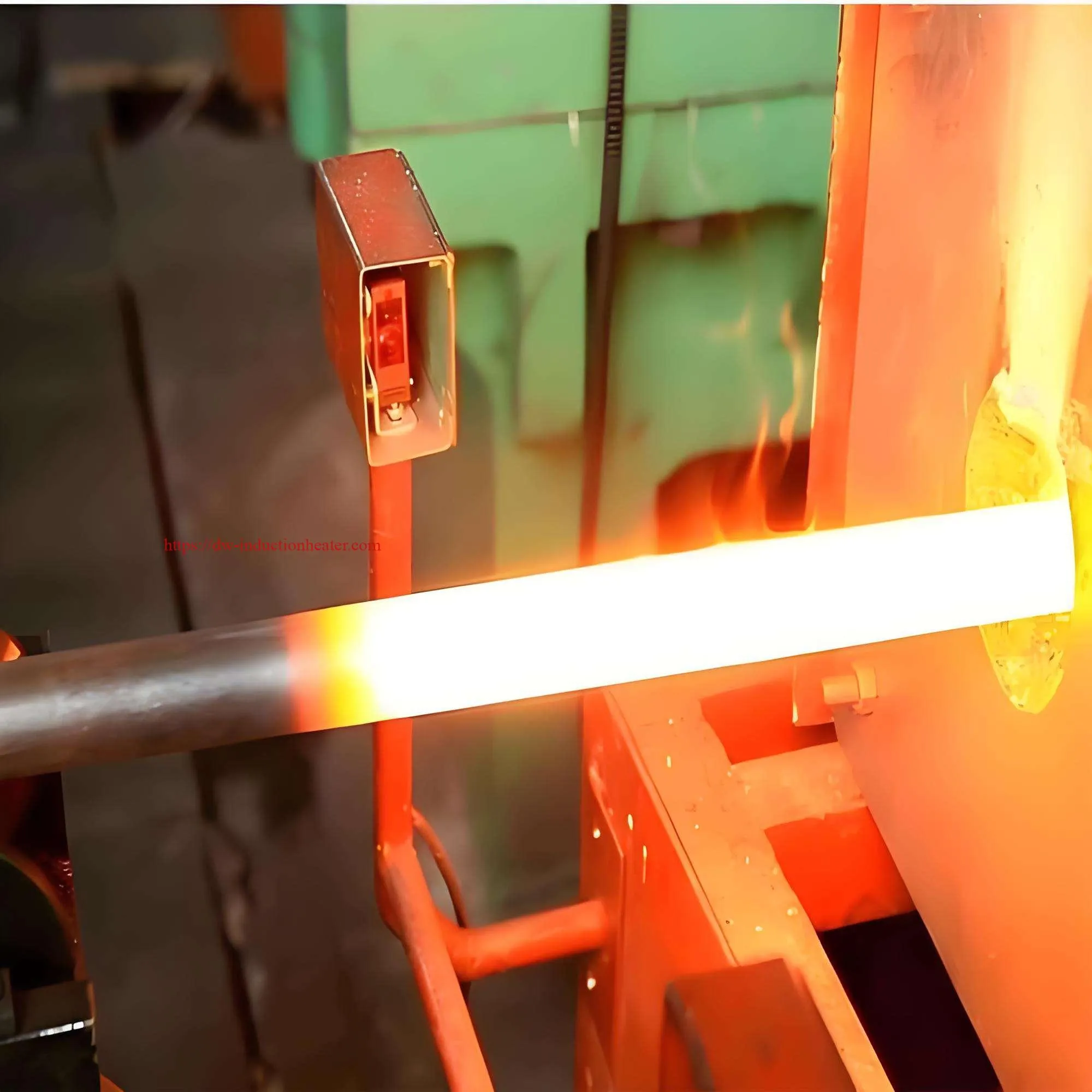
5. Customizable Induction Coil Design
Different metal workpieces require different induction coil geometries.
HLQ can provide application-specific coil designs for steel rods, billets, shafts, tubes, fittings, and other industrial components.
Appropriate coil design helps improve magnetic coupling, heating distribution, and production repeatability.
6. Continuous-Duty Industrial Design
The DW-MF-35KW has a published 100% duty-cycle rating at 40°C under specified conditions.
For continuous production, the electrical supply, cooling-water system, induction coil, and operating parameters must satisfy the equipment requirements.
7. Integrated Equipment Protection
The machine includes protection functions for overvoltage, overcurrent, overheating, phase loss, and cooling-water shortages.
These functions support equipment protection when combined with proper installation, preventive maintenance, and safe operating procedures.
8. Flexible Application in Metalworking Industries
The DW-MF-35KW can be considered for small-scale forging, localized metal heating, hot forming, and selected thermal assembly applications.
For more information about industrial forging processes, explore HLQ’s
induction forging and hot forming applications.
Industrial Applications of Magnetic Induction Forging Equipment
The DW-MF-35KW induction forging equipment is designed for selected metal heating applications where controlled localized heating and medium-frequency electromagnetic penetration are required.
1. Steel Rod Induction Heating for Hot Forging
Induction heating is widely used to prepare steel rods and bars for hot forging.
The induction coil generates an alternating magnetic field that heats the steel workpiece to the required forming temperature.
For many carbon and alloy steels, conventional hot forging temperatures may fall within approximately 900–1250°C, depending on the material grade and forging procedure.
The DW-MF-35KW can be considered for selected small steel rod and localized end-heating applications.
Actual processing capability depends on rod diameter, heated length, steel grade, heating time, and required production rate.
2. Steel Billet Induction Heating Before Forging
Medium-frequency induction heating is used to heat steel billets before forging, rolling, extrusion, and other metal forming operations.
The 1–20kHz operating range provides frequency options suitable for evaluating relatively small billet heating applications.
The required heating power depends on billet mass, initial temperature, target temperature, thermal properties, and processing time.
For larger billets or high-throughput industrial forging lines, higher-power induction heating equipment is generally required.
Explore HLQ’s
induction billet heating systems for forging and extrusion
for larger workpieces and customized production configurations.
3. Metal Bar and Rod End Heating
The DW-MF-35KW can be configured for localized heating of metal rod ends before mechanical forming.
Typical applications include steel bar end forging, rod upsetting, localized hot forming, and selected fastener manufacturing processes.
A properly designed induction coil concentrates the heating area within the required section of the workpiece.
The process parameters must be selected to achieve the desired temperature without excessive overheating or undesirable deformation.
4. Metal Tube-End Heating for Extrusion and Forming
Medium-frequency induction heating can be used to heat selected sections of steel tubes before extrusion, expanding, reducing, or other forming operations.
The induction coil can be designed according to tube diameter, wall thickness, heating length, and temperature requirements.
The final heating arrangement should account for temperature distribution through the tube wall and the risk of distortion.
5. Induction Shrink Fitting and Thermal Assembly
Induction heating can temporarily expand metal components to facilitate interference-fit assembly.
Typical applications include heating steel hubs, mechanical housings, shaft-mounted components, and selected industrial fittings.
The required temperature depends on material expansion coefficients, interference allowances, dimensional tolerances, and acceptable thermal stresses.
6. Small-Scale Induction Metal Melting
A properly configured medium-frequency induction heating power supply can support certain small-scale metal melting applications.
Potential materials include aluminum, copper, brass, and selected ferrous alloys.
However, the DW-MF-35KW power supply alone does not constitute a complete induction melting furnace.
A compatible furnace body, induction coil, crucible, electrical matching circuit, and cooling system must be selected for the intended metal and charge weight.
For production melting requirements, explore HLQ’s
industrial induction melting furnaces.
7. Shaft and Gear Induction Heat Treatment
The DW-MF-35KW can be considered for selected shaft and gear heating applications.
For induction hardening, suitable hardenable steel must be heated to the required austenitizing temperature and subsequently quenched using an appropriate process.
The required operating frequency depends on the workpiece dimensions, heating pattern, and desired hardened depth.
The final hardness and case depth must be verified through testing.
8. Mold and Die Preheating
Induction heating can be used to preheat selected metal molds, dies, and industrial tool components.
Controlled preheating may help reduce thermal gradients before subsequent manufacturing operations.
The necessary induction power and heating cycle depend on mold mass, material properties, geometry, and required temperature distribution.
9. Welding Joint Preheating
Medium-frequency induction heating can also be used for localized preheating of suitable steel components before welding.
The preheating temperature must be selected according to the steel grade, thickness, welding procedure, and applicable welding standards.
Temperature monitoring should be included when the welding procedure requires controlled preheat or interpass temperatures.
Recommended Applications and Induction Coil Configurations
| Application | Suitable Materials | Heating Purpose | Recommended Coil Configuration |
|---|---|---|---|
| Steel Rod Forging | Carbon Steel / Alloy Steel | Heating Before Hot Forging | Multi-Turn Solenoid Coil |
| Steel Billet Heating | Carbon Steel | Heating Before Forging | Customized Encircling Coil |
| Rod End Heating | Steel Bars and Rods | Localized End Heating | Short Solenoid Coil |
| Tube-End Heating | Steel Tubes | Heating Before Extrusion | Tubular Induction Coil |
| Shrink Fitting | Steel Hubs and Housings | Thermal Expansion | Encircling Induction Coil |
| Small-Scale Metal Melting | Copper / Aluminum / Steel | Melting Metal Charges | Compatible Furnace Induction Coil |
| Shaft Heat Treatment | Hardenable Steel | Localized Heat Treatment | Customized Hardening Coil |
| Gear Heat Treatment | Carbon Steel / Alloy Steel | Controlled Gear Heating | Application-Specific Induction Coil |
| Mold Preheating | Tool Steel | Controlled Preheating | Customized Heating Coil |
| Welding Preheating | Carbon Steel / Alloy Steel | Preheating Before Welding | Localized Heating Coil |
Engineering Recommendation:
The configurations listed above are application references rather than guaranteed processing capacities. Final feasibility depends on the workpiece, induction coil, electrical matching arrangement, and heating cycle.
How Does a Medium Frequency Induction Forging Machine Work?
A medium frequency induction forging machine uses electromagnetic induction to generate heat directly within electrically conductive metal workpieces.
The system combines an induction power supply, electrical matching circuit, water-cooled induction coil, and workpiece-handling arrangement.
Step 1: Three-Phase AC Power Input
The induction power supply receives three-phase industrial AC electricity.
The incoming electrical power is converted through the rectification and power conversion circuitry.
Step 2: IGBT Inverter Power Conversion
The IGBT inverter generates medium-frequency alternating electrical power.
The DW-MF-35KW has a published operating frequency range of 1–20kHz.
The actual operating frequency depends on the inverter, resonant circuit, induction coil, and workpiece load.
Step 3: Alternating Magnetic Field Generation
Medium-frequency alternating current flows through the water-cooled induction coil.
This current generates a changing magnetic field around the metal workpiece.
Step 4: Eddy Current Heating
The changing magnetic field induces circulating electrical currents inside the conductive metal.
These induced currents produce heat through electrical resistance.
For ferromagnetic materials, magnetic losses can also contribute to heating below the Curie temperature.
Step 5: Heating to the Required Forging Temperature
The metal workpiece is heated until it reaches the temperature required by the manufacturing process.
The temperature distribution depends on the material, workpiece dimensions, frequency, induction coil design, and heating time.
For through-heating applications, sufficient time must be allowed for heat conduction and temperature equalization.
Step 6: Transfer to the Forging Process
After reaching the required temperature, the workpiece can be transferred to the forging press, forming machine, or other production equipment.
The handling arrangement may be manual or automated depending on the production-line configuration.
How to Choose the Right Induction Forging Machine
Selecting suitable induction forging equipment requires evaluating the metal material, workpiece dimensions, target temperature, required heating time, and production capacity.
The required thermal power can be estimated from the mass of material heated, its specific enthalpy increase, the process efficiency, and the heating time.
For an initial engineering estimate:
P = m × Δh / (t × η)
Where:
- P: Required average electrical heating power, kW
- m: Workpiece mass, kg
- Δh: Specific enthalpy increase, kJ/kg
- t: Heating time, seconds
- η: Overall heating efficiency, expressed as a decimal
This equation provides an initial estimate only. The enthalpy change should reflect the actual material and temperature range, while efficiency must account for the relevant system losses.
For accurate machine selection, customers should provide:
- Workpiece material and steel grade
- Rod or billet diameter
- Workpiece length and weight
- Required heated length
- Initial workpiece temperature
- Target forging temperature
- Required heating time
- Production capacity in pieces per hour or kg/h
- Available electrical supply
- Cooling-water conditions
- Manual or automatic operation requirements


Selection Note:
The DW-MF-35KW is best evaluated for relatively small workpieces or localized heating. Large-diameter billets and high-output forging production lines normally require greater power and may need lower operating frequencies.
FAQs About Magnetic Induction Forging Equipment
FAQ 1: What is magnetic induction forging equipment?
Magnetic induction forging equipment is an industrial heating system that uses electromagnetic induction to raise the temperature of metal workpieces before forging or hot forming.
The induction coil creates an alternating magnetic field that induces electrical currents inside the conductive metal.
These currents generate heat within the workpiece through electrical resistance.
The HLQ DW-MF-35KW is a medium-frequency induction heating machine with a published maximum oscillation power of 35kW and an operating frequency range of 1–20kHz.
Typical applications include steel rod heating, billet end heating, localized forging preparation, and selected industrial heat-treatment processes.
FAQ 2: What frequency is best for induction forging?
The best frequency for induction forging depends on workpiece diameter, material properties, required heating depth, and processing time.
Medium-frequency induction heating is commonly selected for steel bars and billets that require greater electromagnetic penetration.
Lower frequencies generally increase electromagnetic penetration in conductive materials.
The DW-MF-35KW induction forging machine operates within a published range of 1–20kHz.
For larger workpieces requiring deep through-heating, lower-frequency or higher-power equipment may be required.
The final frequency should be established through engineering evaluation and practical heating trials.
FAQ 3: Can a 35kW induction forging machine heat steel rods to forging temperature?
Yes. A 35kW medium-frequency induction forging machine can be suitable for heating selected small steel rods or rod ends to forging temperatures.
Many carbon and alloy steel forging processes use temperatures within approximately 900–1250°C, depending on the material and forming requirements.
However, the maximum rod diameter and achievable heating time cannot be determined from machine power alone.
Heating capacity depends on the steel grade, workpiece dimensions, induction coil design, thermal efficiency, and production rate.
For high-throughput forging applications, higher-power induction heating equipment may be more appropriate.
FAQ 4: What are the advantages of induction forging compared with gas furnace heating?
Induction forging provides rapid electromagnetic heating, localized energy delivery, and improved controllability for suitable metalworking applications.
Unlike conventional gas furnaces, induction heating does not require combustion at the workpiece.
Induction heating can also reduce unnecessary heating of surrounding equipment and improve the repeatability of production cycles.
For short heating cycles and localized forging applications, induction heating may reduce processing time and improve operating flexibility.
Actual energy savings, oxidation reduction, and productivity improvements depend on the workpiece and production conditions.
FAQ 5: Can magnetic induction forging equipment heat stainless steel, copper, and aluminum?
Yes. Electromagnetic induction heating can be used with electrically conductive materials, including stainless steel, copper, brass, aluminum, carbon steel, and alloy steel.
However, different materials have different electrical resistivity, magnetic permeability, thermal conductivity, and heat capacity.
Copper and aluminum are nonferromagnetic and have relatively high electrical conductivity, which can affect induction coupling and heating efficiency.
The induction frequency, coil design, and heating power must therefore be selected according to the material and workpiece dimensions.
The suitability of the DW-MF-35KW for a specific nonferrous metal application should be verified through engineering evaluation.
FAQ 6: What cooling system is required for a 35kW induction forging machine?
The HLQ DW-MF-35KW is a water-cooled induction heating system.
The published cooling requirements specify water pressure greater than 0.2MPa and a flow rate of 6L/min.
However, the complete heating installation may require additional cooling capacity depending on the induction coil, capacitor unit, connecting cables, and operating duty.
A suitable industrial recirculating cooling-water system should maintain stable flow, temperature, pressure, and water quality.
The complete cooling requirements should be confirmed before installation and commissioning.
FAQ 7: Can a 35kW induction forging machine operate continuously for 24 hours?
The HLQ DW-MF-35KW has a published 100% duty-cycle rating at 40°C under specified conditions.
This means the equipment is designed for continuous-duty operation when the electrical supply, cooling system, induction coil, and operating parameters meet the manufacturer’s requirements.
Continuous production requires suitable cooling capacity, stable electrical input, equipment monitoring, and preventive maintenance.
The 100% duty-cycle specification should not be interpreted as a guarantee of uninterrupted operation under all environmental or production conditions.
FAQ 8: How do I select the right induction forging equipment for steel billets?
Selecting the correct induction forging machine requires evaluating the billet material, diameter, length, mass, required forging temperature, heating time, and production capacity.
The required heating power is determined primarily by the thermal energy needed to raise the workpiece temperature and the available heating time.
Operating frequency should be selected according to electromagnetic penetration and the required temperature distribution.
The HLQ DW-MF-35KW is a potential solution for selected small-scale steel rod and billet heating applications.
Larger billets, higher production rates, or demanding through-heating requirements may require more powerful induction heating systems.
HLQ Induction Equipment Co., Ltd. can assist customers with induction power selection, frequency matching, customized induction coil design, and suitable equipment configurations.
Why Choose HLQ Magnetic Induction Forging Equipment?
HLQ Induction Equipment Co., Ltd. manufactures industrial induction heating equipment and customized electromagnetic heating systems for metalworking and manufacturing applications.
Our product range includes medium-frequency induction forging machines, steel billet heating systems, induction heating power supplies, induction melting furnaces, induction hardening equipment, and customized industrial heating solutions.
The DW-MF-35KW Magnetic Induction Forging Equipment is designed for manufacturers requiring a medium-frequency induction heating solution for selected steel rod forging, billet end heating, and industrial metal heating applications.
HLQ can assist customers with evaluating suitable heating power, operating frequency, induction coil configurations, and production requirements.
Information Required for a Technical Quotation
- Metal material and grade
- Workpiece diameter and length
- Workpiece weight
- Initial temperature
- Target heating temperature
- Required heating time
- Production capacity per hour
- Required heated length
- Available electrical power supply
- Cooling-water conditions
- Manual, semi-automatic, or automatic operation
- Workpiece drawings or photographs
Providing detailed technical requirements helps ensure that the recommended induction heating equipment matches the intended production process.