Induction Heating Steel Rods
Induction Heating Steel Rods Simultaneously for Molding
Quick Answer
Induction heating of steel rods can bring several rods to temperature together inside one coil.
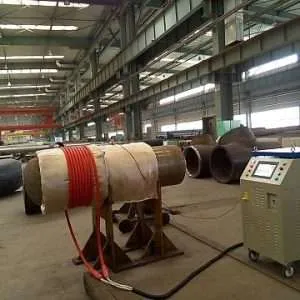
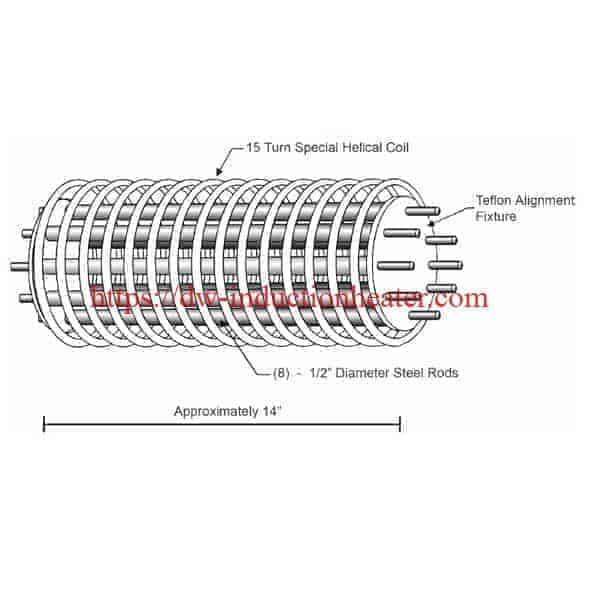
In this HLQ case, eight steel rods (Ø1/2 in × 14 in, held by Teflon end plates) were placed in a fifteen-turn helical coil. A DW-MF-25kW system ran at 20 kHz, and the rods reached 212 °F (100 °C) in 45 seconds for a molding operation. The rods heated uniformly without rotating the rod capsule, energy consumption dropped, and the operation was hands-free.

What is Induction Heating of Steel Rods?
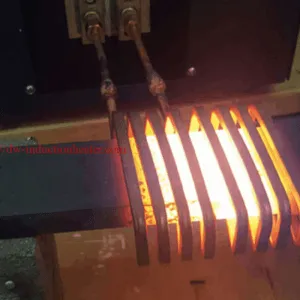
A helical coil carrying alternating current surrounds the rods and induces eddy currents in them, so the rods heat directly. Several rods can be held together in a non-conductive fixture and heated in a single cycle.
| Item | HLQ case data |
|---|---|
| Objective | Heat eight steel rods simultaneously to 212 °F (100 °C) for a molding operation |
| Material | 8 steel rods, 1/2 in (12.7 mm) diameter × 14 in (355.6 mm) long, held by 2.5 in (63.5 mm) diameter Teflon end plates |
| Temperature | 212 °F (100 °C) |
| Frequency | 20 kHz |
| Equipment | DW-MF-25kW induction heating system with a remote workhead containing one 0.66 µF capacitor, plus a coil designed for this application |
| Coil | Fifteen-turn helical coil |
| Heating time | 45 seconds |
| Results | Uniform heating without rotation of the rod capsule; decrease in energy consumption; hands-free operation |
Key Applications

| HLQ case | Part | Temperature | Time | Frequency | Coil |
|---|---|---|---|---|---|
| Steel rods for molding (this page) | 8 × Ø12.7 × 355.6 mm rods | 212 °F (100 °C) | 45 s | 20 kHz, DW-MF-25kW | 15-turn helical |
| Aluminium chamber for powder expansion | Ø110 × 35 mm chamber | 150 °C (302 °F) | 120 s | 20 kHz, DW-MF-25kW | Two pancake coils |
| Pliers handle for bending | 3.75 in zone on a 5 in handle | 1200 °F (649 °C) | 30 s | 50 kHz | Multi-turn helical |
Related cases: induction heating aluminium chamber and induction heating steel handle for bending. For heating only the rod ends, see induction heating end of rods and billets.
Suitable Materials
| Item | Role | Notes |
|---|---|---|
| Steel rods | Heated part | Electrically conductive; heated by eddy currents |
| Teflon (PTFE) end plates | Fixture | Not electrically conductive, so not heated by induction; hold and space the rods |
The original case names the rods both “steel” and “stainless steel”. Confirm the grade, because carbon steel (magnetic) and austenitic stainless steel (non-magnetic) respond differently at 20 kHz.
Working Principle

- The DW-MF-25kW power supply feeds a remote workhead with one 0.66 µF capacitor.
- The fifteen-turn helical coil around the rod capsule carries 20 kHz current and produces an alternating magnetic field along the rods.
- Eddy currents heat all eight rods at the same time, and the Teflon end plates stay cold.
- Because the coil surrounds the whole capsule, the rods heat uniformly without rotation.
Background: understanding the skin effect and how an induction heater works.
Current penetration depth at 20 kHz (physics reference)
| Material | Resistivity | µr | Depth δ |
|---|---|---|---|
| Austenitic stainless steel (non-magnetic) | ≈ 0.72 µΩ·m | 1 | ≈ 3.0 mm |
| Carbon steel below the Curie point | ≈ 0.17 µΩ·m | Magnetic (≫ 1) | Well under 1 mm |
Calculated with δ = 503·√(ρ / (µr·f)). The rod radius is 6.35 mm.
Technical Specifications
| Parameter | Value in the HLQ case |
|---|---|
| Parts | 8 steel rods, Ø1/2 in (12.7 mm) × 14 in (355.6 mm) |
| Fixture | 2.5 in (63.5 mm) diameter Teflon end plates |
| Target temperature | 212 °F (100 °C) |
| Heating time | 45 seconds |
| Frequency | 20 kHz |
| Power supply | DW-MF-25kW |
| Workhead | Remote, one 0.66 µF capacitor |
| Coil | Fifteen-turn helical |
Energy check (physics estimate)
| Quantity | Value |
|---|---|
| Volume per rod | π × (6.35 mm)² × 355.6 mm ≈ 45 cm³ |
| Mass of 8 rods | ≈ 2.83 kg (carbon steel) / ≈ 2.85 kg (stainless) |
| Heat from 20 °C to 100 °C | ≈ 104 kJ (cp 0.46 J/g·K) / ≈ 114 kJ (cp 0.50 J/g·K) |
| Average power into the rods over 45 s | ≈ 2.3–2.5 kW |
The estimate assumes a 20 °C start and excludes coil, workhead and radiation losses, so the actual supply power is higher.
Recommended Model Selection
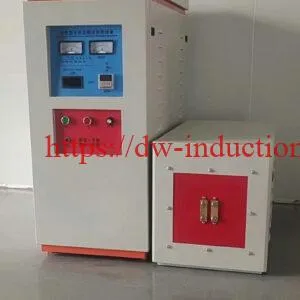
DW-MF-25kW (published data)
| Maximum power | Maximum current | Frequency | Supply | Duty cycle |
|---|---|---|---|---|
| 25 kW | 36 A | 1–20 kHz | 3-phase 380 V ±10% | 100% |
Details: 25 kW solid state IGBT induction heating power supply.
| HLQ series | Power | Frequency | Typical use |
|---|---|---|---|
| DW-MF | 15–300 kW | 1–20 kHz | Larger sections and deeper heating; used in this case |
| DW-HF | 15–160 kVA | 20–80 kHz (15 kW: 30–100 kHz) | Smaller sections and surface zones |
| DW-UHF | 4.5–60 kW | By model, up to 2.0 MHz | Very small parts and thin zones |
Full model data: HLQ induction heating device models.
Process Workflow

| Step | Action | Case reference |
|---|---|---|
| 1 | Assemble 8 rods with Teflon end plates | Ø2.5 in plates hold the rods in place |
| 2 | Place the capsule inside the coil | Fifteen-turn helical coil |
| 3 | Apply power | DW-MF-25kW, 20 kHz |
| 4 | Heat all rods together | No rotation of the capsule |
| 5 | Reach temperature | 212 °F (100 °C) after 45 seconds |
| 6 | Transfer to molding | Molding operation |
| 7 | Next capsule | Hands-free, repeatable cycle |
Station layout

Common Problems and Solutions
| Problem | Likely cause | Solution |
|---|---|---|
| Rods heat unevenly | Rods not evenly spaced, or capsule off-centre in the coil | Space the rods with the end plates; centre the capsule in the coil |
| Rods too cold or too hot | Power or time not matched to the load | Confirm power and time by test (45 s in the case) |
| Results vary between cycles | Different rod count, size or position | Use the same load and position every cycle |
| Fixture heats up | A conductive fixture in the field | Use non-conductive fixtures such as Teflon |
Engineering Selection Guide
| Factor | What to confirm | Why it matters |
|---|---|---|
| Rod material | Carbon steel or stainless steel | Changes the penetration depth and heating behaviour |
| Rod count and size | For example, 8 × Ø12.7 × 355.6 mm | Sets coil diameter and length |
| Target temperature and time | For example, 212 °F in 45 s | Sets the power rating |
| Coil | Length covering the full rods (15 turns in the case) | Uniform heating along the rods |
| Fixture | Non-conductive material | Only the rods should heat |
| Coil engineering | Shape and turn count | See induction heating coil design |
Advantages and Limitations
| Advantages | Limitations |
|---|---|
| Uniform heating without rotation of the rod capsule | The coil is designed for one capsule size |
| Decrease in energy consumption | The rod material must be confirmed for frequency selection |
| Hands-free operation | The fixture must be non-conductive |
| Eight rods heated in one 45-second cycle | Power and time must be confirmed by test |
Why Choose HLQ?
| Strength | Evidence |
|---|---|
| Multi-part heating | Eight rods heated together in one coil |
| Application coils | Fifteen-turn helical coil for the capsule |
| DW-MF series | 15–300 kW, 1–20 kHz, 100% duty cycle |
| Remote workhead | Compact heating station at the part |
| Related cases | Aluminium chamber heating; pliers handle bending |
| Hands-free process | No rotation; repeatable cycle |
10 Core FAQs
1. What temperature were the rods heated to?
212 °F (100 °C).
2. How long did it take?
45 seconds for all eight rods together.
3. How many rods were heated at once?
Eight rods, each 1/2 in (12.7 mm) in diameter and 14 in (355.6 mm) long.
4. Which coil was used?
A fifteen-turn helical coil.
5. Which equipment and frequency?
A DW-MF-25kW system with a remote workhead holding one 0.66 µF capacitor, at 20 kHz.
6. How were the rods held?
By 2.5 in (63.5 mm) diameter Teflon end plates, which are not heated by induction.
7. Did the capsule need to rotate?
No. The rods heated uniformly without rotating the capsule.
8. How much heat do the rods absorb?
By physics estimate, about 104–114 kJ from 20 °C to 100 °C, or about 2.3–2.5 kW on average over 45 seconds, before losses.
9. What are the benefits?
Uniform heating without rotation, a decrease in energy consumption, and hands-free operation.
10. What is needed for a quotation?
Rod material, diameter, length and quantity; the target temperature and time; the fixture design; and the available supply.