


Induction Heating Copper Wire for Stripping
Induction Heating Tinned Copper Wire Ends for Stripping
Quick Answer
Induction heating of copper wire for stripping melts the tin on pre-tinned stranded copper wire, so the strands fuse together and the wire end strips more easily.
In this HLQ case, a DW-UHF-4.5KW solid-state power supply with a 300 pF remote heat station drove a multi-turn coil fitted with a ceramic guide tube. The strands reached 500 °F (260 °C) in 1–2 seconds, on both single and dual multi-strand wires. Up to 20 kW at 400 kHz could not heat the small copper wires.

What is Induction Heating of Copper Wire for Stripping?
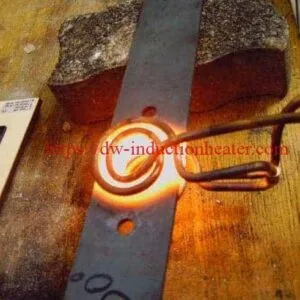
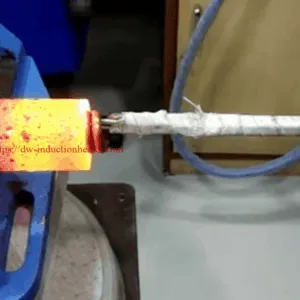
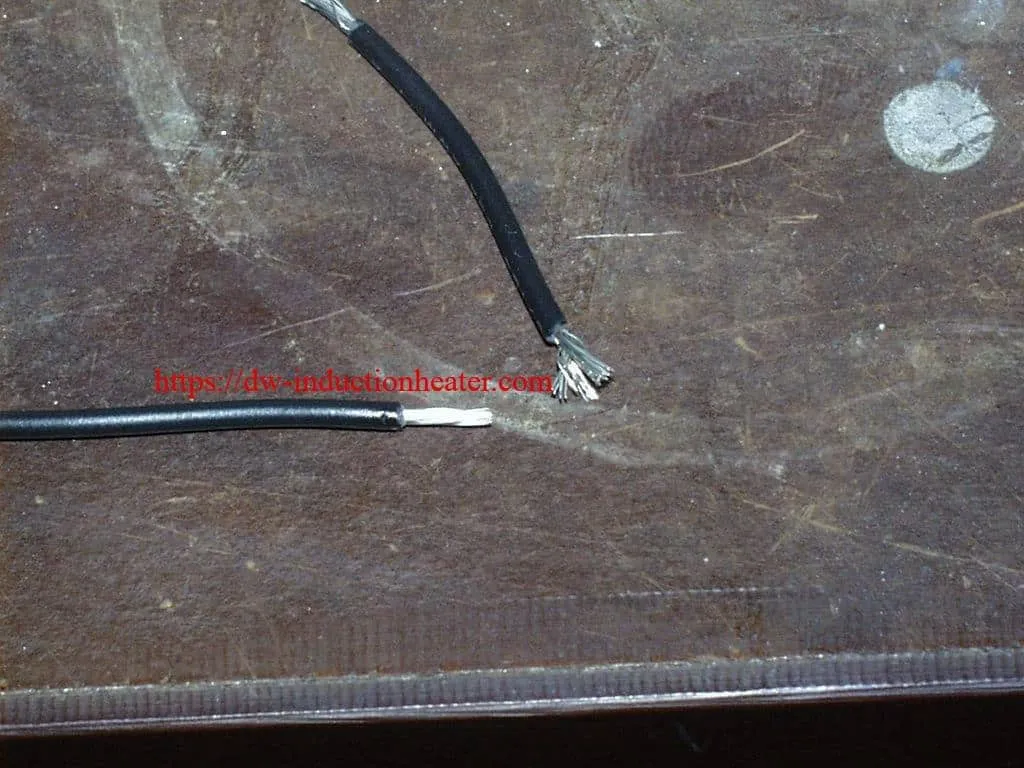
A coil carrying very-high-frequency current induces eddy currents in the copper strands. The strands heat until the tin coating melts, and the molten tin coalesces (fuses) the strands into a solid end that is easier to strip.
| Item | HLQ case data |
|---|---|
| Objective | Heat pre-tinned copper wires of various diameters to 500 °F (260 °C) to melt the tin and coalesce (fuse) the wires for easier stripping |
| Material | Pre-tinned copper wires 0.01mm in diameter |
| Temperature | 500 °F (260 °C) |
| Frequency | 900 MHz |
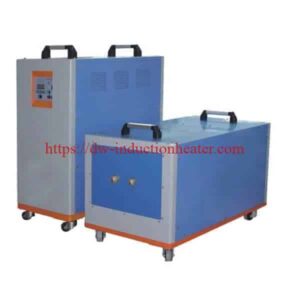
| Equipment | DW-UHF-4.5KW solid-state induction power supply with a remote heat station containing three 100 pF capacitors (300 pF total), plus a coil designed for this application |
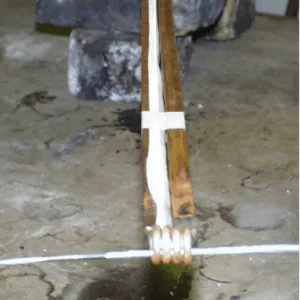
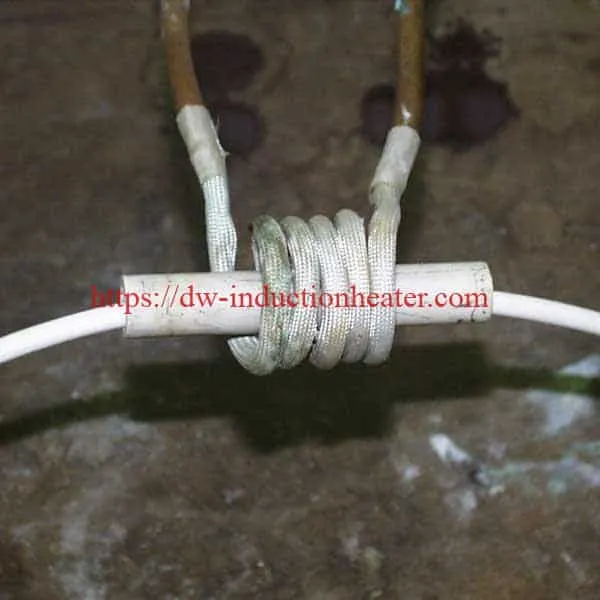
| Coil | Multi-turn coil with a ceramic tube inside to guide and centre the wire |
| Time | 1–2 seconds |
| Results | Strands heated to 500 °F at the specified rate; works on a single multi-strand wire and on a dual multi-strand wire assembly |
| Test note | Up to 20 kW of power at 400 kHz could not heat the small copper wires |
Key Applications
| HLQ case | Part | Temperature / result | Equipment |
|---|---|---|---|
| Wire end fusing for stripping (this page) | Pre-tinned stranded copper wire | 500 °F (260 °C) in 1–2 s | DW-UHF-4.5KW, 300 pF |
| Stainless steel cable stress relief | Ø0.64 mm and Ø0.46 mm cable, 14 cm static zone | 510–815 °C in 2–8.8 s | DW-UHF-4.5KW, 4.03 kW |
| Co-axial wire soldering | Centre conductor and shielding braid | Reached 500 °F in 10 s | DW-UHF-4.5kW, multi-turn coil |
| Copper wire soldering to a buss bar | Two tinned stranded copper wires | 446 °F (230 °C), 30 s | DW-UHF-6kW, four-turn split helical coil |
Case pages: induction heating stainless steel wire cable, induction soldering co-axial wire and induction soldering copper wires. For inline wire heat treatment, see continuous induction annealing for wire and cable.
Suitable Materials
| Item | Role | Notes |
|---|---|---|
| Pre-tinned stranded copper wire | Heated part | Tin coating melts (tin melts at about 232 °C) |
| Single multi-strand wire | Tested | Heated to 500 °F at the specified rate |
| Dual multi-strand wire assembly | Tested | Same system and coil |
| Ceramic tube | Guide inside the coil | Not electrically conductive; centres the wire and prevents arcing |
Strand diameter and count decide the frequency needed. Confirm them by an initial test.
Working Principle

- The DW-UHF-4.5KW supplies very-high-frequency current through a remote heat station (three 100 pF capacitors, 300 pF).
- The multi-turn coil sets up an alternating field around the wire end, which sits inside a ceramic guide tube.
- Eddy currents heat the copper strands.
- At 500 °F (260 °C) the tin melts and fuses the strands in 1–2 seconds.
- The ceramic tube keeps the wire centred, so it cannot touch the coil and arc.
Background: understanding the skin effect and how an induction heater works.
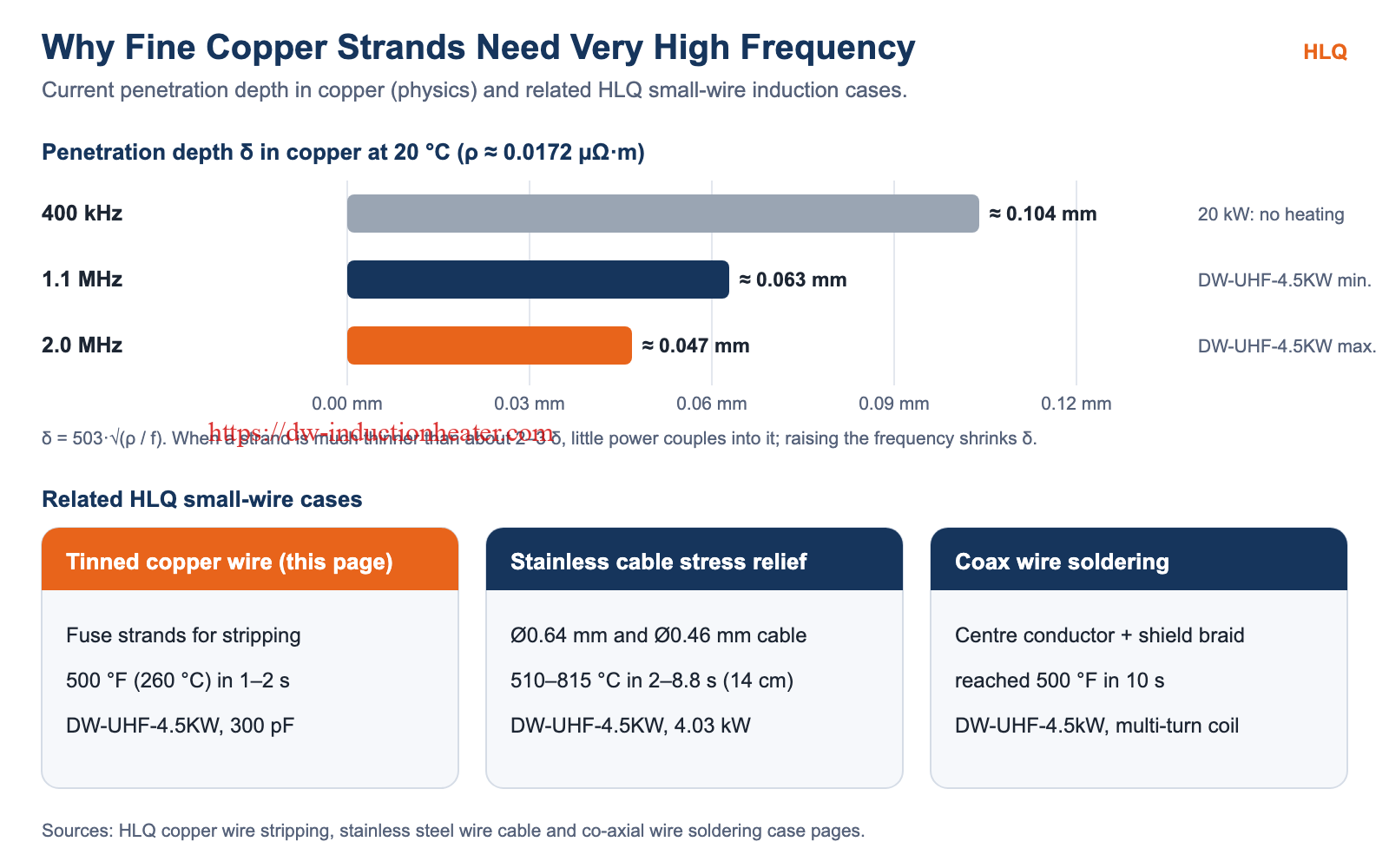
Current penetration depth in copper at 20 °C (physics reference)
| Frequency | 400 kHz | 1.1 MHz | 2.0 MHz |
|---|---|---|---|
| Depth δ (ρ ≈ 0.0172 µΩ·m) | ≈ 0.104 mm | ≈ 0.063 mm | ≈ 0.047 mm |
Calculated with δ = 503·√(ρ / f). A strand much thinner than about 2–3 δ couples little power, which is why fine strands need very high frequency. This matches the test finding that 20 kW at 400 kHz could not heat the wires.
Technical Specifications
| Parameter | Value in the HLQ case |
|---|---|
| Part | Pre-tinned stranded copper wire ends |
| Target temperature | 500 °F (260 °C) |
| Heating time | 1–2 seconds |
| Power supply | DW-UHF-4.5KW, solid state |
| Heat station | Remote, three 100 pF capacitors (300 pF) |
| Coil | Multi-turn, with ceramic guide tube |
| Wire types tested | Single multi-strand wire; dual multi-strand wire assembly |
DW-UHF-4.5KW (published data)
| Power | Maximum current | Frequency | Supply | Duty cycle |
|---|---|---|---|---|
| 4.5 kW | 20 A | 1.1–2.0 MHz | Single-phase 220 V ±10% | 100% |
Recommended Model Selection
| HLQ series | Power | Frequency | Use for wire work |
|---|---|---|---|
| DW-UHF-4.5KW | 4.5 kW | 1.1–2.0 MHz | Fine stranded wire ends (this case); stainless cable stress-relief tests |
| DW-UHF (other models) | 6–60 kW | By model | Larger wires and higher throughput |
| DW-HF | 15–160 kVA | 20–80 kHz (15 kW: 30–100 kHz) | Larger sections |
Full model data: HLQ induction heating device models. Lower frequency did not work for these fine strands, so the frequency must be confirmed by test.
Process Workflow

| Step | Action | Case reference |
|---|---|---|
| 1 | Run initial tests | Confirm the individual strands reach the right temperature |
| 2 | Insert the wire end through the ceramic guide tube | Centred in the coil |
| 3 | Apply power | DW-UHF-4.5KW |
| 4 | Melt the tin | Strands at 500 °F (260 °C) |
| 5 | Fuse the strands | 1–2 seconds |
| 6 | Remove the wire | Next wire end |
| 7 | Strip | Fused end strips more easily |
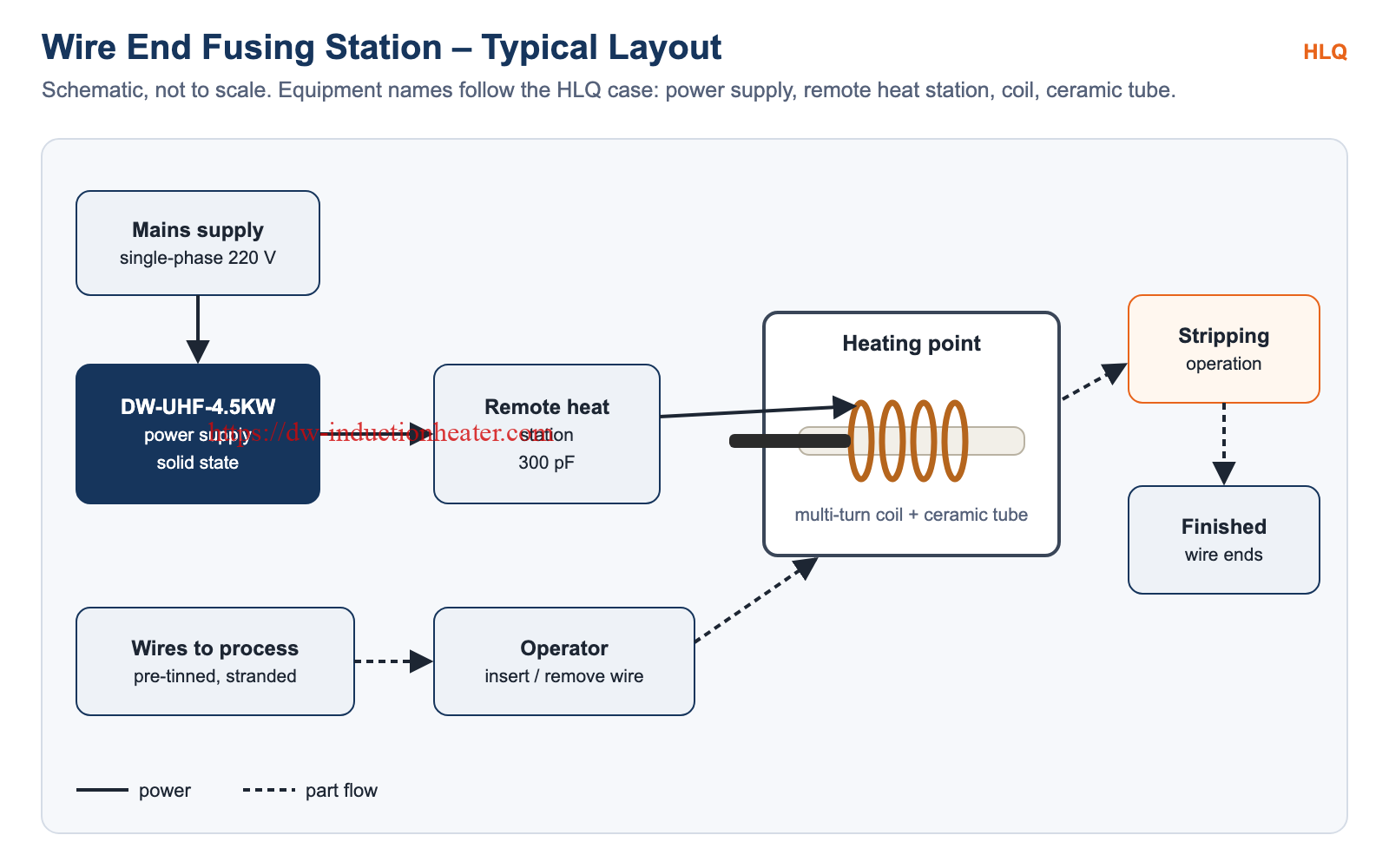
Station layout
Common Problems and Solutions
| Problem | Likely cause | Solution |
|---|---|---|
| Strands do not heat | Frequency too low for fine strands | Use very high frequency; 20 kW at 400 kHz failed in the test |
| Arcing in the coil | Wire touching the coil or off-centre | Use a ceramic tube to guide and centre the wire |
| Strands not fused | Temperature or time too low | Confirm 500 °F in 1–2 s in initial tests |
| Inconsistent wire ends | Insertion depth varies | Use the same insertion depth and time for every wire |
Engineering Selection Guide
| Factor | What to confirm | Why it matters |
|---|---|---|
| Wire construction | Strand diameter, strand count, single or dual wire | Sets the required frequency |
| Coating | Pre-tinned or bare strands | The process relies on tin melting |
| Target | For example, 500 °F (260 °C) in 1–2 s | Sets power and coil design |
| Coil and guide | Multi-turn coil with a ceramic tube | Even heating and no arcing |
| Supply | Single-phase 220 V for DW-UHF-4.5KW | Installation |
| Throughput | Wire ends per hour | Cycle time and handling |
Advantages and Limitations
| Advantages | Limitations |
|---|---|
| Fine strands heated in 1–2 seconds | Needs very high frequency; 400 kHz did not work |
| One system for single and dual multi-strand wires | A ceramic guide is needed to avoid arcing |
| Non-contact heating of the wire end | Strand size must be confirmed by test |
| Compact single-phase 220 V power supply | The process applies to pre-tinned strands |
Why Choose HLQ?
| Strength | Evidence |
|---|---|
| Fine-wire experience | Wire fusing, stainless cable stress relief, coax and copper wire soldering |
| Very high frequency | DW-UHF-4.5KW at 1.1–2.0 MHz |
| Test-based process | Initial tests confirm strand temperature |
| Arc-free coil design | Ceramic guide tube inside the coil |
| Compact installation | Single-phase 220 V supply |
| Flexible | Single and dual multi-strand wires |
10 Core FAQs
1. What does this induction process do?
It melts the tin on pre-tinned copper strands so the strands fuse, making the wire end easier to strip.
2. What temperature is used?
500 °F (260 °C). Tin melts at about 232 °C.
3. How long does it take?
1–2 seconds per wire end.
4. Which equipment was used?
A DW-UHF-4.5KW solid-state power supply with a remote heat station of three 100 pF capacitors (300 pF).
5. Why not use a lower frequency?
In the test, up to 20 kW at 400 kHz could not heat the small copper wires. Fine strands need very high frequency.
6. Why is there a ceramic tube in the coil?
It guides and centres the wire and prevents arcing in the coil.
7. Does it work on more than one wire at a time?
Yes. It worked on a single multi-strand wire and on a dual multi-strand wire assembly.
8. Does the copper melt?
No. Copper melts at about 1,083 °C. At 260 °C only the tin melts and fuses the strands.
9. What other wire jobs has HLQ done?
Stress-relieving stainless steel cable, soldering co-axial wire, and soldering tinned copper wires to a buss bar.
10. What is needed for a quotation?
Wire construction (strand diameter and count), coating, target temperature and cycle time, production rate and the available supply.