Induction Heat setting Nitinol
Induction Heat Setting Nitinol Wire in a Steel Fixture
Quick Answer
Induction heat setting of Nitinol heats a steel fixture that holds the Nitinol in the required shape, then quenches it, so the alloy remembers that shape.
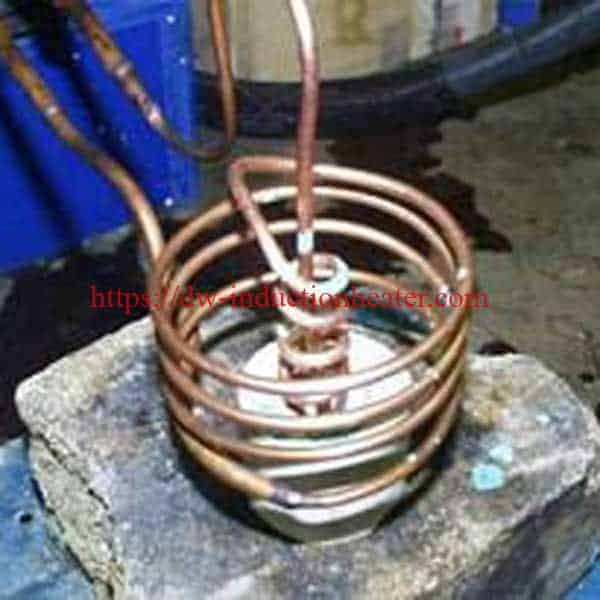
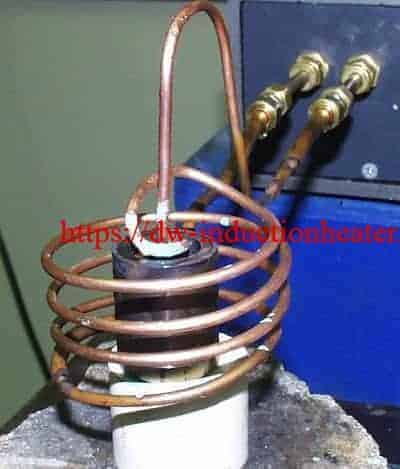
In this HLQ case, a 0.005 in (0.13 mm) Nitinol wire sat in a shape etched on a steel fixture. A special four-turn internal and external helical coil, driven by a DW-UHF-6kW-I at 500 kHz, heated the fixture to 930 °F (500 °C). It was held for 2.5 minutes and then quenched in water. The wire was shaped as desired within 4 minutes, using less energy and time than oven heating.
What is Induction Heat Setting of Nitinol?
Nitinol is held in the required shape by a steel fixture, die or mandrel. The fixture is heated by induction to the set point, held there, and then quenched, so the part keeps the shape for its shape-memory function.
The wire is very fine, so the fixture is what is heated. It passes heat to the wire in the same way an induction-heated susceptor does; see induction susceptor heating.
| Item | HLQ case data |
|---|---|
| Objective | Heat a 0.005 in (0.13 mm) diameter Nitinol wire for a shape-setting application |
| Material | Nitinol wire; steel fixture |
| Temperature | 930 °F (500 °C) |
| Frequency | 500 kHz |
| Equipment | DW-UHF-6kW-I solid-state power supply with a remote heat station containing two 0.33 µF capacitors (0.66 µF total), plus a coil designed for this application |
| Coil | Special four-turn internal and external helical coil |
| Hold time | 2.5 minutes at the set point |
| Quench | Fixture quenched in water immediately after the heat cycle |
| Results | Parts made to shape-memory specification; wire shaped as desired within 4 minutes, using less energy and time than traditional oven heating |
Key Applications
| HLQ case | Fixture / part | Temperature | Time |
|---|---|---|---|
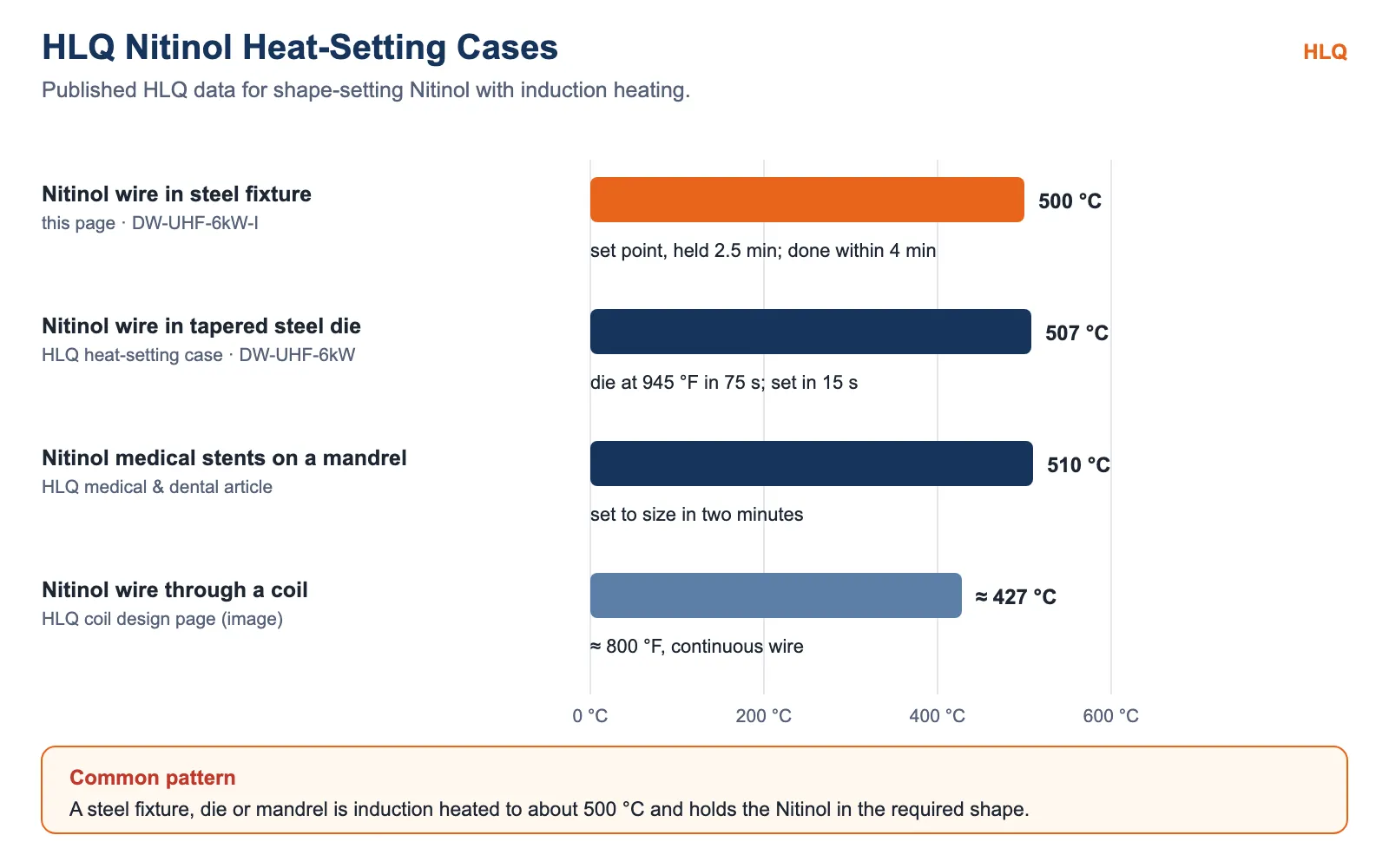
| Nitinol wire in steel fixture (this page) | Concentric steel cylinders with the shape etched on the inner OD | 930 °F (500 °C) | 2.5 min hold; shaped within 4 min |
| Nitinol wire in a tapered steel die | 2 in (50.8 mm) tapered steel die inside a steel tube; wire tacked with instant adhesive | Die heated to 945 °F (507.2 °C) | 75 s heating; setting achieved in 15 s |
| Nitinol medical stents | Stents on a mandrel | 510 °C | Set to size in two minutes |
| Continuous Nitinol wire | Wire passing through an induction coil | About 800 °F (426.7 °C) | Continuous |
Related HLQ pages: induction heat setting a shape memory alloy, induction heating for medical and dental applications and induction heating coil design.

Suitable Materials
| Item | Role | Notes |
|---|---|---|
| Nitinol wire, Ø0.005 in (0.13 mm) | Part to be shape-set | Held in the shape etched on the fixture |
| Steel fixture | Induction-heated part | Modified to reduce thermal mass; inner cylinder drilled for the internal coil |
| Steel die / mandrel | Induction-heated part in related cases | Tapered die; stent mandrel |
| Water | Quench medium | Fixture quenched immediately after the heat cycle |
Working Principle
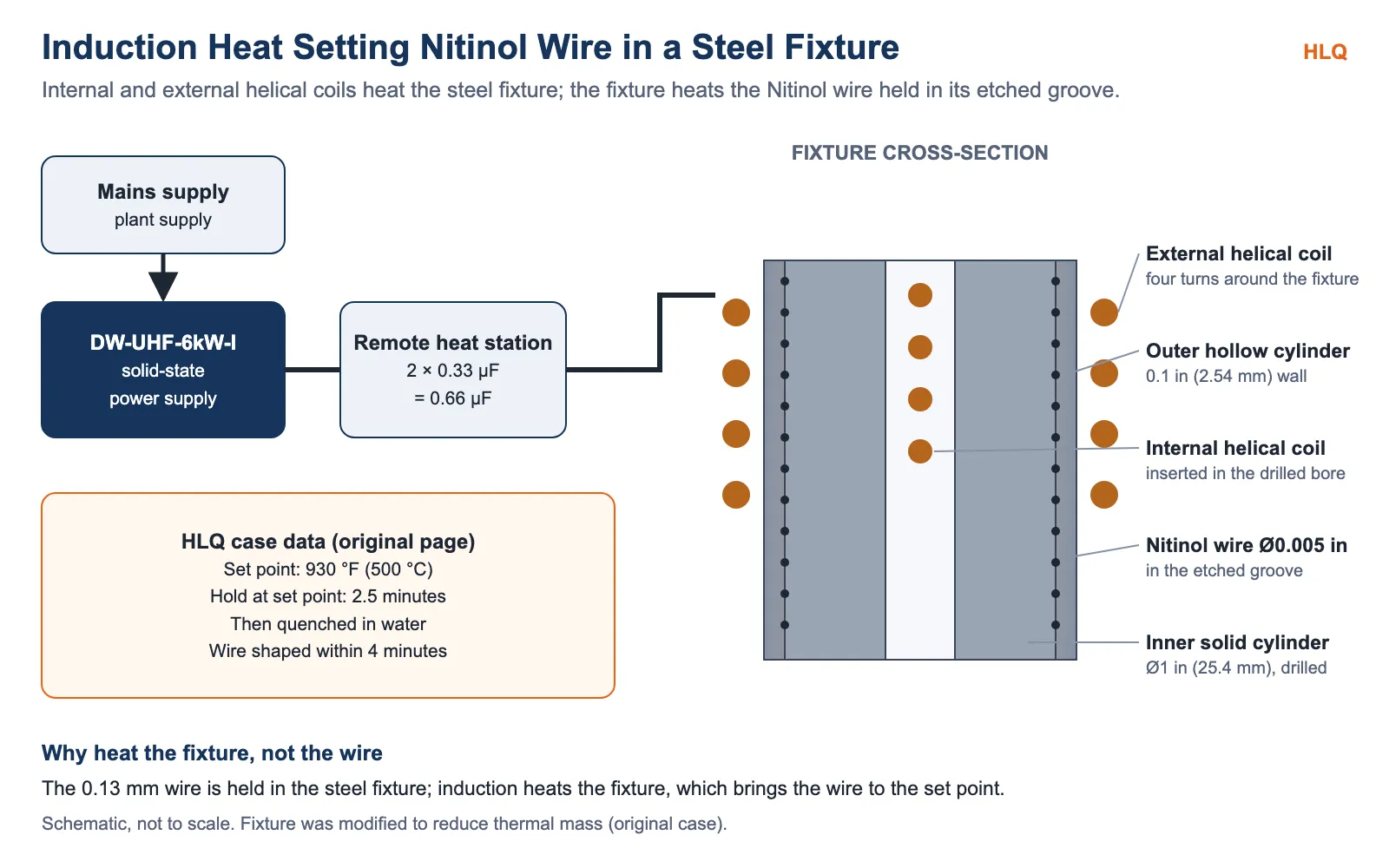
- The DW-UHF-6kW-I drives a remote heat station (2 × 0.33 µF) at 500 kHz.
- The four-turn coil works on both sides of the fixture: inside the drilled bore of the inner cylinder and around the outer cylinder.
- Eddy currents heat the steel fixture: a 0.1 in (2.54 mm) thick hollow outer cylinder over a 1 in (25.4 mm) solid inner cylinder.
- The fixture brings the Nitinol wire in the etched shape to 930 °F (500 °C), and it is held there for 2.5 minutes.
- Quenching the fixture in water completes the shape setting.
Background: how an induction heater works.
Technical Specifications
| Parameter | Value in the HLQ case |
|---|---|
| Nitinol wire diameter | 0.005 in (0.13 mm) |
| Fixture outer cylinder | Hollow, 0.1 in (2.54 mm) thick |
| Fixture inner cylinder | Solid, 1 in (25.4 mm) diameter, drilled for the internal coil |
| Set point | 930 °F (500 °C) |
| Hold time | 2.5 minutes |
| Quench | Water |
| Total time to shaped wire | Within 4 minutes |
| Frequency | 500 kHz |
| Power supply | DW-UHF-6kW-I |
| Heat station capacitance | 2 × 0.33 µF = 0.66 µF |
| Set-up measurement | Thermocouple on the empty fixture |
Recommended Model Selection
| HLQ series | Power | Frequency | Nitinol use |
|---|---|---|---|
| DW-UHF-6kW | 6 kW | 300–1100 kHz | Heat-setting fixtures and dies (this case: DW-UHF-6kW-I at 500 kHz) |
| DW-UHF (other models) | 4.5–60 kW | By model | Larger fixtures or higher output |
| DW-HF | 15–160 kVA | 20–80 kHz (15 kW: 30–100 kHz) | Larger, heavier fixtures |
Full model data: HLQ induction heating device models. Fixture mass and size decide the power, so the cycle is confirmed by test.
Process Workflow

| Step | Action | Case reference |
|---|---|---|
| 1 | Prepare the fixture | Modified to reduce thermal mass; inner cylinder drilled for the coil |
| 2 | Establish the heating cycle | Thermocouple test on the fixture without a part |
| 3 | Load the Nitinol | Wire placed in the etched shape; outer cylinder slipped over |
| 4 | Position the coil | Internal and external helical coil |
| 5 | Heat and hold | To 930 °F (500 °C); hold 2.5 minutes |
| 6 | Quench | Fixture quenched in water immediately |
| 7 | Unload the part | Shaped to specification within 4 minutes |
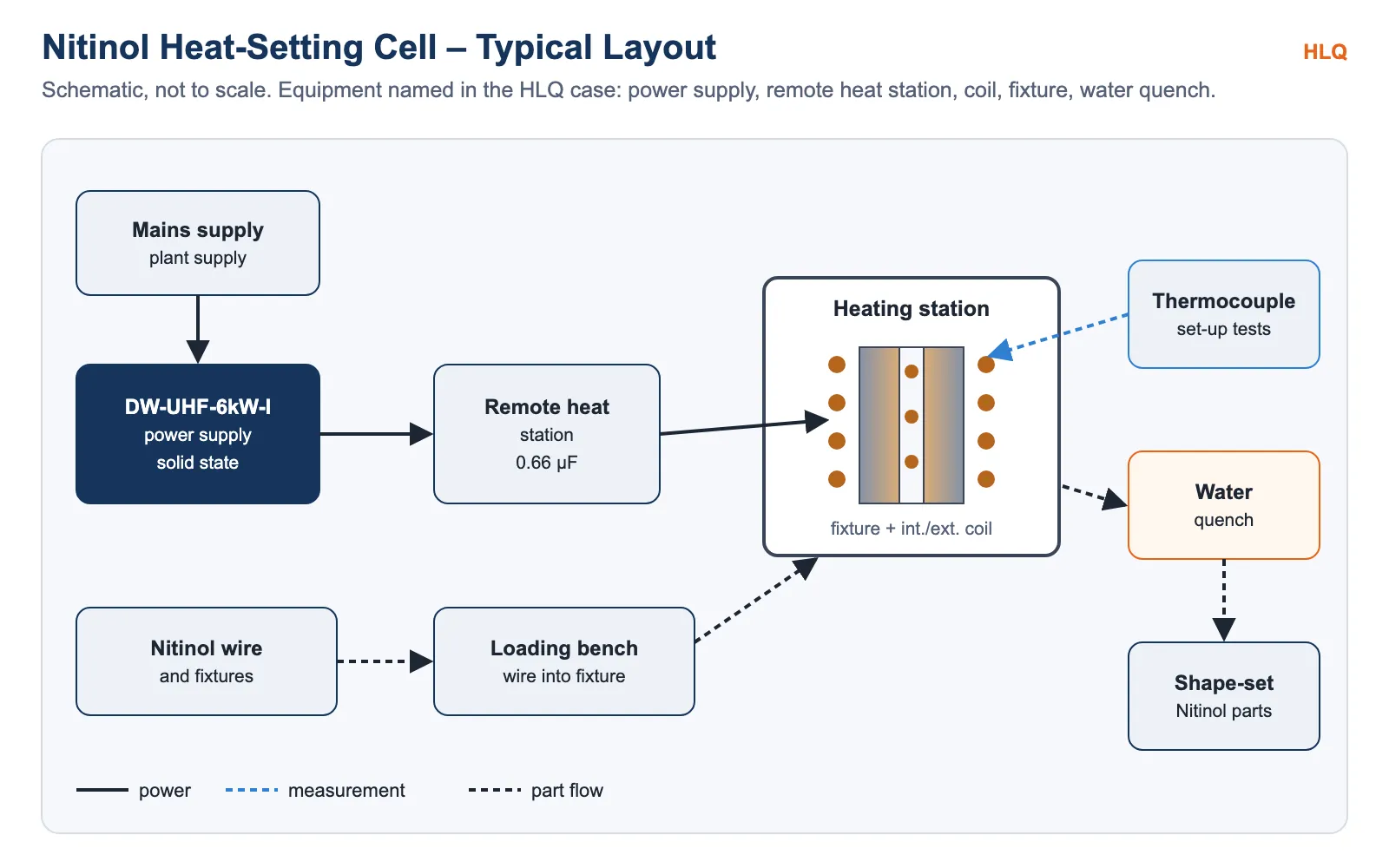
Cell layout
Common Problems and Solutions
| Problem | Likely cause | Solution |
|---|---|---|
| Fixture heats too slowly | Fixture thermal mass too high | Reduce the fixture mass, as was done in the case |
| Uneven fixture temperature | Coil on one side only | Use an internal and external coil |
| Cycle not repeatable | Heating cycle not established | Set the cycle first with a thermocouple on the empty fixture |
| Shape not retained | Hold time or quench not followed | Hold 2.5 min at the set point and quench immediately |
Engineering Selection Guide
| Factor | What to confirm | Why it matters |
|---|---|---|
| Nitinol part | Wire, tube or stent size | Sets the fixture design |
| Fixture, die or mandrel | Geometry and thermal mass | Sets power and heating time |
| Set point and hold | For example, 930 °F (500 °C) for 2.5 min | Shape-memory result |
| Quench | Water quench after heating | Completes the setting |
| Coil | Internal, external or both | Uniform fixture temperature |
| Coil engineering | Turns, shape and fit to the fixture | See understanding the skin effect |
Advantages and Limitations
| Advantages | Limitations |
|---|---|
| Wire shaped within 4 minutes | The fixture must be designed and tested |
| Less energy and time than traditional oven heating | The coil is designed for each fixture |
| Heat delivered to the fixture zone | The heating cycle must be established by test |
| Repeatable cycle once established | Thermal mass affects cycle time |
Why Choose HLQ?
| Strength | Evidence |
|---|---|
| Nitinol experience | Wire-in-fixture, tapered die, stent mandrel and continuous wire examples |
| Fixture engineering | Thermal mass reduced; coil inside and outside the fixture |
| DW-UHF power supplies | DW-UHF-6kW: 300–1100 kHz |
| Test-based set-up | Thermocouple cycle development before production |
| Medical industry | Heat treatment of memory alloys for medical applications |
| Faster than ovens | Less energy and time in the case |
10 Core FAQs
1. What temperature is used to heat set Nitinol in this case?
930 °F (500 °C), held for 2.5 minutes.
2. How long does the cycle take?
The wire is shaped as desired within 4 minutes.
3. Why is the fixture heated instead of the wire?
The 0.13 mm wire is held in the etched shape on the steel fixture. Induction heats the fixture, and the fixture brings the wire to the set point.
4. Which coil was used?
A special four-turn internal and external helical coil.
5. Which equipment and frequency?
A DW-UHF-6kW-I with a remote heat station (2 × 0.33 µF), at 500 kHz.
6. What happens after heating?
The fixture is quenched in water immediately.
7. How was the heating cycle developed?
With a thermocouple on the fixture, without a part, during initial tests.
8. Why was the fixture modified?
To reduce its thermal mass. The inner cylinder was also drilled so the internal coil could be inserted.
9. What other Nitinol jobs has HLQ shown?
Wire set in a tapered steel die (945 °F in 75 s), stents set on a mandrel at 510 °C in two minutes, and continuous wire heating at about 800 °F.
10. How does it compare with an oven?
In the case, induction shaped the wire using less energy and time than traditional oven heating.