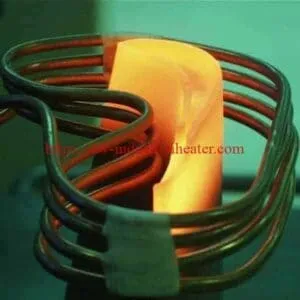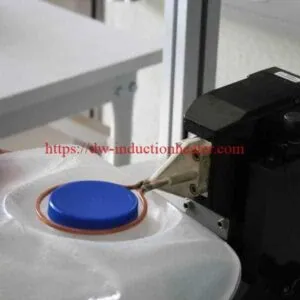


Induction Heating Sealing
Induction Heat Sealing of Aluminium Foil Covers on Jars and Bottles
Quick Answer
Induction heating sealing bonds an aluminium foil cover to a container without the coil ever touching the cover. Induction heats the aluminium film, which raises the temperature of the sealing product on the side of the cover in contact with the jar. Pressure is applied to the cover at the same time, for 0.5 to 1.5 seconds.
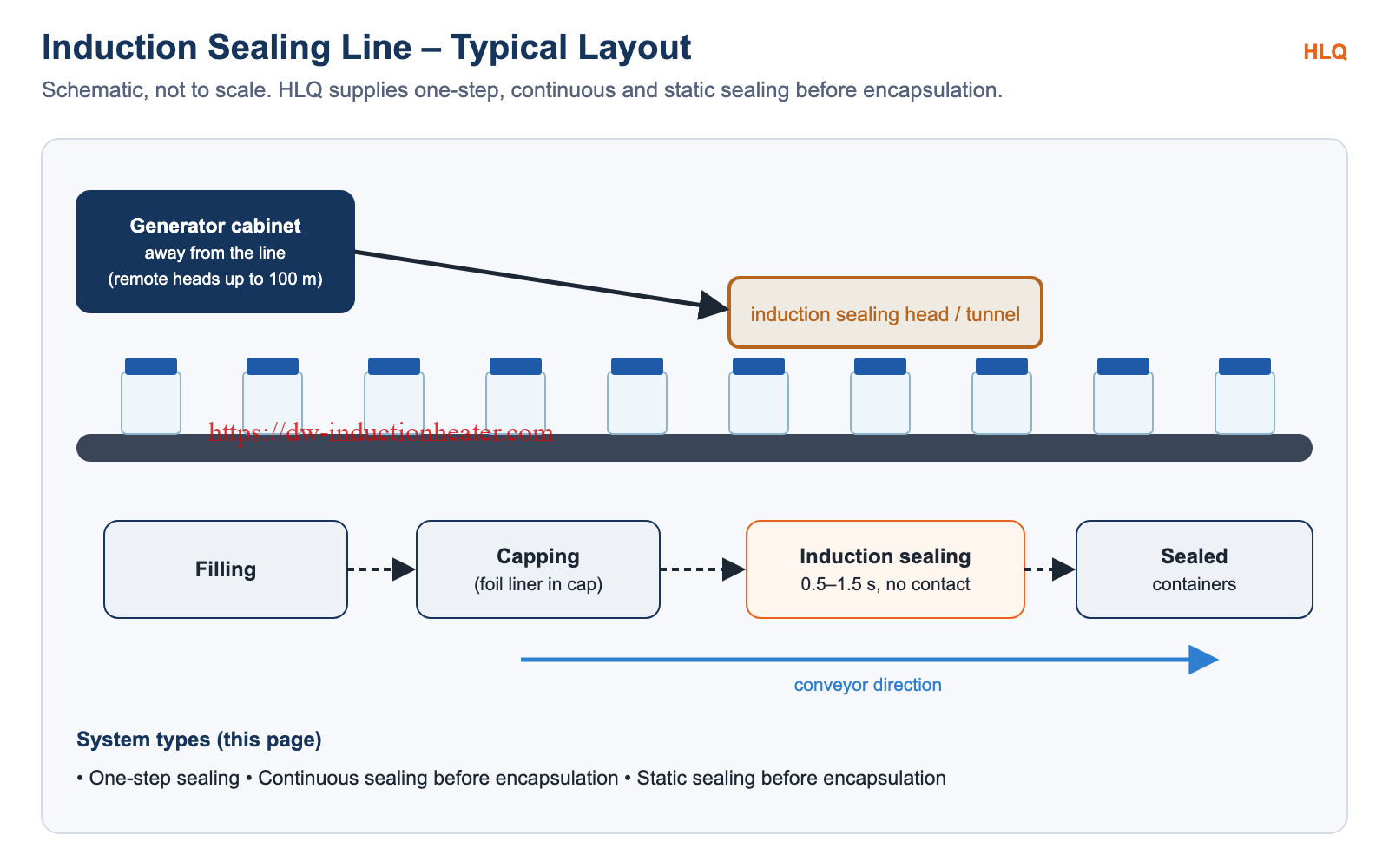
The process works for all container shapes and for glass, cardboard and plastics (PE, PP, PVC…). It gives tamper protection, safety, hygiene and product preservation. HLQ supplies one-step sealing systems, continuous sealing before encapsulation and static sealing before encapsulation.

What is Induction Heat Sealing?
Induction heat sealing is an elegant way to seal aluminium covers on jars of food products. The heat is generated in the cover itself, as close to the sealing surface as possible. This simplifies the process and avoids the overheating problems of resistor-type sealing heads.
| Item | From this page |
|---|---|
| Purpose | Seal aluminium covers on jars of food products |
| Benefits | Tamper protection, safety, hygiene and product preservation |
| Heat + pressure time | 0.5 to 1.5 s |
| Contact | No contact between the inductor and the cover |
| Container shapes | Circular, oval, square, rectangular and others |
| Container materials | Glass, cardboard and plastics (PE, PP, PVC…) |
| Generator | Medium-frequency, solid-state components, no parts subject to wear |
| System types | One-step sealing; continuous sealing before encapsulation; static sealing before encapsulation |
Key Applications
| Application | Published HLQ data | Reference |
|---|---|---|
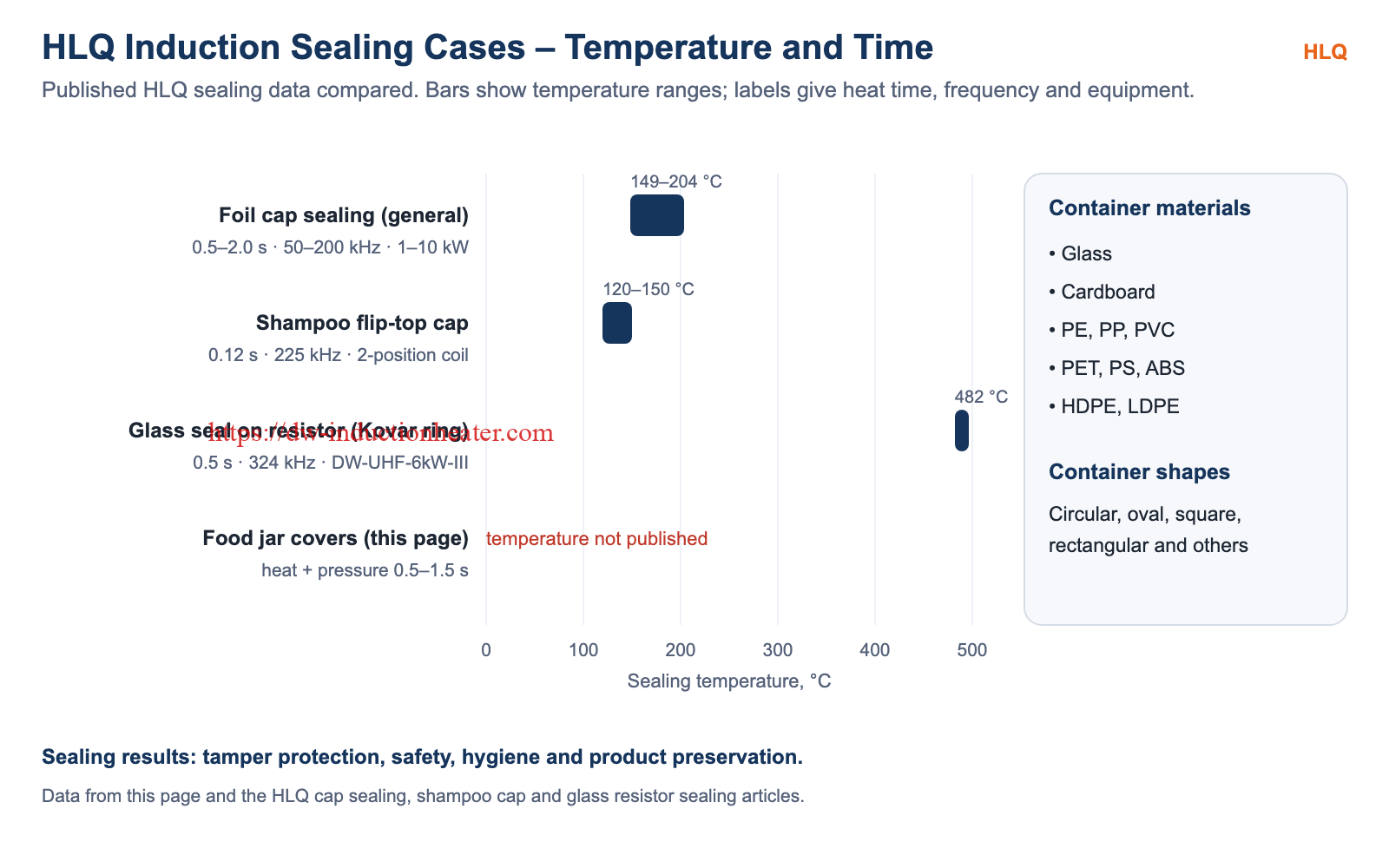
| Aluminium foil cover on food jars | Heat + pressure 0.5–1.5 s | This page |
| Foil cap sealing on plastic containers | 149–204 °C (300–400 °F) in 0.5–2.0 s; 1–10 kW at 50–200 kHz; remote sealing heads | heating aluminum foil for cap sealing |
| Shampoo flip-top cap with 0.9″ foil | 120–150 °C (250–300 °F) in 0.12 s at 225 kHz; two-position helical coil in a tunnel | high frequency induction cap sealing |
| Glass seal on a resistor (Kovar ring) | 482 °C (900 °F) in 500 ms at 324 kHz, DW-UHF-6kW-III | induction sealing glass to enclose resistors |

Suitable Materials
| Material | Role | Source |
|---|---|---|
| Aluminium foil / film | Heated by induction | This page |
| Glass, cardboard, PE, PP, PVC | Container | This page |
| PET, PS, ABS, HDPE, LDPE and glass bottles | Container | HLQ foil sealer pages |
| Foil laminates: backing board/reseal, wax layer, aluminium foil, heat-seal film | Liner build-up | HLQ foil cap sealing article |
Working Principle

- The solid-state generator drives a sealing head placed over the cap. The coil does not touch the cover.
- The alternating field induces eddy currents in the aluminium foil inside the cap.
- The foil heats the sealing layer on the side in contact with the container.
- Combined with pressure for 0.5–1.5 s, the sealing layer bonds to the container lip.
Background: how an induction heater works.
Technical Specifications
| Parameter | Value | Source |
|---|---|---|
| Heat + pressure time | 0.5–1.5 s | This page |
| Foil sealing temperature (typical) | 149–204 °C (300–400 °F) | HLQ foil cap sealing article |
| Generator power and frequency | 1–10 kW, 50–200 kHz | HLQ foil cap sealing article |
| Remote sealing head distance | Up to 100 m from the power cabinet | HLQ foil cap sealing article |
| Contact | None between inductor and cover | This page |
Recommended Model Selection
HLQ induction foil sealers
| Model | 2500 W | 1800 W | 1300 W |
|---|---|---|---|
| Sealing diameter | 60–180 mm | 50–120 mm | 15–60 mm |
| Max power | 2500 W | 1800 W | 1300 W |
| Weight | 72 kg | 51 kg | 38 kg |
| Common data | Value |
|---|---|
| Sealing speed | 20–300 bottles/min |
| Transfer speed | 0–12.5 m/min |
| Input voltage | Single phase 220 V, 50/60 Hz |
| Body | Stainless steel |
| Containers | PP, PE, PET, PS, ABS, HDPE, LDPE and glass bottles |
Details: aluminum foil sealing machine with induction heating and induction sealing machine for aluminum foil. Custom sealing heads and generators: HLQ induction heating device models.
Process Workflow

| Step | Action |
|---|---|
| 1 | Fill the container with product |
| 2 | Fit the foil laminate into the cap |
| 3 | Fit the cap to the container |
| 4 | Pass the container under the sealing head: induction heat + pressure for 0.5–1.5 s, no contact |
| 5 | The heat-seal layer melts onto the container lip |
| 6 | The seal sets as the foil cools |
| 7 | A tamper-evident, hygienic seal is ready for shipping |
Line layout
Common Problems and Solutions
| Problem | Cause | Solution |
|---|---|---|
| Overheating at the sealing head | Resistor-type heated sealing heads | Induction generates heat in the cover itself |
| Worn sealing parts | Contact sealing heads | No contact; solid-state generator with no parts subject to wear |
| Poor bond to the container | Liner not compatible with the container material | Choose a liner compatible with the container (HLQ sealer pages) |
| Uneven seal around the opening | Foil perimeter not heated evenly | Coil positioned so the entire foil perimeter heats uniformly |
| Seal quality varies | Energy changes from cycle to cycle | Microprocessor control delivers the same energy each cycle |
Engineering Selection Guide
| Factor | What to confirm | Why it matters |
|---|---|---|
| Opening diameter | 15–60, 50–120 or 60–180 mm | Sealer model |
| Container material and shape | Glass, plastic, cardboard; round or other shapes | Liner and sealing head |
| Line speed | Bottles per minute | Power and tunnel length |
| Liner type | Supported (backing board/wax) or unsupported | Heat and seal behaviour |
| System type | One-step, continuous or static | Line integration |
| Supply | Single phase 220 V for the foil sealers | Installation |
Advantages and Limitations
| Advantages | Limitations |
|---|---|
| No contact between the inductor and the cover | Needs a conductive (aluminium) foil liner |
| Heat generated in the cover, close to the seal | Liner must suit the container material |
| Works for all container shapes | Sealer size depends on the opening diameter |
| Solid-state generator with no wearing parts | — |
| Tamper protection, hygiene and product preservation | — |
Why Choose HLQ?
| Strength | Evidence |
|---|---|
| Three system types | One-step, continuous and static sealing |
| Foil sealer range | 1300, 1800 and 2500 W; 15–180 mm openings |
| High line speeds | 20–300 bottles/min |
| Sealing experience | Jars, bottle caps, shampoo caps, glass-to-metal seals |
| Remote sealing heads | Power cabinet away from the production area |
10 Core FAQs
1. What is induction heat sealing?
A non-contact sealing method. Induction heats the aluminium film of the cover, which melts the sealing layer onto the container.
2. How long does sealing take?
Heat combined with pressure for 0.5 to 1.5 seconds.
3. Does the coil touch the cover?
No. There is no contact between the inductor and the cover.
4. Which container materials can be sealed?
Glass, cardboard and plastics such as PE, PP and PVC. HLQ foil sealers also handle PET, PS, ABS, HDPE and LDPE.
5. Which container shapes can be sealed?
Circular, oval, square, rectangular and other shapes.
6. What temperature is typical?
In HLQ’s foil cap sealing article, 149–204 °C (300–400 °F) in 0.5–2.0 seconds.
7. Why use induction instead of heated sealing heads?
The heat is generated in the cover itself, so the overheating problems of resistor-type heads are avoided, and the solid-state generator has no wearing parts.
8. Which HLQ sealers are available?
Foil sealers of 1300, 1800 and 2500 W, for openings of 15–60, 50–120 and 60–180 mm, at 20–300 bottles/min.
9. What system types does HLQ supply?
One-step sealing, continuous sealing before encapsulation, and static sealing before encapsulation.
10. What is needed for a quotation?
The container material, shape and neck size, the cap and liner type, the line speed, the preferred system type, and the available supply.