

induction heating hot rolling
Induction Heating for Hot Rolling of Plough Disc Edges
Quick Answer
Induction heating for hot rolling heats the circumference of plough discs just before the pressure rolls form the sharp edge.
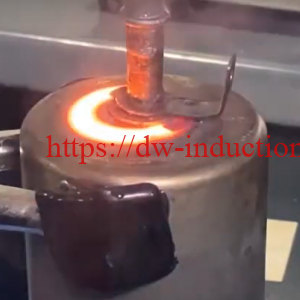
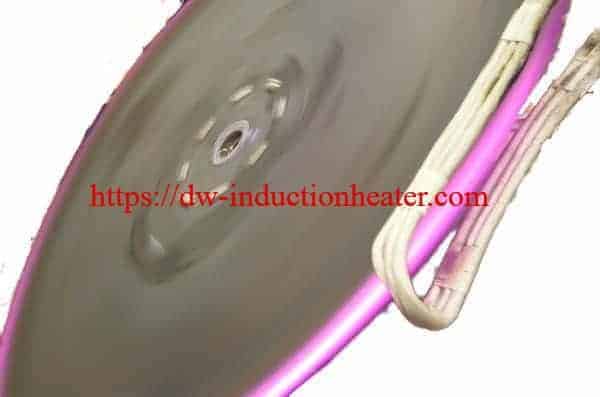
In this HLQ case, a DW-HF-120 kW induction heating system at 75 kHz heated flat boron steel discs (OD 460–710 mm, 3.2–10 mm thick) to 725 °C (1335 °F). A 250 mm (10″) coil placed over the edge did the heating, and after a few seconds the disc began to turn at 30 rpm. The pressure rolls then closed, and the final edge was formed after two turns. The desired profile takes a few seconds this way, compared with a few minutes for cold rolling.

What is Induction Heating for Hot Rolling?
An induction coil heats a narrow zone of the part — here, the edge of a plough disc — immediately before it is formed by pressure rolls. Because only the edge is heated, the rolls can form the profile quickly while the rest of the disc stays cooler.
| Item | HLQ case data |
|---|---|
| Objective | Heat the circumference of plough discs before the hot rolling (sharpening) process |
| Material | Flat boron steel discs, OD 460–710 mm (18–28″), thickness 3.2–10 mm (8/64–25/64″) |
| Temperature | 725 °C (1335 °F) |
| Frequency | 75 kHz |
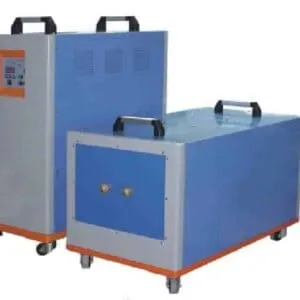
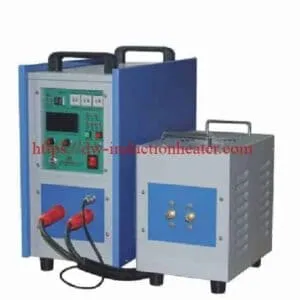
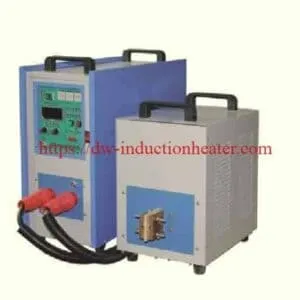
| Equipment | DW-HF-120 kW induction heating system with 2 work heads, a switching system, 4 specially designed coils and a chiller system |
| Control | PLC system; each of the two rolling machines has its own remote work head and rotating platform |
| Fixture | Disc held horizontally by a central nonmagnetic plate 100 mm smaller than the disc diameter |
| Coil position | 250 mm (10″) coil over the blade, rotationally ahead of the pressure rolls |
| Cycle | A few seconds of heating, then the disc turns at 30 rpm; final edge after two turns |
Key Applications

| Application | Heated zone | HLQ reference |
|---|---|---|
| Hot rolling (sharpening) of plough disc edges | Disc circumference | This case |
| Continuous heating of steel strip | Moving strip | induction heating steel strip continuously / induction strip heating solutions |
| Billet heating before forging, extrusion and rolling | Whole billet | induction billet heating system for forging, extrusion and rolling |

Suitable Materials
| Material | Notes |
|---|---|
| Boron steel discs | Flat discs, OD 460–710 mm, 3.2–10 mm thick (this case) |
| Other steel parts formed hot at an edge or rim | Coil, frequency and temperature confirmed by test |
Working Principle

- The DW-HF-120 kW supplies 75 kHz power, and the switching system directs it to the work head of the active rolling machine.
- The 250 mm coil over the disc edge induces eddy currents in the rim.
- After a few seconds, the edge reaches 725 °C, and the disc starts to turn at 30 rpm.
- The coil sits rotationally ahead of the pressure rolls, so each section of the edge is heated just before it is rolled.
- The rolls close and form the sharp profile; the final edge is obtained after two turns.
| Disc OD | Circumference | Edge speed at 30 rpm (calculation) |
|---|---|---|
| 460 mm | ≈ 1.45 m | ≈ 0.72 m/s |
| 710 mm | ≈ 2.23 m | ≈ 1.12 m/s |
Two turns at 30 rpm take about 4 seconds (calculation). Background: skin effect in induction heating.
Technical Specifications
| Parameter | Value |
|---|---|
| Disc material | Boron steel, flat |
| Disc OD | 460–710 mm (18–28″) |
| Disc thickness | 3.2–10 mm (8/64–25/64″) |
| Edge temperature | 725 °C (1335 °F) |
| Frequency | 75 kHz |
| Power supply | DW-HF-120 kW |
| Work heads | 2, remote, with switching system |
| Coils | 4 specially designed; 250 mm (10″) heating coil |
| Cooling | Chiller system |
| Disc speed | 30 rpm |
| Rolling | Final edge after two turns |
| Control | PLC |
Recommended Model Selection
DW-HF-120KW (HLQ published data)
| Item | Value |
|---|---|
| Input | 3 × 380 V, 50/60 Hz |
| Maximum oscillating power | 120 kVA |
| Maximum input apparent power | 130 kVA |
| Frequency | 30–80 kHz (product page); 20–80 kHz (model table) |
| Duty cycle | 100% at 30 °C |
| Cooling water | At least 6 L/min; 0.3 MPa reference |
| Main unit / extension unit | 650 × 350 × 560 mm / 700 × 350 × 460 mm |
| Weight | 135 kg |
Full details: DW-HF-120KW magnetic induction heating equipment.
DW-HF series (3-phase 380 V, 100% duty)
| Model | Power | Input current |
|---|---|---|
| DW-HF-25KW | 25 kVA | 23 A |
| DW-HF-35KW | 35 kVA | 51 A |
| DW-HF-45KW | 45 kVA | 68 A |
| DW-HF-60KW | 60 kVA | 105 A |
| DW-HF-80KW | 80 kVA | 130 A |
| DW-HF-90KW | 90 kVA | 160 A |
| DW-HF-120KW | 120 kVA | 200 A |
| DW-HF-160KW | 160 kVA | 260 A |
All models: HLQ induction heating device models.
Process Workflow

| Step | Action |
|---|---|
| 1 | Place the disc horizontally on the rotating platform |
| 2 | Hold it with the central nonmagnetic plate (100 mm smaller than the disc) |
| 3 | Position the 250 mm coil over the edge, ahead of the pressure rolls |
| 4 | Heat for a few seconds until the edge reaches 725 °C |
| 5 | Turn the disc at 30 rpm |
| 6 | Close the pressure rolls; the final edge is formed after two turns |
| 7 | Unload the disc (the process lends itself to robotic automation) |
Cell layout

Common Problems and Solutions
| Problem | Cause | Solution |
|---|---|---|
| Edge not at temperature when rolling starts | Rotation starts too early | Heat until the edge reaches 725 °C, then start rotation (as in the case) |
| Edge cools before the rolls | Coil too far from the rolls | Place the coil rotationally just ahead of the pressure rolls |
| Heat in the disc centre | Field coupling into the support | Central support plate made of nonmagnetic material |
| One power supply for two machines | Machines alternate | Switching system with one remote work head per machine |
| Many disc sizes | OD 460–710 mm range | Specially designed coils (four in the case) |
Engineering Selection Guide
| Factor | What to confirm | Why it matters |
|---|---|---|
| Disc size range | For example, OD 460–710 mm, 3.2–10 mm thick | Coil design and set |
| Edge temperature | For example, 725 °C | Power and heating time |
| Rotation speed and rolling turns | For example, 30 rpm, two turns | Edge speed past the coil |
| Number of rolling machines | For example, two | Switching system and work heads |
| Automation | PLC, robot loading | Cycle consistency |
| Cooling | Chiller capacity; ≥ 6 L/min for DW-HF-120KW | Continuous operation |
Advantages and Limitations
| Advantages | Limitations |
|---|---|
| Profile formed in a few seconds instead of a few minutes (cold rolling) | Coils must suit the disc size range |
| Higher metallurgical quality of the finished edge (case result) | Heating and rolling must be timed together |
| One power supply can serve two machines | Machines share the supply through switching |
| Suits PLC control and robotic automation | Chiller and cooling water are required |
Related: induction hardening machine.
Why Choose HLQ?
| Strength | Evidence |
|---|---|
| Fast hot rolling cycle | Seconds instead of minutes |
| Multi-station systems | One DW-HF-120 kW, switching system, two work heads |
| Custom coils | Four coils designed for the discs |
| Automation ready | PLC control; suits robotic handling |
| DW-HF series | 25–160 kVA, 100% duty |
10 Core FAQs
1. What is heated in this application?
The circumference of flat boron steel plough discs, before hot rolling (sharpening).
2. What disc sizes were processed?
OD 460–710 mm (18–28″) and 3.2–10 mm thick.
3. What temperature is used?
725 °C (1335 °F).
4. Which equipment and frequency were used?
A DW-HF-120 kW induction heating system at 75 kHz, with 2 work heads, a switching system, 4 coils and a chiller.
5. How long does heating take?
A few seconds until the edge reaches temperature.
6. How is the edge formed?
The disc turns at 30 rpm, the pressure rolls close, and the final edge is obtained after two turns.
7. Where is the coil placed?
A 250 mm (10″) coil sits over the blade, rotationally ahead of the pressure rolls.
8. How is the disc held?
Horizontally on a rotating platform, by a central nonmagnetic plate 100 mm smaller than the disc diameter.
9. How does it compare with cold rolling?
The desired profile is achieved in a few seconds instead of a few minutes, and the finished edge has higher metallurgical quality.
10. What is needed for a quotation?
The disc sizes and material, the edge temperature, the cycle time, the number of rolling machines, the automation needs, and the available supply.