


induction heating rivets
Induction Heating Rivet Ends for Head Forming
Quick Answer
Induction heating rivets brings only the rivet end, where the head will be formed, to forming temperature, with no flame or gas.
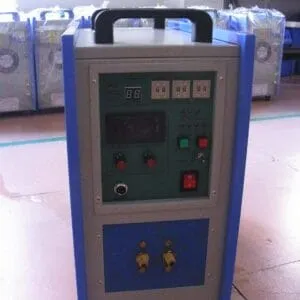
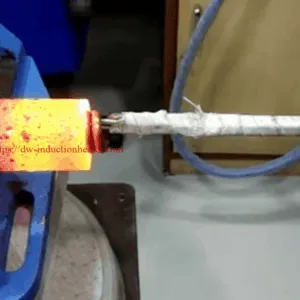
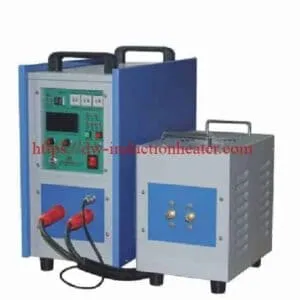
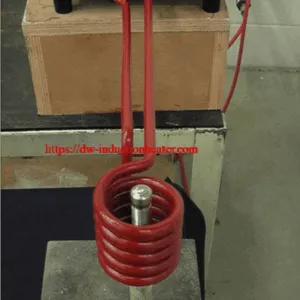
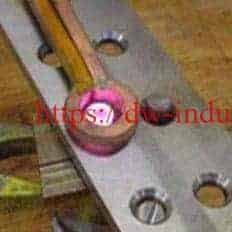
In this HLQ case, a single-turn solenoid coil on a hand-held workhead heated steel rivets to 700 °C (1292 °F) in 10 to 15 seconds before head forming. The coil was powered by a DW-UHF-6kW induction heating system at 583 kHz, with one 1.5 µF capacitor in the remote workhead. A footswitch starts a fixed, repeatable heat cycle, and only the rivet head is heated, which saves energy.
What is Induction Heating of Rivets?
A coil placed around the rivet end induces eddy currents only in the part inside the coil. The rivet end heats in seconds, while the parts being joined stay outside the coil. The heated end is then formed into the rivet head.
| Item | HLQ case data |
|---|---|
| Objective | Heat steel rivets prior to head forming |
| Material | Steel rivets |
| Temperature | 700 °C (1292 °F) |
| Frequency | 583 kHz |
| Equipment | DW-UHF-6kW induction heating system with a remote workhead containing one 1.5 µF capacitor, plus a coil designed for this application |
| Coil | Single-turn solenoid coil |
| Heating time | 10 to 15 seconds before head forming |
| Operation | Hand-held workhead with footswitch |
Key Applications

| Item | Rivet ends (this case) | Structural rivets (HLQ case) |
|---|---|---|
| Purpose | Head forming | Hot riveting |
| Material | Steel rivets | Low-carbon steel, Ø11.1 mm |
| Temperature | 700 °C | 1050 °C |
| Time | 10–15 s | 22–25 s |
| Equipment | DW-UHF-6kW, 583 kHz | DW-HF-25kW, 48–55 kHz |
| Coil | Single-turn, hand-held | Encapsulated helical |
Structural rivets and bars: induction heating of carbon steel rivets and bars. Related end-heating processes: induction forging of bar and rod ends and the fundamentals of induction bar end heating.
Suitable Materials
| Material | Notes |
|---|---|
| Steel rivets | Heated to 700 °C for head forming (this case) |
| Low-carbon steel structural rivets | Heated to 1050 °C for hot riveting (HLQ rivets and bars case) |
Working Principle

- The operator places the hand-held single-turn coil over the protruding rivet end.
- The footswitch starts the fixed heat cycle on the DW-UHF-6kW.
- Current in the coil induces eddy currents only in the rivet end inside it.
- After 10–15 seconds, the rivet end reaches 700 °C (1292 °F).
- The coil is lifted off, and the head is formed.
Background: skin effect in induction heating and induction hot forming and forging.
Technical Specifications
| Parameter | Value |
|---|---|
| Workpiece | Steel rivets |
| Heated zone | Rivet end (head) |
| Temperature | 700 °C (1292 °F) |
| Heating time | 10–15 s |
| Frequency | 583 kHz |
| Power supply | DW-UHF-6kW |
| Workhead | Remote, hand-held, one 1.5 µF capacitor |
| Coil | Single-turn solenoid |
| Cycle start | Footswitch, fixed heat cycle |
Recommended Model Selection
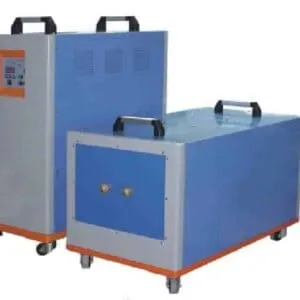
DW-UHF ultra-high frequency series (100% duty)
| Model | Power | Input current | Frequency | Supply |
|---|---|---|---|---|
| DW-UHF-4.5KW | 4.5 kW | 20 A | 1.1–2.0 MHz | 1-phase 220 V |
| DW-UHF-6.0KW | 6.0 kW | 28 A | 300–1100 kHz | 1-phase 220 V |
| DW-UHF-10KW | 10 kW | 15 A | 100–500 kHz | 3-phase 380 V |
| DW-UHF-20KW | 20 kW | 30 A | 50–250 kHz | 3-phase 380 V |
| DW-UHF-30KW | 30 kW | 45 A | 50–200 kHz | 3-phase 380 V |
| DW-UHF-40KW | 40 kW | 60 A | 50–200 kHz | 3-phase 380 V |
| DW-UHF-60KW | 60 kW | 90 A | 50–150 kHz | 3-phase 380 V |
Small rivet ends at 700 °C: DW-UHF-6kW with a hand-held workhead (this case). Larger rivets heated to forging temperature (1050 °C) used a DW-HF-25kW at 48–55 kHz in a separate HLQ case. All models: HLQ induction heating device models. For another hand-held HLQ set-up, see handheld induction brazing of HVAC tubing.
Process Workflow

| Step | Action |
|---|---|
| 1 | Rivet in place, end protruding |
| 2 | Place the hand-held single-turn coil over the rivet end |
| 3 | Press the footswitch to start the fixed heat cycle |
| 4 | Heat for 10–15 s to 700 °C (1292 °F) |
| 5 | Lift the coil off the rivet |
| 6 | Form the rivet head |
| 7 | Move to the next rivet |
Workstation layout

Common Problems and Solutions
| Problem | Cause | Solution |
|---|---|---|
| Rivets heated differently | Manual timing | Fixed heat cycle started by the footswitch |
| Heat spreads into the joined parts | Coil larger than the rivet end | Single-turn coil sized to the rivet end |
| Rivet cools before forming | Delay after heating | Form the head right after the 10–15 s cycle |
| Flame and gas in the work area | Torch heating | Induction heating needs no flame or gas |
Engineering Selection Guide
| Factor | What to confirm | Why it matters |
|---|---|---|
| Rivet size and material | Diameter, length, steel grade | Coil size and power |
| Forming temperature | For example, 700 °C (head forming) or 1050 °C (hot riveting) | Power supply series |
| Heating time | For example, 10–15 s | Power rating |
| Access | Hand-held or fixed coil | Workhead type |
| Supply | 1-phase 220 V for DW-UHF-6kW | Installation |
Advantages and Limitations
| Advantages | Limitations |
|---|---|
| Easy to use: hand-held unit and footswitch | The coil is designed for each rivet size |
| No flame or gas required | The operator must place the coil on each rivet |
| Repeatable, fixed heat cycle | Larger rivets need more power or a lower-frequency series |
| Saves energy: only the rivet head is heated | — |
Why Choose HLQ?
| Strength | Evidence |
|---|---|
| Hand-held workheads | Remote workhead with footswitch |
| Rivet experience | Rivet ends (700 °C) and structural rivets (1050 °C) |
| Custom coils | Single-turn coil designed for this application |
| Full range | DW-UHF and DW-HF series |
| Clean process | No flame or gas |
10 Core FAQs
1. What is heated in this application?
The end of steel rivets, before the head is formed.
2. What temperature is used?
700 °C (1292 °F).
3. How long does heating take?
10 to 15 seconds per rivet.
4. Which equipment was used?
A DW-UHF-6kW induction heating system with a remote workhead containing one 1.5 µF capacitor.
5. What frequency was used?
283 kHz.
6. Which coil was used?
A single-turn solenoid coil designed for this application.
7. Is the unit hand-held?
Yes. A hand-held workhead is used, and a footswitch starts the heat cycle.
8. Why use induction instead of a torch?
No flame or gas is needed, the heat cycle is fixed and repeatable, and only the rivet head is heated, which saves energy.
9. Can larger rivets be heated?
Yes. In another HLQ case, Ø11.1 mm low-carbon steel rivets reached 1050 °C in 22–25 s with a DW-HF-25kW.
10. What is needed for a quotation?
The rivet material and size, the heated length, the target temperature, the number of rivets per hour, the choice of hand-held or fixed station, and the available supply.