


induction heating aluminium
Induction Heating Aluminium Susceptor for Powder Expansion
Quick Answer
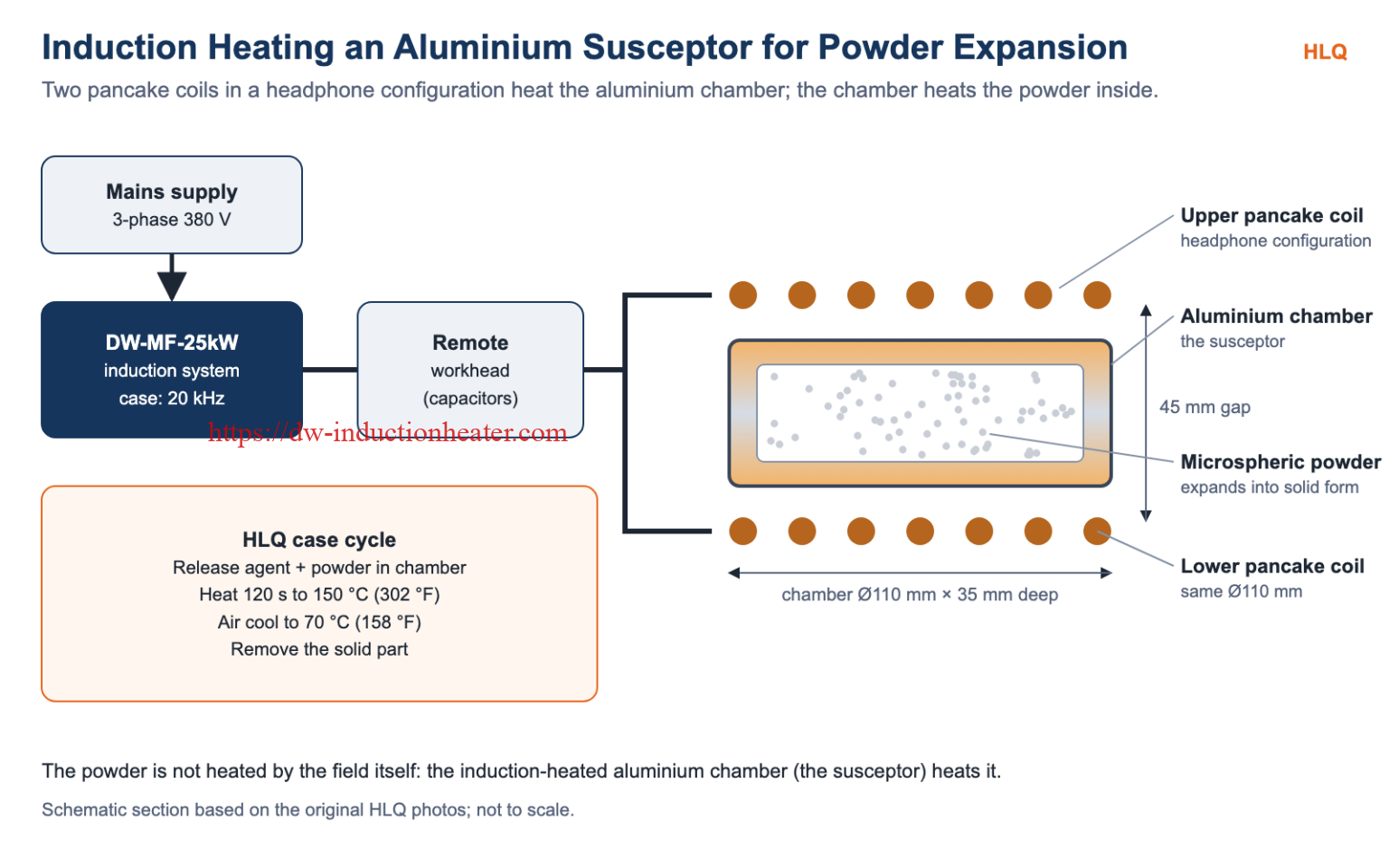
Induction heating aluminium chambers is a form of susceptor heating: the coils heat the aluminium chamber, and the chamber heats the material inside it.
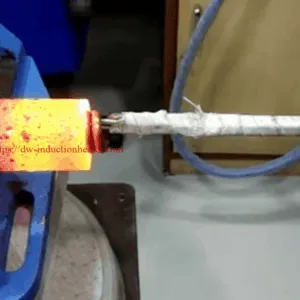
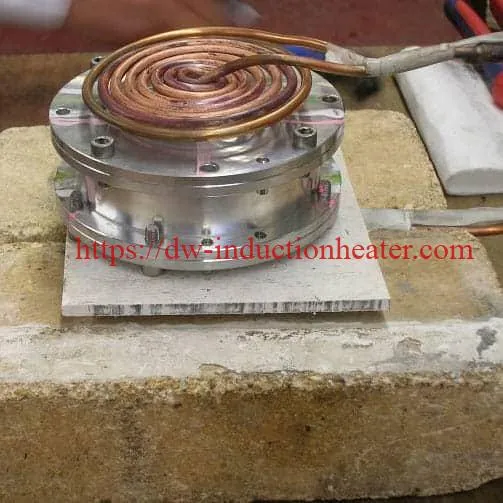
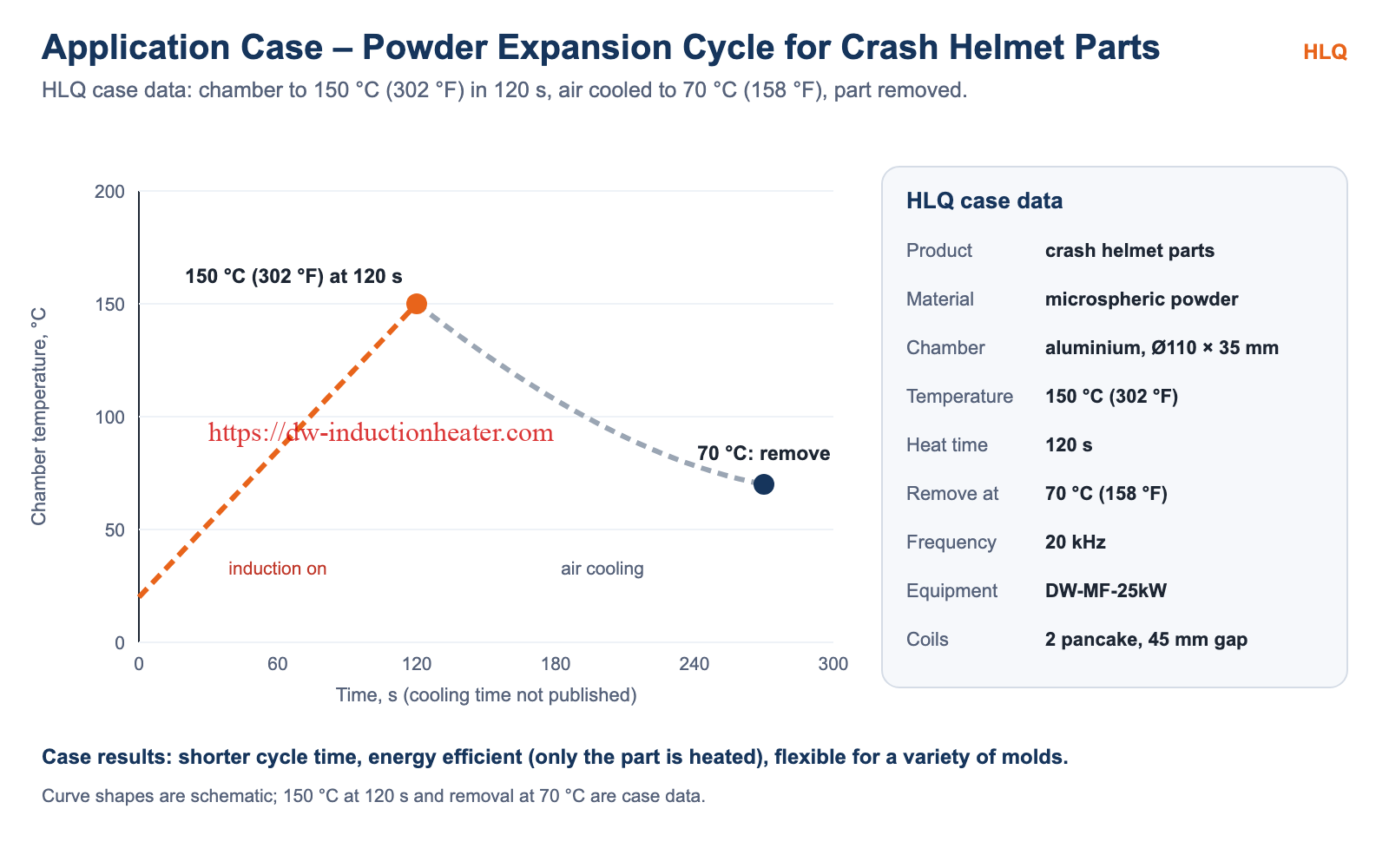
In this HLQ case, microspheric powder in an aluminium chamber 110 mm (4.3 in) in diameter and 35 mm (1.3 in) deep was expanded into solid form for crash helmets. Two pancake coils in a headphone configuration heated the chamber to 150 °C (302 °F) in 120 seconds, powered by a DW-MF-25kW induction heating system at 20 kHz. The chamber then air-cooled to 70 °C (158 °F), and the part was removed. Induction shortens the cycle time, heats only the part (which makes small production runs practical), and works with a variety of molds.
What is Induction Heating of an Aluminium Susceptor?
A susceptor is an electrically conductive part, here an aluminium chamber, that is heated by induction and then passes the heat to a material that cannot be heated by induction directly. In this case, the material is microspheric powder that expands into a solid part.
| Item | HLQ case data |
|---|---|
| Objective | Expand powder into solid form for use in crash helmets |
| Material | Microspheric powder; aluminium chamber 110 mm (4.3 in) diameter × 35 mm (1.3 in) deep holding the powder |
| Temperature | 150 °C (302 °F) |
| Frequency | 20 kHz |
| Process time | 120 seconds |
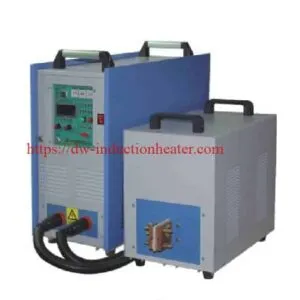
| Equipment | DW-MF-25kW induction heating system with a remote workhead containing (4) 2.6 µF capacitors (for a total of 2.6 µF) |
| Coils | Two pancake coils, 110 mm (4.3 in) diameter, with a 45 mm (1.8 in) gap, in a headphone configuration |

Key Applications
| Application | HLQ case data | Reference |
|---|---|---|
| Powder expansion for crash helmet parts | Aluminium chamber, 150 °C in 120 s, DW-MF-25kW, 20 kHz | This case |
| Aluminium cake molds, product release | 150 °C, DW-HF-60kW, 65 kHz | induction heating aluminum cake molds |
| Graphite susceptor for glass reflow | 950 °C in 32 s, DW-HF-25kW, 80 kHz | induction heating graphite susceptor |
| Heating non-conductive materials | Susceptor transfers the heat | induction susceptor heating |
| Curing coatings and adhesives | Heat from the metal part | induction curing |
Suitable Materials
| Material | Role | Notes |
|---|---|---|
| Aluminium chamber | Susceptor (heated by induction) | 110 mm diameter × 35 mm deep |
| Microspheric powder | Heated material | Expands into solid form at 150 °C |
| Release agent | Process aid | Sprayed on the chamber bottom |

Working Principle

- The DW-MF-25kW drives the two pancake coils at 20 kHz.
- The coils sit above and below the chamber in a headphone configuration, with a 45 mm gap.
- Eddy currents heat the aluminium chamber, the susceptor.
- The chamber heats the microspheric powder to 150 °C, and the powder expands into solid form.
| Item | Value |
|---|---|
| Skin depth in aluminium at 20 kHz (calculation) | ≈ 0.58 mm (δ = 503·√(ρ/f), ρ ≈ 2.65×10⁻⁸ Ω·m, pure aluminium at 20 °C) |
More: induction heating coil design and skin effect in induction heating.
Technical Specifications
| Parameter | Value |
|---|---|
| Chamber | Aluminium, 110 mm (4.3 in) diameter × 35 mm (1.3 in) deep |
| Material heated | Microspheric powder |
| Temperature | 150 °C (302 °F) |
| Heating time | 120 s |
| Removal temperature | 70 °C (158 °F), after air cooling |
| Frequency | 20 kHz |
| Power supply | DW-MF-25kW |
| Coils | Two pancake coils, Ø110 mm, 45 mm gap, headphone configuration |
Recommended Model Selection
The powder expansion case used the DW-MF-25kW at 20 kHz. All DW-MF models work at 1–20 kHz on a 3-phase 380 V supply, with 100% duty cycle.
| Model | Power | Input current |
|---|---|---|
| DW-MF-15 | 15 kW | 23 A |
| DW-MF-25 | 25 kW | 36 A |
| DW-MF-35 | 35 kW | 51 A |
| DW-MF-45 | 45 kW | 68 A |
| DW-MF-70 | 70 kW | 105 A |
| DW-MF-90 | 90 kW | 135 A |
| DW-MF-110 | 110 kW | 170 A |
| DW-MF-160 | 160 kW | 240 A |
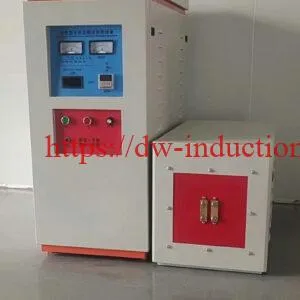
Details: DW-MF-25kW solid state induction heating power supply. All models: HLQ induction heating device models.
Process Workflow

| Step | Action |
|---|---|
| 1 | Spray release agent on the bottom of the chamber |
| 2 | Add the microspheric powder |
| 3 | Place the chamber between the pancake coils |
| 4 | Heat for 120 s to 150 °C (302 °F) |
| 5 | The powder changes into solid form |
| 6 | Air cool to 70 °C (158 °F) |
| 7 | Remove the part from the chamber |
Station layout

Common Problems and Solutions
| Problem | Cause | Solution |
|---|---|---|
| Part sticks in the chamber | No release layer | Spray release agent on the chamber bottom before filling |
| Uneven expansion | Heat from one side only | Two pancake coils in a headphone configuration |
| Part damaged on removal | Removed while too hot | Air cool to 70 °C before removal |
| Long cycles, high energy use | Heating a whole oven | Induction heats only the chamber (case result) |
Engineering Selection Guide
| Factor | What to confirm | Why it matters |
|---|---|---|
| Mold / chamber | Material and size (Ø110 × 35 mm aluminium in the case) | Coil size and frequency |
| Material inside | Powder or resin and its process temperature | Temperature set point |
| Cycle time | For example, 120 s heating | Power rating |
| Coil arrangement | One side or both sides | Heating uniformity |
| Mold changes | Variety of molds | Coil flexibility |
| Utilities | 3-phase 380 V; cooling water | Installation |
Advantages and Limitations
| Advantages | Limitations |
|---|---|
| Reduces cycle time for increased production | Needs a conductive susceptor (the aluminium chamber) |
| Energy efficient: only the part is heated | Cooling time adds to the cycle |
| Makes small production runs practical | Coils are matched to the chamber size |
| Flexible: a variety of molds can be used | Cooling water is required |
Why Choose HLQ?
| Strength | Evidence |
|---|---|
| Susceptor heating experience | Aluminium chambers, graphite susceptors |
| Coil design | Headphone pancake coils |
| Aluminium experience | Chambers, cake molds, wheels, flanges |
| DW-MF series | 15–160 kW, 100% duty |
| Short cycles | 150 °C in 120 s |
10 Core FAQs
1. What is heated in this application?
An aluminium chamber (the susceptor) that holds microspheric powder.
2. What is the purpose?
To expand the powder into solid form for use in crash helmets.
3. What size is the chamber?
110 mm (4.3 in) in diameter and 35 mm deep.
4. What temperature is used?
150 °C (302 °F).
5. How long does heating take?
120 seconds.
6. Which equipment was used?
A DW-MF-25kW induction heating system at 20 kHz with a remote workhead.
7. Which coils were used?
Two pancake coils, 110 mm in diameter, with a 45 mm gap, in a headphone configuration.
8. When is the part removed?
After air cooling to 70 °C (158 °F).
9. Why is it called susceptor heating?
The powder is not heated by the field directly. The induction-heated aluminium chamber heats it.
10. What is needed for a quotation?
The mold or chamber material and size, the material to be heated, the target temperature and cycle time, the parts per hour, and the available supply.