

Induction Heating Wire Stripping
Induction Wire Stripping: Burning Off Varnish from Flat Copper Wire
Quick Answer
Induction wire stripping heats the end of a varnished copper wire until the varnish coating burns off.
In this HLQ case, a flat copper wire bundle was inserted into an eight-turn helical coil with a 0.62 in (15.7 mm) ID. A DW-UHF-10kW system at 204 kHz heated it to 1300 °F (704 °C) for 5 seconds, and the wire then cooled naturally.
Compared with mechanical scraping, induction is faster and highly repeatable. Larger cross-sections need a longer heat time or higher power.

What is Induction Wire Stripping?
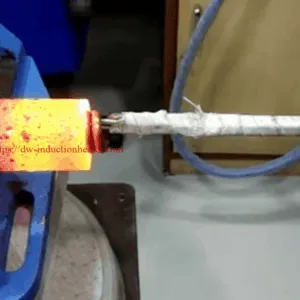
An induction coil induces eddy currents in the copper conductor, so the wire end heats from within. At 1300 °F the varnish coating burns off, leaving a stripped end without mechanical scraping.
| Item | HLQ case data |
|---|---|
| Objective | Heat wires to burn off the varnish coating |
| Material | Flat copper wire bundle with a rectangular cross-section of .025 square inches (.0635 square centimeters) |
| Temperature | 1300 °F (704 °C) for 5 seconds |
| Frequency | 204 kHz |
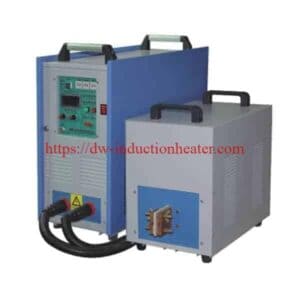
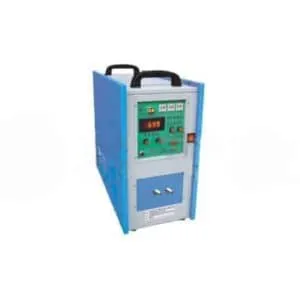
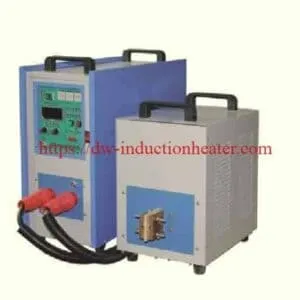
| Equipment | DW-UHF-10kW induction heating system with a remote heat station containing one 1.00 µF capacitor, plus a coil designed for this application |
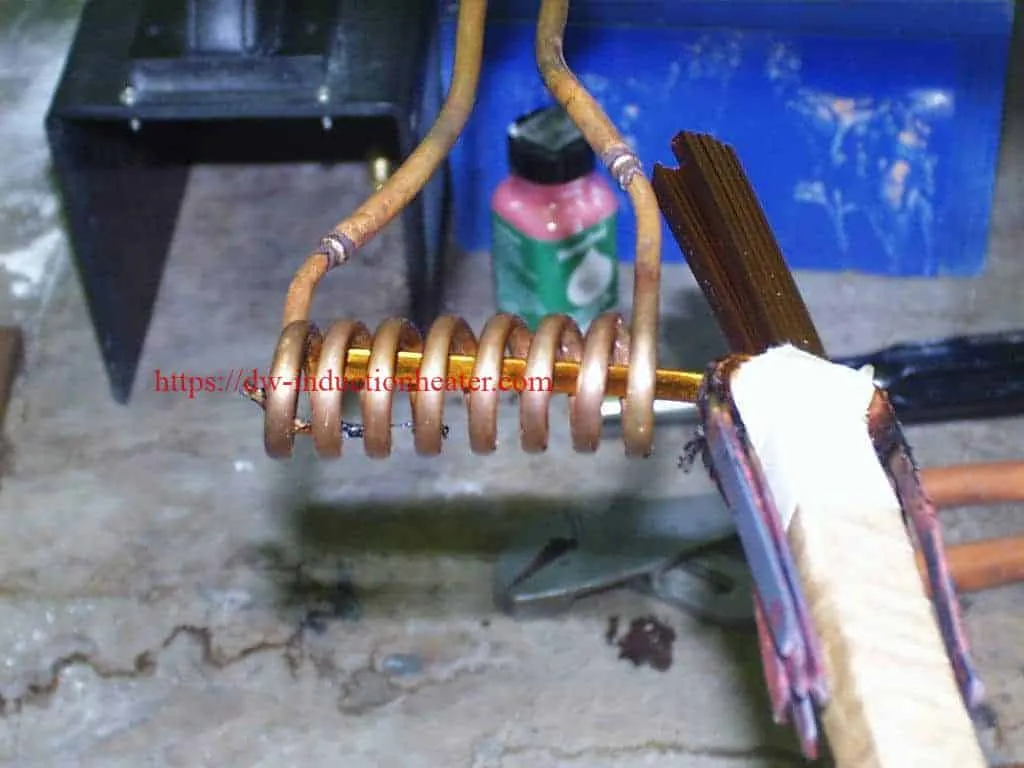
| Coil | Eight-turn helical coil, 0.62 in ID |
| Process | An individual wire is inserted and heated for 5 seconds; it is then removed and cools at a natural rate |
| Results | Compared with mechanical scraping: faster, and highly repeatable for consistent results |
Key Applications

| HLQ case | Part | Temperature / time | Equipment |
|---|---|---|---|
| Varnish burn-off (this page) | Flat copper wire bundle | 1300 °F (704 °C), 5 s | DW-UHF-10kW, 204 kHz |
| Tinned wire fusing for stripping | Pre-tinned stranded copper wire | 500 °F (260 °C), 1–2 s | DW-UHF-4.5KW, 300 pF |
| Stainless cable stress relief | Ø0.64 mm and Ø0.46 mm cable | 510–815 °C, 2–8.8 s | DW-UHF-4.5KW, 4.03 kW |
Related pages: induction heating copper wire for stripping (tinned strands), induction heating stainless steel wire cable and induction wire heating process applications.
Suitable Materials
| Item | Role | Notes |
|---|---|---|
| Flat copper wire bundle | Heated conductor | Rectangular cross-section |
| Varnish coating | Removed | Burns off at the process temperature |
| Larger cross-sections | Heated conductor | Need a longer heat time or higher power |
For removing paint and coatings from steel surfaces, see induction coating removal and induction thermal stripping of paint and coatings.
Working Principle

- The DW-UHF-10kW drives a remote heat station with one 1.00 µF capacitor at 204 kHz.
- The eight-turn helical coil (0.62 in ID) surrounds the inserted wire end.
- Eddy currents heat the copper conductor to 1300 °F (704 °C).
- The varnish coating burns off within the 5-second cycle.
- The wire is removed and cools naturally.
Background: understanding the skin effect and how an induction heater works.
Current penetration depth in copper at 204 kHz (physics reference)
| Copper temperature | Resistivity | Depth δ |
|---|---|---|
| 20 °C | ≈ 0.017 µΩ·m | ≈ 0.15 mm |
| About 700 °C | ≈ 0.063 µΩ·m | ≈ 0.28 mm |
Calculated with δ = 503·√(ρ / f). Copper is non-magnetic (µr = 1).
Technical Specifications
| Parameter | Value in the HLQ case |
|---|---|
| Part | Flat copper wire bundle, rectangular cross-section |
| Process temperature | 1300 °F (704 °C) |
| Heat time | 5 seconds per wire |
| Frequency | 204 kHz |
| Power supply | DW-UHF-10kW |
| Heat station | Remote, one 1.00 µF capacitor |
| Coil | Eight-turn helical, 0.62 in (15.7 mm) ID |
| Cooling | Natural cooling after removal |
DW-UHF-10kW (published data)
| Power | Maximum current | Frequency | Supply | Duty cycle |
|---|---|---|---|---|
| 10 kW | 15 A | 100–500 kHz | 3-phase 380 V ±10% | 100% |
Recommended Model Selection
| HLQ model | Power | Frequency | Wire job |
|---|---|---|---|
| DW-UHF-10kW | 10 kW | 100–500 kHz | Flat copper wire varnish burn-off (this case) |
| DW-UHF-4.5KW | 4.5 kW | 1.1–2.0 MHz | Fine tinned strands; small stainless cable |
| DW-UHF-20kW and above | 20–60 kW | By model | Larger cross-sections or shorter cycle time |
Full model data: HLQ induction heating device models. Larger cross-sections need a longer heat time or higher power, so confirm the cycle by test.
Process Workflow

| Step | Action | Case reference |
|---|---|---|
| 1 | Prepare the coil | Eight-turn helical, 0.62 in ID |
| 2 | Insert one wire end | Individual wire |
| 3 | Apply power | DW-UHF-10kW, 204 kHz |
| 4 | Burn off the varnish | 1300 °F (704 °C) for 5 seconds |
| 5 | Remove the wire | Out of the coil |
| 6 | Cool | Natural rate |
| 7 | Next wire | Same depth and time |
Station layout

Common Problems and Solutions
| Problem | Likely cause | Solution |
|---|---|---|
| Varnish not fully removed | Heat time too short for the cross-section | Use a longer heat time or higher power for larger sections |
| Results vary between wires | Insertion depth or time varies | Keep the same depth and 5-second cycle for every wire |
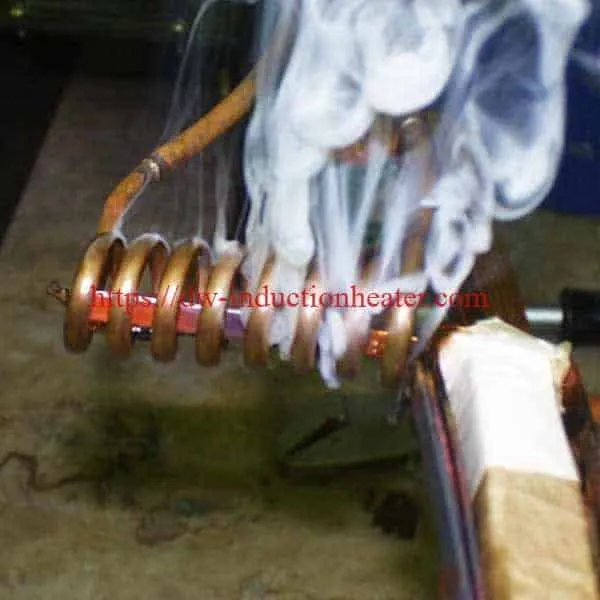
| Smoke in the work area | Burning varnish | Provide ventilation at the heating point |
| Wire does not fit the coil | Bundle too large for the 0.62 in ID | Size the coil to the bundle |
Engineering Selection Guide
| Factor | What to confirm | Why it matters |
|---|---|---|
| Wire bundle | Cross-section and shape | Sets heat time and power |
| Coating | Varnish type | Sets the burn-off temperature |
| Target | For example, 1300 °F for 5 s | Sets the power rating |
| Coil | Turns and ID | Fit and heating pattern |
| Stripped length | Heated zone length | Sets coil length |
| Supply | 3-phase 380 V for DW-UHF-10kW | Installation |
Advantages and Limitations
| Advantages | Limitations |
|---|---|
| Faster than mechanical scraping | Burning varnish produces smoke |
| Highly repeatable for consistent results | Heat time or power must scale with cross-section |
| Non-contact heating of the wire end | The coil is sized to the wire bundle |
| Natural cooling; no quench step | The cycle must be confirmed by test |
Why Choose HLQ?
| Strength | Evidence |
|---|---|
| Wire experience | Varnish burn-off, tinned wire fusing, stainless cable stress relief |
| DW-UHF series | DW-UHF-10kW: 100–500 kHz, 100% duty |
| Application coils | Eight-turn helical, 0.62 in ID |
| Repeatable process | Same 5-second cycle for every wire |
| Scalable | Heat time or power matched to the cross-section |
| Coating removal range | Steel surface coating removal systems as well |
10 Core FAQs
1. What does induction wire stripping do?
It heats the wire end so the varnish coating burns off.
2. What temperature is used?
1300 °F (704 °C) for 5 seconds.
3. Which equipment was used?
A DW-UHF-10kW with a remote heat station holding one 1.00 µF capacitor.
4. What frequency?
204 kHz.
5. Which coil?
An eight-turn helical coil with a 0.62 in (15.7 mm) ID.
6. What happens after heating?
The wire is removed from the coil and cools at a natural rate.
7. What about larger wires?
Larger cross-sections need a longer heat time or higher power.
8. Why use induction instead of scraping?
It is faster and highly repeatable, so results are consistent.
9. Is ventilation needed?
Yes. The varnish burns off and produces smoke, as the original HLQ photo shows.
10. What is needed for a quotation?
The wire type, shape and cross-section; the coating type; the stripped length; the cycle time and production rate; and the available supply.