Induction Tempering Saw Blades
Induction Tempering Saw Blades: Drawing Back to HRC 50–52
Quick Answer
Induction tempering saw blades can draw back (temper) a hardened steel band saw blade to an exact hardness while the blade moves continuously.
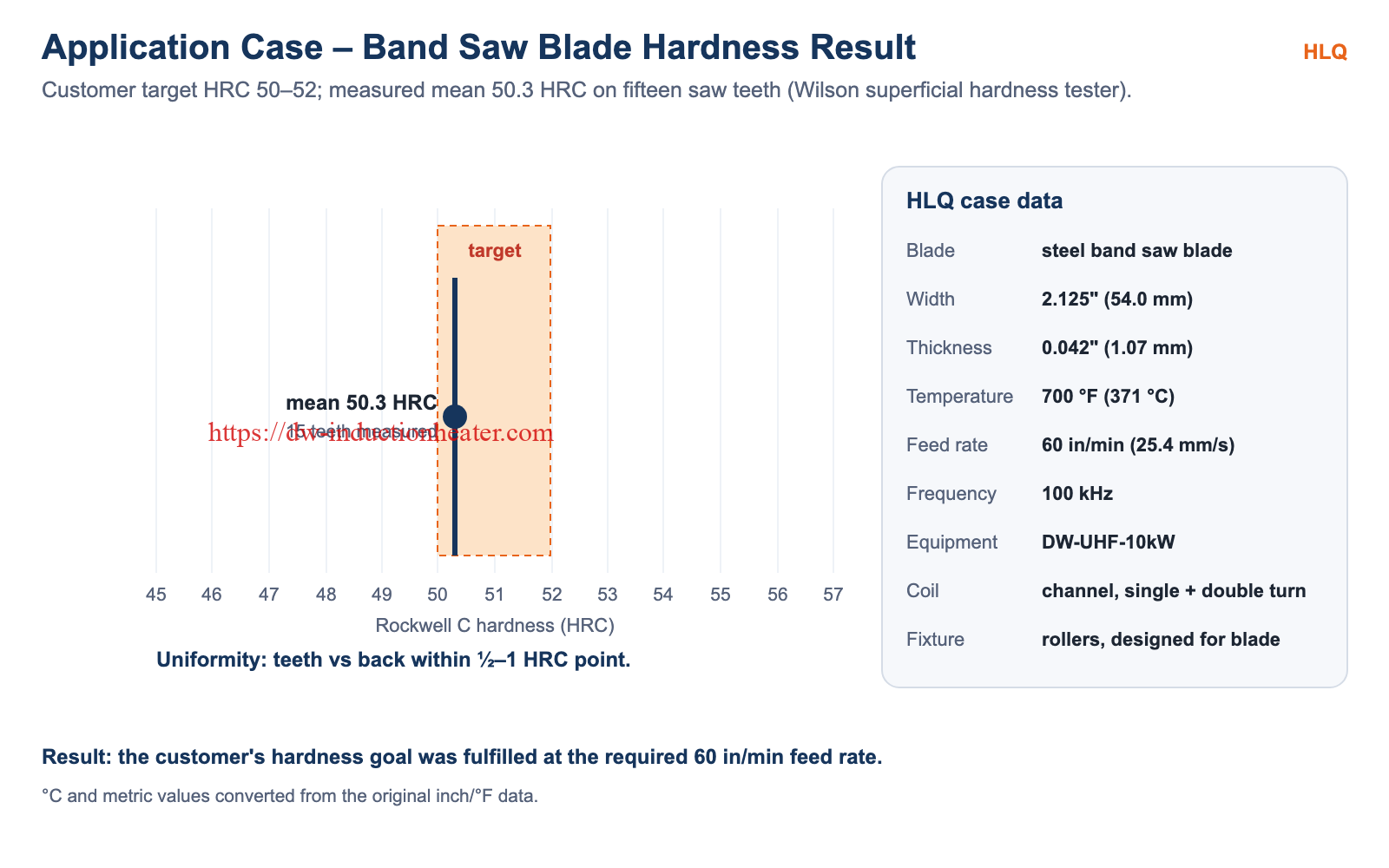
In this HLQ case, a 2.125″ wide, 0.042″ thick steel band saw blade was drawn back to a Rockwell hardness of 50–52 HRC at 60 inches per minute. The hardness between the teeth and the back of the blade had to stay within ½ to 1 point. A water-cooled channel coil with concentrator plates heated the blade to 700 °F (371 °C), powered by a DW-UHF-10kW at 100 kHz through a step-down transformer. The measured mean hardness was 50.3 HRC on fifteen saw teeth, which fulfilled the customer’s goal.

What is Induction Tempering Saw Blades?
Saw blades are heat treated by induction in two ways. Hardening heats the teeth above the critical temperature and quenches them. Drawing back (tempering) reheats a hardened blade to a lower temperature so it reaches a specified hardness. This page covers drawing back a continuous steel band saw blade.
| Item | HLQ case data |
|---|---|
| Objective | Draw back steel saw blades to a Rockwell hardness of 50–52 |
| Uniformity | Hardness within ½ to 1 point between the teeth and the back of the blade |
| Rate | 60 inches per minute |
| Material | Steel band saw blade, 2.125″ wide, 0.042″ thick |
| Temperature | 700 °F (371 °C) |
| Frequency | 100 kHz |
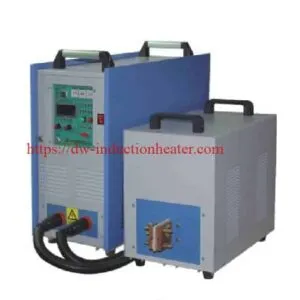
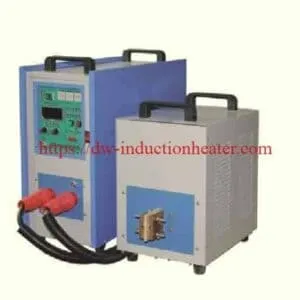
| Equipment | DW-UHF-10kW solid-state induction power supply with a step-down transformer and a remote heat station containing three busses and eight capacitors, total capacitance 0.66 µF |
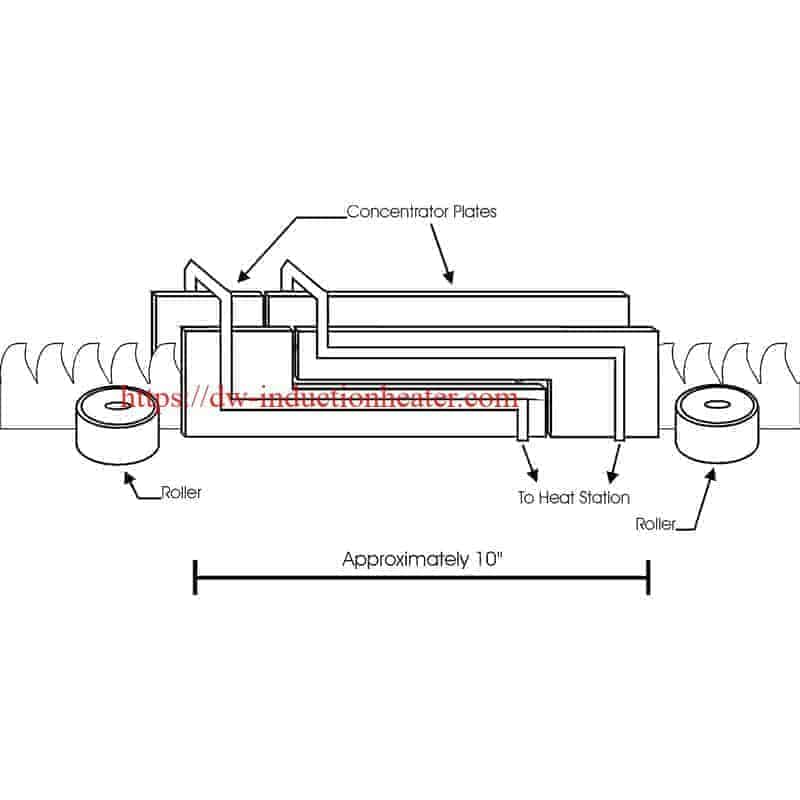
| Coil | Water-cooled coil designed for this application, using single and double turns |
Key Applications
| Saw blade process | HLQ data | Reference |
|---|---|---|
| Drawing back band saw blades | 700 °F, 100 kHz, 60 in/min, HRC 50–52 | This case |
| Hardening saw blade teeth | 1650 °F (899 °C), 134 kHz, five teeth per four seconds | induction hardening saw blade teeth |
| Saw tooth and blade edge hardening | DW-UHF-10KW machine | 10kW induction saw blade hardening machine |
| Continuous strip heating | Moving strip | induction strip heating solutions |
Suitable Materials
| Material | Process | Notes |
|---|---|---|
| Hardened steel band saw blade | Drawing back (tempering) | 2.125″ × 0.042″; HRC 50–52 (this case) |
| Hardenable steel saw teeth | Hardening | HLQ saw teeth case |
Background on hardening and tempering: induction hardening treatment for steel surfaces and induction hardening and tempering of steel rod and wire.
Working Principle
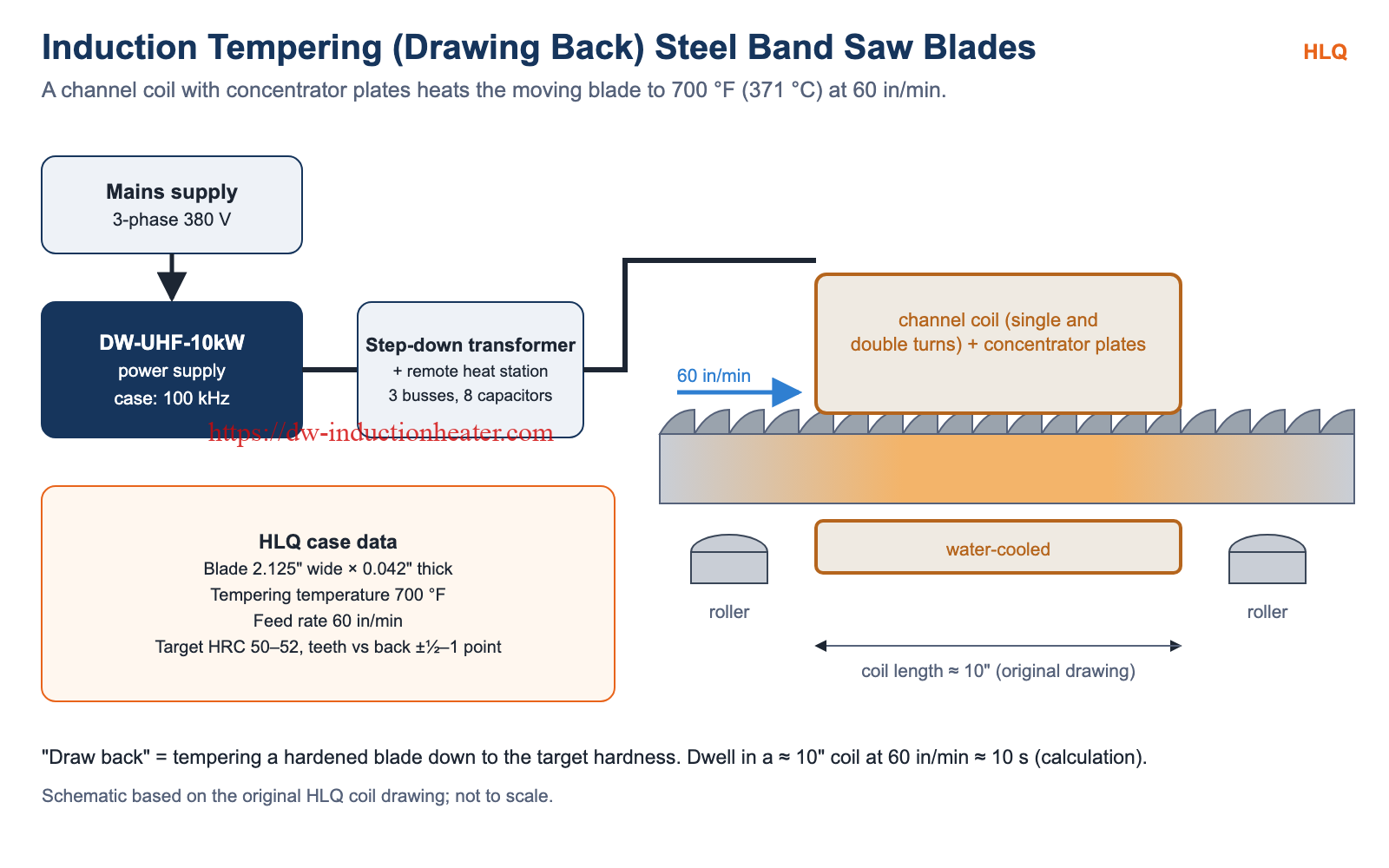
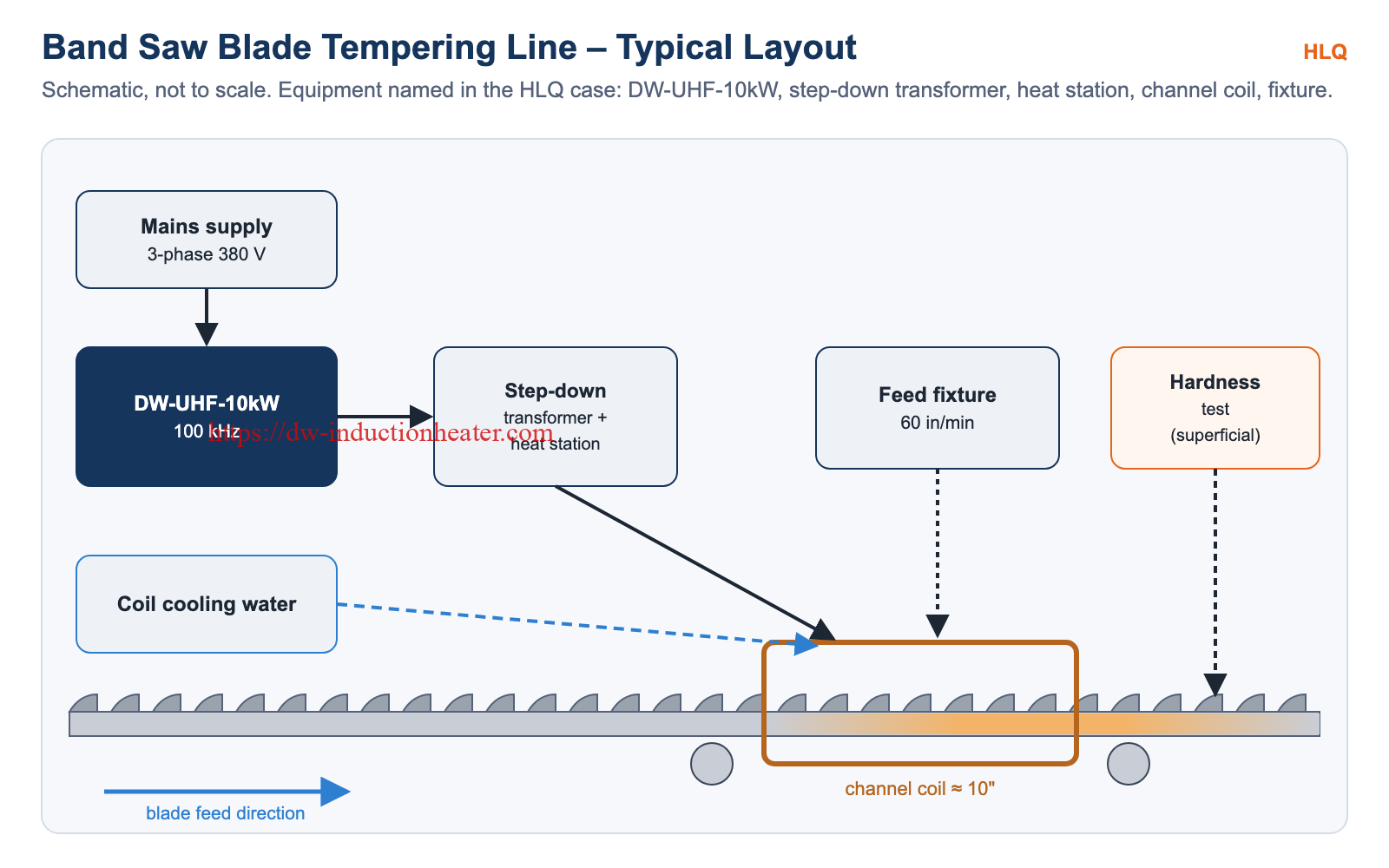
- The DW-UHF-10kW supplies 100 kHz power; a step-down transformer reduces the voltage to the coil.
- The remote heat station (three busses, eight capacitors) feeds the water-cooled channel coil.
- Concentrator plates shape the heat pattern across the blade, so the teeth and the back reach similar hardness.
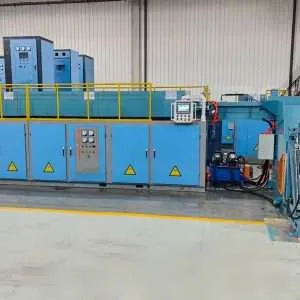
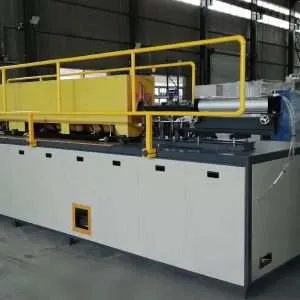
- Rollers and a designed fixture move the blade through the coil at 60 in/min, heating it to 700 °F.
| Conversion / calculation | Value |
|---|---|
| Feed rate 60 in/min | ≈ 1.52 m/min ≈ 25.4 mm/s |
| Dwell in a ≈ 10″ coil at 60 in/min | ≈ 10 s |
| 700 °F | ≈ 371 °C |
Technical Specifications
| Parameter | Value |
|---|---|
| Blade | Steel band saw blade |
| Width | 2.125″ (54.0 mm) |
| Thickness | 0.042″ (1.07 mm) |
| Target hardness | HRC 50–52 |
| Uniformity | Teeth vs back within ½–1 point |
| Temperature | 700 °F (371 °C) |
| Feed rate | 60 in/min |
| Frequency | 100 kHz |
| Power supply | DW-UHF-10kW with step-down transformer |
| Heat station | Three busses, eight capacitors, 0.66 µF total |
| Coil | Water-cooled channel coil, single and double turns, concentrator plates |
| Result | Mean 50.3 HRC on fifteen saw teeth (Wilson superficial hardness tester) |
Recommended Model Selection
DW-UHF-10KW (HLQ published data)
| Item | Value |
|---|---|
| Rated output | 10 kW |
| Frequency options | 50–300 kHz or 100–500 kHz |
| Input | 380 V ±10%, three-phase, 50/60 Hz |
| Duty cycle | 100% (with specified cooling) |
| Main unit | 570 × 260 × 500 mm, approx. 30 kg |
DW-UHF series (100% duty)
| Model | Power | Frequency | Supply |
|---|---|---|---|
| DW-UHF-4.5KW | 4.5 kW | 1.1–2.0 MHz | 1-phase 220 V |
| DW-UHF-6.0KW | 6.0 kW | 300–1100 kHz | 1-phase 220 V |
| DW-UHF-10KW | 10 kW | 100–500 kHz | 3-phase 380 V |
| DW-UHF-20KW | 20 kW | 50–250 kHz | 3-phase 380 V |
| DW-UHF-30KW | 30 kW | 50–200 kHz | 3-phase 380 V |
| DW-UHF-40KW | 40 kW | 50–200 kHz | 3-phase 380 V |
| DW-UHF-60KW | 60 kW | 50–150 kHz | 3-phase 380 V |
All models: HLQ induction heating device models.
Process Workflow
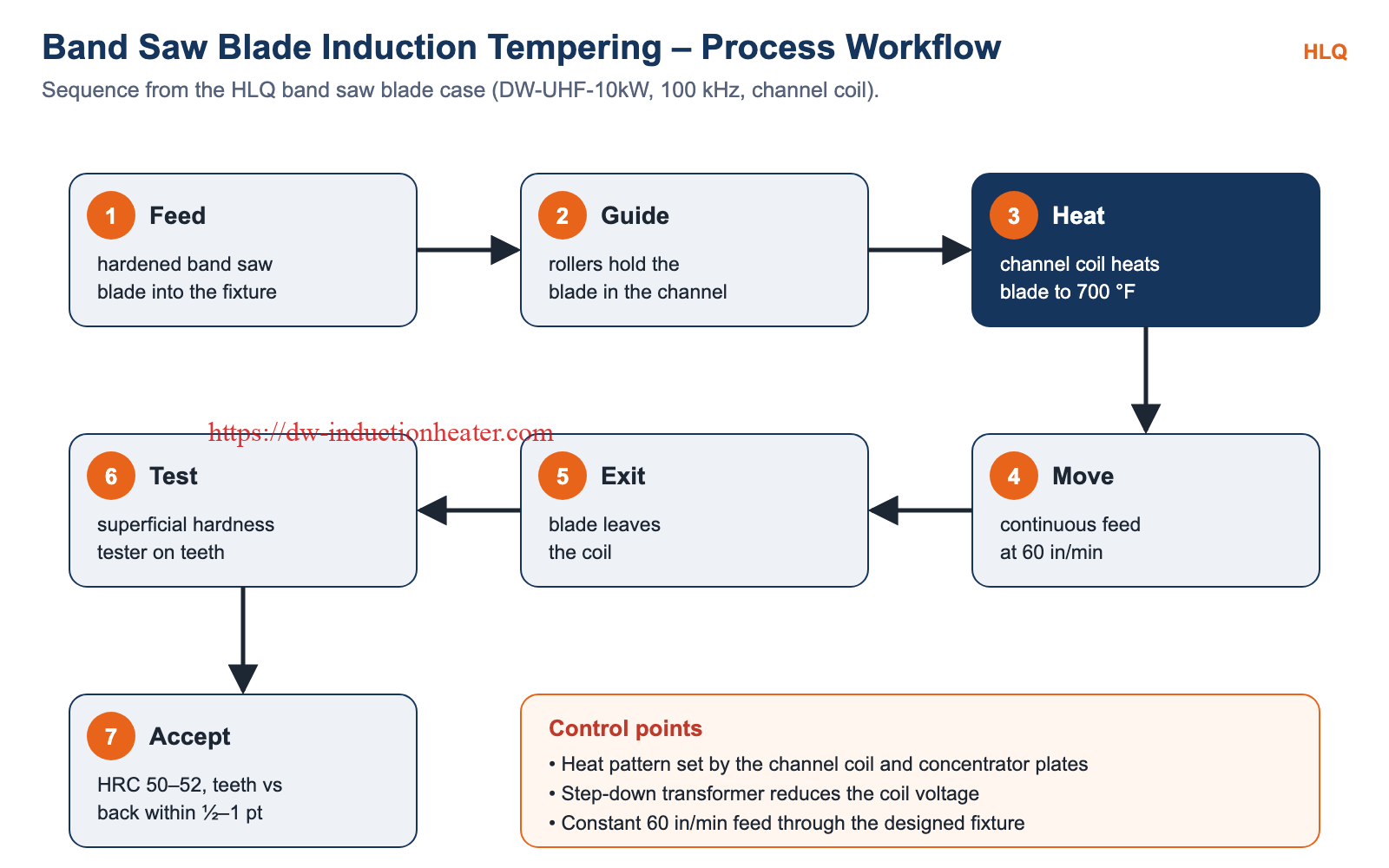
| Step | Action |
|---|---|
| 1 | Feed the hardened band saw blade into the fixture |
| 2 | The rollers guide the blade through the channel coil |
| 3 | The channel coil heats the blade to 700 °F |
| 4 | The blade moves continuously at 60 in/min |
| 5 | The blade leaves the coil |
| 6 | Test hardness on the teeth with a superficial hardness tester |
| 7 | Accept: HRC 50–52, with teeth vs back within ½–1 point |
Line layout
Common Problems and Solutions
| Problem | Cause | Solution in the HLQ case |
|---|---|---|
| Teeth and back at different hardness | Heat pattern not matched to the blade profile | Uniquely designed channel coil with concentrator plates |
| Voltage too high for the coil | Coil impedance | Step-down transformer to reduce the voltage |
| Feed rate not met | Coil length or fixture limits | Channel coil and a specifically designed fixture for 60 in/min |
| Coil overheating | Continuous operation | Water-cooled coil |
Engineering Selection Guide
| Factor | What to confirm | Why it matters |
|---|---|---|
| Blade size | Width and thickness (2.125″ × 0.042″ in the case) | Coil channel and power |
| Process | Hardening or drawing back | Temperature and quench need |
| Target hardness | For example, HRC 50–52 | Temperature setting |
| Uniformity | Teeth vs back tolerance | Concentrator plates and coil turns |
| Feed rate | For example, 60 in/min | Coil length and power |
| Supply | 3-phase 380 V for DW-UHF-10KW | Installation |
Coil design background: induction hardening coil for steel surface hardening.
Advantages and Limitations
| Advantages | Limitations |
|---|---|
| Hardness on target: mean 50.3 HRC | Coil and fixture are designed for each blade size |
| Continuous processing at 60 in/min | Heat pattern must be tuned for teeth vs back uniformity |
| Uniform teeth-to-back hardness | Coil cooling water is required |
| Compact 10 kW power supply | — |
Why Choose HLQ?
| Strength | Evidence |
|---|---|
| Proven result | Mean 50.3 HRC on fifteen saw teeth |
| Channel coils | Single and double turns with concentrator plates |
| Saw blade experience | Drawing back blades and hardening teeth |
| DW-UHF series | 4.5–60 kW, 100% duty |
| Line integration | Step-down transformer, remote heat station, fixture |
10 Core FAQs
1. What does “draw back” mean for saw blades?
It means tempering a hardened blade down to a specified hardness, here HRC 50–52.
2. What blade was processed?
A steel band saw blade, 2.125″ wide and 0.042″ thick.
3. What temperature was used?
700 °F (371 °C).
4. How fast does the blade move?
60 inches per minute.
5. Which equipment was used?
A DW-UHF-10kW at 100 kHz, with a step-down transformer and a remote heat station with three busses and eight capacitors.
6. Which coil was used?
A water-cooled channel coil with single and double turns and concentrator plates.
7. How uniform is the hardness?
The requirement was within ½ to 1 point between the teeth and the back of the blade.
8. What hardness was achieved?
A mean of 50.3 HRC on fifteen saw teeth, measured on a Wilson superficial hardness tester.
9. Can HLQ also harden saw teeth?
Yes. In another HLQ case, saw teeth were hardened at 1650 °F (899 °C) at a rate of five teeth per four seconds.
10. What is needed for a quotation?
The blade width, thickness and steel grade, whether you need hardening or tempering, the target HRC and uniformity, the feed rate, and the available supply.