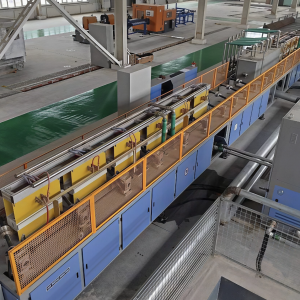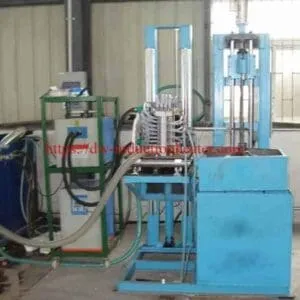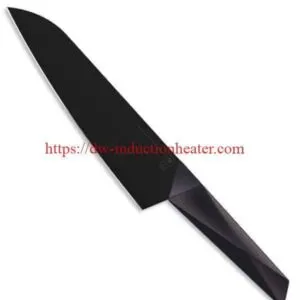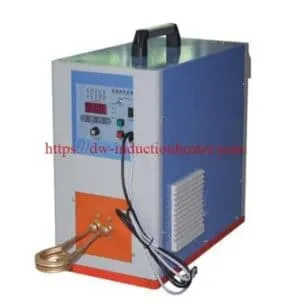
Induction Hardening Saw Blades Machiney 10kw
10kW Induction Saw Blade Hardening Machine for Precision Saw Tooth Hardening
What Is a 10kW Induction Saw Blade Hardening Machine?
A 10kW induction saw blade hardening machine is an ultra-high-frequency induction heating system designed for localized heat treatment of steel saw blades, cutting teeth, and small precision metal components.
Manufactured by HLQ Induction Equipment Co., Ltd., the DW-UHF-10KW induction hardening system delivers up to 10kW of output power, with available operating frequency configurations of 50–300kHz or 100–500kHz.
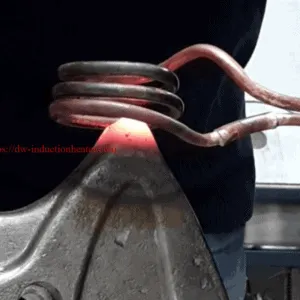
The machine uses electromagnetic induction to rapidly heat selected areas of suitable hardenable steel saw blades before controlled quenching. This process can improve tooth hardness, wear resistance, and cutting-edge durability while limiting unnecessary heating of the blade body.
Key Applications:
- Circular saw blade tooth hardening
- High-frequency induction hardening of cutting tools
- Localized steel blade edge hardening
- Small metal component surface hardening
- Precision heat treatment of steel cutting edges
- Induction brazing of carbide or diamond blade segments with suitable coils and process settings
The compact 10kW induction hardening machine is suitable for manufacturers requiring precise localized heating, repeatable processing, and efficient production of small cutting tools.
Technical Specifications — 10kW Induction Saw Blade Hardening Machine
Technical Parameters
| Technical Parameter | Specification |
|---|---|
| Product Name | Induction Saw Blade Hardening Machine |
| Manufacturer | HLQ Induction Equipment Co., Ltd. |
| Model | DW-UHF-10KW |
| Heating Technology | Ultra-High-Frequency Induction Heating |
| Rated Output Power | 10 kW |
| Available Frequency Options | 50–300 kHz or 100–500 kHz |
| Input Voltage | 380V ±10% |
| Input Power Supply | Three-Phase AC |
| Input Frequency | 50/60 Hz |
| Input Current | 3–15 A (published specification; to be confirmed) |
| Power Electronics | IGBT Inverter Technology |
| Operating Modes | Constant Current / Constant Power |
| Rated Duty Cycle | 100% (subject to specified cooling conditions) |
| Main Unit Dimensions | 570 × 260 × 500 mm |
| Main Unit Weight | Approximately 30 kg |
| Heating Method | Electromagnetic Induction |
| Quenching Method | External quenching system, application-dependent |
| Hardening Depth | Shallow hardening, potentially below 1 mm depending on material and process |
| Temperature Control | Application-dependent; optional monitoring and control configuration |
| Induction Coil | Customized for saw blade geometry |
| Primary Applications | Saw Tooth Hardening, Blade Edge Hardening, Precision Surface Hardening |
| Additional Applications | Carbide Brazing, Diamond Segment Brazing, Small Metal Parts Heating |
| Installation | Industrial Workshop / Production Line |
| Automation | Customized Integration Available |
Engineering Note: The published page lists both 25 kg and 30 kg for the machine weight. The technical specification table lists 30 kg, which should be verified before final publication. Frequency options refer to alternative equipment configurations, not necessarily a continuously selectable 50–500 kHz range.
Recommended Applications and Process Selection
| Application | Suitable Material | Recommended Heating Method | Important Considerations |
|---|---|---|---|
| Circular Saw Tooth Hardening | Hardenable Carbon Steel | Localized Induction Hardening | Coil positioning and quenching |
| Steel Cutting Blade Hardening | Suitable Tool Steel | High-Frequency Induction Heating | Steel-specific heat treatment cycle |
| Saw Blade Edge Hardening | Medium/High-Carbon Steel | Selective Edge Heating | Minimize blade distortion |
| Small Cutting Tool Hardening | Hardenable Tool Steel | Precision Induction Heating | Hardness and case-depth verification |
| Carbide Saw Tip Brazing | Steel Body + Carbide Tip | Induction Brazing | Brazing filler and joint temperature |
| Diamond Segment Brazing | Steel Core + Diamond Segment | Localized Induction Brazing | Avoid diamond thermal damage |
These are application categories rather than guaranteed processing capabilities. Final feasibility must be verified using the customer’s blade dimensions, material grade, required hardness, and production rate.
Key Advantages of Induction Saw Blade Hardening
Precision Heating for Saw Teeth
High-frequency induction heating concentrates thermal energy in the selected region of the steel blade, enabling controlled localized heat treatment.
Fast Heating and Repeatability
Compared with conventional torch heating, induction heating offers rapid energy delivery and repeatable heating cycles when the induction coil, workpiece position, and operating parameters are controlled.
Reduced Blade Distortion
Selective heating can reduce unnecessary thermal exposure of the blade body. Proper coil design, heating cycles, and quenching are essential for minimizing distortion.
Improved Wear Resistance
When suitable steel is correctly hardened and tempered, induction heat treatment can improve cutting-edge hardness and wear resistance.
Compact 10kW Equipment
The DW-UHF-10KW provides a compact solution for localized heating of small cutting tools and precision components.
Custom Induction Coil Design
HLQ offers application-specific induction coil configurations based on blade diameter, tooth geometry, material, heating location, and production requirements.
 FAQs

FAQ 1: What is an induction saw blade hardening machine?
An induction saw blade hardening machine is specialized induction heating equipment used to heat selected areas of suitable steel saw blades before rapid quenching.
The process increases the hardness and wear resistance of the treated steel by forming a hardened microstructure.
Compared with conventional whole-blade heating, localized induction hardening offers more precise control over the heated area and can help reduce unnecessary thermal distortion.
FAQ 2: What frequency is recommended for induction hardening saw blade teeth?
High-frequency and ultra-high-frequency induction heating are commonly considered for localized saw tooth and cutting-edge hardening.
The HLQ DW-UHF-10KW machine is offered with frequency configurations of 50–300 kHz or 100–500 kHz.
The most suitable operating frequency depends on the steel grade, tooth geometry, required hardened depth, coil design, and heating time.
Higher frequency generally produces shallower electromagnetic penetration, although actual hardening depth also depends on thermal conduction and process parameters.
FAQ 3: Can a 10kW induction hardening machine harden circular saw blades?
Yes. A 10kW induction hardening machine can be suitable for localized hardening of certain circular saw blade teeth and cutting edges.
However, processing capability depends on the blade diameter, steel composition, tooth dimensions, required hardness, and production speed.
For larger saw blades or high-throughput manufacturing, higher-power induction hardening equipment or automated tooth-indexing systems may be necessary.
FAQ 4: What hardness can be achieved by induction hardening saw blade teeth?
The achievable hardness depends primarily on the steel composition, initial microstructure, austenitizing temperature, quenching medium, and tempering conditions.
For suitable medium-carbon and high-carbon steels, induction hardening can produce substantial improvements in surface hardness and wear resistance.
Some high-carbon cutting steels can achieve hardness around 58–65 HRC under appropriate heat treatment conditions, but these values are not guaranteed for every saw blade material.
The required hardness should be confirmed through sample testing and metallurgical inspection.
FAQ 5: How deep can induction hardening penetrate into saw blade teeth?
Induction hardening depth depends on operating frequency, heating duration, power density, material properties, and quenching conditions.
The DW-UHF-10KW is designed for shallow localized heating applications, including applications targeting hardened depths below 1 mm.
Actual effective case depth must be measured after processing. It cannot be determined from frequency or machine power alone.
FAQ 6: Can an induction saw blade hardening machine also braze carbide or diamond saw tips?
Yes. A suitable induction heating system can also be used for brazing carbide saw tips or diamond blade segments when equipped with the appropriate induction coil and brazing process configuration.
However, induction brazing and induction hardening are different metallurgical processes.
Induction hardening involves heating hardenable steel and subsequently quenching it, while induction brazing joins components using a molten filler metal without melting the main workpieces.
The process must be carefully controlled to protect carbide and diamond cutting materials.
FAQ 7: What are the advantages of induction hardening compared with conventional flame hardening?
Induction hardening provides several advantages over conventional flame hardening, particularly for precision cutting tools.
These include localized heating, rapid thermal response, repeatable operating parameters, easier integration with automated production lines, and reduced direct flame exposure.
Induction heating also allows manufacturers to control heating power and cycle time electronically.
However, final hardening quality still depends on the steel grade, induction coil design, quenching arrangement, and process validation.
FAQ 8: How do I choose the right induction hardening machine for saw blades?
Selecting the correct induction hardening machine requires evaluating several important manufacturing parameters.
These include blade diameter, blade thickness, tooth geometry, steel grade, target surface hardness, required hardening depth, and production capacity.
Small saw teeth requiring localized shallow hardening may be suitable for a 10kW ultra-high-frequency system.
Larger blades, wider heating areas, or faster production rates may require higher-power induction hardening equipment.
HLQ Induction Equipment Co., Ltd. can recommend an appropriate induction power supply, operating frequency, customized coil, and quenching arrangement based on the customer’s technical requirements.