

Induction Hardening Knife Blade
Induction Hardening Knife Blade: Lawn Mower Bed Knife to 45–55 HRC
Quick Answer
Induction hardening knife blade means heating only the selected edge zone with an alternating magnetic field and quenching it immediately. In this HLQ case, an 18″ (457.2 mm) 1070 steel bed knife for a reel lawn mower was scanned by a single-turn channel coil with ceramic guides for 30 seconds, heated to 1550 °F (843.3 °C) at 160 kHz with a DW-UHF-30kW induction heating system, and quenched immediately to reach 45–55 HRC, measured 0.062″ (1.6 mm) from the cutting edge. Immediate quenching and rigid fixturing prevented distortion.
Table of Contents
- What is Induction Hardening of Knife Blades?
- Key Applications
- Suitable Materials
- Working Principle
- Technical Specifications
- Recommended Model Selection
- Process Workflow
- Common Problems and Solutions
- Engineering Selection Guide
- Advantages and Limitations
- Why Choose HLQ?
- 10 Core FAQs
What is Induction Hardening Knife Blades?
 Induction hardening of knife blades is a selective heat treatment: an induction coil heats a defined area of the blade, such as the cutting edge, to hardening temperature, and the blade is quenched immediately. The rest of the blade stays outside the heated zone. HLQ applied this method to harden a selected area of an 18″ bed knife blade for a reel lawn mower to 45–55 HRC, measured 0.062″ (1.6 mm) from the cutting edge.
Because the heat is generated inside the steel by eddy currents, the process offers precise and accurate placement of heat, consistent and repeatable results, and clean, non-contact heating.
Key Applications
- Lawn mower bed knives – edge-zone hardening of an 18″ reel mower bed knife (this case).
- Stainless steel knife and surgical blades – see hardening stainless steel knife blades with induction.
- Blade and knife preheating – see induction preheating blades and knives.
- Saw teeth – see induction hardening saw teeth of blade.
- Band saw blades – see induction tempering saw blades.


| HLQ case | Temperature | Frequency | Equipment |
|---|---|---|---|
| Lawn mower bed knife (this page) | 1550 °F (843.3 °C), 30 s scan | 160 kHz | DW-UHF-30kW |
| 420 stainless surgical blades | 1850 °F (1010 °C) | 365 kHz | DW-UHF-6kW |
| Saw blade teeth | 1650 °F (899 °C), five teeth | 134 kHz | – |
| Blade and knife preheating | 850 °C in 13–19 s | 57–80 kHz | DW-HF-15kW |
| Band saw blade tempering | 700 °F (371 °C), 60 in/min | 100 kHz | DW-UHF-10kW |
Suitable Materials
| Material | HLQ case | Result |
|---|---|---|
| 1070 carbon steel | Lawn mower bed knife, 18″ × 1 17/32″ × 0.135″ | 45–55 HRC at 0.062″ (1.6 mm) from the edge |
| 420 stainless steel | Surgical blades | See the stainless steel knife blade case |
Induction hardening requires a hardenable steel. Send the steel grade with your inquiry so the temperature can be confirmed for your blade.
Working Principle

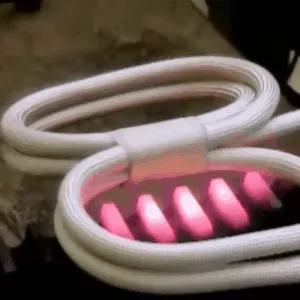
The DW-UHF-30kW supplies high-frequency current to a remote workhead with four capacitors totalling 1.0 µF. The single-turn channel coil wraps the edge of the blade, and ceramic guides hold the coil in position as it scans the 18″ length in 30 seconds. Eddy currents heat the edge zone to 1550 °F (843.3 °C), and the blade is quenched immediately.
Heating depth is governed by the skin effect. Calculation (δ = 503·√(ρ/f), hot steel above the Curie point, ρ ≈ 1.2×10⁻⁶ Ω·m, µr = 1): at 160 kHz, δ ≈ 1.4 mm, compared with the 3.4 mm blade thickness.
Technical Specifications
| Parameter | Case data |
|---|---|
| Objective | Harden a selected area of an 18″ bed knife blade for a reel lawn mower |
| Material | 1070 steel |
| Blade size | 18″ (457.2 mm) × 1 17/32″ (38.9 mm) × 0.135″ (3.4 mm) |
| Temperature | 1550 °F (843.3 °C) |
| Frequency | 160 kHz |
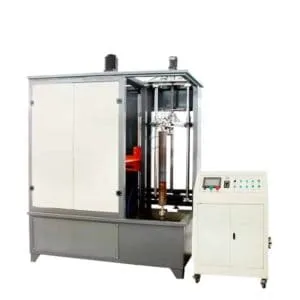
| Equipment | DW-UHF-30kW induction heating system, remote workhead with four capacitors totalling 1.0 µF |
| Coil | Single-turn channel coil with ceramic guides |
| Heating time | 30 s scan along the blade length |
| Scan speed (calculated) | 18 in / 30 s ≈ 0.6 in/s (≈ 15.2 mm/s), assuming one pass |
| Quench | Immediate quenching after heating |
| Fixturing | Rigid fixturing to prevent distortion |
| Hardness target | 45–55 HRC, measured 0.062″ (1.6 mm) from the edge |
Recommended Model Selection
This case used the DW-UHF-30kW. The DW-UHF series data below comes from the HLQ induction heating device model table.
| Model | Power | Max. input current | Frequency | Supply |
|---|---|---|---|---|
| DW-UHF-4.5kW | 4.5 kW | 20 A | 1.1–2.0 MHz | 1-phase 220 V |
| DW-UHF-6.0kW | 6.0 kW | 28 A | 300–1100 kHz | 1-phase 220 V |
| DW-UHF-10kW | 10 kW | 15 A | 100–500 kHz | 3-phase 380 V |
| DW-UHF-20kW | 20 kW | 30 A | 50–250 kHz | 3-phase 380 V |
| DW-UHF-30kW (this case) | 30 kW | 45 A | 50–200 kHz | 3-phase 380 V |
| DW-UHF-40kW | 40 kW | 60 A | 50–200 kHz | 3-phase 380 V |
| DW-UHF-60kW | 60 kW | 90 A | 50–150 kHz | 3-phase 380 V |
All DW-UHF models are rated for 100% duty cycle.
Process Workflow

- Clamp – hold the blade in a rigid fixture.
- Position – place the single-turn channel coil with ceramic guides at the cutting edge.
- Scan – the coil travels the 18″ length in 30 seconds.
- Heat – the edge zone reaches 1550 °F (843.3 °C) at 160 kHz.
- Quench – quench immediately to prevent distortion.
- Test – measure hardness 0.062″ (1.6 mm) from the edge.
- Accept – 45–55 HRC in the hardened zone.

Common Problems and Solutions
| Problem | Cause | Solution (from this case) |
|---|---|---|
| Blade distortion | A long, thin blade (18″ × 0.135″) heated along one edge | Rigid fixturing and immediate quenching |
| Uneven hardness along the length | Changing coil-to-edge gap during the scan | Ceramic guides on the channel coil keep the coil positioned on the blade |
| Hardness outside 45–55 HRC | Temperature or quench not as specified | Heat to 1550 °F (843.3 °C), quench immediately, and check at 0.062″ (1.6 mm) from the edge |
| Heated zone wider than required | Coil design or frequency not matched to the zone | Use a coil designed for the blade profile; check the skin depth at the chosen frequency |
More coil guidance: induction hardening coil for steel surface hardening.
Engineering Selection Guide
| Frequency | Calculated skin depth in hot steel (µr = 1, ρ ≈ 1.2×10⁻⁶ Ω·m) |
|---|---|
| 100 kHz | ≈ 1.7 mm |
| 160 kHz (this case) | ≈ 1.4 mm |
| 200 kHz | ≈ 1.2 mm |
| 500 kHz | ≈ 0.8 mm |
- Long blades, edge zone only: scan with a single-turn channel coil, as in this DW-UHF-30kW, 160 kHz case.
- Small stainless blades: the HLQ surgical blade case used 365 kHz with a DW-UHF-6kW.
- Tempering after hardening: the HLQ band saw blade case used 100 kHz with a DW-UHF-10kW.
- Data to send: blade drawing (length, width, thickness), steel grade, hardened zone, hardness and measuring position, output per hour, available power supply and cooling water.
For general surface hardening, see induction hardening treatment for steel surfaces.
Advantages and Limitations
| Advantages | Limitations |
|---|---|
| Precise and accurate placement of heat | The coil must be designed for the blade profile |
| Consistent, repeatable results | Rigid fixturing is needed to prevent distortion |
| Clean, non-contact heating | Immediate quenching must be built into the station |
| Only the selected zone is hardened | Process data must be confirmed for each steel grade and blade size |
Why Choose HLQ?
- Documented blade cases: bed knives, stainless surgical blades, saw teeth, band saw blades and knife preheating.
- A full DW-UHF range from 4.5 kW to 60 kW, all at 100% duty cycle.
- Remote workheads and custom coils, including channel coils with ceramic guides for scanning.
- Process development based on your blade drawing, steel and hardness target.
10 Core FAQs
1. What was hardened in this case?
A selected area of an 18″ 1070 steel bed knife blade for a reel lawn mower.
2. What hardness was specified?
45–55 HRC, measured 0.062″ (1.6 mm) from the cutting edge.
3. What temperature was used?
1550 °F (843.3 °C).
4. Which frequency was used?
160 kHz.
5. Which induction machine was used?
A DW-UHF-30kW induction heating system with a remote workhead containing four capacitors totalling 1.0 µF.
6. Which coil was used?
A single-turn channel coil with ceramic guides.
7. How long does the heating take?
The coil scans the length of the blade in 30 seconds.
8. How is distortion prevented?
By immediate quenching and rigid fixturing.
9. How deep does 160 kHz heat in hot steel?
Calculated skin depth is about 1.4 mm above the Curie point, compared with the 3.4 mm blade thickness.
10. What information is needed for a quotation?
The blade drawing, steel grade, hardened zone, hardness and measuring position, output, and available power supply and cooling water.