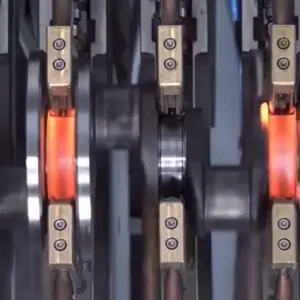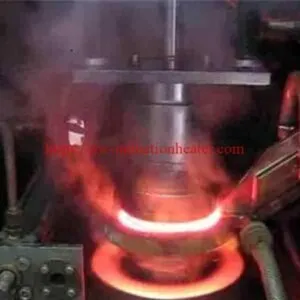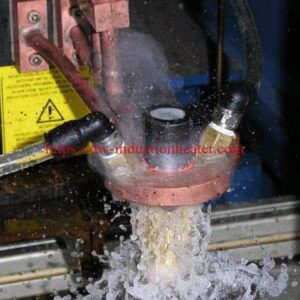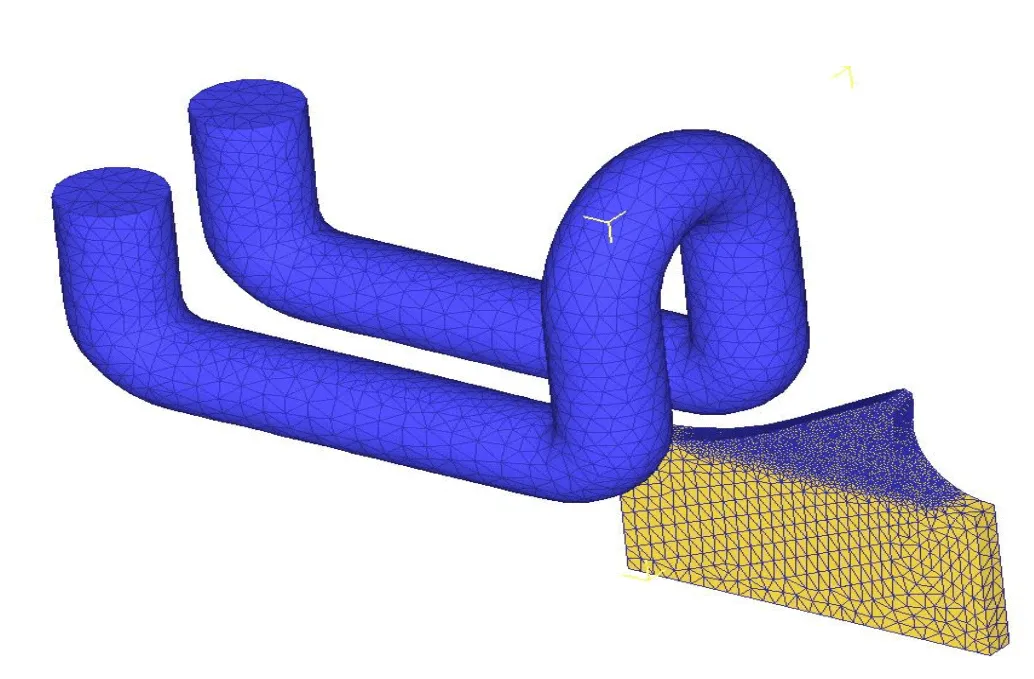
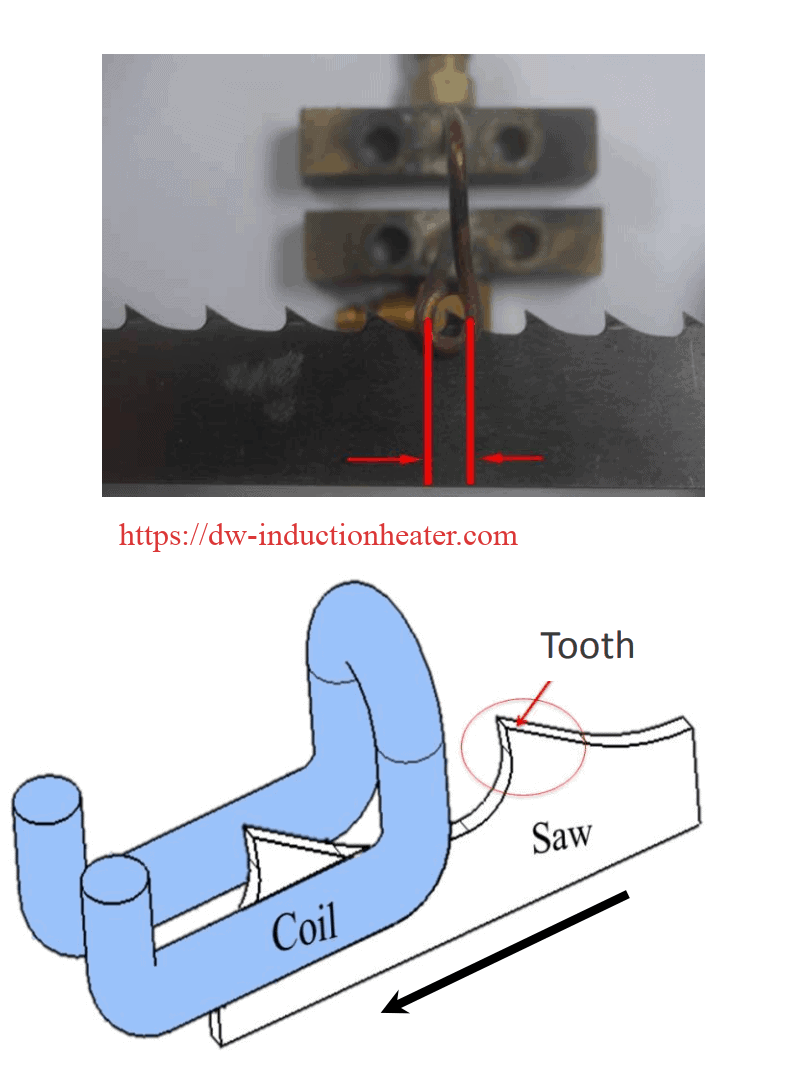


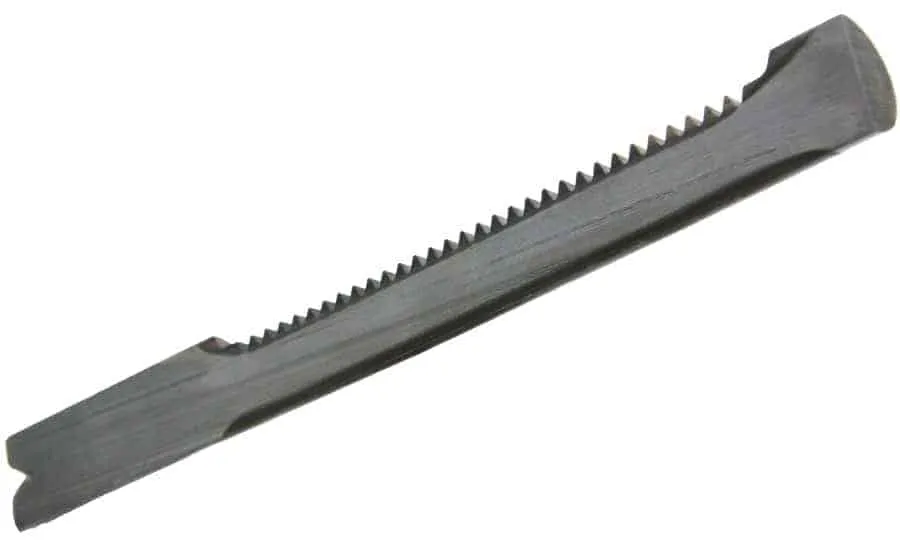
Induction hardening saw teeth of blade
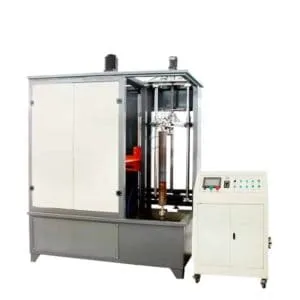
Induction Hardening Saw Blade Teeth Machine
Quick Answer: What Is Induction Hardening for Saw Blade Teeth?
Induction hardening of saw blade teeth is a localized heat-treatment process that uses a high-frequency electromagnetic field to rapidly heat only the cutting teeth of a steel saw blade, followed by controlled quenching to increase tooth hardness, wear resistance and cutting life while minimizing heat input to the blade body.
Induction hardening saw teeth of blade
Method of induction hardening the teeth of a steel saw blade composed of “high speed tool steel,” which comprises passing a high frequency induction current through the teeth of the blade so that all the particles of the teeth, both on the surface and in the interior thereof, are heated to the critical temperature of approximately 2375″ F. without similarly heating other portions of the blade, controlling the frequency and magnitude of the induced current so that substantially all of the carbides in the teeth are in condition to dissolve in the austenitic matrix practically as soon as the steel reaches the critical temperature, and thereupon cooling the teeth to a temperature substantially below the critical temperature before substantial grain growth occurs; instead of either hardening the entire blade or merely induction surface hardening the teeth.
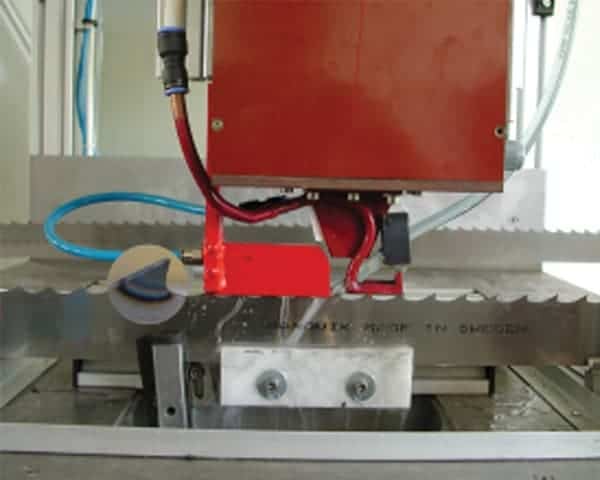
Induction hardening saw teeth of blade for a hardening application; the objective is to reduce the heating time
Material : Section of the saw blade
Temperature: 1650 ºF (899 ºC)
Frequency : 134 kHz
Equipment : DW-UHF-30kW 50-150 kHz induction heating system equipped with a remote workhead containing eight 1.0 μF capacitors.A multiple position two-turn helical induction heating coil designed and developed specifically for this application

The induction heating coil was developed so that it would not concentrate heat in the outside edge valley of the tooth. The part was placed under the coil approximately 1/8” (3.2 mm) away and the power was turned on. With the 30 kW DW-UHF induction heating power supply the part heated to temperature within the targeted rate of five teeth per
four seconds.
Results/Benefits
Speed: The customer was already using induction, but wanted to upgrade to a higher power system to increase
their production rate (Prior to first using induction from HLQ, the client used a torch.)
Precision and Repeatability: A torch isn’t as precise as induction nor is it repeatable, whereas induction can be
implemented to be highly repeatable
Efficiency: Induction hardening uses less energy than a torch and offers instant on/off heating
FAQ – Induction Hardening Saw Blade Teeth
1. What is induction hardening of saw blade teeth?
Induction hardening is a localized heat-treatment process in which high-frequency electromagnetic energy rapidly heats the saw teeth to their required hardening temperature, followed by controlled quenching.
The objective is to increase tooth hardness and wear resistance without unnecessarily heating the entire saw blade.
2. What temperature is required to induction harden saw teeth?
The correct temperature depends primarily on the steel grade.
Many carbon and alloy steels used for hardenable cutting components are processed in an approximate range of 800–950°C, but specialized tool steels and high-speed steels can require substantially different temperatures.
In the existing HLQ saw blade application, the target temperature is approximately 899°C (1650°F).
The material grade should therefore always be confirmed before determining the final temperature.
3. What frequency is best for saw tooth induction hardening?
High frequencies are normally preferred because saw teeth are relatively small and localized heating is required.
Typical operating frequencies may range from approximately 30 kHz to 500 kHz.
Small teeth generally require higher frequencies, while larger teeth or deeper hardened layers may use lower frequencies.
One existing HLQ application operates at approximately 134 kHz.
4. How much induction heating power is required?
Required power depends on:
- Saw blade diameter
- Blade thickness
- Tooth size
- Tooth pitch
- Steel grade
- Target temperature
- Number of teeth heated simultaneously
- Required production speed
Small saw blade applications may require only 10–30 kW, while larger blades or high-speed production lines can require 60–100 kW or more.
HLQ can calculate the appropriate power after receiving the blade drawing and required production rate.
5. What hardness can be achieved?
Final hardness depends mainly on:
- Steel chemistry
- Carbon content
- Initial microstructure
- Austenitizing temperature
- Heating time
- Quenching medium
- Quenching rate
- Tempering process
Therefore, the required HRC value and blade material should be specified before equipment selection.
6. Can only the teeth be hardened without hardening the blade body?
Yes.
This is one of the main advantages of induction heating.
By designing the induction coil and operating frequency correctly, energy can be concentrated around the tooth tip, flank and/or root while minimizing heating of the blade body.