
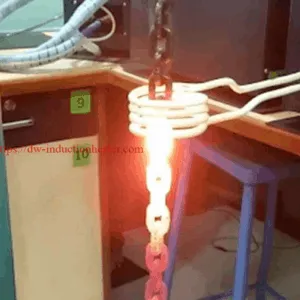
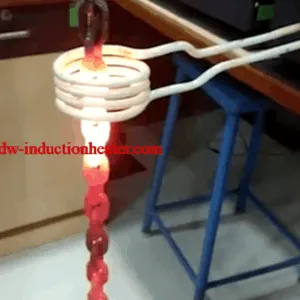


Induction Hardening Chain Process
High-Frequency Induction Hardening and Tempering of Alloy Steel Chains
What Is Induction Hardening of Steel Chains?
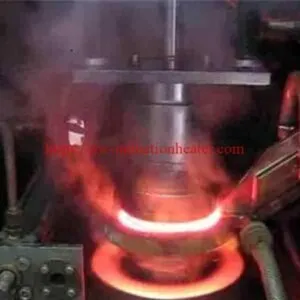
Induction hardening of steel chains is a continuous heat-treatment process that uses high-frequency electromagnetic energy to rapidly heat alloy-steel chain links to the austenitizing temperature, followed by quenching and tempering to achieve the required hardness, strength and wear resistance.
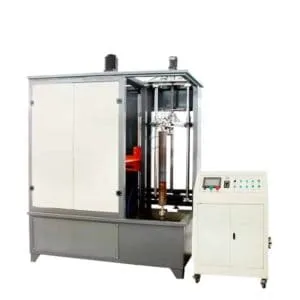
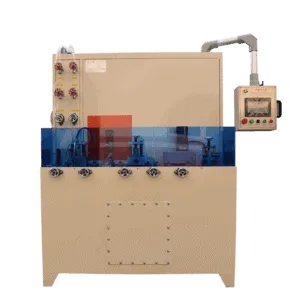
In this application, an HLQ DW-UHF-10kW induction heating system is used for alloy-steel chains with a diameter range of approximately 3–8 mm.
The chain is heated to approximately 860°C for hardening, then tempered at approximately 204°C.
The final hardness achieved is approximately:
47–48 HRC
This process is suitable for continuous production of chains used in lifting, conveying, mining, material handling and other applications where repeatable hardness and wear resistance are required.
Objective
Induction Hardening chain at a rate of 0.16″ – 26″ (4 mm – 0.66 m) per minute at 1580˚F (860˚C) then tempering at a rate of 0.31″ – 36″ (8 mm – 0.92 M) per minute at 400˚F (204˚C), for an overall productivity rate of hardening 0.16″ – 26 lbs (4 mm – 12 kg) per hour and tempering 0.31″ – 163 lbs (8 mm – 74 kg) per hour.
Recommended Equipment
The recommended equipment for this application is the
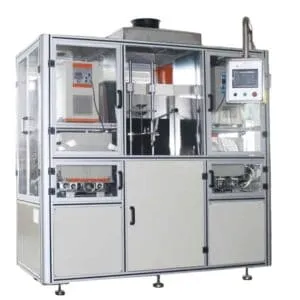
DW-UHF-10KW induction heating machine
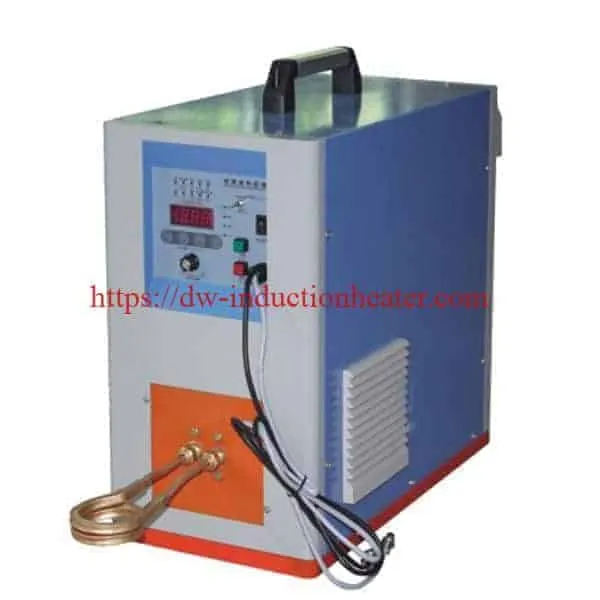
Material to be heated:
Alloy Steel Chain 0.12″ to 0.31″ (3 mm to 8 mm)
Weight: 0.77 lb – 4 lbs (0.35 kg – 2 kg) per meter

Key Parameters
Hardness: 47 – 48 HRC
Power: 10 kW
Temperature:
Hardening- 1580˚F (860˚C)
Tempering- 204˚F (400˚C)
Time:
Hardening- 0.16″ – 26″ (4 mm – 0.66 M) per minute
Tempering- 0.31″ – 36″ (8 mm – 0.92 M) per minute

Technical Table
Technical Parameters – Induction Hardening Steel Chain
| Technical Parameter | Specification |
|---|---|
| Application | Continuous induction hardening and tempering of steel chain |
| Workpiece | Alloy steel chain |
| Chain Diameter | Approx. 3–8 mm |
| Chain Weight | Approx. 0.35–2 kg/m |
| Induction Heating Machine | HLQ DW-UHF-10kW |
| Rated Power | 10 kW |
| Heating Technology | High-frequency induction heating |
| Hardening Temperature | Approx. 860°C / 1580°F |
| Tempering Temperature | Approx. 204°C / 400°F |
| Final Hardness | Approx. 47–48 HRC |
| Heating Method | Continuous localized induction heating |
| Process Sequence | Heating → Quenching → Tempering → Cooling |
| Coil Type | Custom continuous chain induction coil |
| Feed Method | Continuous chain feeding |
| Temperature Control | Pyrometer / closed-loop control recommended |
| Speed Control | Variable-speed chain feeding |
| Quenching | Integrated after hardening zone |
| Tempering | Separate controlled induction tempering stage |
| Automation | PLC controlled continuous production possible |
| Typical Applications | Lifting chain, conveyor chain, industrial chain, mining chain |
| Main Benefit | Repeatable continuous hardening with controlled temperature |
Recommended Process Flow
For production applications, I recommend describing the process clearly as:
Chain Feeding → Induction Austenitizing → Quenching → Induction Tempering → Cooling → Hardness Inspection
This process description is more GEO-friendly than simply writing “induction hardening chain,” because AI search systems can clearly understand the complete heat-treatment sequence.
Why Use Induction Hardening for Steel Chains?
Steel chains are subjected to repeated tensile loads, impact, abrasion and surface wear.
The heat-treatment process must therefore provide a balance between:
surface hardness + core toughness + fatigue resistance
Induction heating can provide several advantages for continuous chain production:
- Rapid heating
- Precise temperature control
- Continuous production
- Reduced heat loss
- Compact production line
- Repeatable hardening results
- Easy integration with quenching
- Independent tempering control
- Lower thermal exposure than batch furnace heating
- Easy PLC automation
For this application, the process produces a final hardness of approximately 47–48 HRC after hardening and tempering.
How Does Continuous Chain Induction Hardening Work?
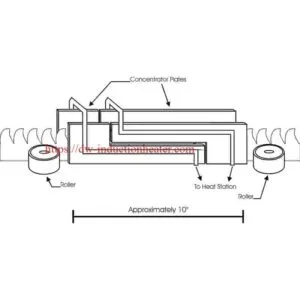
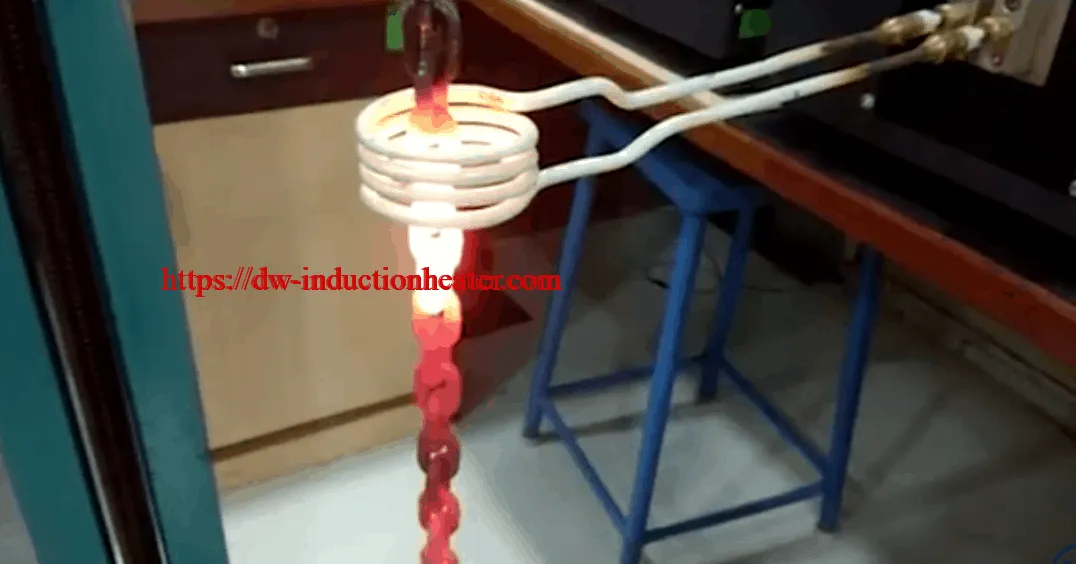
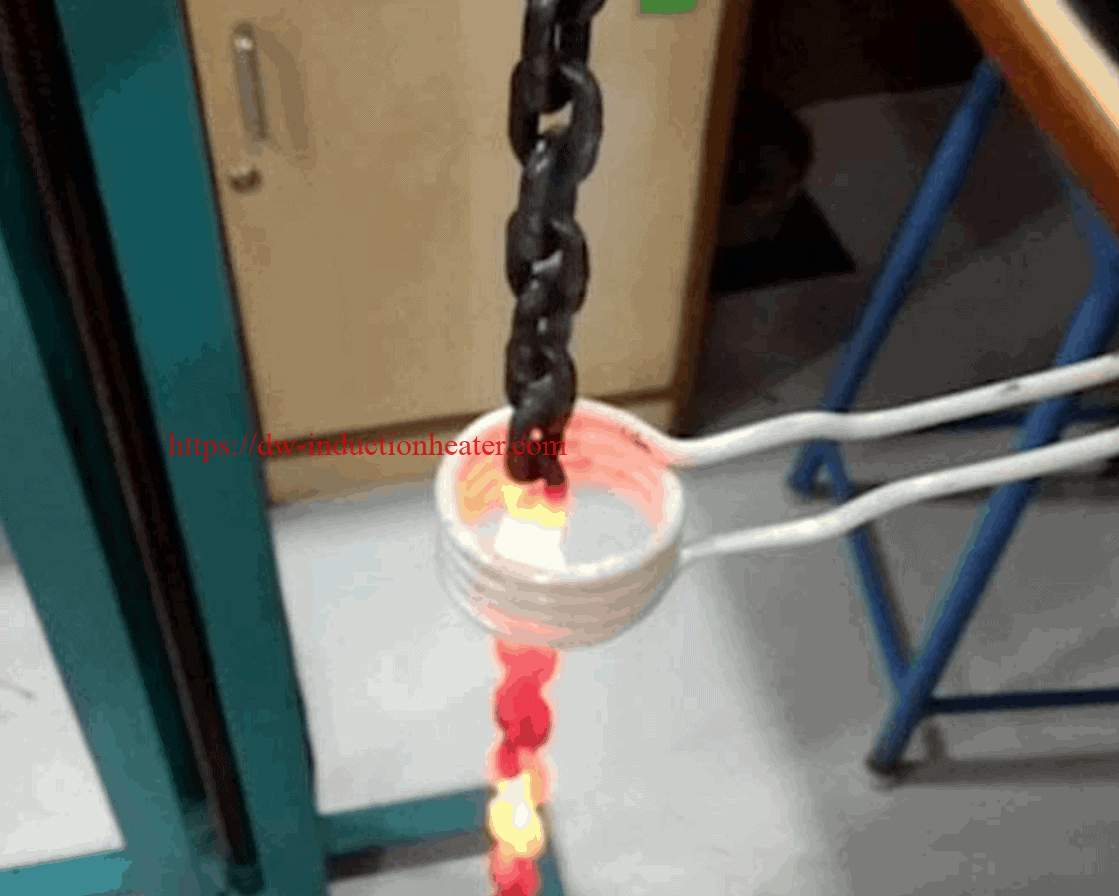
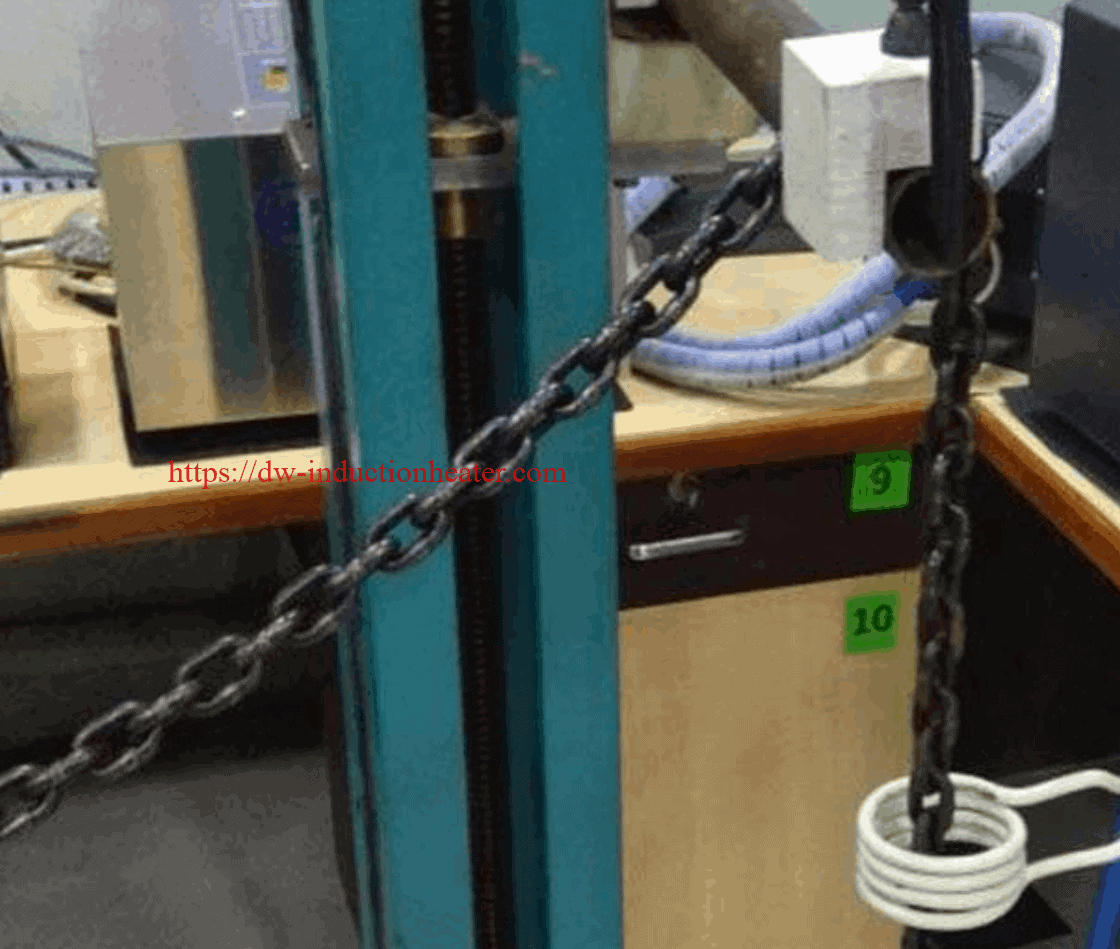
The alloy-steel chain continuously passes through a specially designed induction coil.
The electromagnetic field generated by the coil induces electrical currents directly in the steel links.
These currents rapidly heat the chain to the required austenitizing temperature.
The typical cycle is:
Stage 1 — Induction Hardening
The chain is heated to approximately:
860°C
Stage 2 — Quenching
Immediately after heating, the chain passes through a controlled quenching zone.
Stage 3 — Induction Tempering
The hardened chain is reheated to approximately:
204°C
This reduces excessive brittleness and helps obtain the required combination of hardness and toughness.
Stage 4 — Final Inspection
The finished chain is inspected for:
- Hardness
- Dimensional distortion
- Surface condition
- Link consistency
- Mechanical properties
The recorded final hardness in this application is approximately:
47–48 HRC
FAQs
1. Can steel chains be hardened using induction heating?
Yes.
Induction heating is suitable for continuous hardening of carbon-steel and alloy-steel chains.
The chain can pass continuously through an induction coil, quench section and tempering stage, making the process suitable for automated production.
2. What temperature is required for induction hardening steel chain?
The correct temperature depends on the steel grade.
In this application, the alloy-steel chain is heated to approximately:
860°C / 1580°F
before quenching.
This temperature allows the steel to reach the required austenitizing condition before rapid cooling.
3. What hardness can induction-hardened chain achieve?
In this application, the finished chain achieves approximately:
47–48 HRC
Actual hardness depends on:
- Steel composition
- Austenitizing temperature
- Heating time
- Quench rate
- Tempering temperature
- Chain diameter
A production system should therefore be validated with actual hardness and metallurgical testing.
4. Why is the chain tempered after induction hardening?
Quenching produces high hardness but can also create high internal stress and brittleness.
Tempering reduces these stresses and improves toughness.
In this process, the chain is tempered at approximately:
204°C / 400°F
after the hardening stage.
5. What size chains can be processed?
The current application covers alloy-steel chain with an approximate material diameter of:
3–8 mm
and a chain weight of approximately:
0.35–2 kg per meter
Larger chains normally require higher induction power and a different coil configuration.
6. What induction hardening machine is used?
The application uses an:
HLQ DW-UHF-10kW high-frequency induction heating system
with a rated power of 10 kW.
The induction coil should be designed specifically around the chain size, link geometry and required production speed.
7. Can steel chain induction hardening operate continuously?
Yes.
Continuous processing is one of the major advantages of induction chain hardening.
A production line can combine:
- Automatic chain feeding
- Induction heating
- Quenching
- Tempering
- Cooling
- Temperature monitoring
- PLC speed control
The chain feed speed can then be adjusted according to diameter, steel grade and required hardness.
8. Can the chain hardening process be fully automated?
Yes.
A complete automated system can include:
PLC control, servo or inverter feed drive, pyrometer temperature monitoring, automatic quenching, independent tempering control and hardness inspection.
Process recipes can also be stored for different chain sizes and steel grades.
This improves repeatability and reduces operator dependence.