Induction Annealing of Magnetic Steel Strips
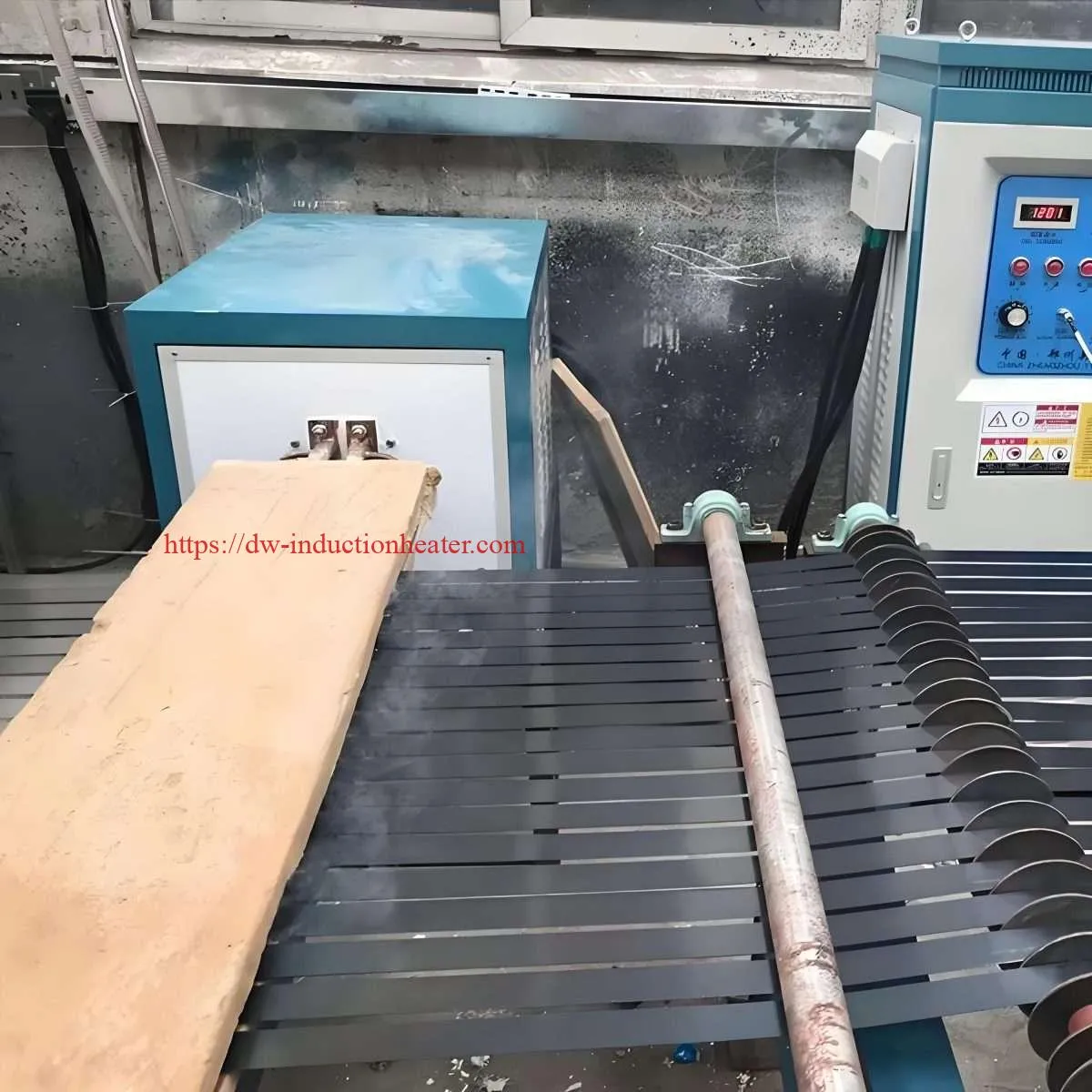
Annealing a Magnetic Steel Strip with a DW-UHF-10KW Induction Heater at 250 kHz
Objective:
To heat magnetic steel strips to 1,400 °F (760 °C).
The strip has to come up to a defined anneal temperature quickly, and it has to come up to it the same way every time, because the strip then continues through the production line. A furnace is not practical for the job: the part is small, the heat-up has to be fast, and the furnace occupies more space than the cell can give it. Induction heating solves all three, because the heat is generated inside the strip itself rather than transferred to it from an external source.
The wider equipment range for this class of work is covered by HLQ’s ultrahigh frequency induction heating series, and the published method for this class of heat treatment is set out under induction annealing heating treatment equipment.
 Technical Parameters

| Parameter | Specification |
|---|---|
| End Product | Steel strips |
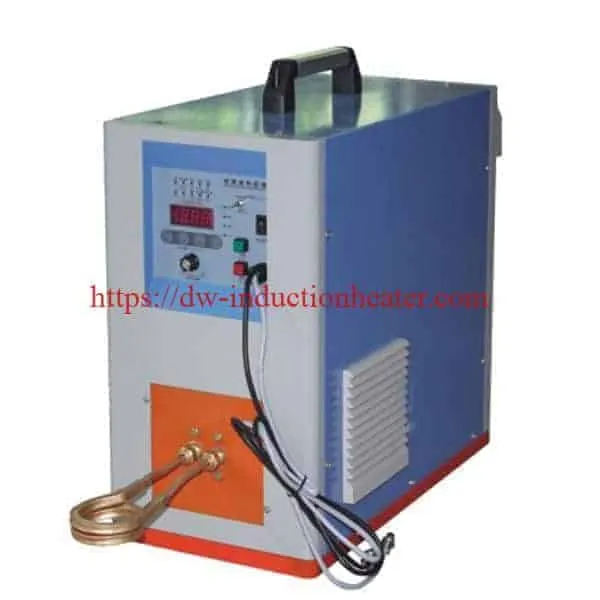
| Equipment | DW-UHF-10KW Induction Heater, with a workhead and a coil specifically designed for this application |
| Materials | Magnetic steel |
| Temperature | 1400 °F (760 °C) |
| Frequency | 250 kHz |
The published specification of the DW-UHF-10KW induction heater is reproduced below as published by the manufacturer.
| Technical parameter | Specification |
|---|---|
| Product name | Induction Saw Blade Hardening Machine |
| Manufacturer | HLQ Induction Equipment Co., Ltd. |
| Model | DW-UHF-10KW |
| Heating technology | Ultra-high-frequency induction heating |
| Rated output power | 10 kW |
| Available frequency options | 50–300 kHz or 100–500 kHz |
| Input voltage | 380 V ±10% |
| Input power supply | Three-phase AC |
| Input frequency | 50/60 Hz |
| Input current | 3–15 A (published specification; to be confirmed) |
| Power electronics | IGBT inverter technology |
| Operating modes | Constant current / constant power |
| Rated duty cycle | 100% (subject to specified cooling conditions) |
| Main unit dimensions | 570 × 260 × 500 mm |
| Main unit weight | Approximately 30 kg |
| Heating method | Electromagnetic induction |
| Temperature control | Application-dependent; optional monitoring and control configuration |
| Induction coil | Customized for the workpiece geometry |
| Primary applications | Selective and localized heating of steel components |
| Installation | Industrial workshop / production line |
| Automation | Customized integration available |
Testing:
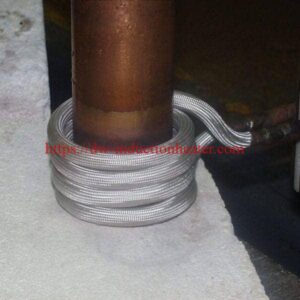
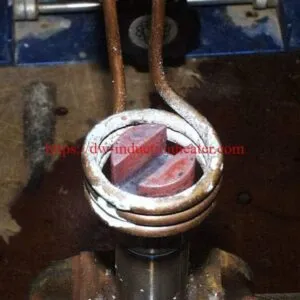
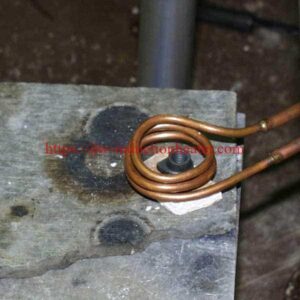
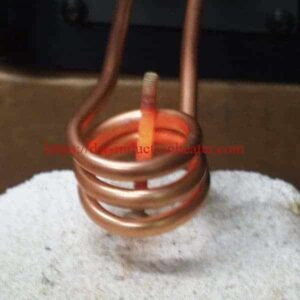
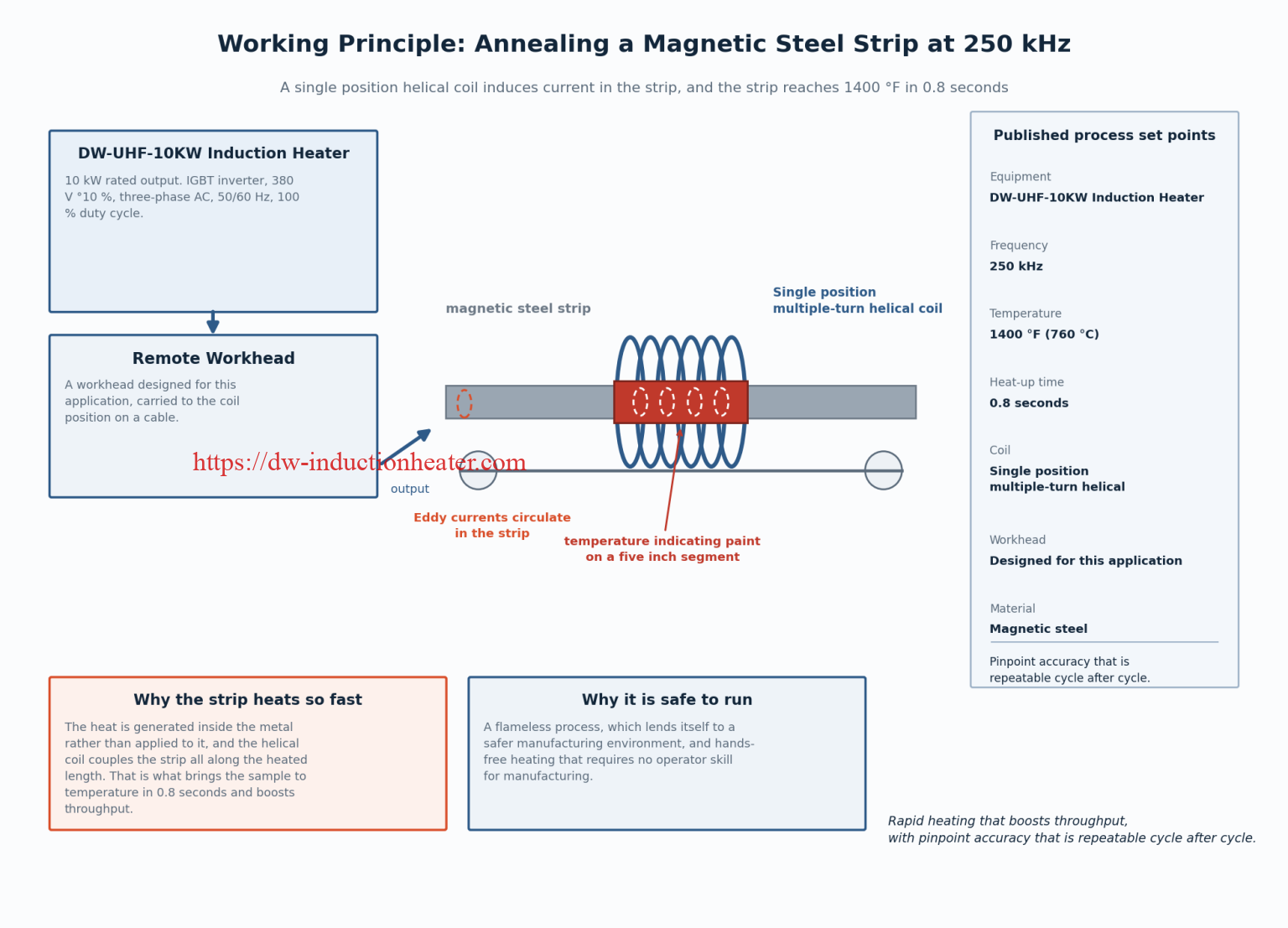
A custom-designed single position multiple-turn helical coil was built to generate the required heating for this annealing application. Initial tests were conducted to optimize the power delivered to the part. Temperature indicating paint was then applied to a five-inch segment along the part, which dissolves when the part reaches target temperature. It took 0.8 seconds to heat the sample to temperature, which met the client’s goal.

The coil is the part of this application that had to be designed rather than selected. A single position, multiple-turn helical geometry was chosen so that the magnetic field couples to the strip over the full width of the heated length, and the number of turns sets how much of the strip is covered at once. Because the workhead and the coil are designed for this application as a matched pair, the coupling is the same on every strip, and that is where the published repeatability comes from.
Magnetic steel is the reason this application responds so quickly to a high-frequency field. The magnetic properties of the material are part of what determines how the induced current distributes, and at 250 kHz the heating is concentrated in the strip rather than spread away from it. The result is that a five inch segment reaches 1400 °F in 0.8 seconds, with the heat confined to the length of strip inside the coil and no flame anywhere near the part.
The temperature indicating paint method is worth noting on its own. It gives an unambiguous visual confirmation that the part reached the target temperature, because the paint dissolves when the temperature is reached, and it removes the need for a contact thermocouple on a part that is moving through the cell. The standard coil range is covered by the published induction heating coils category, with this application-specific helical design sitting alongside it.


The five controlled stages that take a strip from coil design to a verified anneal are set out below. Stage 4 is where the result is decided, because it is the stage in which the strip has to reach 1400 °F within the cycle time.
- Coil design. A custom-designed single position multiple-turn helical coil is built to generate the required heating for this annealing application.
- Initial tests. Initial tests are conducted to optimize the power delivered to the part.
- Paint application. Temperature indicating paint is applied to a five-inch segment along the part; it dissolves when the part reaches target temperature.
- Heating. Power is applied at 250 kHz and the strip reaches 1400 °F (760 °C) in 0.8 seconds.
- Verification. The paint dissolves, confirming that the part reached target temperature and that the client’s goal was met.
The common problems specific to this application, and the process control that answers each one, are set out below.
| Problem | Possible cause | Recommended solution |
|---|---|---|
| Slow heating | Poor coil coupling, insufficient useful power, or excessive heated mass | Verify loaded power, coil design and the heating cycle |
| Uneven heating | Incorrect coil geometry or workpiece positioning | Review field distribution and fixture alignment |
| Surface overheating | Excessive local power density or insufficient thermal equalization time | Review heating power, frequency and duration |
| Insufficient core temperature | Inadequate heating duration or unsuitable frequency | Validate cross-sectional temperature and consider alternative frequency selection |
| Temperature not reached on every part | Power not optimized for the part, or the coil coupling varying with strip position | Initial tests conducted to optimize the power delivered to the part, with the coil and workhead fixed as a matched pair |
| Oxidation on the strip | Heat applied from an external source in an open atmosphere | A flameless process with the heat generated inside the metal |
| Cycle time too long for the line | Heat transferred through a furnace rather than generated in the part | Rapid heating that boosts throughput, with the strip at temperature in 0.8 seconds |
| Cooling water alarm | Insufficient flow, blockage or excessive temperature | Stop heating and inspect the cooling circuit |
For the wider family of heat treatment equipment and the published reference cases, HLQ’s custom induction heating applications route covers the coil design and application work that goes into a purpose-built solution for a specific product.
Benefits:
| Benefit | Published outcome |
|---|---|
| Rapid heating | That boosts throughput; the strip reaches 1400 °F in 0.8 seconds |
| Hands-free heating | That requires no operator skill for manufacturing |
| Flameless process | Which lends itself to a safer manufacturing environment |
| Pinpoint accuracy | That is repeatable cycle after cycle |
summary
The DW-UHF-10KW Induction Heater at 250 kHz, with a workhead and a custom-designed single position multiple-turn helical coil built for this application, anneals magnetic steel strip to 1400 °F (760 °C) in 0.8 seconds per part.
The decisive factor is that the heat is generated inside the strip rather than applied to it from outside. There is no flame in the cell and no furnace to heat up, so the cell is safe to run and quick to cycle; the heat stays confined to the length of strip inside the coil; and because the coil geometry and the workhead are fixed, the same result is obtained on every strip.
| Parameter | Value |
|---|---|
| End product | Steel strips |
| Equipment | DW-UHF-10KW Induction Heater |
| Workhead | Designed for this application |
| Coil | Custom-designed single position multiple-turn helical coil |
| Frequency | 250 kHz |
| Temperature | 1400 °F (760 °C) |
| Material | Magnetic steel |
| Heat-up time | 0.8 seconds |
| Verification method | Temperature indicating paint on a five inch segment, which dissolves at target temperature |
| Production rate | Rapid heating that boosts throughput |
For the wider equipment range, HLQ’s induction heating PDF carries the full machine catalogue, and the general principles of the process are set out under why use induction annealing.