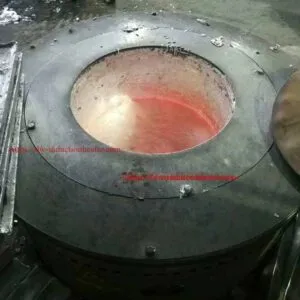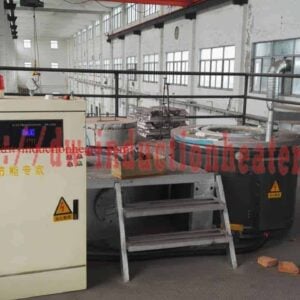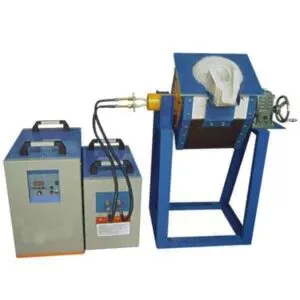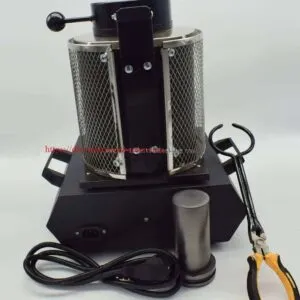


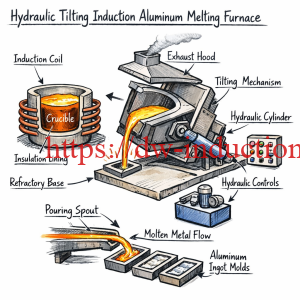

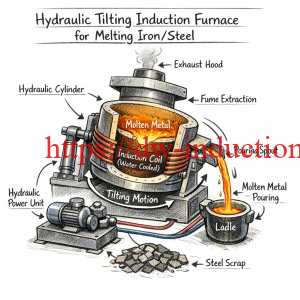

Hydraulic Tilting Induction Furnace for Melting Steel, Copper, Brass and Aluminum
Hydraulic Tilting Induction Furnace for Melting Iron, Steel, Copper, Brass, Aluminum and Other Metals
Table of Contents
- Introduction
- What Is a Hydraulic Tilting Induction Furnace?
- Working Principle of Induction Melting
- Main Structure of the Furnace System
- Suitable Metals and Alloys
- Applications in Foundry and Metal Recycling
- Advantages of Hydraulic Tilting Induction Furnaces
- Melting Iron and Steel
- Melting Copper and Copper Alloys
- Melting Brass
- Melting Aluminum and Aluminum Alloys
- Typical Technical Parameters
- How to Choose the Right Furnace Capacity
- Operation Process
- Safety and Maintenance
- Conclusion
- Frequently Asked Questions
1. Introduction
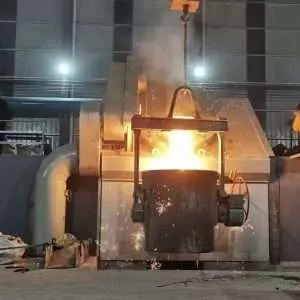
A hydraulic tilting induction furnace is one of the most widely used electric induction melting systems in modern foundries, metal recycling plants, precision casting workshops and alloy production facilities. It is designed to melt a wide range of metals, including iron, carbon steel, stainless steel, copper, brass, bronze, aluminum, zinc alloys, nickel alloys and other ferrous or non-ferrous metals.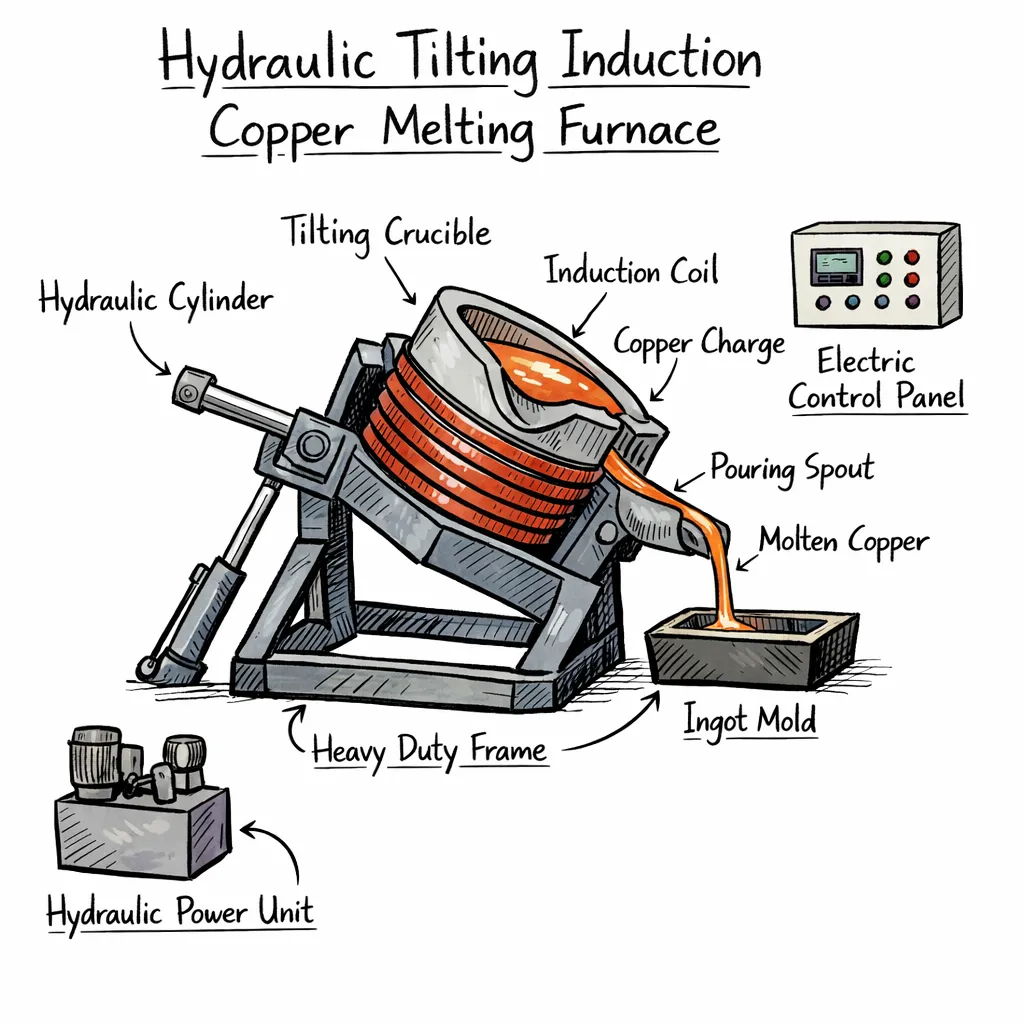
Compared with traditional fuel-fired furnaces, an induction melting furnace offers faster heating, higher thermal efficiency, better temperature control, cleaner working conditions and easier automation. The hydraulic tilting structure allows the operator to pour molten metal smoothly, safely and accurately into molds, ladles or casting systems.
For manufacturers that need flexible melting of different metals, the hydraulic tilting induction furnace is an ideal choice. It can be used for small-batch production, continuous foundry operation, metal recycling, alloy development and customized casting production.
2. What Is a Hydraulic Tilting Induction Furnace?
A hydraulic tilting induction furnace is an electric melting furnace that uses electromagnetic induction to heat and melt metal inside a crucible. The furnace body is mounted on a tilting frame and controlled by a hydraulic cylinder. After the metal is fully melted, the furnace can be tilted forward to pour molten metal into a mold or ladle.
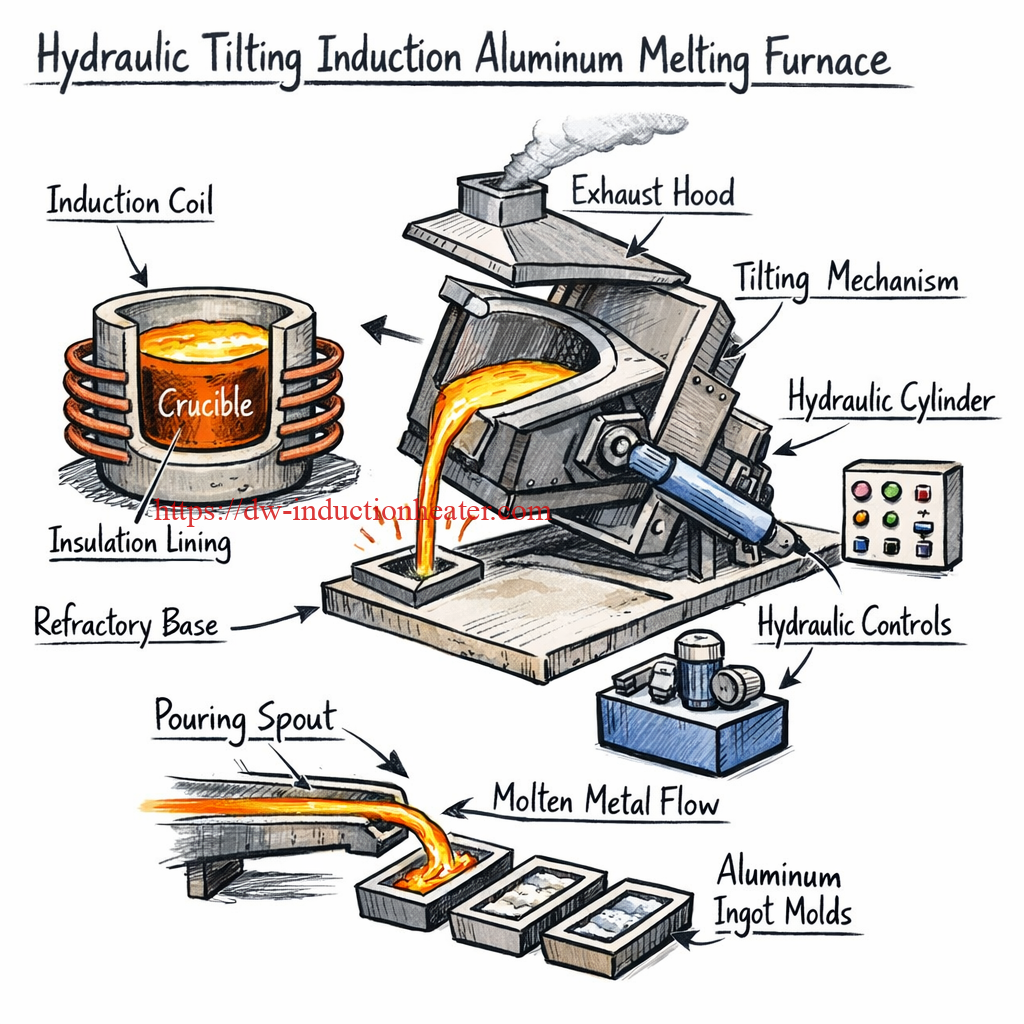
The system usually includes:
| Main Part | Function |
|---|---|
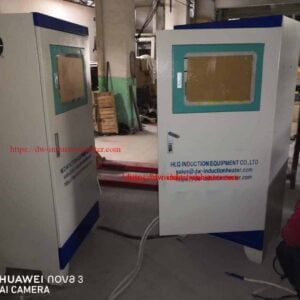
| Induction power supply | Converts grid power into medium-frequency or high-frequency current |
| Induction coil | Generates the electromagnetic field for heating |
| Crucible | Holds the metal charge during melting |
| Furnace body | Supports the coil, lining and crucible structure |
| Hydraulic tilting system | Controls furnace pouring angle |
| Cooling system | Cools the induction coil and power supply |
| Control cabinet | Controls power, temperature, alarms and operating status |
| Temperature measuring system | Monitors molten metal temperature |
| Safety protection system | Protects against overcurrent, overheating, water failure and leakage |
The furnace is especially suitable for foundries that require safe and stable pouring. Instead of manually lifting crucibles or using unstable mechanical pouring methods, the hydraulic tilting system provides controlled and smooth discharge of molten metal.
3. Working Principle of Induction Melting
The core principle of the hydraulic tilting induction furnace is electromagnetic induction heating.
When medium-frequency alternating current passes through the copper induction coil, it creates an alternating magnetic field. The metal charge placed inside the crucible is affected by this magnetic field, generating eddy currents inside the metal. These eddy currents produce heat because of the electrical resistance of the metal. As the temperature rises, the metal gradually melts.
The process can be summarized as:
Electric power → Induction power supply → Induction coil → Magnetic field → Eddy current in metal → Heat generation → Metal melting
 Because heat is generated directly inside the metal, induction melting is highly efficient. The molten metal also experiences electromagnetic stirring, which helps improve temperature uniformity and alloy composition consistency.
4. Main Structure of the Furnace System
4.1 Induction Power Supply
The power supply is the heart of the furnace. It converts industrial three-phase electricity into medium-frequency current. Common induction melting power supplies include:
| Power Supply Type | Features |
|---|---|
| IGBT medium-frequency power supply | High efficiency, stable control, suitable for small and medium furnaces |
| SCR/KGPS power supply | Mature technology, suitable for large melting capacity |
| Digital induction power supply | Better control, monitoring and protection |
| Dual-output power supply | One power supply can serve two furnace bodies alternately |
For industrial melting, medium-frequency systems are commonly used because they provide strong penetration and fast melting for both ferrous and non-ferrous metals.
4.2 Furnace Body
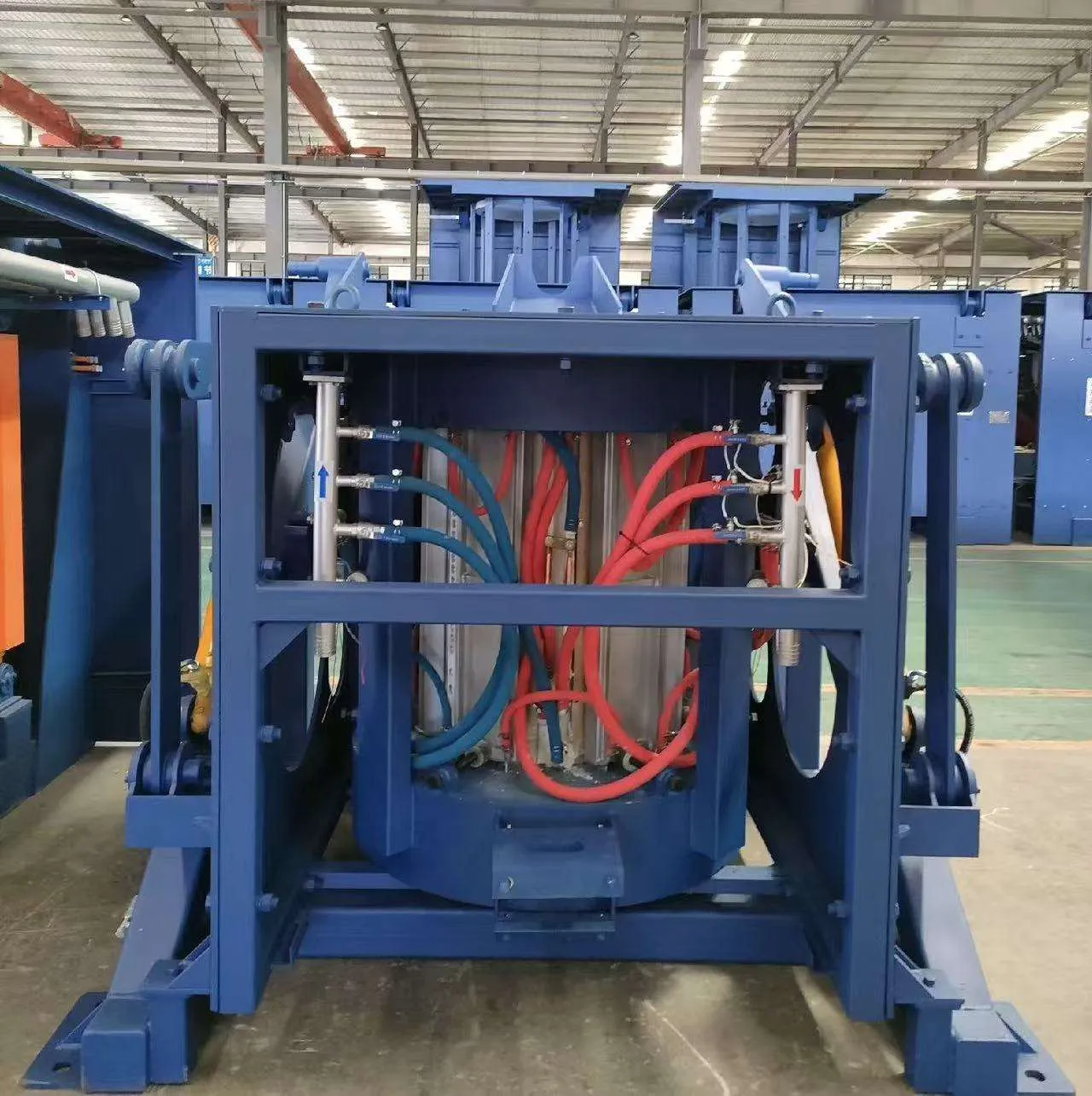
The furnace body contains the induction coil, insulation layer, magnetic yoke, crucible and refractory lining. It must withstand high temperature, repeated heating and cooling, mechanical tilting and molten metal pressure.
4.3 Crucible and Refractory Lining
The crucible or furnace lining material must be selected according to the metal being melted.
| Metal | Recommended Lining Type |
|---|---|
| Iron and steel | Acidic, neutral or basic refractory lining |
| Stainless steel | Neutral or basic lining |
| Copper and brass | Graphite, silicon carbide or special refractory lining |
| Aluminum | High-alumina or non-wetting refractory lining |
| Zinc alloy | Low-temperature compatible refractory lining |
Choosing the correct lining is very important for furnace life, melt purity and safety.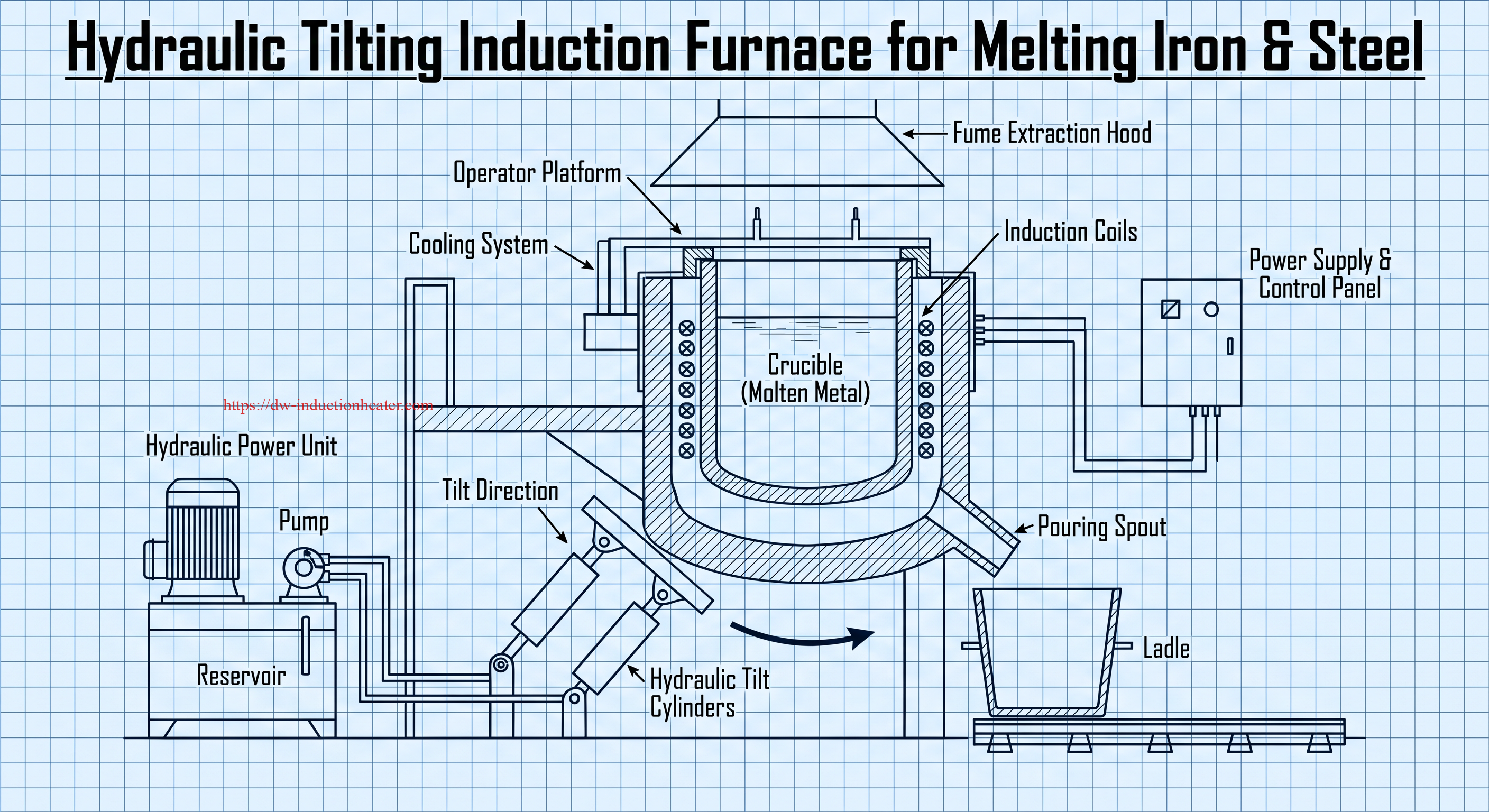
4.4 Hydraulic Tilting System
The hydraulic tilting system includes hydraulic pump, oil cylinder, control valve, oil tank and tilting frame. It allows the furnace to tilt smoothly and return safely.
| Feature | Benefit |
|---|---|
| Smooth tilting | Reduces splashing and improves pouring accuracy |
| Adjustable angle | Suitable for different molds or ladles |
| Strong load capacity | Supports heavy furnace bodies and molten metal |
| Easy operation | Operator can control pouring safely |
| Emergency return | Improves safety during abnormal conditions |
4.5 Cooling System
The induction coil and power supply require water cooling. For stable operation, the cooling water system must provide correct pressure, flow rate and temperature.
| Cooling Method | Application |
|---|---|
| Open water cooling | Simple system, lower initial cost |
| Closed-loop cooling tower | Better water quality and stable cooling |
| Industrial chiller | Suitable for precise temperature control |
| Soft water circulation | Protects coil and power electronics from scaling |
5. Suitable Metals and Alloys
A hydraulic tilting induction furnace can melt many metals, but different metals require different furnace designs, power levels, crucibles, linings and temperature control strategies.
| Metal Type | Typical Melting Temperature | Furnace Suitability |
|---|---|---|
| Cast iron | 1150–1250°C | Very suitable |
| Carbon steel | 1450–1550°C | Very suitable |
| Stainless steel | 1450–1600°C | Very suitable |
| Copper | 1083°C | Very suitable |
| Brass | 900–1050°C depending on alloy | Suitable with fume control |
| Bronze | 950–1100°C | Very suitable |
| Aluminum | 660°C | Very suitable |
| Zinc alloy | 380–420°C | Suitable for low-temperature design |
| Nickel alloy | 1300–1450°C | Suitable with proper lining |
| Precious metals | Varies | Suitable for small precision furnaces |
For best performance, one furnace should preferably be optimized for a specific metal family. For example, a furnace designed for steel melting may not use the same crucible and lining as a furnace designed for aluminum melting.
6. Applications in Foundry and Metal Recycling
Hydraulic tilting induction furnaces are widely used in:
| Industry | Application |
|---|---|
| Steel foundry | Melting steel scrap, carbon steel, alloy steel |
| Cast iron foundry | Melting gray iron, ductile iron, cast iron scrap |
| Copper processing | Melting copper, bronze, copper scrap |
| Brass recycling | Melting brass valves, brass chips, brass fittings |
| Aluminum casting | Melting aluminum ingots, cans, profiles and scrap |
| Automotive parts | Casting engine parts, brackets, gears and housings |
| Hardware manufacturing | Producing tools, fittings and machine parts |
| Art casting | Bronze sculptures, aluminum artworks |
| Laboratory metallurgy | Alloy development and test melting |
| Metal recycling | Recovering valuable metals from scrap |
Because induction furnaces are electric, compact and easy to control, they are very suitable for both industrial production and customized small-batch manufacturing.
7. Advantages of Hydraulic Tilting Induction Furnaces
7.1 Fast Melting Speed
Induction heating generates heat directly inside the metal, so melting is faster than many resistance or fuel-fired methods.
7.2 High Energy Efficiency
The energy conversion efficiency is high because there is no flame, no combustion loss and less heat waste. This helps reduce production cost.
7.3 Clean and Environmentally Friendly
The furnace does not require coke, coal, oil or gas combustion. It reduces smoke, dust and combustion emissions.
7.4 Accurate Temperature Control
The operator can adjust power output and monitor temperature. This is important for alloy quality, casting consistency and metallurgical control.
7.5 Good Molten Metal Quality
Electromagnetic stirring helps improve temperature distribution and alloy uniformity. The sealed or semi-closed melting environment can also reduce contamination.
7.6 Safe Pouring
The hydraulic tilting system provides controlled pouring, reducing the risk of manual handling accidents.
7.7 Suitable for Many Metals
One of the biggest advantages is flexibility. With suitable lining, crucible and power configuration, the furnace can melt ferrous and non-ferrous metals.
8. Melting Iron and Steel
For iron and steel melting, the furnace requires higher power and stronger refractory lining because the melting temperature is much higher than aluminum or brass.
Typical materials include:
| Material | Examples |
|---|---|
| Cast iron | Gray iron, ductile iron, chilled cast iron |
| Carbon steel | Low carbon steel, medium carbon steel, high carbon steel |
| Alloy steel | Tool steel, manganese steel, chromium steel |
| Stainless steel | 304, 316, 410, 430 stainless steel |
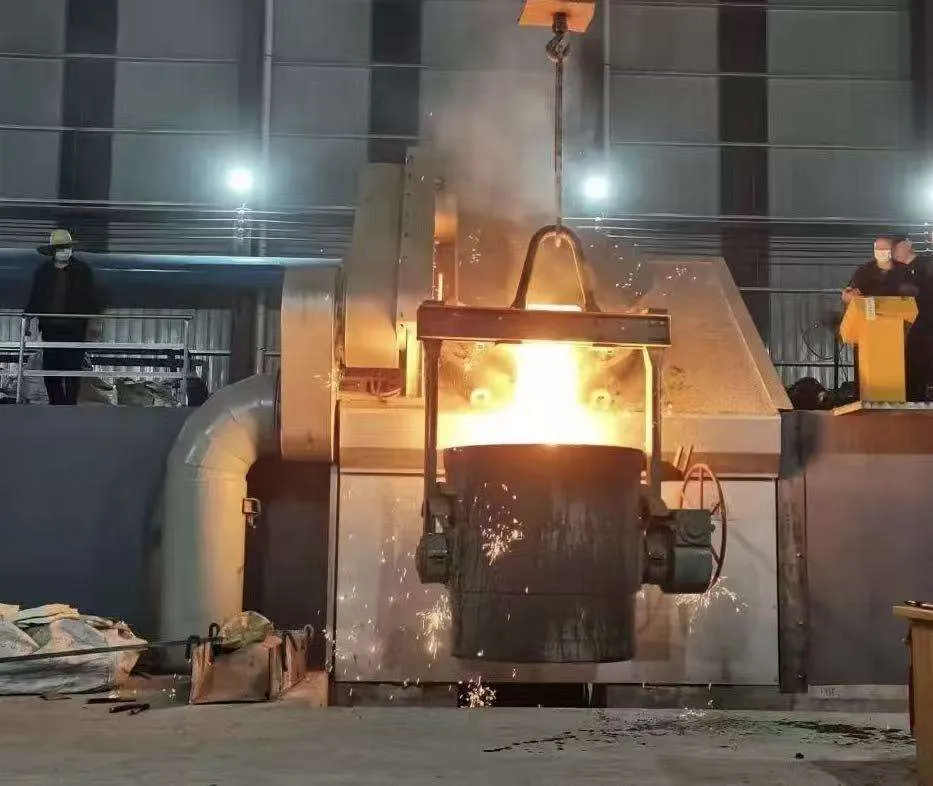
For steel melting, temperature can reach around 1500–1600°C. The induction furnace must have reliable cooling, strong insulation, high-temperature refractory lining and accurate temperature monitoring.
Common applications include:
- Steel casting
- Machine part casting
- Valve and pump body casting
- Gear blank production
- Iron scrap recycling
- Stainless steel remelting
- Alloy steel production


9. Melting Copper and Copper Alloys
Copper has excellent electrical and thermal conductivity, so furnace design must consider fast heat transfer and oxidation control. Copper melts at around 1083°C, and induction melting is widely used for copper processing.
| Suitable Copper Material | Application |
|---|---|
| Pure copper | Electrical parts, copper ingots, copper billets |
| Bronze | Bearings, bushings, sculptures, marine hardware |
| Brass | Valves, fittings, decorative parts |
| Copper scrap | Recycling and remelting |
| Copper wire scrap | Recovery and ingot production |
For copper melting, graphite crucibles and proper atmosphere control can help reduce oxidation. The pouring process should be stable to avoid excessive turbulence and oxide inclusion.
10. Melting Brass
Brass is an alloy of copper and zinc. It is commonly used in valves, faucets, plumbing fittings, decorative hardware, electrical components and precision parts.
When melting brass, the main concern is zinc evaporation. Zinc has a much lower boiling point than copper, so if the brass is overheated, zinc loss may occur. This can change the alloy composition and create zinc oxide fumes.
| Requirement | Recommendation |
|---|---|
| Temperature control | Avoid overheating |
| Fume control | Use ventilation and dust/fume collection |
| Melting speed | Fast melting reduces zinc loss |
| Flux use | Use suitable flux if required |
| Pouring | Smooth hydraulic tilting reduces oxidation |
| Alloy correction | Check composition and add zinc/copper if needed |
A hydraulic tilting induction furnace is suitable for brass melting because it offers fast heating and controlled pouring. However, it should be equipped with good fume extraction, especially for brass scrap recycling.
11. Melting Aluminum and Aluminum Alloys
Aluminum melts at about 660°C, much lower than iron, steel or copper. Therefore, an aluminum induction melting furnace usually requires lower temperature but careful oxidation control.
| Aluminum Material | Examples |
|---|---|
| Aluminum ingots | Standard casting feedstock |
| Aluminum cans | Recycling material |
| Aluminum profiles | Extrusion scrap |
| Aluminum chips | Machining waste |
| Aluminum alloy scrap | Wheels, engine parts, structural parts |
Aluminum melting advantages with induction furnace include:
- Fast melting
- Low oxidation compared with open flame heating
- Accurate temperature control
- Good for recycling aluminum scrap
- Compact equipment layout
- Clean workshop environment
For aluminum melting, the furnace lining should have good resistance to aluminum penetration. Non-wetting refractory material is recommended to extend furnace life.
12. Typical Technical Parameters
Below is a general reference table for hydraulic tilting induction furnaces. Actual parameters should be customized according to metal type, melting capacity, production rhythm and power supply conditions.
| Furnace Capacity | Recommended Power | Suitable Metals | Approx. Melting Time per Batch | Typical Application |
|---|---|---|---|---|
| 50 kg | 30–80 kW | Aluminum, copper, brass, small steel batch | 20–60 min | Lab, small casting |
| 100 kg | 60–120 kW | Aluminum, copper, brass, iron | 30–70 min | Small foundry |
| 250 kg | 120–250 kW | Steel, iron, copper, aluminum | 40–90 min | Medium casting |
| 500 kg | 250–500 kW | Steel, cast iron, copper alloys | 45–100 min | Industrial foundry |
| 1000 kg | 500–1000 kW | Steel, iron, copper, brass, aluminum | 60–120 min | Large production |
| 2000 kg | 1000–1600 kW | Steel, iron, copper alloys | 90–150 min | Heavy foundry |
| 3000 kg | 1500–2500 kW | Steel, iron, copper, aluminum | 100–180 min | High-capacity melting |
Reference Configuration Table
| Item | Small Furnace | Medium Furnace | Large Furnace |
|---|---|---|---|
| Capacity | 50–250 kg | 500–1000 kg | 2000–3000 kg or more |
| Power supply | IGBT / medium frequency | IGBT or SCR | SCR / high-power MF |
| Tilting type | Hydraulic tilting | Hydraulic tilting | Heavy-duty hydraulic tilting |
| Cooling | Water cooling | Closed-loop water cooling | Industrial cooling system |
| Control | Manual or digital | Digital control | PLC automatic control |
| Application | Lab and small foundry | Standard production | Continuous industrial production |

13. How to Choose the Right Furnace Capacity
13.1 Metal Type
Different metals require different power levels. Steel requires more energy than aluminum because of its higher melting point. Copper also requires strong power because of high thermal conductivity.
13.2 Batch Weight
The batch capacity should match the amount of molten metal required for each casting cycle. A furnace that is too small reduces productivity. A furnace that is too large wastes energy for small batches.
13.3 Melting Speed
If the production line requires frequent pouring, the furnace should have enough power to complete melting within the required cycle time.
13.4 Furnace Lining
| Metal | Lining Selection |
|---|---|
| Steel | High-temperature refractory lining |
| Cast iron | Acidic or neutral lining |
| Copper | Graphite or special refractory crucible |
| Brass | Fume-resistant and zinc-compatible design |
| Aluminum | Non-wetting aluminum lining |
13.5 Power Supply
The power supply must match local grid voltage, frequency and electrical capacity. It should include protection against overcurrent, overvoltage, water shortage and overheating.
13.6 Pouring Method
If precise pouring is required, hydraulic tilting is preferred. For large foundries, automatic pouring control can also be added.
14. Operation Process
A typical operation process includes:
| Step | Operation |
|---|---|
| 1 | Check power supply, cooling water and hydraulic system |
| 2 | Inspect furnace lining and crucible |
| 3 | Load metal charge into the crucible |
| 4 | Start cooling system |
| 5 | Start induction power supply |
| 6 | Gradually increase power |
| 7 | Melt metal and remove slag if needed |
| 8 | Measure molten metal temperature |
| 9 | Adjust alloy composition if required |
| 10 | Tilt furnace hydraulically and pour molten metal |
| 11 | Return furnace to upright position |
| 12 | Prepare for next melting batch |
For steel and iron, slag removal and temperature control are very important. For brass, avoid overheating to reduce zinc loss. For aluminum, avoid excessive oxidation and dross formation.
15. Safety and Maintenance
15.1 Safety Precautions
Molten metal is extremely dangerous. Operators must follow strict safety procedures.
- Wear heat-resistant protective clothing
- Use face shields, gloves and safety shoes
- Keep water away from molten metal
- Check hydraulic system before pouring
- Ensure cooling water flow is normal
- Use proper fume extraction for brass and zinc-containing alloys
- Avoid overfilling the crucible
- Do not operate with damaged furnace lining
- Install emergency stop and alarm systems
15.2 Furnace Maintenance
Regular maintenance extends furnace life and improves melting efficiency.
| Maintenance Item | Recommended Action |
|---|---|
| Induction coil | Check insulation and water leakage |
| Cooling system | Remove scale and maintain water quality |
| Hydraulic cylinder | Check oil level, seals and pressure |
| Furnace lining | Inspect cracks, erosion and wear |
| Power cabinet | Clean dust and check electrical connections |
| Temperature sensor | Calibrate regularly |
| Tilting frame | Check bolts, bearings and alignment |
A damaged furnace lining can cause molten metal leakage, which is one of the most serious risks in induction melting. Lining inspection must be part of daily operation.
16. Conclusion
A hydraulic tilting induction furnace is a powerful, clean and efficient melting solution for iron, steel, copper, brass, aluminum and many other metals. It combines electromagnetic induction heating with hydraulic pouring control, making it suitable for modern foundries, recycling plants, alloy production workshops and precision casting factories.
Its main advantages include fast melting, high energy efficiency, accurate temperature control, clean operation, flexible metal compatibility and safe pouring. By selecting the correct furnace capacity, power supply, refractory lining, cooling system and hydraulic tilting design, manufacturers can achieve stable production, lower operating cost and better molten metal quality.
For companies working with different metal materials, a hydraulic tilting induction furnace can be one of the most practical and valuable pieces of melting equipment.
17. Frequently Asked Questions
1. Can one hydraulic tilting induction furnace melt steel, copper, brass and aluminum?
Yes, but the furnace lining, crucible and operating temperature must be suitable for each metal. In industrial production, it is better to use dedicated linings or separate furnaces for different metal families to avoid contamination and lining damage.
2. What is the difference between a hydraulic tilting furnace and a fixed induction furnace?
A fixed induction furnace does not tilt, so molten metal must usually be removed by ladle or other transfer method. A hydraulic tilting furnace can pour molten metal directly and smoothly, making it safer and more convenient for casting production.
3. Is induction melting suitable for brass?
Yes. Induction melting is very suitable for brass, but temperature must be carefully controlled because zinc can evaporate if overheated. Good ventilation and fume collection are necessary.
4. What capacity can a hydraulic tilting induction furnace have?
Common capacities range from 50 kg to 3000 kg or more per batch. Small furnaces are used for laboratories and small foundries, while large furnaces are used for industrial casting and metal recycling.
5. Does an induction furnace need water cooling?
Yes. The induction coil and power supply require water cooling. A stable cooling system is essential for safe and continuous operation.
6. What metals are best suited for induction melting?
Induction furnaces can melt cast iron, carbon steel, stainless steel, copper, brass, bronze, aluminum, zinc alloys, nickel alloys and many other metals. The correct furnace design depends on the metal type and melting temperature.
7. Is a hydraulic tilting induction furnace energy efficient?
Yes. Because heat is generated directly inside the metal through electromagnetic induction, energy efficiency is high compared with many traditional fuel-fired furnaces.
8. How do I choose the right power for the furnace?
Power depends on metal type, batch capacity and required melting time. Steel requires higher power than aluminum. For example, a 1000 kg steel furnace may need around 500–1000 kW, while a 1000 kg aluminum furnace may require less power depending on the melting speed requirement.