
Case Study: Induction Brazing for Automotive Aluminum Heat Exchanger Manifolds

- Application
Induction brazing is widely used in the automotive industry to join aluminum heat exchanger manifolds to tubes or headers in components such as:
- Radiators
- Condensers
- Intercoolers
- Oil coolers
- Battery cooling systems for EVs
This process uses high-frequency electromagnetic induction heating to precisely heat the joint area and melt a brazing filler metal without overheating surrounding components.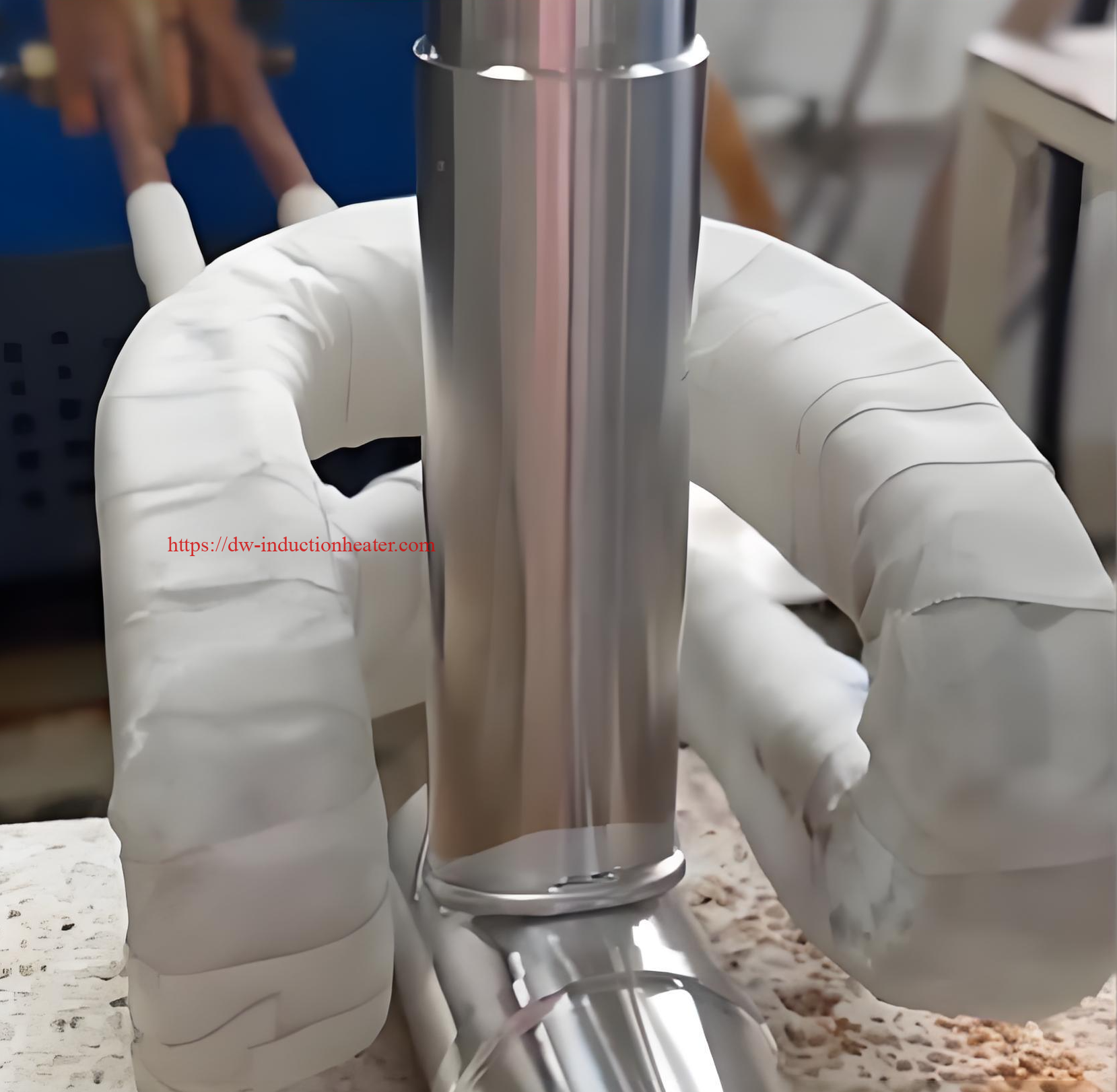
- Objective
The main objectives of implementing induction brazing in the production of aluminum heat exchanger manifolds are:
- Achieve high-strength, leak-proof joints
- Ensure precise localized heating
- Increase production efficiency
- Reduce energy consumption
- Maintain consistent brazing quality
- Enable automation in automotive manufacturing lines
Compared with flame brazing or furnace brazing, induction brazing offers better temperature control and faster cycle times.
- Material with Size
| Component | Material | Size Specification |
| Heat Exchanger Manifold | Aluminum Alloy 3003 / 6061 | Ø25–40 mm |
| Tube/Header | Aluminum Alloy 3003 | Ø8–16 mm |
| Brazing Filler Metal | Aluminum-Silicon (AlSi12) | Ring Ø1.5–2 mm |
| Flux | Non-corrosive aluminum brazing flux | Powder or paste |
Typical joint clearance: 0.05 – 0.15 mm
- Equipment with Power and Frequency
| Parameter | Specification |
| Induction Power Supply | DW-UHF-20 kW |
| Frequency Range | 50 – 150 kHz |
| Induction Coil Type | Custom water-cooled copper coil |
| Heating Time | 5 – 15 seconds |
| Cooling Method | Water Cooled |
The high frequency ensures uniform heating of thin aluminum components while minimizing thermal distortion.
- Industry
- Automotive heat exchanger manufacturing
- Automotive HVAC systems
- Electric vehicle battery cooling systems
- Automotive radiator production lines
Many automotive suppliers integrate induction brazing stations into automated assembly lines.
- Equipment
Typical induction brazing equipment configuration includes:
| Equipment Component | Description |
| Induction Heating Power Supply | Solid-state IGBT power supply |
| Induction Brazing Coil | Custom ” C ” type coil designed for manifold geometry |
| Cooling System | Closed-loop water cooling system |
| Fixture & Positioning System | Precision clamping and alignment |
| Temperature Monitoring | Infrared pyrometer or thermocouple |
| Automation System | PLC-controlled robotic handling |
The system can be integrated with robotic loading and unloading systems to achieve high production throughput.
- Process
The induction brazing process for aluminum heat exchanger manifolds includes the following steps:
Step 1: Surface Preparation
- Clean aluminum surfaces to remove oil and oxide layers.
- Apply brazing flux to the joint area.
Step 2: Filler Placement
- Position Al-Si brazing ring at the joint interface.
Step 3: Component Assembly
- Insert tube into manifold or header.
- Secure assembly using precision fixtures.


Step 4: Induction Heating
- Induction coil surrounds the joint area.
- High-frequency current generates an alternating magnetic field.
- Eddy currents heat the aluminum joint area rapidly.
Step 5: Brazing
- The filler metal melts at approximately 577–610°C.
- Molten filler flows into the joint gap through capillary action.
Step 6: Cooling
- Controlled cooling ensures metallurgical integrity and joint strength.
Typical Cycle Time
10–20 seconds per joint
- Benefits
| Benefit | Description |
| Precise Heating | Heat localized only at the joint area |
| High Production Speed | Short brazing cycles suitable for mass production |
| Energy Efficient | Up to 60% energy savings compared to flame brazing |
| Clean Process | No open flame, minimal oxidation |
| Consistent Quality | Excellent repeatability |
| Automation Friendly | Easily integrated into robotic assembly lines |
Additional advantages include reduced operator skill requirements and improved workplace safety.
- Reference Info
Typical production parameters used in automotive manufacturing:
| Parameter | Typical Value |
| Brazing Temperature | 580–610°C |
| Heating Time | 8–12 seconds |
| Joint Strength | >80 MPa |
| Production Rate | 250–400 joints/hour |
| Energy Consumption | 0.05–0.08 kWh per joint |
Induction brazing is increasingly used in EV thermal management systems where precision and repeatability are critical.

FAQ
- Why is induction brazing preferred for aluminum heat exchangers?
Induction brazing provides fast, localized heating, ensuring high-quality joints while preventing overheating of thin aluminum components.
- What filler metals are commonly used in aluminum induction brazing?
The most common filler metal is Aluminum-Silicon alloy (AlSi12) because it has good flow characteristics and excellent corrosion resistance.
- What frequency is typically used for aluminum induction brazing?
Frequencies between 50 kHz and 200 kHz are commonly used to ensure efficient heating of thin aluminum components.
- Can induction brazing be automated in automotive production lines?
Yes. Induction brazing systems can easily integrate with robotic handling, PLC controls, and automated fixtures for high-volume manufacturing.
- How does induction brazing compare with furnace brazing?
Induction brazing offers faster cycle times, lower energy consumption, localized heating, and easier automation, making it ideal for modern automotive production.
